

To honor the 20-year anniversary of Overland Journal, we are revisiting special heritage content in the upcoming 100th issue of the magazine. Originally published in Overland Journal’s Gear 2013 issue, this article is part of that celebration.
I distinctly remember the moment I became aware of auxiliary lights. I was 15 years of age and sitting on the school bus. It was a fall morning, and we rounded the corner of the local auto row near my high school. Sitting on a car lot in all its glory was a bright yellow Chevy Luv. It was lifted, fitted with chrome wheels and big tires, and had one of those cool double roll bars. Up top were four smiley faces staring back at me—KC Daylighters. I envisioned motoring down a distant two-track in the dead of night, my smiley-faced friends lighting the way, forewarning me of any hazards such as the stray jackrabbit or cow.
In Graham Jackson’s driving light comparison two years ago (Overland Journal Gear 2010), he mentioned one of the standard rules of overland travel: Don’t travel at night. He also shared his adrenaline-filled experience avoiding a wayward donkey. I tend to abide by his don’t-drive-at-night principle for security reasons, but I too have narrowly avoided game-ending collisions with four-legged foes, most of which have been on Nevada highways. If you do need to travel at night, here are two additional tenets to consider: reduce your speed, and fit your vehicle with high-quality auxiliary lights. I have nothing against steak (or donkey) tartare, but its preparation is best left to a trained chef.
Considerations
Of the dozens of companies in the auxiliary lighting sector, about half have jumped on the LED bandwagon. LEDs are available from the micro to the macro, and everything in between. Things to consider when selecting a light: What type of night driving do you do? How much room is available for mounting? Do you prefer traditional styling or a light bar? Do you want a wide beam for ample peripheral illumination? Or do you drive like Robbie Gordon late for a date with the checkered flag and need several thousand feet of visibility?
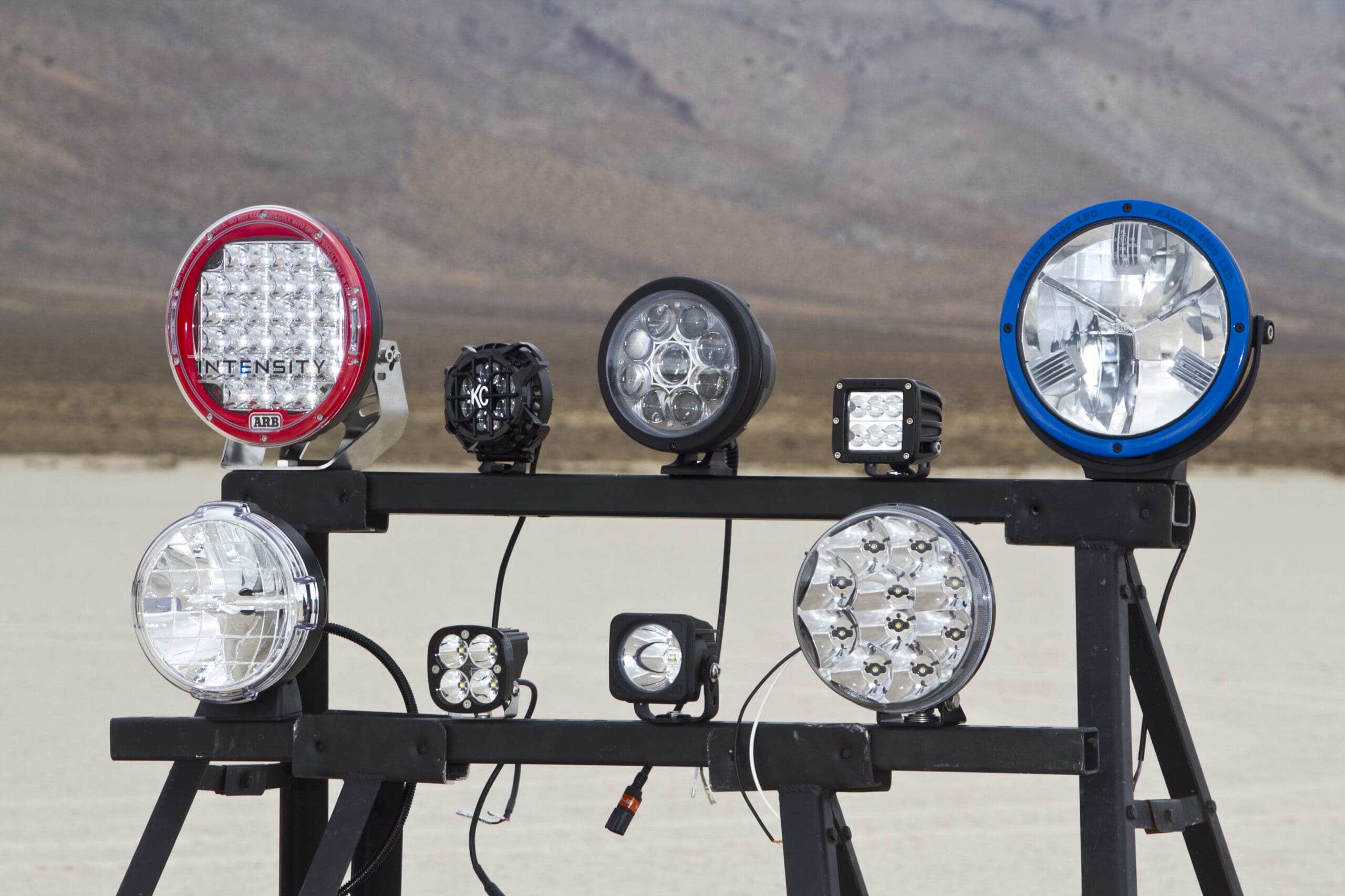
For this review, we chose options that might have helped Graham avoid his near-death experience in Botswana: long-range driving lights (we’ll visit light bars in the future). Furthermore, we broke the field into two categories (compact and large round) and sourced them from companies with long-standing reputations for quality. We put the word out last spring and were fortunate to be on the short list for pre-production units from ARB, KC HiLites, and Vision X. Some of the lights selected are sold as single units, some as pairs, and with or without a wiring harness. For this reason, we are not specifically analyzing harnesses. However, if provided, we took into account the quality, ease of installation, and instructions in the overall conclusions.
Properties of Light
Rather than paraphrasing Mr. Jackson’s articulate explanation of electromagnetic radiation and the properties of light, I’ll let Graham do it. However, I would suggest that when deciding on what type of light to purchase, you re-read his detailed analysis of color temperature, legal issues, wiring, and halogen and HID technology.
“The production of light from any source we are concerned with in this article comes from electrons. In general terms, when power is applied to an atom, some of the electrons in the atom can take that energy onboard and become excited, moving to a higher orbit around the nucleus. When the electron relaxes back to its original orbit, it releases energy in the form of a photon, the wavelength of which will be specific to the element emitting the photon. The photon, of course, is electromagnetic radiation, and if we can see it, then it is in the visible range we call light. If the radiation is a slightly longer wavelength than visible, it will be infrared, or heat, and a shorter wavelength will be ultraviolet. Most light-producing sources will emit a spread of wavelengths of light called a spectrum. The visible-light spectrum is 380 nanometers (nm) to 750 nm. Different colors we perceive represent different wavelengths within that range.
Not all visible light sources emit all wavelengths in the visible range. The most obvious example is colored light: red light is a longer wavelength than blue. White light is not its own color or wavelength, but is a mix of wavelengths. Not all lights are equal, and many of the properties, both good and bad, displayed by driving lights will come from this spectral difference.”
Some Light on LEDs
Though the public’s introduction to LED technology came in the early ’70s with Texas Instruments’ TI-2500 Datamath calculator, awareness of electroluminescence has been around since British experimenter H.J. Round discovered it in 1907, using a silicon-carbide crystal and a cat’s whisker detector. The awareness was there, but it would be six decades before commercial applications became practical. When they did, they were quite costly.
We can thank Dr. Jean Hoerni and Thomas Brandt of Fairchild Semiconductor for the millions of LED applications we have today. Dr. Hoerni invented the planar process (the birth of the modern integrated circuit board and a process that is still used today), and Brandt figured out how to make them cheap. The TI-2500, if you remember, had red LEDs. They were very small and only available in the one color. To be read, a small plastic magnifying glass was placed above each digit.
The advantages over incandescent bulbs were immediately apparent: lower power consumption, smaller size, longer lifespans, faster startup and shutdown times, and more robust construction. This is made possible by the way an LED generates light. A diode is, in layman’s terms, a valve that allows electrons to flow in a single direction. When forward-biased (on), excited electrons move into, or recombine with, electron holes, releasing energy in the form of photons. The process is called electroluminescence, and some of the light produced falls in the visible spectrum. Though original LEDs were red, by changing the elemental properties, or doping, they can be manipulated to produce electromagnetic radiation at any wavelength.
Mysteries of Gazillion Candlepower Lights
You probably recall the days of 5,000-watt flea market stereo systems and million-candlepower (cd) auxiliary lights (put any name here). They didn’t sound or illuminate any better than 100-watt stereos or 100,000-cd lights. The reason is that there wasn’t a standardized system for measuring the output of various electronics. Rather than a case of dishonesty, it was a matter of the manufacturer choosing test data that looked more impressive on the box.
With LED lights, at least with reputable manufacturers, such discrepancies fall in the category of gross versus net output. A raw, unmounted LED array may very well generate an aggregate sum of 5,000 lumens or more. However, how LEDs are powered and positioned, as well as how the light is managed, or columnized, will render a figure that is much less impressive. Think of a lit candle in a dark room; it would be pretty hard to read a book by this light. However, place a well-crafted reflector behind it and voilà. Though some light (lumens) is lost during the reflective process, light projected on the pages seems to have increased. How visible light is managed has much to do with real-world performance.
We hear terms like candela (cd), lumen (lm), and lux (lx) in describing performance. A quick note on the difference between lumens and lux: a lumen is a measure of generated light, while lux is a measure of perceived light per unit area.
As laymen, we have no way to validate such claims. To accurately evaluate performance, other than subjective field testing, we needed proper equipment. This is where Jim Horvath, owner of HHW Technologies in Redlands, California, came in. Jim’s company produces high-end fiber optic lighting systems for cardio and neurosurgeons—I consider him a lighting industry expert. To clear the air on the mystery of lumens, color temperature, and performance, he offered us the use of his lab.
We subjected each light to a thorough evaluation using a Sphere Optics 20-inch integrating sphere and matching SLM800 Series spectrometer. This system’s function is to measure total photonic energy entering the sphere, thus eliminating any loss due to human error or other. It is certified and calibrated by the National Institute of Standards and Technology (NIST), and approved for the production of medical equipment. It is extremely accurate, and the results were nothing less than surprising.
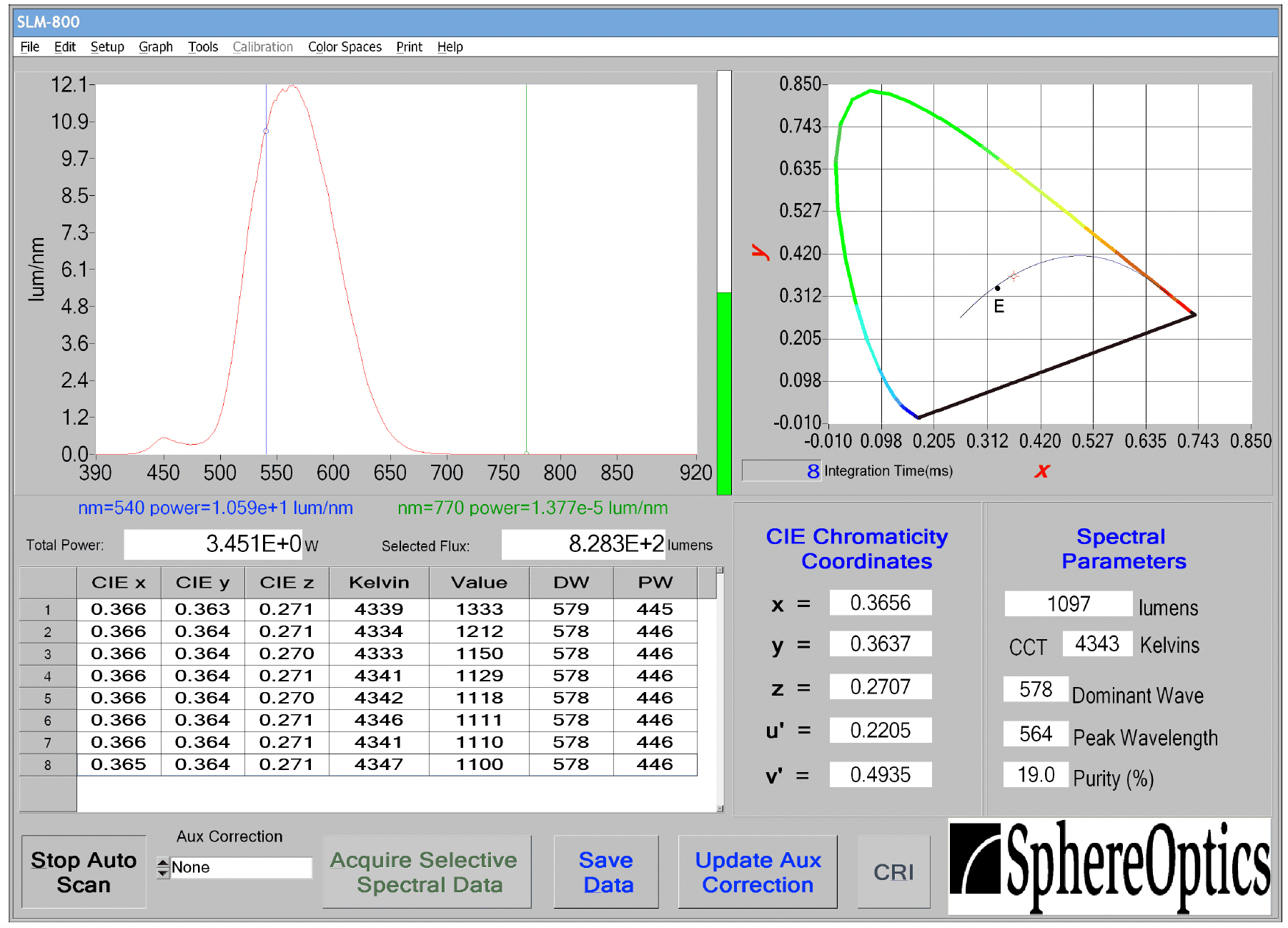
Using a Sphere Optics integrating sphere and matching SLM800 spectrometer we were able to record luminous flux (output), color temperature, and the Color Rendition Index (CRI) of each light during a 40-minute evaluation.
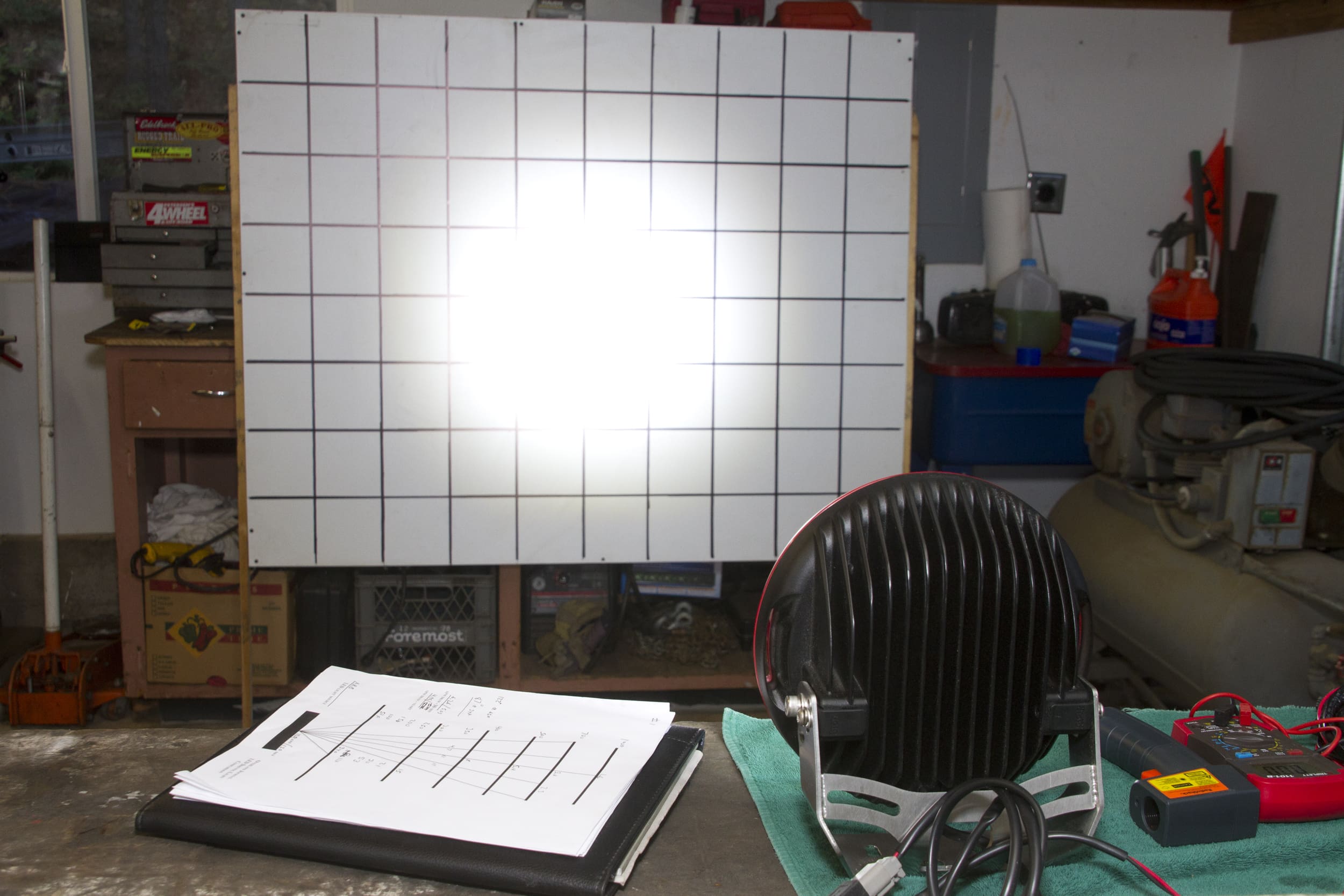
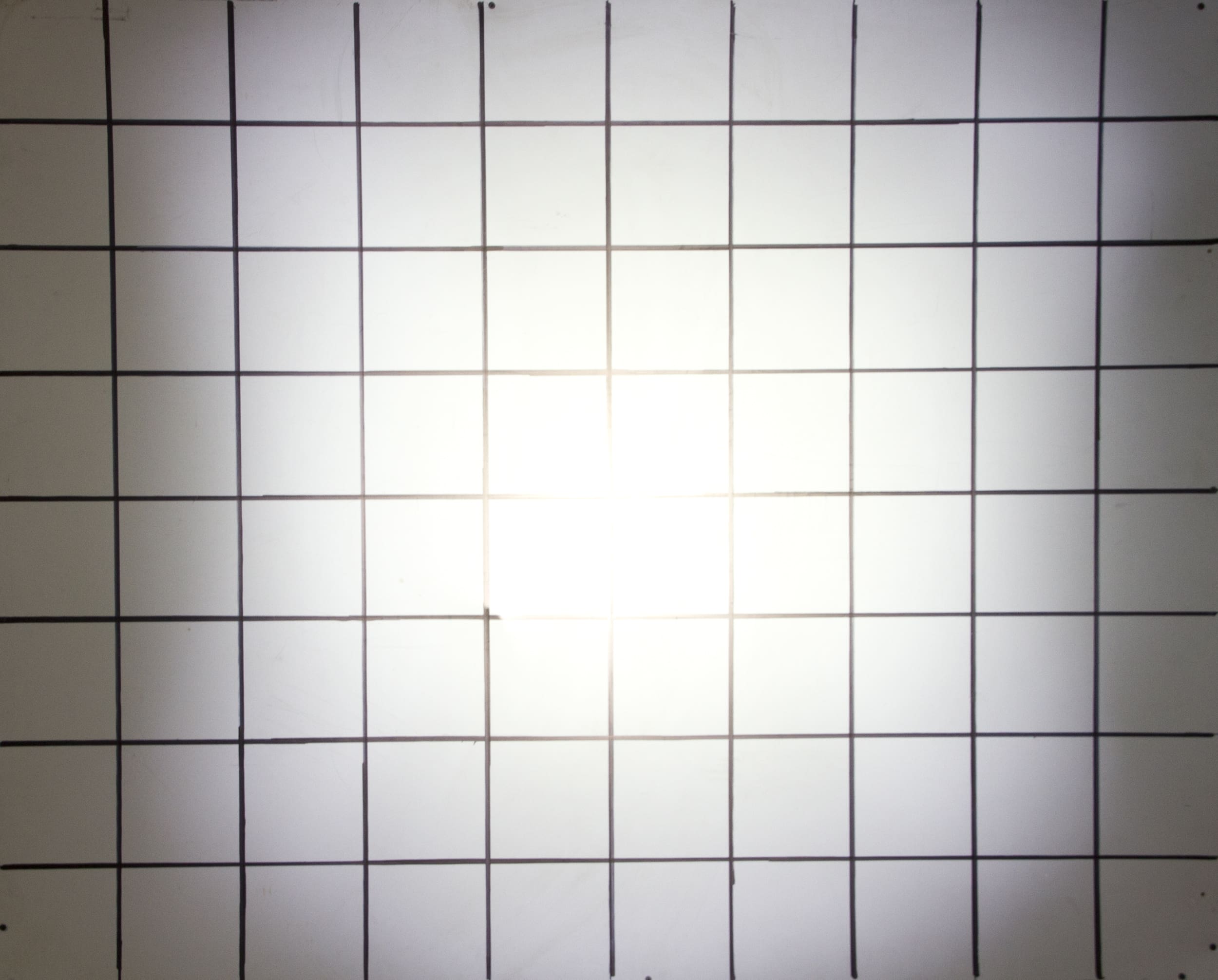
Cartesian grid provided data on beam pattern.
Pattern, Intensity, and Color Temperature
Identifying pattern, beam reach, and intensity required several types of tests.
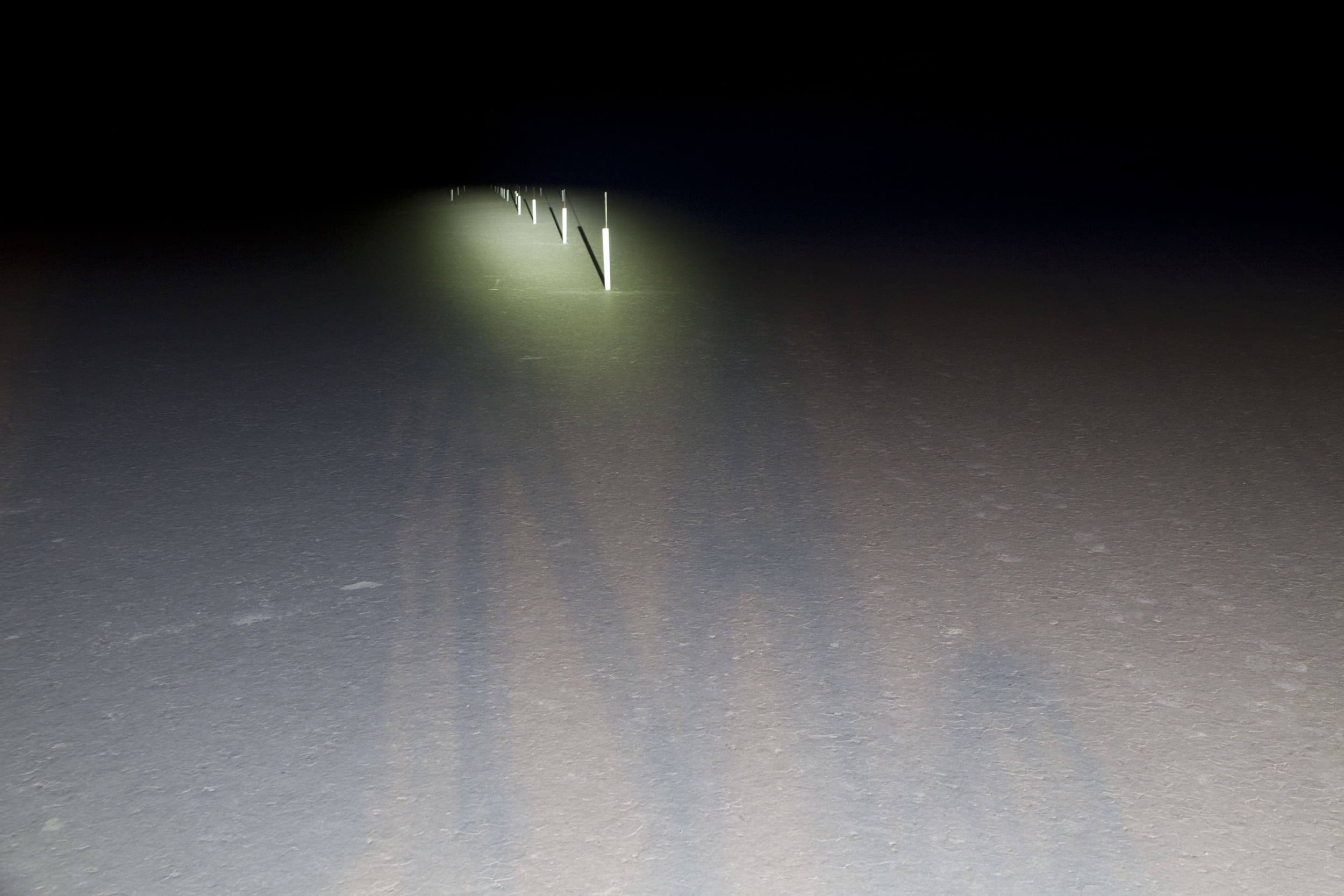
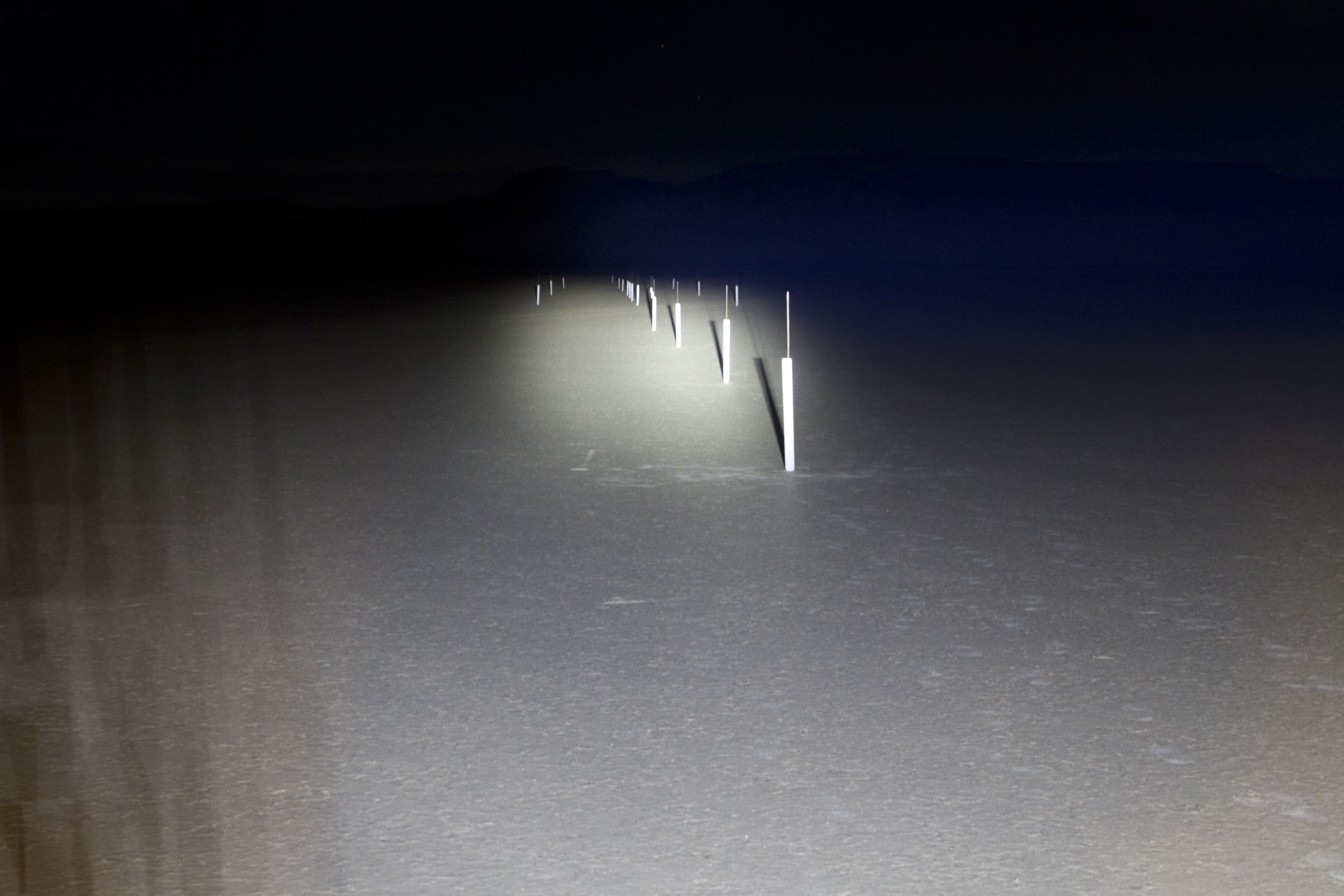
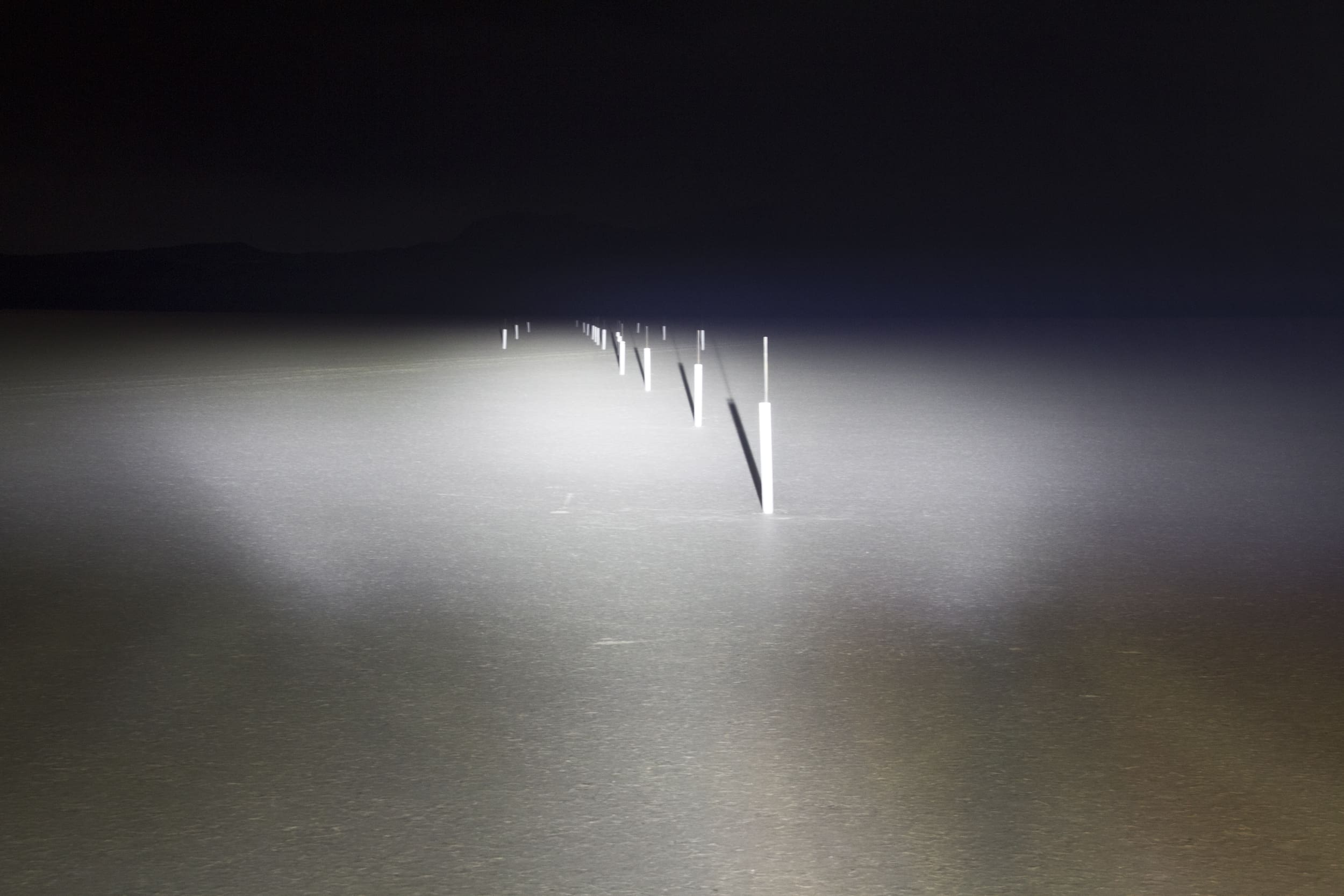
Beam reach To simulate a highway or long straight two-track, we headed to a large dry lakebed in Northern Nevada and set up a grid of reflective stakes across the playa. They were placed at 50-foot increments up to 500 feet, then every 100 feet to a final distance of 1,000 feet. Beginning at the 300-foot mark, markers were set to each side, 15 feet off center, to represent reflectors of a road. Luminance readings were taken, in lux, at each marker with a professional-grade Sekonic Lightmaster Pro L-478D incident light meter. Because results vary depending on how the meter was positioned, and the fact that lights could not be perfectly aligned with the grid, 12 readings were taken at various heights and attitudes at each marker, with the highest reading being recorded. The meter’s lowest detectable level is .5 lux; about the same as a full moon night.
Beam pattern To analyze the multi-axis nature of the beam pattern, I needed a repeatable short-range test. Using a Sharpie and a 4- by 6-foot sheet of non-reflective white plastic, I marked off a Cartesian grid on 6-inch increments. By placing the grid 8 feet from the light source, each increment represented 3.58 degrees. Measuring the number of grid marks from the center on both the x- and y-axis and multiplying by two provided empirical beam-pattern data. It also displayed hot and dark spots, and transitions to the peripheral areas.
Intensity In the lab, we fitted each light to the integrating sphere, turned it on, and let it run for 40 minutes. The spectrometer measured output in lumens, color temperature in Kelvins (K), and the Color Rendering Index (CRI). The CRI represents the average wavelength within the visible spectrum, and a higher number is better. Data readings were taken every five minutes.
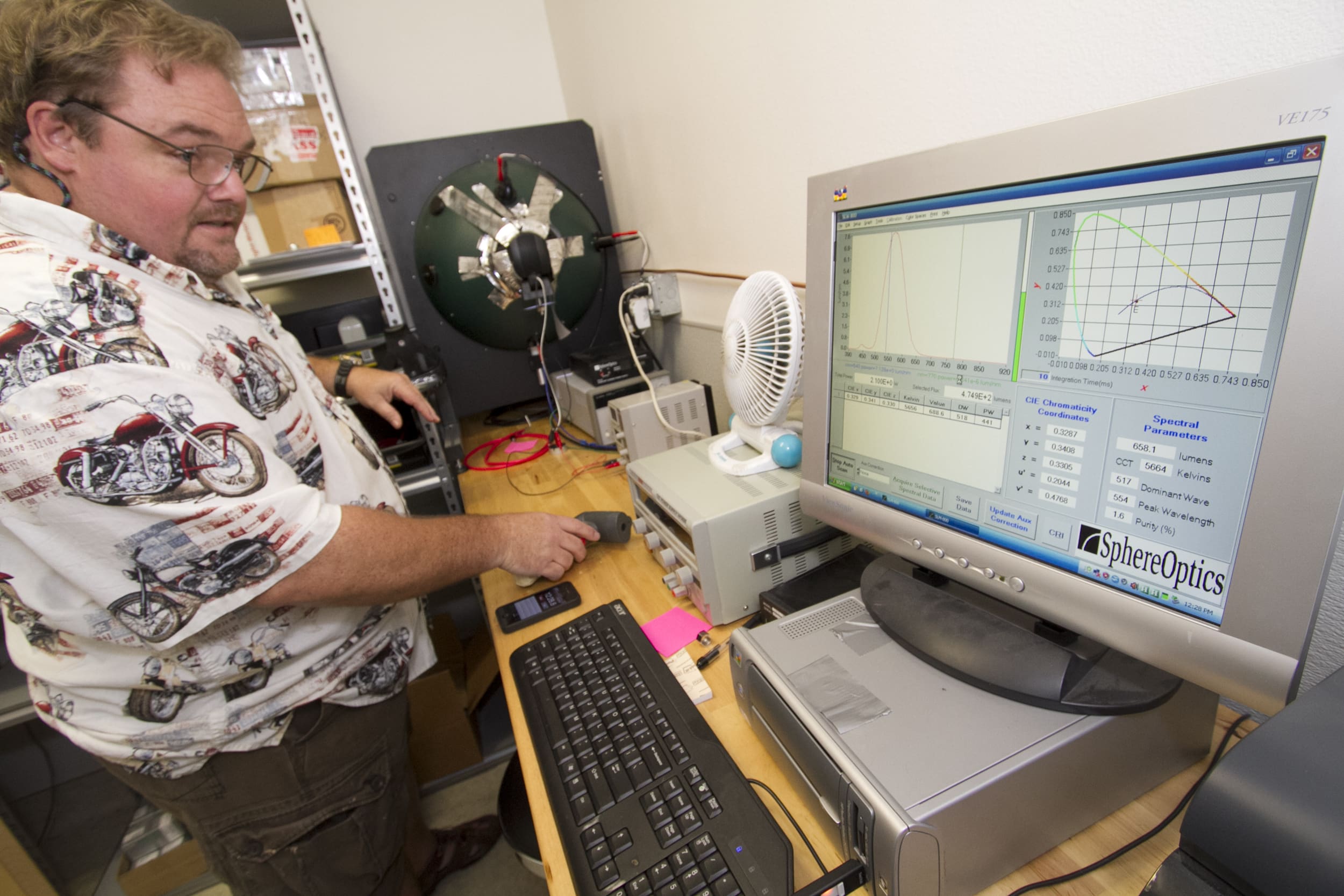
Sphere Optics 20-inch integrating sphere and spectrometer used to analyze color temperature and lumens.
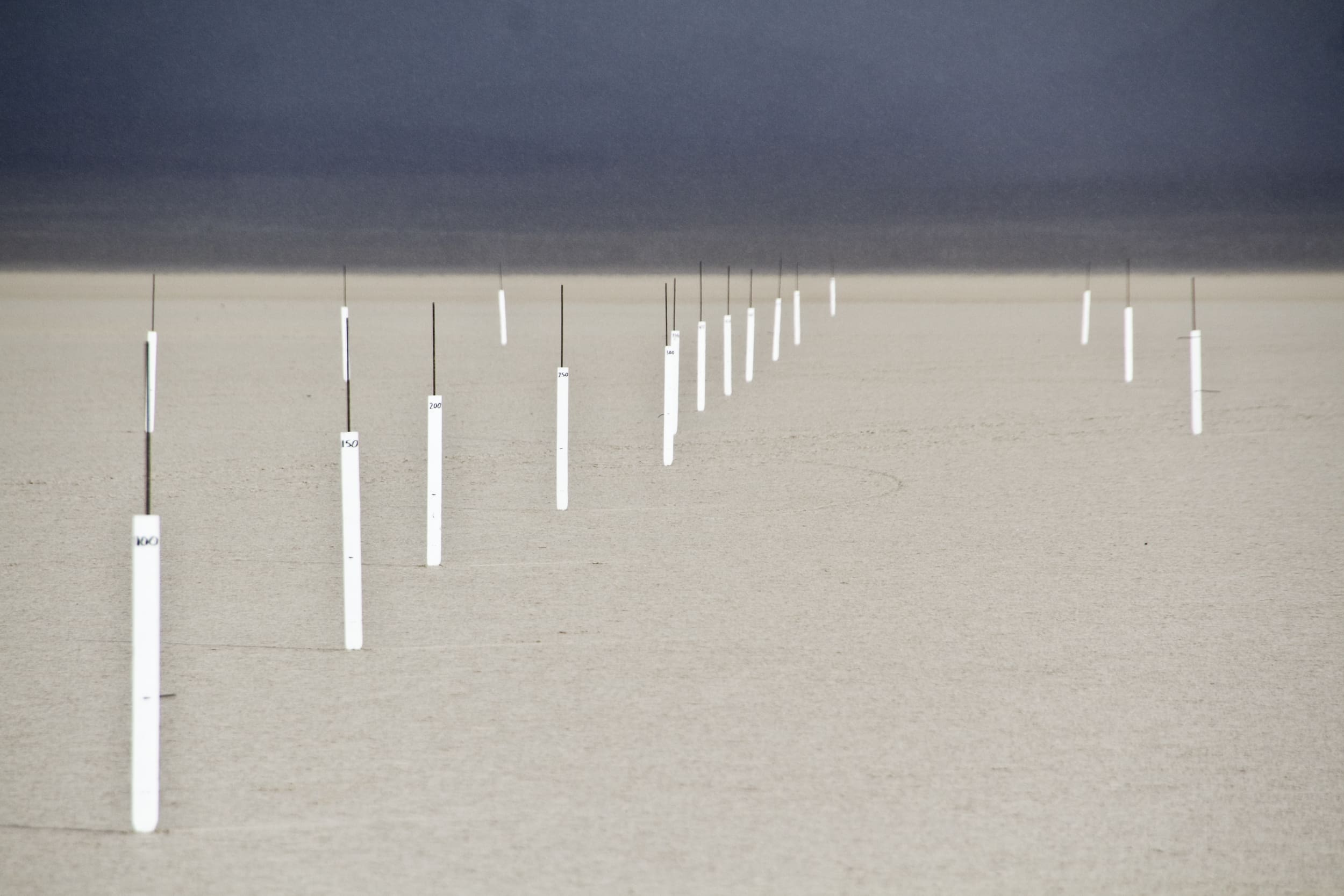
Reflective stakes were placed at various increments up to 1,000 feet.
Thermal Degradation
LEDs emit electromagnetic radiation beyond the visible spectrum in the form of heat, and heat negatively affects performance. The longer a unit is on, the greater the potential for heat buildup and a reduction of luminance. Because trail conditions and weather vary, I wanted to simulate a worst-case scenario—stopped on the trail on a warm evening to repair a tire on the vehicle in front of you, and your bumper-mounted LEDs are illuminating the scene.
During our desert test, temperatures hovered in the 30s (F), much too low for any heat-related reduction in performance. During our lab session (80°F ambient), we were able to simultaneously record amperage draw, maximum temperature of the heat sink, and lumens—temperature is inversely related to amperage draw and lumen output. However, most units have thermal management systems to protect components in the case of excessive heat buildup. The goal was to find out where each light stabilized with regard to temperature, lumen drop, and amperage draw. After each light was tested, we let it run for another three hours.
The Reflector
An LED, with the exception of its base, emits light in an almost spherical pattern. To collimate light into a forward-projected beam, a reflector is needed. Manufacturers dedicate considerable resources to perfecting reflector design for maximum efficiency. The caveat to this is that there is roughly a 10 percent loss of light (lumens) with each surface it hits. Bulb, or LED placement in relation to the reflector, also has a significant effect. Placing a light source low provides a narrow beam, while a higher position creates a wider pattern. While most lights in this review use forward-facing LEDs, a few use rear-facing technology. The jury is still out on which is more efficient.
Materials and Construction
It is interesting how much things have changed since Mr. Jackson’s lighting review just two years ago. With regard to construction, body materials ranged from stainless steel to plastic, and lenses were predominantly glass. This review’s crop predominantly uses cast-aluminum housings and polycarbonate lenses. LEDs produce a fair amount of heat. Aluminum, which is lightweight and offers excellent heat dissipation, is a natural selection for both the housing and the heat sink; most of which are integral units.
Submersion
The most common mounting position for auxiliary lighting is on the front bumper. Like a point man on recon, the bumper and your lights are the first things to be submerged when crossing a body of water. To me, having a light that emerges on the other side shining is a big deal. All lights in the test are either water-resistant or have an Ingress Protection rating (IP). IP68 is the gold standard for dust and water ingress. The first numeral determines dust ingress; 6 is the highest rating (complete protection). The second numeral represents resistance to water ingress; 8 is the highest rating (continuous immersion), while a 7 is rated for 1-meter depth for 30 minutes. Lights with an IP67 or IP68 rating were turned on and submerged for 30 minutes; others received a continuous spray to simulate heavy rain.
Vibration and Salt Spray
Anything mounted on the front bumper of a four-wheel drive (one that gets used in real-world environments) will be subject to conditions and dynamic forces beyond what we might expect: high-G impacts, vibration, and, if you live near the coast, reagents such as salt water. ASTM B117 code specifies accepted practices for measuring saltwater corrosion resistance. Interestingly, while the method is clear, the duration can vary from as little as 24 hours to up to 5,000 hours. A few of our entrants are ASTM B117 tested, one at 3,000 hours. This test is beyond the scope of our review.
The international standard for testing everything from ballistic shock to vibration resistance is the MIL-STD-810 code. Subsection “G,” method 514.6, the vibration test, calls for exciters (shaker table) to perform a three-axis shaking, thus simulating real-world conditions. While none of our test subjects displayed excessive vibration when mounted (we couldn’t source a shaker table and a paint shaker would be too violent), a few are MIL-STD-810G rated.
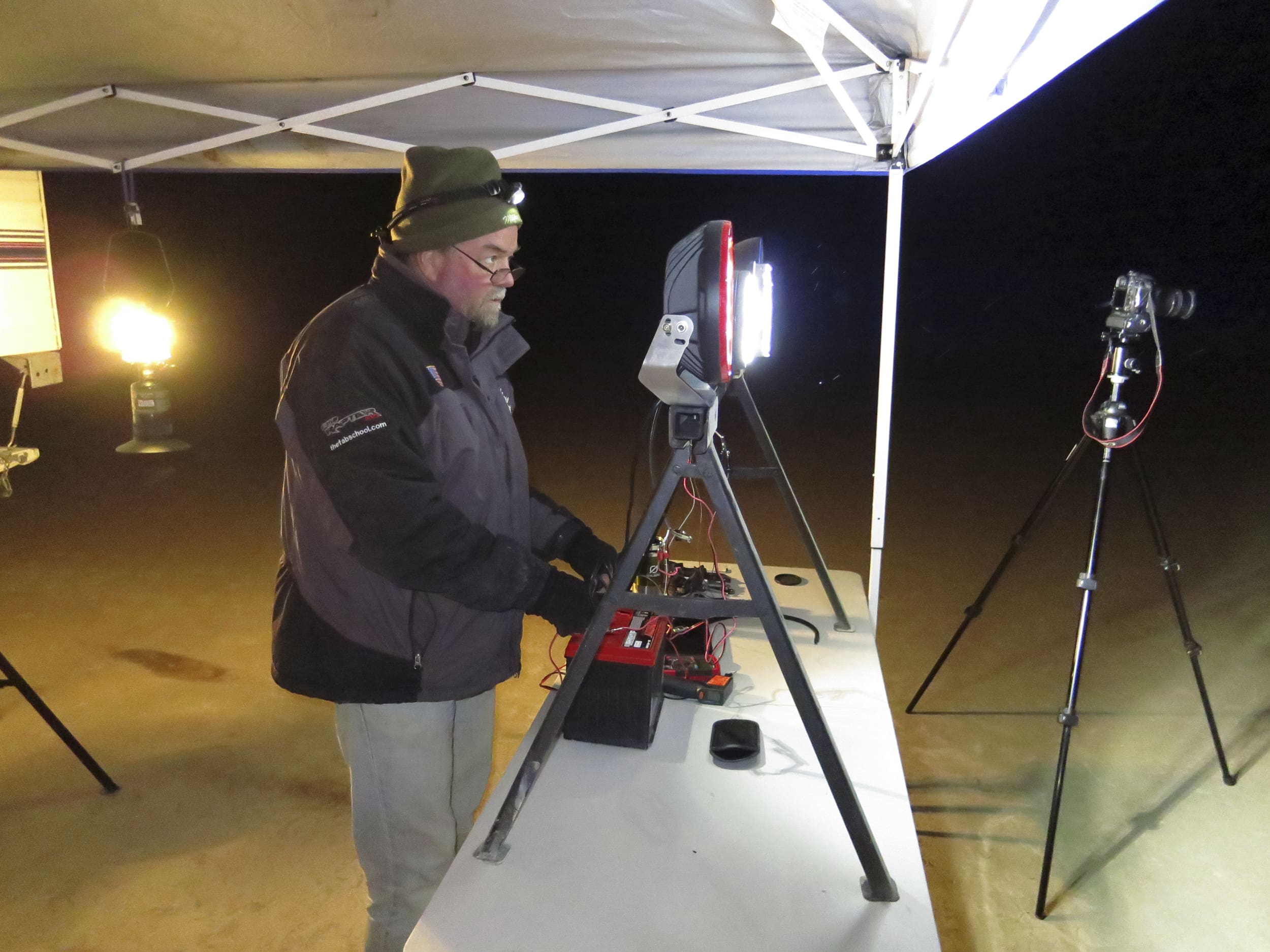
Chris Collard spent three 30°F nights in Northern Nevada performing a side-by-side comparison.
Pattern and Intensity Test
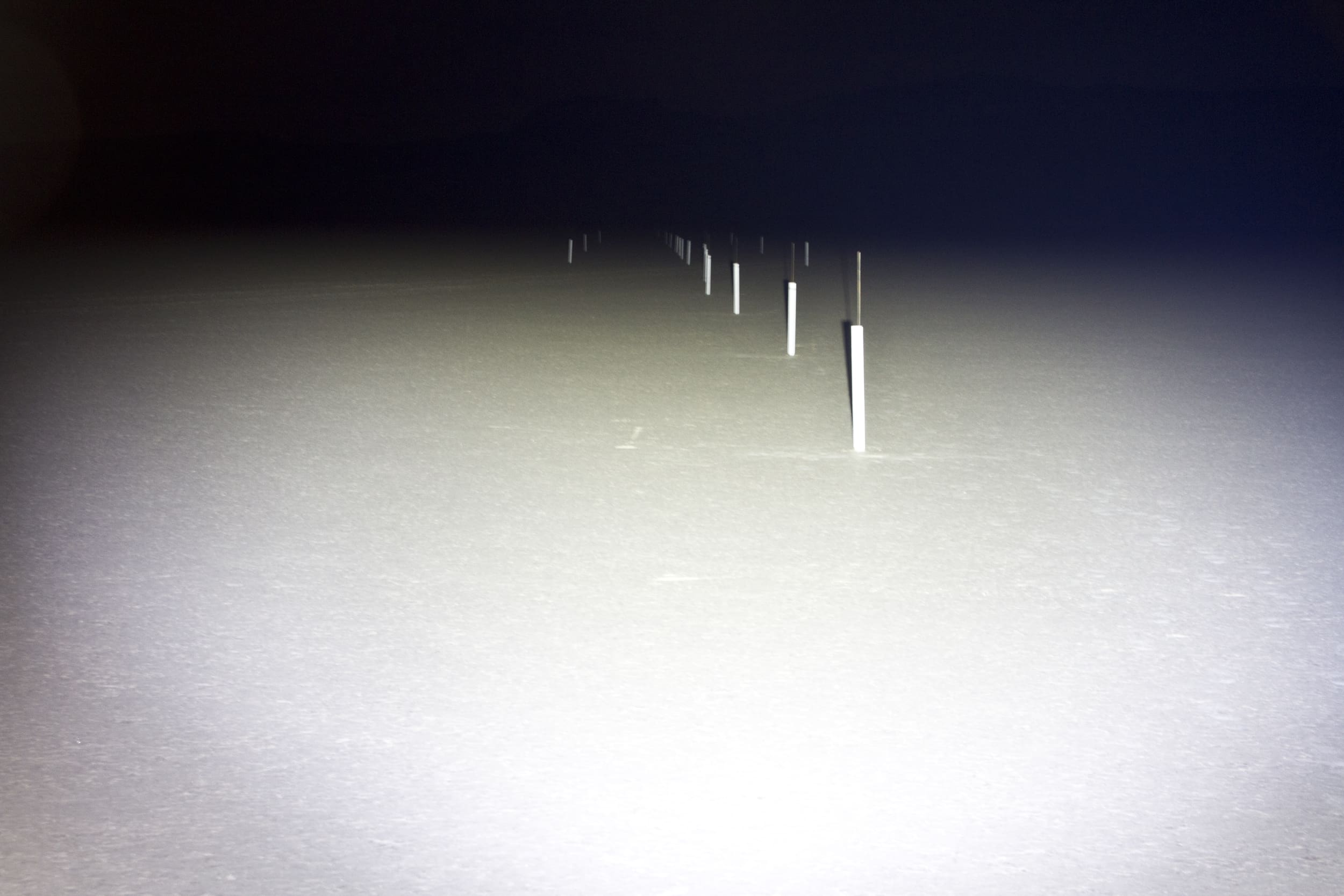
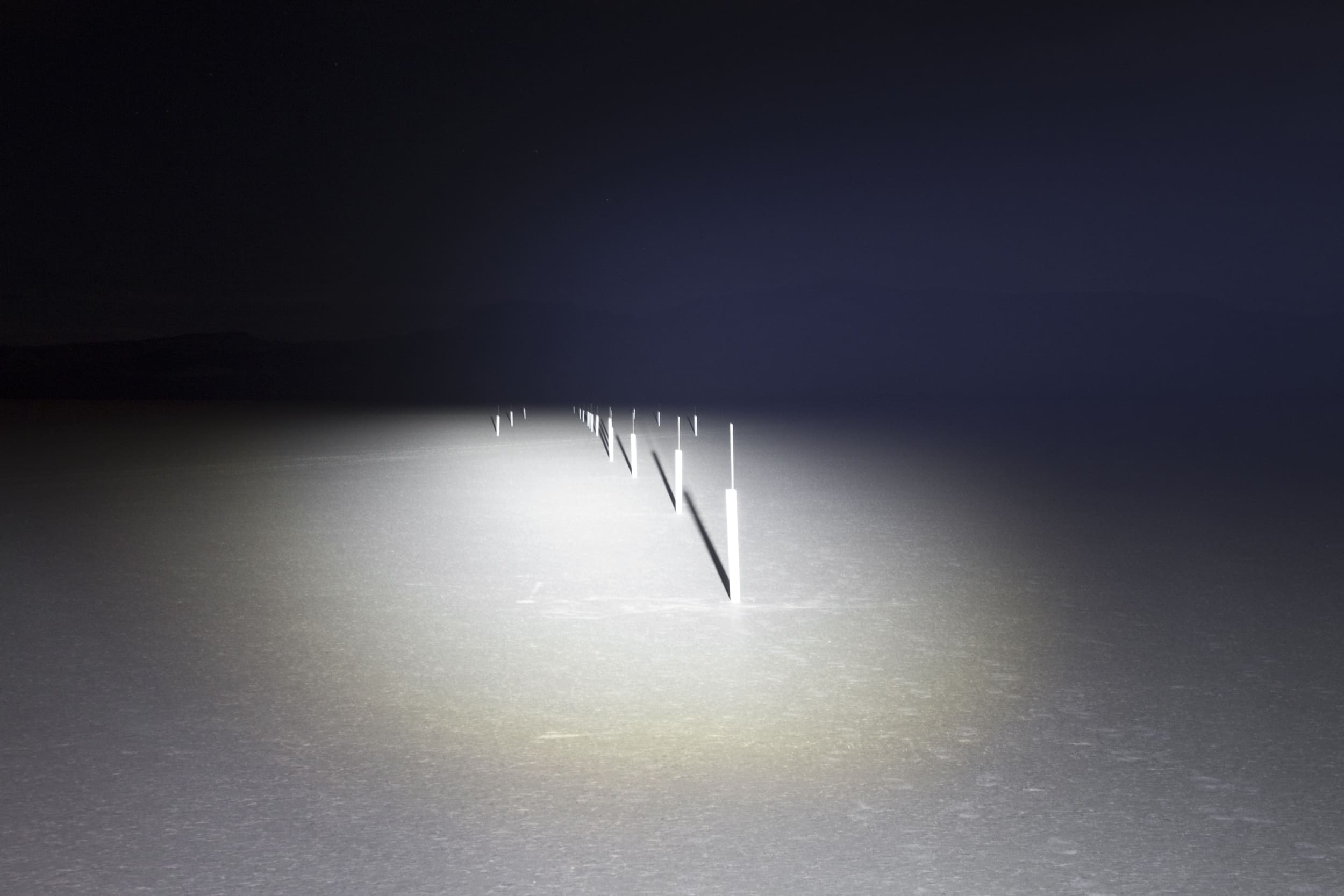
Beam Reach
Purpose: To simulate light on a highway or long straight two-track.
Displayed: Luminance readings at specified distances.
Specifications: Reflective stakes placed at 50-foot increments up to 500 feet, then every 100 feet to a final distance of 1,000 feet. Beginning at the 300-foot mark, markers were set to each side, 15 feet off-center, to represent reflectors of a road.
Images from left to right: Rigid Dually D2, ARB Intensity, KC Hilites 4-inch, Hella 4000 LED, Baja Designs Squadron, KC Hilites 6-inch, Vision X Optimus, Truck-Lite, PIAA LP570.
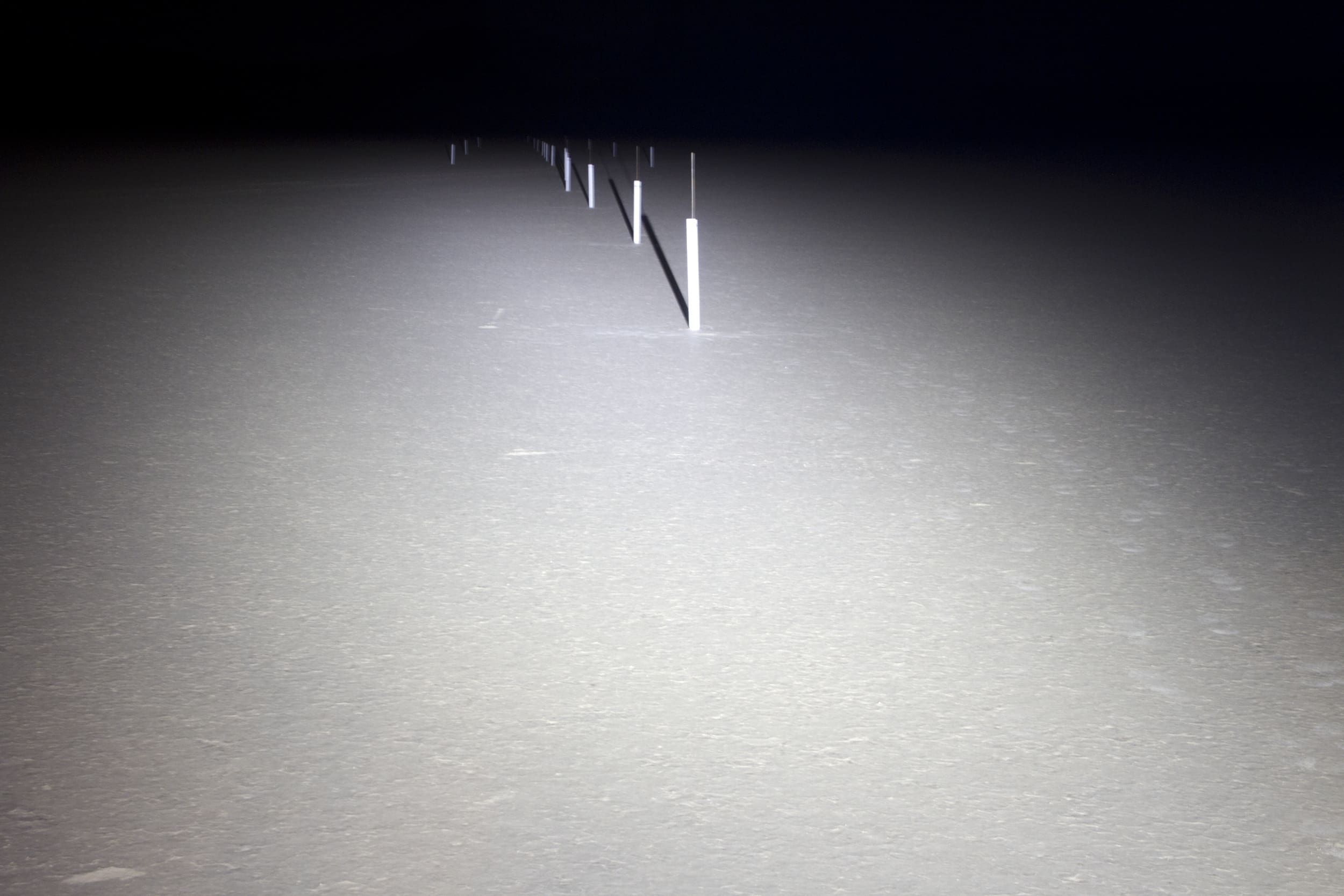
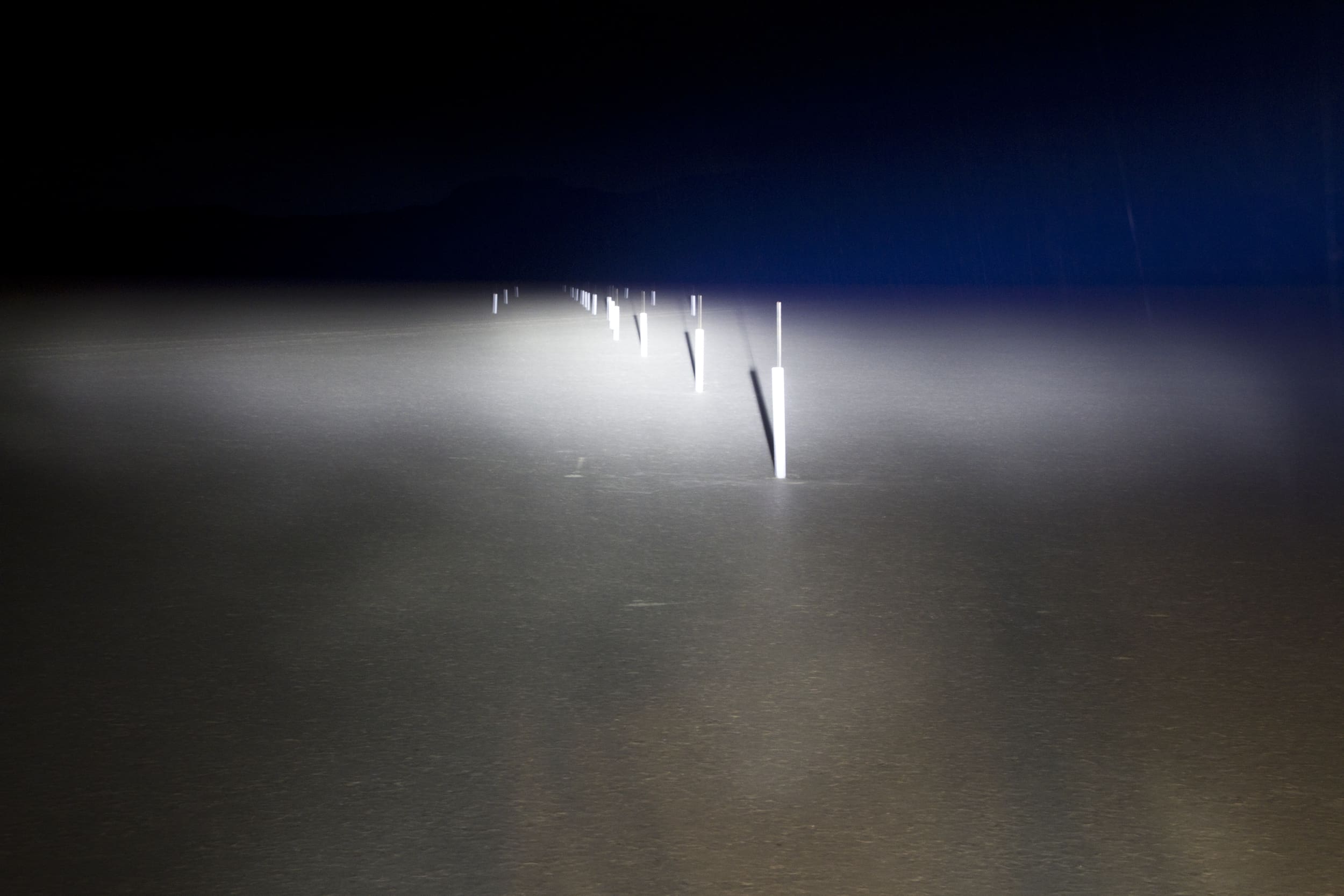
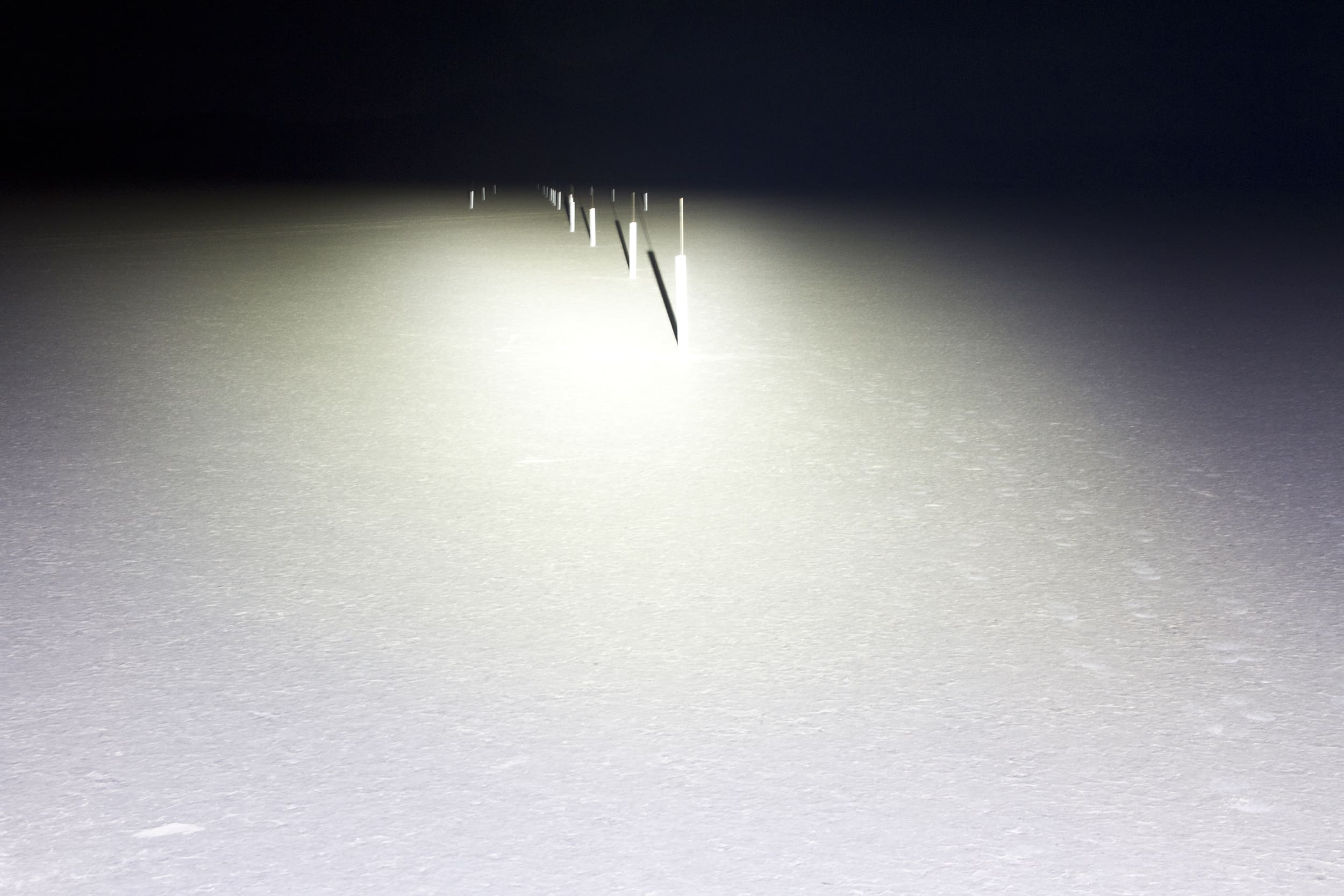
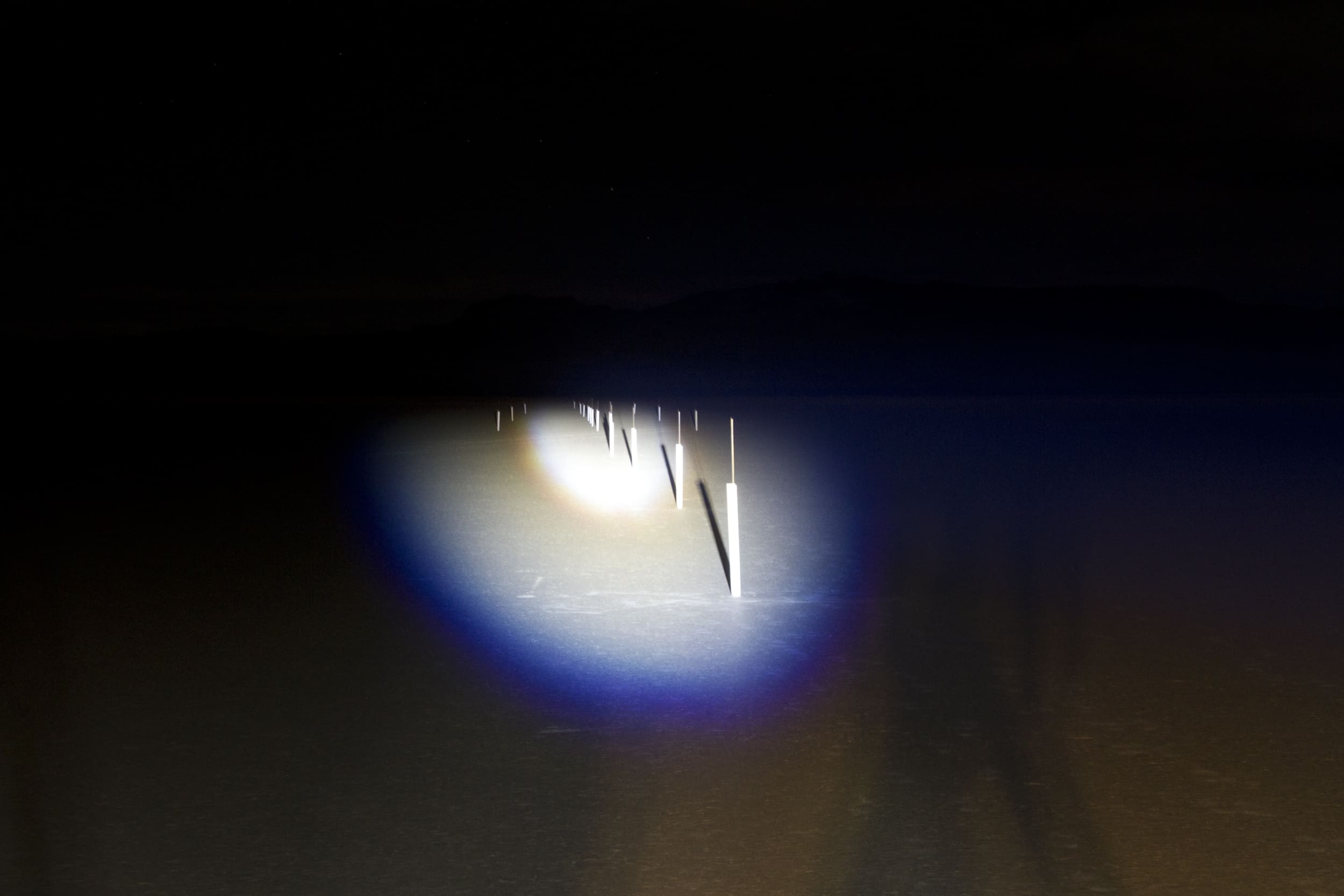
Beam Pattern
Purpose: To analyze the multi-axis nature of beam pattern.
Displayed: Hot and dark spots, and transitions to the peripheral areas of each light.
Specifications: Cartesian grid on 6-inch increments. Grid placed 8 feet from light source. Each increment represents 3.58 degrees.
Images from left to right: Rigid Dually D2, ARB Intensity, KC HiLites 4-inch, Hella 4000 LED, Baja Designs Squadron, KC HiLites 6-inch, Vision X Optimus, Truck-Lite, PIAA LP570.
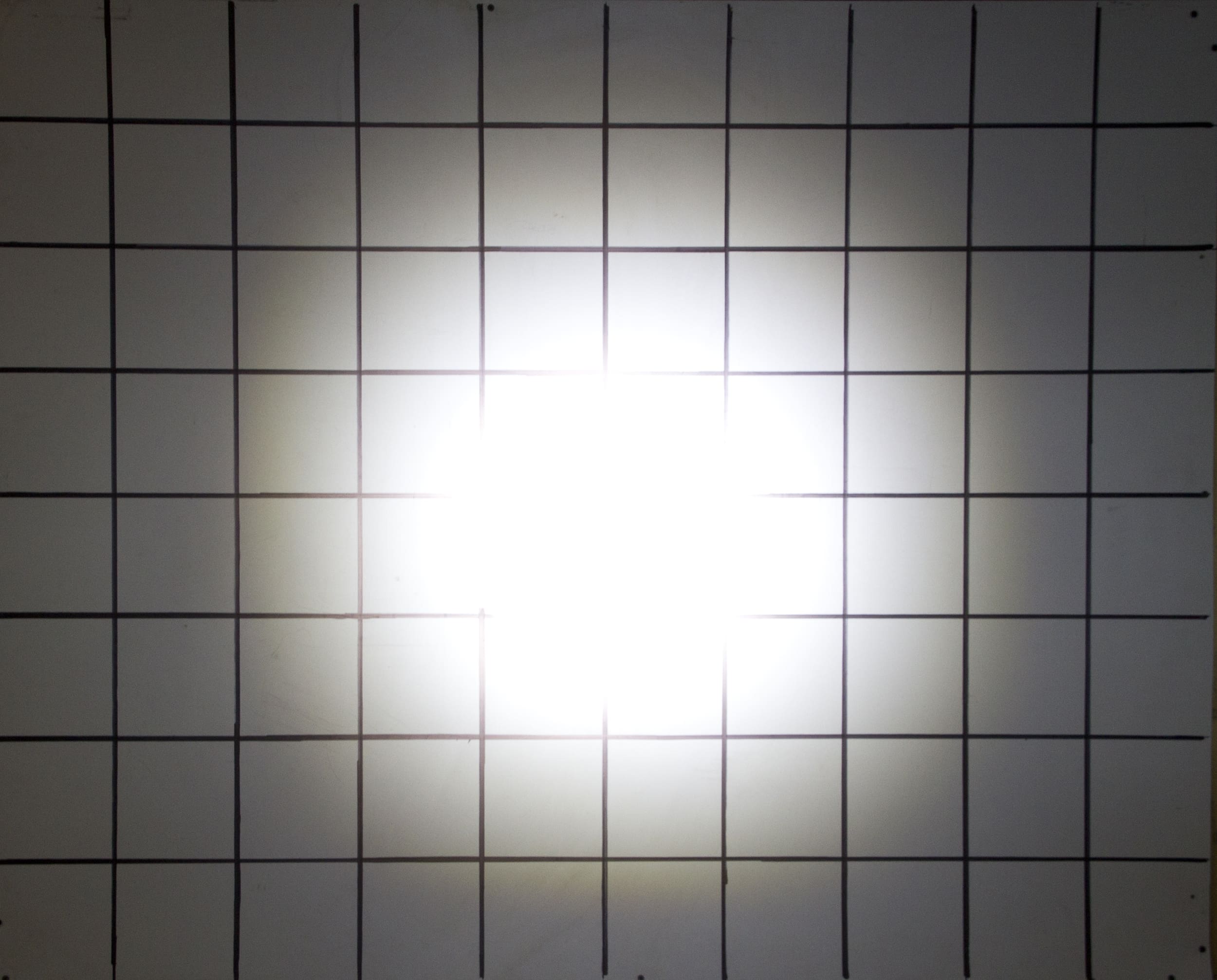
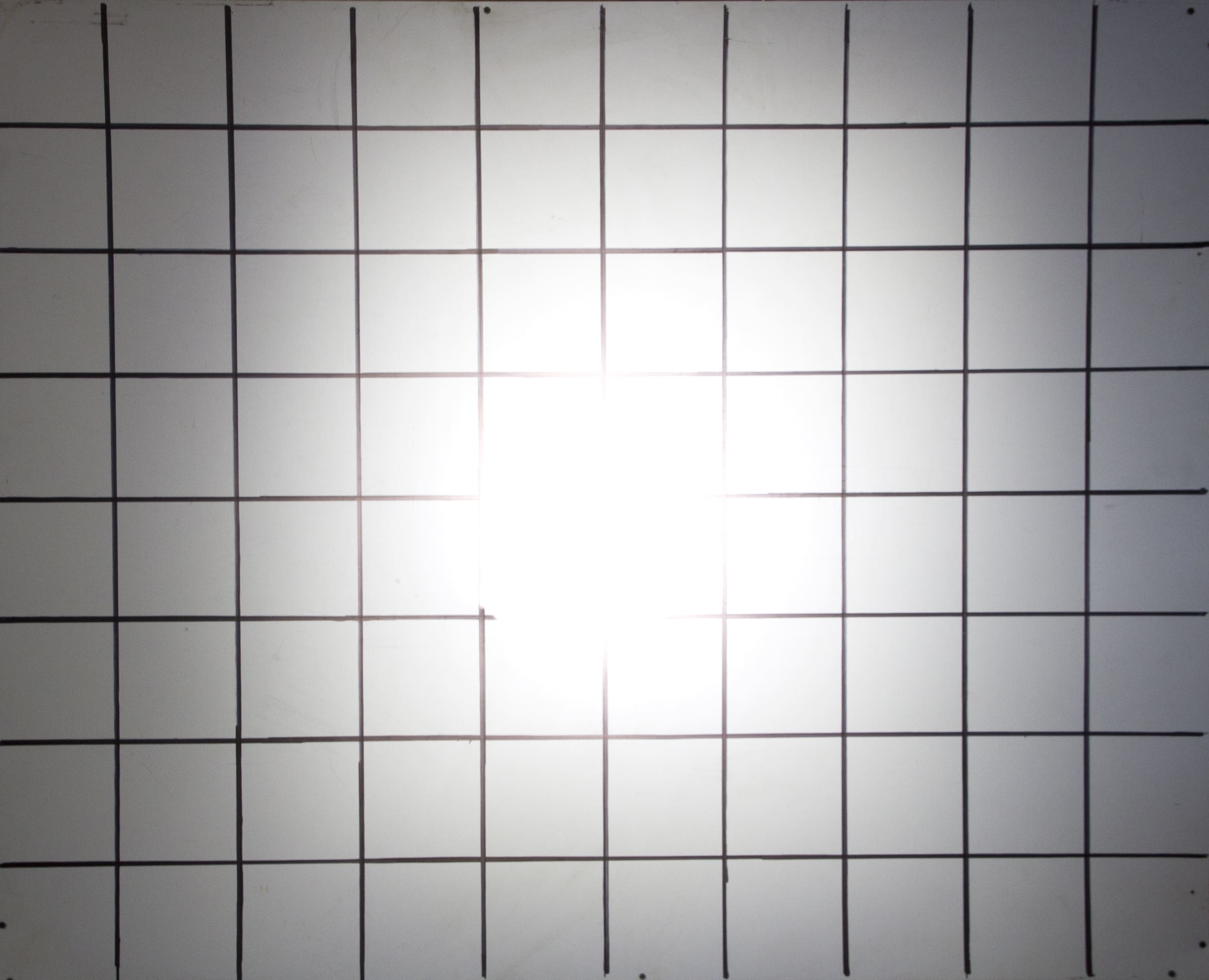
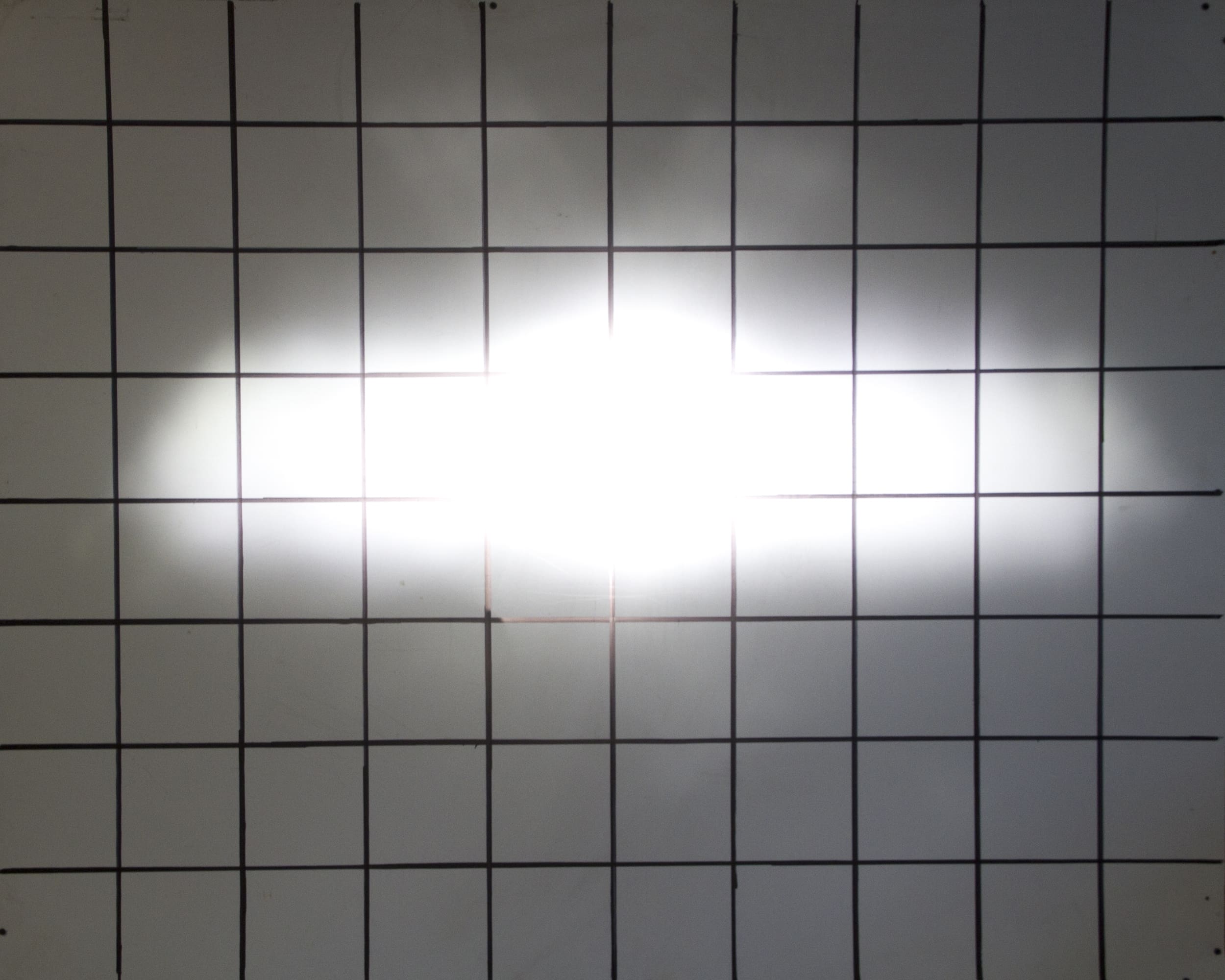
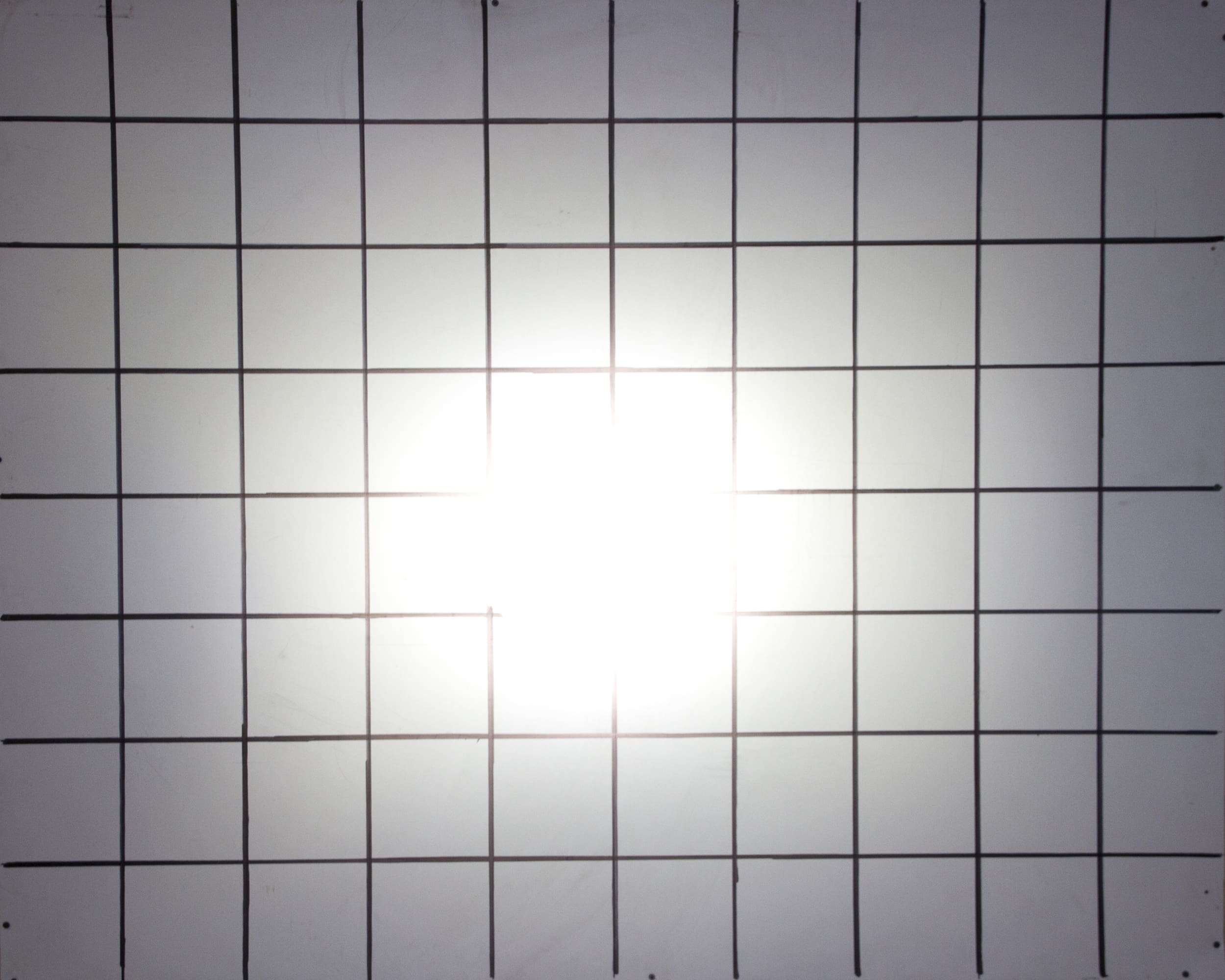
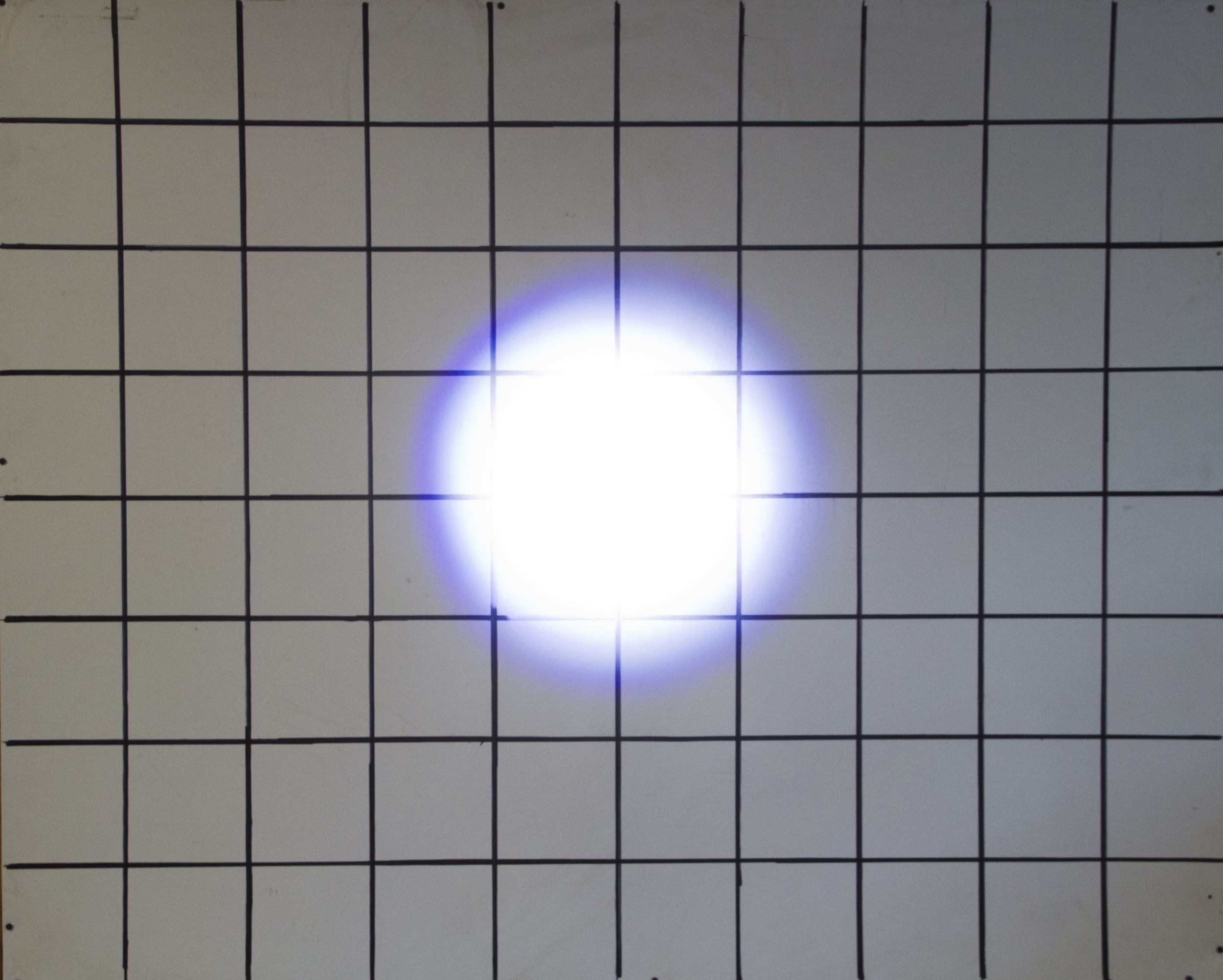
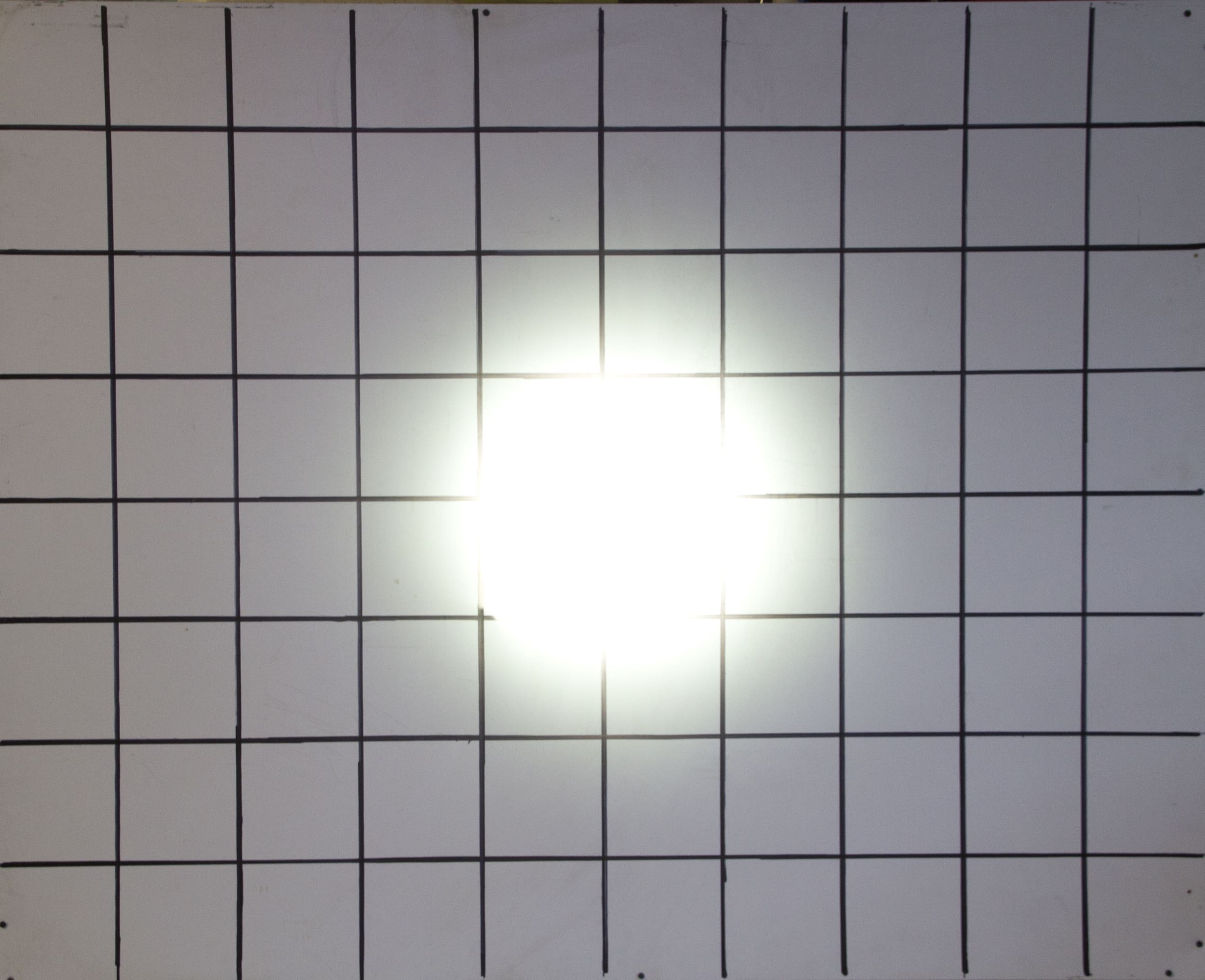
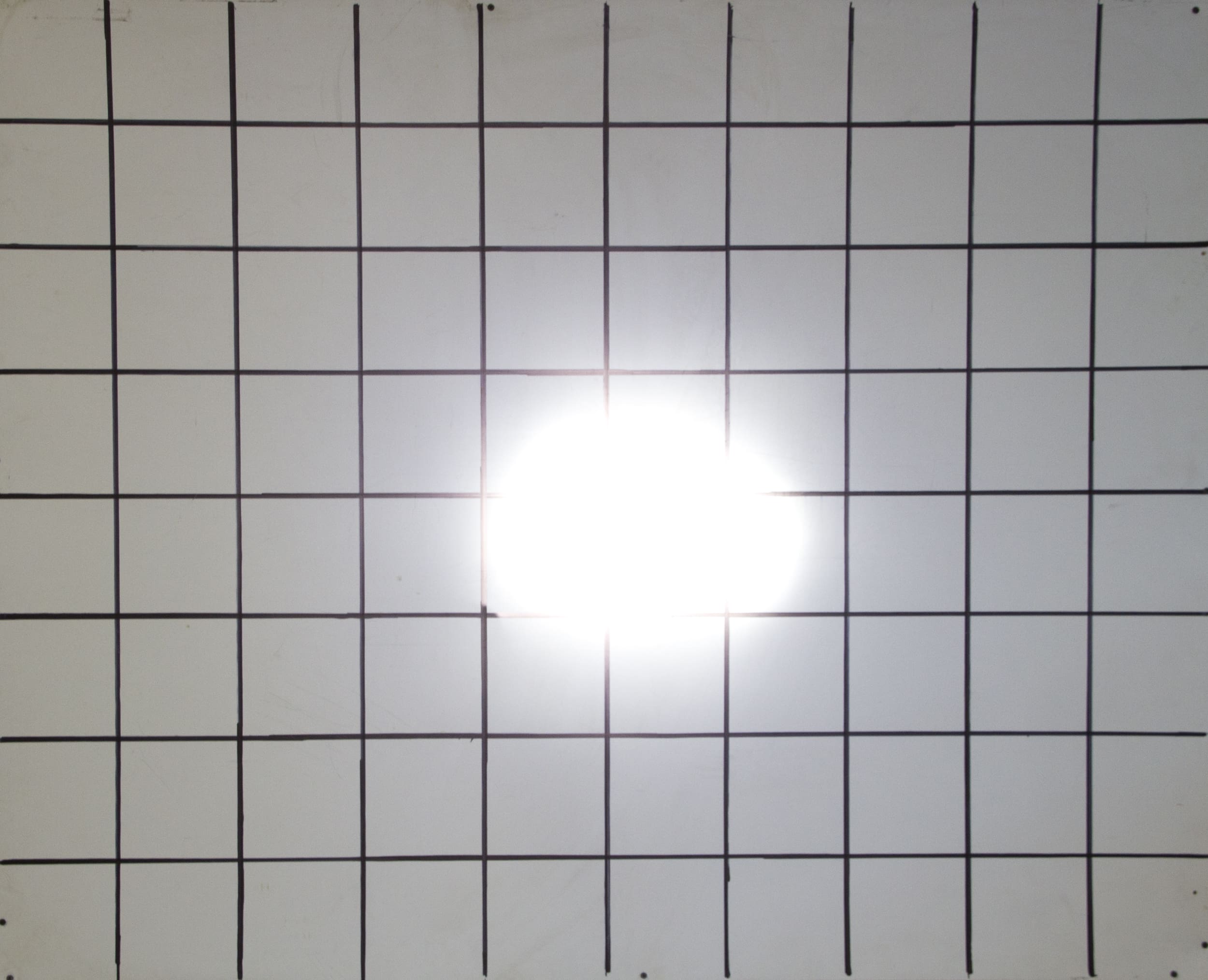
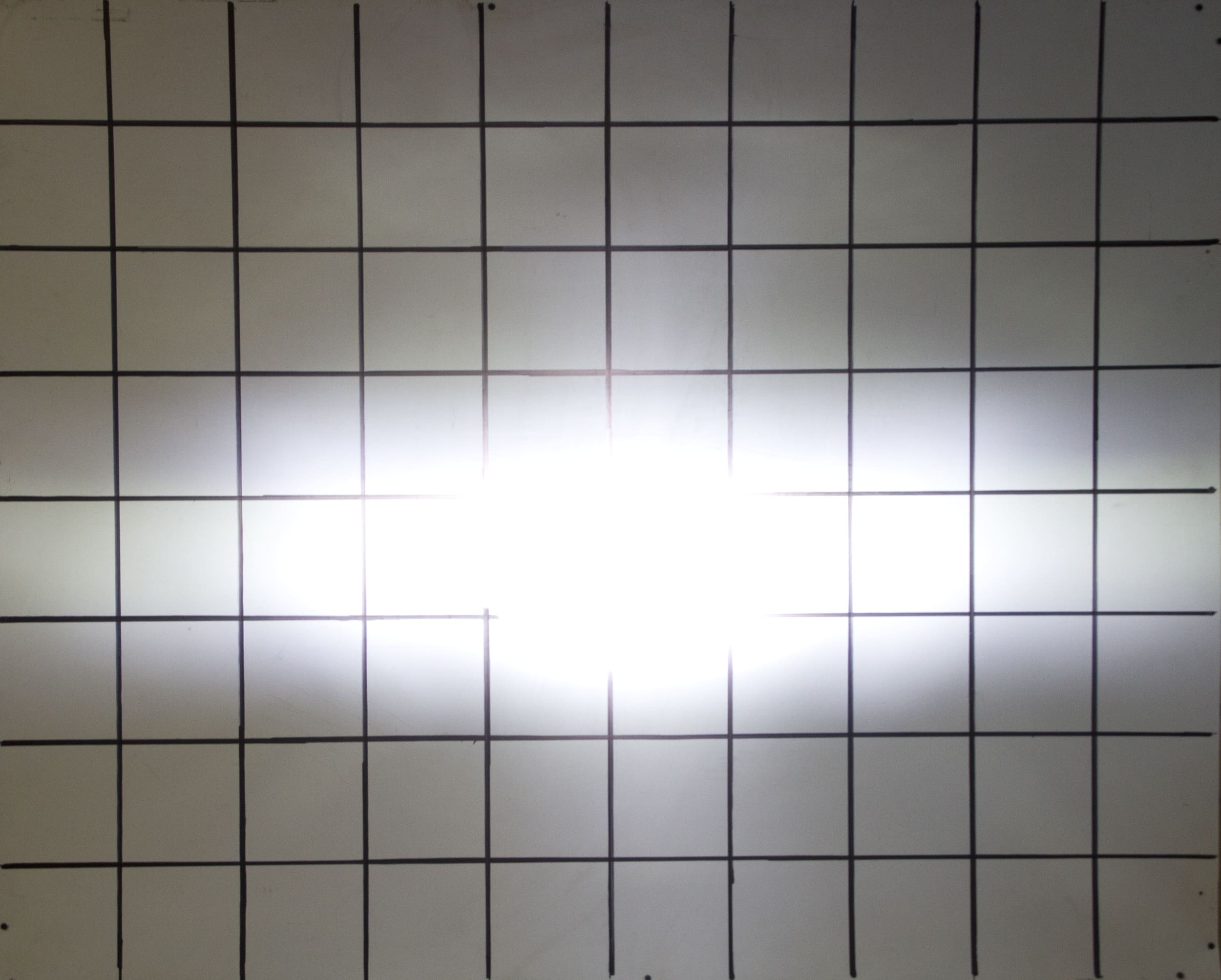
COMPACT LED LIGHTS
Rigid Dually D2
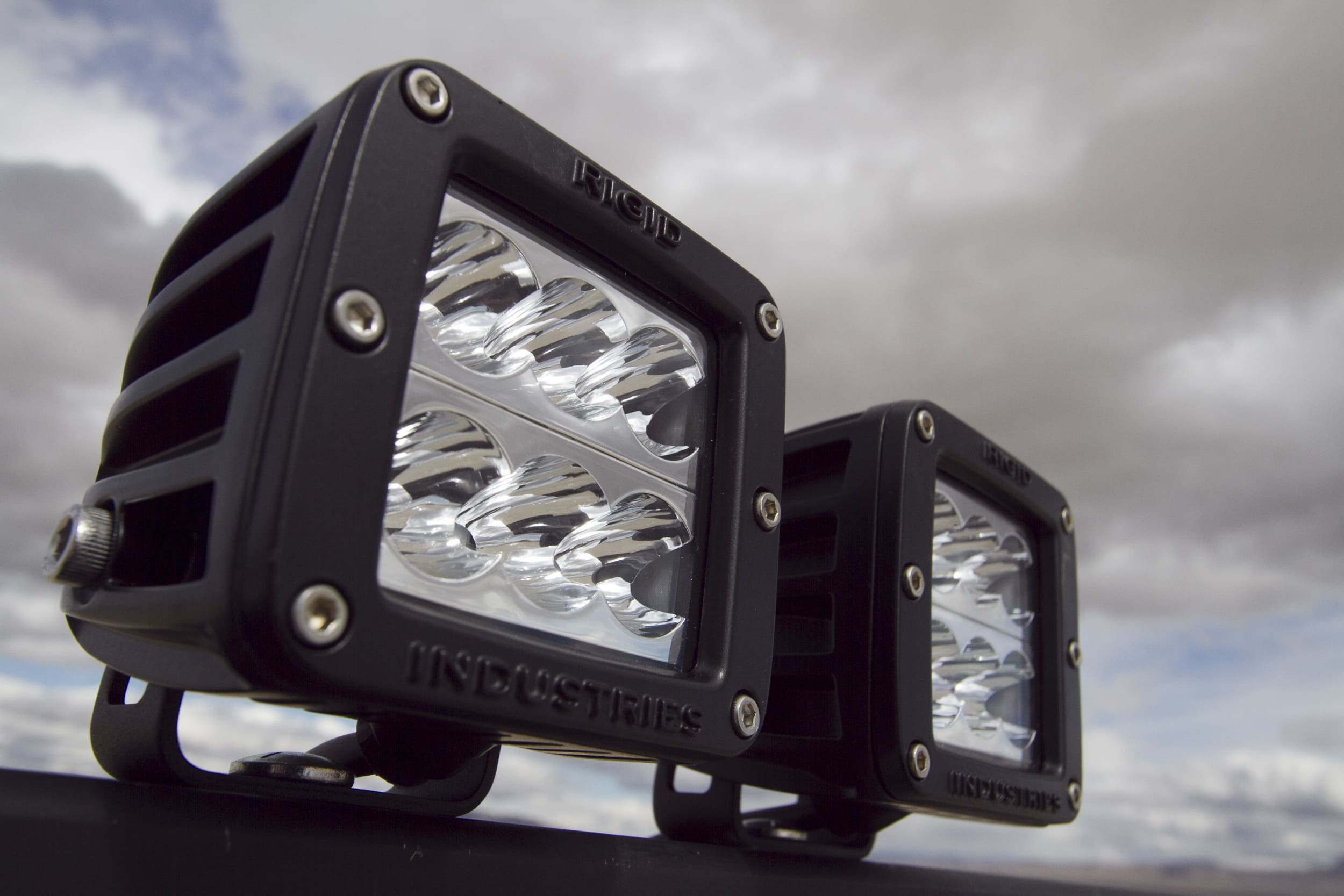
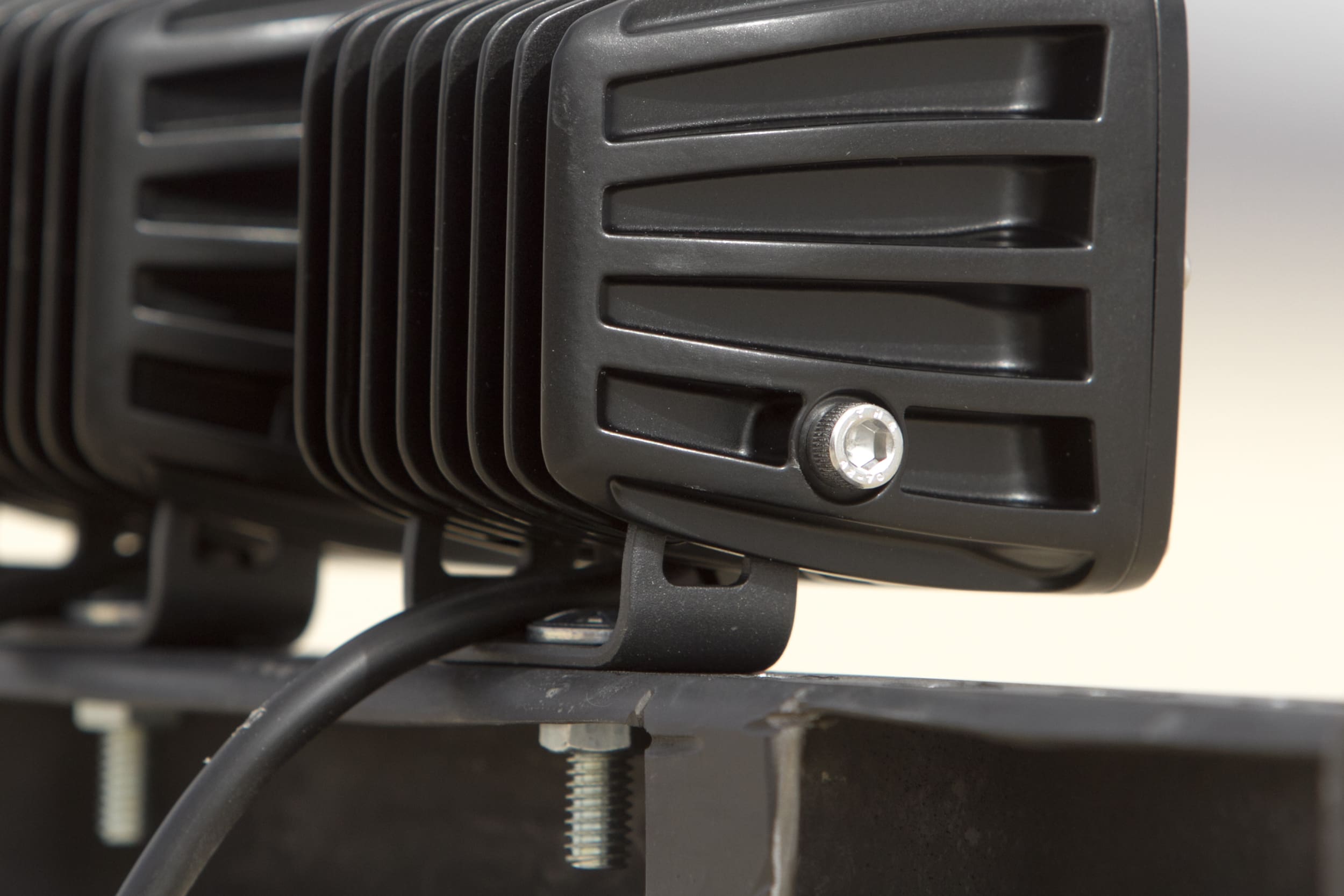
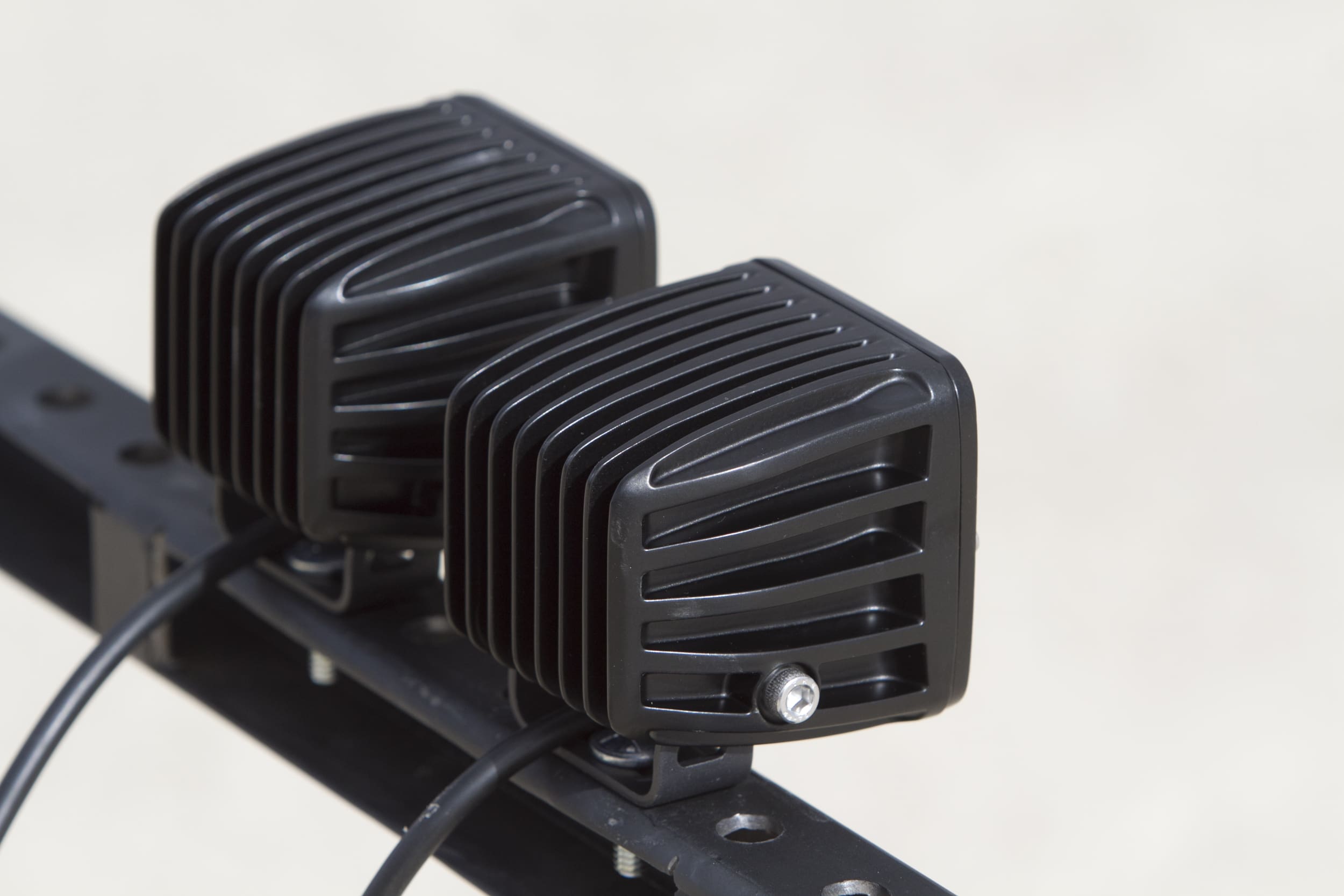
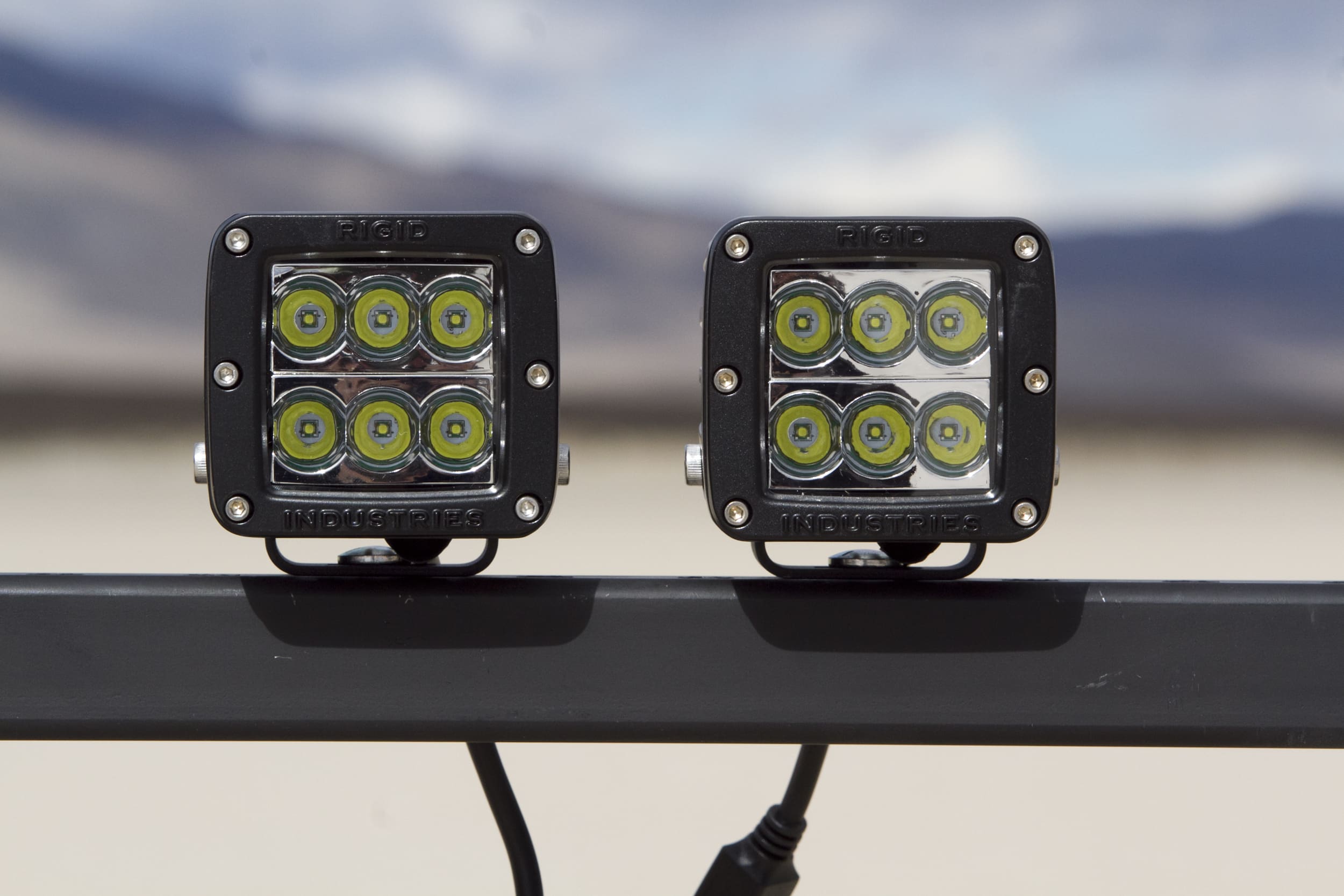
Rigid was one of the early leaders in high-output LED lighting technology and has forged a respected name in the industry. The Dually D2, a cubical compact, deviates from their traditional light bar style. Construction, as with the other units in the test, is of die-cast aluminum. The pressed steel mount is simple and functional, though mounting for a forward projection is only possible on horizontal surfaces. It is also not preassembled, and you’ll need nimble fingers to get the small Nyloc nuts in place. The Dually is sold as a single unit or in pairs with a wiring harness. Connections are first-rate waterproof Deutsch, the harness is properly fussed, and switching is via a toggle button.
The six LEDs are configured in a two-by-three arrangement, each sitting fairly deep in a small, patented Spector Optics reflector. The Dually provides an hourglass pattern, which is evenly dispersed. A hot spot occupies the center 10 degrees, and usable illumination reaches subjects up to 15 degrees off center. Foreground illumination is excellent. Unfortunately, due to a communication error, Rigid sent a wide-pattern unit rather than their driving beam. I did not have time to source another set prior to our desert testing but decided to put them up against the others. Though the 350-foot markers were visible and clear, the beam tapered off rapidly beyond that.
In the lab, the Dually experienced a 10 percent drop in lumen output and amperage draw. The unit stabilized at 147° F, 1.82 amps, and 958 lm. Color temperature hovered right at 5,675 K, and the CRI was 71. The CRI was the lowest of the group, but according to our lighting expert Jim Horvath, a three-point variation is barely noticeable to the human eye. The Dually is IP68 rated, as well as MIL-STD-810G, the standard for vibration resistance. Internally regulated, it will operate with 9 to 36 volts input, and internal thermal management protects the unit from overheating. I regret not being able to put Rigid’s dedicated driving light up against the rest. Even so, I thought this unit performed well considering it being out of its genre. Made in USA.
Pros:
- Excellent beam pattern
- Foreground illumination
- High lumen output
- Quality construction
- Includes harness
Cons:
- Range
- Mount not assembled
KC HiLites LZR 4-inch Round
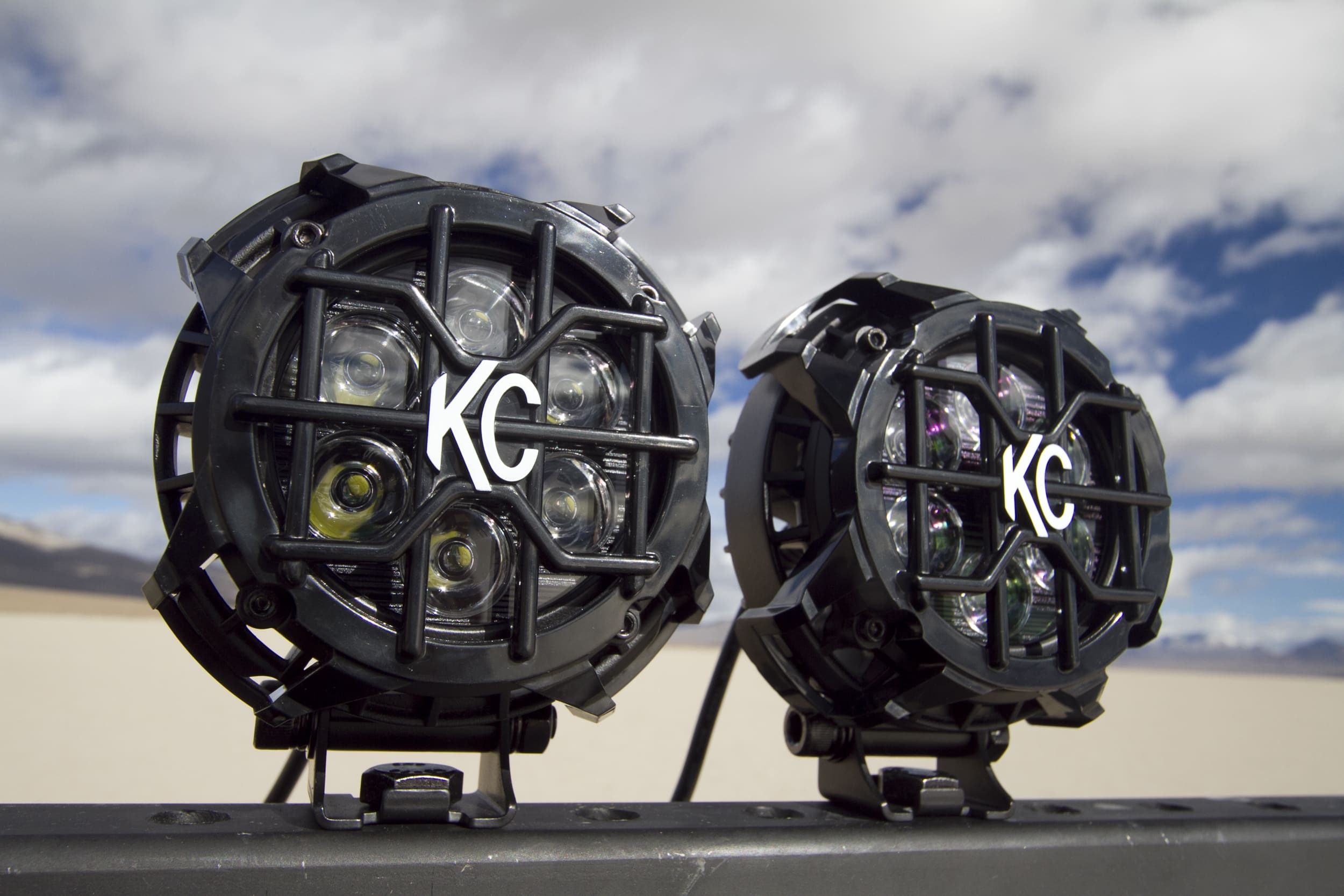
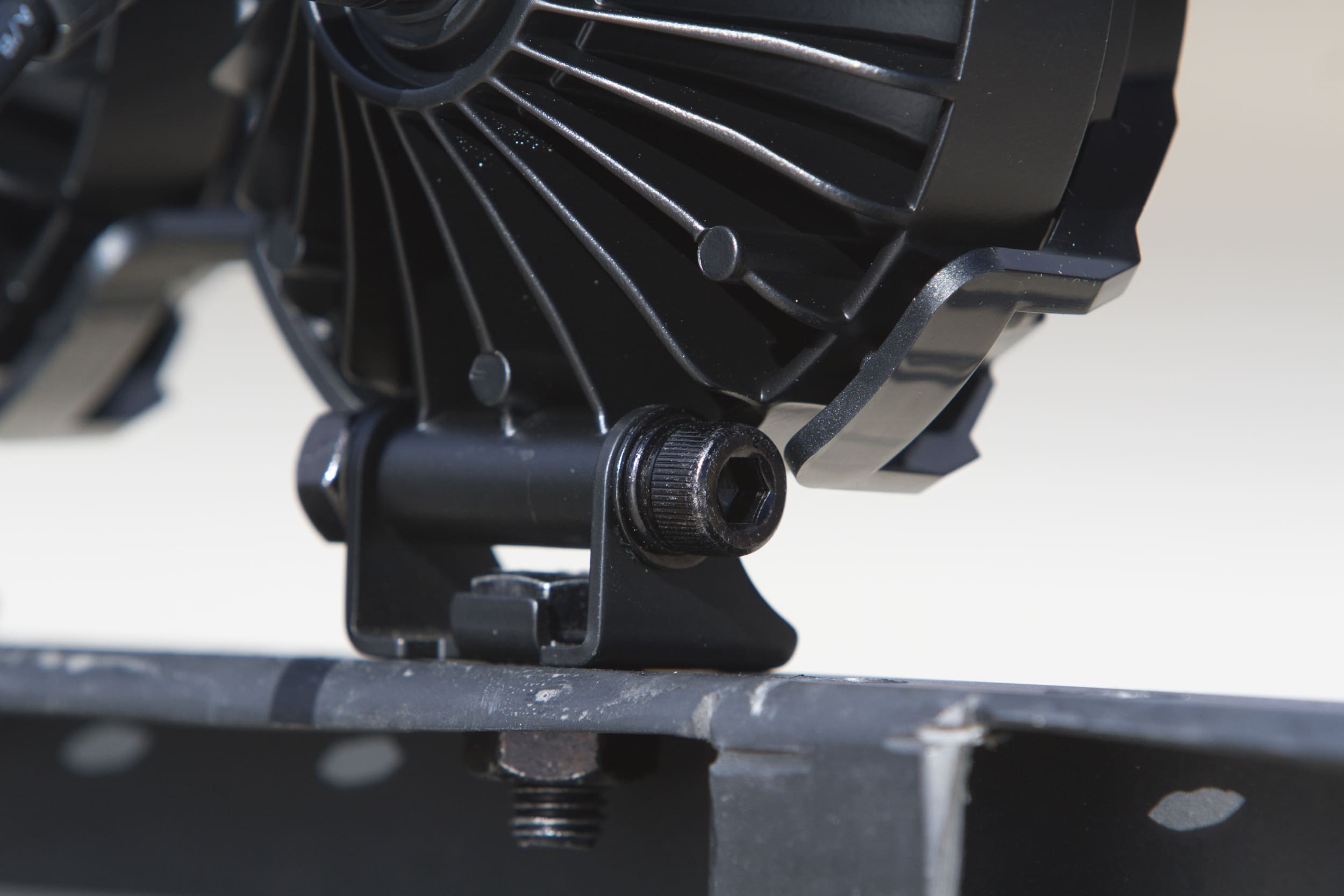
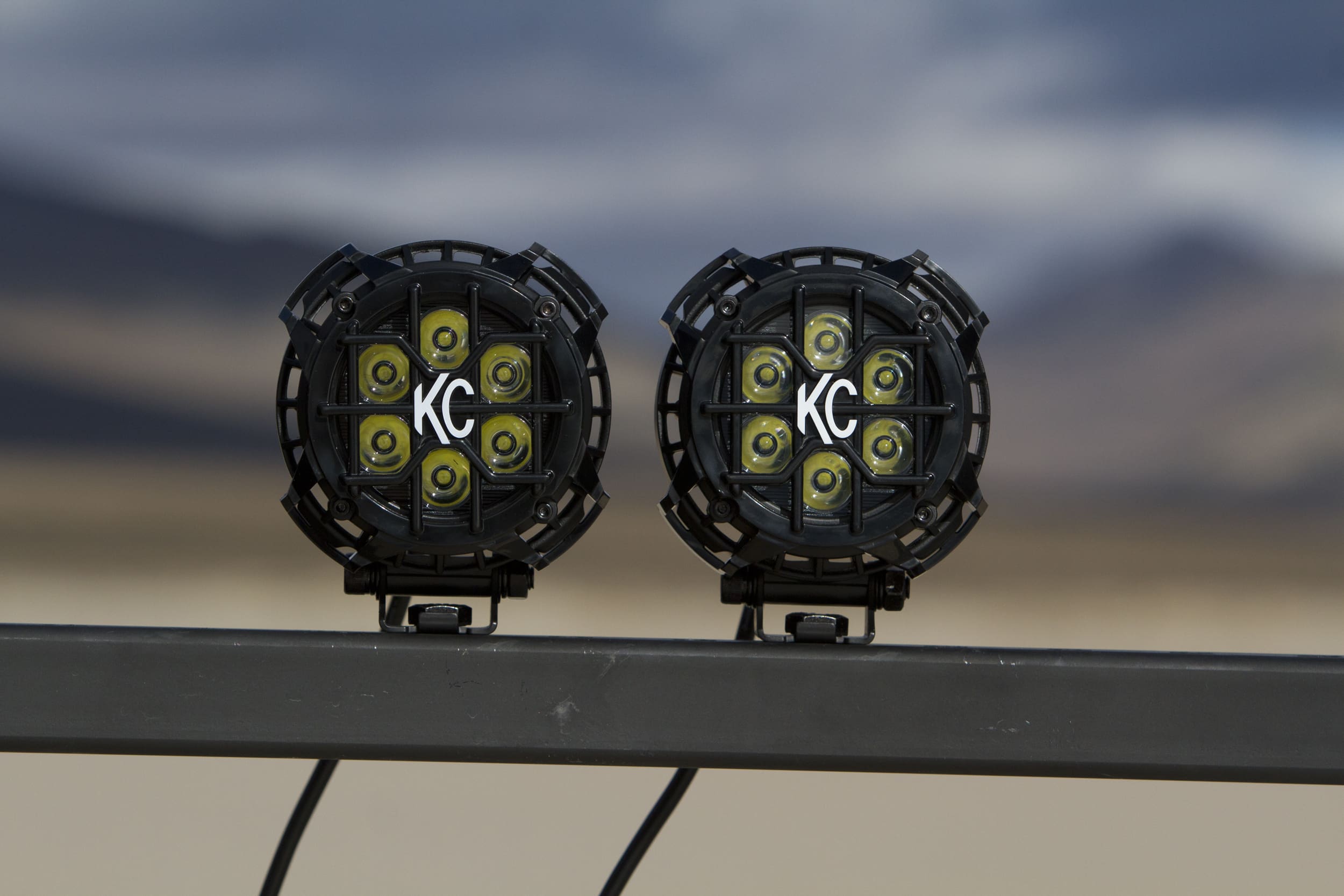
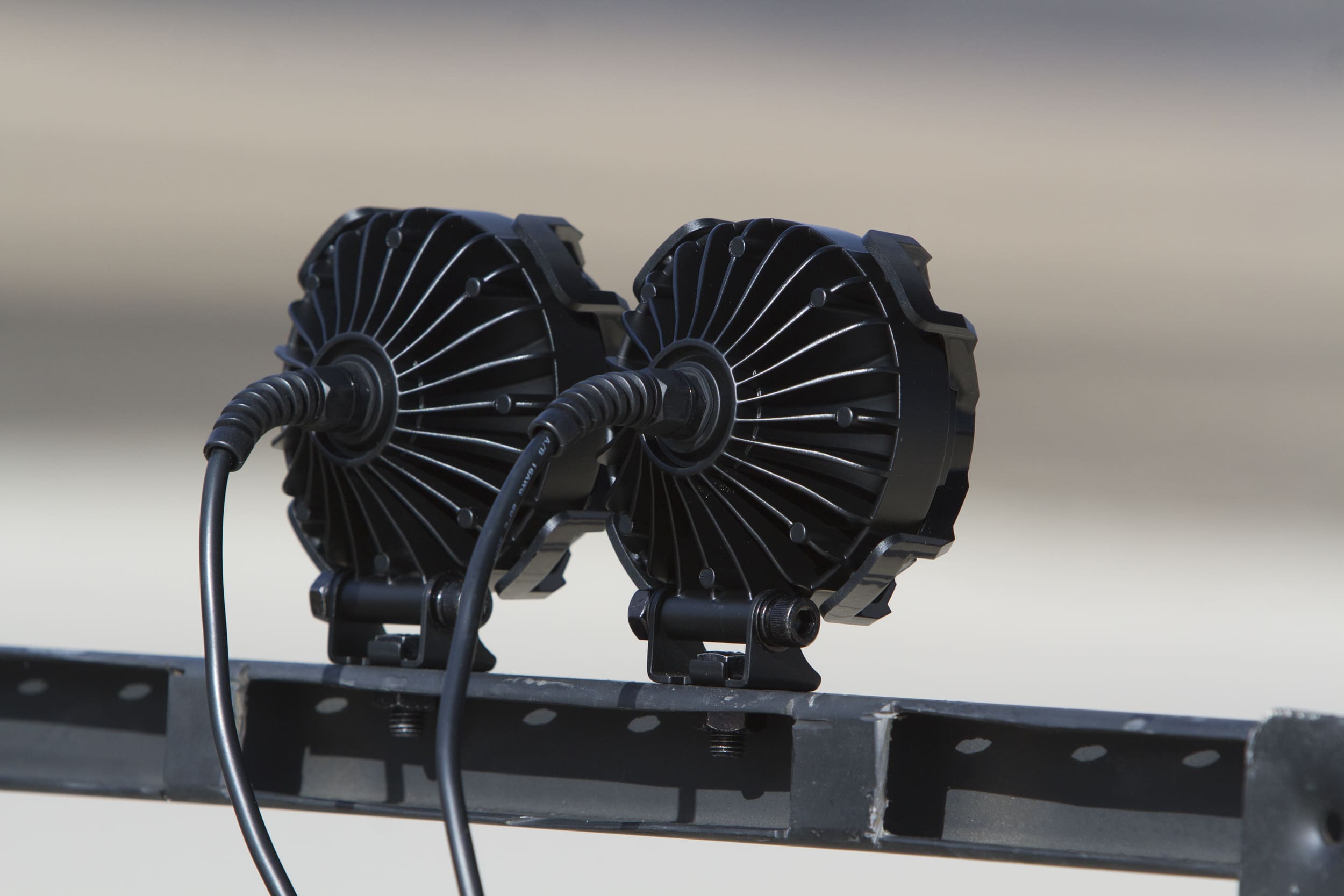
KC HiLites is the granddaddy of off-highway auxiliary lighting, and we expected no less than a worthy competitor. What I immediately noticed was the turbine-style radial heat sink that allows air to flow through the edges of the light from the front. The housing is die-cast from aircraft-grade aluminum, and mounts and hardware are stainless steel. The mount has a rear nut lock, a nice feature, and by the size of the mounting bolt (.375 in), I wouldn’t expect this light to go anywhere. These units were shipped without packaging or a wiring harness, but the retail kit does include a MIL-SPEC harness. Wire loom access is via a thread-in compression fitting and is very sturdy. Lead ends are simple butt connectors. The injection-molded protective light guard is designed such that it does not obstruct the beam whatsoever.
Six 3.3-watt LEDs are configured in a circular pattern, and the unit is rated at 30 watts. This is the only unit in the review that does not use reflectors to collimate the beam. Instead, it implements an inner optical lens. This is similar to the optics of KC’s 6-inch round. The outer lens is optic-free polycarbonate. The LZR provided very evenly distributed light, about 28 degrees on the x- and y-axis, and with no shadowed areas. On the playa, there was an abundance of light in the foreground, which continued to the first of our 30-foot road markers (350 feet). Though the columnized beam did not have the longest reach, it dropped below detectable levels at 500 feet; illumination prior to that point was very good.
Test results in the lab supported our fieldwork. Amperage draw over the 40-minute test ranged from 1.18 to 1.15, extremely even, with luminous flux dropping from an initial 768 lm to a final of 726 lm. Maximum temperature after being on for several hours in a static position remained no higher than 130°F. Spectrometer readings resulted in color temperatures of 4,249 to 4,299 K, with a CRI of 72. The unit is IP68 for dust and water and had no issues with the dunk test. US-designed, made in Taiwan.
Pros:
- Solid construction
- Even light diffusion
- Low current draw
- Low running temperatures
- Waterproof
Cons:
- Cost
- Horizontal mount only
Baja Designs Squadron | Editor’s Choice
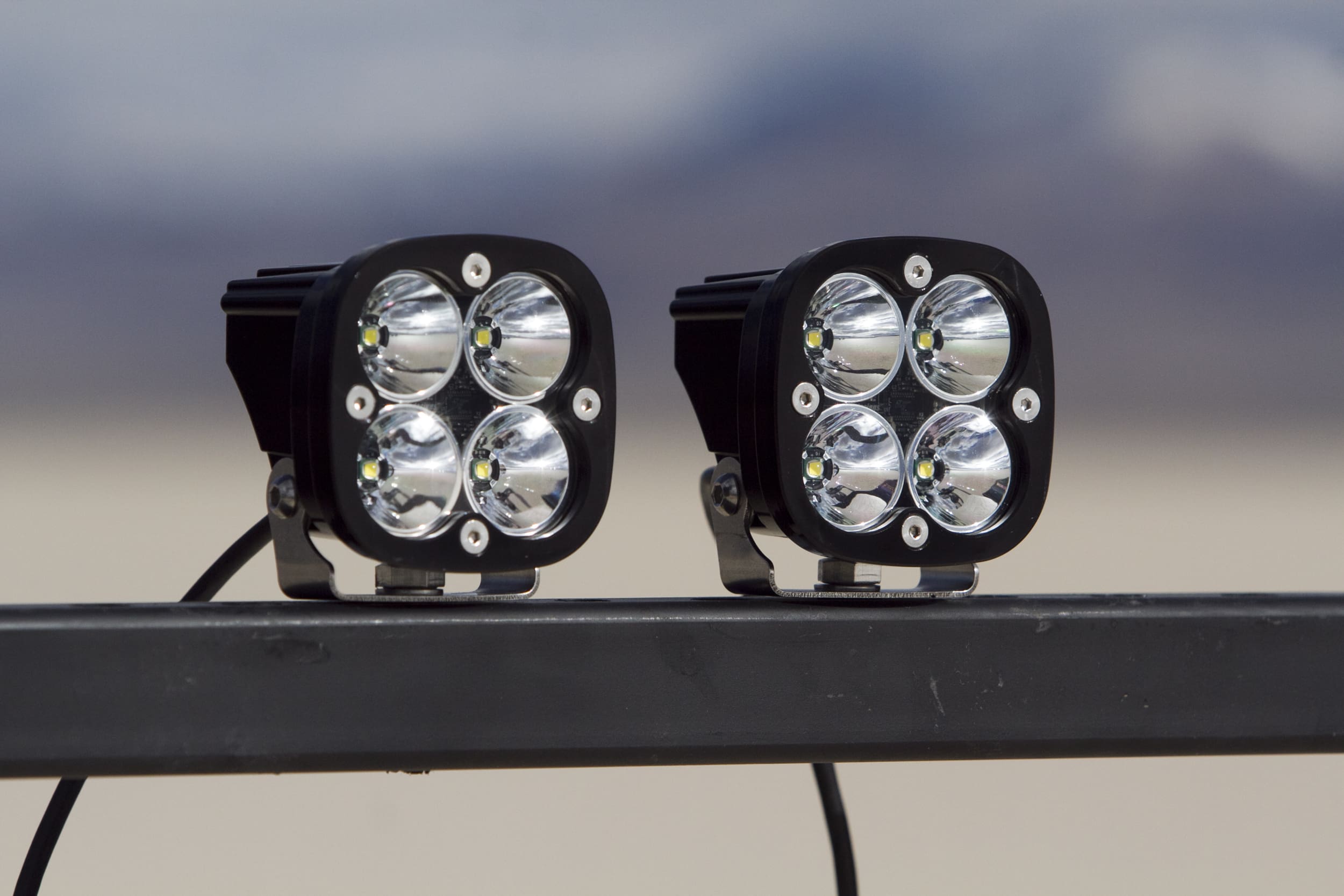
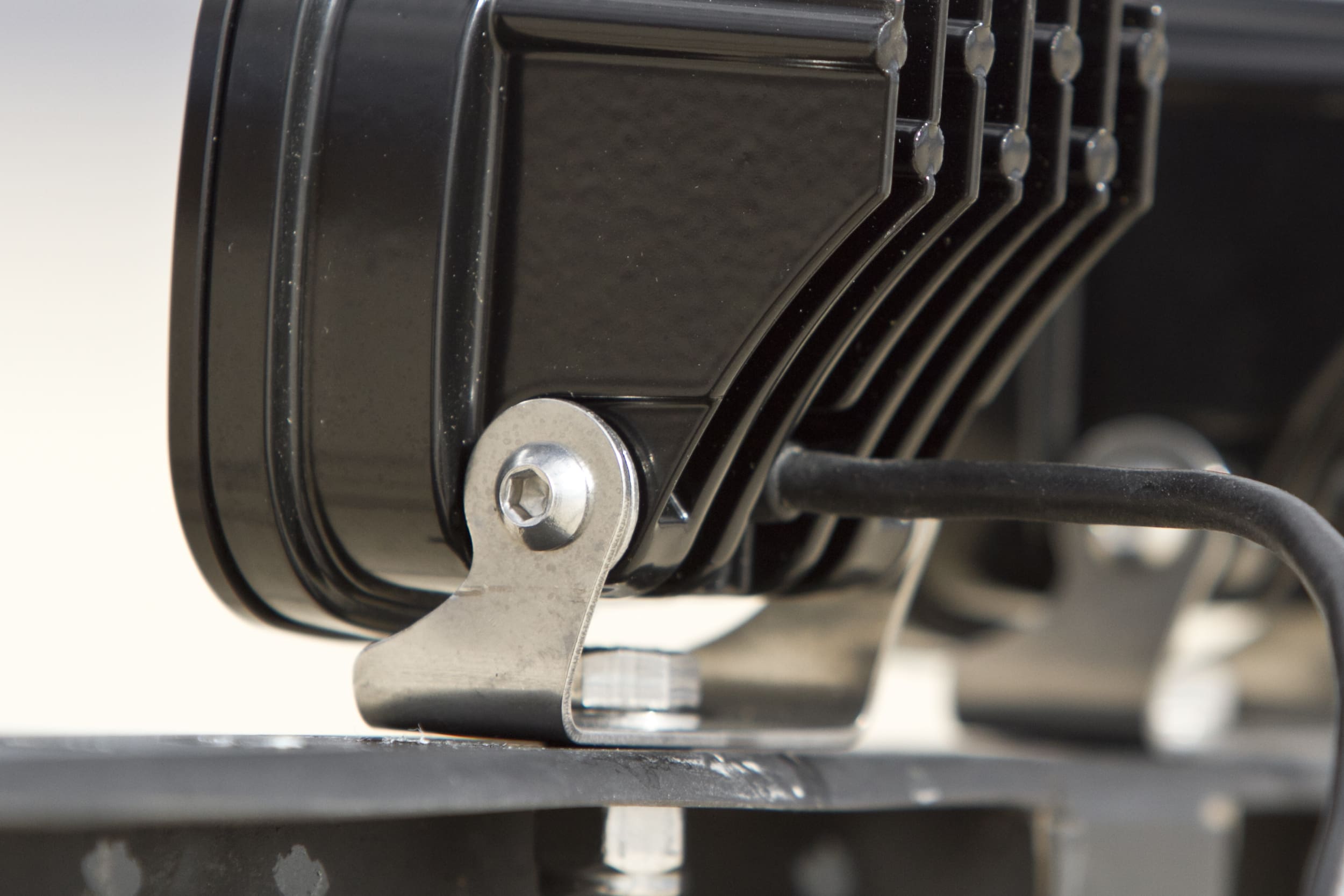
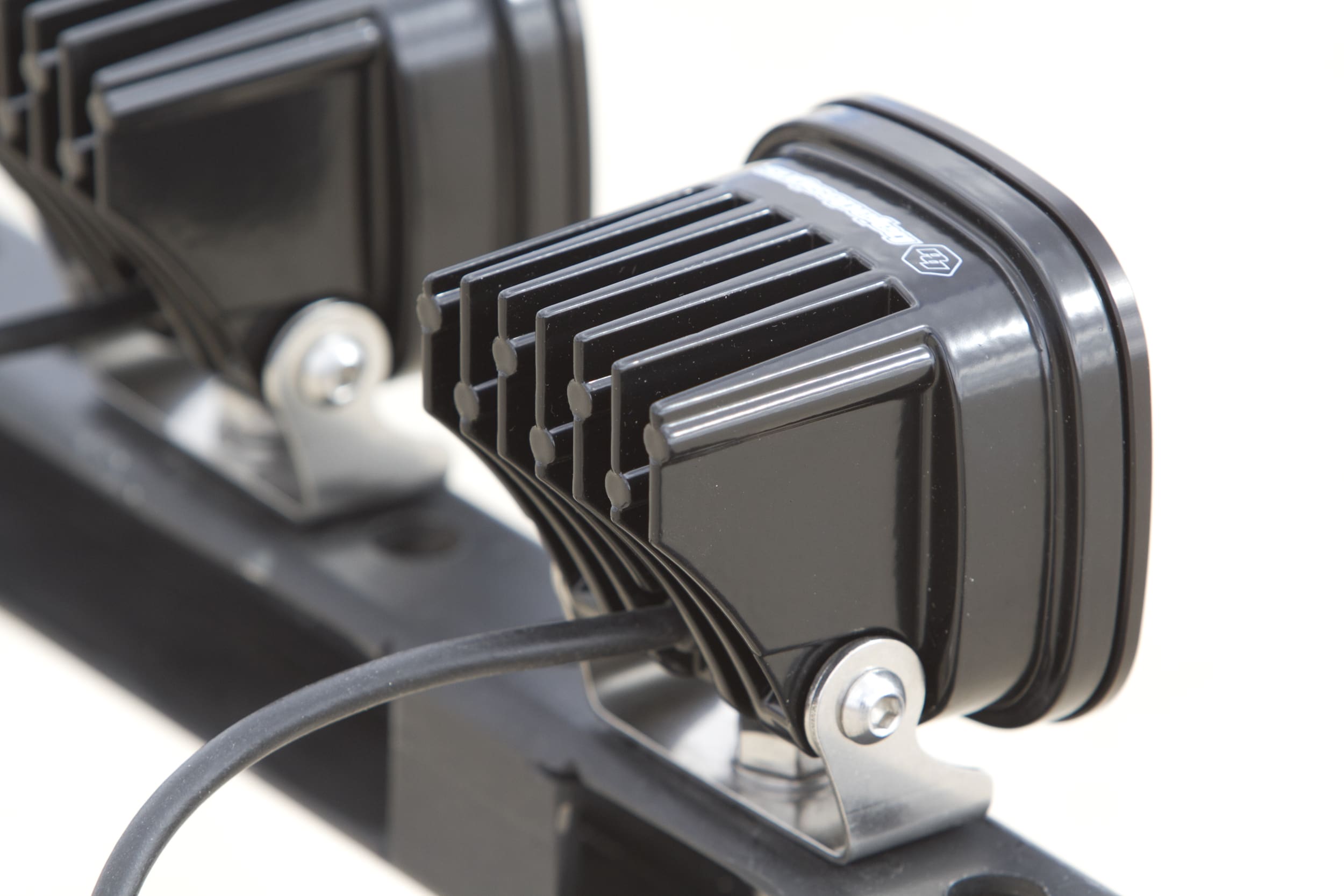
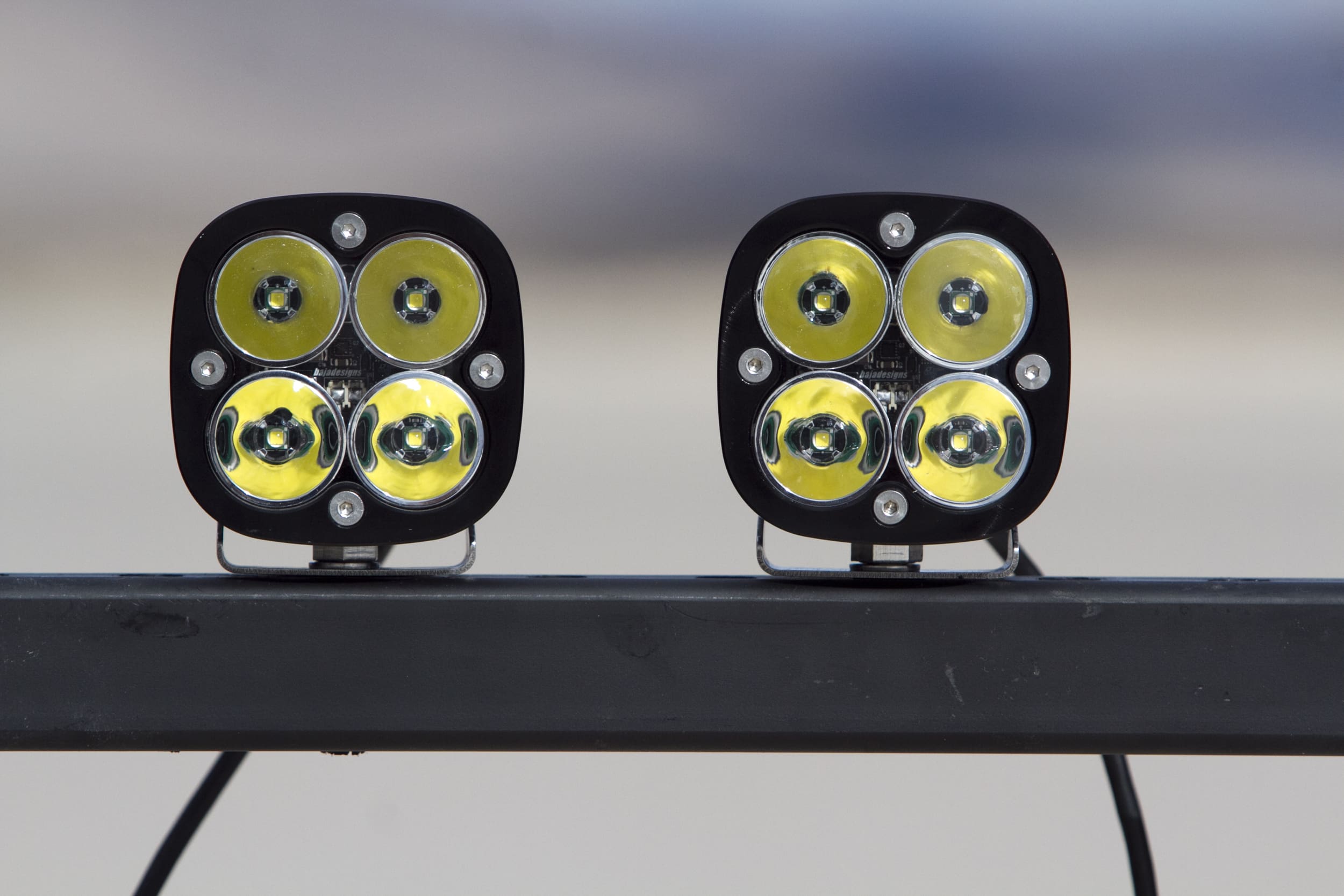
The Baja Designs Squadron was the lightest and most compact of the four units tested. The 3-inch by 3-inch housing is die-cast aluminum, powder-coated black, and has a deep array of fins on the back that function as an effective heat sink. The stainless-steel mount adjusts with an Allen wrench and is more than sufficient for the light’s 12-ounce mass. However, due to the mount position, it cannot be mounted on a vertical surface. The hardware is also stainless steel, but it could use a fixed nut lock on the back of the mount.
Four Cree T6 Bin LEDs reside in simple conical reflectors, and the lens is polycarbonate. The beam pattern is round in shape and covers 25 degrees on the x- and y-axis with no hot spots or shadows. The optional wiring harness features waterproof press-fit connections, and components appear worthy of long-term service.
In field testing, the Squadron was a strong performer. It provided 2.7 lux at the 300-foot range, falling off to .67 at 650 feet. Under the discerning eye of the integrating sphere, it provided a 1,333- to 1,097-lm output over the 40 minutes, a drop of 18 percent, the largest in the test. Far less than the manufacturer’s 3,600-lm claim, but on par with the differences seen in all lights reviewed. Current draw ranged from 2.2 amps at the five-minute mark to 1.8 amps at 40 minutes, and thermal build-up resulted in a final temperature of 160° F. Though both figures were of the highest in the test, an Active Thermal Management system should protect components from overheating. The CRI, at 74, was the highest (best) of any of the nine lights reviewed. Color temperature came in at 4,347 K, slightly less than the advertised 5,000 K. Again, this deviation is on par with all units tested.
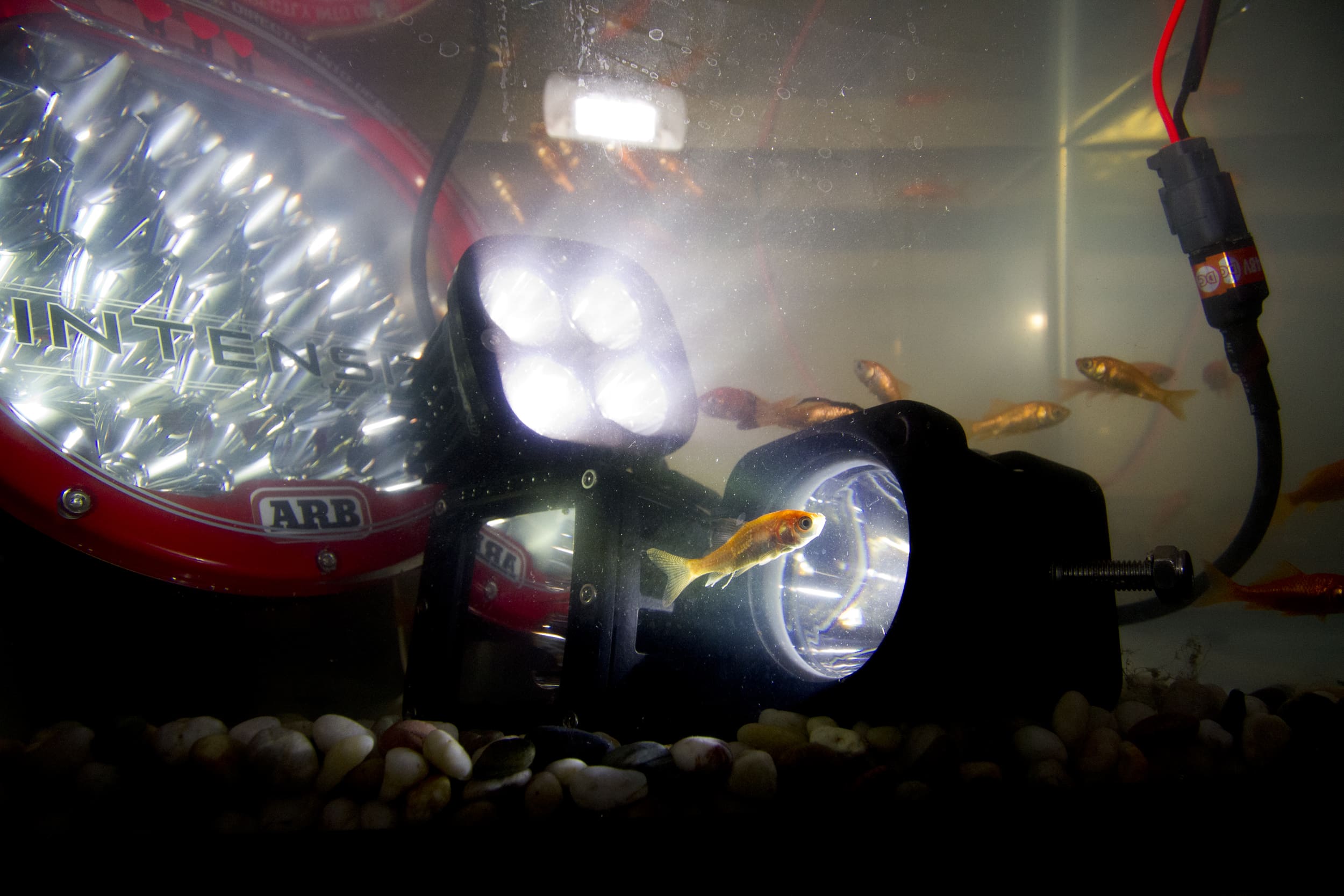
The unit is IP68 rated for water and dust ingress, and seemed perfectly happy hanging out with the goldfish in my aquarium. It is not salt spray rated, but I’m guessing that the black Mil-A-8625 Type III powder-coated finish would do well in adverse conditions. It is also MIL-STD-810G rated for vibration. They are available in four beam patterns, including spot, flood, driving, and wide-cornering. The unit tested was the driving version. Made in USA.
Pros:
- Wide, even beam pattern
- Good range
- Lightweight and fully waterproof
- Best CRI
Cons:
- Horizontal mounting only
- Heat buildup
- Cost
Vision X Optimus | Value Award
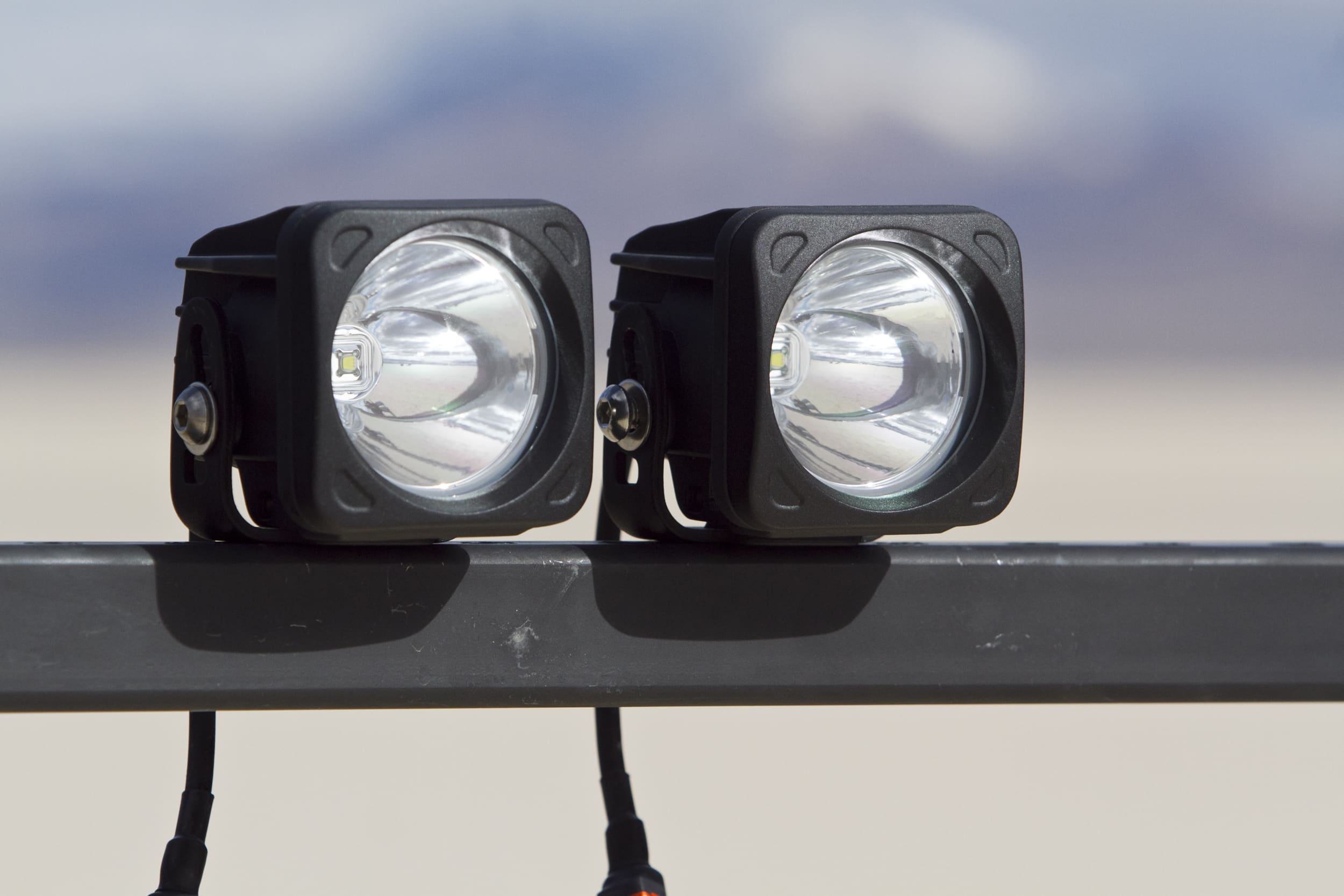
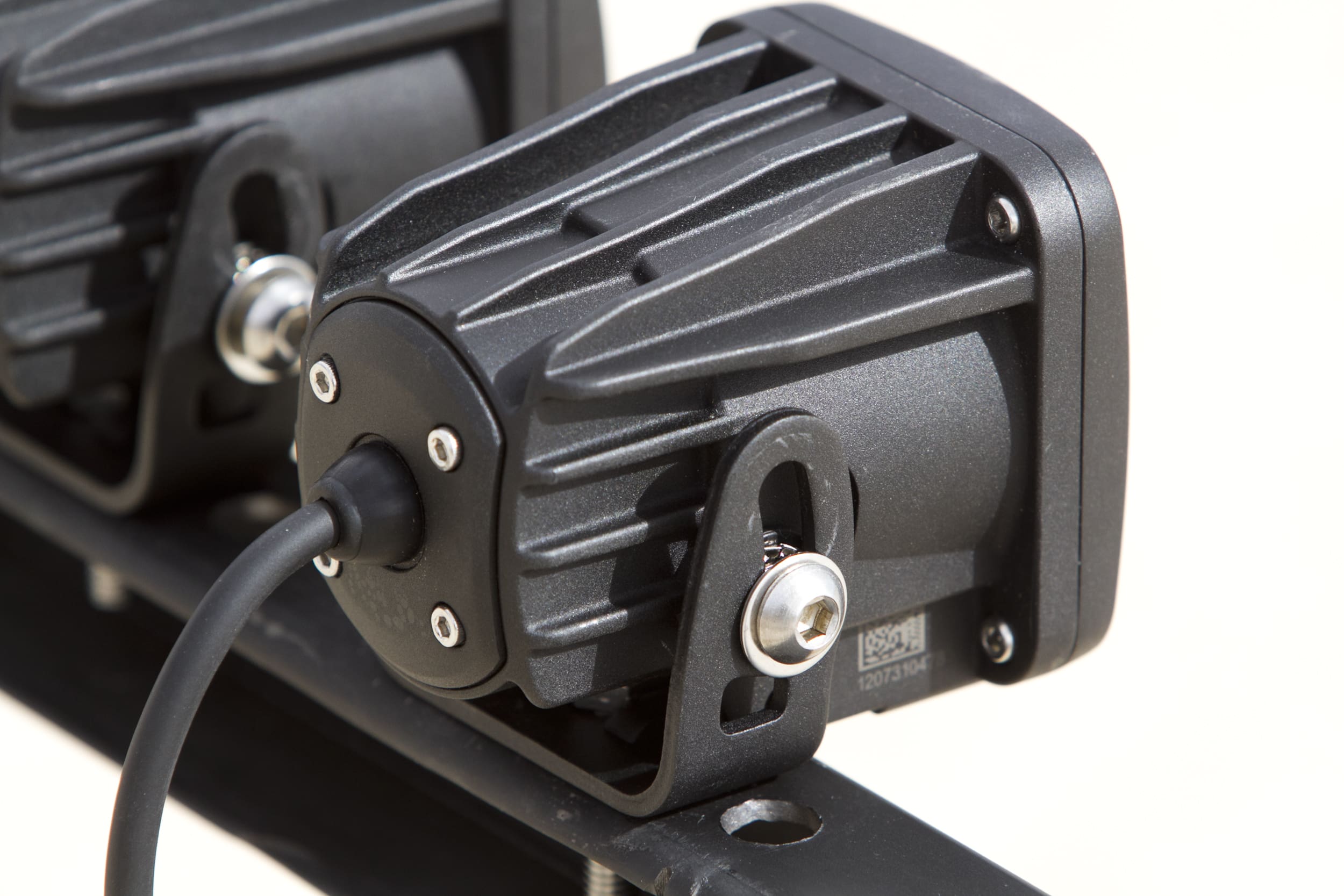
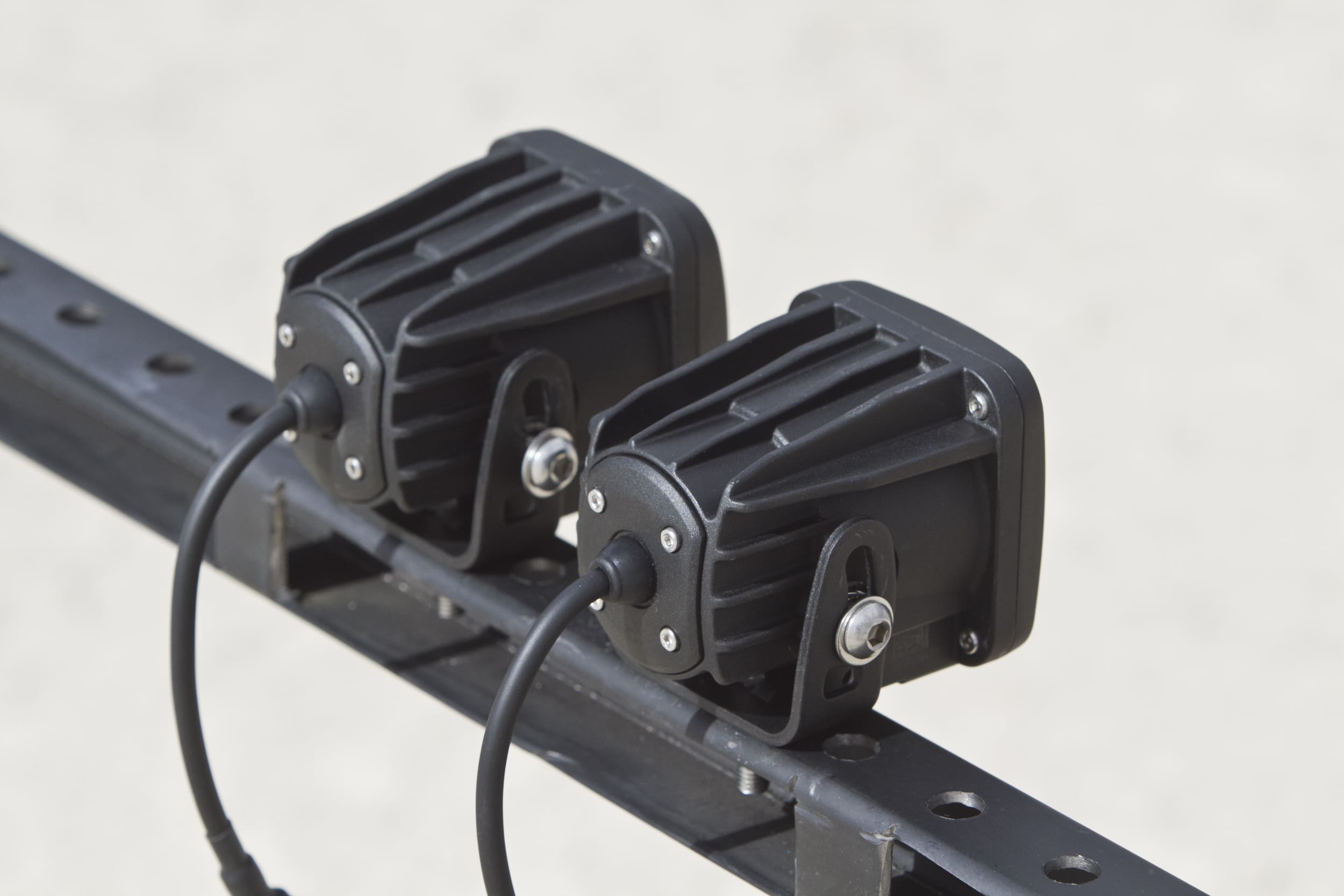
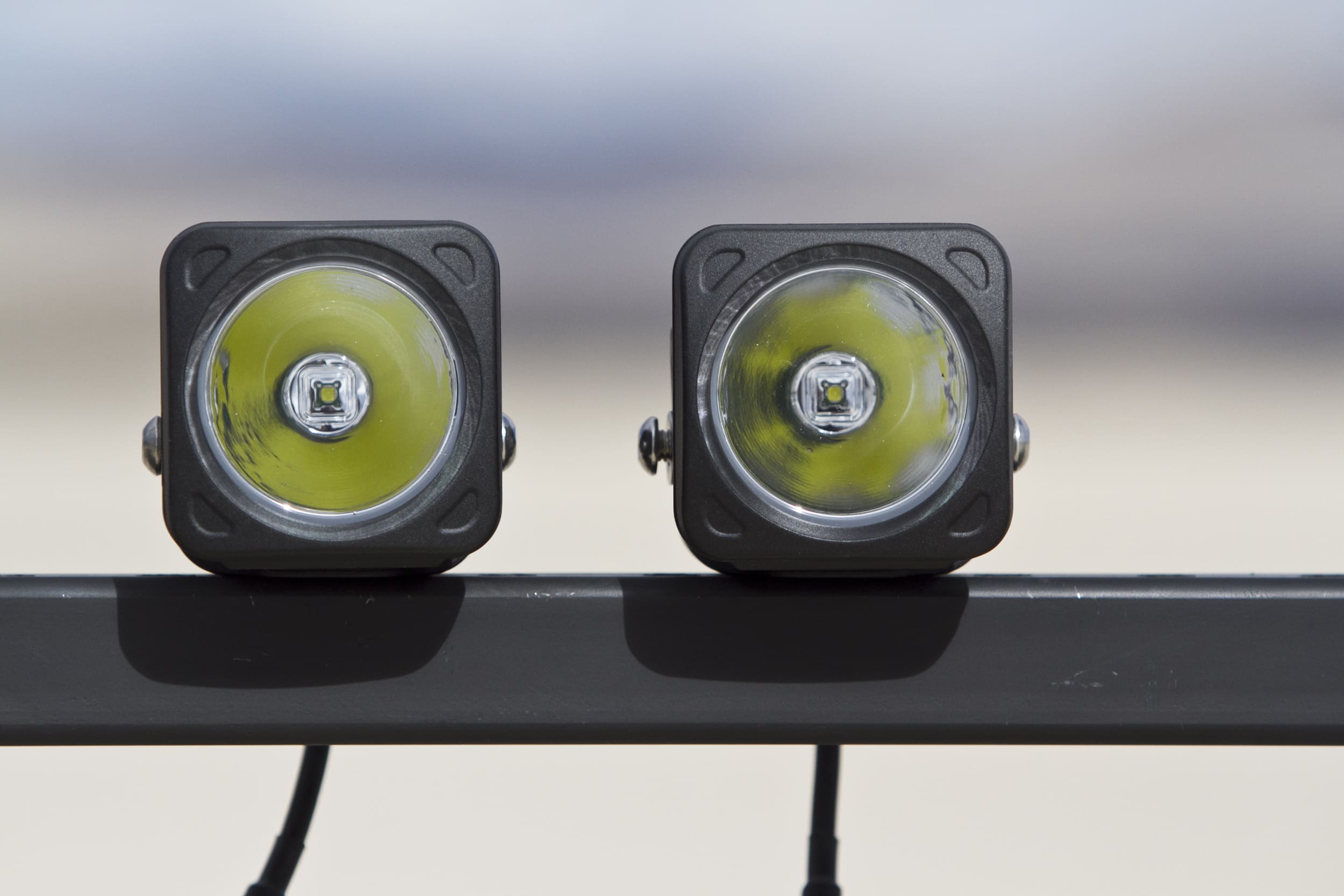
Vision X, while not a household name, produces auxiliary lighting options for everything from ATVs to heavy equipment. The cyclops-looking Optimus is their latest entrant into the high-output compact sector. It is solidly constructed of aircraft-grade die-cast aluminum with a pressed-steel mount; both are powder-coated. The mount is stamped with a nut lock for easy installation. The unit is sold in pairs, and a wiring harness with waterproof Deutsch quick-connect fittings is included.
This is the only unit tested with a single 10-watt LED and was the lowest wattage of the lights tested. Its LED sits deep in a proprietary conical reflector and behind a clear polycarbonate lens. The Optimus shoots straight and long with its pencil-beam optics, and a useful area the same dimensions as its spot, right at 10 degrees on the x- and y-axis. Though it lacks any foreground or peripheral lighting, the 30-foot grid markers in our desert test were well lit at a 700-foot distance. Falling off the incident meter reading at 800 feet, the Optimus provided the best reach of any of the compact units.
Lab results fared well with the Optimus. Amperage draw was an even .68 amps throughout the 40-minute test, temperature readings topped at a low 107°F, and lumen output, though the lowest in the group at 411 lm, had the lowest reduction as a percentage; less than 3 percent. With these test results, I doubt its thermal management would ever kick in. Internally regulated, it can work with voltages from 12 to 32V, and its IP68 rating allows for extended submersion. Considering the single 10-watt bulb, impressive range, and minimal power consumption, Vision X has done a remarkable job with reflector technology. Made in South Korea.
Pros:
- Low power consumption
- Low running temperatures
- Great range
- IP68 rated
- Low price
Cons:
- Limited peripheral illumination
LARGE ROUND LIGHTS
ARB Intensity
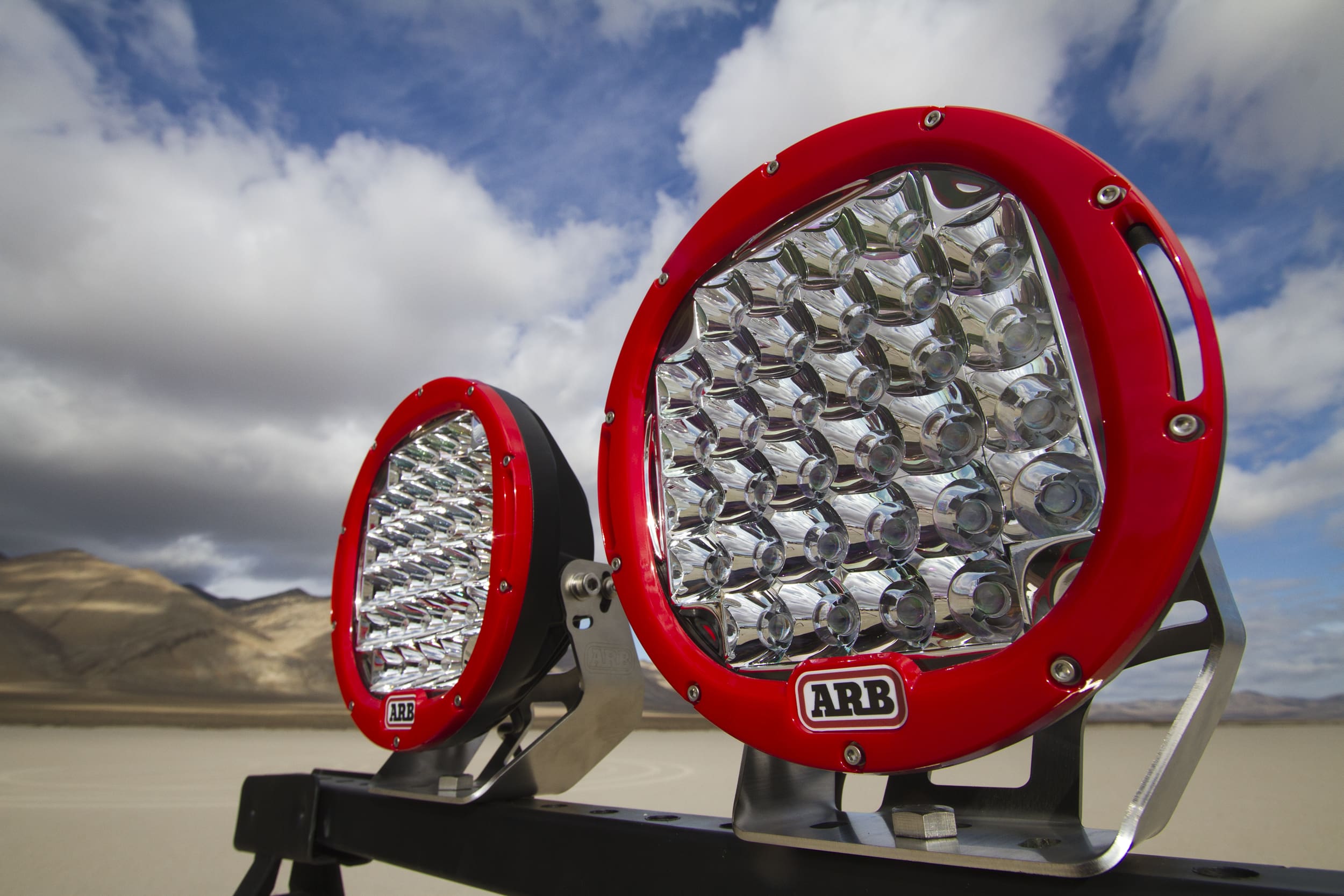
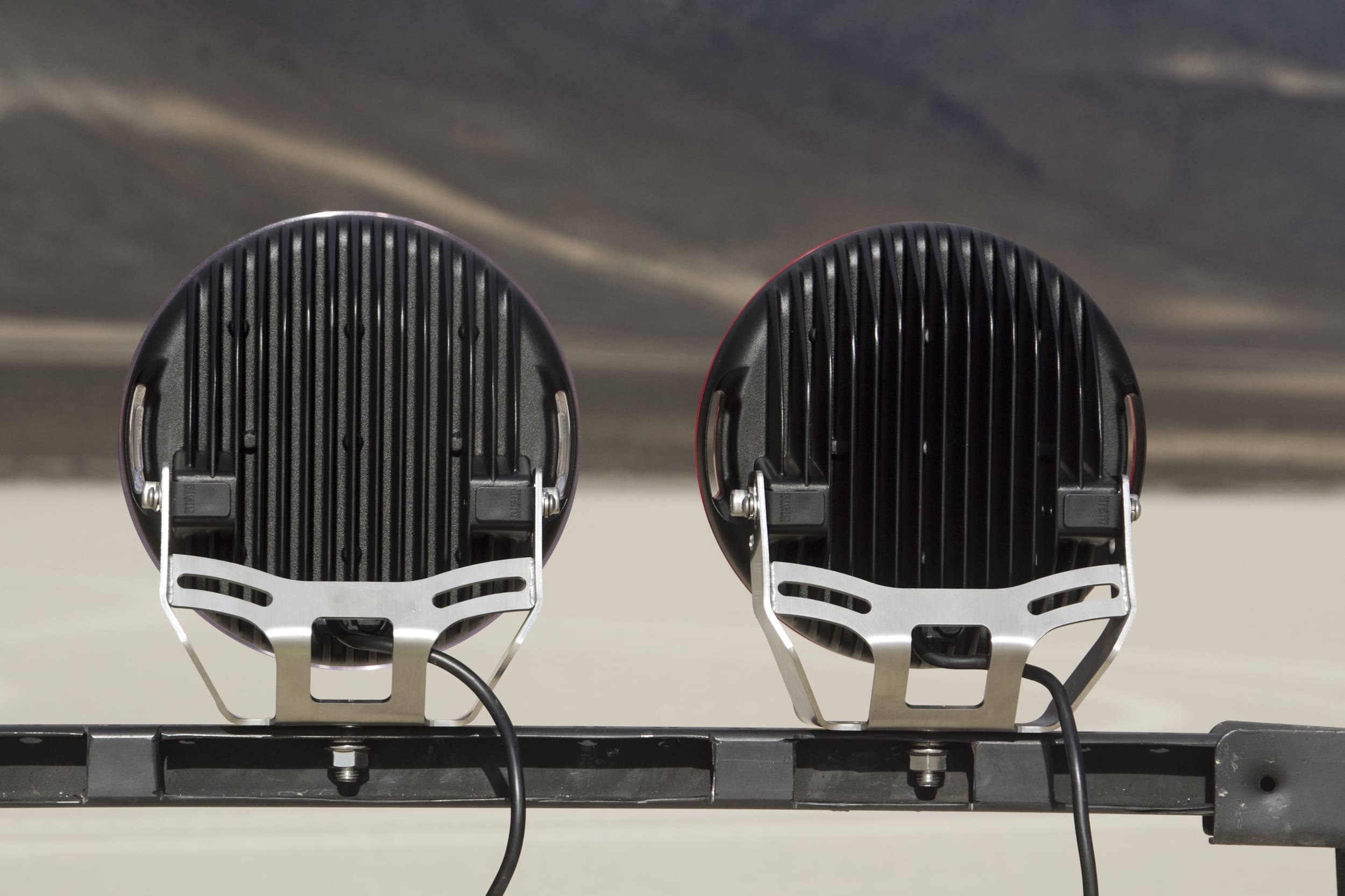
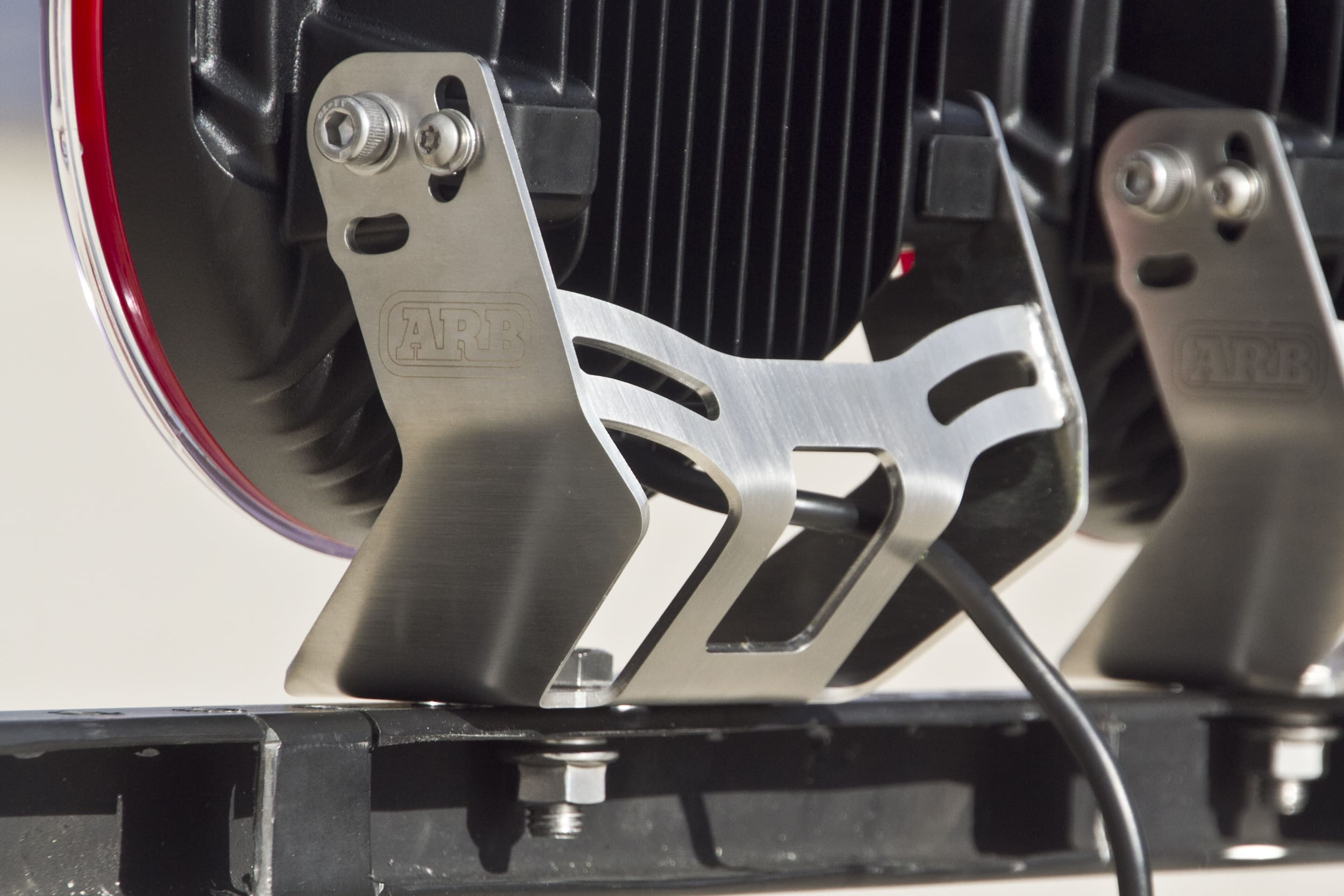
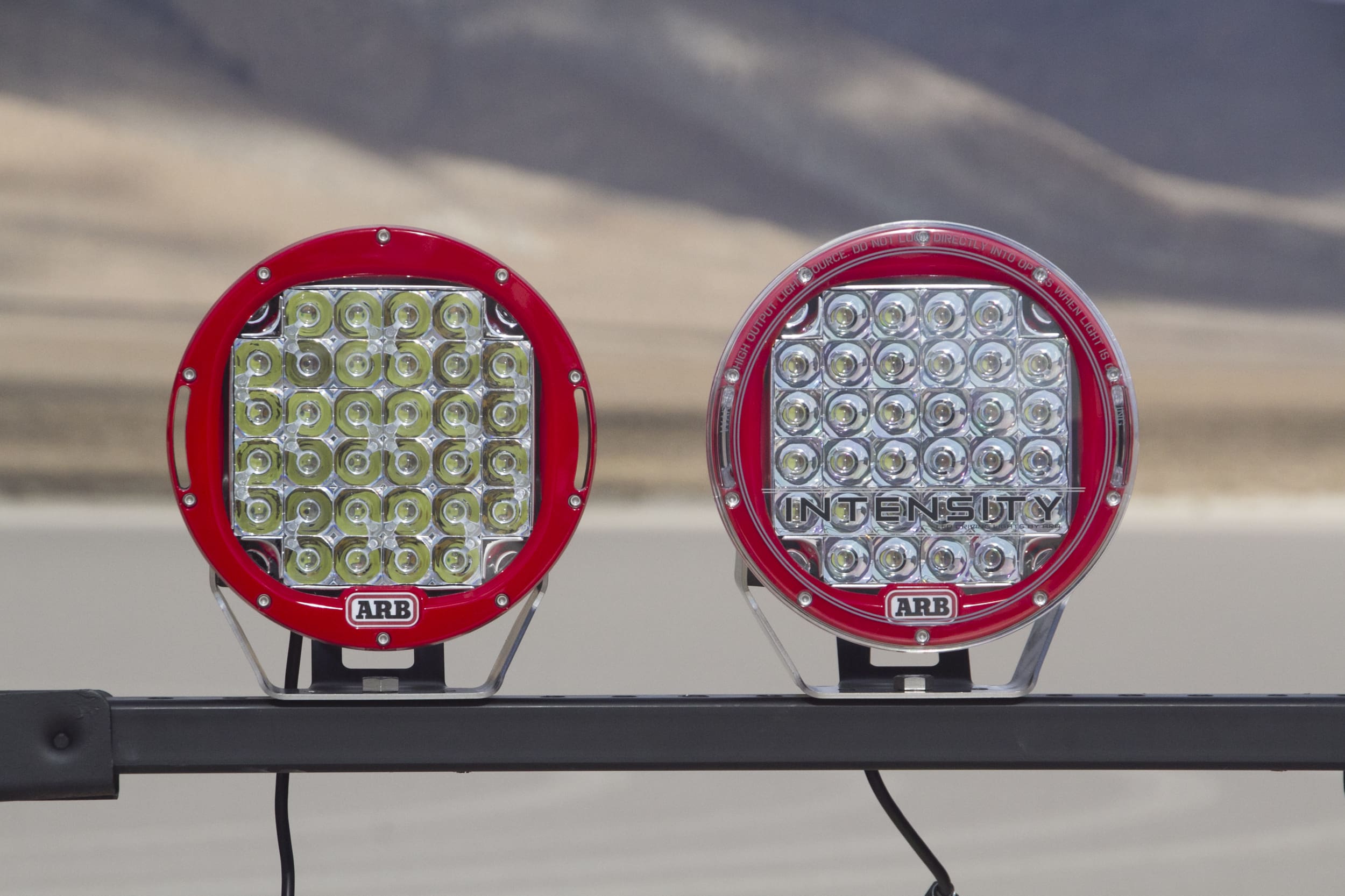
ARB is Australia’s original manufacturer of high-quality four-wheel drive gear. Interestingly, they have never branded their own light … until now. Because of the time-sensitive nature of our testing, we were fortunate to receive 2 of only 10 pre-production units in existence. Opening the box revealed everything I expected from a company with ARB’s mantra. At nearly 10 inches in height, the Intensity is by far the largest and heaviest light in the test. The beautifully crafted stainless steel mount supports a pressure-cast A360 aluminum body. The exterior ring is ARB’s signature red, and the lens and thick lens cover are polycarbonate. A security measure is added with the use of Allen-head cap screws and Torx adjusting nuts.
The company claims a 93 percent efficiency rating on its patented reflector design. The 25-degree beam pattern (as tested) is almost perfectly round, with a hot spot occupying the center 9-10 degrees, and drop-off is very smooth to the outer margins. In the field test, the Intensity provided a highly effective beam from 30 feet to well past the 1,000-foot marker, to which it was casting a defined shadow. Credit is given to the array of an unprecedented 32 3-watt LEDs and well-designed optics.
Fitting the unit to the integrated sphere produces impressive results. While it was not anywhere near the manufacturer’s claim of 8,200 lm (25 percent seemed to be average for most lights tested), it did produce far more than any other light: 2,025 lm after the 40-minute stabilizing period. Color temperature average was 5,625 K, and CRI landed at 71, matching KC’s 6-inch round for the top rating. Operating temperature leveled out at 137° F, with 5.2 amps of current draw. Considering the lumen output and amperage draw, the unit runs fairly cool. It is also IP68 and MIL-STD-810G certified for water ingress and vibration, with a 3,000-hour salt spray rating.
Five days after the aquarium dunk, I re-tested amperage draw for each unit. After a few seconds, droplets began to precipitate on the reflectors and lens. Unfortunately, the light leaked. I was extremely impressed with this unit and am really disappointed it failed this test. Made in USA.
Pros:
- Excellent range
- Broad beam pattern
- Solid construction
- High lumen output
- Good CRI
Cons:
- Size and weight
- Unit leaked
Hella Rallye 4000 LED
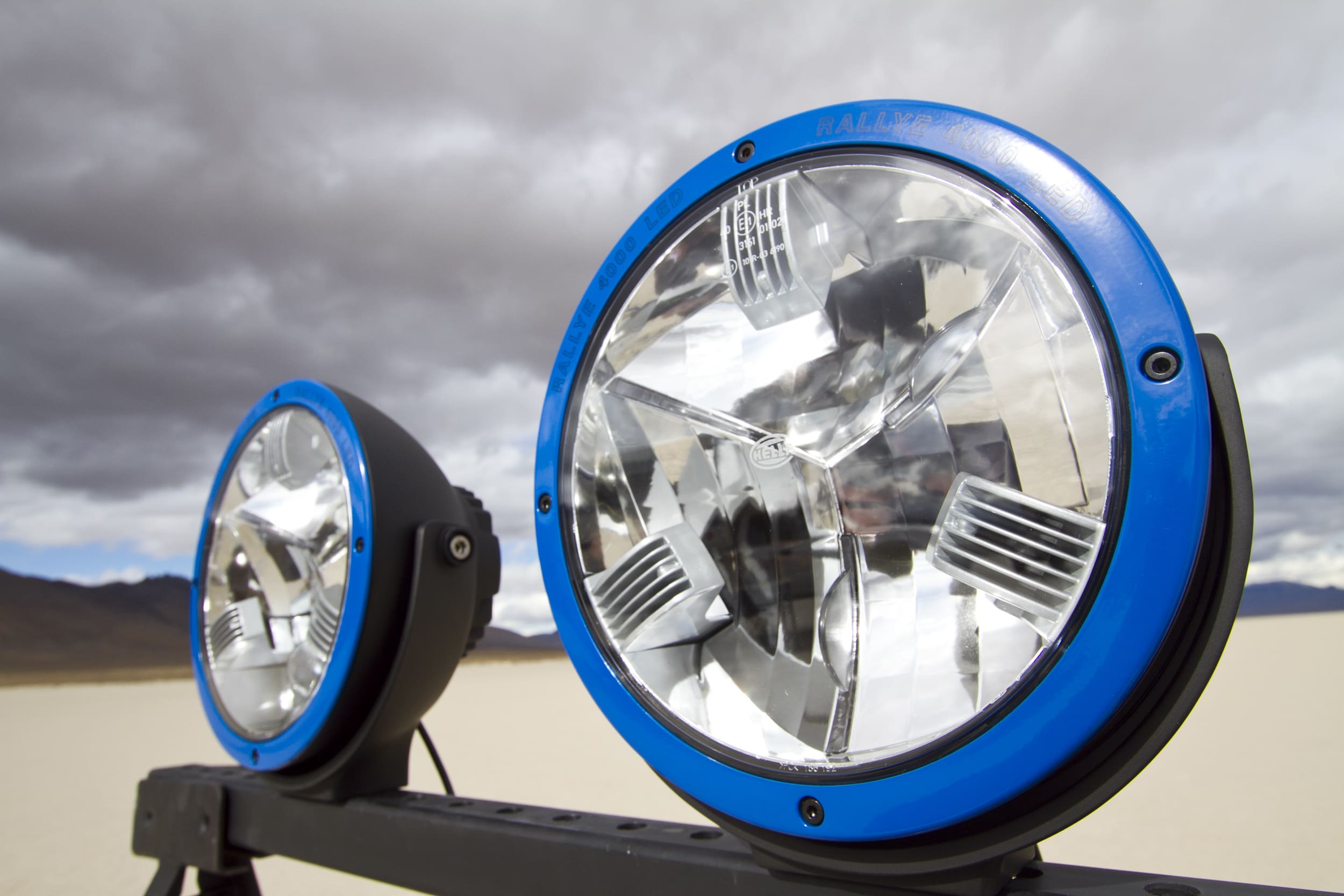
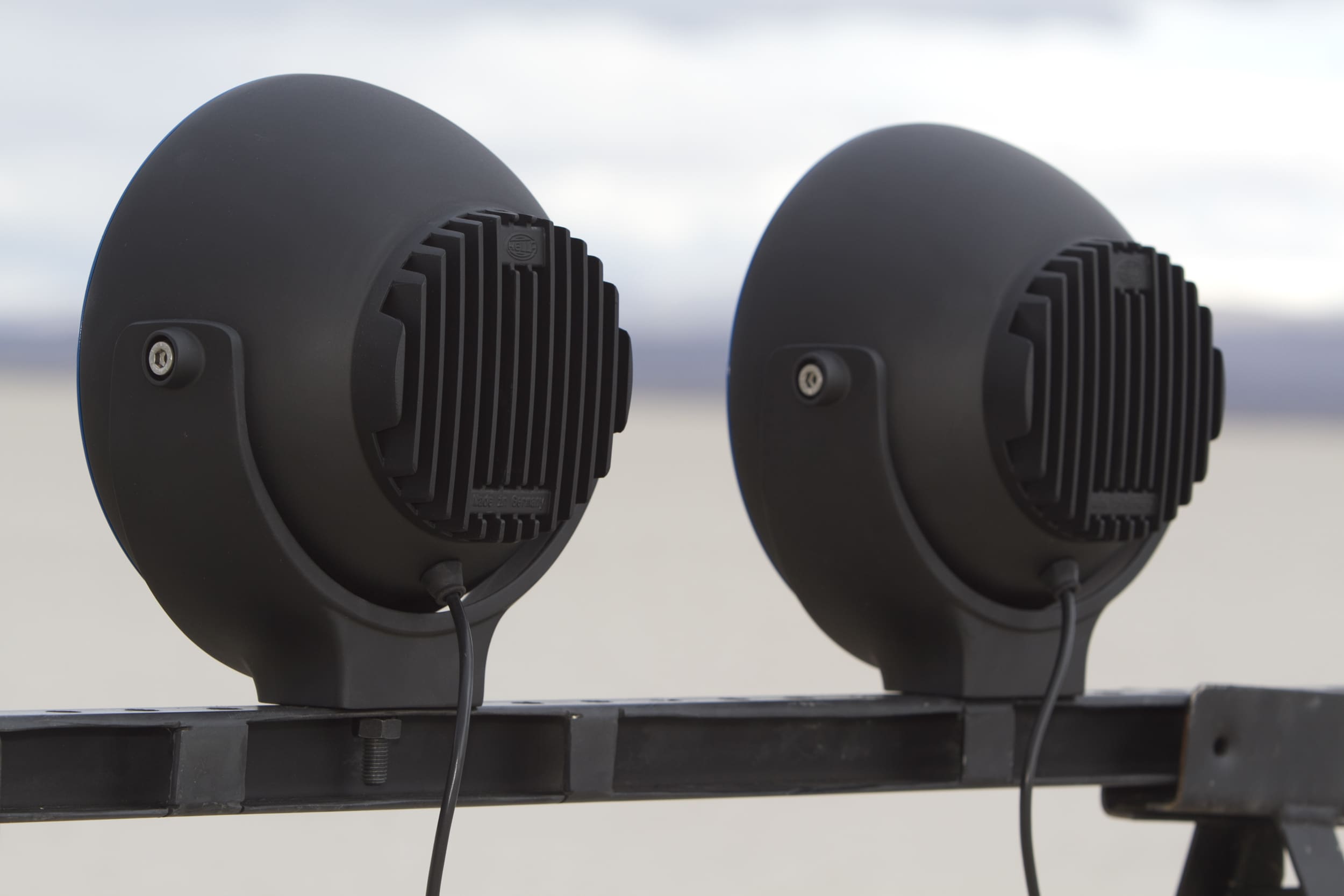
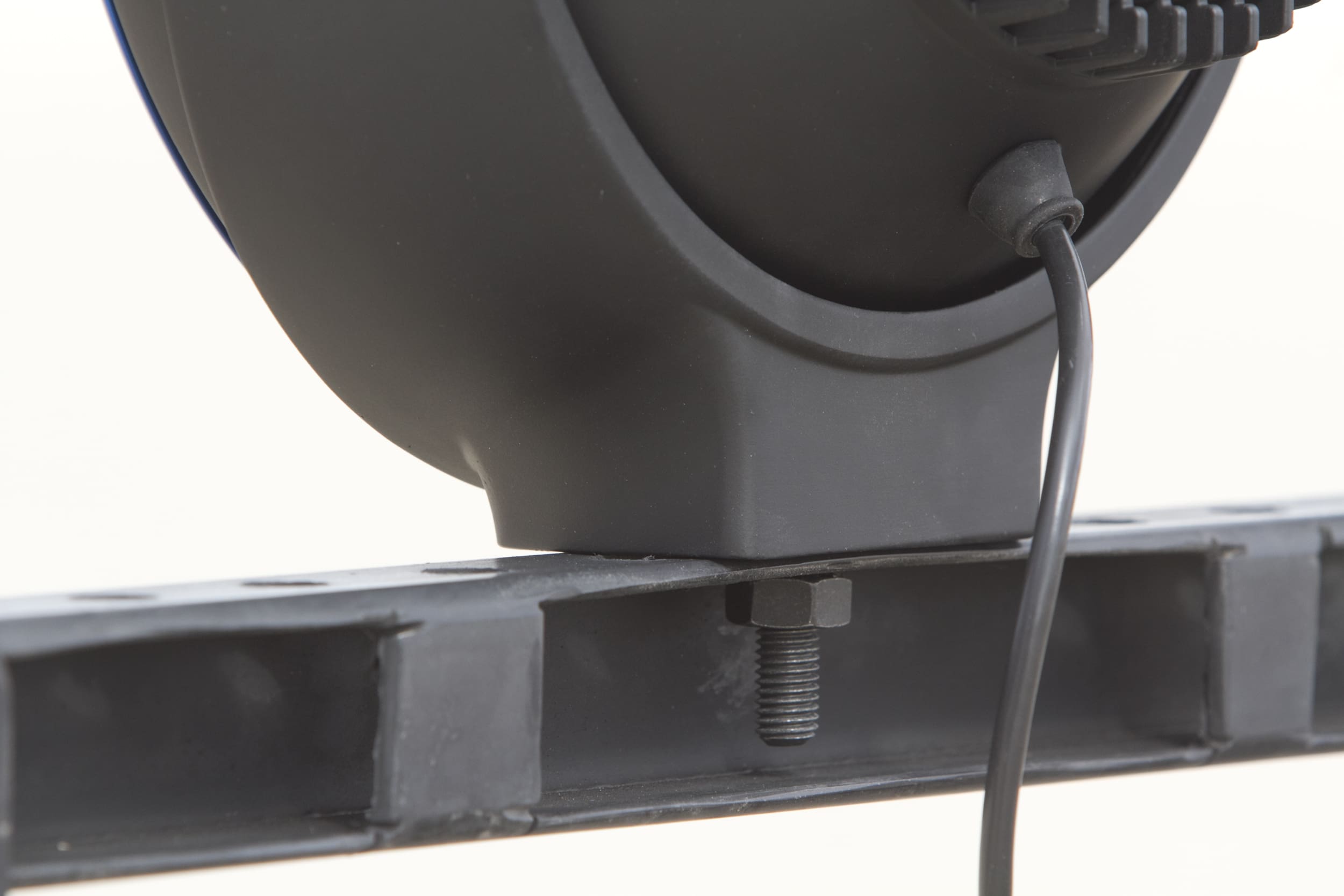
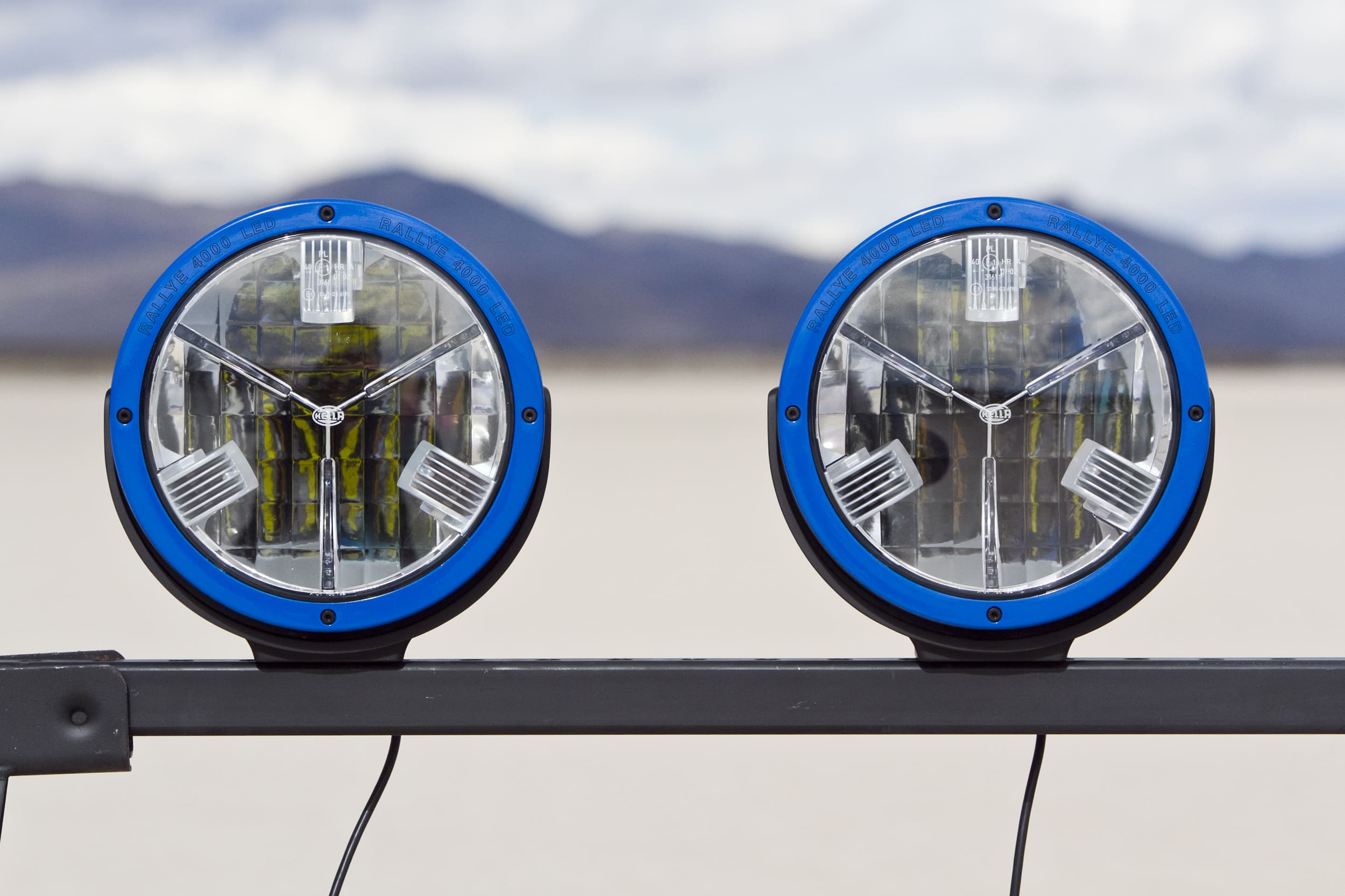
The Hella company, founded in 1899, has more than 100 years of experience providing lighting options for four-wheeled modes of transportation—the first being kerosene lamps for horse-drawn carriages. The Rallye 4000 is a beautifully crafted work of art. Its large half-sphere, die-cast aluminum body is eclipsed by a solidly built aluminum mount; both are powder-coated black. The mounting pad is broad and displayed no vibration when fitted to my bumper, but the style does limit it to horizontal surfaces. The heat sink array of fins on the back seemed rather small considering the size of the light. Units are sold individually, as is the wiring harness.
The reflector is a proprietary Kartoval Optics design, and collimates light from three rear-facing 10-watt LEDs. The lens is made of optics-free polycarbonate. In our desert grid test, the Rallye 4000 provided a flat but solid driving beam in the shape of an elongated rectangle. Its hot spot occupies the center 10 degrees, and a very bright and usable array spreads out 15 degrees to either side. When positioned for road driving, the flat pattern does limit illumination of the first 50 feet of the foreground (where your standard headlights should pick up the slack). Road markers were clearly lit to the 1,000-foot range, the incident meter reading 1.0 lux.
Per the Hella data sheet, the Rallye 4000, at 1,500 lm, should have had the lowest output in the test. However, its 639 lm reading in the integrating sphere put it right in line with all other units, short of the ARB Intensity. With a 30-watt rating and stabilized current draw of 2.13 amps, I would surmise the Kartoval reflector is very efficient. Temperature at 40 minutes was only 108° F, second only to the KC 6-inch round. Color temperature hovered right at 4,623 K, and the CRI came in at 68, mid-range in the group. Internal regulation allows for a voltage input of 9-34V. Hella states the unit is dustproof and waterproof, but it is not rated. I found out by dunking it in the aquarium (without power—the fish were fine) that it will fill with water. After drying out, it was fine and allowed no water ingress while sitting under an overflowing rain gutter for three hours. I would need a Baja silt bed to see how it does with dust. Made in Germany.
Pros:
- Excellent range and broad pattern
- Highly efficient reflector
- Runs cool
Cons:
- Cost
- Size
- Limited foreground illumination
- Not submersible
KC HiLites 6-inch Round
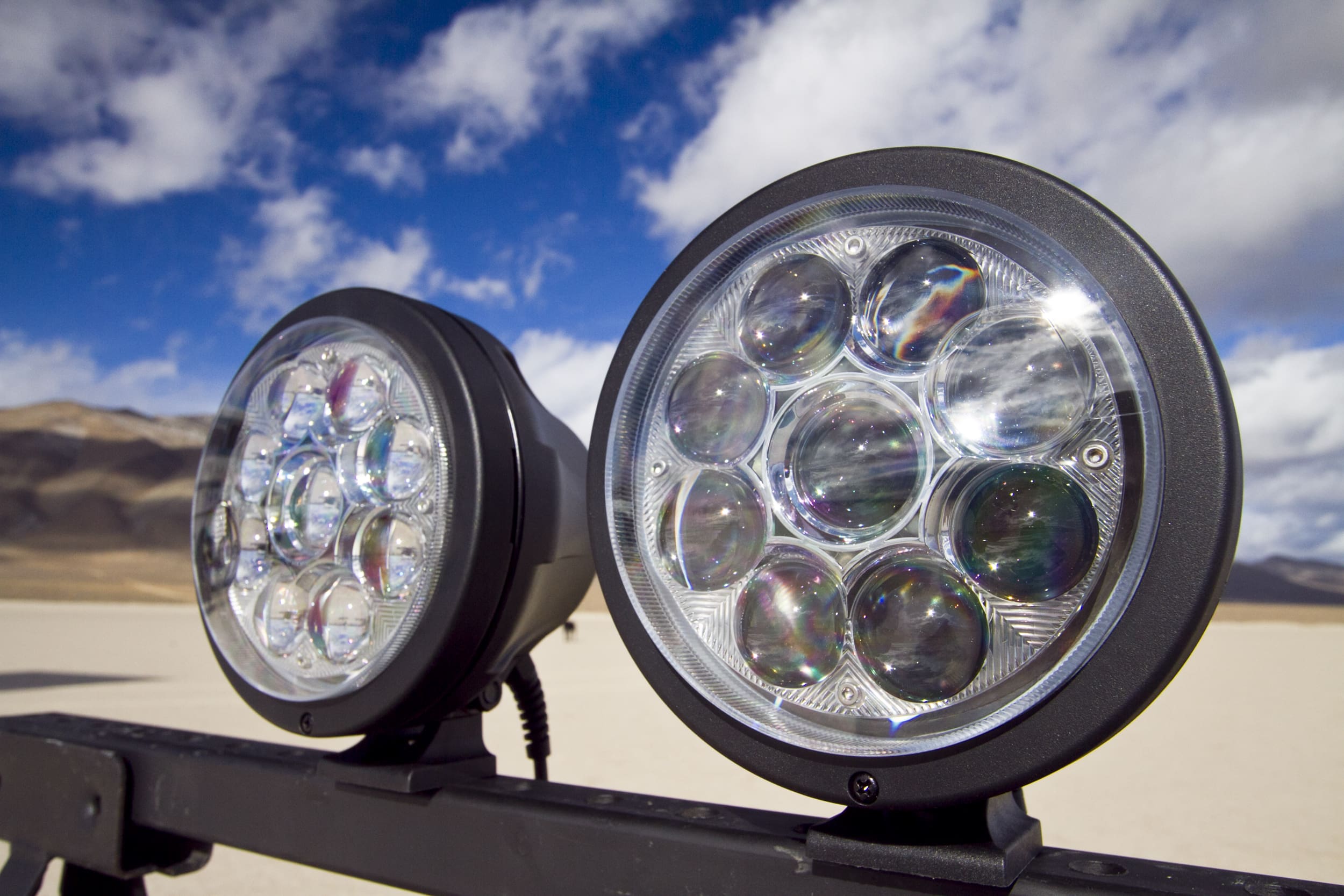
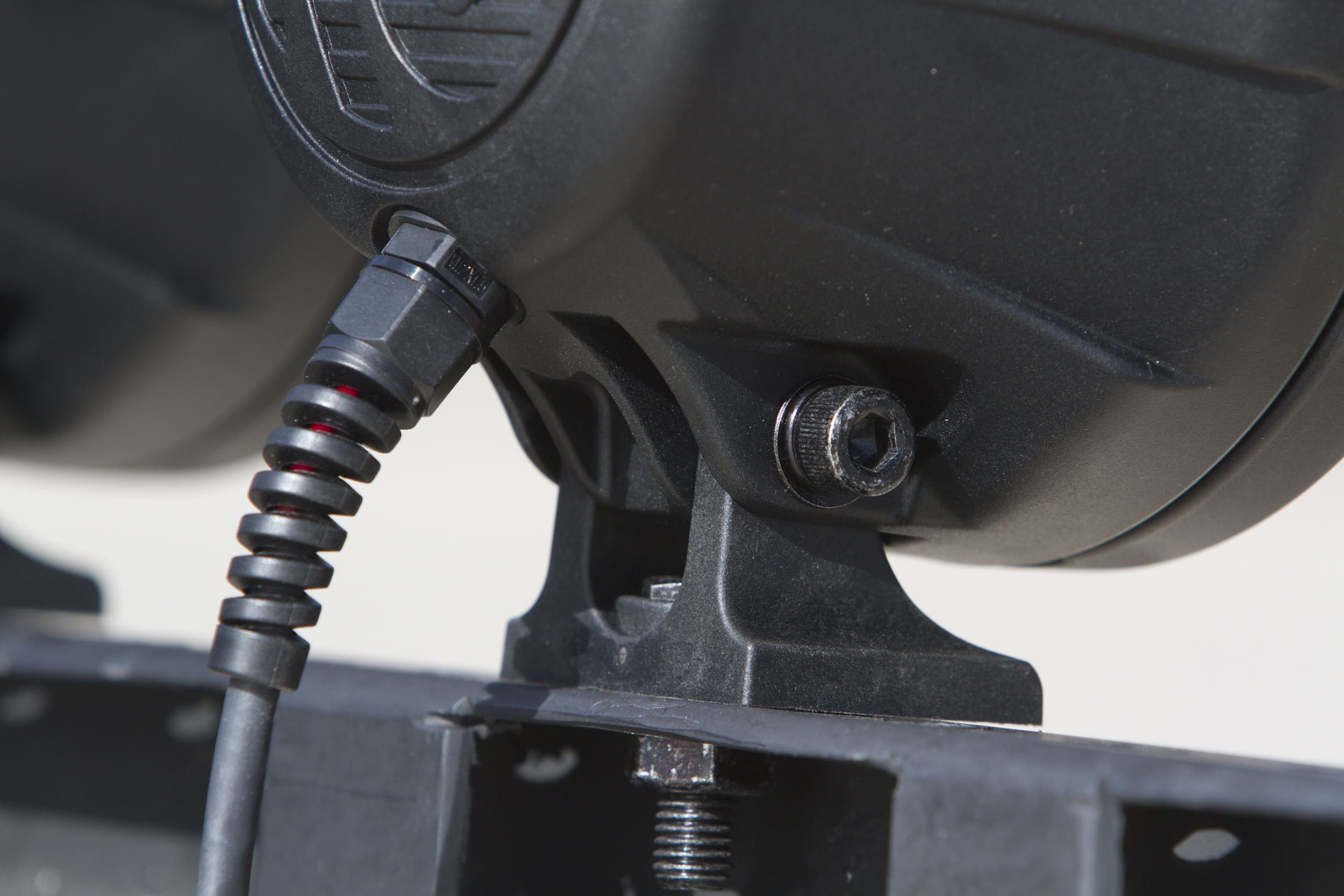
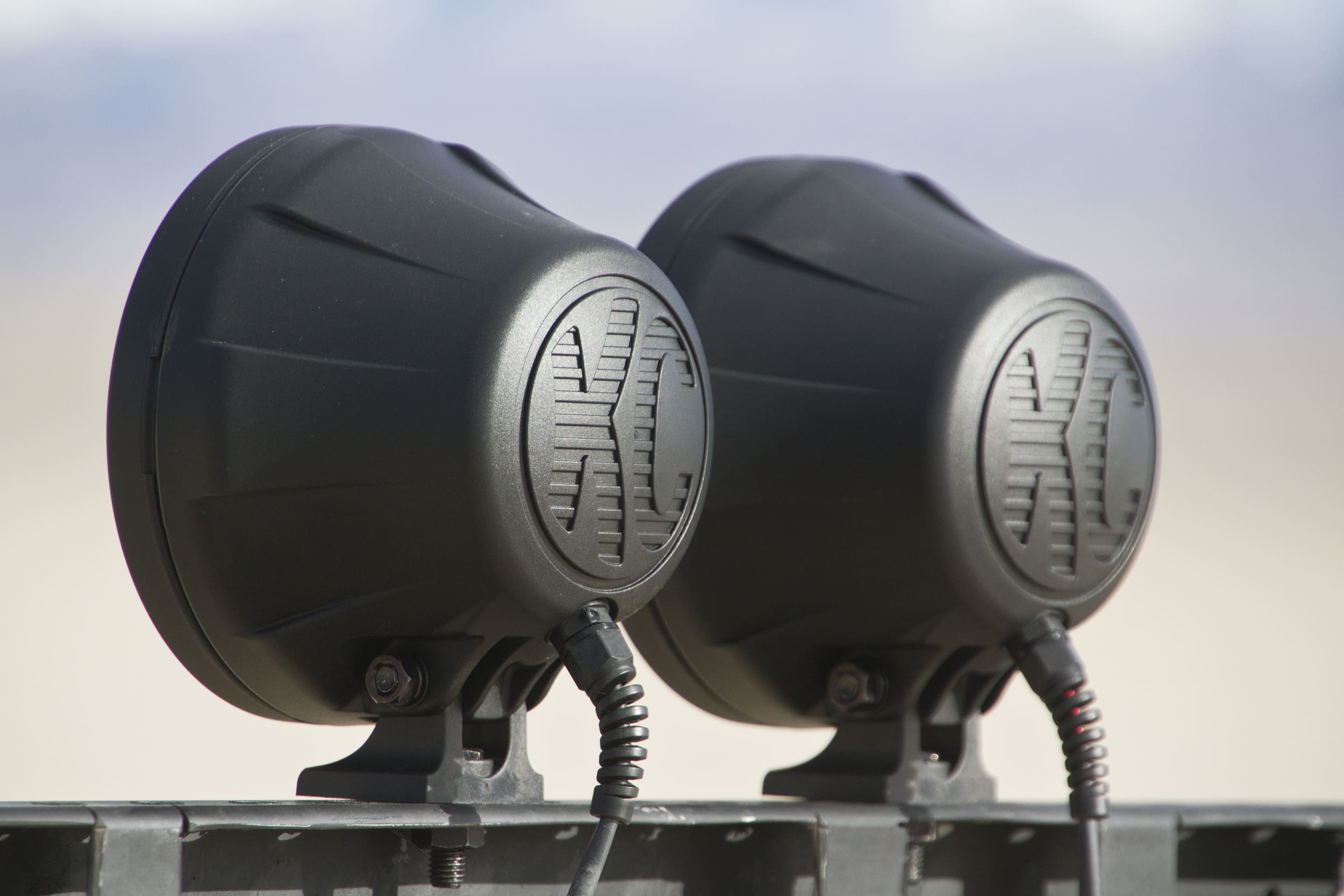
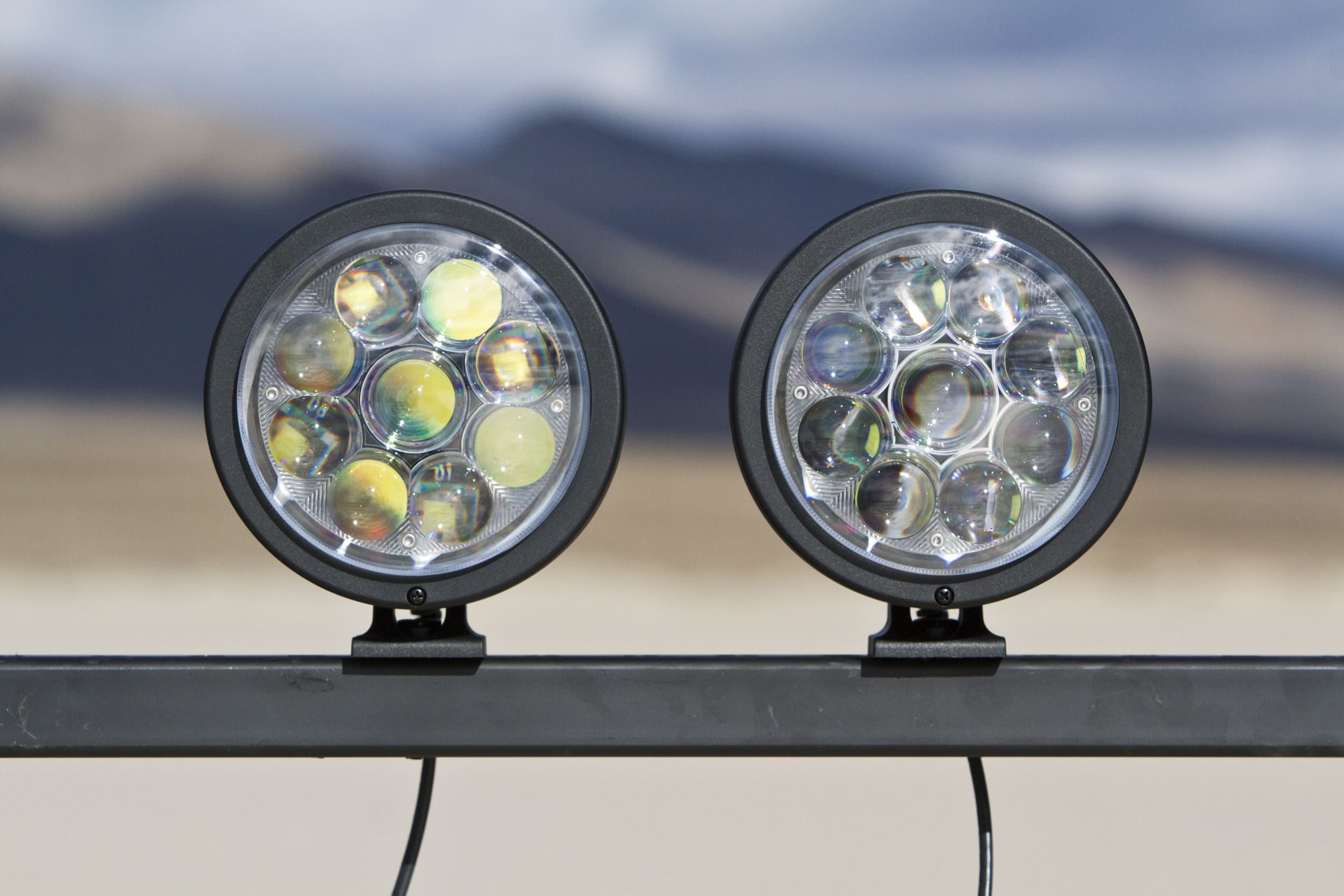
The KC HiLites 6-inch round was one of three pre-production lights we received. Its body is injection-molded acrylic, hailing from a different approach than any others in the test. Interestingly, the heat sink is internal, and there is no apparent ventilation. The lens also varies from the others in that it is not optics free. Of the eight exterior LEDs in the circular pattern, every other one has a magnifying lens over it. Below is a primary lens, again with a clear semi-sphere magnifier. Both are crafted from polycarbonate. The combination gives each LED a fish-eye appearance. The mount is composite, and like its sibling, the LZR 4-inch round, has a hefty .375-inch bolt. Wiring connections are MIL-SPEC, thread-on, and waterproof, though the lights we received still had butt-connector wire leads. It is unknown if a harness will be included at this time.
KC built its reputation on high-intensity long-range racing lights, and the 6-inch round follows suit. Though it lacks peripheral and foreground illumination, its concentrated 10-degree beam will pierce a retina-burning hole through any night sky. The incident meter readings (9.3 lux at 300 feet and 1.0 lux at 1,000 feet) put the KC 6-inch second only to the ARB and even with the Hella. The 30-foot side markers were illuminated, but just on the edge of the primary beam. The 1,000 marker was well lit, but I must admit that after looking at my test photo, I may have had the beam set a little too low on the horizon.
Lab results were interesting. Despite its impressive range and intensity, lumen output was the lowest in the group (530 at startup and dropping to 477 after 40 minutes). I would attribute this to the innovative and efficient dual optical lenses. Current draw for the nine Cree LEDs (rated at 30 watts) was also very low, stabilizing at 1.86 amps. After letting this light run for four hours, I expected the unventilated housing to be hot enough to fry an egg. Surprisingly, it was by far the coolest in the lot, peaking at a scant 98°F. The CRI, 71, matched the ARB light for best in class, and color temperature hovered at 5,294 K. Because it is not yet rated for water or dust ingress, I called KC HiLites President Michael DeHass with regard to the aquarium test. He said, “Shouldn’t be a problem.” It passed with no issues. I like this type of confidence in one’s products. US-designed, made in Taiwan.
Pros:
- Excellent range
- Waterproof
- Lightweight
- Low current draw
- Runs cool
Cons:
- Limited peripheral illumination
- Horizontal mounting only
Truck-Lite 7-inch #81711 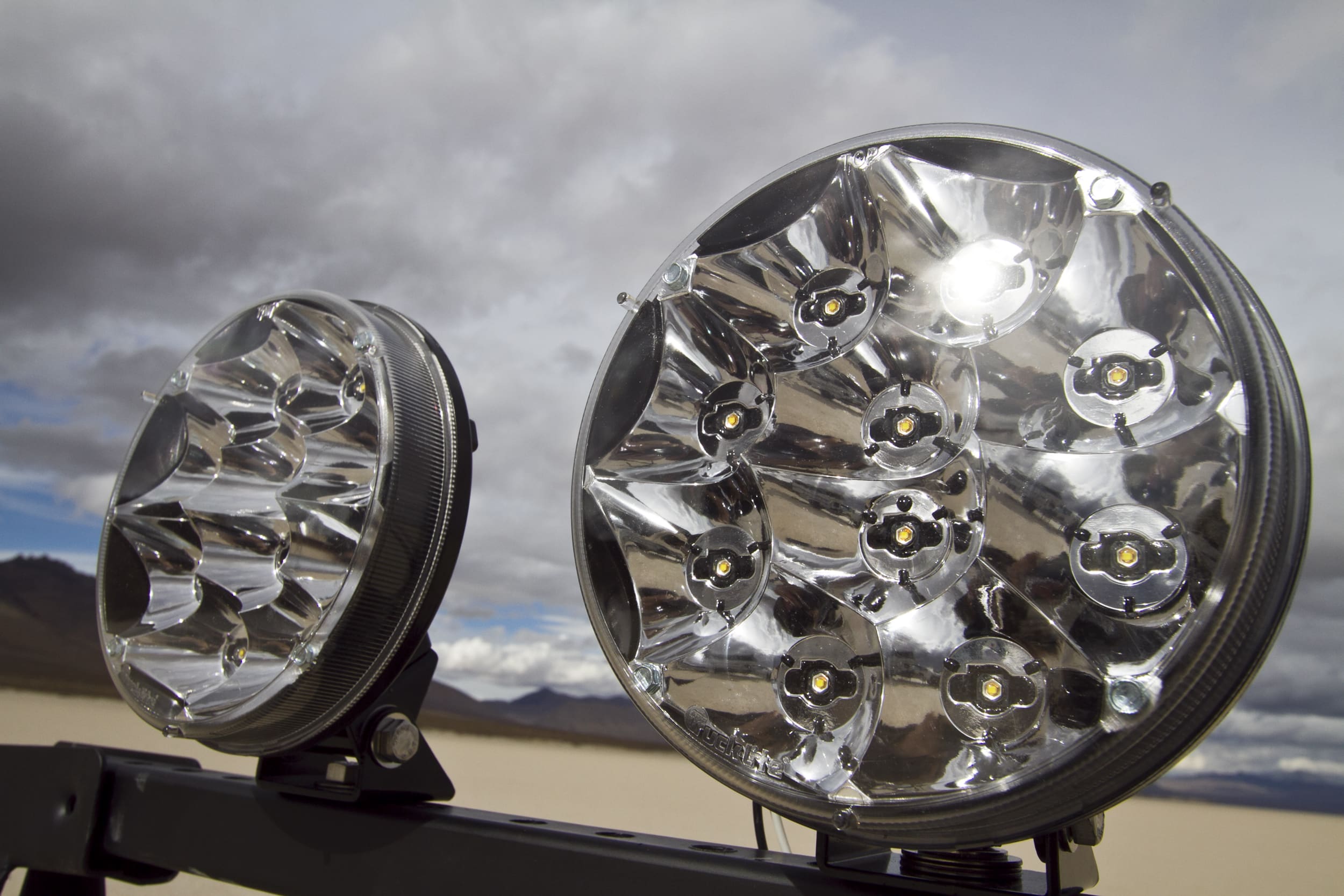
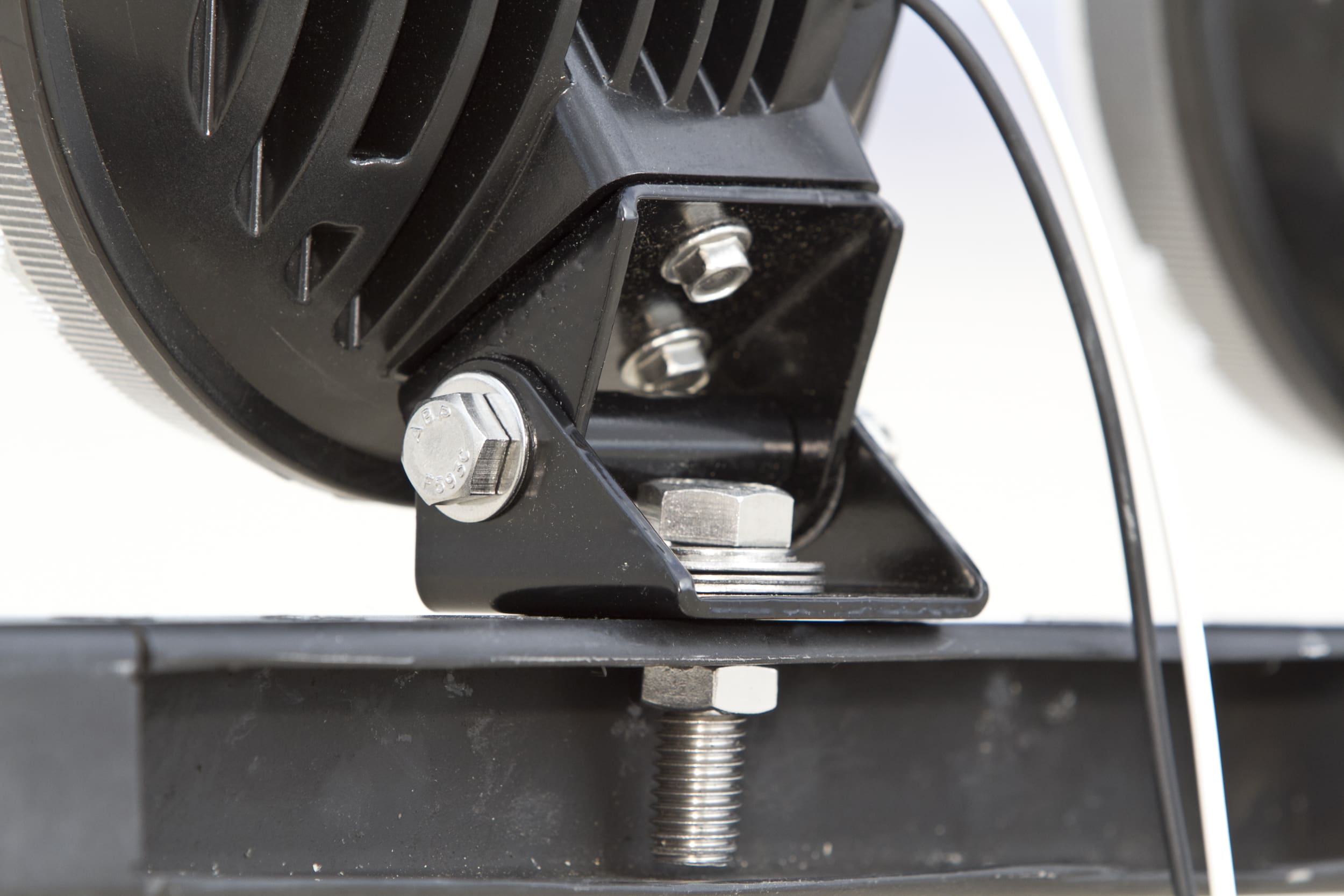
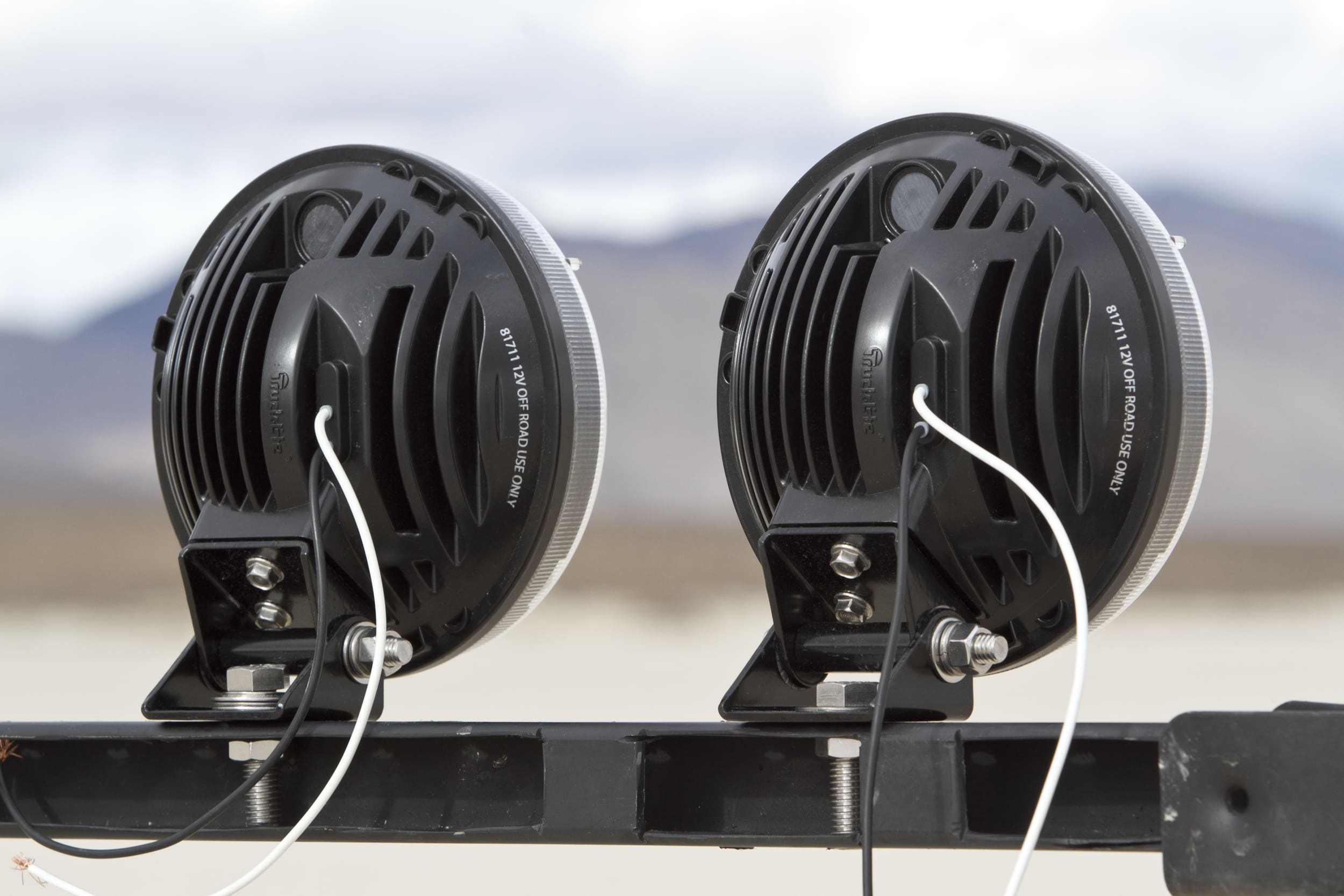
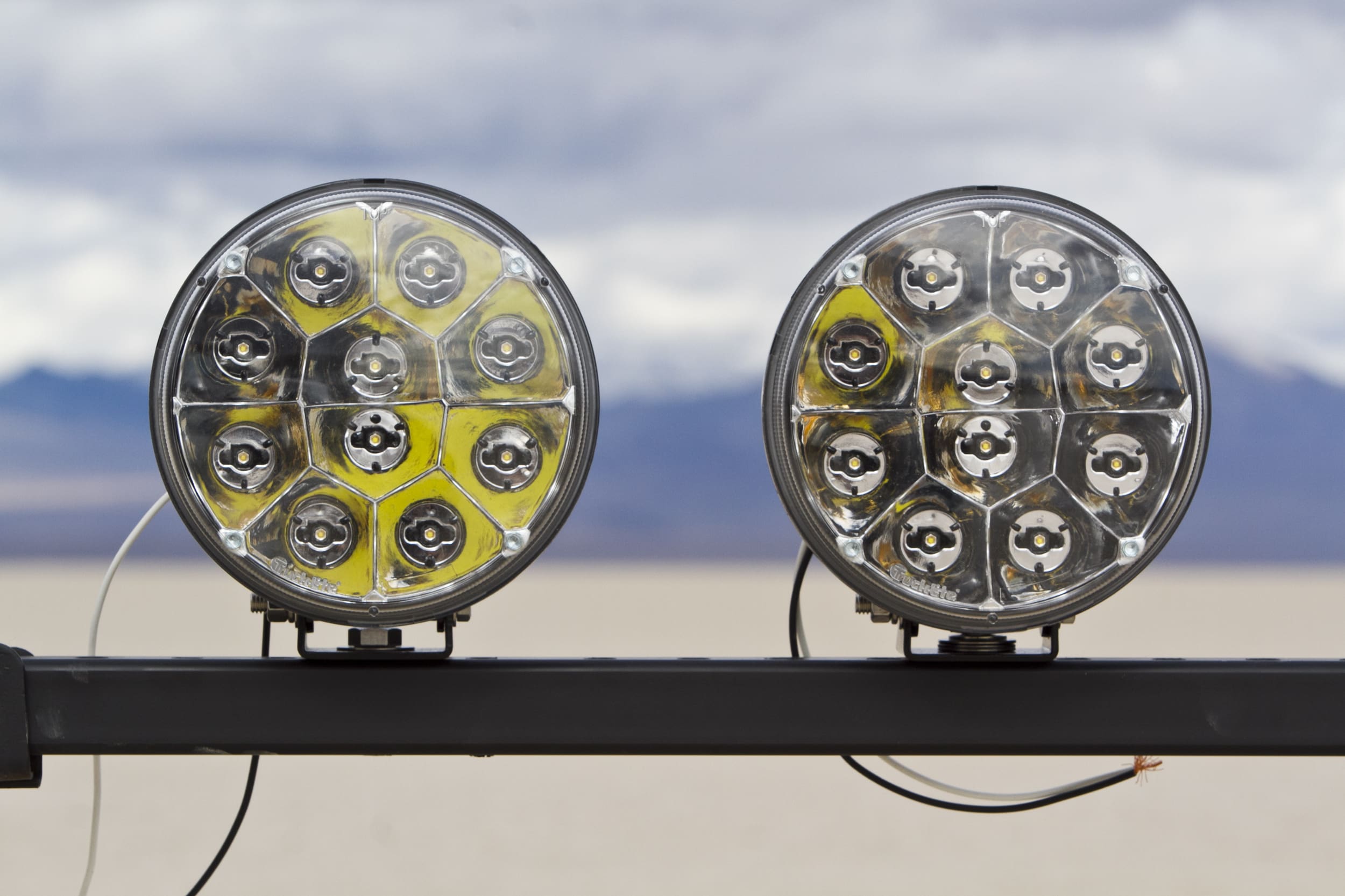
Truck-Lite was born in the 1950s when founder George Baldwin, in need of a more reliable truck light, began tinkering with other companies’ products. The rather generically named #81711, a 7-inch round, is their offering in the high-output LED market. As with the other lights in this review, it has an aircraft-grade die-cast aluminum housing, anodized rather than powder-coated, and a polycarbonate lens. It can be installed on a horizontal or vertical surface via a pressed-steel mount. Wiring is simple loose leads that are sealed at the housing. Units are sold individually, and the harness is optional.
The proprietary hybrid reflector has a wide flat base and a wide girth for each of its 10 LEDs. Out on the playa, the #81711 projected a tightly concentrated round pattern with limited foreground or peripheral coverage; both compare with KC’s 6-inch round. With 2.7 and .7 lux recorded at the 500- and 1,000-foot markers, beam reach is good. The Cartesian grid confirmed field results; the beam being limited to the 10 degrees on the x- and y-axis. With multiple LEDs to work with, I feel this light could benefit from modifying a few of the reflectors to project a wider pattern.
An output rating was not available for this light, but integrating sphere testing rendered a 642 lm reading. Color temperature came in at 4,535 K, and the CRI was 67. Each of these findings landed right in the middle of our LED pack. It is internally regulated for an input of 9-33V. Amperage draw at the end of 40 minutes was 3.63 amps. From a thermal management standpoint, the #81711 stabilized at 166°F, hottest in the group by almost 30°. The stated operating range is -58 to 166°F ambient temperature, and this could be an issue if traversing a Kalahari two-track where nights can hover in the low 90s. Its thermal management system would protect components, but your lighting might be compromised. During its visit with my fish, the #81711 seemed to do fine. It was during the lab testing that I noticed moisture inside the lens. I was told this light was IP67 rated (1 meter for 30 minutes), but I would say it is water-resistant rather than waterproof.
Pros:
- Good beam reach
- Solid construction
Cons:
- Lacks foreground coverage
- Not waterproof
- High running temperature
PIAA LP570 LED | Value Award & Editor’s Choice
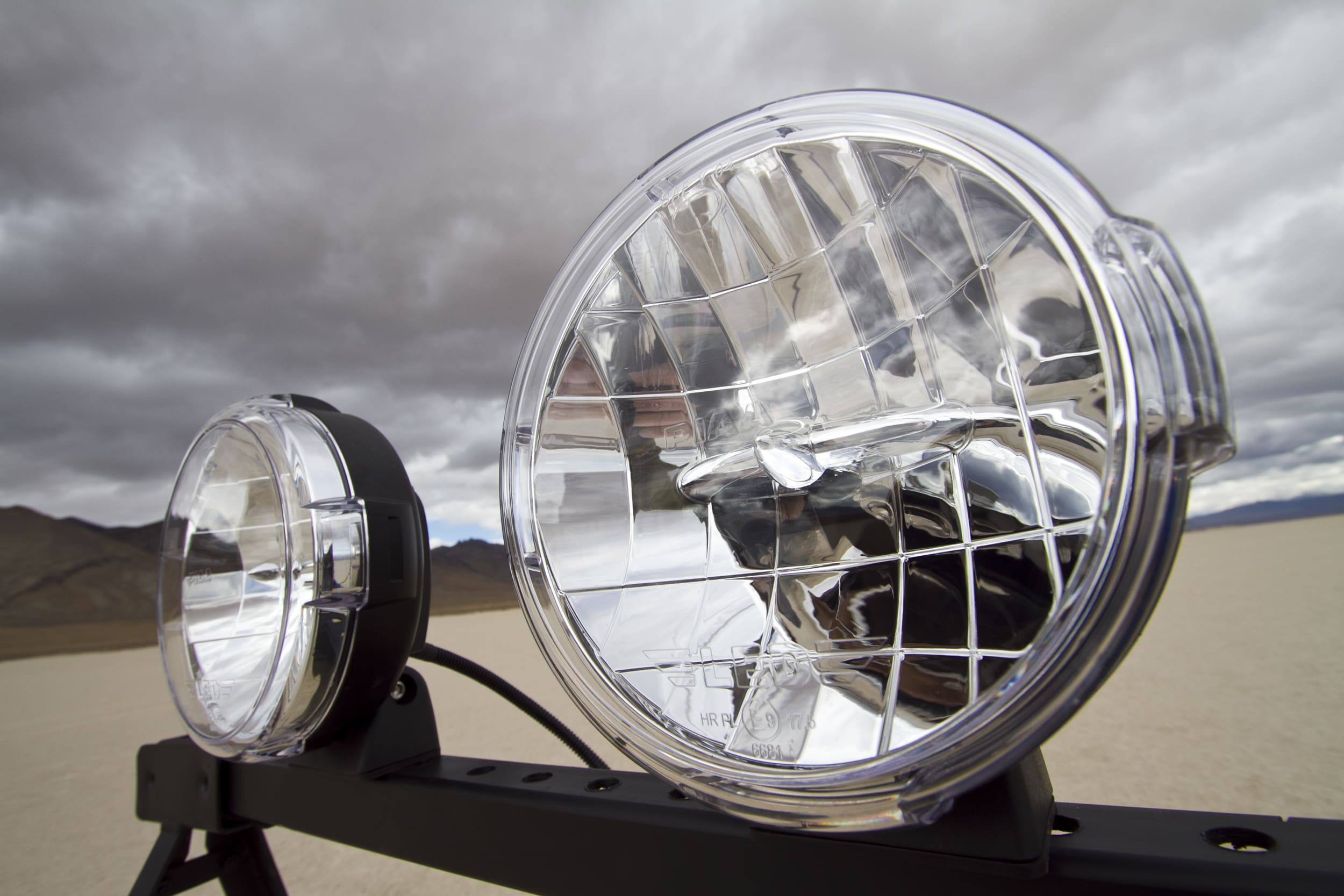
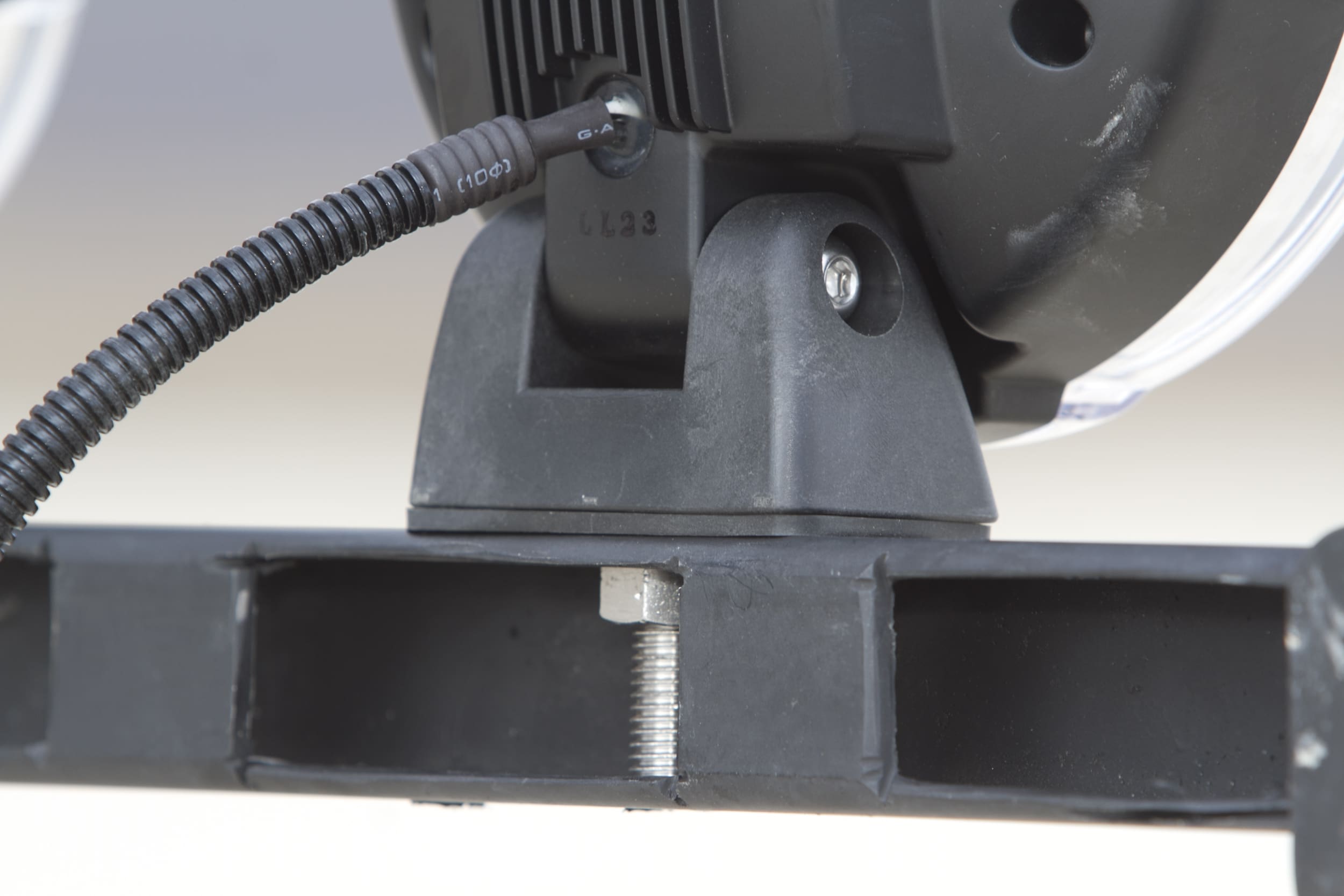
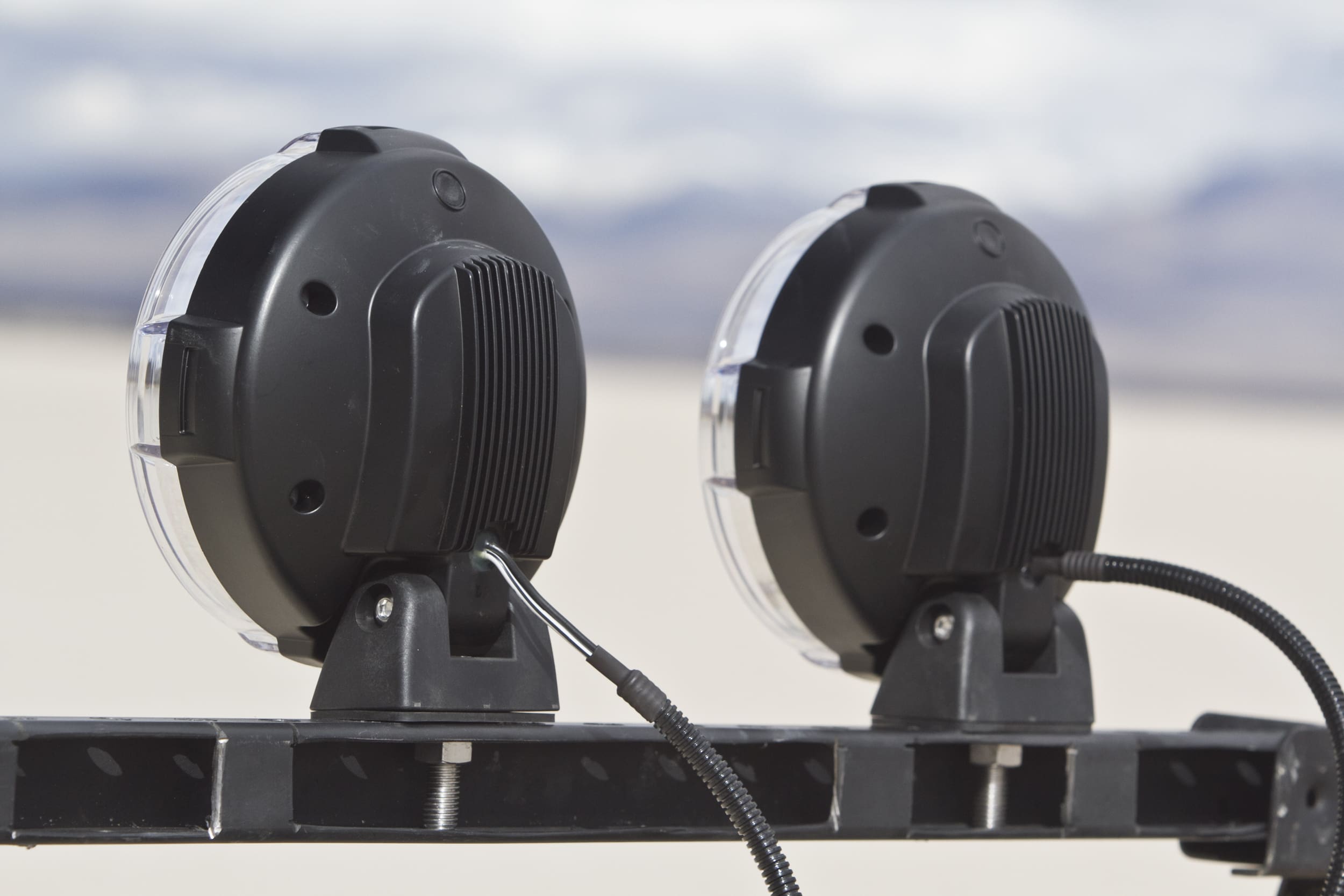
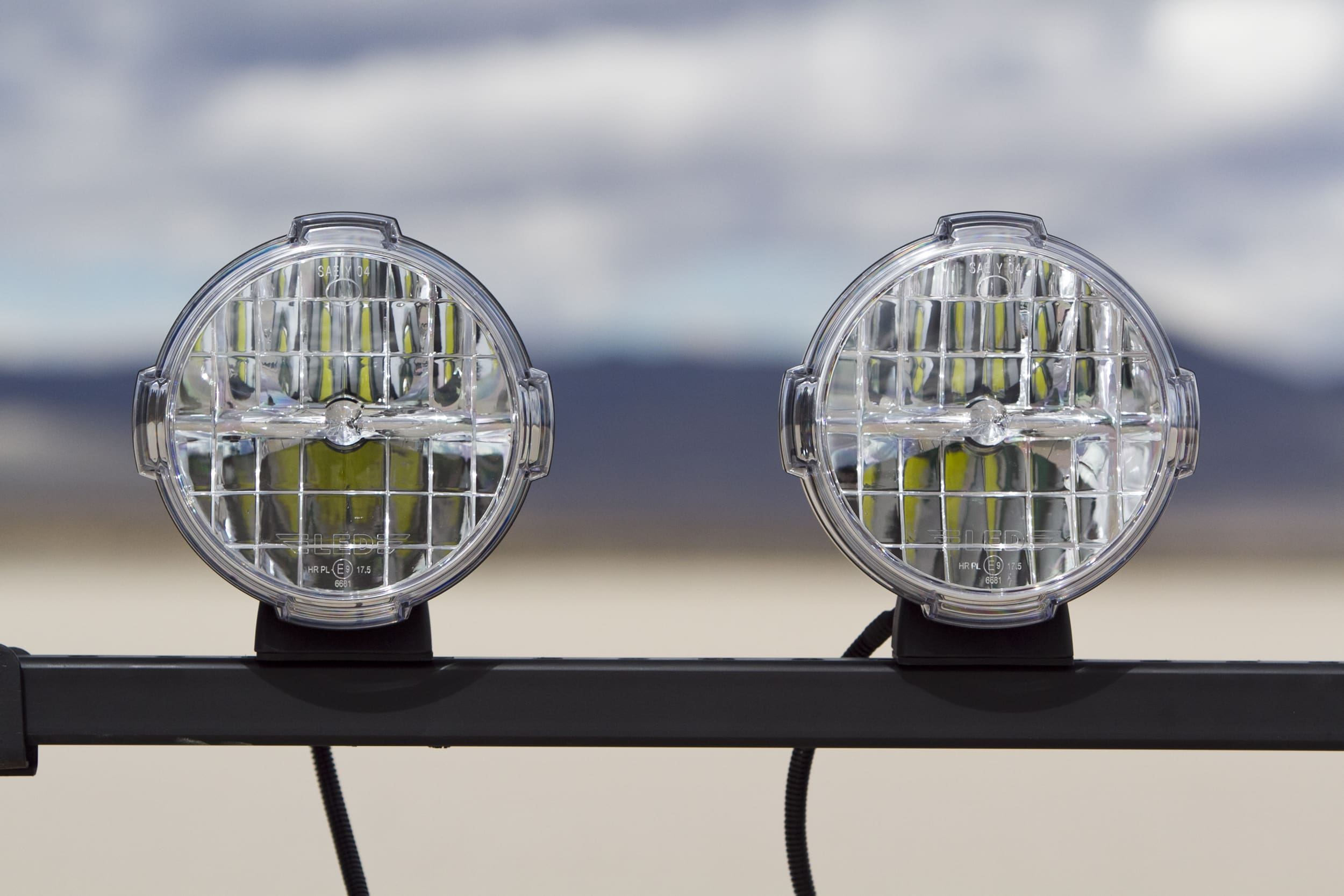
I received the PIAA LP570 earlier in the year as a review unit and have had the most hands-on time with this light. It is one of two lights in the test with rear-facing LEDs. There are two, rated at 5 watts, columnized by a full-width, half-sphere reflector with a Cartesian-style grid molded in. A horizontal arched bar holds the LEDs. The outer lens is optics-free polycarbonate that seems to be press-fitted to an aircraft-grade cast-aluminum housing. It has a wide composite base with a vibration-dampening rubber pad. Hardware is a hefty .465-inch stainless steel bolt. For forward projection, it must be mounted on a horizontal surface.
The LP570 offers a very efficient combination of reach and pattern. Our whiteboard test rendered a 35-degree spread (y-axis) with a 10-degree sweet spot in the center. There is some diffusion in the immediate foreground, but the useful beam hits the ground at about 40 feet. The wide pattern had no issues lighting our 30-foot road markers at 700 feet distance. Incident meter readings were a respectable 2.5 lux at 500 feet, tapering off to .70 at 1,000 feet. There is, however, a slight shadowed band across the center of the horizontal plane, possibly due to the center bar that holds the LEDs. It does not detract from visibility, but it should be known.
In my “News from the Trade” introduction (Winter 2012), I mistakenly stated output at an unfathomable 75,000 lm. PIAA rates this light at 75,000 cd, a term that is basically antiquated. Under the eye of the integrating sphere, actual output ranged from 688 lm at startup to 626 lm after the 40-minute stabilization period. Surface temperature of the heat sink, at 123°F, was low, second only to the KC 6-inch round, and current draw was a reasonable 1.83 amps. Though color temperature was 5,681 K, this light retains some of the typical blues known to LED driving lights. CRI, a measure of average wavelength in the visible spectrum, came in at 66, the lowest of the lights tested. This light is IP67 rated for water and dust ingress and passed the 30-minute dunk test with no issues. Made in Taiwan.
Pros:
- Good beam reach and wide beam pattern
- Cool operating temps
- Low current draw
- Price
- Submersion proof
Cons:
- Horizontal mount only
- Low CRI
- Slight shadow in beam pattern
Conclusions
Compact Lights
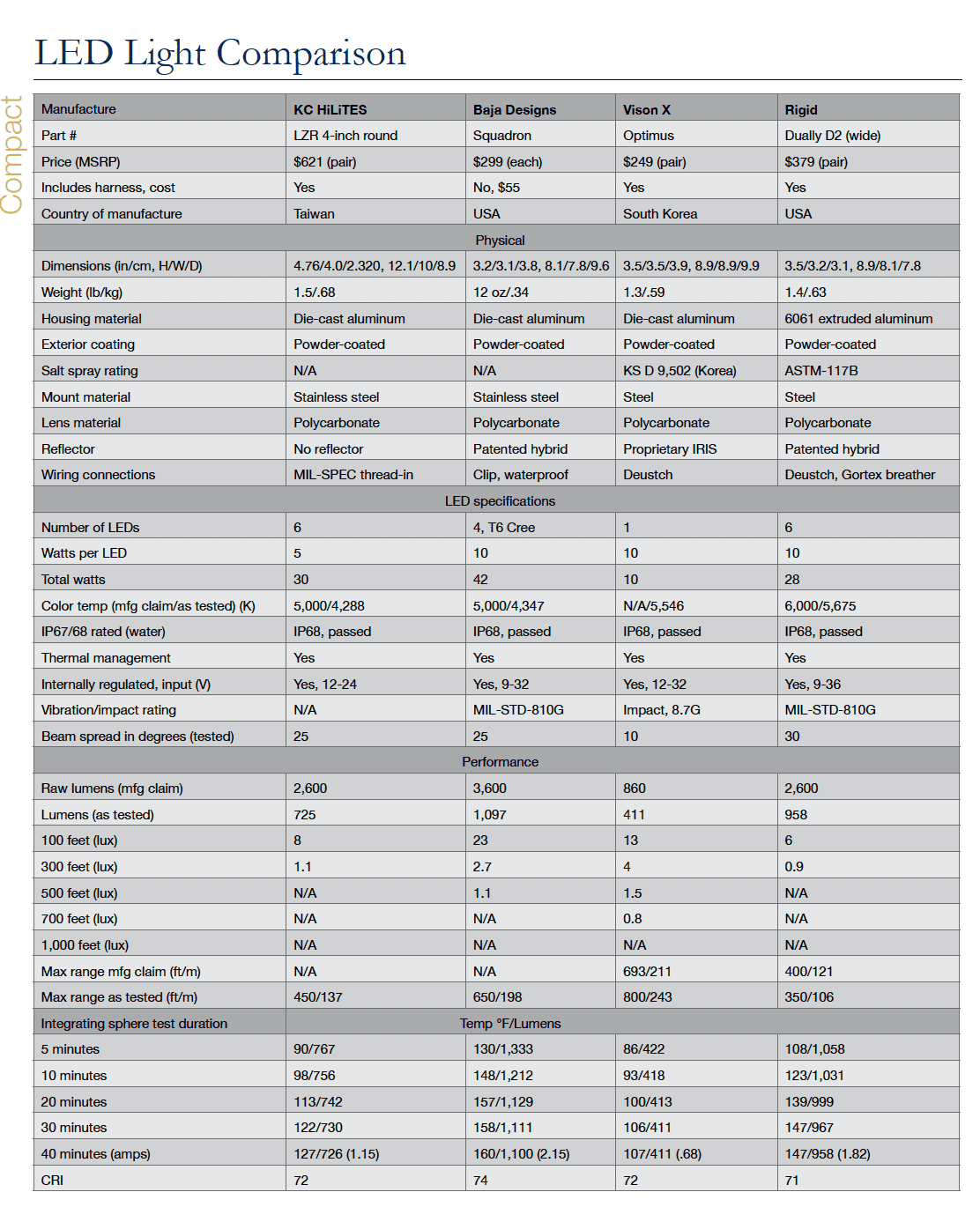
Rigid’s Dually D2 did well in the lab and field testing, providing even distribution of light and solid figures from the integrating sphere. Unfortunately, the unit we received was a wide-pattern model rather than their long-range driving light. Because we had no time for sourcing another unit prior to departing for our desert testing, we put the Dually into the mix with the others. That being said, it did come up short with regard to beam range but would make a solid choice if mounting a combination of lights.
The Vision X Optimus did nothing less than impress me. The optical management of a single 10-watt bulb is phenomenal. With the lowest lumen output in the batch, it still outpaced all others in its class with regard to range. Though it could definitely use additional peripheral illumination, the combination of field and lab performance, along with its featherweight price, places the Optimus at the top of the Value Award category.
The Baja Designs Squadron and KC HiLites LZR 4-inch round were neck and neck on most factors. With good range and broad foreground illumination, reasonable power consumption and running temperatures, I think both would make excellent options for a compact light designed for slow- to medium-speed driving. With the slightly longer reach, higher lumen output, and CRI number, I’m giving the Editor’s Choice nod to Baja Designs’ Squadron.
Large Round
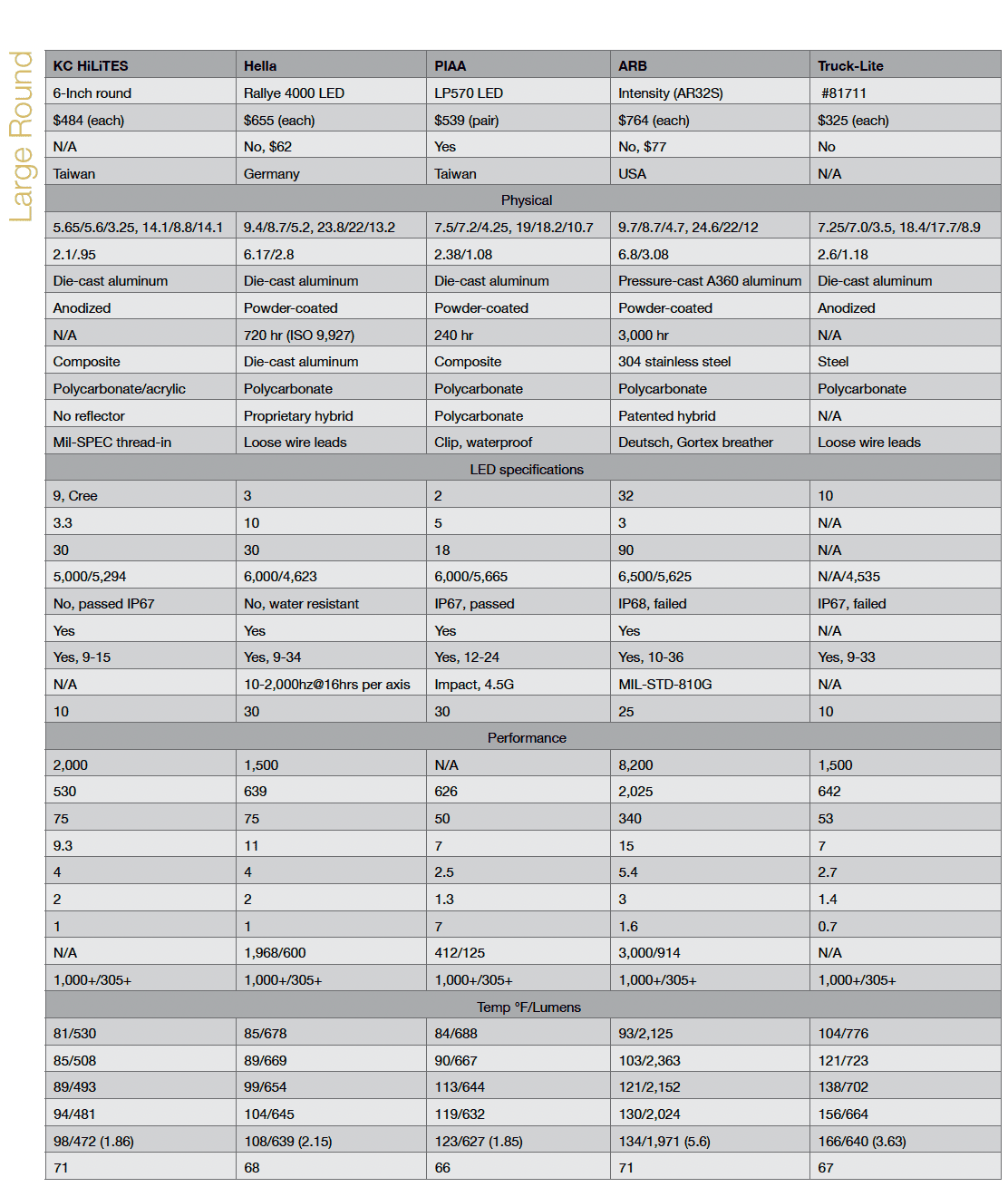
The KC-HiLites 6-inch round calls to the racer in me. Though I love to meander along the lonely desert two-track smelling the agave, I do have my Robbie Gordon moments. This light has a powerful, centrally focused beam and excellent reach—it easily casts shadows on our 1,000-foot marker. The magnifying optics reminded me of early LED calculators from the ’70s. However, I feel that it could benefit from collimating one or two LEDs into a slightly wider pattern, thus increasing illumination at the margins. Standard headlights will take up the foreground slack, and mounting a compact wide-angle unit such as the Rigid Dually D2 (wide) would provide full coverage.
Based on overall performance, excellent attention to detail, and quality of construction, the ARB Intensity could have easily taken the Editor’s Choice award. I’ve deliberated over how far under the bus I should throw it for the water ingress issue; in my opinion, water in your lights is a big deal. Ours were pre-production units; the company is aware of this issue and will be resolving it prior to a public offering. It would be easy to overlook this infraction. However, the Editor’s Choice and Value Award must be based on the products we have in hand, what we tested.
We have Truck-Lite LED driving lights on the Overland Journal Jeep J8 that I’ve been driving. They work well, and the #81711 falls in line with regard to performance. Like the KC 6-inch, this light provides a concentrated round beam but limited peripheral coverage. Though heat sink fins seem to provide good coverage, higher-than-average current draw sent temperatures to 160°F. Though within the operating range, further testing on a 90°F Arizona night might be in order. Where the light failed was in the submersion test. Stormy weather would probably be okay, but I would use caution with subjecting this light to submersion, as it did collect moisture inside.
The Hella Rallye 4000 LED is the type of light I’d expect to see atop a European rally car. It’s large and intimidating, and emits an impressive amount of light. In our field work and lab testing, it had excellent reach, low current draw and running temperatures, and good peripheral illumination. Though its size may limit mounting options, and it was one of the most costly lights in the test, this is a very nice light. Though they are weather resistant, my reservation falls in the fact that they cannot be submerged. If you’ll NEVER subject your lights to submersion (rack mount), the Rallye 4000 would work very well as an overland choice.
The PIAA LP570 LED was a strong performer, almost keeping pace with the larger and more expensive units in the test. It offered a nice wide beam pattern and good reach in our field work. In lab testing, including current draw, luminous output, and running temperatures, the 570 owed no apologies. It is a little lighter in construction, but after a few months on the bumper of my Tacoma, I noticed no vibration or negative impressions. Considering its performance in the field and lab, along with the reasonable price of $539 for the pair (including wiring harness), it is well deserving of both the Editor’s Choice and our Value Award.
Our No Compromise Clause: We do not accept advertorial content or allow advertising to influence our coverage, and our contributors are guaranteed editorial independence. Overland Collective may earn a small commission from affiliate links included in this article. We appreciate your support.
