

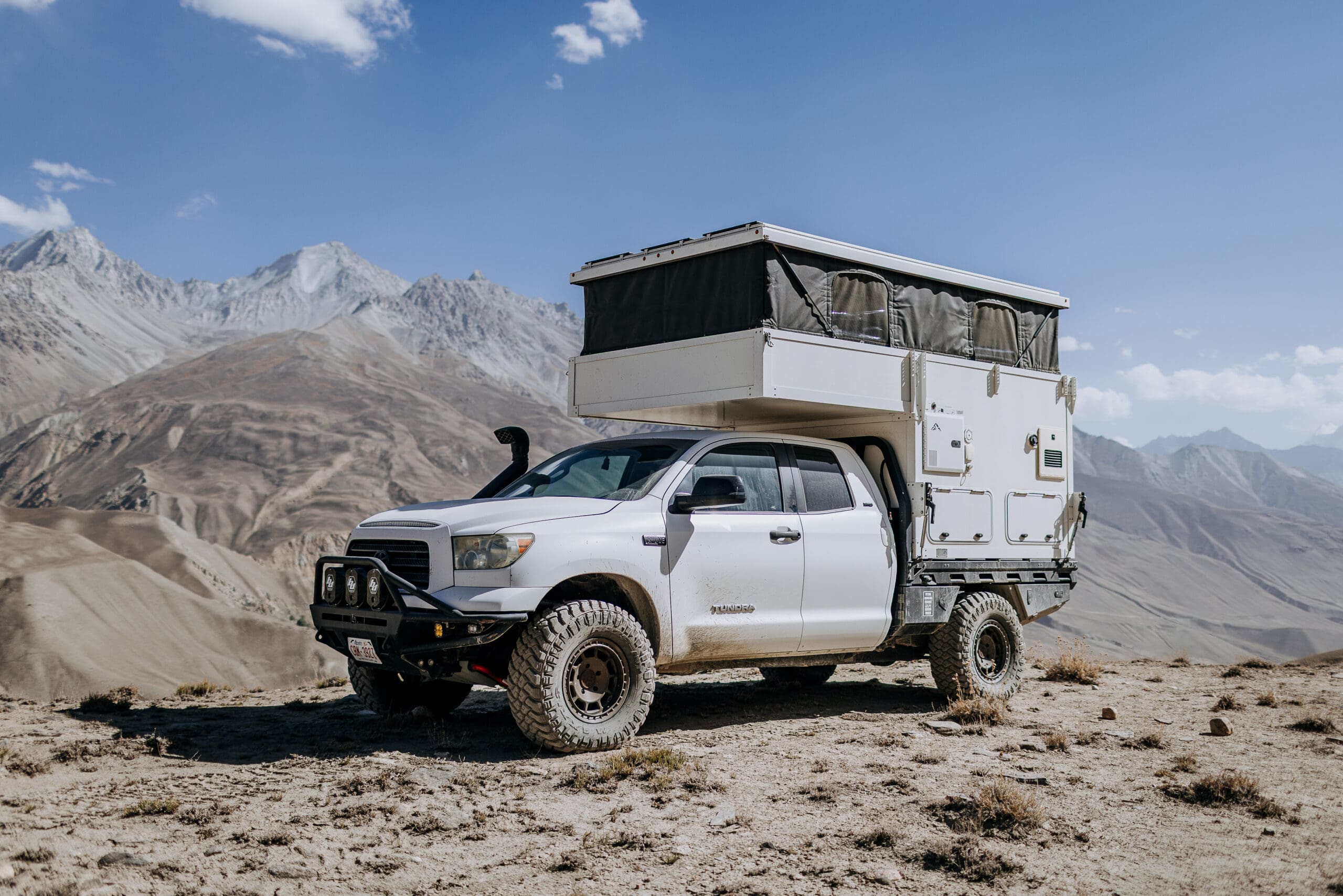
Our 1990 Toyota Pickup, affectionately named “Little Red,” has been our go-to adventuremobile since 2013. It has seen a couple of continents and a few revisions along the way, but it remains an antiquated, underpowered, 36-year-old minitruck. It does a wonderful job of scoot-ing through moderately sized whoops, narrow trails, and soft sand while the Go Fast Camper V1 wedge camper keeps the truck light with a taste of inside living space. However, over the past decade, our lifestyle on the road has changed. Now we work remotely (requiring a proper workspace), and we don’t always have the option to chase summer (meaning that a four-season camper would be a huge benefit). The decision to step out of Little Red and into something else was difficult enough, but the real question was, What would we choose next?
We wanted a truck and flatbed camper to shelter us in comfort from wind, rain, and sub-zero temperatures while providing some semblance of off-pavement prowess when the road turned to dirt. Since these travels would be outside North America, vehicle parts availability overseas was key.
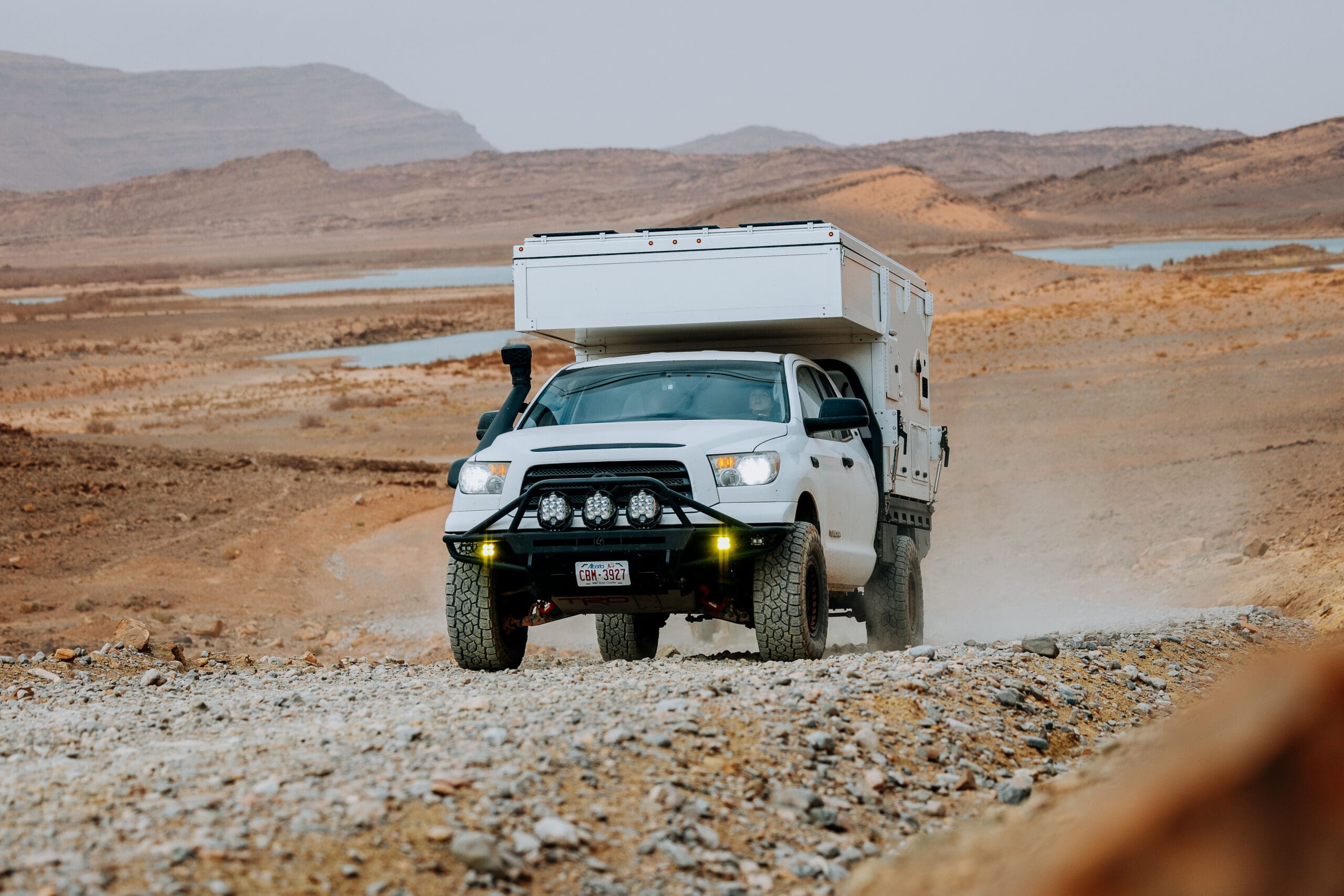
We decided to go with the truck that was already parked in our driveway—our 2008 Toyota Tundra with only 191,350 kilometers on the clock. We initially thought it was too large for international travel, but research revealed that the Tundra is about the same width as a Sprinter 144. On a trip through Saudi Arabia, we saw Tundras and Sequoias everywhere. I checked the Instagram feeds of off-road shops in Kazakhstan and saw a few Tundras kicking around. This was enough proof that parts availability shouldn’t be a problem, depending, of course, on where we end up. Worst case scenario: we could order parts online via Part Souq and have DHL deliver to us. Spoiler alert: this is a viable option.
Once convinced our well-maintained, paid-for Tundra could work, the rest of the benefits fell into place. Plus, the Tundra shares a plethora of parts with the internationally sold 200-Series Land Cruiser. This was proven when a front wheel bearing failed in southern Morocco, and we were able to scavenge one off a low-mileage 200 Series. Genius. Although the payload isn’t substantial, we felt we could make it work for us as long as we selected a camper and other components that are light and necessary.
We started this process by removing the rear seat, saving 86 pounds, then installing an Antigravity 60-amp-hour lithium starting battery, cutting an additional 55 pounds off the stock truck. Our choice to limit weight by omitting a winch kept 75 pounds off the front of the truck, and after nearly three years, our MaxTrax Minis have been enough to get us out of any sticky situations. The bare necessities of camping gear we brought were light, compact, and lifted straight out of our little 1990 Pickup.
Suspension
Although factory springs and shocks will likely result in a more comfortable ride and last longer than aftermarket components on a stock vehicle, they were not designed to manage the weight of a vehicle approaching its gross vehicle weight rating (GVWR) for extended periods.
ARB designed and built the BP-51 from the ground up as a performance shock for overland use. That means it will work well on and off the pavement while withstanding the rigors of long-term, long-distance travel. As I write this, we’ve put over 55,000 kilometers on this set and have been happy with the compromise they offer. They perform somewhere between a basic Nitrocharger and a Fox 2.5, but most importantly, require very little maintenance. These BP-51 shocks allow for rebound control to match the payload and spring rate. All of our shocks have rebound set to max, whereas the compression is currently set halfway for the front and about 8 out of 10 on the rear.
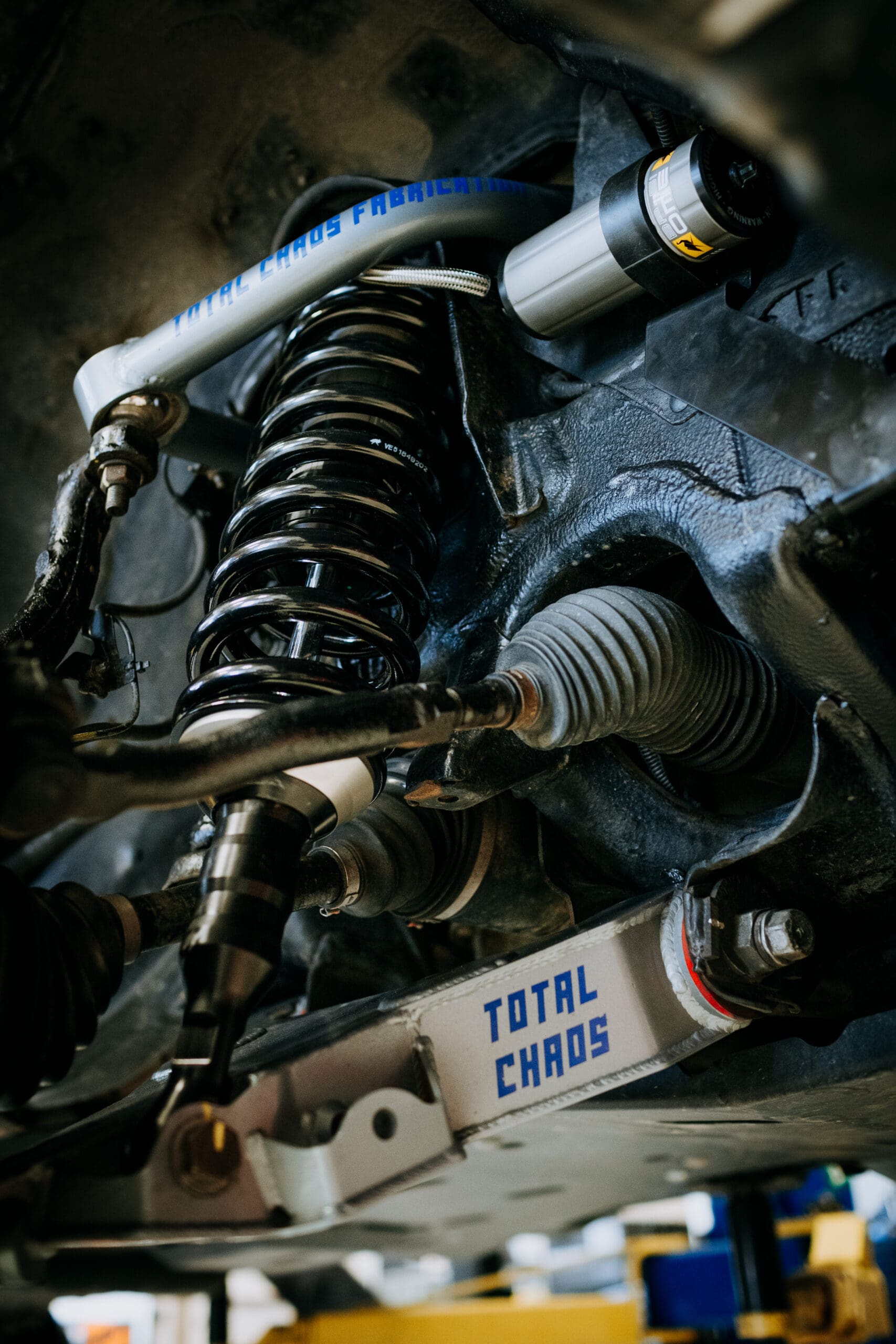
The Total Chaos Fabrication upper and lower control arms provide greater wheel travel than stock, but do require occasional greasing of the polyurethane bushings. The control-arm stability bestowed by those bushings is welcome when driving a large truck at speed. A pair of uniballs and a removal tool remain in the truck in case a swap-out is needed. A set of Timbren front bump stops and a TRD sway bar round out the front suspension modifications.
We called Scott Born at Deaver Spring Inc and gave him the rundown of our plans and an estimated total weight of the Tundra. He selected a U748LXHD spring for us based on our assumed maximum of 1,500- 1,600 pounds of constant payload. To complement the Deavers, we installed Timbren SES bump stops with an Archive Garage Stealth HD U-bolt flip kit. A rear Hellwig sway bar helps control body roll.
Read more: OME BP-51 Suspension Introduction, Rear Suspension, Gears, and ARB Air Locker
Wheels and Tires
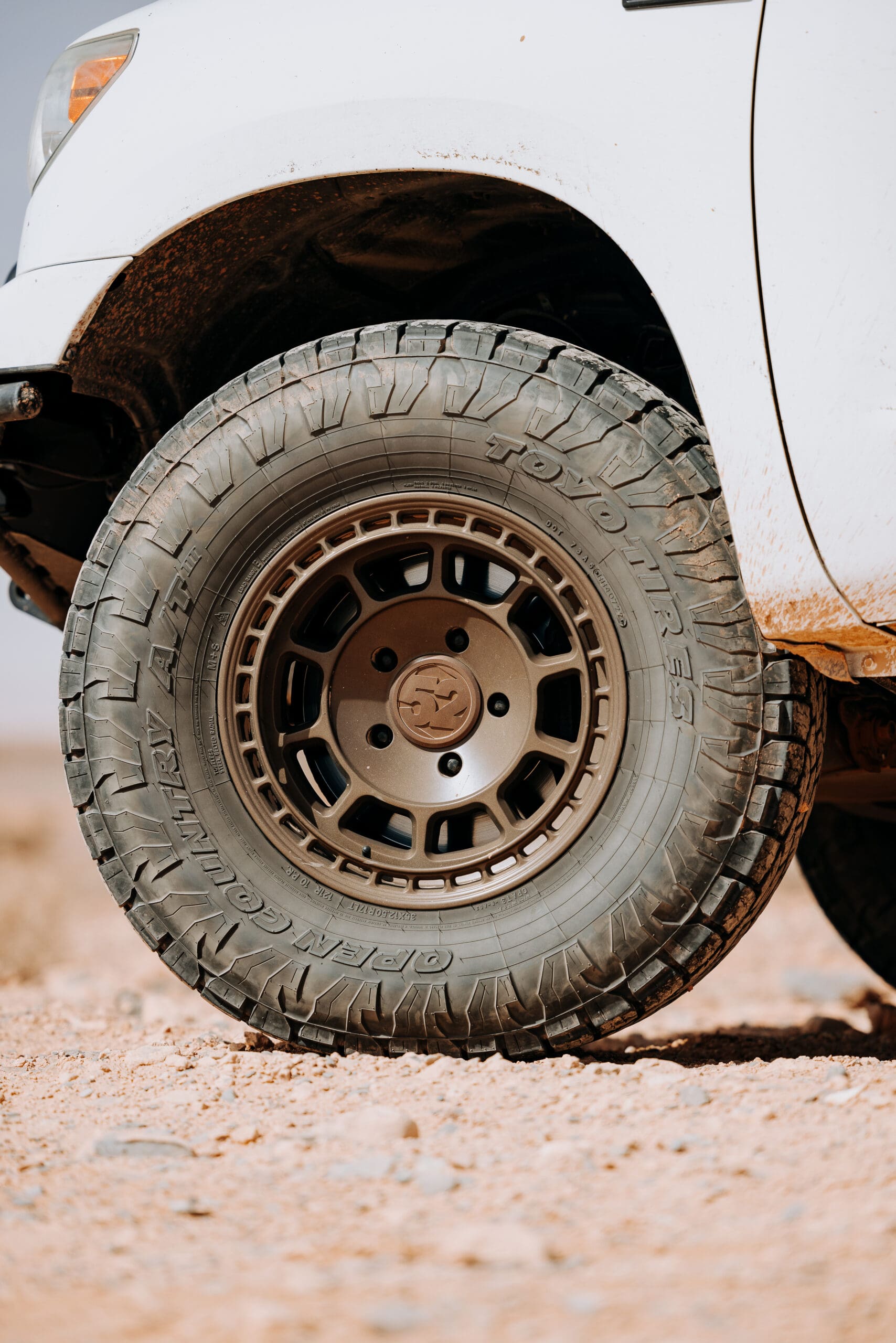
We chose a 35×12.50R17 Load E tire because it’s fairly easy to find worldwide and also fits in the factory spare tire location. We moved from a Toyo Tires Open Country M/T to an A/T III to reduce weight (saving 18 pounds per corner), and an all-terrain with a Three-peak Mountain Snowflake Rating performs much better in winter driving conditions. We wrapped the Toyos around bronze Fifteen52 Traverse HD wheels. While we were at it, we mounted the spare tire in the back seat of the truck to move the almost 90 pounds toward the front of the Tundra.
Mits Alloy Tray and OEV Camper
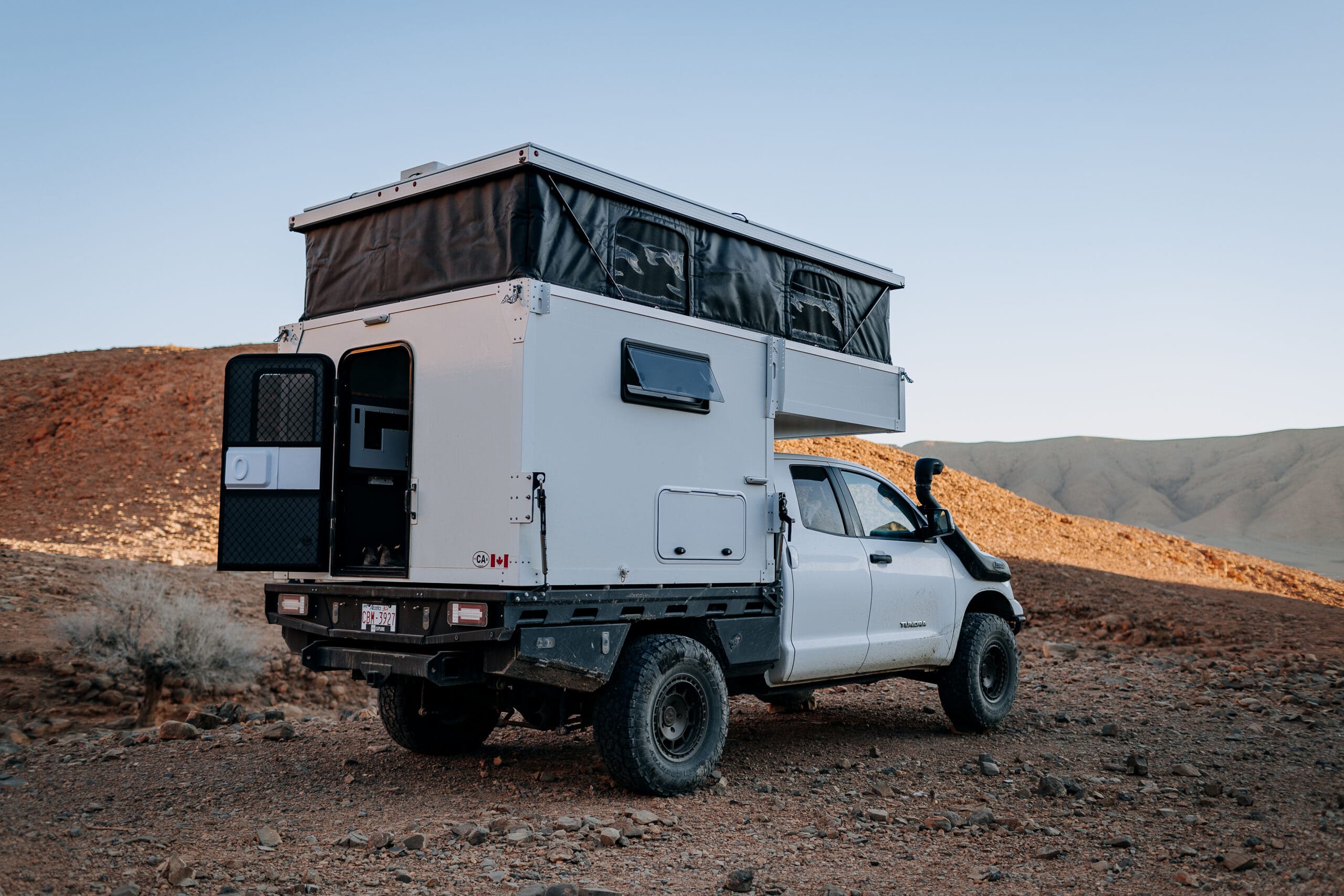
We traveled to Mule Expedition Outfitters in Issaquah, Washington, to have the 7-foot-long Mits Alloy tray installed. The tray comes complete with black powder coating, side cabinets, a headache rack, a water tank (a perfect graywater tank), and a rear drawer. Mule built a custom receiver that is not only tucked up higher but also wraps around the frame to help distribute the load of the flatbed and camper, all while reducing torsional flex.
With all the options installed, the tray weighed about the same as the stock Tundra bed. To trim down, we removed the cavernous rear drawer and stripped at least another 150 pounds from the truck.
Deciding which camper to buy for our Tundra was difficult. Price, weight, availability, layout, and construction quality were all critical factors. We spent a few nights in XOverland’s Prospector and Four Wheel Camper Hawk Flatbed and a weekend in AT Overland’s first Aterra XL camper. The FWC Hawk was the least expensive option, and the Aterra was the most expensive. Both had lead times that stretched to well over a year, and neither felt quite right for us.
Honestly, we couldn’t find anything that fit our needs until Overland Explorer Vehicles (OEV) released their flatbed Alpine model. Based on their Back Country slide-in camper, but with sides that extend down for use on a flatbed, providing secure storage space, it felt like the perfect combo. It’s the lightest of their flatbed models, meaning that with our weight-loss plan, it weighs less than their 1/2-ton slide-in camper in a Tundra.
The Alpine checks off quite a few other boxes for us. It has a queen-size bed with generous clothes storage below, a wrap-around seating area for use as a mobile office, insulated hard and soft walls, and plenty of natural light within the living area. The high R-value of the walls and roof, along with the efficient Truma heater, keeps us nice and warm when we inevitably find ourselves in winter conditions. Aside from the layout, a factory visit and conversation with designer Mark Cymbaluk gave us confidence that it could withstand long-term living. After almost three years, it has shown nearly no sign of wear to date.
OEV designed and built custom mounts to tie the Alpine camper together with the Mits Alloy tray. The 20 rubber feet on the bottom and front of the camper, combined with the Torklift Derringer tie-downs, provide a secure mounting solution while allowing a small amount of movement, reducing stress on the rigid tray and truck frame. The camper also comes standard with a Thetford cassette toilet and water heater, but to simplify things and keep the weight down, we eliminated them and passed on all available factory options, such as roof racks, MOLLE panels, solar panels, and awnings.
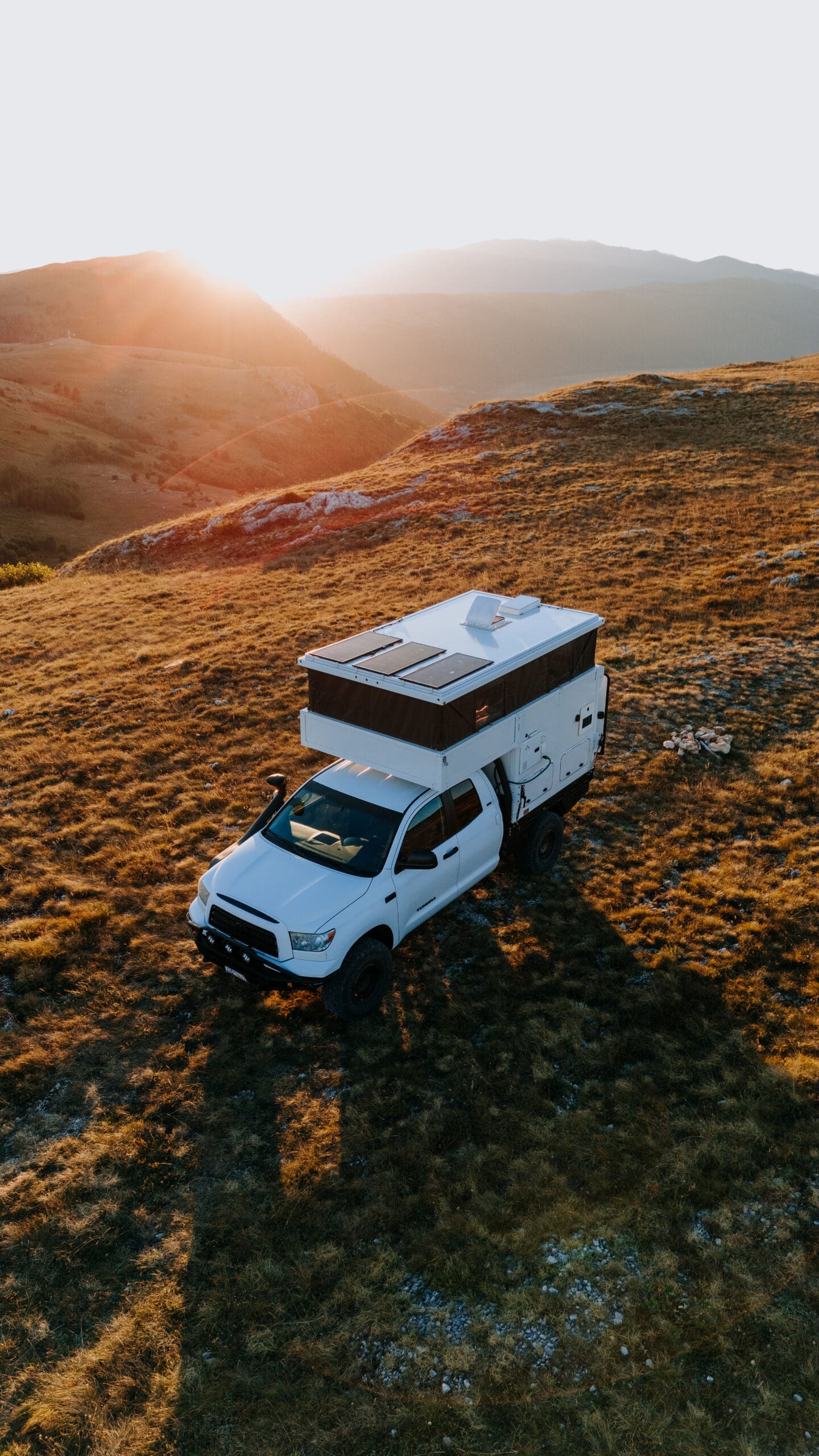
Read more: Armor from C4 Fabrication and TRD, MITS Alloy Tray and OEV Alpine Camper Installation
OEV Alpine Camper Upgrades for Full-time Living
The intentional bare-bones setup meant we could select components based on our very specific wants and needs, such as the Dometic CFX3 55IM fridge. It’s the perfect not-too-big size with a roomy interior, and the “IM” stands for a bonus ice maker. The rapid freeze plate and included trays have ice cubes ready in a matter of hours, just in time for our next happy hour on the beach or in the middle of the desert. Yes, gin and tonics in the middle of the Moroccan desert with plenty of ice are delicious.
The Alpine comes standard with a stainless steel Suburban drop-in two-burner stove, but we swapped it out for an induction cooktop. Although power-hungry, it has been a game-changer. Cooking in an enclosed space with gas is something we try to avoid, so the ease and safety of using the Dometic CI20 Induction Cooktop was a welcome change. As expected, LPG can be hard to find on this side of the Atlantic, so rationing the propane for the Truma Vario Heat heater has worked out well.
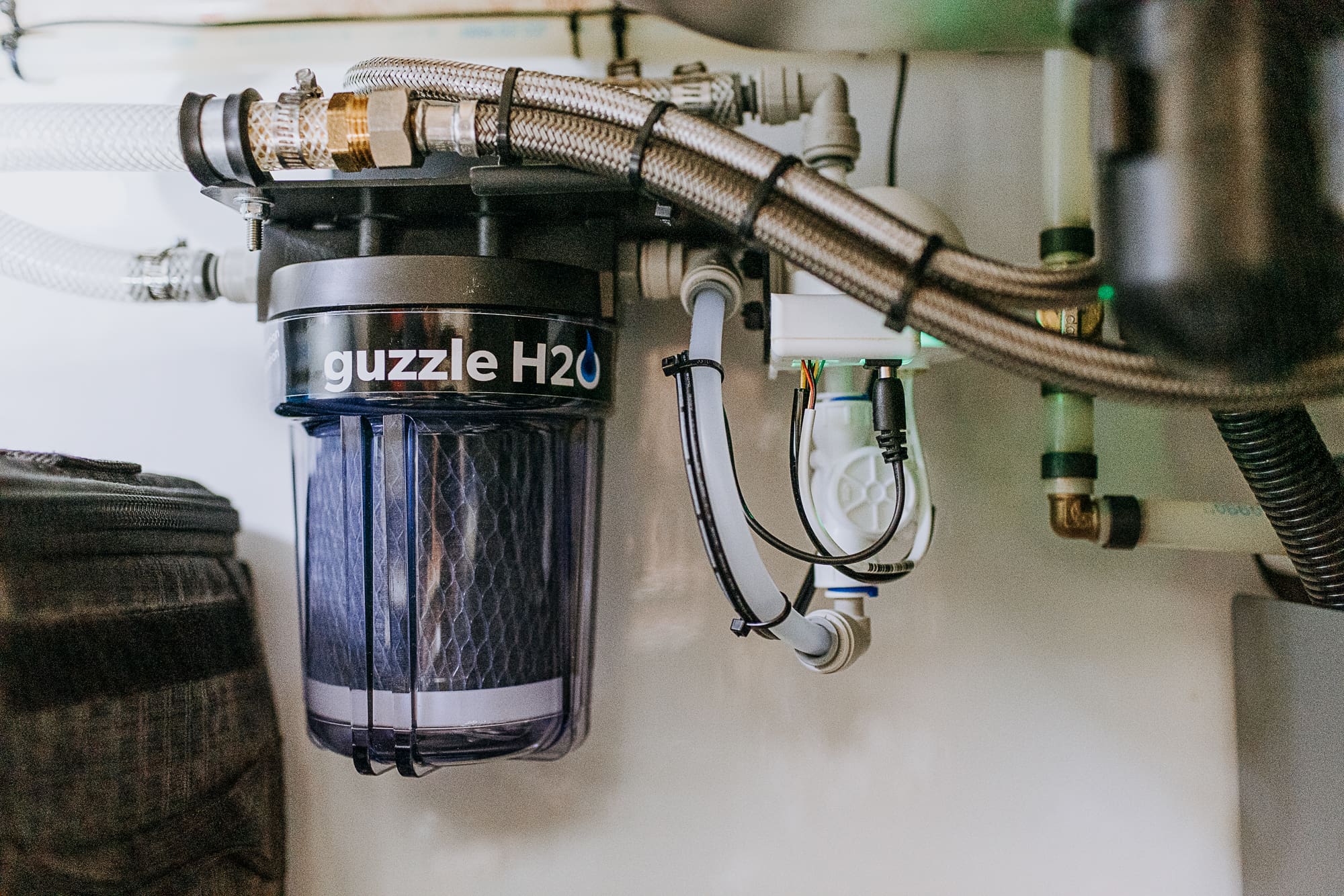
We’re just as particular with our international water sources, and for good measure, we decided to add an under-counter Guzzle H2O Stealth to filter the water at the point of use. The Stealth features both ultraviolet (UV) and carbon block filtration, resulting in great-tasting water while eliminating 99.99 percent of harmful bacteria. We now needed a way to power every-thing. Three Zamp Solar Obsidian 100-watt rigid panels were paired with three Anti-gravity 100-amp-hour lithium batteries. These panels are about half the height and weight of standard rigid solar panels—useful since we need to maximize both the roof area and payload.
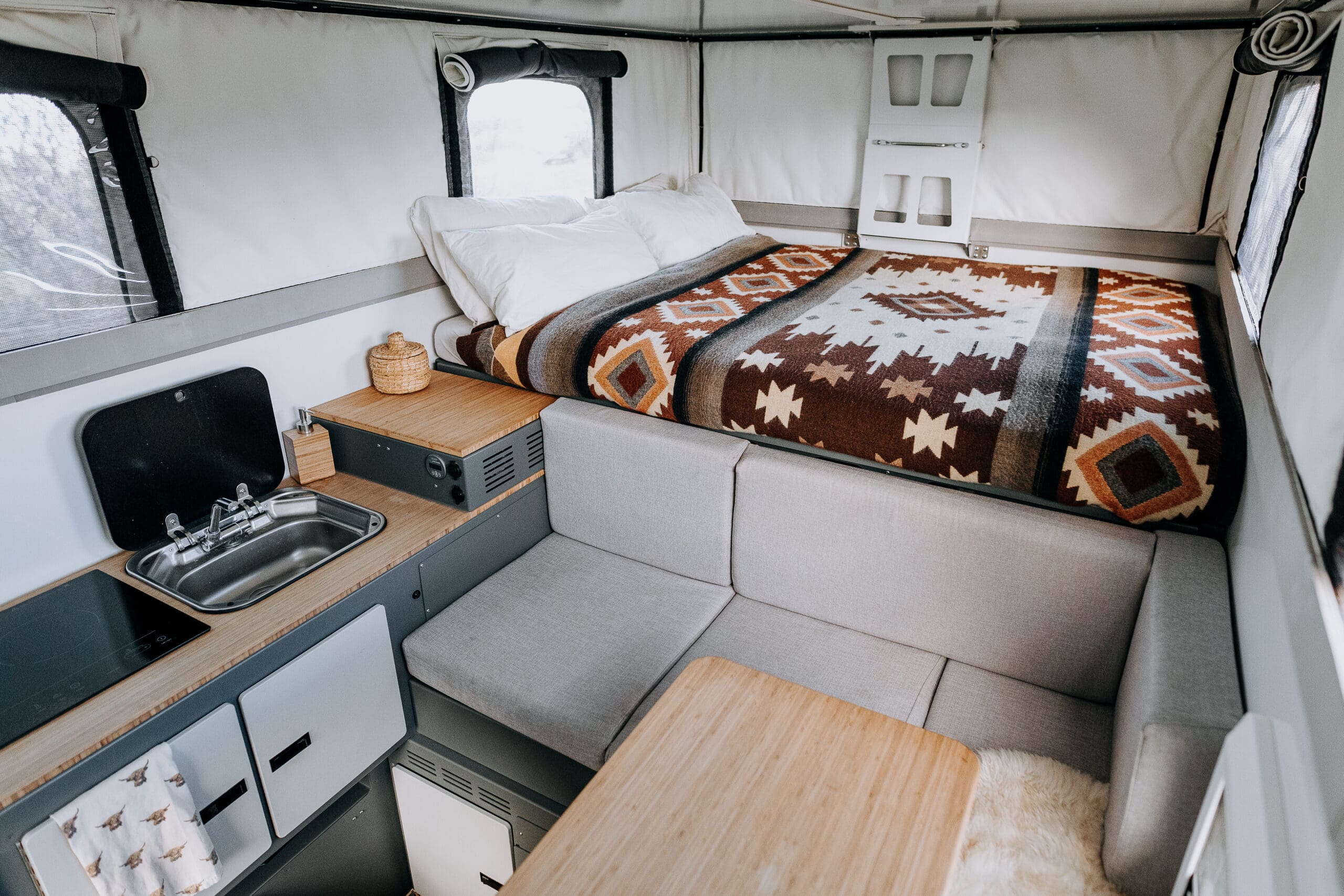
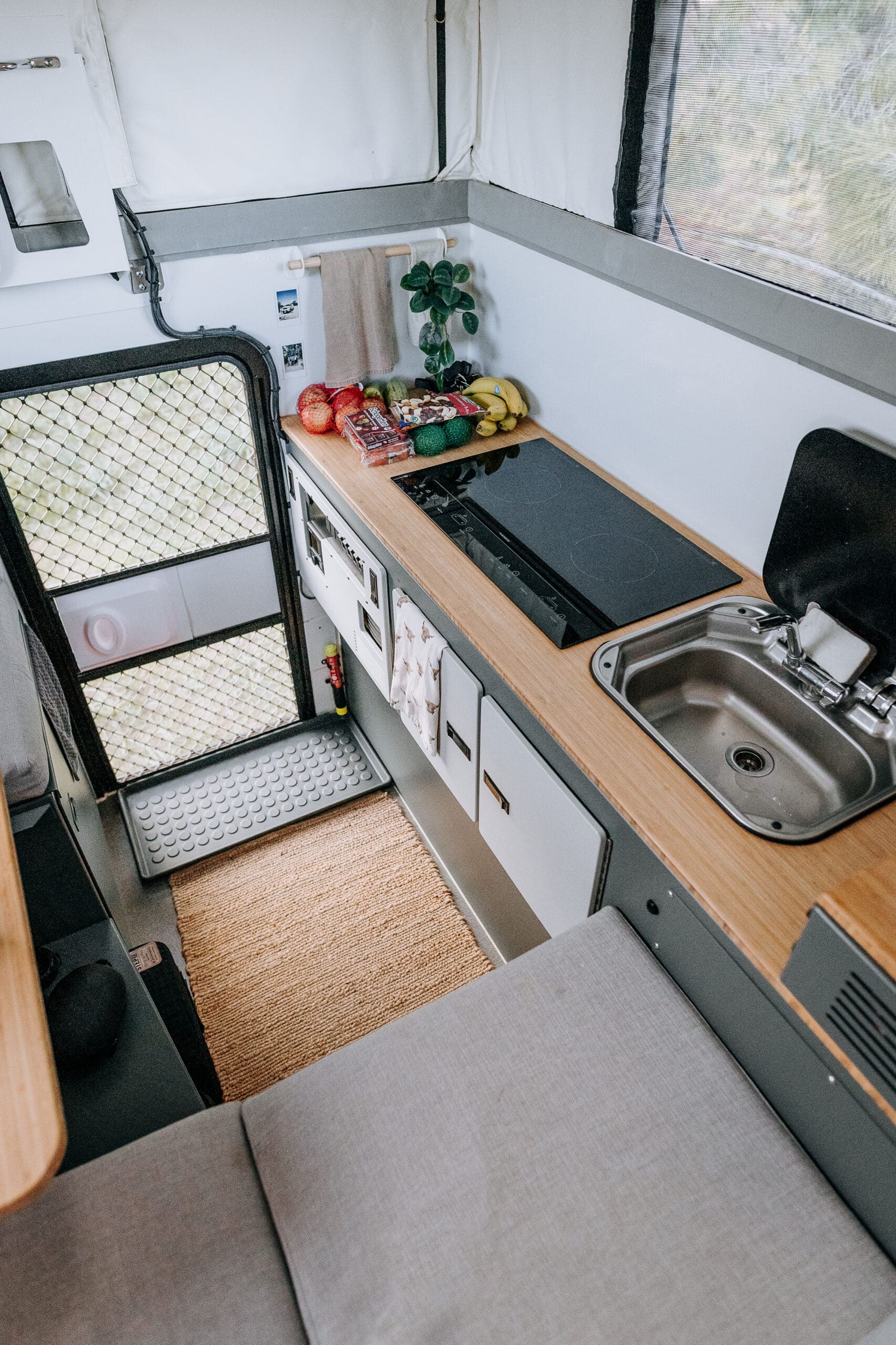
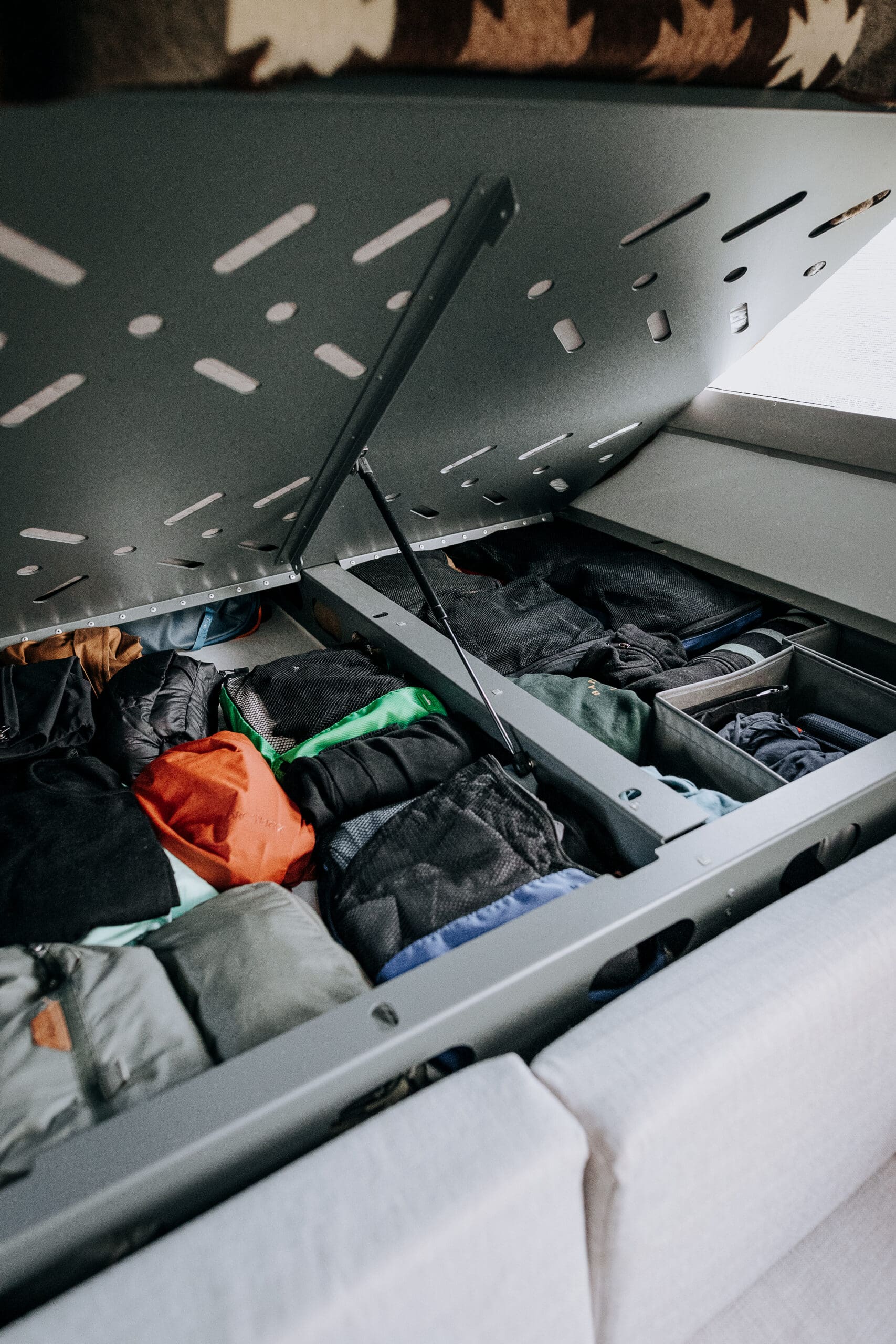
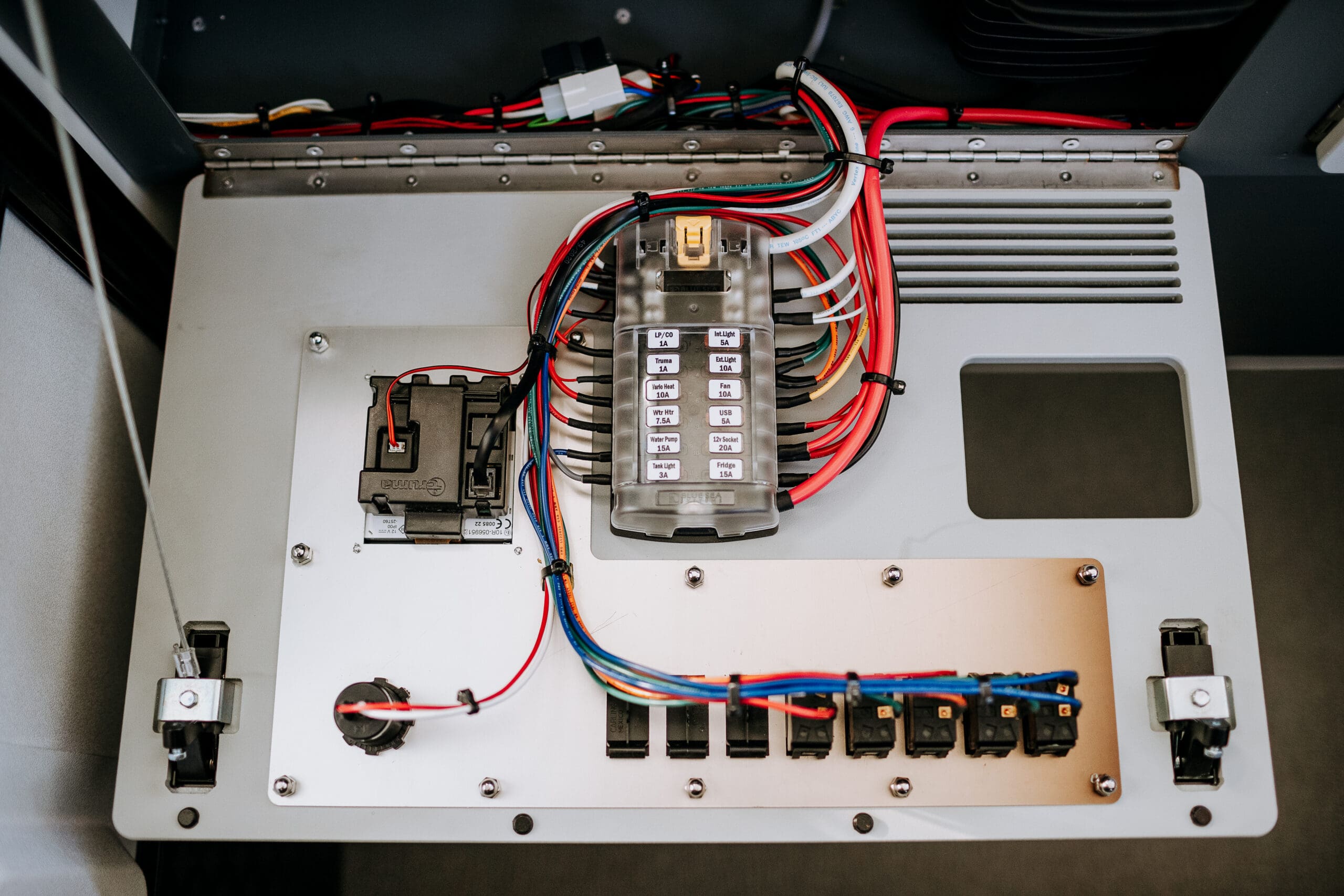
Read more: OEV Alpine Camper Upgrades
Transfer Flow 48-Gallon Fuel Tank
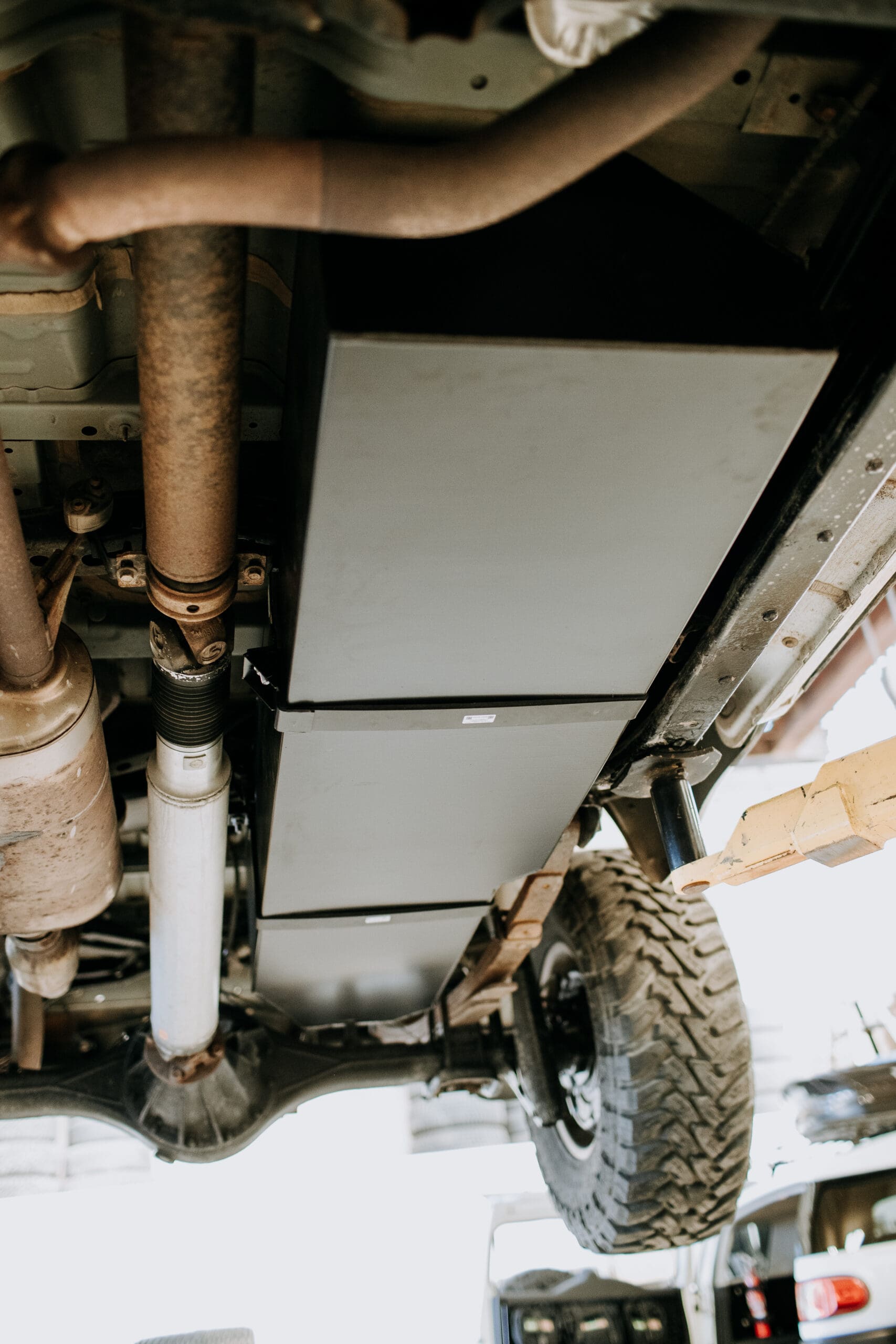
Range anxiety is real. After having the luxury of a long-range fuel tank in our 1990 Toyota Pickup and the ability to skip sketchy gas stations or drive hundreds of additional kilometers off-pavement, we knew installing a larger tank was a priority for our 2008 Toyota Tundra.
The large replacement tank lets us retain a factory fuel pump, sending unit, and hoses. It doesn’t take up space otherwise being used for something else (such as a spare tire), and it doesn’t require a separate tank and ad-ditional fuel pump, keeping plumbing and electrical nice and simple. The space within the chassis is now used for fuel, and we don’t need to add a roof rack or complicated bumper with heavy swing-outs to accommodate jerry cans. On a foray into the Western Sahara, we traveled up to 800 kilometers between fuel stations, all off-pavement and much of that with the transfer case putting power to both differentials.
Read more: 46-Gallon Transfer Flow Fuel Tank Install
Truck Interior
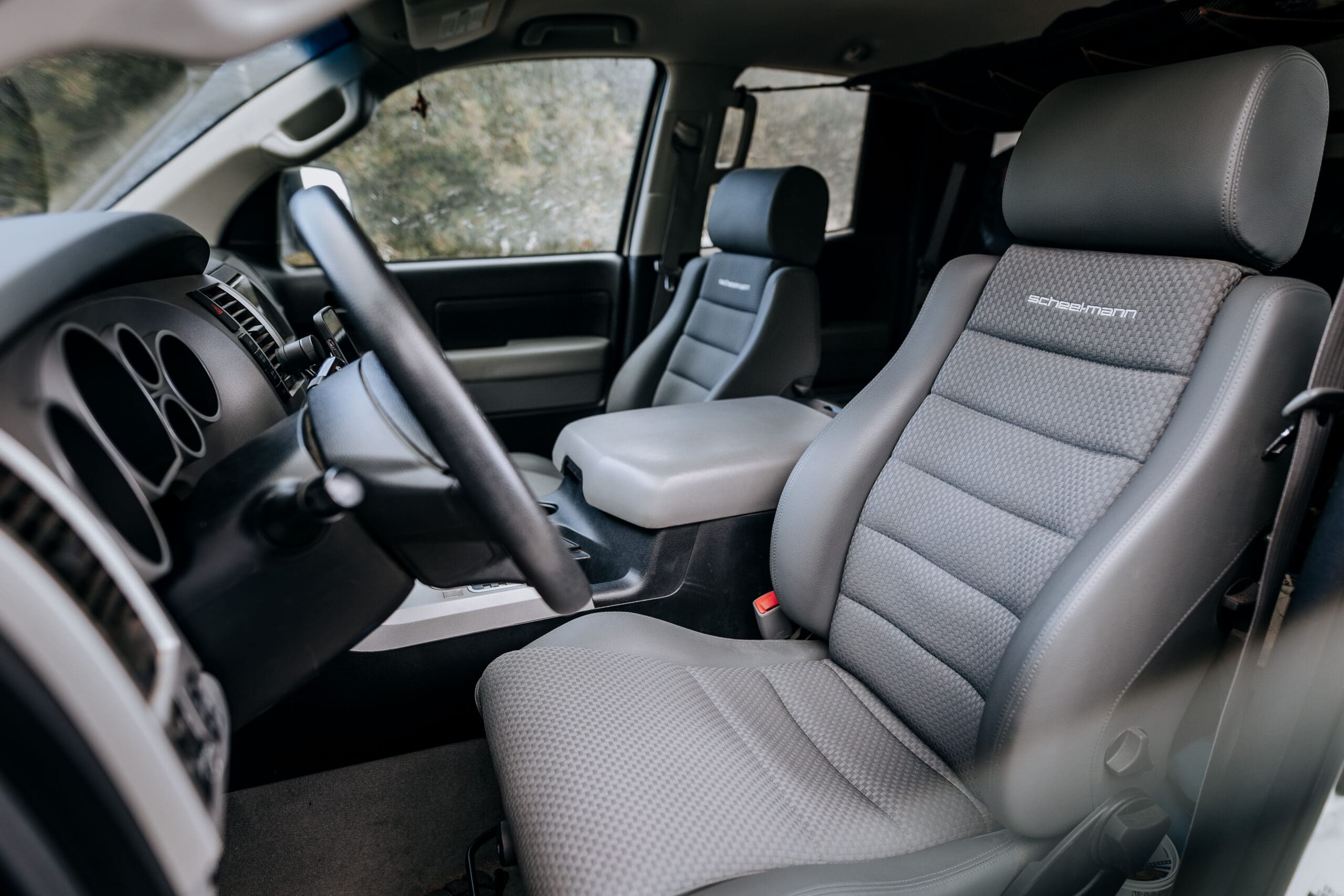
Long, tedious drives are part of any overland trip. Staying comfortable and alert during those stints in the driver’s seat is an important safety consideration. This was the biggest reason we swapped the soft stock buckets in our 2008 Toyota Tundra TRD Off-Road for a pair of gray Scheel-Mann Vario F seats. The 10-way adjustability, moderate side bolsters, and firm support have made a world of difference behind the wheel. We feel fresh after long drives, have eliminated any back pain from said drives, and, to be fair, modernized the look and feel of our 2008 Toyota Tundra.
From the driver’s side Scheel-Mann seat, I can easily access the sPod HD Switch Panel or the modified Tuffy Center Console insert (from a newer model Tundra), the Blue Ridge Overland Gear attic (originally designed for a 4Runner), and the Quad Lock Vent Mount phone mount and MagSafe wireless charging head. Overall, the interior is straightforward, yet effective, meaning that when we park the truck on a busy street, we don’t have any loose items scattered about that could entice would-be thieves.
The Proof is in the Pudding
Three years of living out of a vehicle has its way of pointing out the flaws. To date, the camper and interior still look and work like new. Of course, the almost 20-year-old Tundra has requested we change some of the original parts, but we can hardly be upset with a 30-minute tie-rod-end replacement in a Marrakech campground, with Genuine Toyota parts courtesy of Parts Souq. Overall, the truck straight-up works.
I could complain about the Tundra’s width in narrow British lanes, the overall weight of the truck when I’d prefer to really have some fun in the dunes of Erg Chebbi, or the lackluster fuel economy when European gasoline occasionally tops $10 per gallon. Those downsides are outweighed by a luxurious living space that we can hole up in for days when storms roll in; a big, dumb naturally aspirated V8 that provides plenty of power and is happy with the least expensive gasoline we can find; and a setup suited to slow travel. We can work consistently, have those precious dollars roll in, and slowly head east toward wide-open landscapes we’ve never seen before.
Specifications
2008 Toyota Tundra TRD Off-Road
Power
5.7-liter 3UR-FE V8
6-speed automatic transmission
Suspension and Drive
5.29:1 axle gearing – Motive Gear front, Nitro Gear and Axle rear
ARB air locker
Open front differential
ARB BP-51 adjustable internal-bypass shocks
Total Chaos stock-length upper control arms
Total Chaos stock-length lower control arms
Total Chaos leaf spring shackles
Deaver Suspension U748LXHD leaf springs
Timbren Active Off-Road bumpstops front and rear
Archive Garage U-bolt flip kit
TRD front sway bar
Hellwig rear sway bar
Wheels and Tires
Fifteen52 Traverse HD 17×8.5 wheels
Toyo Tires A/T III 35×12.50R17 tires
Recovery and Armor
C4 Fabrication Hybrid front bumper
TRD front skid plate
MaxTrax Mini recovery boards
Interior
Scheel-Mann Vario F front seats
Tuffy Security Products locking center console insert
Blue Ridge Overland Gear 4Runner gear attic
Quad Lock Vent Mount phone mount
Accessories
Transfer Flow 46-gallon fuel tank
Baja Designs LP9 Pro lights on front bumper
Baja Designs Squadron Pro lights
Baja Designs S2 SAE lights connected to factory fog switch
ARB twin motor air compressor mounted under hood
Slee Off Road ARB air compressor mount
sPod Bantam X HD Universal power distribution system
Antigravity Batteries Group 27 lithium starting battery
Camper
Overland Explorer Vehicles Alpine camper
Victron MPPT 100/30 solar charge controller
Victron Orion-Tr Smart 12/12-30 DC-DC Charger
Dometic CFX3 55IM fridge/freezer
Zamp 100-watt Obsidian Solar Panels (3)
Antigravity Batteries DC-100-V1 lithium batteries (3)
Samlex America NTX-2000 pure sine wave inverter
Dometic CI20 induction cooktop
Guzzle H20 Stealth water filtration and purification system
Watch this 2008 Toyota Tundra build in action during Desk to Glory’s “Why We Overland” six-part film series on the Expedition Portal YouTube channel.
Editor’s Note: This article was originally published in Overland Journal’s Spring 2026 Issue.
Our No Compromise Clause: We do not accept advertorial content or allow advertising to influence our coverage, and our contributors are guaranteed editorial independence. Overland International may earn a small commission from affiliate links included in this article. We appreciate your support.
