

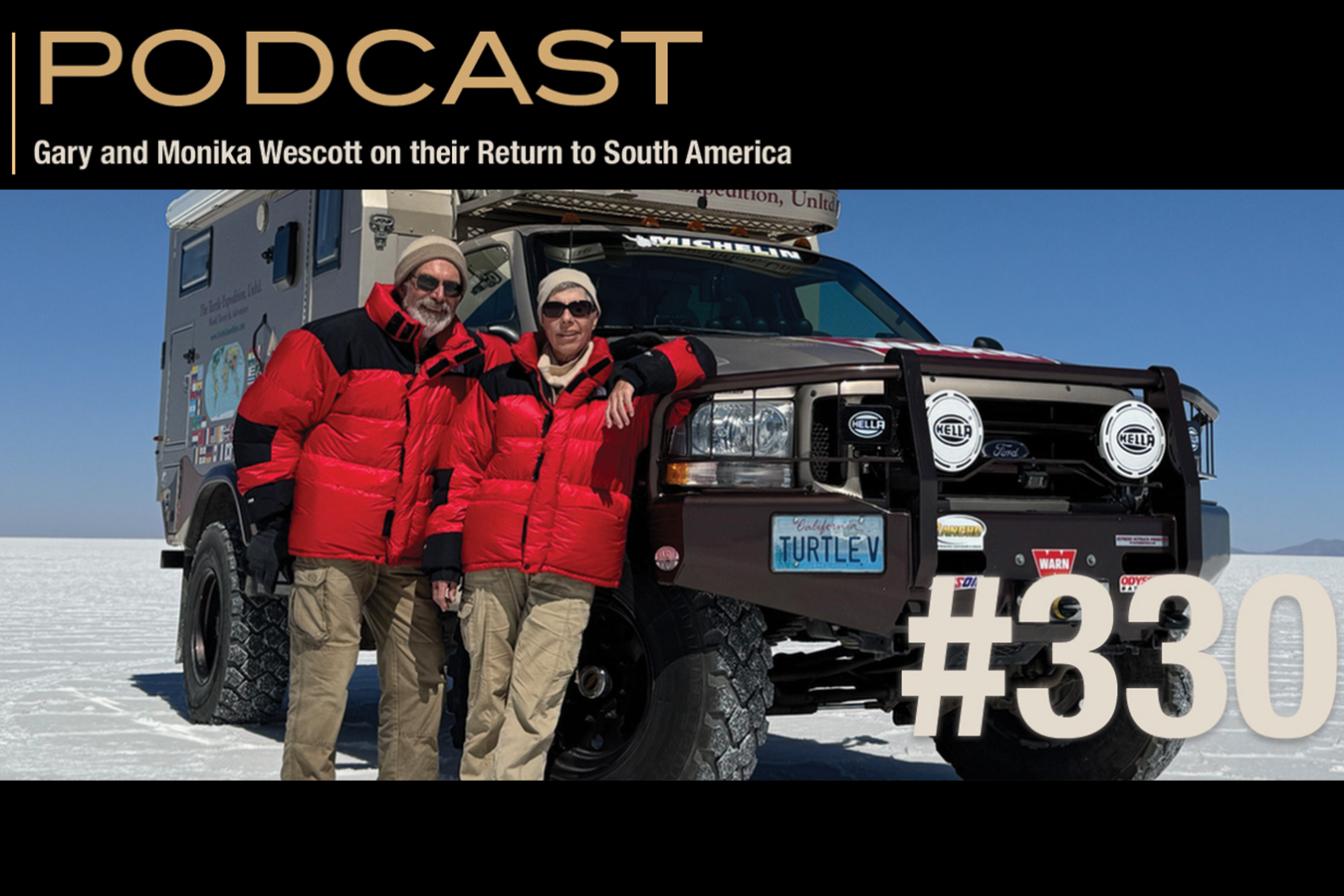
In this episode of the Overland Journal Podcast, host Ashley Giordano interviews Monika and Gary Wescott, seasoned photojournalists with 50 years of travel experience. They share insights into the Turtle Expedition, detailing the custom build and features of their Turtle V vehicle. The Wescotts also reflect on the evolution of travel photography, communication on the road, and changes in the overlanding community over the decades. They highlight their philanthropic work supporting girls’ education in Central Asia, demonstrating the power of giving back and cultural connection through language. Throughout the conversation, Monika and Gary emphasize the importance of pursuing dreams, learning life lessons from global adventures, and finding lasting joy in exploration.
Overland Journal Podcast Episode #330
Tune in Apple Podcasts | Spotify | YouTube
The Overland Journal Podcast is brought to you this week by Hankook Tire and Midland Radio
For additional heritage content and news, sign up for Overland Journal’s Weekly Dispatch: overlandjournal.com.
New to Overland Journal and want to grab a subscription? Visit Overland Journal and enter code: overlandpodcast at checkout for 20% off. We thank you for being a subscriber.
youtube.com/watch?v=a90B0CI3NhE&feature=youtu.be
Guest Bio:
For over four decades, Gary Wescott and Monika Mühlebach Wescott have led global expeditionary photojournalism. Combining exploration, storytelling, and cultural connections, the husband-and-wife team has traversed Earth’s most challenging terrains. Published internationally across major media, their work documents human resilience, extreme geography, and overlanding adventure. Gary’s path began in 1967 while studying journalism at San Diego State University. Monika grew up in Wiesendangen, Switzerland, developing a love for hiking and fluency in five languages. The two joined forces in Mexico 10 years later, embarking on a shared journey of travel, photojournalism, and outdoor endurance.
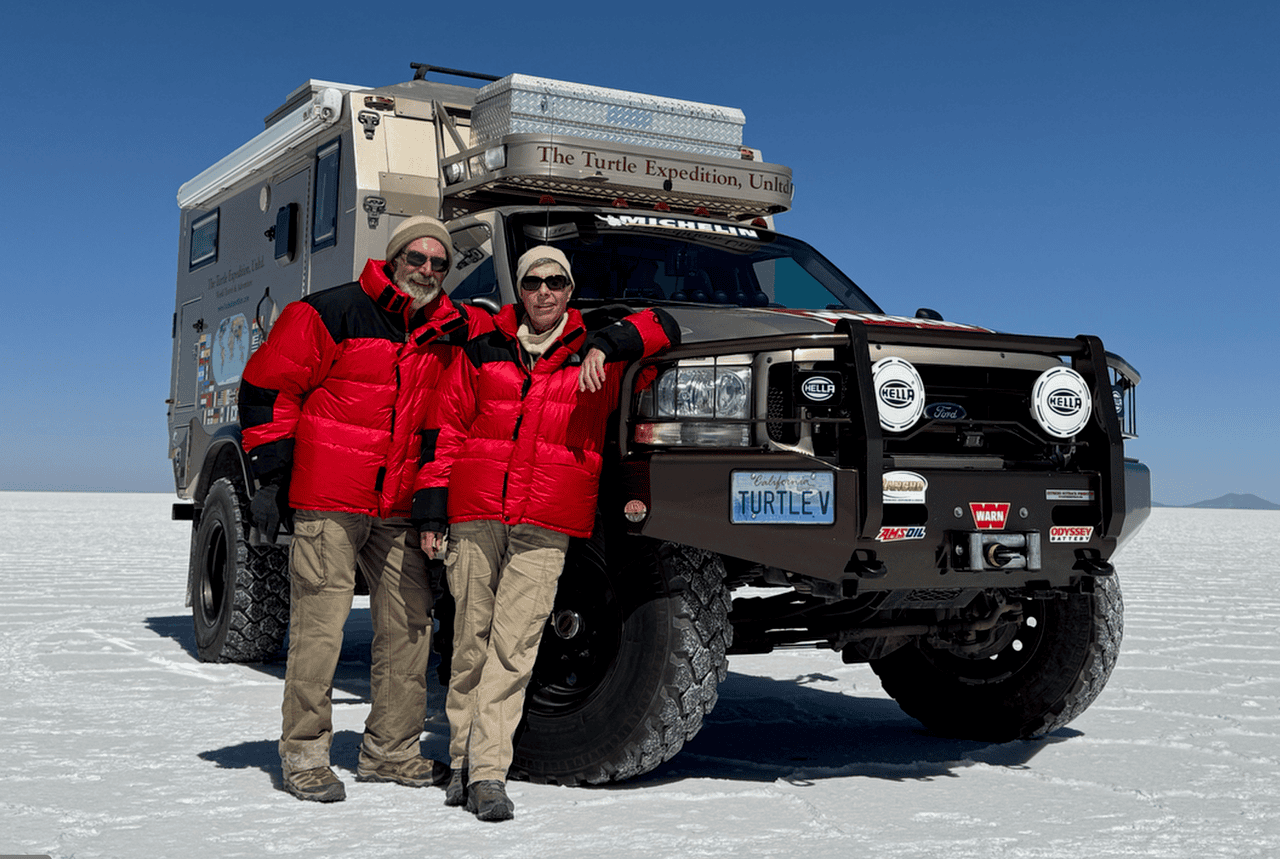
Gary and Monika Wescott: Website | Instagram | Facebook
Overland Journal Podcast: The Turtle Expedition Shares 50 Years of Overland Wisdom
Living Legends: Gary and Monika Wescott of the Turtle Expedition
Host Bio:
Ashley Giordano
Ashley Giordano’s first foray into overland travel involved a 48,800-kilometer journey from Canada to Argentina with her husband, Richard, in their well-loved but antiquated 1990 Toyota Pickup. Currently cruising along the iconic Silk Road in a 2008 Toyota Tundra, her full-time navigator duties are rewarded with bowls of plov and lagman noodles, hikes in the Tian Shan, and countless cups of fragrant Tashkent tea. As senior editor at Overland Journal, you can usually find Ashley buried in a pile of travel books, poring over maps, or writing about the unsung women of overlanding history, including her enduring inspiration, Barbara Toy. @desktoglory_ash

Our No Compromise Clause: We do not accept advertorial content or allow advertising to influence our coverage, and our contributors are guaranteed editorial independence. Overland Collective may earn a small commission from affiliate links included in this article. We appreciate your support.
Transcript
Ashley (00:05)
Hello and welcome to the Overland Journal Podcast. I’m your host, Ashley Giordano. And as Overland Journal approaches its 20-year anniversary, we’re catching up with some of the people who have helped shape this community, sharing the stories, lessons, and adventures that brought us here. With that said, today my guests are Monica and Gary Westcott. Welcome back to the podcast, you two.
Monika and Gary Wescott (00:28)
Thank you. Thank you.
Ashley (00:30)
So you can find the previous episode in the show notes. We’ll include that below because you guys, this isn’t your first rodeo. You’ve been on the podcast before and talked all about your travels. But what’s your elevator pitch for the folks who aren’t familiar with your story?
Monika and Gary Wescott (00:46)
well people haven’t heard of us or followed us, we’ve been traveling we’re photojournalists. We’ve been traveling around the world for fifty years now, driving specially built c custom expedition campers, sometimes even a car with a rooftop tent, sometimes a Land Rover, and sometimes a car with a tent. And so it’s it’s a combination of skills and ideas evolved from from
many different countries and thousands of miles of driving and figure figuring out what works.
And since well, Gary started in seven nineteen seventy-two. I joined him in nineteen seventy seven. since then the vehicles have evolved from a 109 Land Rover to a Chevy with a half a little pop-up camper, then to Fords, F-350s, the we call turtles, turtle three and turty four. There were three fifties with four-wheel pop-up campers and
With this Turtle Four, we drove across Russia and Siberia in ninety-six, where temperatures fell down to minus eighty. We came to Europe and we decided we wanted something a little more comfortable for all four seasons. And that was the idea behind the Turtle Five, which we still have today. It’s twenty six years old. we just came back from South America. We were there for twenty-one months.
And the name did the name
Ashley (02:37)
So you were doing
this before it was cool.
Monika and Gary Wescott (02:40)
Yeah, well, Overland Journal one time, Chris Coller wrote an article called Living Legends, and so I guess we’re we’re kinda falling that category. case people wonder where the name turtle came from, our first vehicle was a Land Rover. And it was very slow with the original six cylinder engine. And so and it was blue. We called it the blue turtle. And so people would ask us, they’d see the tire on the hood, with the land rover with the tire on the hood, it looks like it’s going someplace.
So we say, where are you going? We would say, South America. This was in South Lake Tahoe A lot of people didn’t know where South America was. So we said, really? Yeah, we and they then they would say, Well, how long are you going to be gone? And they were expecting a week, two. And we would say, three to five years. And their mouths would open, really? And so that’s been so we call we had had to have a name, so we called it the Turtle Expedition, because we traveled very slowly, like a turtle, with a house on our back.
And the name stuck.
Ashley (03:32)
And traveling
traveling slowly is it lends itself really well to writing and learning new things and all that overlanding entails. And so if you’re traveling really quickly, it’s hard to balance all those things. So you’re both journalists. I want to dive a little bit into your writing history and some of the most memorable stories that you’ve written. so yeah.
So I’m curious, when an article goes to print, not everything can be included due to word count, relevance, etc. Which of your published articles involved a memorable story behind the story?
Monika and Gary Wescott (04:13)
There would be many. one of our favorite ones is when we were traveling across Russia, after the winter, so it was by August, we were in a Central Asian part of Russia in a at a semi-tominless republic called Tuva. They have their Buddhist
by religion, they’re Buryat, so they speak, I believe, a Turkic language. And we wanted to follow a route to the next
republic which is called Altai. That’s the Switzerland of the Central Asia over Russia. But we didn’t really want to drive the long way around, which was go around going north and then coming back south again. So we were looking for another road that was closer in the south. Well it turned out to be a road that was very close to the Mongolian border. And we got in trouble. they knew we were there, but then they eventually let us go continue on.
After we ended up at the police station in a little in the only little town on that road. And they said, well, there are two roads. One is goes to the left and one goes to the right. So we said, okay, we’ll go to the one to the right. On the way, we stopped for lunch, and there was a beautiful mountain called Mountain
Montungaiga, and in front was this huge meadow. I mean it sort of looked like Switzerland with the Alps, and there were yurts on the other side of the river, and we said, we wish we could go there, it’s so beautiful. Well, here come two horses galloping, three people, they came to visit and they invited us to go to have chai tea at the yurt. So we went, ended up
spending three days there, which was a great experience, because the lady we stayed with, she had two teenagers. She her first language wasn’t Russian either. And our Russian was very rudimentary, like a two year old s putting words together. But
Because she also, Russian was her second language, she knew how to use a dictionary and the conversations we had and learned about each other’s lives was just unbelievable. we introduced them to popcorn and whatever hot chocolate pudding and they prepared some of their their regular meals. eventually after three days we moved on on this road and it was August, early August and it started snowing.
But back to back to this visiting with this woman. Chai in that part of the world is not just a cup of tea. Chai involves coming in and sitting down for a full meal. Yeah, that’s all of Russia was like that. Anyway, so we were driving up and then there was a fork in the road and Gary decided to go the left hand side and we ended up in a bog.
And we sank sank down all the way down to the axles. We had our travel trailer behind us, or support trailer behind us. So we were stuck. I mean stuck to the point where you could turn the key off and walk away and nobody came. I did I di I did a story for Overland Journal. It’s called Are You Stuck or Just Temporarily Detained? If you’re stuck it you just you you just leave the keys in the ignition and walk away ’cause no one’s gonna steal the vehicle. If you’re temporarily detained, there is a way out. But
Ashley (07:25)
Right.
Monika and Gary Wescott (07:26)
We obviously had to get out of there because it was snowing and eventually we were able to
We had found some rocks and we used the sand ladders, the high lift jocks. We had two of luckily. So we were able to turn the trailer around and eventually the truck. But thanks to three we call them yak boys, they were cowboys, but they were heritaging racks. So thanks to three yak boys who came to our assistance who had spotted us way in the distance, we finally made it by about ten o’clock at night to turn around. I mean I was I was holding the flashlight and pointing pointing
at all the holes that were in this bog so Gary wouldn’t sink down again with one of the wheels. And we made it and invited them for dinner and I made a quick soup.
And so the five of us sat in there in and in a camper, warm camper, we had the heater on, and they wanted to hear some music. So two while being famous for their throat singing, we Gary put on his new CD that we had, and they said, no, no, no, no, no. They wanted to hear American music. So he pulled out a Whitney Houston. Whitney Houston Whitney Houston and they just absolutely loved it. So every time we hear Whitney Houston, we remind
Now back back to getting unstuck. Remember, we did have a trader with 100 gallons of jet fuel in it. That was our winter diesel supply for driving this route. Because you had to have this really cold weathered diesel, or if you got if it was worn, if it was some summer diesel, it would clog up the filters. So we did have a winch on the back of the truck, an 8,000 pound worn winch. We put a pole pal in the back, which is something that was available then, with a big, a big deck ground anchor. We put that on the other side of the trader, on the back of the trailer.
It was not the only time we got stuck. No, not going to But it was it it was definitely it helped us. We were not stuck, we were just temporarily detained.
Ashley (09:17)
I’m gonna use that from now on.
Monika and Gary Wescott (09:19)
Well
the that the Yak voice told us that that was the end of travel season. There are no more vehicles going until next summer. So we knew we had to get out of there.
Ashley (09:28)
Wow. Thanks for sharing that.
Monika and Gary Wescott (09:30)
And we still
we still had about I’d say about a two thousand foot climb still to get over the summit and down to the other side of the valley. Well we we returned back to that town and took the other road. And that in itself was a big another big adventure. But we made it. Yeah.
Ashley (09:48)
Awesome. What
Monika and Gary Wescott (09:49)
We we took the
we we we we took the lessons that find finding that road was difficult because there was no markers, just you know, a sand track here and there and a water crossing here and there. And I I had learned something on the Australian camel trophy. We had to find we had we had to follow a route. And we did something that I nobody had ever th had really thought of. We just found the telephone poles.
Telephone companies have to make a road to put the telephone poles out. So we just followed the telephone poles and we found the ne we found the next village. Anyway. and and
Ashley (10:20)
That is hot tip.
Monika and Gary Wescott (10:21)
we finally we finally did get over the top. Monica’s gonna get to this too. Well we were climbing, we were yelling at the kid climb, climb, climb, because we knew if we didn’t get out of there, we’d be there for spring. It’d be over. So we finally got over the top, ended down with side, and the town we were going to is Kosagach.
If you look up Koshigash in the in the South American handbook, it means the middle of nowhere. That’s a town. So we made it over the top, got down to the bottom, stopped. we made it. With a lot of endolin
Ashley (10:48)
You made it.
Monika and Gary Wescott (10:49)
for sure. Yep. Yep. And and bigly
Ashley (10:51)
Yeah. Need a little bit of relaxation after that.
Monika and Gary Wescott (10:55)
a little bit, yeah. A shot a sh a shot of of vodka helped.
Ashley (10:59)
Yes. So that’s a great story. what is your favorite story, or do you have a f a favorite story that you’ve written or another memorable one?
Monika and Gary Wescott (11:10)
Well just being a little look back to that first story, one of the one of the things that was happening is I was driving up for the final little maybe a hundred yards to get over the top. So we knew we had made it to the top. And there were was snowing, it was like two feet of snow on one side and holes on the other side. And Monica was running ahead checking to see where the holes were. Because if I sa if I stopped anywhere I’d really be stuck.
And I’d already backed in one time. I backed up once again when mud flaps caught the tires and it tore them off. So we just put them in the back. And we’re still I’m still pulling a tr trader full of with a hundred gallons of jet fuel. Okay. So s finally we got up to the top and we realized got the we’re to the top and it was both of us we just realized, wow, that’s what teamwork’s about.
Ashley (11:51)
True.
Monika and Gary Wescott (11:51)
So
it what is a favorite story? You have a favorite story. share. so many stories as well. The girl of the Palmer Mount. Palmer Mount. Okay. So we’re we’re on our separate trip, we’re driving the Silk Road. The goal was to drive Marco Polo’s legendary Silk Road from the most we wanted to start on the most western point of the Eurasian landmass, which turned out to be a place called Cabo de Roca. Cabo de Roca in Portu Portugal.
And and one of the goals was to drive the Silk Road and also just for fun to drive ocean to ocean wheels on the ground from the Pacific to the Atlantic.
And we and we started across and there it was fine. Everything at the strep was running perfectly. And we were we were going through the a lot of the countries that we had heard about, read about, Italy,
Greece, Turkey, Georgia. Georgia. And then we started to get into the Stans
No problem across getting across borders or anything. So we what about the mountains? Well, we were in the Pamier Mountains and it was actually a section that Marco Polo had traveled and we stopped at a l a river with a little creek because we wanted to wash off the dust of the truck. This is the second highest mountains in the world. We camped at sixteen thousand feet that night. Anyway, so these
Three girls came across the bridge carrying windows because their father was building a little garage on the other side of the highway and one of them
stopped and she’s have we were washing the truck and she actually took the brush out of Gary’s and started w helping us clean the truck. She just walked out into the water. She was eleven years old. Eventually the father came and we all looked at the map and he was explaining to them where they were and we said where we were and eventually the father invited us for chai. And we walked back to their house which was about ten minutes away.
And this one girl was eleven years old, there were six siblings, named Mashura.
And she just had this sparkle in her eye, and she was just so curious about everything. She was the only one that would sit in in the truck in the front, had the seatbelts on, looked really cool. And we took pictures of the whole family, and then later we we were able to print them the pictures as a souvenir, which is something we like to do. Now now they have people have phones, but before they didn’t have phone. They didn’t have a phone. So this girl just sparked her.
Interest and we really wanted to ha help her get a good education. She had a she had a she had a look in her eye and her smile that said clearly she didn’t speak a word of English, but her face said, I don’t know who you are, I don’t know where you came from. I’m helping. She did. And they were
We know there were farmers, they had goats and they had a cow. the school was really bad. They didn’t have a math teacher for two years, we learned later. But I just I wrote I had the mother write down the address. Just
I don’t know. I just we just felt that we need in the future we needed to do something. The name of the village is all we had. It was actually the second time this happened to us. Well one time in nineteen eighty eight in Peru, high up in the mountains, we met this cute little girl who was also her sister was teach learning English and wanting to be a teacher and we felt that we really could needed to help her, but the parents never contacted us because she was there with her grandfather.
Once we got back to the states, in 2016, we were looking for a way to contact her, and there was a place in the town called Khoruk. Two hours away. On the Afghan border, that had what they called the the American corner. And it was an effort by the US consulate to establish these centers for people to learn English and maybe learn.
More about the European culture because Russia’s influence was very big. The director of that he volunteered to drive up to that village. He was 26 years old, named Sheroz. He went to the village and gave the parent, the father, and Mashura, mother was not there, the information that we would like to help her get a better education. And they accepted. So Cheros was instrumental in helping us with Mashura.
He found eventually a place for her to stay, first at his father’s house and then at his sister’s house, who had two girls, and Mashura lived there for four years until she graduated from high school. So that was the start of a whole new project because they eventually
Through our donut box program, we actually were able to we are helping five other girls to to follow their dreams and get an education. So when this first happened, when when when when Shiraz first went up and explained to Ma Mashura and her father that we wanted to to get her g give her a high school education.
in this private school in town. sheep sheep was crying and he called the next day in in disbelief, say, is this is this really gonna happen? Schwarz says, yes, it’s gonna happen. Yeah. So she moved. So she graduated from high school and eventually she had applied to a university in Poland.
And she just graduated with a bachelor’s in international management. So in December, and that’s part of our next trip, which I’m maybe taking early on now, she will be have the festivities of graduation will be in December and we are flying to Poland to be there.
She in the meantime just started today in a hotel management school in Spain and she will be getting her masters in two years. Learning Spanish. When she already started learning Spanish. So she not only speaks five languages now, she’s gonna learn she speaks six languages. before she only
Ashley (17:59)
Wow.
Monika and Gary Wescott (17:59)
one. No English at all. Yeah. Cool. So for us
Ashley (18:02)
Yeah, my gosh. So you’re in regular
contact obviously with her and with her family. that’s so incredible.
Monika and Gary Wescott (18:06)
yeah, with WhatsApp two two or three times a week. Yeah. We are we are
our other parents. For for us to watch this young girl grow and experience the education. I mean it was like watching a flower bloom.
Mm. It’s amazing. The you know the
Ashley (18:26)
Mm.
Monika and Gary Wescott (18:26)
the the problem with third world I’m not saying that derogatory, third world countries that people are very intelligent. The parents really want their children to get an education. What’s lacking is finances. And
So we are really happy that we can help all these girls, and we can talk about the other ones later, to follow their dreams, get an education, to eventually support themselves, their families and their communities. So they are well taught about paying it forward. We all expect them to do something similar down the future when they can, be it financially or being just the good deeds.
They and they have responsibilities because nothing is for free. So we can talk about that later on.
Ashley (19:14)
Mm. I love this so much because it’s like you guys wrote you had this experience and then you wrote the the article, but it goes so much further than that one article. Like you’re still in twenty twenty six now. It’s still happening. Yeah.
Monika and Gary Wescott (19:25)
That’s right. Yeah. No, yeah, it’s not even close yet. Some of the
some some of the girls that we are that we are sponsoring, one one is amazing,
She was she she was a good friend of ma of Massura’s in high school, and that’s how she met us. And we we had learned from her that one of her dreams from childhood almost was she wanted to be a dentist.
Have no idea where she got the idea, but that for her, she and her mother decided she was gonna be a dentist. See she was in that private school because her her parents you know the the the traditions in that area is that the youngest child or the youngest boy, he gets or she gets the house, the farm.
and sh d taking care of the parents. The older ones, the oldest ones usually they want them to have a the best education they can get. So Mashura is the older of two, no man I’m sorry, Manija, the other friend the friend, is the older of two girls. Her grandmother was a teacher and she used her retirement funds to pay for that school. Well that school was probably six hundred dollars a year.
So her grandma died and she had two more years left to go to that school. So without help, she would have had to go to the regular public school.
And her parents would raise a cow every year, I mean a calf every year and sell it and were able to pay part of it. So that’s why she asked us if we possibly could help her. And we have a very good Mexican rancher friend who is a bachelor and had lots of nieces and he was willing to take over the payments for this girl. She graduated with honors and she started at
in Adentry University and she just now after four years graduated as the top of her class. And so we’re extremely proud of her. With a bachelor’s degree. No, yeah. And she’s going and now she’s now she’s still working. No, she’s going into residency. And also working on her master’s degree. Well that’s part of the residency program. The other girl
Ashley (21:43)
Right.
Monika and Gary Wescott (21:44)
named Dablati
she was the older girl of the family that Mashura was staying with for four years. She’s also a brilliant student. She received a full scholarship at an American-style university in Kazakhstan in Almaty. And she also just graduated as a public relations and something else with a minor. She was a valid, no, she was a made the dean’s list.
So she too has was very successful. Then we helped Mashura’s older sister who wanted to be a teacher and we helped her a little bit with mostly
support for monthly supports to pay for food and electricity and whatever. She graduated last year and was extremely proud that she now earns $300 a month, which is about three times more than the regular worker does. So she is happy with that. Then the younger sister Yasmina, she wanted to go to a school in a university in a different
part of the country. She’s staying with Korean
They’re Korean Christians. she’s staying with them. She pays only a little bit electricity, and they give her a safe place to stay. she will be graduating lex next year. She has been learning Korean, has been helping a Korean teacher teach Korean. She’s also top of her class. And she so after she graduated, I said, So what are you gonna do now? And she said, Well, I think I should go to work. And I said, No, I think you should continue your studies. So it was not
Even in her concept that she actually could proceed to get a master’s, but now
Ashley (23:28)
Mm.
Monika and Gary Wescott (23:28)
she does, and she wants to study languages, English and Korean. so that’d be next year. then the other girl who’s a dentist, Manija, her younger sister’s also a brilliant student, she just
She’s now in her second year in a language program. She speaks I communicate German with her, in German with her. She speaks excellent German, she speaks excellent English. And it’s just and the parents, because we asked them
they are pa we they are able to pay half of her tuition because I would not want to intrude. No, if they if they can afford it and they feel it’s it’s okay, I want them to be able to to be proud of being able to help their daughter. So we’re just pitching in whatever they can’t afford. It was really an amazing
experience for us because we would we would speak to this girl, I think money was a good example. We were we were reading to her out of a book. She had the same book. So she’d come across words like a bed. She did not know what a bed was. We had to go on the internet, find a picture of the bed, and show it to her. This is a bed.
Well what what Gary’s talking about is actually Mashura’s little sister who lived in the village at that time and it was during COVID. So I spent three hours a week with her reading this book.
And at first it was extremely slow and she got kind of frustrated and I said, Just hold on. I didn’t know we have I had to use the translator e very often because her English wasn’t that good yet. But if you grow up in a village, in a Pamiere traditional village, they have a main room that’s square. There’s a there is a stove in the center. the there’s a platform all the way around. That’s where the people live during the day. They don’t have chairs, they sit on mats.
At night they fold out other mats and that’s where they sleep. So there was no running water in the house. There was an outhouse that all the c all the cooking done is is done on that wooden stove in the center. Yeah. And or outside. And the f the running water was a ditch in front of their house.
So for her d I mean, we were talking about what’s called bo call called the Pand Penderson girls or something. There were like four girls and their father, the mother had passed away, or they went on vacation. And they they rented a cottage, next to a big mansion. So I mean, what is a mansion? What is a hedge? What is a staircase? What is a a big huge table with bear claw st ch at
Feet. S feet. So all these things d you know, I had to explain each and every item. So it was obviously slow. But she loved that book. We actually sent her two more two more editions of of follow up stories and now I’m in their English is good.
Ashley (26:16)
This is an incredible
example of like how as travelers and overlanders you can give back and make a difference. So thank you for sharing
Monika and Gary Wescott (26:24)
Positively. Right.
Ashley (26:26)
all that. That yeah. Incredible. Yeah,
Monika and Gary Wescott (26:27)
It’s fun to share.
Ashley (26:29)
fun to see and for you, I’m sure it’s so it just ho heartwarming and seeing all the updates and and the changes that have occurred. So
Monika and Gary Wescott (26:35)
Yeah. We know we don’t
have any kids, so and our Gary doesn’t really have family, or my family is in Switzerland, they’re all well educated and well off. So I have a daughter. Well what w how else could we use our money instead of just having relatives inherit it? So this is a very good way of giving back
to the o to the people in the world as overlanders because we’ve we’ve
Ashley (27:02)
Totally.
Monika and Gary Wescott (27:02)
had many wonderful experiences and great invitations and this is just while we can help a little bit
And and and so I I was talking about responsibilities, and there’s nothing is free. and what we established is that twice a year these girls have to send a report about what they’ve been doing. They have to send their grades and to have to send photos.
So everybody who has been helping us over the years, family and friends, they get the report of all these girls so they can see that every dollar they are giving, donating to this project are actually going to the kids.
Ashley (28:41)
Monica, you speak five languages. Which ones are they? And how has this taken your travel experience to the next level?
Monika and Gary Wescott (28:49)
you know, coming from Switzerland
Where most people speak at least two or three languages, it always strikes me a little funny that the Americans make such a big deal about speaking languages. But I understand. so I speak Swiss German, which is my native tongue. Then in school we learn German, French, English. I had one year Italian, which don’t speak it, but I speak Spanish. Then in Russia I learned little Russian, and in Brazil we learn some Portuguese. So I’ve always loved languages. I think it’s
fun to be able to communicate with people. I think it’s fun to see the interconnections of the languages, like English and German or Spanish, French and Italian. I was a an elementary school teacher in Switzerland and I had some kids from Italy whose parents did not speak German. So either the kids had to come and translate, which in third graders I really didn’t want to involve them much. So I would speak Spanish and they would speak Italian and we understood each other.
I was never afraid, I it never even crossed my mind to be afraid to go to a country where I don’t speak the language. Because there’s always a way, either with a few words you learn in that language, or and now you know it used to be a dictionary and now it’s a translator, which makes it much easier. But even if you don’t use that, you can act things out, you can you know, you can draw pictures, you you make a food.
Fool
out of yourself, acting it out, like we were trying to have a lady cook an egg in Myanmar, and she was so flabbergasted, I think because we were the first fauna she’d ever seen, she did not understand that I wanted the egg, a raw egg in her soup, and stir it. She wanted to fry the eggs and said, No, I wanted stirred. So finally I was trying to di I was trying to de to demonstrate what how an egg would be. And I I I think I almost laid one.
Ashley (30:42)
Mm-hmm.
Monika and Gary Wescott (30:43)
And she didn’t get it, so finally we went to the market and bought our eggs and threw it in the soup and stirred it and we were done with it. Or do you have you have another story about Afghanistan? I was my my first my first big trip alone, traveling, over landing with a backpack.
I wanted I wanted to k I wanted to get a a train ticket because there there were more cars. So I wanted to get a train ticket to go to Istanbul.
So I went to the desk whether it sold tickets and I and I said, she said, you know, in Russian probably, or whatever language she spoke, can I help you? And I said, I need a ticket to Istanbul. No answer. What’s Istanbul? I I went Constantinople? No, nothing. No. Finally I finally got there’s another word for Byzantine, yeah. I finally got my map.
I just pointed to a place I wanted to go. And she said, ticket office right over there. And the same kind of thing happened again. I was actually in Tehran and I wanted to get the train to Afghanistan. And so I I I asked this guy, where is the train station? And he looked at me. I didn’t speak for he didn’t speak English. He looked at me with a blank look on his face. I finally I took my finger and drew a picture on his desk of what I thought maybe a train would look like. And I went, chok, chuk, chok, chuk, woo-woo. He pointed right over there.
Ashley (31:54)
It’s the most fun thing. I love when you’ve learned just a couple words, maybe before you’ve gone into the country, and you’re
Monika and Gary Wescott (32:00)
Yeah.
Ashley (32:02)
like, this is just a concept, and then you get in and you hear the word or you say the word, and then the
Monika and Gary Wescott (32:08)
Yeah.
Ashley (32:08)
reaction from the receiving end is the best.
Monika and Gary Wescott (32:12)
And and people love it if you if you know a few words in their language. I mean the Latins are famous for that. You you know they finish up the sentence for you. You don’t have to speak Spanish. and
And also, I mean I I think in in the beginning I remember going to Greece when I was a university student. We learned how to count to ten and we learned hello, goodbye, where’s the bathroom? where’s the train station? All those words and you don’t have to say a whole sentence. All you need to throw out is a few nouns and they figure out what you wanna say. With a smile. Yeah.
Ashley (32:48)
Yeah.
Monika and Gary Wescott (32:49)
With smile. Smile is
Ashley (32:49)
Yes, with a smile, that’s important.
Monika and Gary Wescott (32:52)
smile is an important part of communication for sure.
Ashley (32:54)
A hundred percent.
Monika and Gary Wescott (32:56)
Because the from Georgia on the older people were still speaking Russian. So I mean I I’m with my poor Russian, I was sometimes able to ask questions. Or then the younger people they were all learning English. So I it I mean today, even without the the
The translators, it’s gotten more easier because more people speak more than one language. And again, you
Ashley (33:21)
Yep, absolutely.
Monika and Gary Wescott (33:22)
you make up a few things and then you get a few words from them and you put them together. People I would be opening my opening the hood in our truck and I would be checking the oil. In Russia. In Russia. And they had never seen an eight-cylinder diesel engine before. So they would they were purring over it and they were just wowing and ooing and owling. And they and one guy would say,
Scoka cilindra Scoka cilindro. Well I I should have heard it right away. But while he while he said Scosa cilindro, he was counting the injectors. He said, Bosum. Bosum eight cylinder. Okay, Cylindro, Cylinder. Bosum, eight. I got that number already. Okay. So the next time somebody came, he said and then he said turbo and I said dah. Da da. And then and then he said, Hotoshow machine. Great machine. Hottershow.
Everything everything really good.
Ashley (34:07)
Yes. Moshina.
Moshina. Yeah.
Monika and Gary Wescott (34:10)
So from from then
on when anybody opened the hood and it came over and said, Vosum Salin Turbo. I
Ashley (34:19)
Ha ha ha.
Monika and Gary Wescott (34:20)
spoke Russian then. That was in ninety six. Yeah, five. Yeah, three.
Ashley (34:22)
Speaking speaking of Moshinas, let’s talk about the turtle V. I have questions about it. The V, yeah. Turtle five. What knowledge
did you take from decades of overland travel and apply to this build? And tell us about what the build is
Monika and Gary Wescott (34:40)
The the the the the the build is is an F-550 superduty with a totally custom camper on the back and all custom suspension. So done done by research and by very good sponsors we had supplying products. One of the interesting things about any kind of vehicle, Ford especially or Toyota or any of those, there are thousands of Fords out there. Which means that there are
hundreds and hundreds of companies that are making products just a little bit better than what comes from the factory. And so when you find those products and start changing them, the truck gets measurably more reliable and and stronger. People ask us quite often, you know, how do you how do you build a truck like this? Okay, there are four things that to consider. It’s simple. First,
You have to have a bed for two people, And then you have to have some way to cook because you have to have your health. If you don’t have your health, you might as well go home. You’re gonna get sick. And number three, you have to stay clean somehow. I remember s in this in s Siberia with temperatures outside of minus seventy eight degrees, we took sponge bath inside the truck with a with a bucket.
That was only only way we could feel clean. So so sleeping, cooking for health, staying clean. And finally, the last thing I tell people, and it’s very important, before you leave your driveway on any kind of trip, you’re going anywhere, somewhere along the way, whether it’s in the middle of Guadalajara or some small town in the middle of the Bogota or who knows where you are going to have to go to the bathroom.
Figure out how you’re gonna do that before you leave, because if you don’t, you’re in trouble. So you figure that out. Whether whether it’s a porta potty or whether it’s a it’s a portable toilet seat in the plastic bag or whatever it is, figure out how you’re gonna do it. And as far as far as getting clean too, that you know you have to have water.
And not only water, very important. I didn’t mention that. Purified water is incredibly important. Just because it comes out of a tap in a campground does not mean it’s pure. It’s got viruses in it and bacteria. So you have to have some way to get purified water or you’re gonna get sick or it’s fi viruses can kill you. So we figured out how to get how to purify the water with a special filter that the ones that the airplanes use for their fight attendants. So so I think
starting with the Land Rover where we got a lot of camping experiences because it’s basically a vehicle for the outside. I became more difficult when the weather was bad, raiding, like in Mexico and Central America. so every vehicle that we had was a little not only newer technology, but also a little more comfort f for us.
Ashley (37:23)
Yeah.
Monika and Gary Wescott (37:24)
So the Turtle III and the Turtle Four, they were both the same, as we said. They have three fifties with four wheel pop-up campers. But after our Siberian experience, which is probably the the the most difficult expedition we’ve ever had, but it was exciting, and we were safe in Russia. People were extremely friendly and helpful. they were equally surprised that Americans can be nice, like we were with them, and we had many conversations with them.
So we arrived in Europe in in Switzerland at my mom’s house and we parked a trailer and we went to Germany to the Africa Fest and the Safari Club meetings and something like the Sima Show and the outdoor show in Munich, very famous. And we were checking out all these European-built campers. There were a lot of homemade vehicles. People took their
ideas. I mean they were mostly traveling to the Sahara at the time. So oftentimes they’re extremely big and you can see them now in South America still. So we just gathered ideas and we actually met the the people from the factories of three different companies to see if they would build us a camper on top of our F-550. But in the end we decided to do it in the States because there was a problem with the 220
To 20 watt and a volt and 110. And so we had
Ashley (38:47)
Right.
Monika and Gary Wescott (38:47)
it built, started in Canada, and then brought it back to the stays. The ideas we copied three main ideas from Germans. We knew we wanted to have the entrance on the side and not like the four-wheel camper on the back, because every time you went through a mud hole and you were in a dusty situation, you first had to clean the back off with a hose. And so we wanted it.
On the side. We wanted the one thing we did do to gain space was we had a half bed during the day in the back side to side. And at night we were able to flip it over. We have two sinks, and at night we still had the one. The entrance, which is always there. Why not?
make this the shower because you come in with dirty feet anyway or and so there’s a a grey water tank underneath. We have a curtain that goes around. we’ve hot water
faucets there that are hidden when we’re not using them and on on the right hand side behind the cab is the seating area. So under the seat right next to the entrance we can pull out our porta potty and the porta potty can be moved. either it stays in the entrance or we can move it wherever we want to. So for a lot of Americans it’s basically inconceivable that you don’t have an ax an actual little cubby hole for your bathroom.
But we decided that was not important to us and we really needed the space to live more comfortably when not using the bathroom.
Ashley (40:54)
Are there any changes you would make to the truck and camper setup after coming? You guys just come came back semi recently from South America. yeah. What did you learn?
Monika and Gary Wescott (41:03)
Yeah. Yeah, we stayed
twenty twenty one months in the camper. Very only a couple times we at the carnival in Oruro we stayed in a in a a apartment and one other time. it’s there’s very, very little we would change. we the one problem that we have that’s kind of a hassle
if we need it is a water pump is in a very obscure location. We have to pull out all the batteries and then connect it on be on our tummies to try and change the water pump which has gone out a couple of times. that probably would be a change. And then what else? We we re s before we left we upgraded our ancient solar panels from twenty six years ago and and the old
what’s the battery called w we went to age from A GM batteries to lithium batteries. Yeah. And got new solar panels. So that was a big improvement because today you need so much more power to charge all your computers and phones and cameras and flashlights and toothbrushes. Who knows what? Toothbrush. So And we it was i it was i it was important for us too, we about staying clean. We we had water. We had four forty gallon water tank.
And by the way, hot water is more important even. And we had discovered by talking with people at the i in in at the shows in Europe and here, there’s a company in Germany called Ebenspacher. They made a special heater that heats coolant.
to 160 degrees and it transfers it all the way to the engine and circulate in its mainly it’s main to mainly designed to heat the engine because you cannot start an engine, the diesel engine, in those t low temperatures. The oil is so thick it won’t pump up and open the injectors. So anyway, so they did that. But that same coolant heater can be cycled that hot coolant through what’s called a flat plate. And it’s a T heat transfer box.
It takes that coolant and runs it hot coolant and runs it through probably like veins, like like a radiator, and your cold water comes through and comes out at the other side at 120 degrees. Too hot, too hot to even take a shower. But we have
Ashley (43:18)
Yeah.
Monika and Gary Wescott (43:18)
forty gallons of water. So we could basically have a forty gallons of hundred and twenty degree water. And it and it happens within within four or five minutes once you push the button.
So that’s that that is just that is really a an amazing feature that that instead of having a big tank that takes up room, we’re using propane or one tan to heat that water. This is almost instantaneous. Push push a button, wait three minutes, hot water comes out of the sink. Well that was actually an improvement, a change, because we had a hot water tank for a long time and it started leaking, so we had to take the whole cabinet apart and take it out. And it was Sportsmobile that started using
these flat plates. And that’s how we got the idea. It was to support. So that was a big improvement and we gave us more storage. And the problem with a hot water tank is that you always have five or six gallons of water in there. You can’t use them. You can’t use it because it’s always in there. So whenever you take hot one out, it goes a new one goes in goes in. And back in the days in Land Rover, we didn’t have a 40-gallon water tank, we had a 12-gallon water tank. We would just go to an ox ice plant or a Coca-Cola plant and they had a hose on the outside and they had so they said purified
That
Ashley (44:28)
Mm.
Monika and Gary Wescott (44:29)
another item that I just thought of when you were talking about it, you know, you there’re certain things you need to test at home. One of them is how are you going to fill the water tank if you don’t have a hose and a and a faucet? ‘Cause there there are
Ashley (44:43)
Yeah.
Monika and Gary Wescott (44:44)
sometimes it’s just a river or a creek or or a lake a fountain a fountain in the middle of the village and you have to be able to figure out how to get water. So we have And filter it and purify it.
Well the purification is one thing. we use I don’t know what other people use, but you used to use iodine, but many years now we’ve been using two drops of chlorine per liter and I just have a little syringe and it’s marked for forty gallons. I counted the drops at one time and I just squirt it in and be done with it. And then the water is purified, but it doesn’t taste very good because it’s more like a
Los Angeles swimming pool. So
Ashley (45:21)
No.
Monika and Gary Wescott (45:22)
we have a we have a separate filter that takes out the chlorine and that’s what we use for drinking. And it kills the other thing is it kills the vir it kill kills the virus. And the other the other water is good, it’s safe, but we know we use it for dishes and brushing our teeth and showers. So that that’s very important. And then the other the way we back to your back to your question, we have a big funnel we can stick in the hole where the water goes into.
With a piece of scre mesh to catch big stuff like leaves and grass. And we just take a bucket
Ashley (45:54)
Mm-hmm.
Monika and Gary Wescott (45:55)
and pour it in. Yeah, we have two two can two water cans. Yeah, in the back, yeah. Five gallon water cans. Five gallon water cans. Mostly for emergency. Yeah, but that’s how we fill the water sometimes. Yeah. Anyway.
Ashley (46:05)
Nice. Nice. So you were alluding
to the Land Rover and the
Monika and Gary Wescott (46:12)
Yes.
Ashley (46:13)
small tank. You guys have been doing this since the seventies. Much has changed, but some things have stayed the same. What surprises or fascinates you about overland travel in twenty twenty six?
Monika and Gary Wescott (46:25)
We we camped at a lot of campgrounds in in Argentina and where else? Campgrounds? Where? Parking lots. Parking lots, not campgrounds. Parking lot. And we saw a lot of other vehicles. We saw the million dollar MANs from Germany.
And then we saw a lot of F three fifties or F-150s with campers on them. Or vans. And and what we noticed was it’s it’s kinda sad because these people had left home with big dreams about where they wanted to go.
the the the big million dollar motorhomes, they would n they would not have been able to follow us into Baja California, let alone some of the roads we drove in in in the very slowly, I guess. And then and the other vehicle, the smaller one, the the F one fifties, they were so overloaded that that it would be st it
Ashley (47:08)
Mm.
Monika and Gary Wescott (47:08)
was dangerous.
And and and they had no winch and they had no no decent bumper system. They had no way of to jack the vehicle up to even change a tire. and it was it was they had dreams but they didn’t have the the proper equipment to do it safely and comfortably. Well, but it was their adventure. It was their adventure. They they learned just like we did. Yeah, they were they’re probably like learning what I threw. Just because we have done it so long we have a little bit more
More experience of what works for us. Yeah. It may not work for somebody else, but it works for us. Yeah, and we’ve had and we’ve had the advantage of going to these big R V shows in Germany and S Switzerland where we saw what they’ve been building. They’ve been building expedition campers for years. Yeah, and some of that doesn’t work either. Yeah. Well what one of the things that we that we learned from them, very important, is that and we and we had our four wheel campers were great. We l we loved them. But they’re they’re a box. And you cannot twist a box. It will break.
When we traveled in the olden days, you know, with our cameras and slide film, we always had a Polaroid camera.
And when we asked people to take pick if we could take their pictures, they would come and they would pose. Sometimes the whole family, you know, the hair of the kid kids were slicked down and they had their best clothes on and we took this family portrait. And so I usually had the Polaroid camera and I would take a picture and they were even in very remote areas, they somehow knew that this click that the Polaroid did like
and the picture bits bits out. So they would stand there straight faced. And Gary had the other camera. So as soon as that came out, they were all smiling and laughing. And that’s when Gary took the pictures. So these are the pictures what we took for us, but they had their souvenir picture. And I think th that in nineteen ninety six in Russia
The people were still very camera shy. I think it was just because of all the politics and all the they dictate the ships they have gone through. They were extremely cautious if somebody took a picture. So we would always ask. And sometimes they let us take one and sometimes they didn’t. And that was fine. but
We we actually did bring Polaroid film with us. What we didn’t realize, we knew that regular f slide film you could freeze and that was fine. But we didn’t realize that you cannot fleeze Polaroid. So the first time we wanted to take a picture of a family that was just smeared colors. So we had like three hundred dollars worth of Polaroid film that we just had to throw away because it didn’t work. So when we returned in ninety two thousand thirteen, fourteen to the stans
ex-Russia, all of a sudden people were totally relaxed, us taking pictures. And then we realized, well, they all have phones now with cameras, which they didn’t have before. Nobody had phones.
And they would pick take pictures of us. So it was an exchange of taking pictures. And and they weren’t
Ashley (50:07)
Yes Yes.
Monika and Gary Wescott (50:10)
I I would take a picture of a woman giving Monica a a nice tomato and I would show it to her and she smiled and she’d call her friend over. Look, and they they they they they’d get together, I’d get a picture of the two of them, and then the next thing they get their cameras down and take pictures of us.
Ashley (50:26)
Selfie?
Monika and Gary Wescott (50:28)
Yeah. And that’s the same in the in South America too, people who are much more relaxed with having pictures taken. Not everybody, but that’s fine. But sometimes
Ashley (50:36)
Yeah. It’s kinda neat now, isn’t it, with people asking you, Selfie?
Or like they want to take a picture of you with their phone or all of you together with their phone too.
Monika and Gary Wescott (50:44)
Yeah. That’s right.
Sometimes when they were selling like handicrafts, they didn’t want their picture taken. But if you bought something from them, then you get their picture taken. Yeah. Which is fair. I mean in some other places they want money. which understandable. It’s it’s just
Ashley (51:06)
Yeah.
Monika and Gary Wescott (51:07)
makes it a little bit of a
You know, if one person pays them something, then they want something from everybody. So you kinda have to judge with what you do there. And
Ashley (51:17)
Totally.
Monika and Gary Wescott (51:18)
the technology of photography has advanced so incredibly well much with with digital that I mean I I I have to laugh. I I I just I just bought a new s a new Sony that I used in in South America and it was stolen on on on the on the ship. But I remember doing a whole story
For off road magazine with one roll of codochrome, thirty-six pictures. And maybe a couple a couple of pictures in a with the one twenty with black and white because they wanted a bigger frame. And then what else? Well, black and white. Black and white, yeah. Yeah. So and thirty six pictures for a whole story.
In off road magazine. Now you take forty and throw thro most of them away and you have one or two left.
Ashley (52:00)
Yeah.
Monika and Gary Wescott (52:01)
We we developed our own black and white film so Gary could write the stories and the captions. And we remember we were in Belize and it was so hot we had to get up at four in the morning to develop this film. And then we we didn’t couldn’t
make proof sheets, but they had what they call sun paper. So you could put this the negative onto that piece of paper and the so through the sun you you could see the photos. You took them off and you had to write captions quickly because eventually it turned black. And that’s we would send in those those We’d send the roll of film. So Gary could write the captions for for they would just send a roll of film in. They they would
still live. Lots of changes color color change.
Ashley (52:40)
my gosh. Wow.
Monika and Gary Wescott (52:42)
There was no place there’s no place to get codecrone developed in Mexico at that time. Mexico City maybe most of the time. Yeah, that was it. That was it, yeah. So what’s next? Well, we came back on March thirty first, May thirty first, excuse me, after being gone for twenty one and a half months. So there has been a lot of catch up to do. you know.
it’s not only the unpacking was the quickest thing, but if you are on vacation for a week or two, you come back, you empty your suitcase, you wash your clothes, you’re back you can plug back in. If it’s twenty one months it’s a whole different ball game. I s just finished my taxes. and there you know there’s these d if you have doctor’s appointments, you have them throughout the year, everything is just piled up together right now. But finally I can see the end of the tunnel here.
and I can start working in my garden, which is what I really want to do right now. there’s planting season. I’m planting a California cottage garden. I’m waiting for the fountain to show up. So we’re just enjoying home right now, reconnecting with friends around the area and it’s it i it’s just it’s good right now. And still thanks to WhatsApp we’re still watching remotely all the girls how they’re doing. Yeah. And then
Ashley (53:54)
Amazing.
Monika and Gary Wescott (53:55)
We decided instead of driving the truck to another place for right now, we wanna go and fly somewhere, like safari in Africa or maybe back to Southeast Asia, just do stuff that most people do. The the di the the difficulty and the expense of shipping a vehicle from United States to South America or to Europe or to Africa or any place else
It’s incredibly complicated in the end, very expensive in the end, sometimes terrible because things get stolen. And s my feeling now, having having done that, driven around South America for twenty one months, there are many things we wanted to see. For the expense and the comfort, it probably would have been better to fly there, stay in a nice hotel, rent a car and get a guide. Maybe we’re getting old.
Maybe so. No, I’m I’m getting practical. Well we we we have done that. You know, we we we we did go to Egypt and Jordan and we had private guides.
We in twenty December twenty-three one of my big birthday wishes to go and visit Antarctica. we have gone up I I have these big birthday wishes. Always diff something different. I get one too. And so we we one wish was to see the polar bears live in Churchill. s so we have traveled
mostly on our own, but sometimes within like the ship to our to s to Antarctica on another tour on Gary’s birthday this year, to go and see the San Rafael glacier in Chile, southern Chile. S so we we know that part too and it but they both have advantages and disadvantages. But overall
Ashley (55:41)
Definitely.
Monika and Gary Wescott (55:42)
I like the the slowness
And the pace the slower pace of traveling in my own vehicle, preparing my own meals, and just experience what you can. We had some goals set in South America. We wanted to see the carnival in Oruro and Bolivia. We’ve been to the one in Rio, which was very different. we wanted to see the Saladai Uni, the largest soap flat in the world.
I wanted to see where one of my uncles was born, in the jungle in Bolivia. We did that. So those were just points that we we made that we wanted to do and whatever was in happened in between, happened in between. It’s like travels with Charlie by John Steinbeck Don’t let the trip no, don’t take the trip, let the trip take you. Yeah, yeah. That’s sort of our motto
Ashley (56:32)
Nice.
Monika and Gary Wescott (56:33)
has been forever. And also Ford’s f he Hen Henry Ford’s
famous
saying, whether you think you can or you think you can’t, you’re probably right.
Ashley (56:43)
Mm, I like that one. Too. Good quotes.
Monika and Gary Wescott (56:45)
And and that and that follows
that that follows through something that I learned quite accidentally. I mean, from the when I was in high school, I got my first car, I got a dog, I had great times. I went camping, I went went I went two trips into the Sierras with the Boy Scouts, so many things now I realize how did I and I and then I’ve when I started traveling again and I got and I got my found I found my Land Rover and started heading for South America aga really, seriously.
I I realized how how how had I been accomplishing these things. It turns out, funny little thing. There’s a little program, maybe you’ve heard of it, it’s called The Secret.
Well, there’s a book. I read a book and there’s a C D.
Ashley (57:26)
Mm. Mm-hmm.
Monika and Gary Wescott (57:29)
It’s about positive thinking. And I didn’t realize I’ve been using it all along, but it works.
The secret. And what what
Ashley (57:34)
Nice. Yeah.
Monika and Gary Wescott (57:36)
you know people we we’ve always kind of questioned a little bit about what our purpose in life is. I mean we we
travel around, we wrote about it, we had enjoyed lots of experiences. And it was not until the first Overland Expo in Prescott that a man, a motorcycle man, a retired man, came up to us and he put this binder
on the table and we looked at it and he had saved all our South American stories in off-road magazine. Or was it Four Wheeler? Yeah. Whoa, whoa, I one of the two. And he said he followed our whole route that we traveled in South America with his motorcycle. And we sort of he sort of hit us and said, Wow.
And we came to the conclusion that our purpose in life is to inspire people to follow their own dreams. And take you can take it take that that famous saying that I had and turn it s turn it sideways a little bit. The
To s to see the to see the past push on a rock, to see the present push on a flower. To see the future help someone envision and live their dreams.
Ashley (58:51)
Mm, mm.
Monika and Gary Wescott (58:52)
And
we feel like we’ve been doing that now. Through well because we’re talking with hundreds of people at the Overland Expo We we over over the years we’ve got hundreds and hundreds of letters and later emails or people come up and talk to us and say that
we were their inspiration to follow their own dreams, whatever it is. You know, it doesn’t have to be a four wheel drive vehicle. Or a million dollar vehicle from It can be anything. It can be anything, yeah.
Ashley (59:18)
Mm.
Monika and Gary Wescott (59:18)
A hiking trip into the Sierras or or hiring a boat and go somewhere or whatever. But I think it’s wonderful that people ignore all the naysayers around them and just do what they really have in their heart to do because eventually
They will regret that they didn’t do it when they could have done it. Yeah.
It’s a
Ashley (59:40)
Yeah.
Monika and Gary Wescott (59:40)
a little it’s a little special thing that come up after, you know, we we took this cruise in in Antarctica. And we went up and saw all the glaciers and everything and we c we were kayaking through big chunks of ice that were floating around, breaking off glaciers, be trying to go around them because they didn’t want to damage the kayak.
and then and then knowing that if we flip or something there was a zodiac waiting to come pick us up, we had a problem. So we got back to the boat, wonderful, won a trip. We saw hundreds and hundreds of penguins and and other animals and s w whales and steevals and and then we got back to back to the boat and sat down in the big luxury lounge, okay? Ordered order ordered something to drink. I had a a little glass of rum with a piece of ice that I had chipped off one of the ice chests that we
kayaked by it it didn’t taste any different but it was a feeling. Wow. Those are the things you get to do when you’re immerse yourselves in a c in a such situation. The the guide the guide we had in in Egypt was an amazing guy. We actually we we were on a boat we were on a cruise, but we were we were going well we were on a ship. We’re not on a cruise going down the down the Nile. And this guy was a had been a professor. He spoke
And understood He was an Egyptologist.
Ashley (1:00:54)
well I know that you two have inspired the team at Overland Journal and of course a ton of readers through all of the different publications that you’ve
written for and
Monika and Gary Wescott (1:01:05)
We hope so.
Ashley (1:01:06)
all the stories that you’ve shared. So thank you on behalf of the team at Overland Journal for taking the time to chat with me today and for the continued inspiration since the nineteen seventies you’ve provided. It’s it’s a great honor. so thank you.
Monika and Gary Wescott (1:01:20)
Thank you for having us.
Ashley (1:01:21)
Thank you so much.
Monika and Gary Wescott (1:01:21)
Thank you.
Ashley (1:01:22)
And where can we find you online?
Monika and Gary Wescott (1:01:25)
Well, we do have a website, turtle expedition dot com. I haven’t been updating it much. I did some updates on Facebook on their
Turtle Expedition, Monica Westcott, Gary Westcott. We do have an Instagram account, but I have to admit I haven’t been there for a long time. Just there’s just only so much we can do. Even once we got Starlink, which helped a lot with communication before it was very difficult, which is one of the things we certainly would recommend having in other countries makes it easier. so that’s probably it.
Ashley (1:02:00)
Great.
Monika and Gary Wescott (1:02:00)
Yeah, well
we write to us. If someone has a question about one of our one of the things that we use, like our Ebenspocker or our High Live Jack or or anything like that, they can write to us and we’ll answer them. The bachelor’s to go on the website. Yeah. Send us an email.
Ashley (1:02:16)
Great. Well, I’m very excited because a lot of the heritage content includes your articles. So listeners can head to Expedition Portal for that and Overland Journal’s anniversary issue. So to explain that a little bit more, to honor the 20-year anniversary of Overland Journal, we’re revisiting special heritage content in the upcoming 100th issue of the magazine. so
Monika and Gary Wescott (1:02:38)
Wow. Wow.
Ashley (1:02:39)
just yeah, to stay in the loop.
Sign up for the new Overland Journal newsletter, which we’ll put the link in the show notes. And head to exhibitionportal.com for more bonus heritage content, including some of the articles that Monica and Gary referenced today, such as Magic Girl of the Pamiers. Thank you again, you two, for being here today. And I hope that the Overland Journal podcast listeners had a great time too. I sure sure did myself. We’ll catch you next time.