

To honor the 20-year anniversary of Overland Journal, we are revisiting special heritage content in the upcoming 100th issue of the magazine. Originally published in Overland Journal’s Fall 2019 issue, this article is part of that celebration.
It was another spectacular warm and sunny day in the mountains of Tajikistan, as warm as it gets at 14,000 feet. The intense blue sky almost hurt our eyes. This place is often called the “roof of the world,” according to National Geographic, “one of the last truly isolated places on earth.” Turning off the Wakhan Corridor along the Afghan border, once trodden by Marco Polo as he followed the Silk Road, we climbed over the 15,272-foot Koy-Tezek Pass and headed slowly down into a long valley following the turbulent Toguz-Bulak River. The dusty Pamir Highway was as rough in places as the Wakhan Corridor had been.
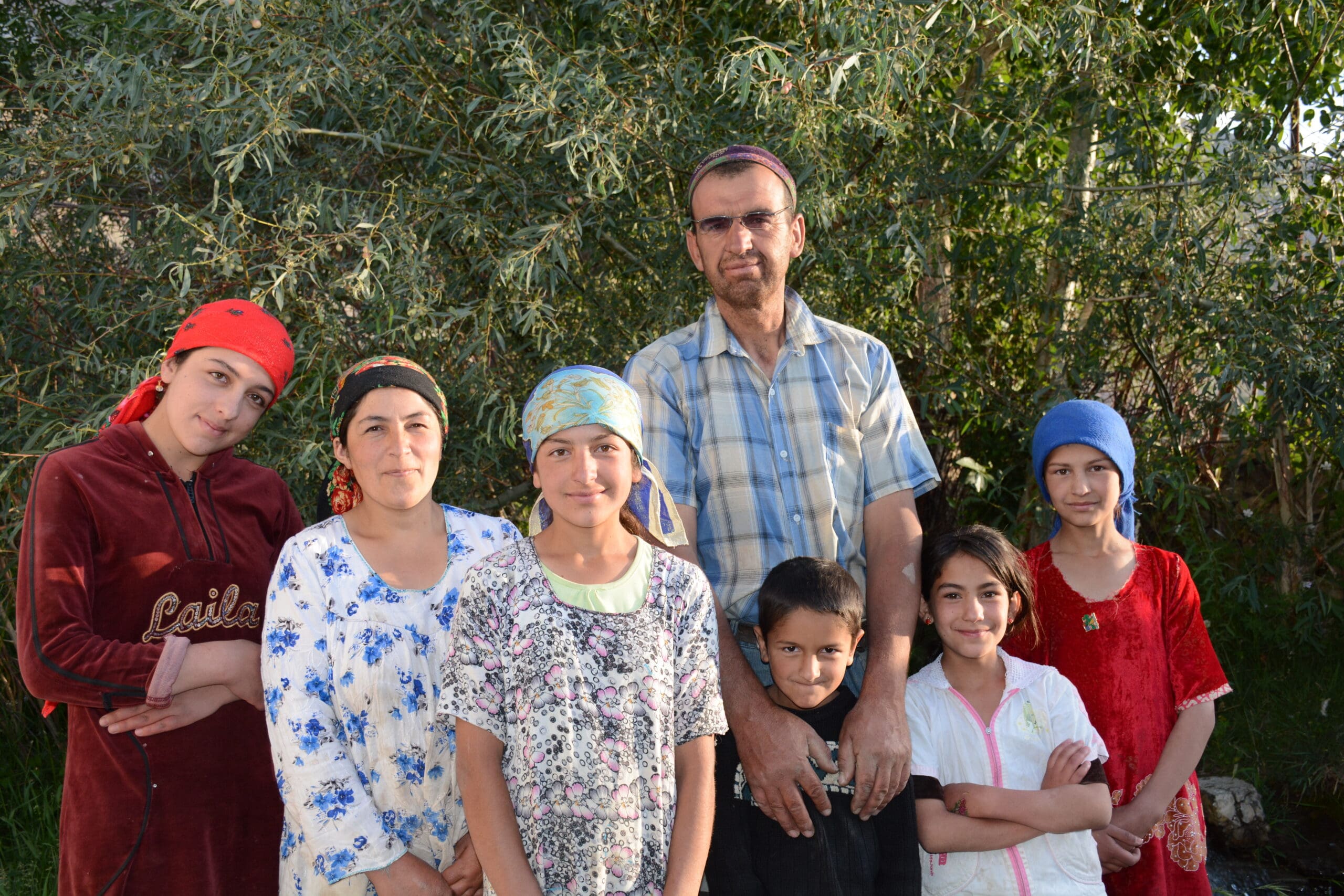
Spotting a small creek on the side of the road, a tributary to the larger swift-rushing river, I backed the truck into it to wash off some of the silt-like powder that had hitched a ride. No sooner had we unpacked our bucket and wash brush than three young girls who had just carried some old window frames across the road came back. As they walked over a small footbridge, the last girl stopped, waded out into the water, took the brush from my hands and started to help me. Monika and I both looked at her and each other in surprise. In these countries, girls of any age don’t approach strange men. She spoke no English and little Russian, only Tajik and the local dialect. But words were not necessary.
There was a magic of wonder in her eyes, along with a smile that said, “I don’t know who you are or where you are from; nevermind, I’m going to help you.”
We were captivated by this young girl who we nicknamed Masha, only 11 years old. We camped there for three days and met her family, who invited us for tea. Each time we saw her and those mysterious eyes, always discreetly catching ours, we could sense her uncomplicated imagination fueled by the burning desire to communicate. Was it her innocent confidence that shyly said, “No fear, bring it on?” Without a single word spoken, she had captured our attention and our hearts.
We started to speculate on how we could help her. Even six months later, after traveling through Kyrgyzstan, China, Mongolia, Russia, South Korea, and Japan, every time we looked at the pictures we had of her, the feeling came back. Through a series of emails, we were able to contact a young man, Sheroz Naimov, the director of the American Corner in Khorog, a free learning center sponsored by the American Embassy designed to promote mutual understanding between the United States and Tajikistan. Khorog is a small town, hardly a city, and the capital of the Gorno-Badakhshan Autonomous Region (GBAO). Situated in a valley at the confluence of the Gunt and the Panj rivers, at 7,217 feet above sea level, it is relatively low when you consider that 50 percent of the country sits at over 10,400 feet.
Khorog is at least three hours from the village where Masha is from, on a road that can be closed by snow or rockfalls at any time. We learned that there was a prestigious private school in Khorog sponsored by the Aga Khan Development Network (AKDN). His Highness, Prince Karim Aga Khan IV, is the founder and chairman of AKDN and is the 49th hereditary Imam of the Shia Ismaili, a very unique and liberal sect of the Muslim religion. There are no mosques or minarets; their home is their church. And women are not required to cover their heads or faces.
Sheroz volunteered to help us. Hitching a ride with a friend to Masha’s village, he spoke to the family and explained that we wanted to sponsor Masha in the Aga Khan Lycée school. His words were met by tears in the young girl’s eyes. Her father called Sheroz the next day to ask disbelievingly, “Is this really going to happen?” Yes, Sheroz told him, but now the first problem would be finding a safe place for her to live in Khorog. Secondly, could she pass the entrance test with her very poor math and Russian?
Sheroz’s father and his sister both opened their homes to her, providing Masha a place to live most of the year while she was at school. Extreme generosity and hospitality are a cornerstone of the Shia Ismaili faith, but the amazing warmth of these people still astounded us. Masha did not pass the school’s entrance test, at first. After three months of intense tutoring, she made the grade. She was 12 years old, nearing 13. We supplied Masha with a phone so that she could call her parents. A computer, printer, and appropriate “city” clothes for four seasons were also necessities. There are other expenses such as a uniform, daily transportation, school supplies, and tuition at Aga Khan Lycée school which is around $48 a month, but the costs are minor when measuring the opportunities they allow. Sheroz arranged a modem and internet connection for Masha, allowing us to Skype and WhatsApp.
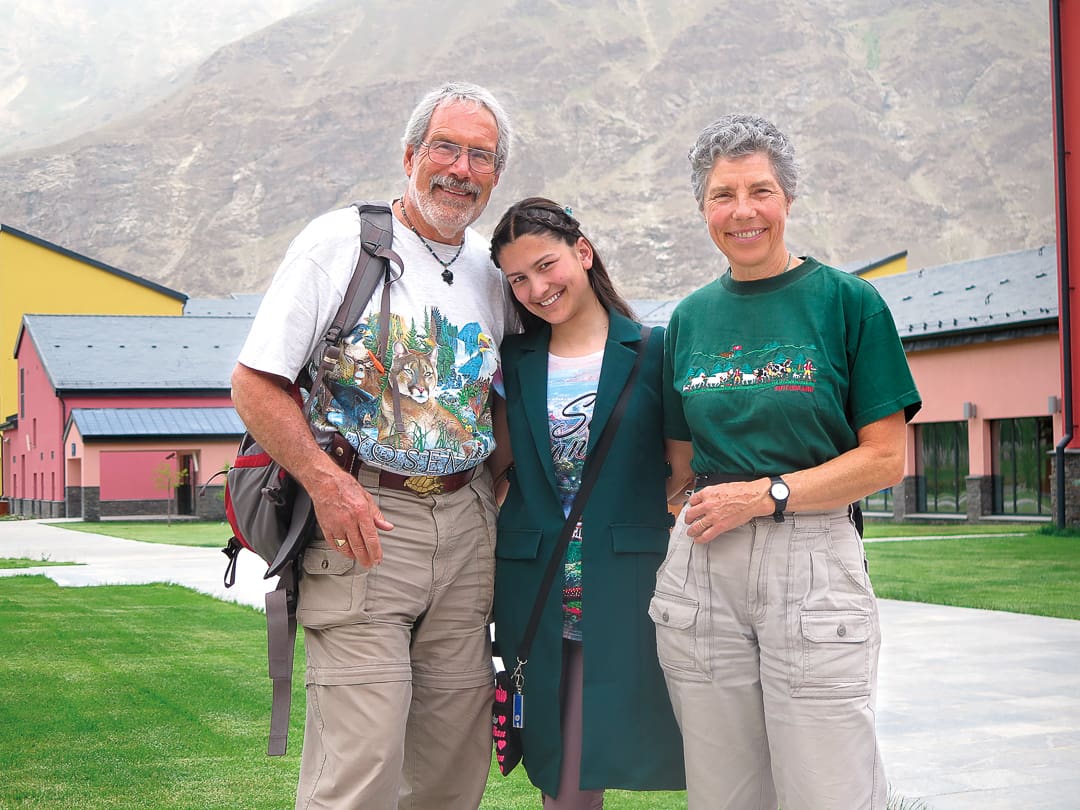
In the beginning, Sheroz had to translate for her, but her smile and the sparkle in her eyes told us she was making the transition from remote village life to being a modern teenage girl in a “city” environment. The difference was great: away from her home, family, and friends, daily chores had changed from gathering firewood and milking goats to practicing her studies and household chores such as cooking. We celebrated Masha’s 15th birthday with her new school friends and family live on Skype—amazing when you consider that Khorog is 7,525 miles and 12 time zones away. She is essentially in her sophomore year of high school, taking 17 classes six days a week with special English and math tutoring after school.
We recently journeyed to Tajikistan to visit Masha and her family, a grueling 26-hour hop from Sacramento to San Francisco to Istanbul to Dushanbe and then a 14-hour drive in a 4WD to Khorog—then another three hours by 4WD to her village. Spending three days at her home in the mountains opened our eyes to conditions we were truly not aware of when we were invited for chai in 2014. It is a unique way of life for the people in the Pamir Mountains who have survived in this remote part of the world for hundreds of years. There is no running water. All washing, dishes, brushing of teeth, etcetera, are done in the irrigation ditch conveniently located in front of Masha’s traditional Pamiri home. The ditch takes its water from the river where cows, sheep, and goats graze. Cooking is done on an old, wood-fired metal stove, and water for tea boiled on an antique hotplate resembling a burner from a 1950’s electric stove. The bread is baked daily in a dilapidated Russian electric oven. As is the norm, we all slept on thin mattresses in a communal living room where meals are served, and all social activities take place.
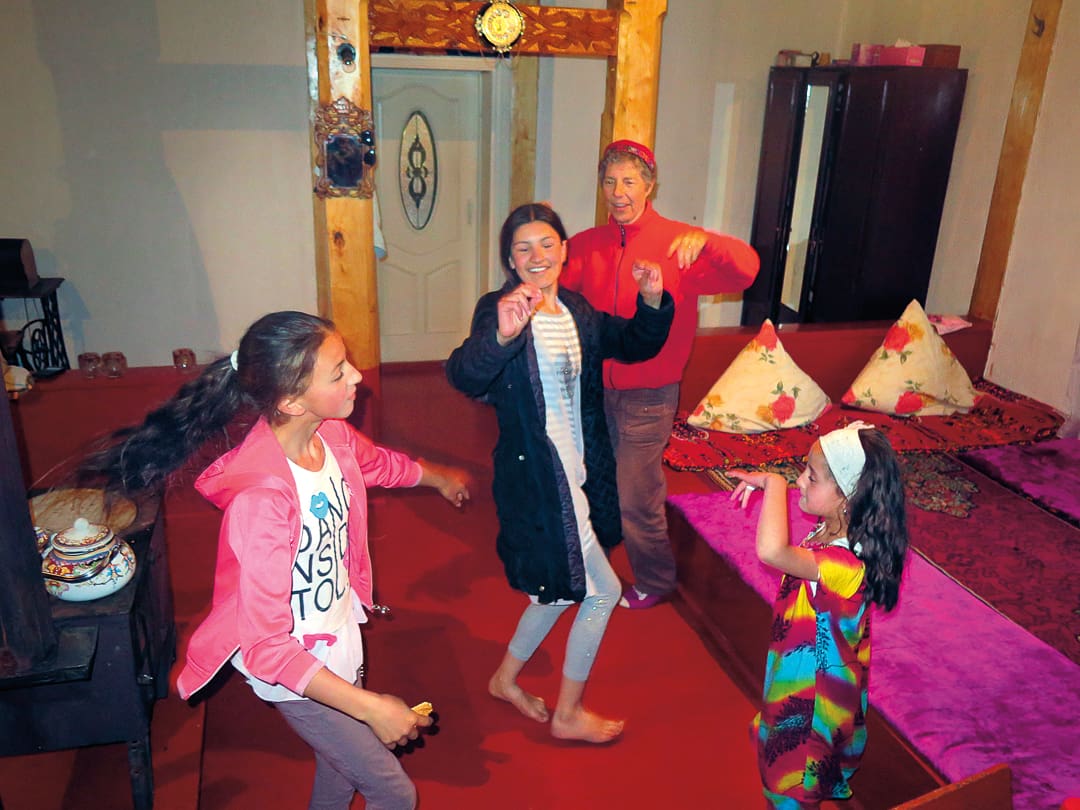
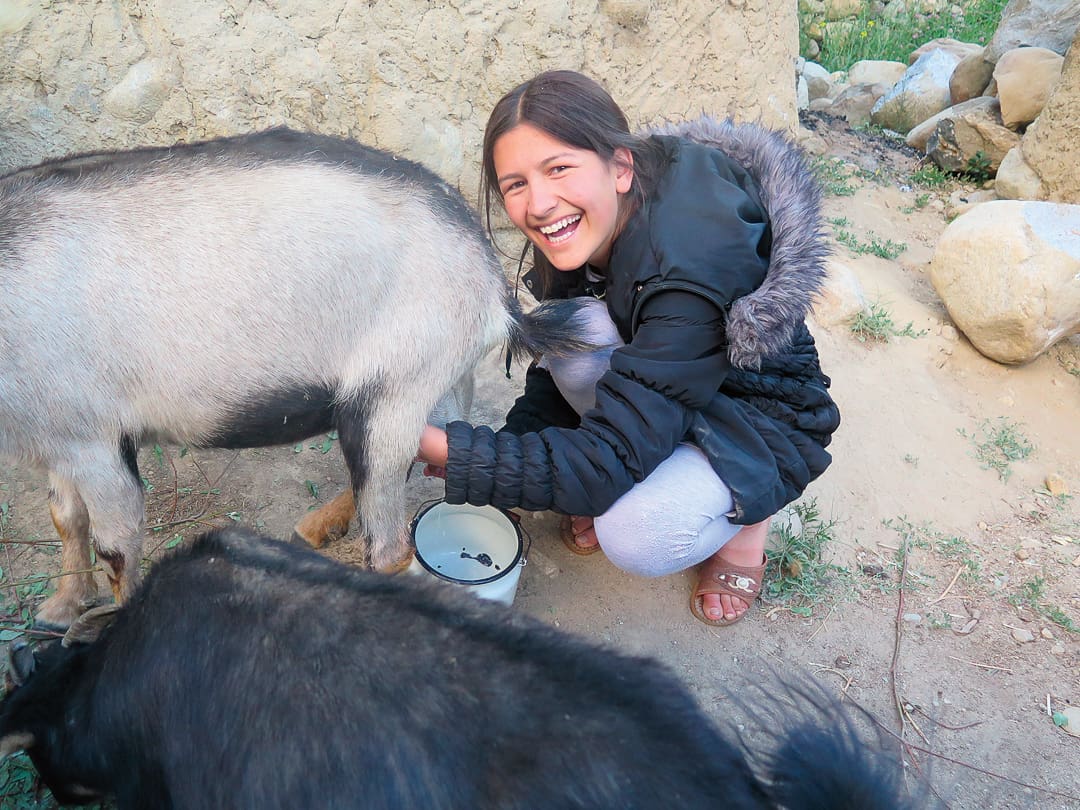
We brought gifts of fruit, chicken, eggs, and vegetables to contribute to the meals. At 10,000 feet, crops are limited to onions, potatoes, and wheat. The standard fare included bread, tea, and potato and onion soup with a bone or a piece of meat from a recently killed sheep to give it some flavor. The community is perhaps 15 or 20 homes spread out across a wide valley, in between potato and onion fields laced with a web of small interconnected irrigation channels. Many families are related, so when a sheep or goat is slaughtered, the meat goes to many homes.
At this elevation, winters are brutal. Animals must be kept in closed sheds because packs of wolves are a problem. Wood gathered during the short summer, and dried cow and sheep dung are the only sources of fuel for heat. We now had a much clearer idea of Masha’s background and the daunting change in her life that we must have offered her. When we met, her future was somewhat predetermined. Now her choices are plentiful, and no doubt a little overwhelming, especially at first. With two and a half more years before she graduates, her current aspirations of being a musician, actress, or doctor may change more than once. Our primary goal is to keep her healthy and happy while she is learning and to allow her the power of dreams.
Before we left Tajikistan, we took Masha and Sheroz’s niece to Dushanbe, the capital of the country. It was their first travel by airplane, and we had fun spoiling them in a new world of museums, zoos, shopping malls, hamburgers, Baskin-Robbins ice cream, pizza, escalators, elevators, and even a 3D movie. A comfortable bed in a nice hotel with unlimited hot water was special. Masha also had her teeth cleaned by a professional dentist, topped off by a manicure and a visit to a hair salon. The two girls returned to Khorog by themselves, by the standard 14- to 19-hour 4WD taxi into the mountains, their minds swirling with impressions from another world.
Our chance meeting of Masha and our ability to sponsor her and watch her learn and grow has become one of the highlights of our lives. It has been a real treasure of overland travel, and an experience we recommend.
Our No Compromise Clause: We do not accept advertorial content or allow advertising to influence our coverage, and our contributors are guaranteed editorial independence. Overland Collective may earn a small commission from affiliate links included in this article. We appreciate your support.