

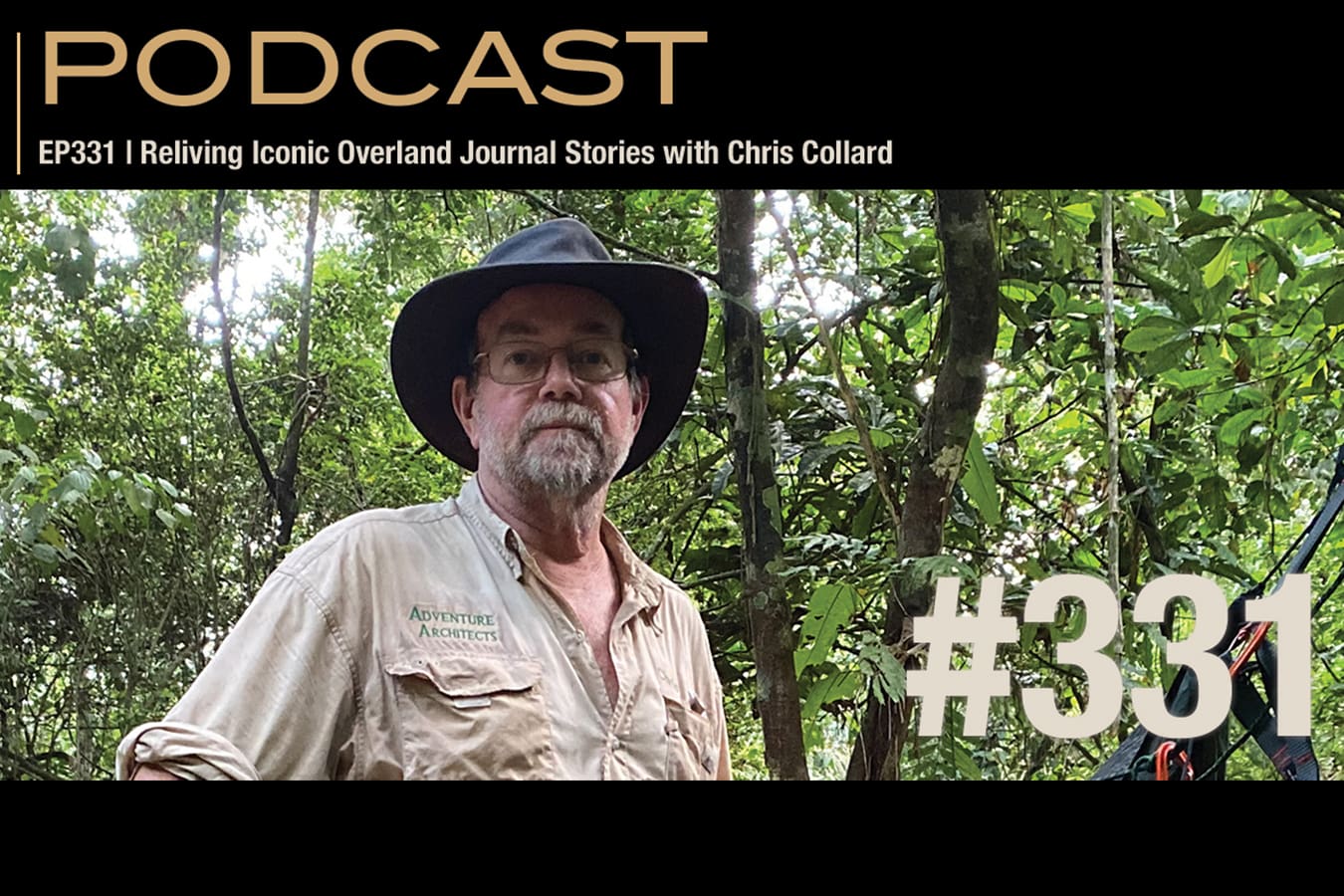
Overland Journal Podcast host Ashley Giordano interviews automotive journalist and former Overland Journal Editor in-Chief Chris Collard (2011–2018) as the publication approaches its 20-year anniversary. Collard discusses recent Sierra Nevada conservation initiatives, trips through Baja and South America, upcoming guided expeditions, and commercial automotive photography. He reflects on managing issue planning and performing data-driven product evaluations—covering coolers, shock absorbers, LED lights, and fire extinguishers—utilizing precise lab testing and field validation, including a transparently resolved ARB prototype failure. Additionally, Collard details international travel challenges, including an emergency appendectomy in Argentina and vehicle logistics in Kenya, emphasizing cross-cultural hospitality and practical safety. He concludes with vehicle insights, personal preferences, and encouragement for aspiring overlanders to begin exploring with existing equipment.
Overland Journal Podcast Episode #331
Tune in Apple Podcasts | Spotify | YouTube
The Overland Journal Podcast is brought to you this week by Hankook Tire and GME Radios
For additional heritage content and news, sign up for Overland Journal’s Weekly Dispatch: overlandjournal.com.
New to Overland Journal and want to grab a subscription? Visit Overland Journal and enter code: overlandpodcast at checkout for 20% off. We thank you for being a subscriber.
https://youtu.be/zOcUEXC4VrYyoutube.com/watch?v=a90B0CI3NhE&feature=youtu.be
Guest Bio:
Chris is an accomplished photographer and writer, with hundreds of articles and thousands of images published across six continents. His assignments have taken him through the Moroccan Sahara, the jungles of Venezuela and Cambodia, and on anti-poaching patrols in Kenya. In 2013, he was part of the Expeditions 7 team that crossed Antarctica. His work has appeared in US publications like National Geographic Adventure, Cigar Aficionado, and Motor Trend, and he has worked with commercial photography clients ranging from auto manufacturers to non-profits. He thrives on the path less traveled. When not working, he can be found on his sailboat, The Office, or conducting “research” in places like Tequila, Mexico.
Luminous Flux: Swim, Sink, or Shine; We Test Nine LED Driving Lights to Their Limits
Overland Journal Podcast: Adventures in Automotive Journalism with Chris Collard
Host Bio:
Ashley Giordano
Ashley Giordano’s first foray into overland travel involved a 48,800-kilometer journey from Canada to Argentina with her husband, Richard, in their well-loved but antiquated 1990 Toyota Pickup. Currently cruising along the iconic Silk Road in a 2008 Toyota Tundra, her full-time navigator duties are rewarded with bowls of plov and lagman noodles, hikes in the Tian Shan, and countless cups of fragrant Tashkent tea. As senior editor at Overland Journal, you can usually find Ashley buried in a pile of travel books, poring over maps, or writing about the unsung women of overlanding history, including her enduring inspiration, Barbara Toy. @desktoglory_ash

Our No Compromise Clause: We do not accept advertorial content or allow advertising to influence our coverage, and our contributors are guaranteed editorial independence. Overland Collective may earn a small commission from affiliate links included in this article. We appreciate your support.
Transcript
#331 | Reliving Iconic Overland Journal Stories with Chris Collard
Ashley: [00:00:00] Hello and welcome to the OVERLAND JOURNAL podcast. I’m your host, Ashley Giordano, and as OVERLAND JOURNAL approaches its 20-year anniversary, we’re catching up with some of the people who have helped shape this community, sharing stories, lessons, and adventures that brought us here. And with that said, my guest today is Chris Collard, automotive journalist extraordinaire.
Welcome back to the podcast.
Chris: Well, thanks for having me, Ashley. Looking forward to it. I’ve been, uh, catching up with some of your podcasts recently. They’re always interesting.
Ashley: Yeah, you were on with Matt Scott last time, so we’ll definitely include the link to that episode in the show notes so people can check it out.
Sponsor: And a special thanks to Hankook Tire for supporting this week’s podcast. What’s it like when over 20,000 Jeeps and more than 50,000 people get together in Pigeon Forge, Tennessee? We joined Hankook Dynapro [00:01:00] Tire to capture the awesome energy of the 2026 14th Annual Jeep Invasion. Keep an eye on expeditionportal.com for our upcoming event recap and get inspired.
Thanks again, Hankook.
Ashley: So Chris, what have you been up to lately? Give us the scoop.
Chris: Recent stuff, hmm, it’s interesting, like lately in the last couple weeks, I was up… Yesterday I was up at a conservation project up in the Sierra Nevada helping with, um, restoration for, uh, for a restoration at Meadow Lake, um, a lot of the stuff.
But in general, um, a lot of my travel’s been in, in Baja, in Mexico, and then I keep a vehicle down in South America with my friend Pablo, and I’ve done a several trips down there. Yeah, so that’s pretty good. A lot of local stuff. I want to preface it with that my dad’s 90 years old. Kinda now in that phase of my life where I’m taking care of my dad, so it’s, uh, kinda cut short a lot of [00:02:00] the, the, you know, the big month or two-month-long trips that I used to be able to do.
But we still squeeze stuff in.
Ashley: What do you have coming up that you’re really looking forward to in the next season?
Chris: So I am, yeah, I’m heading back down to Baja. Actually, I’m guiding a trip down to Baja next month, so actually in a couple weeks, which is fun, kind of for a group of friends. It’s not like contract for hire stuff.
I’m kinda gonna give them the, the highlight reel of northern Baja. So I’m super looking forward to that. And we got a couple projects in the works for early next year. A lot of the stuff that I’ve been doing lately has been, you know, it’s been taking a lot of my time as just my recur- commercial work with auto manufacturers doing, uh, contract photography.
So I was, uh, down with Jeep a couple weeks ago. Yeah, that’s what I’ve been doing recently. I- My kinda, mind kinda spins, so stuff in Australia or Africa or whatnot, but a lot of my stuff lately has been just North American commercial work. Yeah. So it’s [00:03:00] good. I have no complaints. Life has been great.
Ashley: Awesome.
I’m so glad. Where are you… Like, what are you excited about to go on this trip in Baja? Like, what do you have planned? ‘Cause you’ve been to Baja so many times now, and I bet it’s fun to just keep going back and digging up new, new things to see and do there.
Chris: You know, it is, Ashley, and that’s, that’s what I always try to do.
Uh, this is northern Baja, so we’re doing some stuff that I’ve done before, but bringing my friends down to Guadalupe Hot Springs, Kinsaga Bay, Calamway Canyon, around the old mission, and then up through the Catarina Boulder Fields, and El Morro Mole, which was the old onyx mine, one of the world-renowned onyx mine.
That was popular in the ’50s and ’60s. I still have a little chess set that I got when I was a kid in the, I don’t know, early ’70s, that I bought it in Tijuana with my grandma or my aunt, you know, couple onyx pieces. I had no idea what they were, um, as far as what they were made of. But anyway, yeah, doing [00:04:00] that, and then coming up, we might go up to, uh, the observatory if we have time around Mellon Ranch, and then north to, to Ensenada.
So short trip. We’ve only got nine days, but we’re gonna make the most of it. Yeah. And a couple of- Awesome … you know, a couple of new tracks.
Ashley: Ooh
Chris: I always like to find at least… I’ve got a map over here in the corner of my office of Baja that’s been up there for… It’s one of the old Detra play maps, and I think I probably started it around 1990 maybe.
Then I’ve just highlighted in, you know, all the tracks that I’ve been on, and then of course, there’s all kinds of tracks that aren’t on the map, and they’re just yellow lines going across, you know, white space on the Baja map. Yeah, looking forward to that. I, I would like to stay longer, but I come back and immediately go to SEMA, and then I’ve got a program project with Ram Trucks, so I would stay down there for months, but work gets in the way.
Ashley: It does. It does, doesn’t it? It was funny, I was in the used [00:05:00] bookstore here yesterday, and I came across the church and churches guide to camping in Mexico, and I was like, “Oh.”
Chris: Yeah. Yeah. I’ve got- Memories … I’ve got a whole back over here on my bookshelf. There’s like a whole… I’ve got, yeah, I got dozens of books on Baja from all of the historically famous writers.
The one I just finished was from Timberland. It’s called, uh, yeah, Hidden Gem of Mexico. It was published in 1959. That was about their trips down in this, in the, in the ’50s, of course. And you’ve traveled down there, so amazing book to just read their experiences going down south of Portocetus when it was like the old, old road that Arturo Grosso, Mespanoso’s brother made.
You know, he cut that through in the early ’50s, I think, with pickup truck and a couple of friend laborers and a bunch of cases of dynamite. So they went down. This, this couple had been traveling down a lot, so it’s [00:06:00] awesome to read about that stuff and their experiences going around on the old road around Conception Bay and talking about places like Los Coyotes, and the only thing there at the time was a ranch that was run by the Ramirez family.
I mean, super cool stuff.
Ashley: So much. So we have obviously the 20-year anniversary coming up, and you were editor-in-chief of Overland Journal from 2011 to 2018. What were the biggest challenges and wins during those years?
Chris: Well, uh, let me think about that. Um, I had been on the editorial side for quite a long time, uh, from a contributor side to all kinds of different publications.
So stepping in and taking over Jonathan Hanson, who I think did that and just an awesome job of steering the ship, um, you know, were, were big shoes to fill And so when I came in, I kind of looked at a blank slate and had to kind of start from scratch a little bit. So Scott and I sat down [00:07:00] and talked about, you know, I mean, obviously we’re both familiar with the sections of the magazine, but looking at forecasting out on the, our asset list, you know, what’s gonna happen in spring and then summer, and, and what gear tests we’re gonna do, what big gear tests we’re gonna do, what the next gear issue’s gonna look like.
So it was, uh, you know, it was a lot of fun. It was a good chapter. It was, uh… I had, uh, I’d actually met Scott– I had done a multi-part series on Mexico around 2002 or so for a magazine and, and the editor, a, a subscriber had w- written a letter in, and the editor forwarded it to me and basically said, “Hey, that was awesome stuff on Baja.
It’s exactly the stuff I wanna do,” and complimentary. I was like, “Well, that’s nice.” So I emailed him, uh, and it was Scott, and, uh, you know, we kinda stayed in touch after that and intermittently. And a few years later in 2005-ish, he called and said, “Hey, I’m starting this thing called Expedition Portal. [00:08:00] It’s gonna be awesome.”
It’s this website. He told me all about it. And, and I was like, “Okay, great.” So I, you know, checked it out. I think I created an account. And then a couple years later, uh, he called again and said, “Hey, I’m starting a magazine.” And I’m like, “Wow, okay. That’s pretty bold.” Like, I– Like, you are familiar with the fact that they just killed about 25 labels in the automotive space recently, and I think it was maybe Primedia at the time that was running all the, it was the private equity that was running all the magazines.
And he goes, “I know. I know. I know. But it, it’s gonna be different.” Um, like, all right, that’s a gutsy move. And he said, “Can you send me 60 bucks for a subscription?” I’m like, “Yeah.” So, you know, I like supporting the people that are willing to get out there and put it online and create something new. So I, you know- send them the 60 bucks for the sub- be a charter subscriber, and I just believe in that.
There’s a lot of– There are a number of other… It’d be Jonathan Hanson that’s [00:09:00] doing his own editorial magazine project, real nice, Expedition Quarterly. The folks with, uh, the Mountain Gazette came back out a couple years ago, which was a really nice large format. I actually met with those guys about a month ago down in Napa Valley area.
But I, I appreciate anybody that’s willing to jump out there and do something like that. So yeah, I was the editor for seven years. He contacted me when Jonathan was, uh, leaving and jumped in and, and did the best we could. Did the best I could.
Ashley: I was astounded at the variety of articles. It felt like you were all over the world all the time, writing from all these different places on these big, big trips.
And yeah, it was, it was quite impressive looking back at, at all the stories and all of the gear reviews. The main gear reviews of all time, just incredible articles. I was looking at Luminous Flux, which was on accessory lighting and Auto [00:10:00] Flambe, which I’ll let you- Oh, yeah … talk about.
Chris: Yeah.
Ashley: Really, really in-depth testing that was done.
It’s just like next level gear reviews. Yeah, tell us a little bit more about that experience.
Chris: One of the benefits of, you know, I was a contract editor, but technically I was, you know, staff, is that having the latitude to do proper gear tests. And when I say proper gear tests, like the one– if you saw the one we did on ice chests.
But it’s not just throwing a block of ice in, looking at a bunch of coolers, sitting in the sun, and picking which one you like the best color for. You know, we got into some pretty heavy details on those tests, and I appreciated that. We tested shocks, and it was basically a three-test, uh, three-state test.
So we tested them with Joe Bacal in Arizona, and I went down and, uh, I know, uh, Dylan from, uh, Icon Vehicle Dynamics, and he allowed us to use their lab on all the shock, all the [00:11:00] dynos. And you, you know– And he knew going in, it’s like all these tests when I worked with a manufacturer, when they allowed me to– us to use their labs, you know, they also knew it’s like whatever comes out, comes out.
If it’s good, bad, or ugly, you know what I mean? This is the real information as to what’s gonna go apparent. Rather than having the constraints of pay to play, which is like, “Oh, you run an ad or we’re gonna run your, run your, um, your story, and it’s gonna sound good.” So we never did that. And the shock test, the next thing, we went up to my buddy Ned Bacon’s place.
He’s got a mountain, a mountain racetrack behind his house in Minden, Nevada, 30 miles long, and we gave them a proper test. So it was, it was very time-consuming to do those types of tests. And they took-
Ashley: I bet …
Chris: weeks or sometimes months to actually do it right. And then analyzing the data and making sure that we were accurate so that it was a test that, that– an industry standard test with somebody in the industry that knew what the heck [00:12:00] they were talking about to look at it and was like, “Yeah, your product didn’t do as well as we thought, but they did everything right on the testing.”
So, so yeah, it was fun. And there were some challenges. We had… Excuse me. We had, uh– We tested LED lights, driving lights. And I knew a guy that his, his business was making surgical headlamps for surgical– for cardio surgeons, and cardiovascular surgeons, and neurosurgeons. And he said, “Hey, you’re welcome to come down to LA and use my lab.”
And so that was a big deal to have access to that type of equipment for testing LED lights, you know, looking at the lumometers and all that stuff, doing, uh, thermal degr- de– thermal degradation tests. And, you know, people say some of the challenges or things that happened We had, when ARB came out with their, it was AR 32, which was their new big awesome LED blind [00:13:00] the, blind the deer in the headlights, uh, lights.
Lisa Wood was their marketing director, sent me two of them, and we tested them. And after we did the submersing test, and if you saw that article, you probably saw the lead picture was all of a bunch of LED lights that were lit, and they were in an aquarium with a bunch of fish swimming around. Yeah. So I was trying to think, how do you make an impact statement for a lead image?
And that’s, that’s what I came out with. I bought an aquarium and a bunch of goldfish, and dropped them all in there and hoped that the fish would not get electrocuted. The, the fish mostly survived.
Ashley: Mostly?
Chris: But anyway… Yeah. They did survive. It– We didn’t electrocute any fish. Good. But they were goldfish, and goldfish just die.
Anyway, so we did that test, and then we were doing a thermal degradation test, and the lights started creating these little tiny droplet, vapor droplets on the inside. And I’m like, “Uh,” the last thing I ever wanted when I was doing the gear test was for something to fail because I wanted it to… You know, I don’t [00:14:00] want stuff to fail.
I want everything to succeed. Some succeed better than others. But it w- you know, it had leaked obviously. So we were in a dilemma because we as a magazine did not reach out to manufacturers. Once their product was in a test, it was in a test. Like you said, good, bad, or ugly. Yeah, I knew Lisa Woods very well.
I traveled with her in Australia, and I developed a good relationship with ARB, and I knew that these were like two of 10 lights that had been made. They were actually prototype lights. And so, you know, I talked with Scott, I talked with Brian, and the decision was made, we’re gonna call them and let– call Lisa and let her know that their product failed and why.
And the conversation kind of went like this, that I said, “Lisa, I got bad news for you. This is what happened.” And I could tell she was like, “Oh.” And I asked, “Where are the other lights?” And she said, “Well, six of them are with the US Army for testing.” And yeah, it was really bad. [00:15:00] But I, I, I said, “You know, you should probably call them.”
And I told her w- you know, about all the testing. I told her how it failed and what I thought it was. She was like, “Okay, that’s my next call.” So it all worked out. They realized that, that they were able to get the lights back and sort it out, that there just, you know, had a bad seal in the connection where the wiring came in, which was something a manufacturer would completely wanna know, especially somebody that’s making a very high-end product that has potential for military contracts.
So, yeah It worked out, but it was one of those, it’s one of those challenges that you run into, um, you’re gonna run into no matter what you test.
Ashley: Mm-hmm. Hmm. Can you describe the auto flambé test?
Chris: Yeah. For, if I remember that correctly, we were testing fire extinguishers.
Ashley: Yeah.
Chris: Yeah. And- You know, we thought what better way to [00:16:00] test a fire extinguisher than to use it on something that, uh, you run into on the trail occasionally or on the road, and that’s a vehicle on fire.
So yeah, I’m trying to remember back. Actually, the vehicle that we got, it was just an old junker wreck vehicle that we were able to, uh, you know, light it on fire. Basically, yeah, test each of the fire extinguishers for, for how well they worked. You know, the different, you know, different types of fire extinguishers, what they, you know, their efficiency level on a given type of fire, whether it was water and wood or oil.
Usually, the biggest ones we’re worried about are gonna be the, the petroleum product fires. So yeah. It made for a good graphic. Again, we’re a really visual society, so if we can add something that’s kind of fun to look at as they open up to see what they’re gonna read and to grab somebody… I guess that would’ve been maybe early clickbait before the term clickbait came around.
Ashley: Yes. Yeah, [00:17:00] that was back in 2012. Yeah. What else was there? You mentioned another one.
Chris: Hmm. Help me out. I don’t… A lot of that stuff-
Ashley: Yeah. I think it’s important- Okay … to de- for you, like I, I like what you said there because not necessarily the case that readers will realize how long the gear’s been tested or, you know, uh, for those LED lights, you were out in the desert for several days testing lights in different ways and then in the lab and, um, a lot goes into those tests- Mm-hmm
and a lot of time and effort. And the cool thing is it just comes out in a nice little article that’s very succinct, but, um, it’s amazing what goes into them.
Chris: Yeah, and they– I, I’ve always wondered how much… If people actually got through the entire test, which went into great detail on the importance of each of the testing, uh, measures and detail on the results of why it was important.
I’m glad you mentioned that about the desert- Mm-hmm … ’cause yeah, James Lanken and I actually [00:18:00] went out, and this is the test, part of that test was in LA, but another part of the test was up on the Black Rock Desert in, in Nevada, um, doing range testing. So we went out and set up, you know, stakes out for a couple thousand feet, white stakes, and each one was painted with, uh, a number of feet on it, and then we were doing incident light reading measurements at each stake for each light in the middle of the night.
So that test was, yeah, it went on till 4:00 in the morning or so. Yeah, they were, they were fun. They’re a lot of work, but, you know, always look back and think like, “Yeah, that’s, that was a worthy project.”
Ashley: Yeah. Pretty neat. I’m gonna include the, a link in the show notes to Luminous Flux because we’re taking a lot of the heritage content from the journal and putting it on Expedition Portal so people can read that article as it went out on portal.
So I’ll put that link in and you all can read it. But what were some other shenanigans or fun moments during your time at [00:19:00] Overland Journal?
Sponsor: And a special thanks to GME for supporting this week’s podcast. When you’re miles from cell service, communication isn’t a luxury. It’s essential. Introducing the new GME XRS-660-U, a premium handheld GMRS radio built for serious overlanders.
Made in Australia and engineered for the harshest conditions. It features built-in GPS, Bluetooth connectivity, a sunlight-readable full-color display, class-leading two-watt speaker, and rugged IP67 protection. Whether you’re leading the convoy, spotting mates on the trail, or exploring off-grid, the XRS-660-U keeps you connected when it matters most.
Upgrade your communications game and discover the [00:20:00] new GME handheld today. You can visit them at gmeus.com. Again, you can reach them at gmeus.com. Thanks again, GME.
Chris: Well, let’s see. Let’s see, 2011 to 2017, uh, ’18. Wasn’t necessarily an Overland Journal project, but I was … This vehicle that I’ve had in South America with Pablo.
I used to own it with Christian Bucker, who was a technical officer at Overland International. And, uh, my wife and I, he had … We bought it together, and he had left it in Cusco. And my wife and I flew down To pick it up, and we were gonna eventually make our way to Buenos Aires. But, uh, we got into Puno and we got a little Airbnb place to sleep and got some food, and we got sick.
My wife got sick the first night. I got sick the following night with food poisoning, which was fun because she got sick in, in the Airbnb. [00:21:00] I started to get sick in the middle of a plaza down towards Chile, in a little village in the middle of the night, throwing up on my shoes, and it was unpleasant. But we, uh…
I found I had pulled a muscle in my side because my side continued to hurt, and we just, we just kept going. I thought, “Okay, well, this will…” Well, I mean, it was a pretty gut-wrenching affair, and we kept going. We crossed down into Chile at Arica and went down the Chilean coast and then up over the Andes near El San Pedro de Atacama.
But it continued to bother me. It continued to hurt, and just as we crossed into Argentina, I realized, like, this is not a pulled muscle. This is really, this is something serious. And I asked my wife to drive. I was like, “You just gotta get me to a town.” So we ended up getting down into the valley, and we stopped at a, a village.
It was late. We got a, got a room, and she went out to find some food and, and that’s when my [00:22:00] appendix ruptured. And she came back, and I was on the floor.
Ashley: No.
Chris: Fetal position. Yeah, just like the most excruciating pain that I’ve, I’ve experienced for sure. Like somebody sticking a, a searing hot pitchfork into my stomach, into my side and, yeah, it was totally not fun.
I just– I was laying there when she came back in. I was just thinking, “Okay, well, this is the way I’m gonna check out of this planet.” She was able to call a medic. It was at a clinic in town. It had been hospital, but at the clinic, and they picked me up in a backboard. They called it an ambulance, but it was kind of a backboard.
Got me to the clinic and shoved some morphine in my arm, and I was, like, very appreciative of that. And suddenly everything was, you know, flowers and, and daisies, rainbows and daisies. But, uh, they did a, they did– were able to do an ultrasound, and they did that, and they said, “Ah, it’s appendicitis. It’s appendicitis.”
And then I realized, you know, needed to get to a [00:23:00] hospital. And that was in Resistencia, which was about four hours away. So my wife, this was probably 11 o’clock in the evening, my wife threw me in the car, shoved me in our, our four-wheeler and started driving, and we got into Resistencia, and they had been forewarned that we were coming.
In the meantime, I called Red Point. Red Point, it’s a medical evac service that I subscribe to. And, uh, they were on the phone with the hospital as I got there, and they assessed, came up with the same, uh, diagnosis that my appendix was pretty much gone and needed to come out. The Red Point people said… had been conversing with the doctor.
It was a, it was a… I’m gonna back up a second. It was a kind of hospital. It wasn’t like the one I was in in Morocco, but it was pretty third world. The room that they rolled me into had electrical plugs hanging off of wires on the, on the wall. It was little sand dunes blown through the hallways. It was a, a public hospital.
[00:24:00] Argentina has two systems. They have pay-to-play, then they have public, and the public is for everyone. So it would be what you would be call a single-payer healthcare or socialized healthcare, and it is free for everyone, including wayward tourists that rupture their appendix and come crawling and begging for help.
So it was super, super humbling. But definitely cared for and in, in some respects, not third world in the fact that they were able to keep me alive The folks at Red Point talked to the doctors. They got the timeframe for my wife and myself, and when I finally talked to them, this would’ve been around 11 in the morning of that day, that next morning.
They said, “We can get you to Buenos Aires of a first world hospital in about 18 hours by basically a charter plane.” Whoa. “But, but we’re not sure you have that much time based on what you’re telling us.” So, you know, I looked at my wife and I was like, “Well, we’re doing it here.” [00:25:00] I, you know, I do understand ruptured appendix and, um, if it goes septic, you’re pretty much done.
So we decided to do it there, crossed my fingers. They wheeled me into surgery a couple hours later, and I gotta watch the whole thing. It was like they didn’t, they didn’t put me under. They gave me an epidural, so it was basically a spinal tap, so it numbs the certain part of your body. Actually, everything from my chest down was paralyzed, which I did not care for.
Uh, but there was a- Yeah … like, there was like a privacy screen between myself and my stomach. Dang, this is… My photographer side of me is like, “I can’t believe I didn’t bring my iPhone or whatever I had at the time, iPhone,” so I could like at least like go over the top and video down and take some pictures of what they’re doing.
Like, you gotta entertain yourself when you’re laying there helpless. No. So yeah. But there was on, [00:26:00] on the wall, there was like a two-way mirror or piece of glass, so I could see what they were doing. I could see the reflection of what they were doing. And, and before the doctor came in, uh, Dr. Booth, by the way, guy was an angel.
The nurses are prepping me and doing this, and they pull out this book. It looks like a Chilton auto manual. You know them Chilton auto manual books? And they’re flipping through it, and they’re like, “Ah, appendices.” And then they’re pointing at my stomach. “Es aqui?” Is it here? Is it like… I’m like, “Hey, hey, hey, hey.”
It was a little bit concerning. And then, you know, Dr. Booth came in, and they had discussions, and he started cutting away. And a few, you know, 30 minutes later, I guess it was, he read, you know, read- looks over the privacy screen with some long tweezers with this dangly little thing that looks like a bloody finger on it and goes, “Ah, two appendices.
Two appendices.” I’m like… I was like, “Can I, can you put that in a jar for me?” You know, [00:27:00] souvenirs. Put it in some formal- formaldehyde and, uh… Anyway, did not do that. But I was, uh, super humbled and extremely appreciative of Dr. Booth and his staff. Uh, my wife for hanging with me, and, uh, other… I- actually, if you look it up, Ashley, I wrote one of my columns.
It might have been one of my columns or a Tale Way Up called Angels of Argentina. And that would’ve been probably right after that, 2018 or so. And that was about all the people that, that helped. Helped me, helped my wife, helped us with the vehicle, a place to store it, helping to get it transported. ‘Cause as soon as I was out, I was…
They had me on a, on a, on a IV-only diet for five days. No food. I couldn’t put anything in my mouth. No water, nothing. And, and then, uh, I was out, did outpatient Well, I came in after this first day after, let’s see, the first– I came in first day for a fo-follow-up appointment. I still had the drainage tube in my [00:28:00] side.
And, and we’re having this discussion, doctor and the nurse are talking, and I’m sitting there with my wife, and she’d been checking on flights with Delta, explained the situation. We’d already missed our flights of, you know, explaining what we’re been doing. She temporarily, um, she reserved some seats on a flight like 48 hours later.
And we’re just sitting there talking kinda. I’d missed the part that said, “Pull the tube out,” ’cause suddenly the, the nurse just grabs this tube and pulls it out, and I thought it was coming around like jugular. Just wound around my stomach. She’s like, “Okay.” And I’m like, “Man, that, that’s smarted.” It was literally, it was like this.
It’s a fishtail, maybe a fishtail. But it was, it was– had to be like 18 or 20 inches long at least. But they pulled that out, and I looked at my wife and I was like, “We’re getting on that plane.” I’m like, “We’re gonna get the vehicle sorted out.” We had help with that, with a wonderful family that we met through a friend of a friend.
And yeah, so they got the vehicle. We jumped on a Argentine Air flight to Buenos [00:29:00] Aires, overnight in a hotel, and got on a Delta flight and headed home. Checkered out.
Ashley: Wow. My God.
Chris: Yeah. That was an adventure during my tenure at, at Overland Journal. We, I, you know, did all kinds of good stuff besides the gear tests.
I did the project in, in Cambodia with Sam Watson, awesome guy, one of our– he was one of my contributors at the time. I think he probably still works with the Journal. British guy, spent years exploring the Sahara and parts of Africa, other parts of Africa. So we spent a couple weeks in Cambodia and then we headed down to Nairobi, and had lined up a vehicle for, uh, exploring Tsavo in the south and then Meru up in the north.
And the vehicle didn’t work out, so we were there, boots on the ground with no vehicle, scrambling for anything that was four-wheel drive that we could hire for two weeks. There was [00:30:00] nothing available. And Sam, finally, he reached out to a company that he had worked with years earlier on a, with, with Born Free Foundation.
‘Cause this, this project we were on was gonna be working on was with Born Free Foundation. Anyway, this beautiful British, uh, I’d always– Well, I don’t know the word I’m looking for, but, um, pleasantry. They said, “No, I’m sorry, Sam, we don’t have any vehicles.” And poor Sam, I would be like, “Oh, come on, you gotta give me something.”
And Sam’s like, “Well, it’s so wonderful that your business is going so well that you don’t have any vehicles. But if there was anything available, anything, that it would be a speed.” “Wonderful if we could hire.” And then, then the person said, “We, we do have one vehicle back here. It’s, it’s a shop truck. It hasn’t been in the, in the bush for a long, long time.”
And he’s like, “Well, what type of vehicle?” And it was a, a Range Rover Classic, a 1973 with a rooftop tent. Doors didn’t close right, none of them locked. The back rear [00:31:00] gate and the tire were just like an accordion. And that rooftop tent didn’t have any– the zippers were all torn out. And we were like, “That’s perfect.
We’ll take it.” And we had a vehicle, and it was perfect. We called her Mama, Mama Lasimba. I think that’s correct. Yeah, Mother of Lions. And she rattled. She like– she had that Crossfire V8 and just was really, really thirsty. But we had this vehicle, and it was, like, perfect for what we were doing ’cause it rattled like crazy.
Nothing worked, but it, it was able to stay running mostly. One exception, we kinda got lost and, and ended up on the smuggler’s route to Somalia When we were trying to find our POC for in Nairobi, and it was, you know, we were– the instructions were come to this town, take this left and just follow it out until the track gets really, really rocky and just keep going.
We’re like, “Okay.” We did that, and, um, we followed this track, and it became really, really rocky and just kept going. And pretty soon we’re out, like, a couple hours, and it’s [00:32:00] midnight or so. And I was thinking, “This just– this is, is not– this can’t be right.” And then the thri- I was driving, the throttle went to the floor, and she just died.
And I’m like, “Oh, that’s not good.” Um, so we’re tinkering with that. T- S-Sam is trying to get any bar on his cell phone, you know, to try to make contact, uh, with no luck. So I’m laying underneath the dash of this Land Rover with my Leatherman, my headlamp, and a spool of bailing wire that I kept in my camera bag and some duct tape, emergency supplies.
And we hear– Sam is like with a– with his torch looking at the bush because this is the land of the bogeyman. It is like lions and tigers and bears, and there’s no one around. We hadn’t seen anybody for hours. And, um, we hear a vehicle approaching, and I could hear it coming, and I’m like, uh, like, “What’s that, Sam?”
And this, like a ’79 series, uh, Land Cruiser pickup, a U with a tray back. It goes, comes flying up through the bush, passes [00:33:00] us, never lifts off the throttle, and just keeps going. And we’re like, “That was weird.” It was this Land Cruiser with a whole bunch of bales of something in the back. And Sam explained this to me ’cause I’m laying on my back underneath the vehicle.
And a few minutes later, it was like step and repeat. The same thing happens again. And I’m like, “Oh, this is, uh, this is…” But we didn’t realize we were on the smuggler route to Somalia. But, uh, the third one went by, and Sam got one bar on his phone, and he con-contacts Victor, our POC, and he’s like, “You are in the wrong place.
You need, you need to go back to town. Go back to town. You’re in a dangerous place.” He– Uh, I think it was 10 words or something like that. And so I finally got the throttle fixed, and we bogey back to town to, uh, the next… We met him at about two o’clock in the morning, and he’s like, “Oh yeah, this is– that’s like the smugglers.
Those are all khat, khat smugglers heading to Somalia.” So we’re glad that we-we were just some stupid lost tourists, and they had more [00:34:00] important things to do.
Ashley: Yeah.
Chris: Then stop and look at us. So you’ve traveled, how stuff goes sometimes and you’re like, you look back, you’re like, “Oh, yeah, that must have been pretty fun at the time.”
But at the time you’re like, you never know which way things are gonna go.
Ashley: Yes. Yes. Absolutely. At the time, yeah, you’re like, “Nope.” And then it makes for a good story afterwards.
Chris: Yeah. Yes. Yes. Exactly. So yeah, it was, again, back to Overland Journal, it was, you know, a good chapter for me. It’s like, you know, I was able to learn a lot about running a publication and building asset lists and managing a budget and, you know, met a lot of people.
I think that I’m pretty sure that I met the two of you guys while I was at the Journal and you guys were off traveling around the Americas. But we were– As an editor, I’m also looking at, I’ve got 100 and, uh, depending on how big, large the book was at the time, but 118 pages that you need to fill with content.
And so that’s like [00:35:00] a squirrel wheel, the rolling door. You’re looking at who your, your A-list contributors are that, who has the ability to do a good, decent gear test. James Langan was great for that, for specific things. And then you have a list of people that can provide good adventure stories and hopefully they know other people that can help fill that space as well.
And very visual magazine, the center of the book would always be all about photography.
Ashley: I’m curious, who is the most unforgettable person you’ve met on the road?
Chris: I’m– The most unforgettable person that I’ve met on the road. Now you’re digging because you meet so many amazing Yeah. Um, hmm. I’ll mention a couple of people, and they may not be the, you know, the quintessential, um, you know, but they’re memorable people.
One was John Blashford-Snell. So John Blashford-Snell is a British colonel. He led the 1971 expedition across the Geren Gap. He– And that was just one of [00:36:00] his many, many expeditions exploring the Blue Nile. In the name of this guy who served in the military, in combat, but when he got out, he still led a whole bunch of really ex- amazing expeditions.
And I was in England and connected with him. I was able to go to his house and interview him. And Bruce Dorn came along, and he managed all the video side of that. But yeah, John Blashford-Snell, amazing guy. Really amazing guy. We’re standing in his lobby where there’s this brass Gatling gun, basically, in his lobby.
It was a ex-military Gatling gun, which was… Has a, has a, a drum on it with like, like, I’m gonna say a drum. It’s basically, it’s nine or ten, 12 barrels like this and like a World War II Gatling gun. They would crank it. Just those early machine guns, basically. So I went in his lo- in, in his atrium of his house.
Um, but while we’re, uh, talking, he– Later after lunch, he prepared us lunch, and like this guy’s just [00:37:00] super humble and been there and done that, you know, everywhere in the world. Um, he’s like, “So, uh, would you like to see Stanley’s watch?” And I’m like-
Ashley: Just
Chris: casually … “You mean Stanley’s watch? Do you mean like Henry Worsley Stanley?”
And he’s like, “Yes, yes, yes. The family gave it to me as a gift a number of years ago.” And I’m like, oh, wow. This is, I mean, over-the-top cool. Yeah. So that, he’s definitely one of the memorable characters I’ve, uh, met during my time with Overland Journal. There’s so many throughout the course of, of travel. I remember, um, there’s somebody, and I didn’t, didn’t know his name.
Um, he was a port guard and a Duwana guard in Lima, Peru. We shipped a bunch of vehicles down in 1998 for the 20th anniversary of the expedition to Las Americas. So there was one of the, the young guard in the port. And we’re not, they’re not allowed to talk to anybody. It was a high, high [00:38:00] security area. But we’re in there, we’re getting the Jeeps out of the, out of the, uh, container.
And like on the third day, we were just about done, but he comes over to me and he’s like, he kind of, well, looks at me. He’s, he kind of nods like, “Come here.” Uh, and so we kind of meet, and he g- in his hand, he’s like, he kind of hands me this piece of paper, and he’s like, “Shh.” And I open it up, and it’s basically, it’s a drawing that he made.
And I looked kind of like this. I got pocket-y pants and, you know, my, my old safari hat and khaki shirt. And there was a guy that was, that was by the name John Kirch, and he was a very big guy, big guy. And so this picture, God, I wish I had it. It’s actually in my journal up on the shelf, my original journal.
It basically said, “Tall man and man with hat.” Tall man for John, and man with hat was me. And he, he looks at me, he’s like, “Indiana Jones.” So Indiana Jones is what his, his com- [00:39:00] his comment was. And I was like, that’s like, was like a, one of the greatest compliments because Indiana Jones, come on.
Ashley: Yeah.
Chris: He’s like everybody’s hero.
Anyway, that, that was, um, and that’s something that I’ve held. Actually, I think I wrote, I wrote either my column or a tail lamp on that as well. Yeah. Yeah. Well, anyway, that, that’s pretty cool. And you meet a lot, you meet so many amazing people on the, on the road. In the middle of Zambia. So in 2008, I spent two months putting together this thing called the Hummer Africa Expedition, you know, and I ended up running solo out of Lusaka up towards the South Luangwa area, and what they call the Blood Highway.
And I got off the highway because everybody said, “Don’t do– Don’t drive that road. You’re– at night, you’re gonna– drunk people come out in the middle of the road and they get hit. They’re gonna see bodies on the road. It’s very dangerous.” And about an hour into it, I realized that they were correct, and I pulled out my [00:40:00] Garmin GPS, and I had, uh, T4A, which is Tracks for Africa, which was like the go-to source for Africa tracks.
And I found this little track, a little faint track that went cut off two sides of the triangle that I was trying to drive. And I took it, and it ended up just being like a goat track down to these little villages, and it was midnight, dark. In the headlights, I would appear on a bicycle and a goat on the back and just– Was it the Wicked Witch of the West?
Riding a rickety bicycle by and just disappear by me and, and little small lights from campfires and the roundabouts off on one side. And around 2:00 in the morning, I was like, “Okay, I was getting tired. I’m gonna find a, a, a wide opening to sleep.” And I thought I was alone, but I stopped and set up the rooftop tent, and I’m getting stuff going, and all of a sudden this huge flash of light from across the road comes up, and somebody had like thrown some paraffin on a fire and lit it, and it lit up like nine roundabouts over on the other side of the [00:41:00] road, and I’m like, “Okay, so I’m not alone.
I got new friends.” I figured that they were just letting me know that they were there, I think. So I, you know, I went to bed. And I got up in the morning and, and I had a whole, you know, bunch of new friends. It’s so amazing, and this would’ve been 2008, I think. Six or 2008. I had a sat phone. I’m like, “This is incredible.
I’m gonna call my wife and just let her know how amazing this place is, and truly a place of muzungus or gringos, you know, don’t go.” And I call her and have talking to her, and earlier, a man on a mot- uh, on a bicycle rattled by, a really old guy with like a muzzleloader, literally like a muzzleloader, cap and ball muzzleloader.
And I’d say… While I’m on the phone with my wife, I’m like, “Oh, there’s the man with the, with the gun again.” And she’s like, “What?” You do not say that to your wife when you’re halfway around the world by yourself [00:42:00] in the middle of Africa. But the memorable part, that was memorable, but more so that these villagers who had noth- absolutely nothing w- were, as I came and met them, and we didn’t have a, a word in common, uh, in common language-wise, but they were willing to offer me a whole meal.
You know, and they lived in bundle balls, you know, branches with elephant dung packed around them. I mean, they were the poorest of the poor from a economic standpoint, not from a, a lifestyle standpoint, because they were living their ancestor had for countless generations. But compared to this rich guy that rolls in, in this Hummer with a rooftop tent and stickers on it, it’s like that is humbling when people like that are– They realize you’re a guest in our village, and we’re gonna offer you some mealy meal.
That’s all we have. That’s all we’re able to do. But that’s always very [00:43:00] humbling It reminds me how amazing- Absolutely … the people of the world are.
Ashley: They are.
Sponsor: And a special thanks to Hankook Dynapro Tire for supporting this week’s podcast. Hankook was recently at the Off-Road Expo in Costa Mesa, California, showcasing some interesting trucks and their tire lineup, and Expedition Portal was along for the ride.
Check out our video and story online as we hang out with Joel DeLauk and learn about his King of the Hammers experience, racing his 1989 Suzuki Samurai. I mean, how cool is that? They were on Hankook Dynapro MT2 tires. Thanks again, Hankook.
Ashley: Absolutely.
Chris: And I- Yes … I, I know, Ashley, that I’m not telling you anything you don’t know, ’cause you have traveled.
You, you received the gift of travel and understand how amazing most people are.
Ashley: Mm-hmm. Yeah, it’s a beautiful thing, and fortunately, w- you know, more people than just me [00:44:00] are listening. So –
Chris: I’m
Ashley: sorry? The message is being spread. More than just m- like, there’s more p- there are more people listening than just me, so you’re, you-
Chris: Yeah,
Ashley: yeah
Chris: yeah. And that-
Ashley: The message is going out there … I
Chris: think that’s a mess- yeah, and I think that’s a message that we need to share. Uh, you know, a lot of people in America get, are kind of scared to, to, you know, travel out of the incubator, which we call America, because of all the stuff that you see on the news.
And while some of it is true, you know, if you paid att- if you, if you took on the, uh, the State Department’s travel site as your doctrine for travel, you would never go anywhere. And if they evaluated- Yeah … our country, they would tell you, “Do not travel in America.” It, it was in the, the international crime census.
It is, like, number 128 out of 168. I mean, you wouldn’t, you wouldn’t travel outside your house. So-
Ashley: Right …
Chris: I think sharing, yeah, sharing that message.
Ashley: Yeah, absolutely. And I, yeah, it’s [00:45:00] incredible, but I guess it just makes sense when we’re traveling and we’re going through, say, for example, in China, so many huge, huge, huge cities all the time, and you just realize that no matter where you are in the world, most people are just going about their daily lives just like you are.
And yeah, s- had so, so many, like you were speaking to, so many great, wonderful, heart-touching moments with, with so many people everywhere. So yeah, it’s great.
Chris: Yeah, most people, they want to feed their family and raise their kids- Mm-hmm … and hope that their kids have a better life than they did. I’m gonna bring back Lois Price.
You all know Lois Price. She is, like, one of my heroes. And after she did, uh, Lois on the Loose and, uh, Red Knuckles and White… What was it? Red Teeth and White Knuckles, that was her second book, and then she did the one called Revolutionary Ride. And so she’s British, and she did a number of trips into [00:46:00] Iran- As an American, you could not at the time travel without an escort, but as, as a Brit you could.
And she said that the Iranian people were some of the most amazing, most gracious, most generous and welcoming people that she’d ever met. And their message was, “Tell the world that we’re not, we’re not all terrorists. We actually wanna be like you. We want to do the things that you do, and we wanna be modern.”
But please basically just share that most of us are just normal people. And that was… That was a valuable discussion and, and lesson for me, just talking with Lois about this country that all we’ve known is what we see on the news.
Ashley: Yep. Wise words. Absolutely. Um, I wanna, before we wrap up, take you through a rapid fire question and answer period.
Chris: Okay.
Ashley: All right. Manual or automatic?
Chris: Manual. [00:47:00]
Ashley: Diesel or
Chris: gasoline? No question. Diesel.
Ashley: Roof tent or ground tent?
Chris: I like roof tents. It’s a false sense of security, but they, they’re pretty handy in some places of the world and with weather.
Ashley: Agreed. Favorite road snack?
Chris: Beef jerky. Biltong if you’re in Africa.
Ashley: Yeah.
Uh, most reliable vehicle you’ve ever owned?
Chris: Toyota. I’ll expand on that. In my shop, I’ve got a 1982 Toyota that I bought 44 years ago. It’s four-wheel drive, Hilux. Had the odometer stopped working at 299,999, and that was probably 25 years ago or more. Um, yeah. So it was my daily driver, it was my rock crawler, it was my Baja rig.
I currently also own a 2002 Tacoma, which you guys are going to see me driving, and it’s got more than 300,000 on it, 340. My wife drives a 4Runner. It’s got more than 300,000 on it. It’s not ’cause we’re cheap, um, we could buy anything we want, but they’re just like, they’re vehicles we like and-
Ashley: [00:48:00] Mm-hmm …
Chris: yeah, and they just are incredibly reliable.
I, my, my take has always been, especially when you’re traveling, especially in the backcountry, that’s… You’ve got a Tundra that’s a what year? 2004? ’07? What year is your truck?
Ashley: Our Tundra, uh, is 2008.
Chris: Yeah. Okay, ’08. So it’s like when your vehicle is part of your team when you’re traveling, it’s like you gotta take care of your vehicle and it will take care of you.
And you gotta trust each other and I, I trust, I put a lot of trust in my vehicles, but that’s, that’s just me. Easy, that was way more than one word. Go ahead. Next.
Ashley: That’s okay. It was great.
Chris: And I own Jeeps. I own- Ram 2500 tow rig, but
Ashley: I love it. Uh, what’s one country you would return to tomorrow?
Chris: Oh, dang.
That’s, see, that’s a trick question. I usually would say it’s a place that I haven’t been yet, but if I needed to return to a country, eh, I don’t know. [00:49:00] Every place is, is different. Every place has had, you know, has so many unique qualities. I mean, you know, Africa, Southern Africa, you know, amazing wildlife. I like the challenge of traveling south of the border for, just my Spanish pretty much stinks.
You know, it’s more of a Spanglish thing. I like traveling south of the border. I’ll be in Baja next, you know, next month, and I’ve driven most, most of the Pan American. Trying to think the sections I haven’t driven. But Belize, one word, Belize. Southern Belize- Oh …
Ashley: on
Chris: the coast. Beautiful country. Nice. I came up from, uh, Panama a n- a number of years ago.
I kind of had to, like, I’d spent a lot of time in Guatemala, and then I had boogied through Belize, and I’m like, “I want to go back there.” So yeah, Caribbean Belize.
Ashley: Solid. Okay, one vehicle you’d buy with no budget limit.
Chris: These are rapid fire. I’m not doing a very good job on this. If I needed it, I would buy it.[00:50:00]
I guess if I was gonna, if I was gonna buy a new vehicle, a brand-new vehicle, I would probably buy a, a 2500 Ram diesel to replace the one I’m, I, I drive right now, which is a 99 24 valve, which I love. But just for a tow vehicle, if I was going to buy a brand-new vehicle for doing some overland stuff, uh, I like Grenadiers.
It’s got some little funky things with the steering, which they are correcting, but I had a chance to drive one around Morocco a couple years ago, and I really like that vehicle. And I’m really proud of Jim Ratcliffe, that’s his name, who owns INEOS, and was the one that decided, “I’m gonna win the America’s Cup, buy the best, pay the best sailors, build the best boat.”
And when Land Rover killed the Defender, decided, “I’m gonna make a Defender. I’m gonna make something better. I’m gonna make what the Defender should’ve, Land Rover should’ve done with the Defender,” and he decided to do it. And I, I love the vehicle. Sitting in the… He used to fly private planes, and [00:51:00] sitting in the, in the driver’s seat, you look at the dash, the overhead console, and it looks like the cockpit of an aircraft.
So yeah. Okay, that’s my answer. Grenadier. More than one word again.
Ashley: Yes. It’s all good. We’re onto the last rapid fire question. Most overrated off-road trend.
Chris: The most overrated off-road trend is that people think that they need to have everything Before they go. They will look at something that you write, Ashley, or that I write, or gear that you test, and they’ll put, uh, so much bling on their vehicle from tents to, you know, RotopaX.
I mean, all the stuff. I’ve taken pictures of vehicles that I see on the… Wow, that’s just way too much stuff integrated. Yeah, the trend is that you need to have everything before you drive out of your driveway. And, you know, to me, that’s just listening to too much advertising for-
Ashley: Mm-hmm …
Chris: or not heeding, you know, the advice of people that are out there doing it, that most of them will say, [00:52:00] “Just get out there and do it.”
‘Cause we started, we didn’t have all this junk when, when we started doing it, you know, driving down to Mexico with my folks in the ’70s, early ’70s. And we had an old canvas marine, marine canvas tent and an old Coleman stove, white fuel stove, and some old military sleeping bags. That is it. You just get the AAA map and you go do it, and, and that’s how you learn.
So I think people put too much emphasis on stuff rather than just getting out there. I’m not saying stuff’s not important, certain stuff, but yeah, but it’s not everything.
Ashley: Yeah. You’re right. It’s not everything. Awesome stuff. Well, thanks Chris for joining us. Thanks for taking the time, and it’s so nice chatting with you.
Chris: Yeah. Ashley, this was fun. And I appreciate your questions because they, a lot of them deviate from the stuff people might normally ask, uh, especially o- obviously the Overland Journal stuff. But [00:53:00] being allowed the whole idea to me, the whole idea of travel, Pablo Rey. So I met him in 2010 at the second Overland Expo in Armada, and we became very good friends and have traveled together.
And he had been traveling for 15 years prior to that, six or seven years in Africa and six or seven years in South America. And, you know, he would say, and he’s got, got a couple of great books that he’s got. You could get one for your podcast, by the way. Um-
Ashley: Yeah …
Chris: you know, he’d say there’s, there’s lots, there’s lots of pretty lakes and beautiful mountains and meadows and rivers and, and beaches, but they all start to look the same after a while.
It’s the, or the, the memories kind of blur together. It’s the people that you meet along the way that you really remember, the relationships that you, that you have and that you build. You’re familiar with Gary and Monica Westcott, The Turtle [00:54:00] Expedition. So they live about 20 miles from me. I used to read their, their stuff in the ’80s.
I’m like, “Holy moly, I saw them driving down the, the highway near Sacramento,” and I damn near locked up the brakes and figured out if I could, would get fired if I turned around and chased them down. So they’re the same things. They’re gonna be over here next, this coming weekend for dinner, and it’s the stories.
They just spent two years in South America, and they are the type… They’re The Turtle Expedition, so they move very slowly, but they meet so many people. And that’s, that’s the stuff that I feel is the most important thing about travel. Yeah. The human experience.
Ashley: Yeah. I’m looking forward to having the Westcotts back on the podcast, so listeners can look forward to that as well.
So we’ll have them on soon. And Lois Price as well, so a few people you’ve mentioned we’re gonna have on, so that is great.
Chris: Yes. They’re gonna, that’d be great. Yeah. They would all be- Yeah … they would all be great. I’m looking [00:55:00] forward
Ashley: to it.
Chris: Yeah. Especially for the, the listeners and the viewers that are maybe just getting into the whole idea of vehicle-based adventure travel, to start, I’ve heard people say it’s like, “Ah, it’s not an adventure unless you have a big problem, like someone’s a gun at you or you cross a border or you have a major breakdown.”
Well, I think that’s a bunch of malarkey. It’s like you gotta start somewhere. Start with what you have and the time available to go out for the weekend. You know, decide that I’m gonna do some tent camping and I’m gonna figure out how to start a fire without a match or a lighter. Little bits at a time.
Or if you can’t, like, I did a trip from the Mexican border to the Canadian border, all dirt roads in 2009, I think. It was 2,300 miles – 3,300 miles in 23 days. And people are like, “Oh my God, I’d love to do that, but I could never get that much time off work.” I’m like, “Just do a week. Do you have a week’s vacation?
Do a week at a time. I’ll, I’ll give you the [00:56:00] route-” Yeah. “… for this section and then this section,” and, and you can do it. Maybe you just can’t do it all in one shot. So that’s my advice. Don’t wait till tomorrow.
Ashley: Mm-hmm. Good advice
Chris: Yeah, and I appreciate you having me on the show, Ashley
Ashley: Yeah, anytime. Where can the listeners find you online?
Chris: Gosh, I have a website that’s quite archaic. I don’t really do a lot with my website. They can find me on social media, Chris Collard. Uh, website is chriscollard.com or adventurearchitects.com. That’s my company. But it’s not like a, it’s not like a high adrenaline active website. It’s more for sending potential clients to.
But yeah, usually I’m pimping articles that I do on social media, whether that’s Facebook or Instagram or in the business world on LinkedIn once in a while. Yeah, or [00:57:00] just out on the trail
Ashley: I always have fun seeing your updates on Facebook from where your office is. It’s like, “Where’s my office now?” It’s kinda-
Chris: Yeah
it’s
Ashley: always fun.
Chris: Yeah My s- my sailboat, Ashley, so my sailboat is called The Office
Ashley: Nice
Chris: So people will call and they’re like, “Chris, what are you doing?” “I’m at the office.” They’re like, “Man, that guy works all the time.” So future adventures-
Ashley: Little do they know …
Chris: little do they know, yeah. Future adventures is, is sailing.
We have a sailboat and I’ve sailed since I was in college. But we get through this chapter with my dad, I plan to, my plan is to buy something in the 45-foot range and do the same thing that we’ve done on land and just go explore the Caribbean or wherever I start, Cape Verde, by water
Ashley: I look forward to seeing those updates.
Yeah.
Chris: Yeah. It’ll be
Ashley: great
Chris: I’ll post something
Ashley: from Baja next month
Chris: Well, thank you again.
Ashley: Perfect. Perfect. We’ll keep our eye out for it. Thank you, Chris [00:58:00]
Chris: Yeah. And thank you, Ashley
Ashley: It’s a pleasure. And to honor the 20-year anniversary of Overland Journal, we’re revisiting special heritage content in the upcoming 100th issue of the magazine.
So to stay in the loop, sign up for our new, the new Overland Journal newsletter. I’ll put the link in bio. And head to Expedition Portal for more bonus heritage content such as the articles that Chris and I talked about today. Thank you for listening, and we’ll catch you next time