

To honor the 20-year anniversary of Overland Journal, we are revisiting special heritage content in the upcoming 100th issue of the magazine. Originally published in Overland Journal’s Summer 2013 issue, this article is part of that celebration.
Photography by Sergio Ballivian
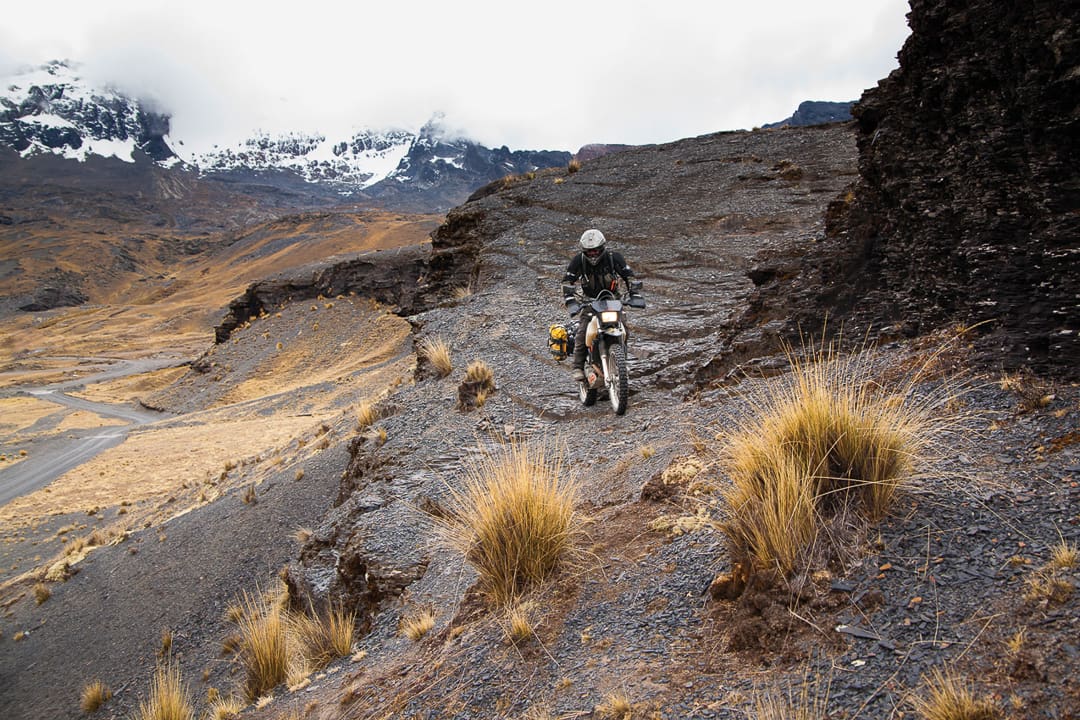
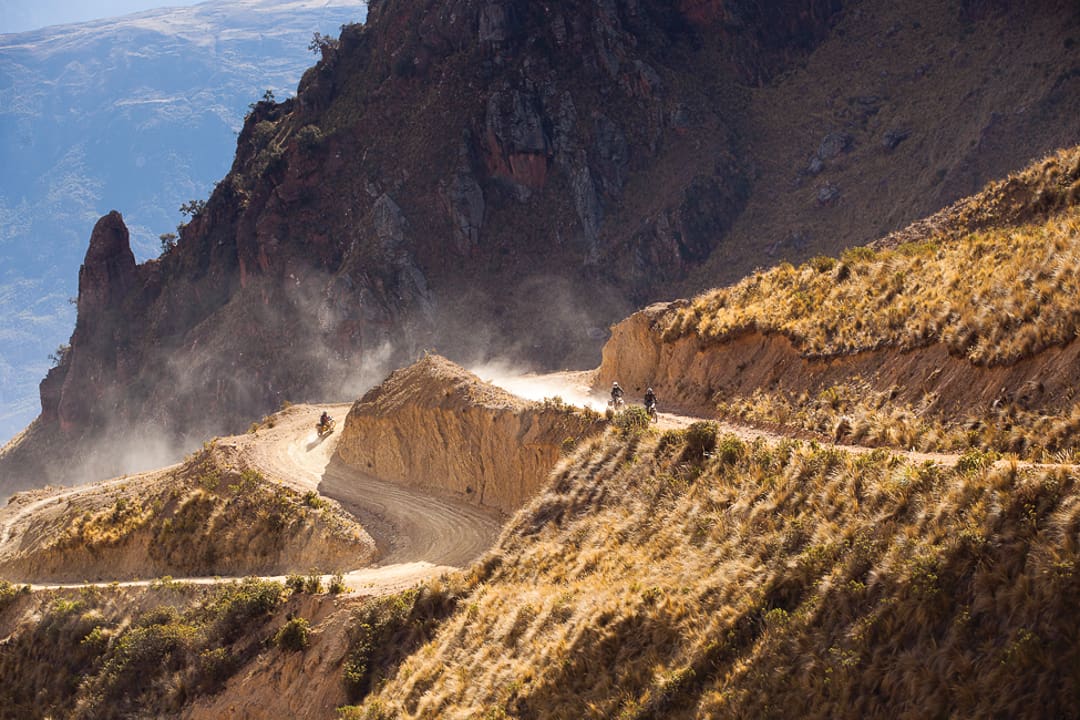
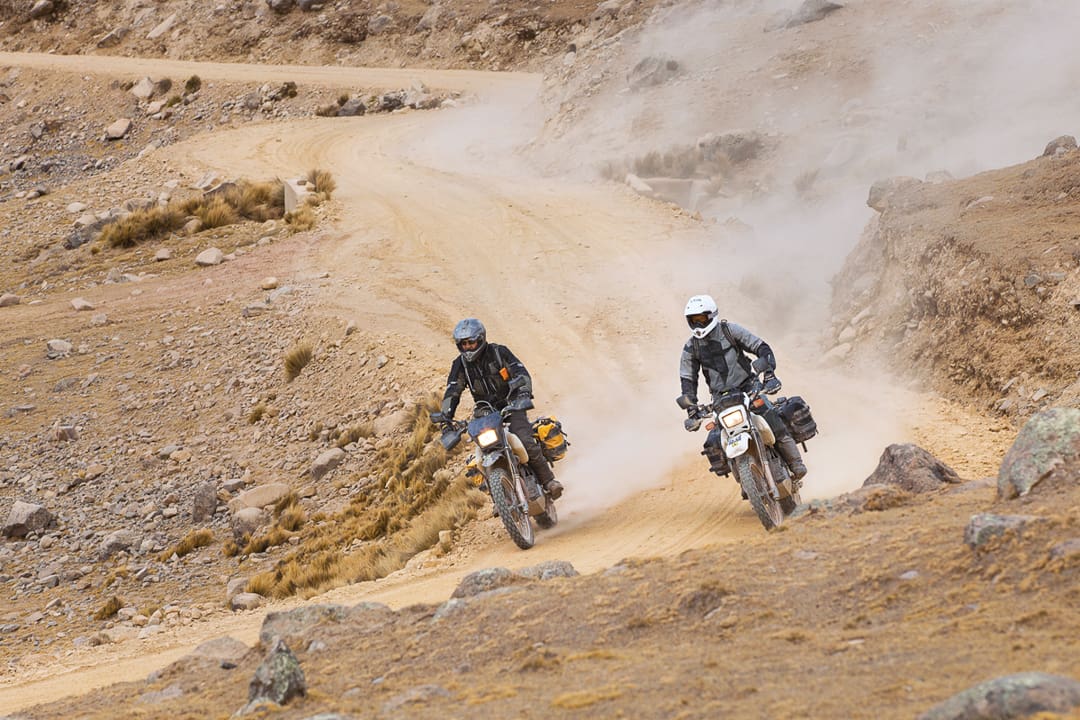
The faint glow of a single taillight fights for significance in the amber haze. As if the pending darkness is not enough, dust now obscures the road ahead. I feel like I’m playing some sort of interactive video game—one that clogs your nostrils and cakes your eyes with grit. My gut tells me not to screw up. Looking left and down, the Choqueyapu River guides us south and east, its silver surface reflecting up from the depths, fading in and out of view through a cloud that is roiling over the edge of this narrow canyon road. Pushing the limit, I close in on my riding partner, dancing over babyheads and ruts, eerily appearing in the sweep of my factory headlight. I can either fall back and let the dust clear, or ease my DR650 into the echelon position—a sketchy move but one that might reward me with some semblance of visibility. Being able to actually see the trail would ease my mind; the river is 2,000 feet below.
Bolivia is a wild place. Towering volcanic spires of the Andes stretch across the west like a pair of sleeping anacondas, their parallel ranges defining the limits of the high, windblown plateau known as the Altiplano. From Lake Titicaca, with its reed-island villages and rich Inca history, to the milder Yungas Valleys and jungles of the Amazon, Bolivia’s diverse flora, fauna, and topography offer endless opportunities for adventure. Butch Cassidy and the Sundance Kid were lured here by the mystique of this landlocked and remote region, driven by a desire to escape the inevitable fate of a gunfighter. (Hopefully we won’t be jumping over any cliffs to evade justice, struggling to flee the persistent Pinkerton agents.) My partner on this foray is not Redford or Newman, but none other than Eric Hougen, a.k.a. “The Wolfman,” founder of Wolfman Luggage. The Wolfman’s ears perked up when he got the news that the two of us had been invited to Bolivia. When he heard that our host would be Sergio Ballivian, owner of Explore Bolivia, it was too juicy an opportunity to miss.
Eric, the son of a foreign service officer, attended grade school in La Paz, where Sergio was one of his schoolmates. Sergio and his sidekick, Oscar Ebert, are adventure junkies and fixers for adventurers interested in exploring Bolivia’s more remote regions. Proper maps for these locales are hard to come by, but we were in good company for this type of trek. A week earlier, we’d landed in the capital city of La Paz and took in a few days of easy riding to become acclimated to the 14,000-foot-plus elevation to come. The next day we sorted gear, loaded the support truck, and referenced our maps.
Because no motorcycle trip through Bolivia would be complete without riding the infamous Highway 6, known worldwide as “The Death Road,” we headed out of town to the north, to the 15,160-foot La Cumbre Pass, in a mix of rain, sleet, and snow. We were about to learn that some of the country’s most intriguing features are those you won’t find on Google Earth.
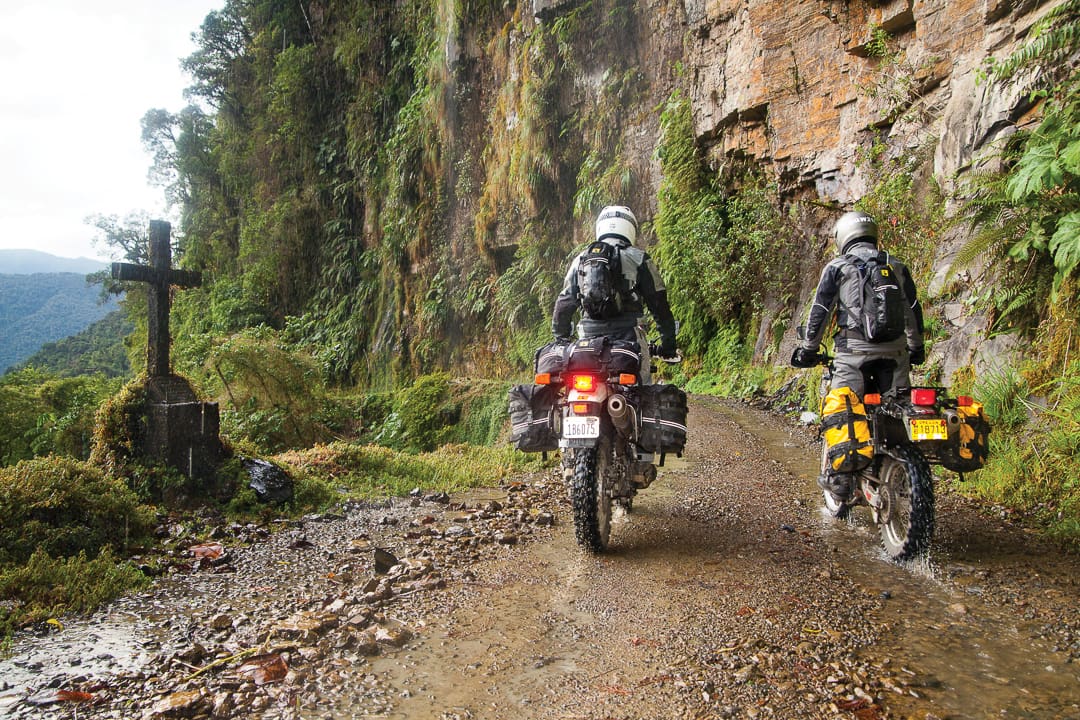
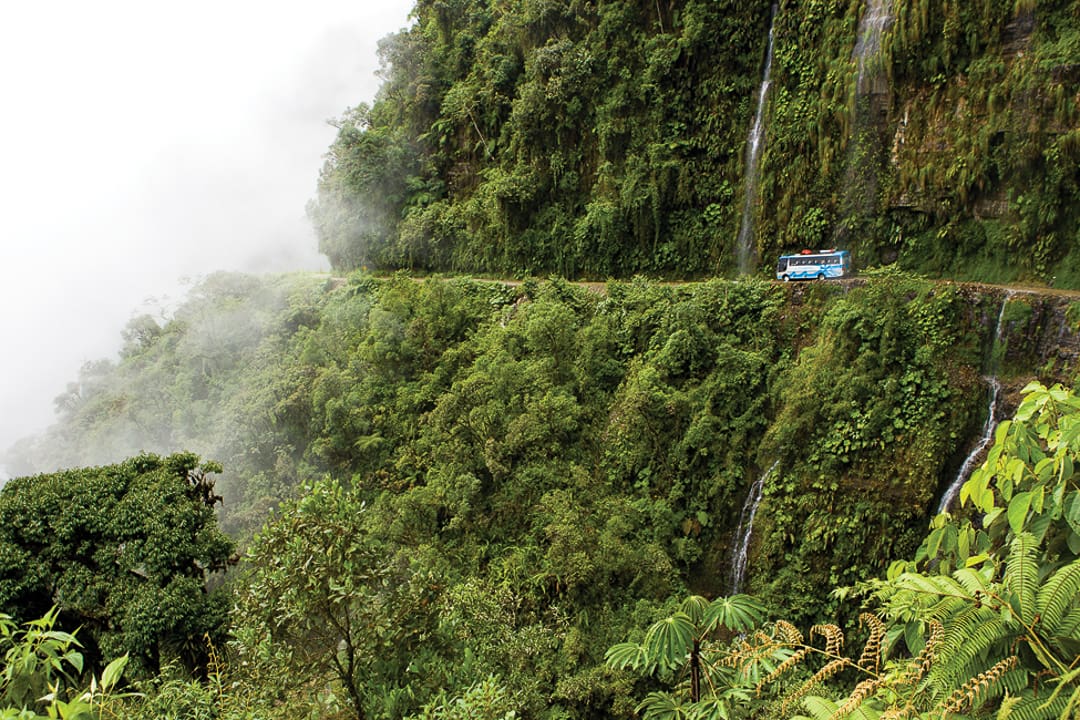
The road presented itself as a thin line skirting a wall of vegetation several thousand feet high. A rocky, moss-covered hillside was to our right. To our left was nothing but air, and a lush tangle of jungle canopy far below. Landslides are frequent here, and before the new paved route was built on the opposite side of the valley, the combination of high traffic and narrow roads created a deadly concoction for travelers. A quarter-mile-long natural car wash left us mud-spattered and soaked as we rode through a waterfall that perpetually showers the road before cascading over the edge. Our insistence on stopping for photos and gawk sessions rewarded us with a rare and beautiful finale—witnessing the last miles of The Death Road in the faint evening light.
Choqueyapu River, The Gatekeeper, and the Inca
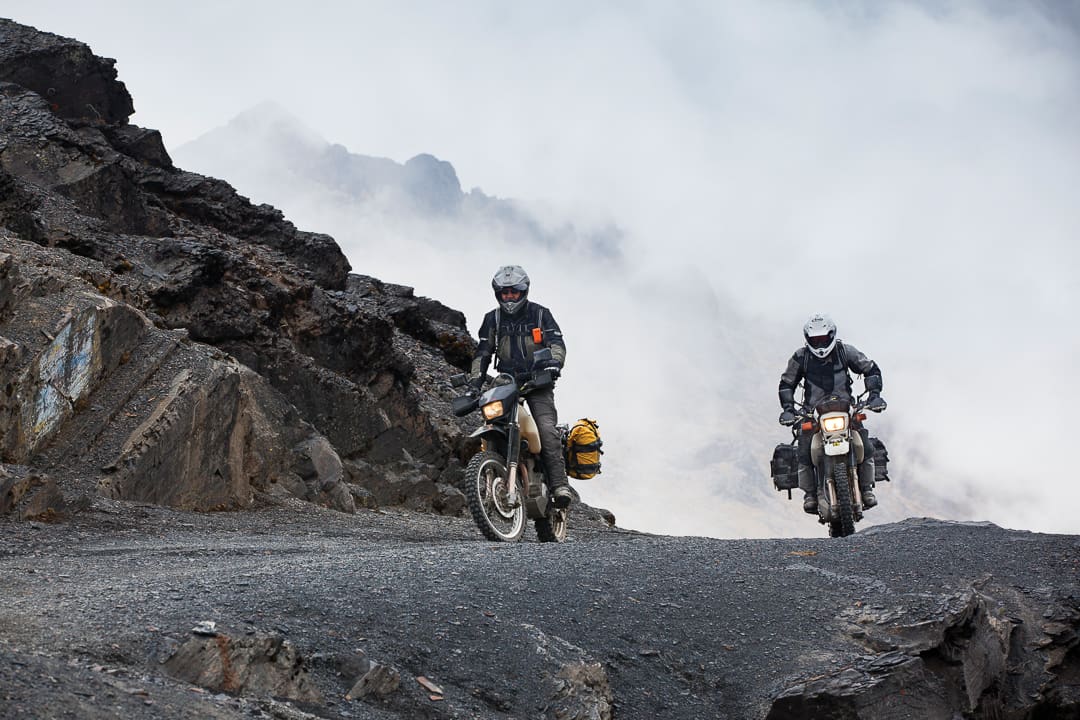
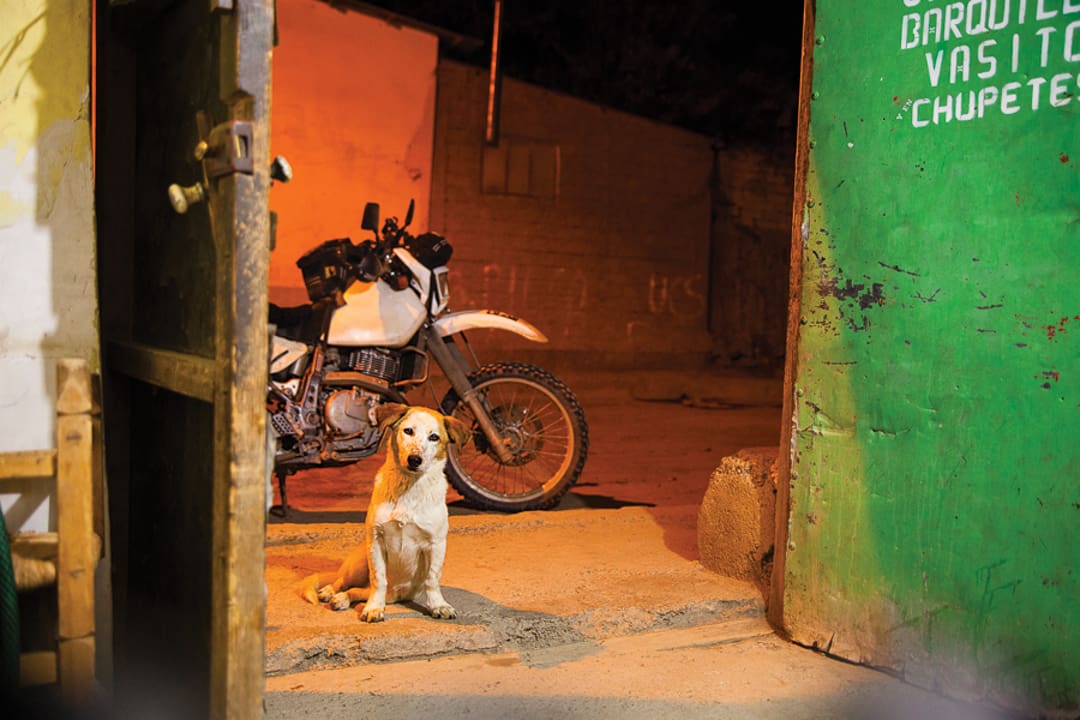
Trying to avoid thoughts of my cliff-edge view of the Choqueyapu River, I roll back on the throttle, close in on Eric, and take position on the track to his left—doubling the candlepower from our marginal headlights. Eric glances my way and eases over to make room. It feels good to take a dust-free breath. With so many miles yet to travel, we sense the urgency of our situation and pick up the pace. Out of the darkness, a long-eared viscacha springs into our headlight beams and boings rabbit-like between the rock face and the blackness to our left. It lopes along for several hundred yards (at 35 mph) before disappearing up a trail to our right. Brisk riding in these canyons at night is crazy, and Sergio had made it clear that “real” clients are never subjected to riding at night, unless by special request. We are fortunate to have been granted this latitude, and the thrill of the ride overcomes our better judgment.
Tiny lights appear on the mountainside ahead like fallen stars. It is the village of Araca. Oscar’s Suzuki closes in behind us as we slow down, followed by Sergio in a Nissan Patrol, laden with our gear and 70 gallons of extra fuel strapped to the luggage rack—there aren’t many gas stations where we’re headed. Over the next week and a half, the route will take us across the blustery Altiplano to the Salar de Uyuni, the world’s largest salt plains.
Our hosts lead us up a narrow cobblestone road that twists through lush vegetation. The scene takes on an Act of Valor aura as we burrow deeper into an aromatic eucalyptus forest. We come to a gate that blocks our way, and the inquisitive face of a small boy peeks over the top, eerie in the light of our dust-filtered headlamps. I’d be nervous if I didn’t trust these guys. The face disappears, and a moment later the gate squeaks open on rusty hinges. We’ve arrived at Hacienda Teneria, currently the home of local engineer Hans Hesse, grandfather of our mysterious gatekeeper. En route, we’d crossed numerous bridges that spanned giant crevasses; each was of Hans’ design. When I say “currently,” I compare Hans’ 78 years here with the foundation stones of the hacienda, which were laid in the 16th century. His living quarters were built during the Colonial Era (1500–1800 CE), and the place has grown by a half-dozen structures over many generations.
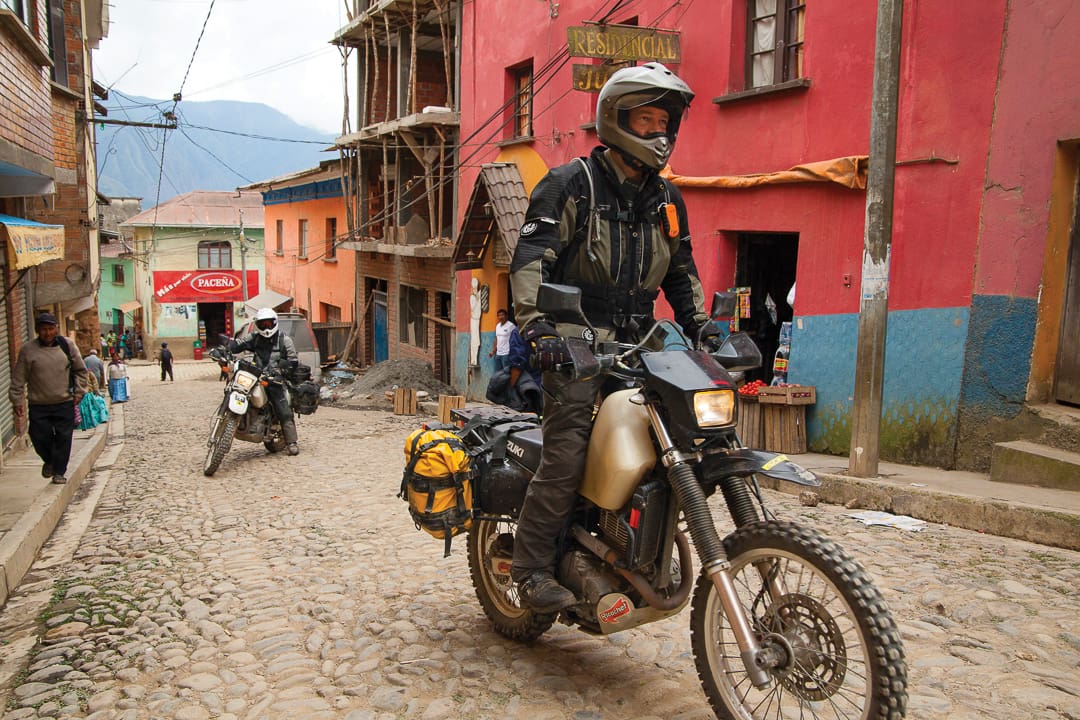
By the light of our headlamps, our tired and dusty crew descends a dark, rocky path. A modest stone lodge appears among the trees, and smoke wafts over us from an outdoor fire, adding BTUs to a boiler full of water for showers. This place is a tinkerer’s dream—all the conveniences of home, but with a Swiss Family Robinson twist. From the wood-burning water heater to a homebuilt welder created from a discarded spool of copper wire, and a drill press made from a repurposed potato press, Hans’ mark is on every stone and tool. Trees, planted by his mother in celebration of his birth, are now massive, mature markers of another time. At dinner, Hans entertains us with stories of Inca treasure, Phoenician visitors, and the connection between our generation and the ancients. Sergio translates as our host yarns on into the night, showing us primitive spear points and dusting off old books, some containing handwritten inscriptions that support his fascinating theories.
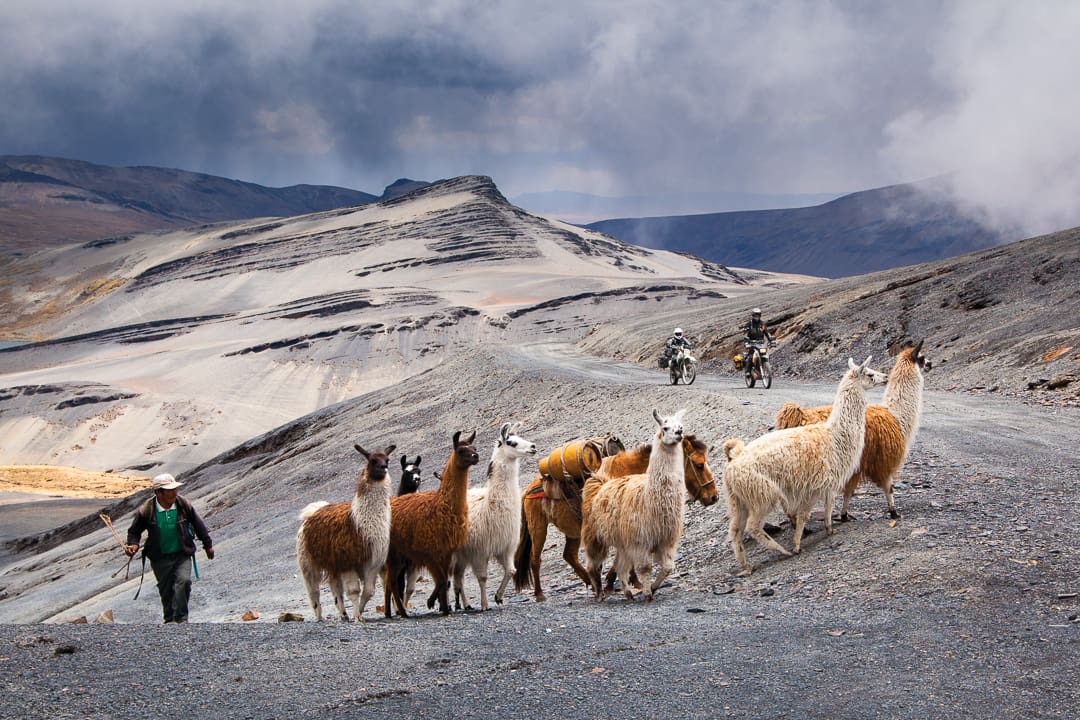
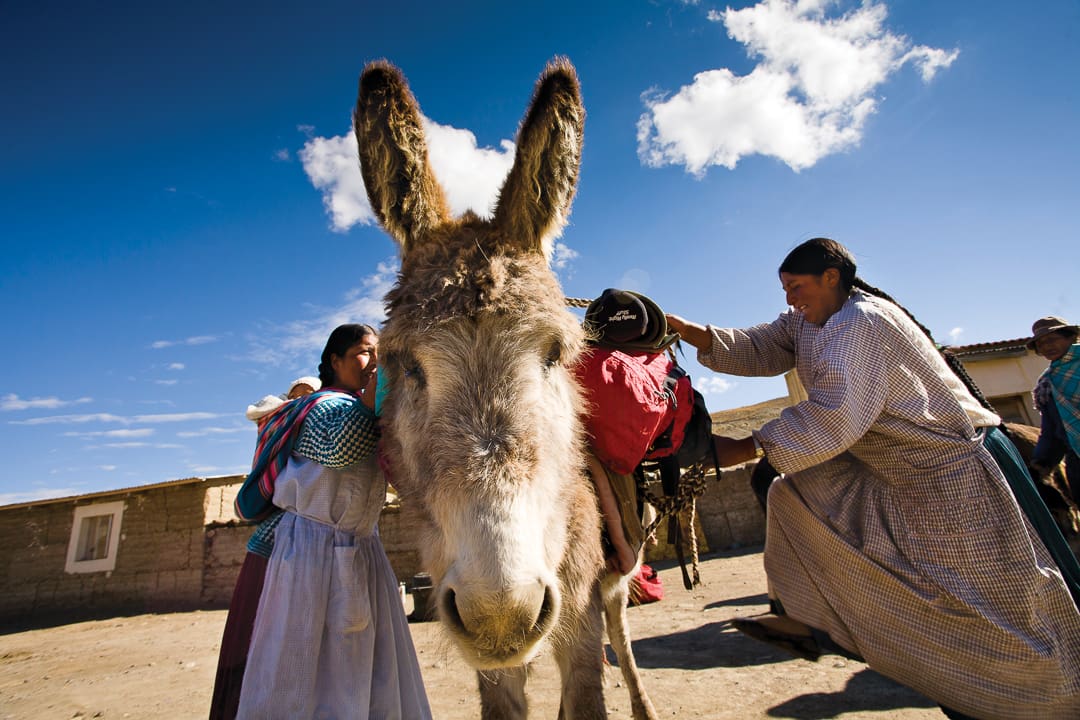
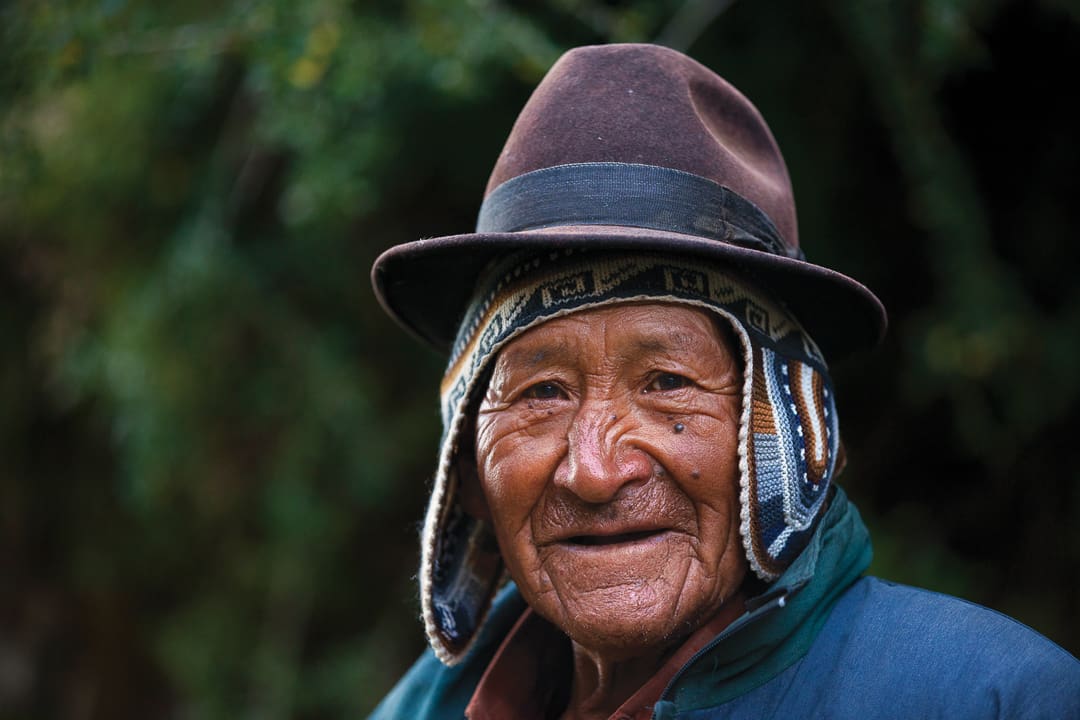
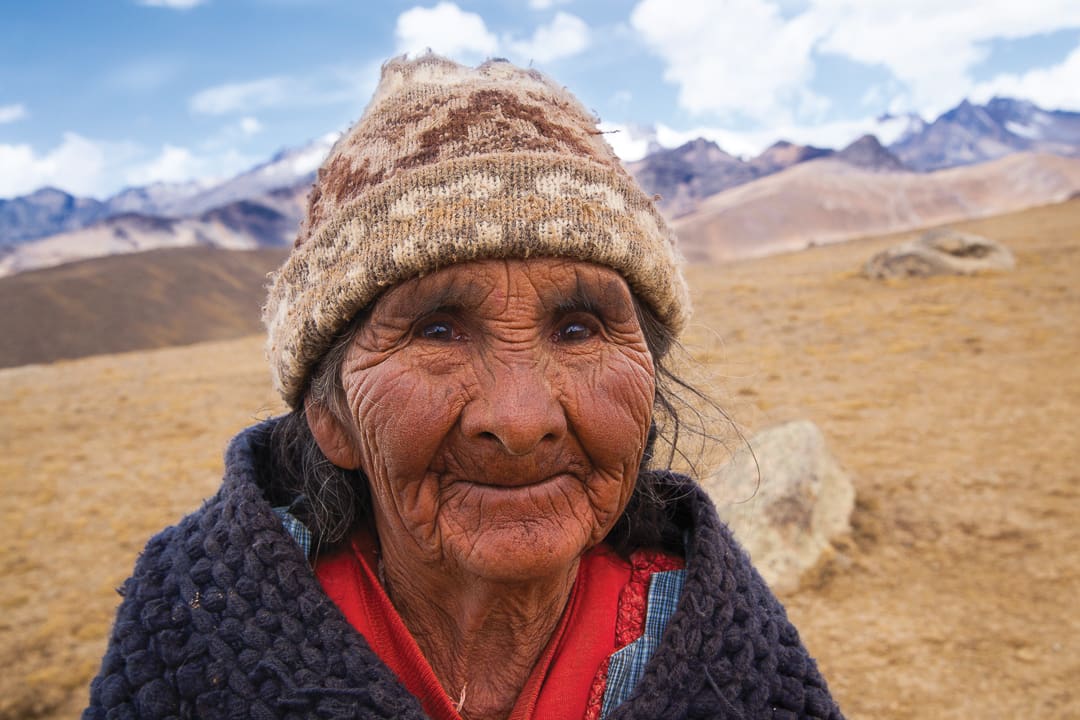
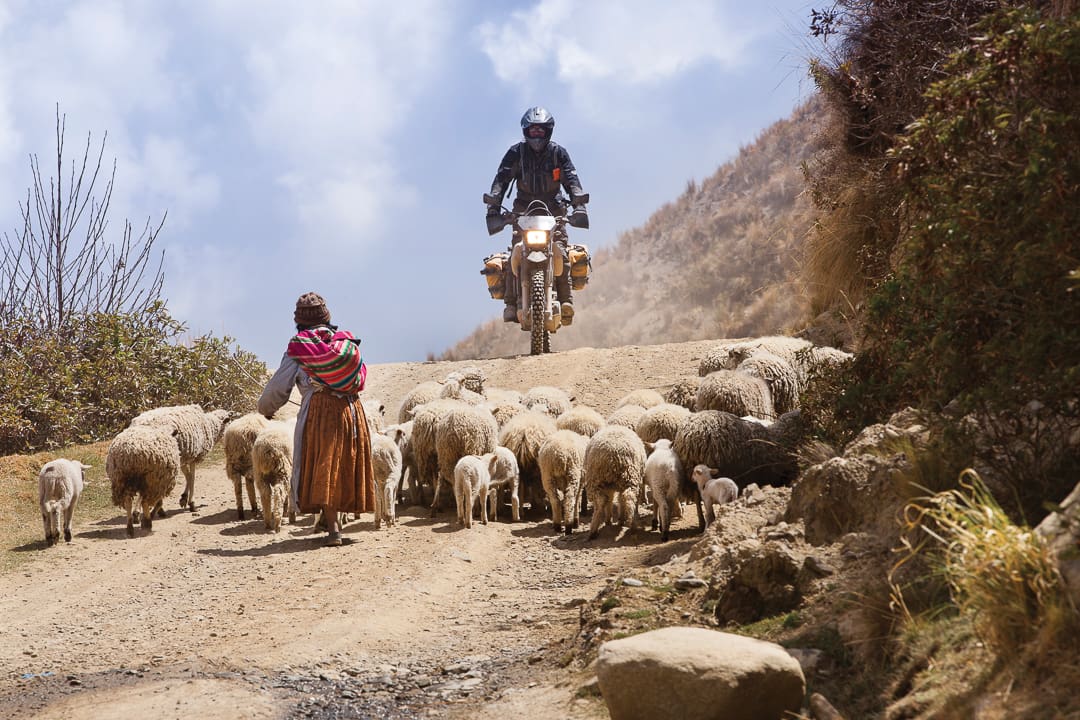
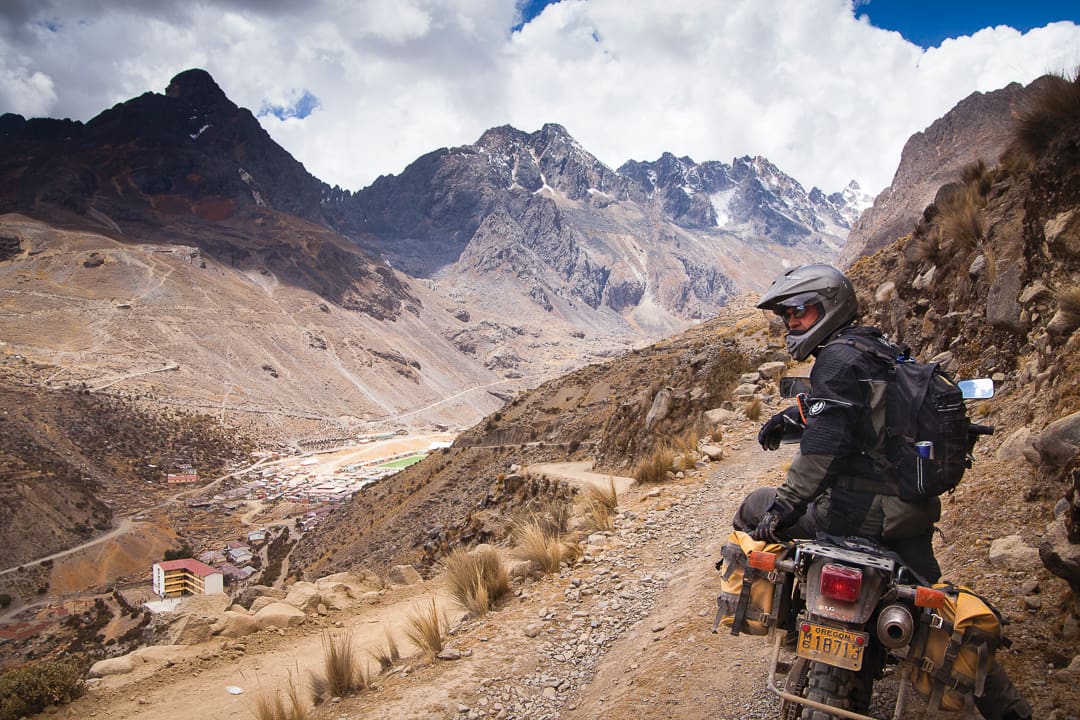
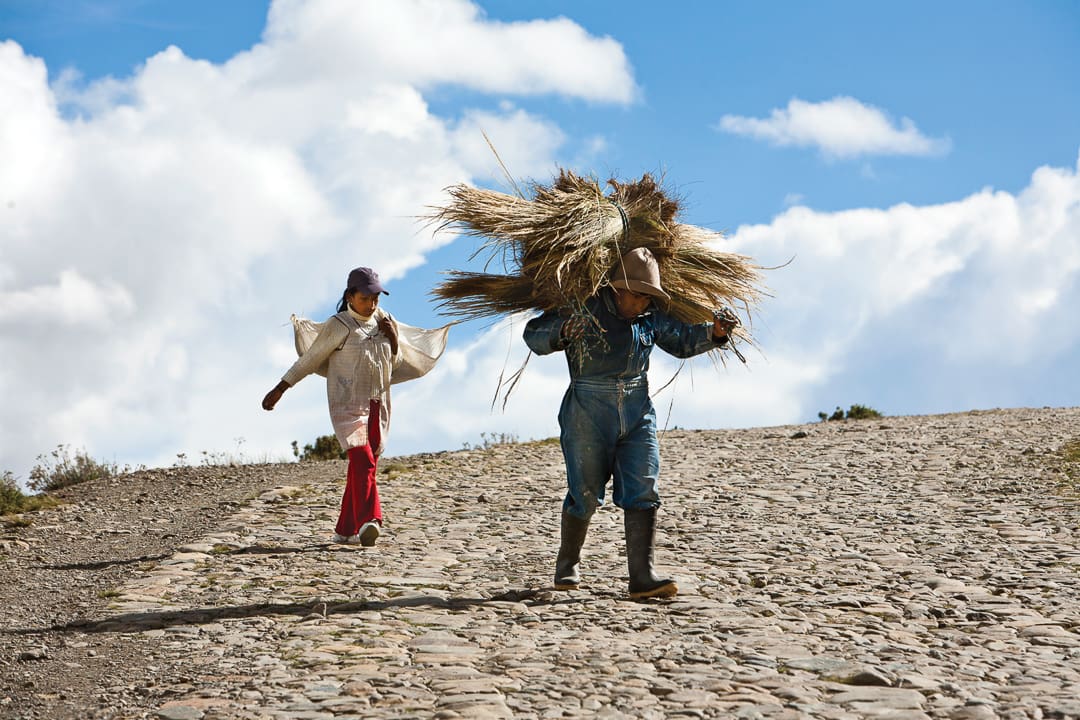
The next morning after breakfast, we refill our tanks and begin the climb out of this canyon, descending into another as we make our way toward the Altiplano. As the lush valley fades behind us, the landscape becomes increasingly arid. It’s more than two vertical miles and a half-day’s ride to the top of Escalerani Pass, which leads us to the village of Luribay, nestled in a valley of hope that springs up like an oasis in this stark but magnificent Andean landscape. Indigenous women, known as cholas, wearing classic bowler hats and colorful, heavy skirts, walk along the trail, occasionally herding sheep or pigs and often carrying large bundles. We stop at 15,000 feet for a photo and meet a woman sitting quietly on a rock overlooking the valley. I coax Oscar into translating a brief interview. She is 100 years old and comes to this place to tend her sheep. The concept of “retirement” isn’t the same for folks in Bolivia. Though her hearing and eyesight are failing, she’s still strong and pulls her share of family duties. Interestingly, she’s not at all disturbed by our query. Further down the trail, we stop to allow a herd of sheep to pass. Another chola trots behind, a young woman, wielding a stick in one hand, her infant bouncing happily in a bundle tied to her back.
Dusk approaches as we arrive in Luribay. We’re tired but fulfilled by today’s challenge. This is truly an adventure rider’s paradise. The mountains seem alive and in constant motion, roads washing out or becoming covered by slides when it rains. Road grading is infrequent or nonexistent. Debris, deep sand, and rocks of all sizes enforce an attitude of attentiveness. Our stop for the night, a gated hostel, feels like the Ritz-Carlton after scrambling over these Bolivian backroads. Even the lumpy bed and a bout with electrocution by the bare-wire showerhead couldn’t stave off sleep.
Silver Mines and Salar de Uyuni
A breakfast of fruit, a granola-like cereal, and hard bread is simple but enough to sustain us as we prepare for an early departure. This will be a long day, as it is almost 400 kilometers to Potosí. At 21,000 feet, Mount Illimani looms over our shoulders, marking our orientation better than any compass, daring us to attempt the steep trails leading up its face. We turn tail on the prospect and instead begin a twisty climb toward the high, flat plains of the Altiplano. Warm air gives way to sleet as we ascend above 15,000 feet again. Soon we leave the dirt, subjecting ourselves to the insanity of the Pan-American Highway, a high-speed link that will expedite today’s extended route. Trucks roar past at warp speed, showing little regard for anything smaller. Somehow, the semi-organized chaos works out. The final stretch takes us over a highway that twists and turns through the mountains in racetrack fashion, the miles melting away like ice cream on warm asphalt.
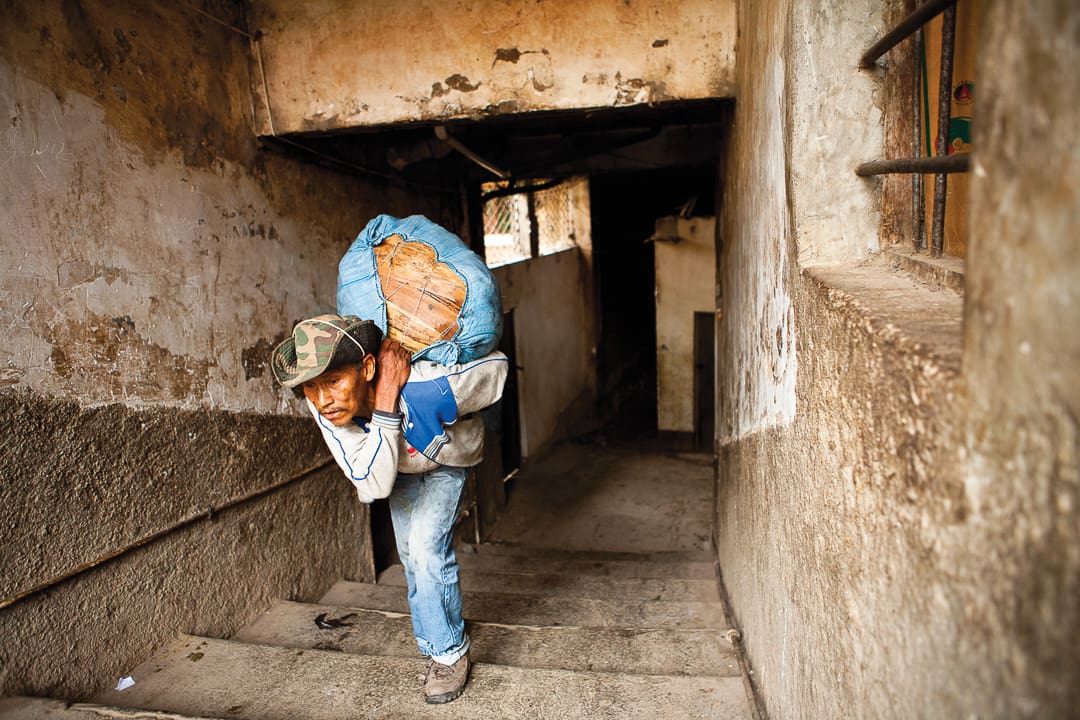
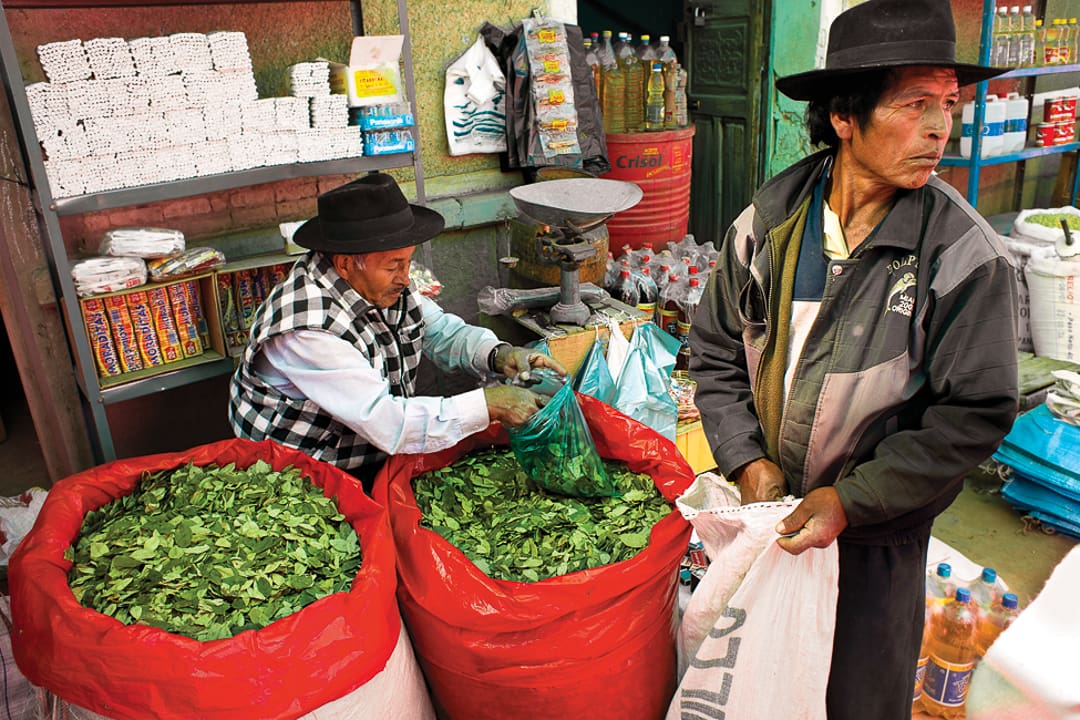
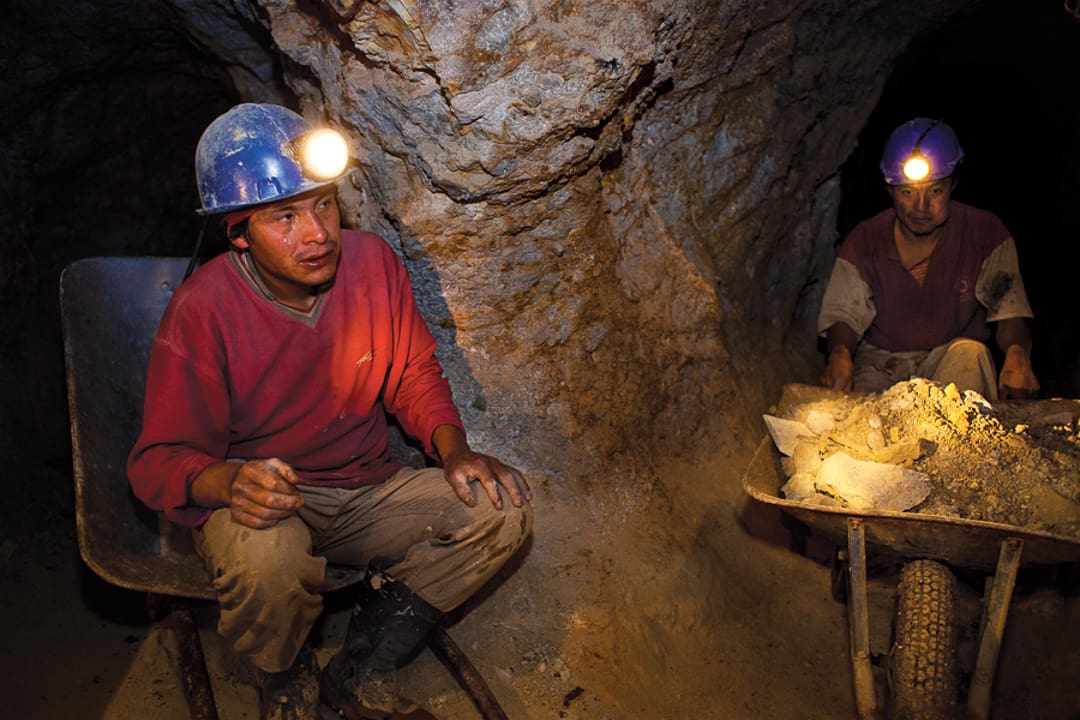
After the 1544 discovery of high-grade silver ore in Potosí Mountain, the city of Potosí became one of the richest in the world. In 1672, the Spanish built a mint here, and the population grew to almost 200,000. Today, the mine still boasts over 500 active tunnels and employs more than 16,000 men. Each day, laborers can be seen pushing ore carts in and out of the mines like a regiment of carpenter ants: laborers consist of men, as women are only allowed in the mines as tour guides. Sergio arranges for us to see inside the mine. Chewing a handful of coca leaves, we walk over two kilometers into the mountain, where temperatures approach 100°F. Coca has a mild narcotic effect, said to ease the effects of altitude and dull the hunger pangs of the miners who work throughout the day without a noon meal. Each of us has brought a supply of the dry, leafy substance to share with miners, along with soda pop and fresh water. We walk bent over beneath splintered post-and-beam shoring that looks as if it could collapse at any moment, yet they have borne the pressure of the mountain for generations. The Wolfman musters the energy to try his hand at filling a few 90-pound sacks with ore while the rest of us watch and gasp for breath in this oxygen-starved, sulfur-tainted hole. The experience reminds me to be thankful for any job available back home in the US.
From Potosí, we pay a visit to the 400-year-old Hacienda Cayara. Though less than an hour’s distance, it is worlds away from the din of the city. Hidden in a valley in the rugged Andean foothills, this magnificent family home turned guesthouse contains a wealth of museum-quality Colonial antiques. The story of its restoration, as well as the many artifacts, provides an unexpected history lesson and fosters a longing to linger, but we must travel on.
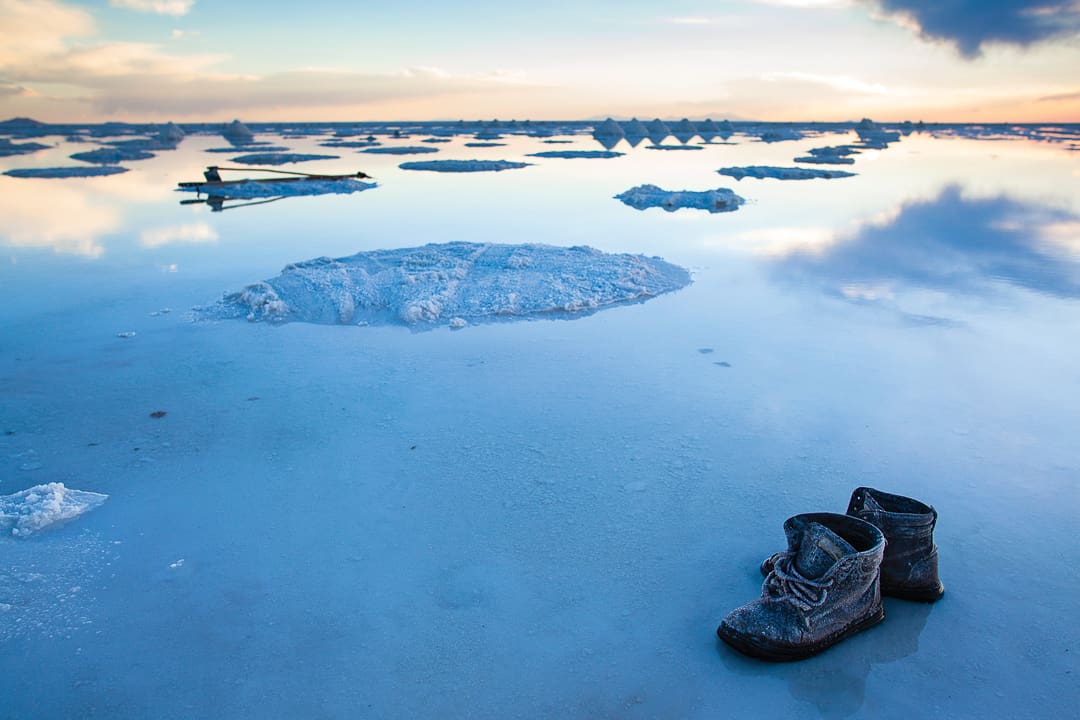
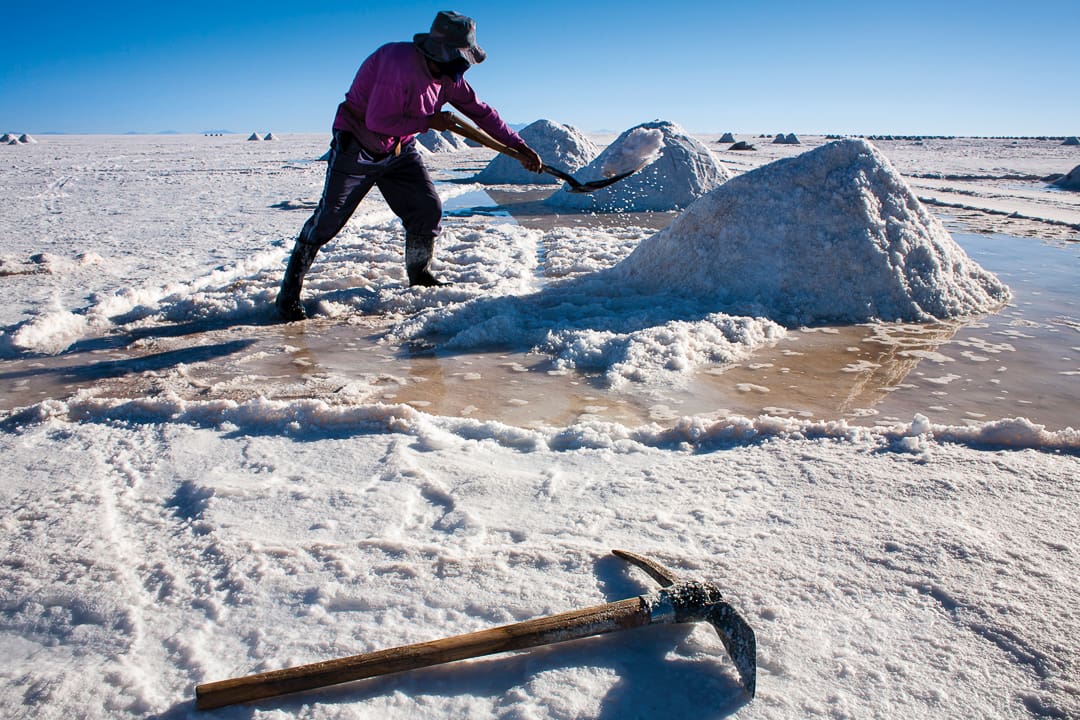
Salar de Uyuni sits at an elevation of 12,000 feet and is flat enough for the calibration of satellites. The crust of this vast saline desert provides almost 5,000 square miles of nothingness for the adventure rider to explore. One can ride fearlessly at top speed with eyes shut and no worries of an approaching obstacle, or sit in absolute silence and watch a sunset like no other. Before setting out over the flats, we visit the Luna Salada, or Salt Moon Hotel, perched on a rocky rise at the east end. Built entirely from salt blocks, the Luna Salada is one of the most unusual hotels in the world. Even the furniture and floor are solid salt. Tonight’s accommodation, however, is still several hours away on the far side of this immense wilderness. We throttle up the DR650s and release them into the sunset like spears launched in slow motion across the white void. Our destination is Doña Lupe’s Posada, a small compound in the village of Jirira. With wide dusty streets, low stone walls, and villagers peeking at us through windows, it’s a scene straight out of The Good, the Bad and the Ugly. The hostel is a welcome sight after a magical moonlit ride across the Salar de Uyuni.
A final stopover in Oruro breaks up our return to La Paz. The route is over an unfinished highway of deep silt and man-made dirt berms, which seem to be placed as barricades. It provides a challenge as we make our way down its length. Back at Hotel Oberland in La Paz, we take a day to recover before saying our goodbyes. These final hours have come as suddenly as a mountain storm. We’re tired, but it’s too soon to go home. The expertise of Sergio and Oscar proved indispensable in seeking out the pearl of South American adventure riding: Bolivia. Native to the area and skilled in the art of long-distance exploration, they removed many of the typical barriers to discovery: finding gas, food, a place to stay, and a suitable route.
Whatever impressions I had of Bolivia have been rearranged. It is much more complex than I had expected, and richer in intrigue and allure. Such a trip changes us as travelers. Bolivia, after our rush to see it, lured us to slow down and learn more about the culture. Every day brought new adventure, every mile a feast for the senses. Butch and Sundance may have been onto something … this is a place I shall surely return to.
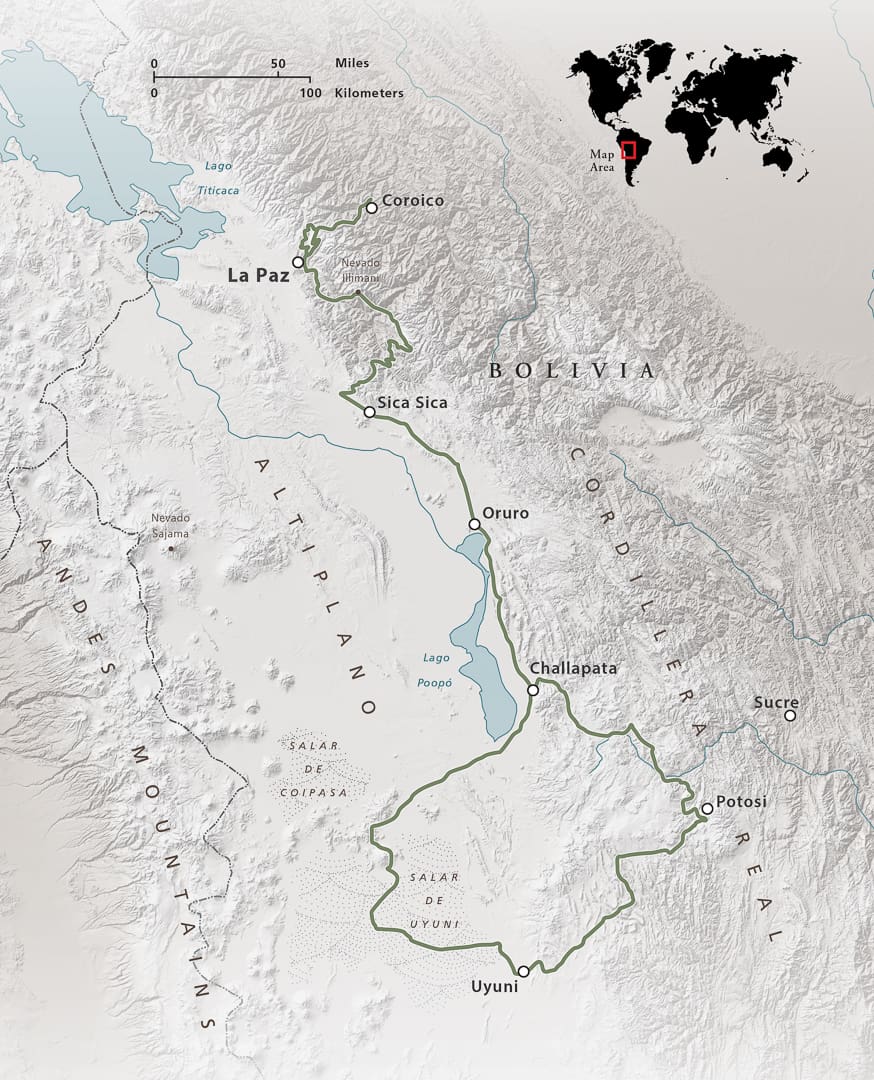
Route: Bolivia TripRoute. Cartography by David Medeiros (mapbliss.com).
Our No Compromise Clause: We do not accept advertorial content or allow advertising to influence our coverage, and our contributors are guaranteed editorial independence. Overland Collective may earn a small commission from affiliate links included in this article. We appreciate your support.
