

To honor the 20-year anniversary of Overland Journal, we are revisiting special heritage content in the upcoming 100th issue of the magazine. Originally published in Overland Journal’s Fall 2025 issue, this article is part of that celebration.
A small announcement on Facebook promoting a possible trekking expedition in Egypt’s White Desert hit an immediate chord. Firstly, it was being run by my Egyptian pal of the last 25 years, Mahmoud Marai. And secondly, it was happening over that rather anti-climactic period after the Christmas holiday, when leftovers are all finished and parties long forgotten. I responded in the affirmative within an hour. I have driven through the White Desert with Mahmoud three times before. Back in 1999, four of us did a short run out of Cairo, skirting around the northern edges of both the Black and White deserts and ending up in the oasis town of Siwa. Then, in 2003, we mounted a three-vehicle expedition much further south to the Gilf al Kebir via the White Desert—10 days of wet wipe washes. On our most recent trip in 2012, we circumnavigated the area on our way further south in two “flat fender” Jeeps, retracing routes taken by the Long Range Desert Group in WWII. Sam Watson’s article (Summer 2013) featured this hugely ambitious trip.
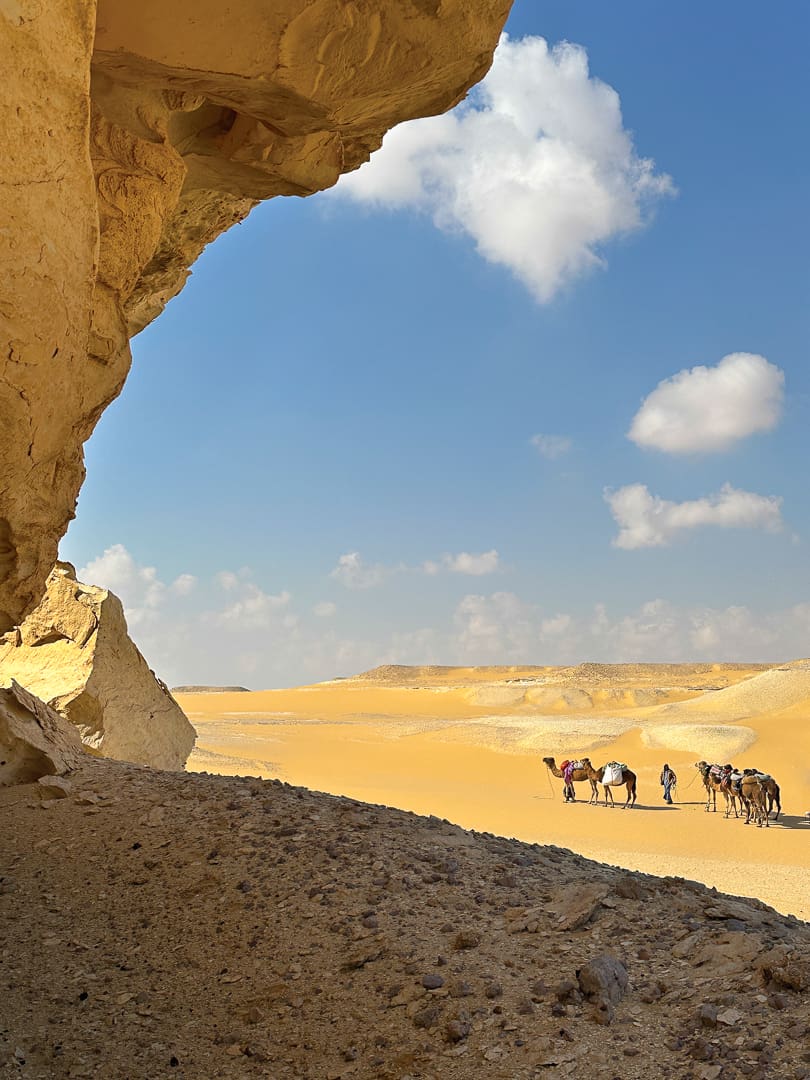
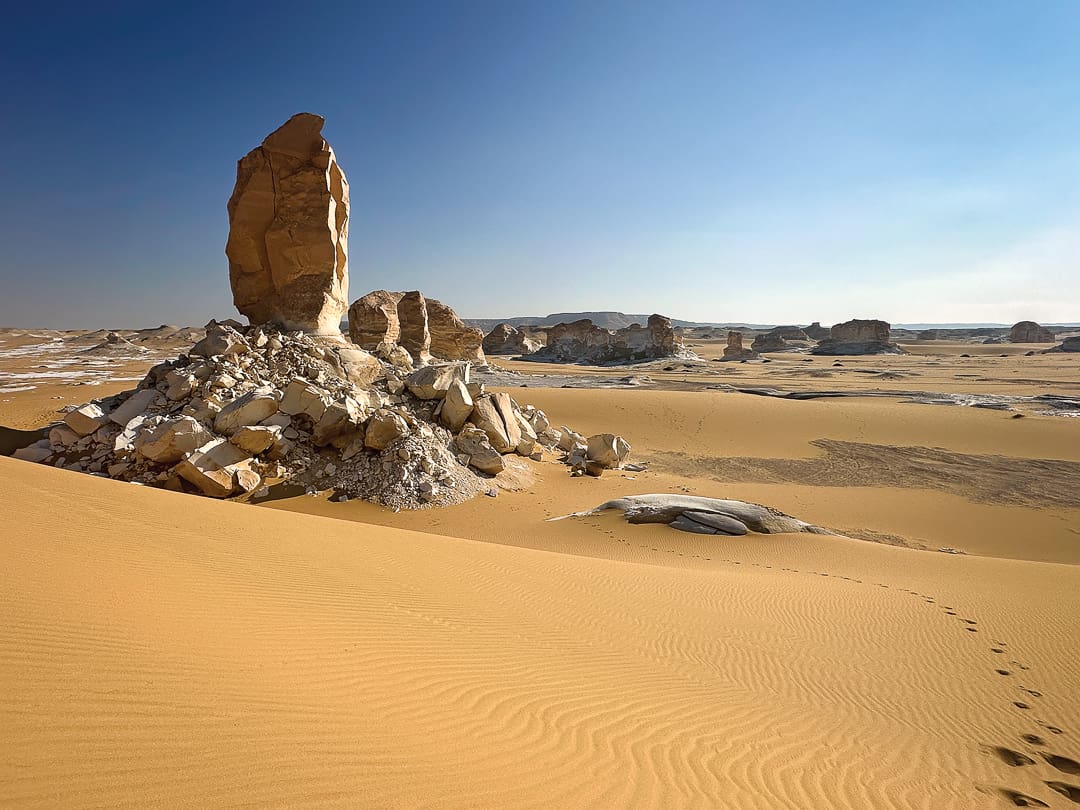
The White Desert has been an Egyptian national park since 2002 to provide some protection for its 300 square kilometres. The characteristic white rock formations that make this small part of the Farafra depression so attractive were formed by wind and sand, creating sand-blasted white sculptural forms rising out of the orange sand of the desert. Since achieving its official park status, the area has become popular with visitors, but they really only get to see the highlights, leaving about 90 percent of the desert in its original empty state. We would be walking away from the tourist destinations, and it was highly unlikely that we would come across another soul.
With my flight to Cairo booked, I asked Mahmoud for details. He answered with the customary desert guide response, “It will be great,” implying that was all I needed to know. My innate English desire for accurate information kicked in, and having turned 70 in 2023, I did need to know the backup plan if I couldn’t complete the proposed 125-kilometre hike over the five days. Mahmoud reassured me that six camels would accompany us, and I was welcome to hop onto one of those, or I could hitch a ride in one of the two Toyota Land Cruiser Troopies that would attend to our every comfort at the beginning and end of each day, adding quickly that we would not see these cars whilst walking.
Mahmoud met me at Sphinx International Airport in a rather stylish old Mercedes 230, and I was immediately reacquainted with the madness of Cairo traffic, where a three-lane carriageway is treated as four. I think Mahmoud used the Merc horn more times in our short journey than I have at home in the last year. Arriving safely at Mahmoud’s house, we were soon joined by some of my fellow travellers, Micky, Sylvia, and Barbara from Italy. After introductions and tea, the five of us climbed into a minibus for the four-hour drive southwest to Al Haiz Oasis Ecolodge, where we were to stay at the beginning and end of our trek. This deliciously tranquil lodge is owned and run by Mahmoud’s desert friend Abdu Shaban, and what was immediately noticeable to our tightly controlled Western lives is that these small oasis towns don’t do paperwork. Yet behind this laid-back attitude, there is great efficiency. Everything just works. Later, we were joined by the rest of the group: Kay and Justin from England; Rania, Noha, Sherief, and Rany from Egypt; and Sonja from Germany.
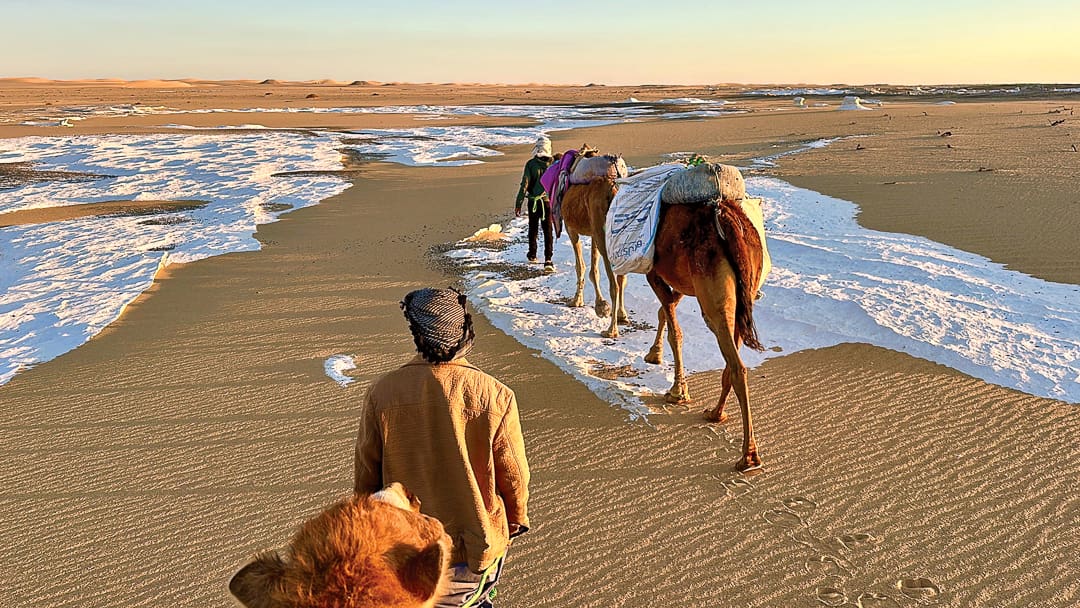
After a large breakfast the following morning, we were taken a short distance to meet our three cameleers and the six distinguished ladies that would be our escorts for the duration of the trip. Camels always exude an air of total patience and understanding, and our six had a dignity that filled us with confidence. Three were to carry backpacks and provisions while the others had saddles in case any of us wanted a ride. Introductions complete, we headed east into the vastness of the White Desert. Few experiences match the feeling of leaving the tarmac behind and heading out into a wilderness of sand and rock under a sky that goes on forever. Questions went through my mind. Would I be able to keep up the pace, or was I too old? Our speed was governed by the camels, and they don’t hang about, so it was a brisk pace from the outset. Our lead cameleer, Amr, continually engaged with his camels in a series of chirping noises, breaking off now and then for bouts of Arabic conversation with his two companions, Hamada and Karim. All three of them walked in the same clothes and footwear they wore every day and viewed this job as no more than a casual stroll with some foreigners. We, on the other hand, were clad head-to-toe in purpose-designed walking gear.
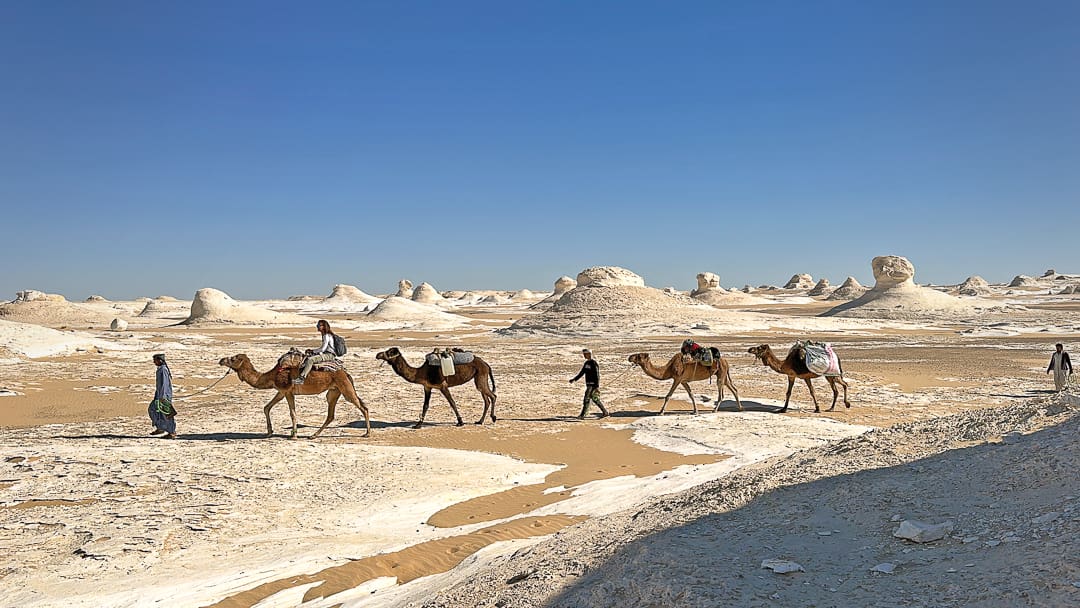
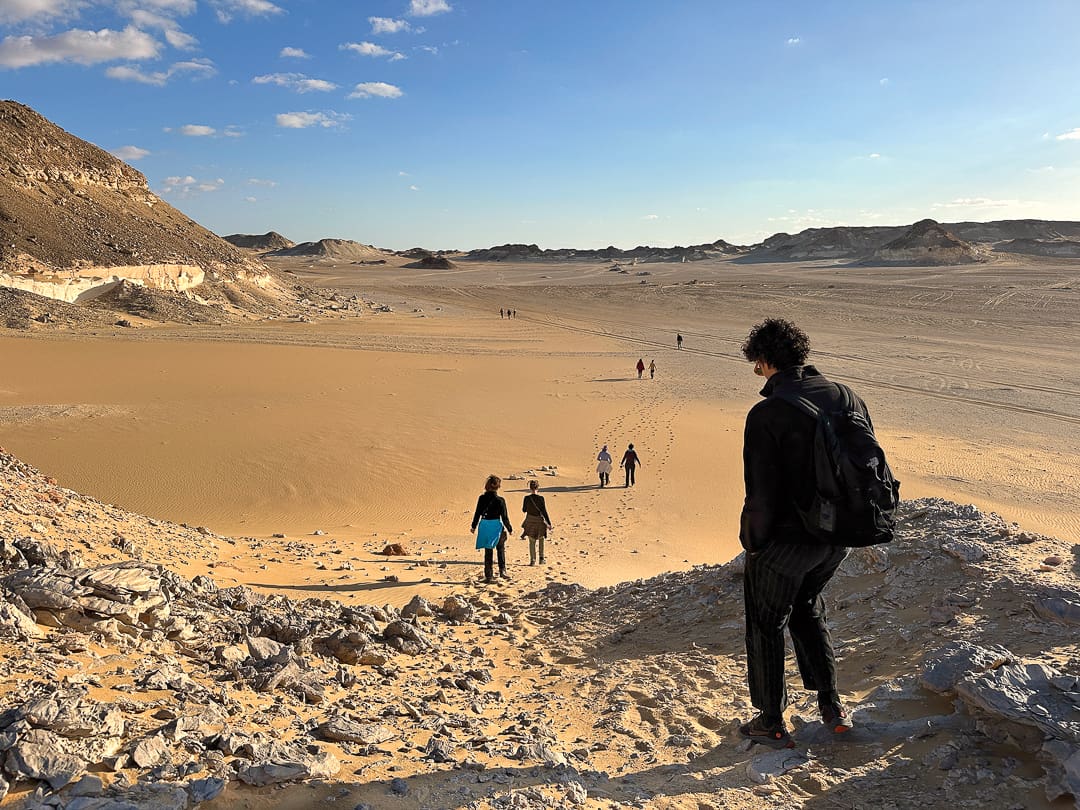
Underfoot, the sand was firm, interspersed with areas of rock and hard chalk. These surfaces, along with warm sunshine and no wind, made for perfect walking conditions. After a fairly leisurely start, our first afternoon of walking was only about 10 kilometres, giving us a chance to get into our stride and appreciate the beauty of this part of the desert. The subtle changes in the landscape were absorbed and discussed, helped by the fact that we did not have to worry about direction or navigation. As long as we followed Mahmoud and the camels, all was well. None of the routes offered any serious challenges. There were gentle inclines on wind-blown sand, and dramatic sun-bleached descents on white calcium, limestone, and quartz crystals, sparkling like jewels in the low winter sunlight.
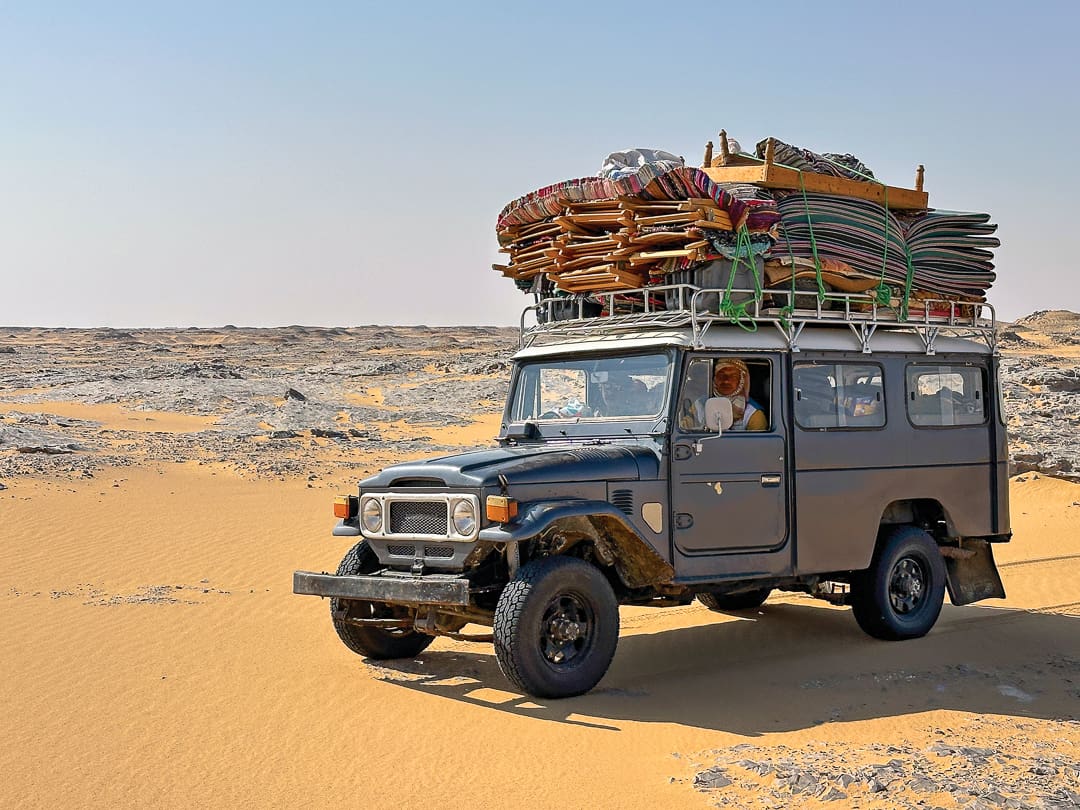
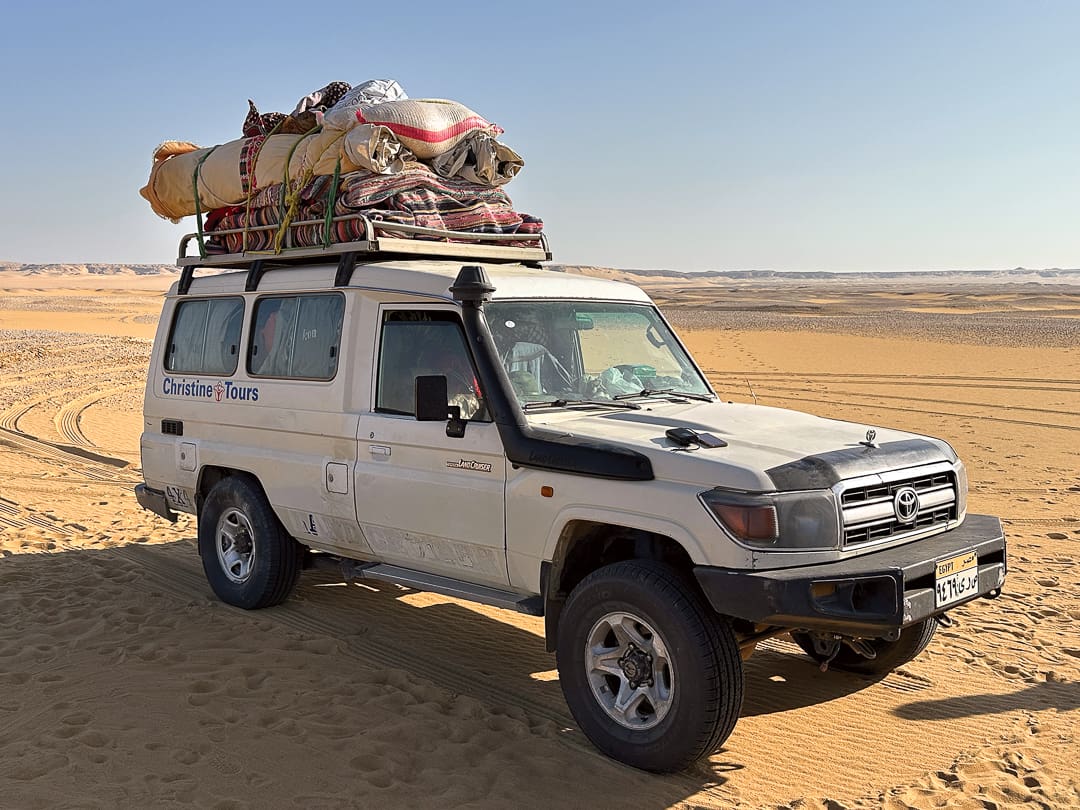
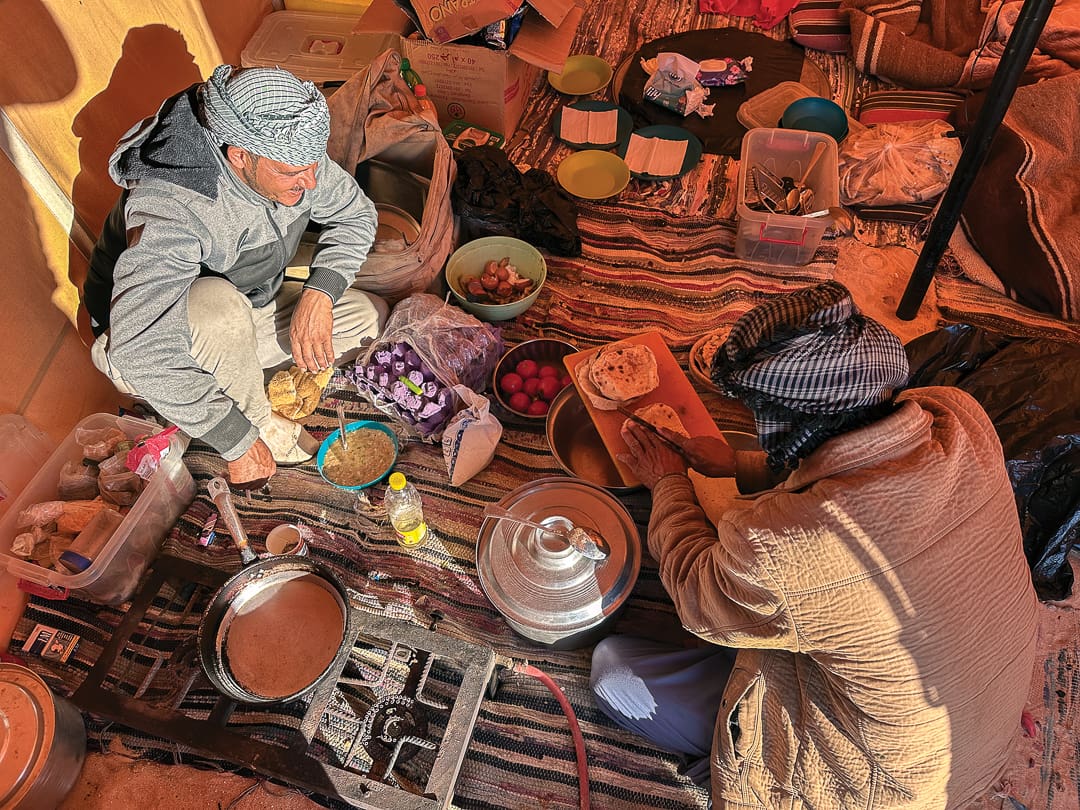
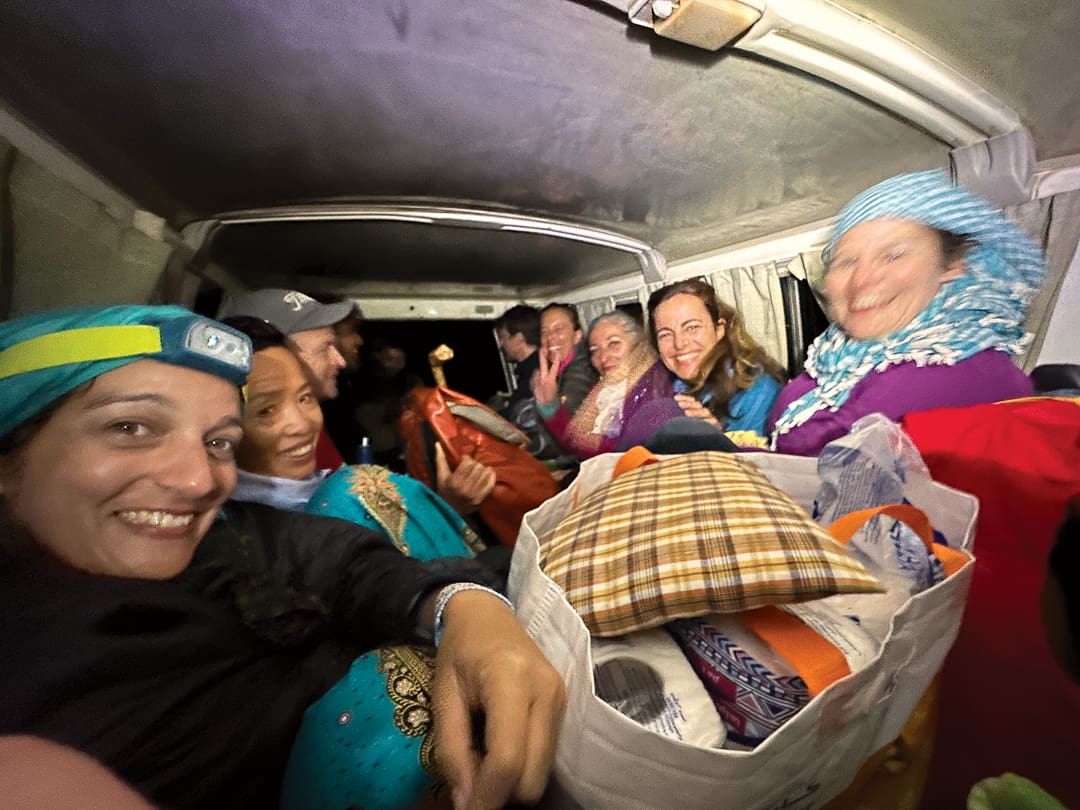
We met the two Toyotas at dusk. The impressive Troopies shared a million kilometres between them. Desert people love their old Toyotas, and these two were as much a part of the setup as the camels. The simplicity of design, ease of field repairs, and sheer indestructibility of these old trucks will ensure they give another 30 years of service (at least). Everything needed to host us was stored in the cavernous rear in a mixture of old Hessian sacks, plastic crates, and cardboard boxes. It looked disorderly, but the team knew where every item was and could retrieve it quickly if required.
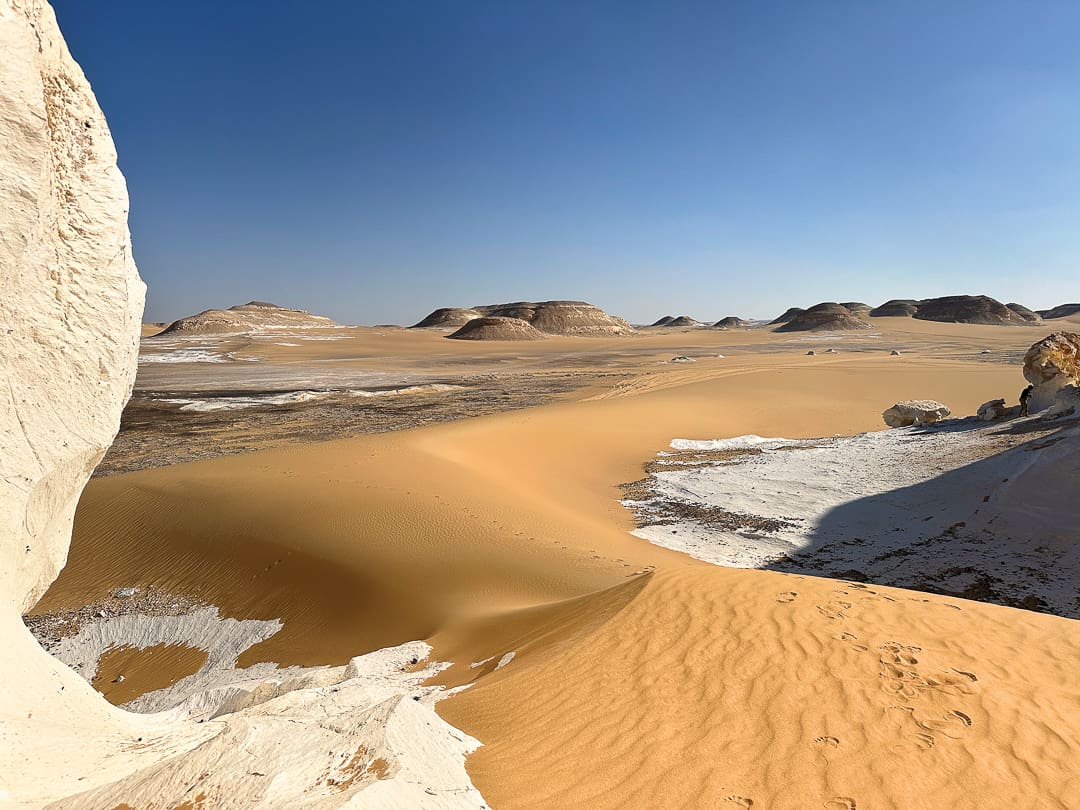
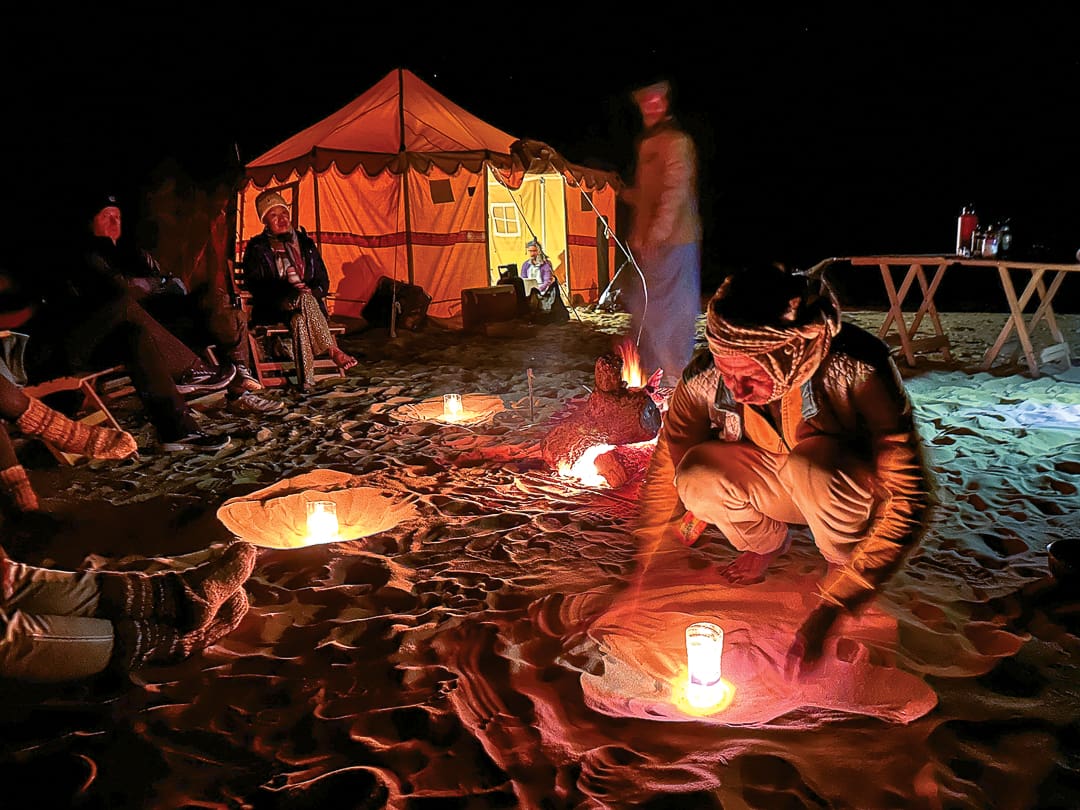
The team had set up our tents and lit a fire, ready to prepare a desert feast for us that evening. Seizing a moment to take some sunset photos of the camp, I scaled a low rock outcrop to get the best view. Shot in the can, I started to walk back down, not appreciating how steep it was. As a result, I fell flat on my face, bashing my nose on a rock—blood everywhere. Barbara was first on the scene and helped me up and back to the camp, where others offered assistance, concern, and sympathy. I was sat down on a chair while Ibrahim, the leader of the logistics group, appeared with a well-stocked first aid kit. His first act was to put instant coffee powder on the wound, which absorbed the blood and quickly dried the gash. Then Kay, who used to be a nurse, took a rather more Western approach; she washed it and suggested I let it dry naturally. I was lucky. The damage was not great, but my ego was wrecked.
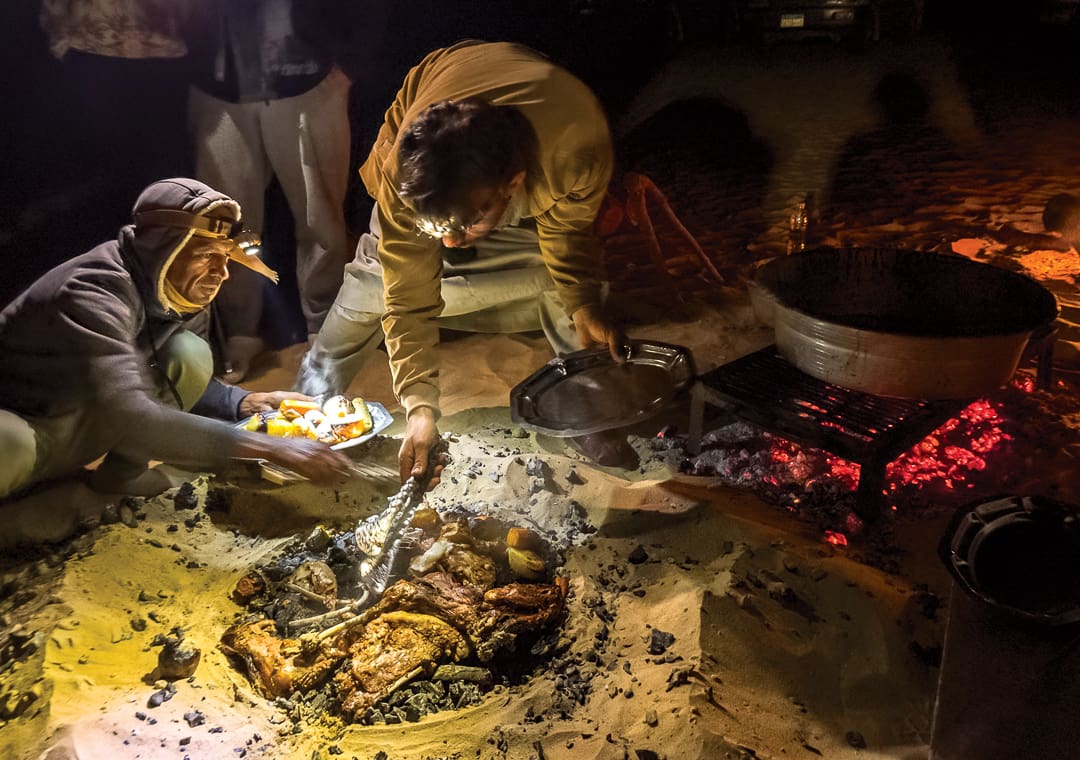
Whilst I was successfully providing the evening’s entertainment, the backup team had prepared our meal. I am always impressed by the resourcefulness of the desert community and how little is needed beyond a few pans and a fire. Meat and vegetables were roasted directly over charcoal and covered with an upturned aluminium pan. Sealed with sand and then covered in glowing embers, it created a very effective oven. Soup was prepared over a gas ring, and 11 of us sat down to a feast of roasted beef and vegetables, followed by fresh fruit.
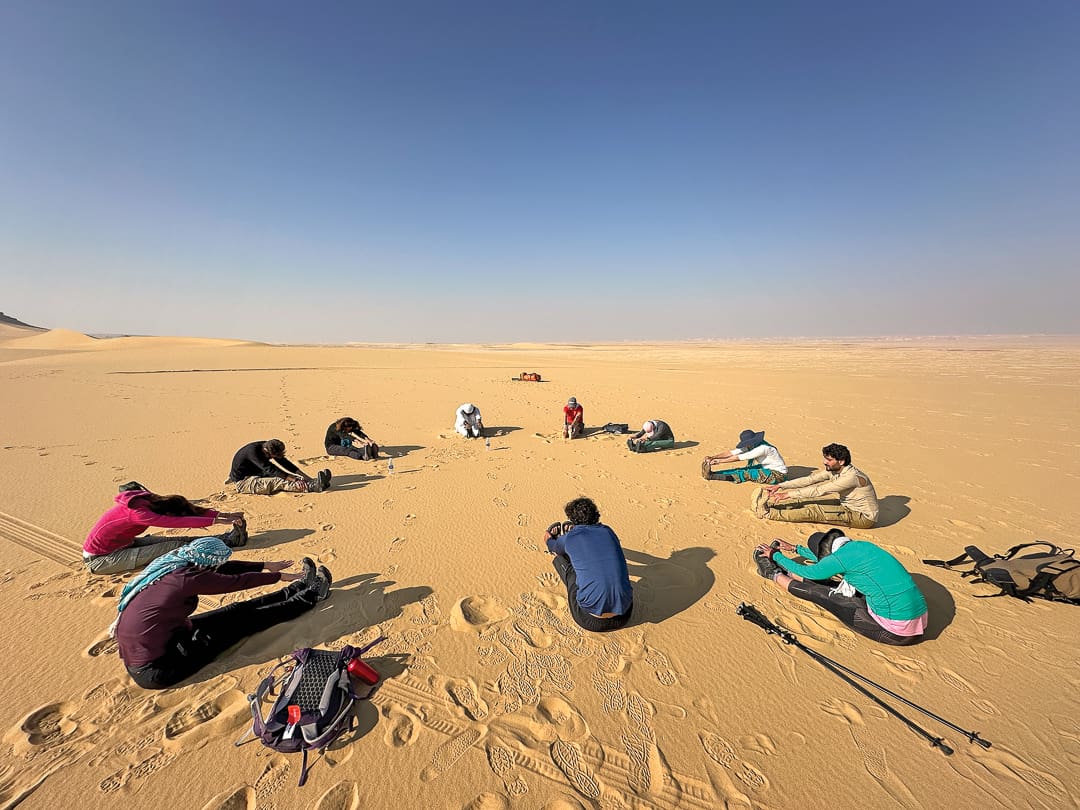
Our days continued at a similar pace, and we were all pleased that we were able to walk the necessary 20 to 25 kilometres a day without much pain. We all took rides on the camels, more for a higher viewpoint of the spectacular scenery than for the chance to rest. Each evening, Kay led a yoga class to stretch our aching limbs. I had never fully appreciated the benefits of yoga until this trip, but could feel each sinew in my tired legs go taut, then relax back into its normal state. The continual exercise, unpolluted air, lack of alcohol, and good food were having a positive effect on my wellbeing, and I felt confident I would be able to complete the walk. I needed to prove to myself that age was no barrier to adventure.
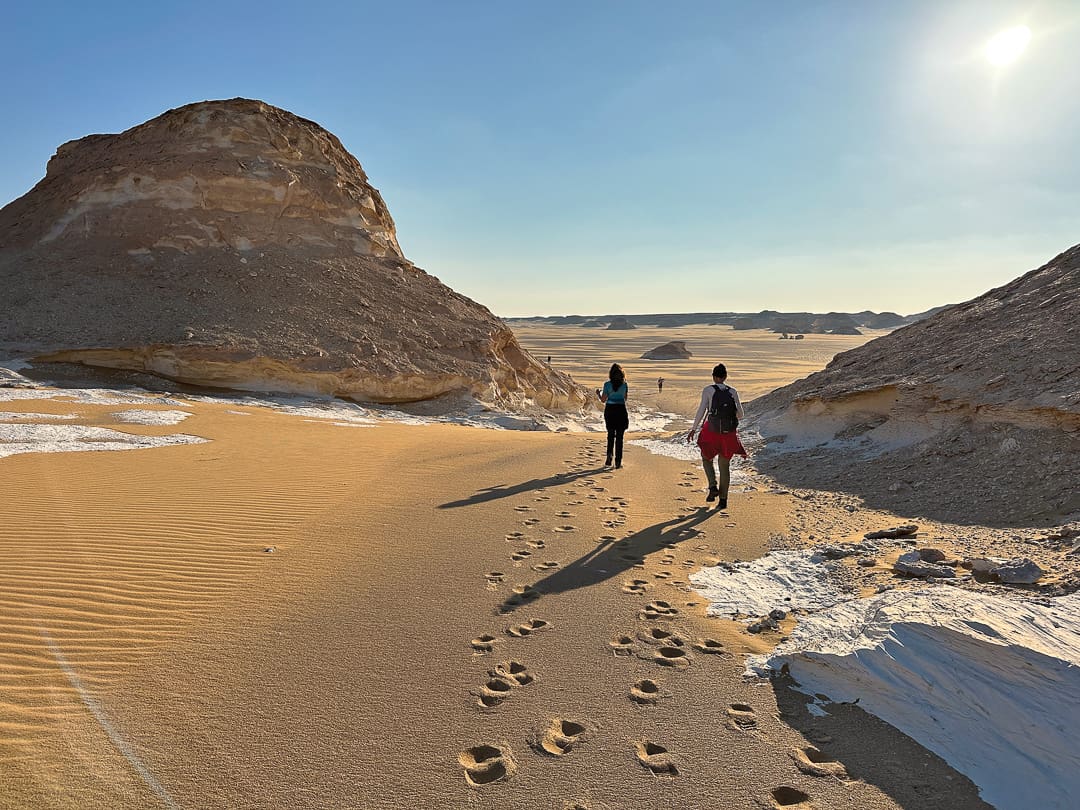
It is a popular myth that deserts are all dunes as depicted in Hollywood movies. Friends at home had wondered if walking across all that sand would be boring, but this was far from the truth. The landscape was ever-changing from low dunes to flat-rock desert that appeared to stretch forever in every direction, and the dramatic chalk that gives the White Desert its name. Late in the afternoon on the fourth day, we were feeling particularly weary and especially looking forward to cresting a dune and seeing our familiar, welcoming camp below, tents ready and fire lit. However, no such sight greeted us, and with dusk rapidly approaching, we were a little concerned. Somehow, a communication error had placed either us or them in the wrong location. The mobile phone reception was patchy, but the Egyptian network gets just about one bar of coverage if you stand on a high dune. It was dark by the time Ibrahim and Ragreb found us frantically waving phone flashlights in the direction of their approaching car headlights. With great relief, we climbed into the back of the Toyota and drove the short distance to camp. It was another tale to tell around the campfire.
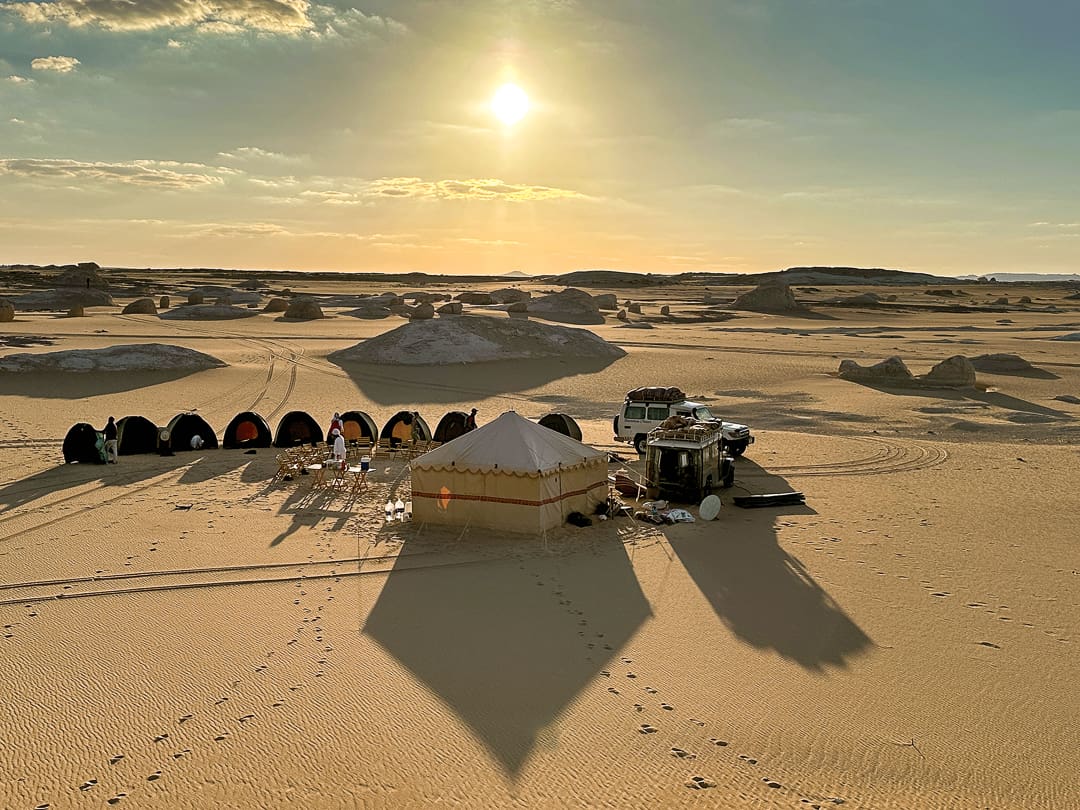
Our fifth and final day was one of great celebration as we passed the 100-kilometre mark. Rany, the most technical of us, had been logging our progress on his GPS and made the announcement, prompting handshakes all round and hearty congratulations. The feeling of achievement was immense, as despite all being fit, half of us were on the wrong side of 50. Later that afternoon, we arrived at our final destination. The team had made camp amongst some of the white chalk outcrops, and we savoured our last night of desert tranquillity with the whole of the Milky Way stretched out above us across a clear sky.
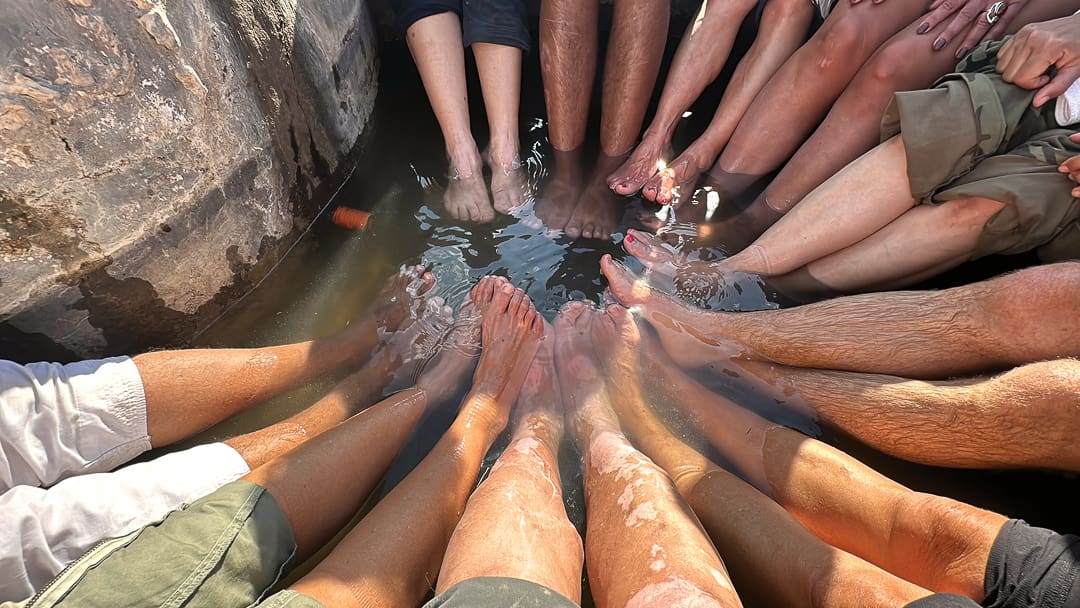
The following morning, we were all sad to be leaving the desert, but Abdu had one last treat lined up for us. I have experienced the hot natural springs of the desert before, but the one he took us to in Baharia had a concrete wall around it to form a rudimentary swimming pool, and the water gushed from a large pipe 24/7 at a temperature of 50°C (122°F). Without getting too technical, that is very hot. You can slow-cook beef at 63°C. The youngest and most energetic of our group, Sherief, jumped straight in, only to leap straight out like a cat on a hot tin roof. The rest of us tentatively lowered our tired bodies into the water bit by bit. It took us a good 15 minutes to get fully submerged. The therapeutic effects were palpable as our limbs relaxed and the heat revived us. We all agreed it had been a marvellous trip and vowed to stay in touch and meet up again, which we have via the same Facebook group that got us all together in the first place. Mission accomplished.
Resources:
Our No Compromise Clause: We do not accept advertorial content or allow advertising to influence our coverage, and our contributors are guaranteed editorial independence. Overland Collective may earn a small commission from affiliate links included in this article. We appreciate your support.
