

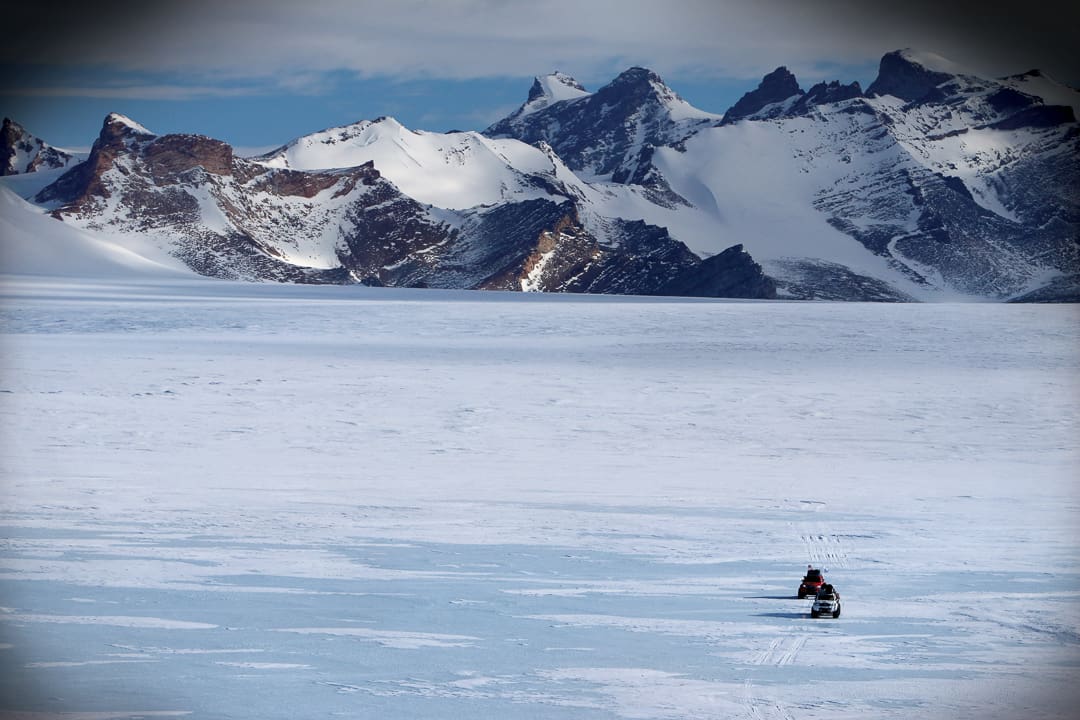
Photography by Chris Collard and Scott Brady
To honor the 20-year anniversary of Overland Journal, we are revisiting special heritage content in the upcoming 100th issue of the magazine. Originally published in Overland Journal’s Spring 2015 issue, this article is part of that celebration.
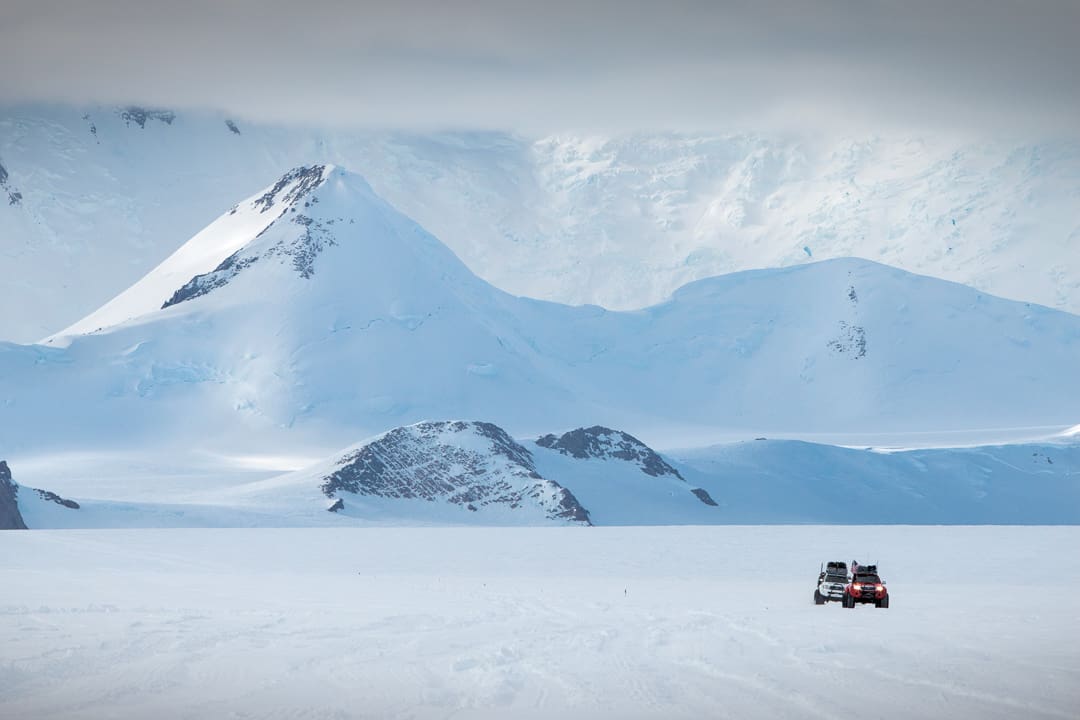
Beyond the windscreen, I can barely make out the edge of the hood; the rest is white upon white. I glance at the thermometer; it reads -25°C, and then at Gísli, my driving partner for the past 12 days. I rub my face and squint tightly in an attempt to stimulate blood flow to my eyes. For the last three hours, we have been transfixed to a thin line on our GPS screen, which is zoomed in as far as it can go. Outside is a world of crevasses and snow bridges. The track line is our guide, our chaperone, our god, at least for the moment. Without it we stop and wait for clear skies, which could be days away. Around my waist is a climbing harness and a 50-foot rope. If we get stuck and need to get out, we’ll tether ourselves to the vehicle. We’ve been traveling for nearly 30 hours straight and are virtually in a state of delirium. Gísli was at the wheel when we entered this bleached hell. When the horizon disappeared, I’d leaned out the window in an attempt to locate our previous track and give Gísli hand-signal directions. This had been a futile effort. I’ve now been driving for 90 minutes and am beat-dog tired. My attention darts from the LCD to the windscreen and back, and I pray for this to be over. This is the White Desert, Antarctica, the coldest, driest, and windiest place on the planet. I rub my face again and force my eyes back to the screen.
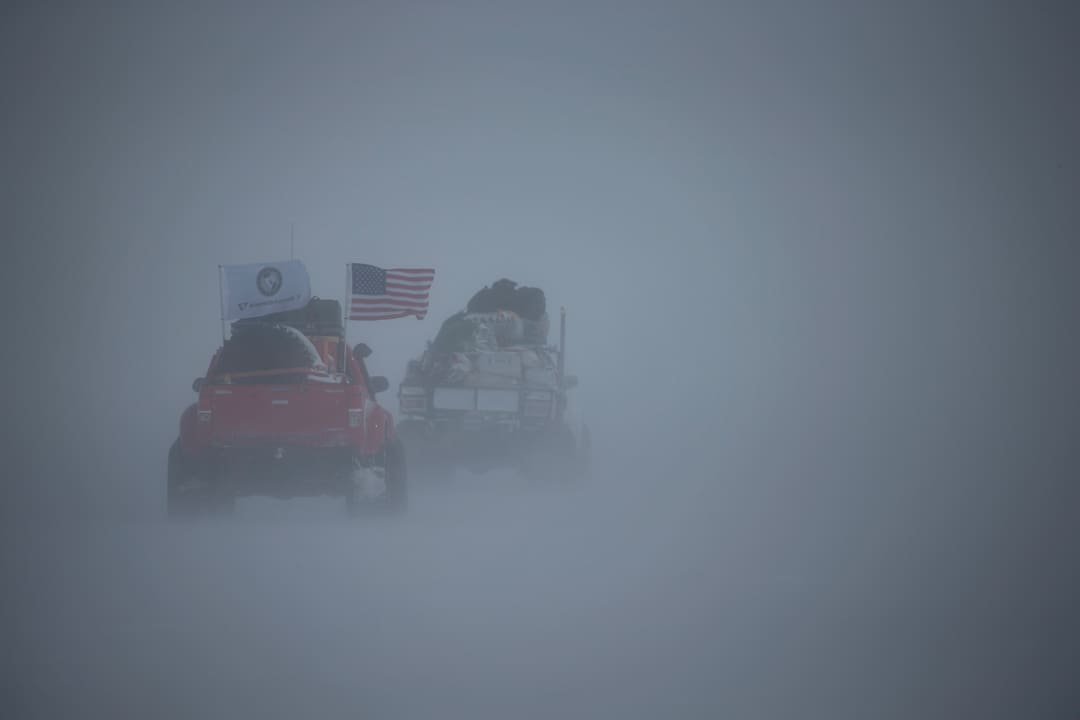
When whiteout conditions reduced visibility to a few meters, we navigated using a GPS breadcrumb track.
Two weeks earlier, Scott Brady, Greg Miller, and I stepped off an Ilyushin IL-76 cargo plane onto a 12,000-foot runway of ice. The flight was everything we had been warned of: cramped, hot then cold, with an elixir of adrenaline flooding out of the air ducts, washing the occupants with anticipation. The plane was Russian built, the pilots were from its motherland, and there were only a few small porthole windows. It was a six-hour flight from Cape Town, South Africa, to the Antarctic Logistics Centre International air base (ALCI) at Novolazarevskaya Station (Novo), where a Southern Ocean cyclone had grounded all aircraft for the past three days.
We had been given the green light to fly less than 24 hours earlier. It was a “go,” and if the weather closed in on Novo, we could have a problem. The Ilyushin had enough fuel to get there and back, but fuel for the back leg was stored in 200-liter drums in the cargo bay. If we breached the halfway point, we were committed to land, regardless of weather, on a runway that was not exactly straight, nor was it level. I asked a fellow passenger who had been on this flight more than once about the landing. She said, “I wouldn’t worry, the pilots sip a few shots of vodka to relax … they do this all the time.” I pulled my lap belt tightly to my waist and reassured myself that she was kidding.
We climbed down a long steel ladder and were greeted by Gísli Karel Elísson, Arctic Trucks’ Antarctic workshop manager and one of the few people on the planet who could be considered an expert on vehicle-based polar travel. We were the first contact they’d had with the outside world in more than a week, and the airfield was buzzing with activity. Ground crews organized loading zones as a forklift loomed calculatedly at bay for its payload like a praying mantis anticipating its next meal. The belly of the plane parted, the loading ramp settled to the ice, and the concert began. Out came pallets of food, barrels of fuel, duffel bags, wooden crates of various sizes and shapes, and Pelican cases bearing “fragile” and “keep frozen” stickers. Keep frozen? That didn’t seem to pose a problem here. The last item to be offloaded was one of vital importance to our team. It was a bright red 4-door Toyota HiLux specially built for Greg and Expeditions 7 by Arctic Trucks.
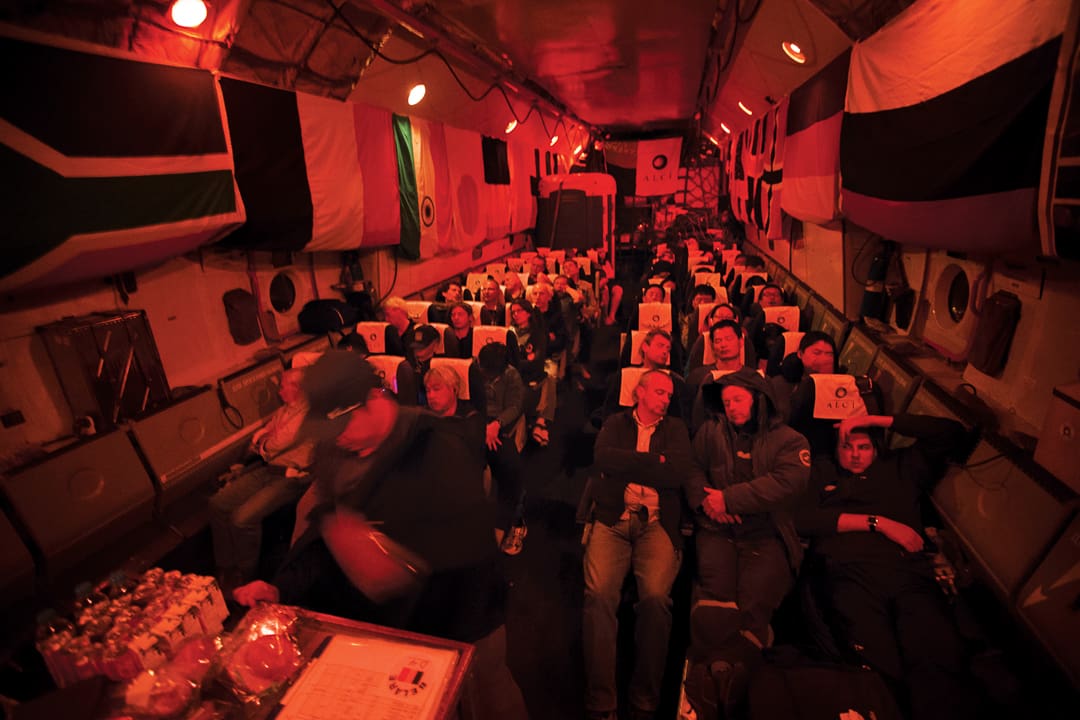
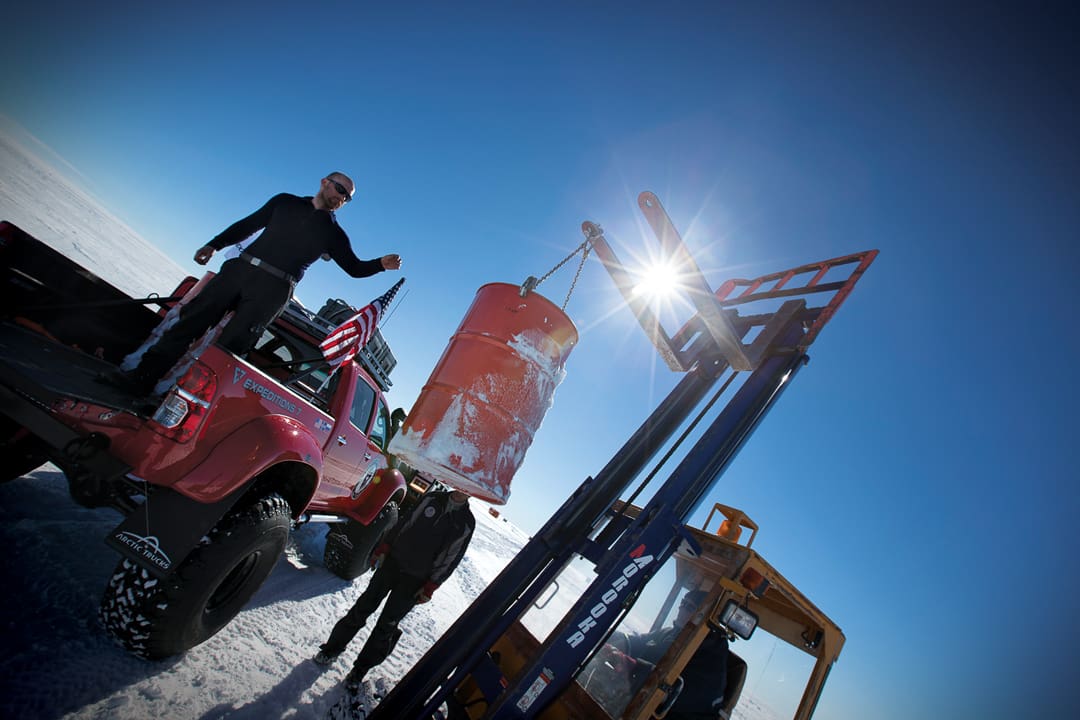
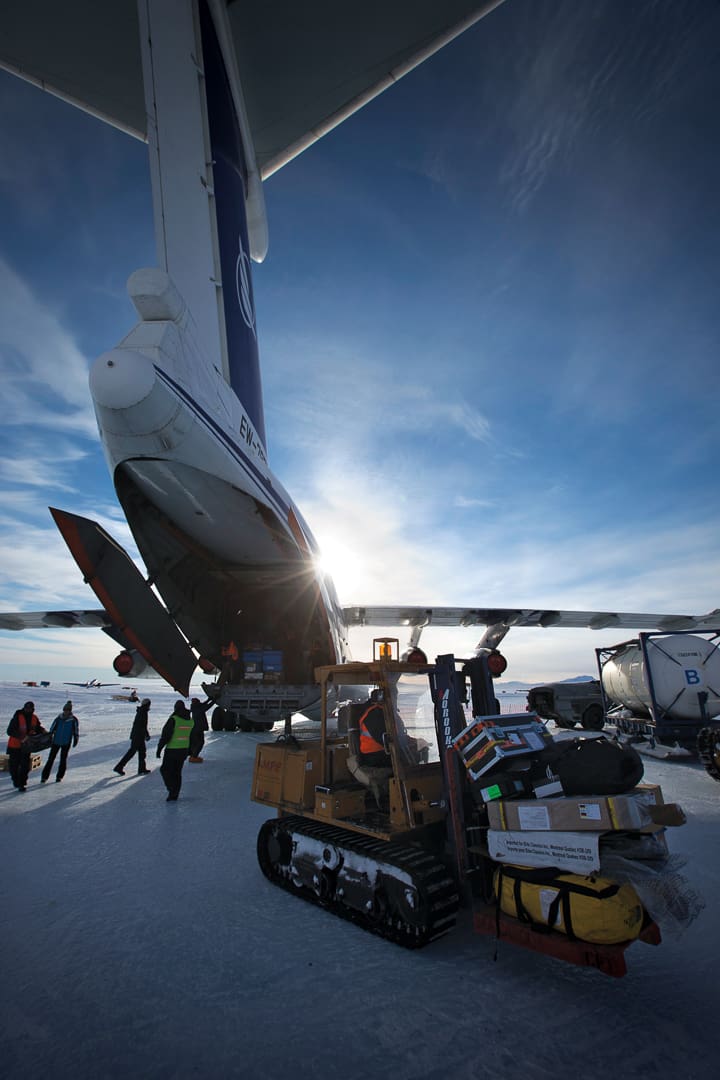
Due to the short time window between the Ilyushin’s touchdown and departure the ALCI airbase at Novolazarevskaya became a flurry of activity.
In the distance, we could see a row of structures: brightly colored shipping containers that had been reincarnated as living quarters, workshops, a communications office, and an upmarket “double-wide” mess hall. With gear piled high, we made our way to the Arctic Trucks shop for last-minute modifications, fuel, verification of GPS tracks, and a nap. In a few hours we’d turn the wheels south, a course we would maintain for the next seven days.
We were about to embark on the sixth leg of the Expeditions 7 trek around the world. Greg, a passionate Land Cruiser aficionado, was fulfilling his dream of driving Land Cruisers not just around the world, but also on all seven continents. He and Scott departed the Arctic Ocean in the northern reaches of Alaska two years prior and had already crossed Europe, Asia, Australia, and Africa. If Siberia had been the tip of the proverbial iceberg, Antarctica would be the 90 percent that lay below the waterline. There were many uncertainties, and they had spent months on the logistics. The plan was to head due south for approximately 2,200 kilometers. If our GPS breadcrumbs were accurate, if we maintained an average pace of 25 kilometers per hour, were spared mechanical issues, and avoided close encounters with crevasses, the Amundsen-Scott South Pole Station would be ours. The next leg, though ambitious, was optional—push north (an odd term at the South Pole where all compass points are, uh, north) toward the Ross Ice Shelf and western edge of the continent. Time would be of the essence, as this would put us nearly 3,000 kilometers from Novo and the season’s last flight back to Cape Town and it wouldn’t wait for a wayward clan of Amundsen wannabes.
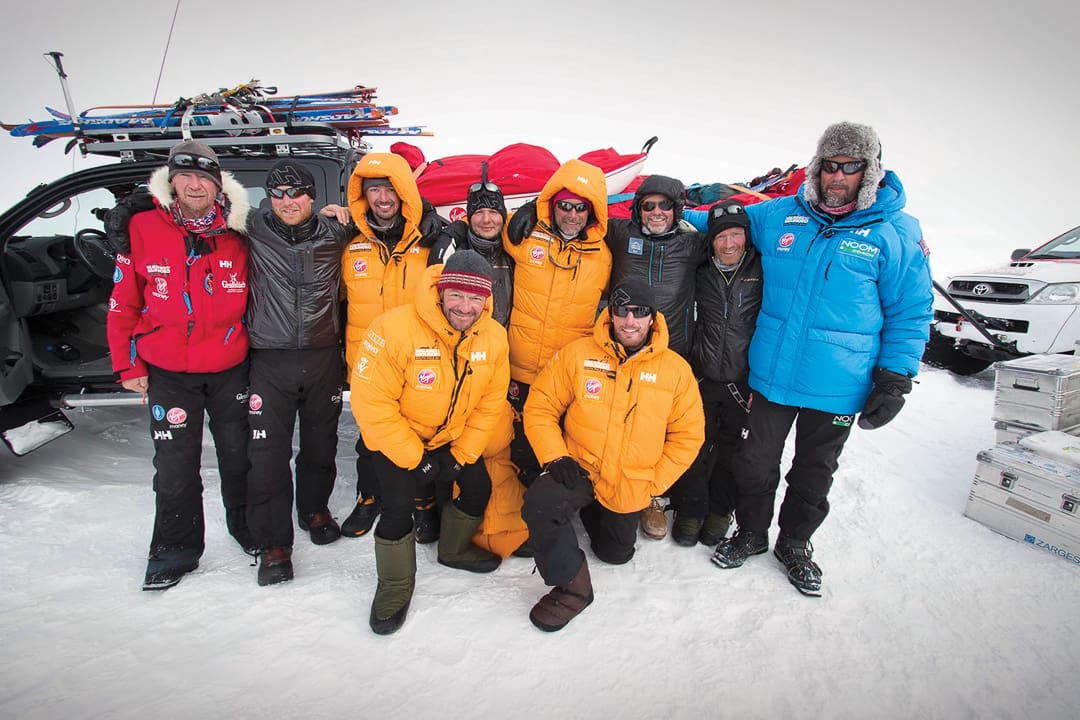
Expeditions 7 Antarctica Team
Scott Brady — Expedition leader, Overland Journal publisher
Chris Collard — Lead paparazzo, Overland Journal editor-in-chief
Gísli Karel Elísson — Polar expert, Arctic Trucks’ chief mechanic
Greg Miller — Lead adventurer, Land Cruiser aficionado
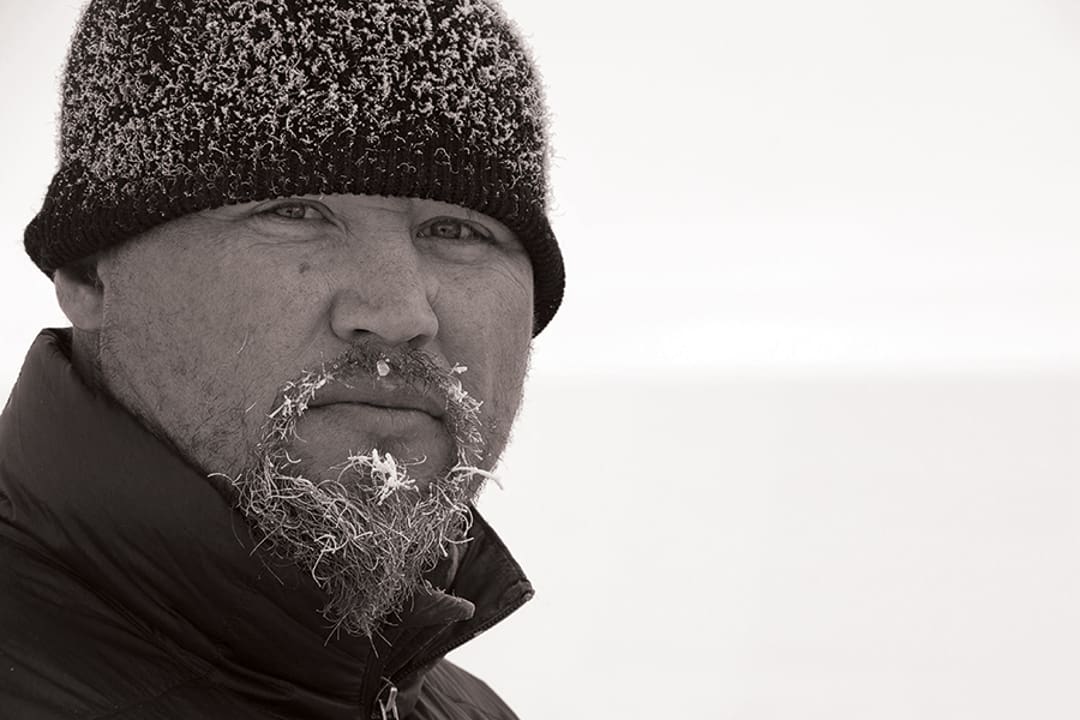


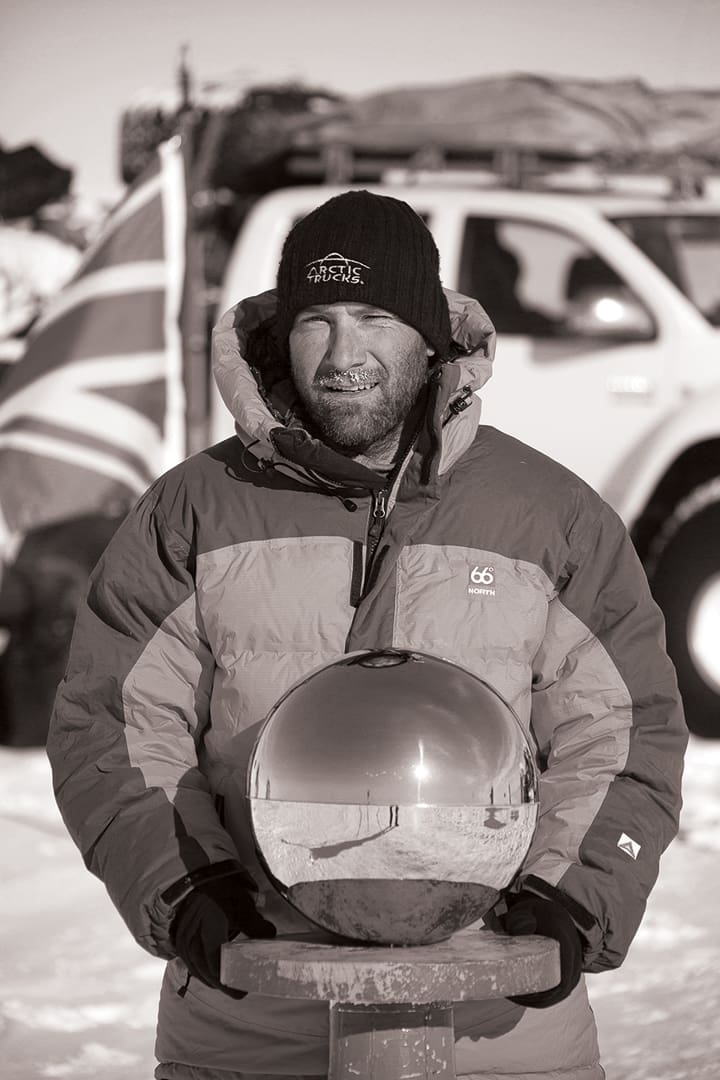
Post Time: Novolazarevskaya
Latitude: S70°
Elevation: 538 m
Temperature: -10°C
The air was crisp and clean, and the skies cerulean blue when we quietly rolled out of Novo. There were no fireworks, banners waving in the wind, or crowds of well-wishers—most of Novo’s enthusiasm reserves had been expended during the departure of a previous group. The morning we arrived, the team from Walking With The Wounded’s (WWTW) South Pole Allied Challenge had departed Novo for a landing zone at S87° to meet their support vehicles. Our paths would cross more than once in the coming weeks.
From an elevation of 538 meters, we began our ascent toward the continent’s center, an 11,000-foot icecap known as the Antarctic Plateau. If you view Antarctica from space, it resembles a stingray with an embarrassingly crude Friar Tuck haircut. The center is nearly void of definition: a polished white dome with straight-cut, scraggly precipices dangling about its extremities. To the northwest, the Antarctic Peninsula tapers off toward Ushuaia, Argentina, like a spiny tail, and the barbed Bransfield archipelago protects it from Nord invaders.
We were crossing fields of cobalt-blue ice that had been swept clean of snow. It resembled a river chasing gravity toward the sea, glacial flows eddying and boiling, constantly tormented and upturned by forces thousands of feet below. Long fissures develop in the crossfire and are slowly covered with drift snow, forming unstable bridges. They are fairly easy to see on the blue ice, but in many areas they are indistinguishable from the surrounding terrain. Here, venturing off the thin line of the GPS track is risky business. As a safeguard, everyone donned a climbing harness and a length of rope. It was mandatory that we tether ourselves to our vehicle if we exited.
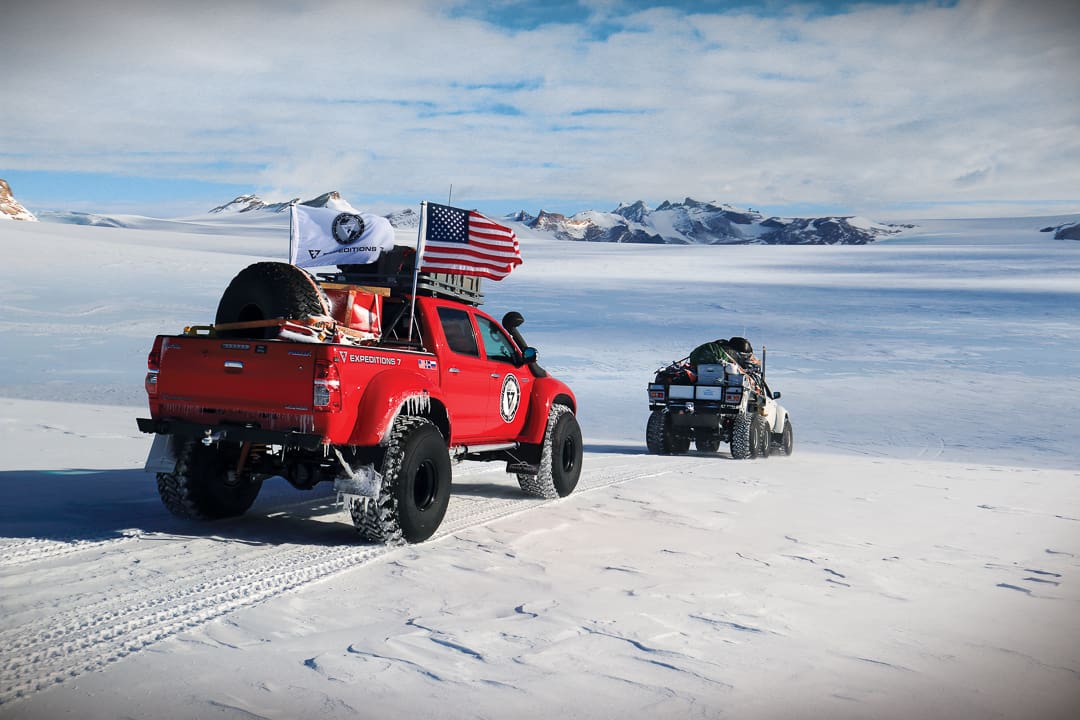

This was Queen Maud Land, a fascinating example of Antarctica’s unique geological DNA. Its coast is veiled under a thick sheet of snow and frozen seawater. Sheer spires, sculpted over millennia by wind, glacial flows, and tectonic movement, punctuate the ice cap. We zigged east and zagged west in a southerly direction as the GPS ticked off meter upon meter of elevation gain. Greg, Scott, and I, the newbies, were in awe of the magnificence of our surroundings. The Shcherbakov Range, a line of craggy, reddish-brown mountains, drifted by to the west; the Conrad, Wohlthat, and Orvin Mountains were beyond. I imagined that from the air these coastal mountains would appear like a supersized stegosaurus submerged in a sea of white silica sand.
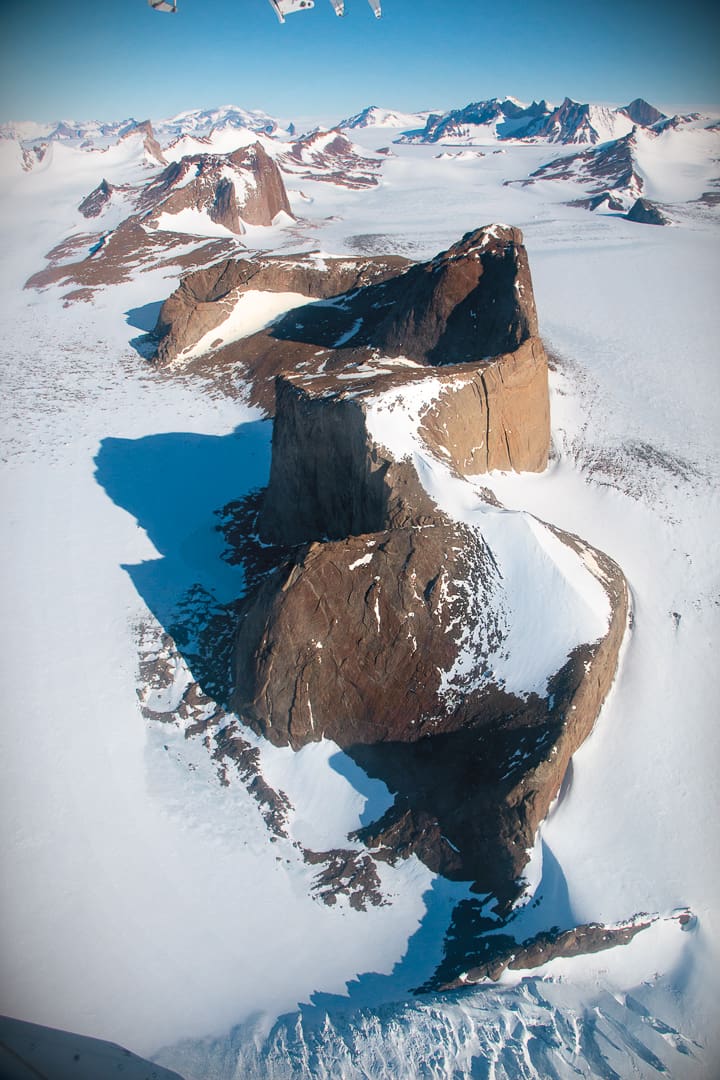
The Fenris Mountains slice through the surrounding glacial fields like the serrated tail of a prehistoric crocodile.
In a particularly steep section my photographic curiosity got the best of me. I was the cinematographer for the trip, and the setting mandated a third-party view. I said to Gísli, “I’m going to walk up the hill. Keep going.” He shrugged and said, “Use care.” I bailed out and began a short trek up the glacier, not knowing what to expect. I’d read of the movement of glaciers, of the fissures that are created as they are slowly pulled away from the heavens. In Greenland, I had heard their groans and cries of rage as they were torn apart by the forces of nature. But I’d rarely walked on one, let alone driven. As I hiked to an elevated position, my mind was awash with an account Gísli had shared. A tourist had wandered onto a glacier without a safety line, fell through a snow-covered crevasse, and became firmly wedged in a funnel of ice deep below. Atop this living and animated organism, I could hear it breathe. It was a sleeping lion; one that I hoped would remain quiescent.
Antarctica is unique unto itself and is the most sparsely populated continent. Average numbers range from 1,000 inhabitants in the winter to an elbow-to-elbow 5,000 in the summer—which pegs the population density meter at 0.00035 people per square kilometer (in the high season). It is a land of extremes ruled by no singular political influence, but rather an alliance of nations in agreement that the continent’s resources and untarnished beauty should be fervently protected and preserved. Most who live in Antarctica are involved in scientific research, and the Antarctic Treaty dictates that no mining or military activities are to take place. Another provision the treaty mandates is a pack-it-in, pack-it-out policy, including empty fuel drums, trash, and human waste. Everything must be hauled out.
This leads us to our relationship with WWTW. Companies such as ALCI, which manage logistics to the eastern hemisphere, are responsible for ensuring that abandoned vehicles, downed aircraft, and cryogenically preserved corpses are not left scattered around the landscape—a noble policy if one considers the debris littering that lofty peak in the Himalayas. In other words, they can’t have a bunch of yahoo explorers venturing off and dying. Accordingly, WWTW and Expeditions 7 were part of each other’s emergency plan. Though we hoped we would meet up with them near the Pole under a celebratory light, if we received “the call” we would respond as needed, regardless of jeopardizing the success of our mission. Likewise, if we had a problem, we would have a platoon of soldiers coming to the rescue.
Camp 72: Thor’s Hammer
Latitude: S72°
Elevation: 2,356 meters
Temperature: -16°C
Time en route: 7 hours
Distance: 154 kilometers
It was around 2200 hours when we reached Thor’s Hammer, our intended camp. I use the term “camp” loosely, as camping in Antarctica is an exercise in survival. This was our first live drill in setting up the tents, latrine, and mess hall. We were in the Land of the Midnight Sun, which hung at about 30 degrees above the horizon. The sub-zero temperature and thin air were immediate reminders of our environment. After fumbling our way through setting up the Arctic Oven mess tent, we pitched our individual abodes and set about cooking dinner. The first order of business was to prepare water. Being warm-blooded creatures from warmer climes, the concept of having to melt ice for water was a bit foreign. It would quickly become second nature: erect the tents, set up three MSR stoves, prepare water, mix up a dehydrated meal, eat, and go to bed.
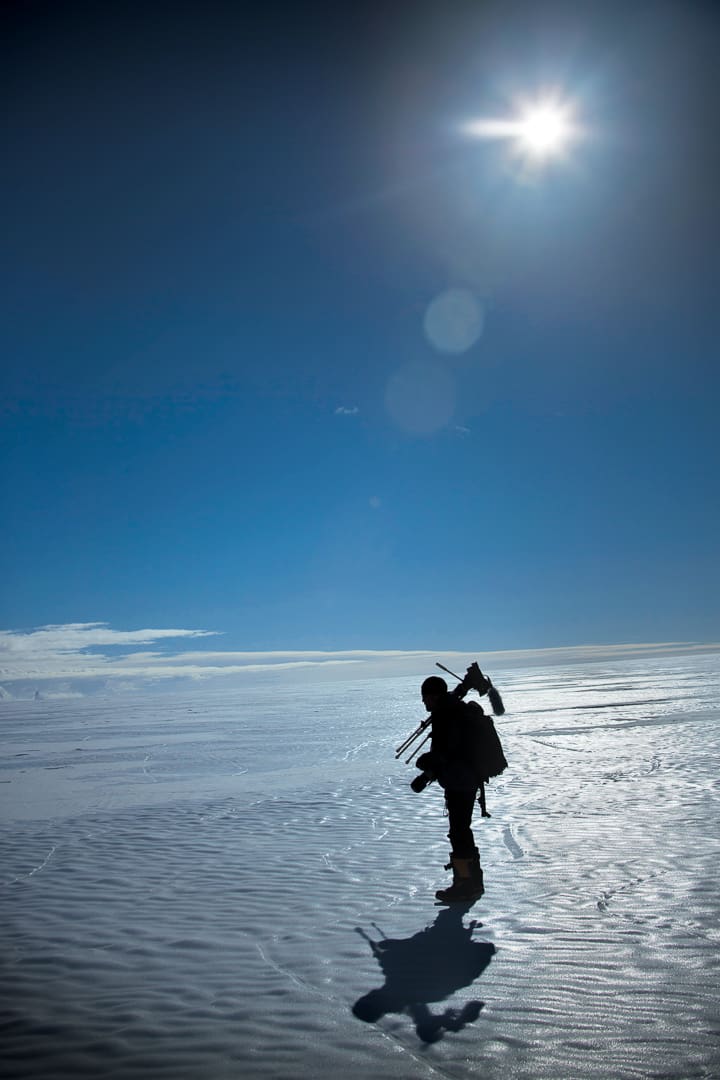
After everyone crawled into their sleeping bags, I took a little walkabout to set up a camera for a time-lapse sequence. I guessed it was around 0100 hours, as the sun was passing nearly due south. Its rays dispensed a harsh and contrasting light as crisp as the snow underfoot. The area around this camp is considered to be, at least by Gísli, a safe zone. I queried whether it was okay to be out on foot without a tether. His response, “I think okay, not so many crevasses here.” As before, I moved slowly and with purpose, using a monopod as a probe and placing each step with care as I made my way up to the base of Thor’s Hammer about a thousand meters to the east.
I recited Gísli’s dissertation on how to detect a crevasse. Mid-span, I paused to survey my surroundings. My lifeline to the world, a small gathering of tents and vehicles, was now a series of distant yellow, red, and orange specks amongst a sea of white … and dreadfully small. It was at this moment, perched alone atop a thousand feet of ice, that it sank in. I was in Antarctica, near the southern extremities of the planet, and it was quite possible that my feet rested where no human had trod before. There were mountains in the near distance, but to the south where the sun beckoned lay a vast sea of emptiness, the White Desert. I reflected on my home in sunny California and my wife, Suzanne, who had assuredly supported my decision to come here, but with trepidation. The wind picked up considerably, and the temperature was dropping steeply; I had ventured far enough.
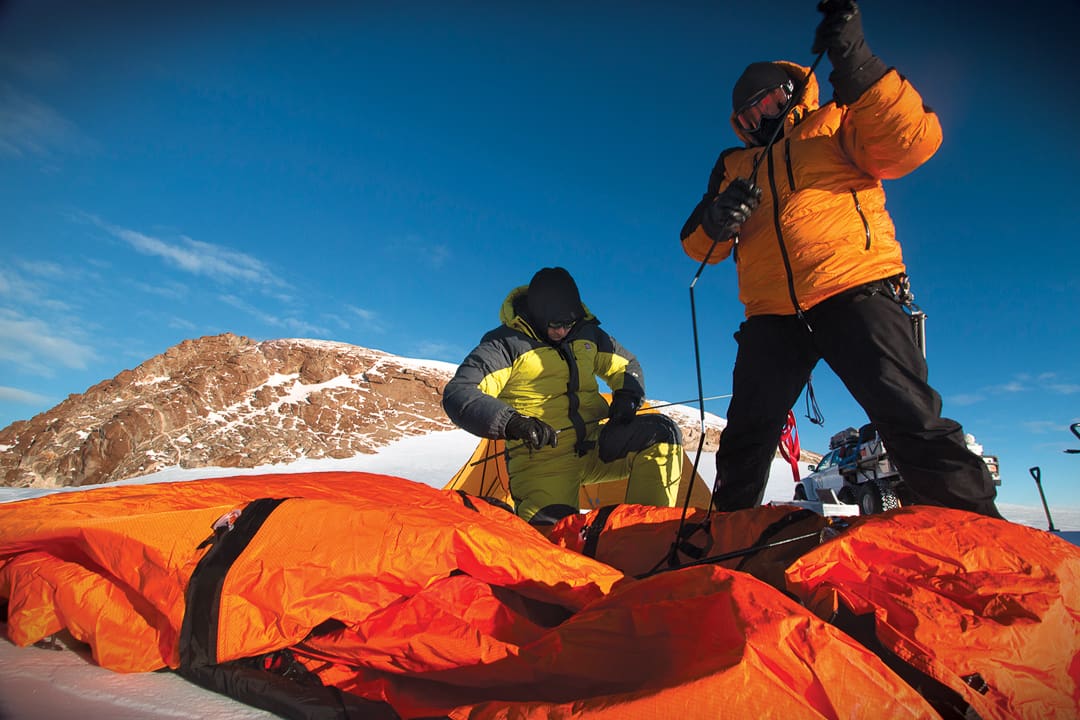

In the morning, if it could be called so, Greg and Scott checked the vehicles and sorted out our gear, while Gísli and I melted snow for coffee and a breakfast of oatmeal and dried fruit. Like a cool sip of water in the heat of the desert, anything warm was a treat. This would become a daily ritual over the next two weeks. I reference “daily” in a general way, as our schedule would be dictated by several factors: the number of hours before the last plane left Novo, distance to cover, human requirements for rest and nourishment, and anticipated rate of travel. The plan was to travel for 20 hours and rest for 10. Driving shifts would be in four-hour rotations, with off-duty times to be spent managing music selection, keeping the driver awake, or pulling a jacket over your head in an attempt to sleep. Since camping would be anything but rounds of “Kum ba yah,” skewer-roasted marshmallows, and sipping coldies, everyone was on board with the 20/10/4 strategy.
At midday, we crossed the tracks of two French skiers who had their sights set on the Pole. Scanning the horizon, we searched for anything that wasn’t white. Though there isn’t exactly a rush hour, there is a rush season. During the next 12 days we’d meet Parker Liautaud, a 19-year-old climate change campaigner who was attempting to set the record for the youngest person to complete an unsupported coast-to-pole ski trek. And there was British adventurer Maria Leijerstam, who would follow the same route up the Leverett Glacier on a recumbent three-wheeled cycle. Add the WWTW crew and a fuel train sliding its way from McMurdo Station to the Pole, and I could see HOV lanes in Antarctica’s future—okay, maybe not for a few more years. Twenty-four hours later we would hear that the French skiers had abandoned their quest due to weather and called in to Novo to be picked up.
Camp 77
Latitude: S77°
Elevation: 3,197 meters
Temperature: -23°C
Time en route: 30 hours
Distance: 720 kilometers
Damn, it was cold. We were now camped at 3,197 meters, and the mercury was continuing to fall. Despite knowing better, I tried to light a Jetboil to mitigate the ice buildup on the inside of my tent. It was simply too cold. The thing froze up and rolled over like a petrified penguin, which made crawling out of my cozy -40°C Nemo sleeping bag that much more enjoyable. I’d brought the stove along because, uh, I’m lazy, and thought it would be nice to warm up my tent and heat a little coffee in the morning. While the idea of slipping the frozen fuel canister in my sleeping bag did cross my mind (for about a millisecond), I stowed the unit permanently and resolved myself to the mess hall for the morning beverage.
We would experience our first whiteout this day. About 12 hours into our 20-hour drive, dense fog and blowing snow closed in like a cloak, obscuring the sun and reducing visibility to 20 meters. The scene was eerie, like a milky cloud of swarming white locusts rolling through an already weird dream. Scott and I saw this as a Canon moment: an opportunity to capture some footage. We released our tethers, climbed out, and watched Greg and Gísli fade into oblivion. I glanced at Scott and knew he was mirroring my thoughts, “If these guys lose the track, we’re screwed.” The radio crackled with Greg’s voice and these sweet words: “We’ve turned around and are heading back on the track, you guys ready?”
While we waited, I couldn’t help but envision the early explorers of this place once known as Terra Australis, a southern landmass thought to act as the planet’s counterbalance for Africa, Asia, and Europe. These guys were tough. They didn’t have Gore-Tex, high-tech boots, or double-layer tents. They also didn’t have four-wheel drive vehicles to retreat to when things went sideways. It made me appreciate the intestinal fortitude they possessed … and our Arctic Trucks.
Antarctica’s environment is otherworldly. While South America boasts the Andes, and Asia enjoys the famed Himalayas, Antarctica claims the title for the highest average elevation. It is not the largest continent—it only ranks fifth—but 98 percent is covered by ice with an average thickness of 3,000 meters. It also claims the lowest recorded naturally occurring temperature on Earth: -89.2°C.
Aware that we were standing on thousands of meters of fallen snow, and considering annual precipitation on the continent’s interior is less than 50 millimeters, begged the question: How did it all get here? The answer was self-evident—it never melts. The limited amount that does fall is blown around until it finds a happy place to rest. Happy is used loosely here as well, as when a snow crystal is permanently planted it becomes party to the evolutionary process of glacier production. If it lands near the coast, it will, over the next million years or so, join a bazillion other crystals in their journey to lower elevations and eventually to the ocean. If it parks itself on the polar plateau, it will be pressed toward the center of the earth, condemned to an eternal existence in a sarcophagus of ice.
In the mountain regions and fringes of the plateau, katabatic winds wreak havoc on anything in their path. They develop when air at higher elevations is cooled, becomes heavy, and is drawn by gravity to areas of less dense air. In Antarctica, katabatics can reach velocities of nearly 200 mph—enough to upend shipping containers and scatter humans like leaves in the path of a landscaper’s blower. Though we would not be blessed with this phenomenon, evidence of their existence was omnipresent. In every direction and as far as the eye could see were sastrugi. When the katabatic winds arrive, predominantly in the fall and winter, they torment the landscape, cutting divots and snow tunnels, and sculpting the ice into sharp and irregular patterns. They can be up to 2 meters in height and are the nemesis of the polar traveler. Sir Ernest Shackleton and Captain Robert Falcon Scott wrote of the sastrugi and the difficulty they imposed. For us, it was a matter of slowing the pace and choosing a path that was as close as possible to our GPS breadcrumbs.
The storm cleared just in time to set up camp. After everyone turned in, I again stood alone on the ice with my camera. It was calm and clear, and the sun was to the west, not that it mattered. It could have been to the south, east, or north, as it barely deviated from its 30-degree declination to the horizon. There was something profoundly peaceful about this environment. Beyond the sastrugi in the foreground, it was nearly pool table smooth, a moonscape so flat and expansive I could see Earth’s curvature. I had queried Anna, our German ALCI representative, about maps of the interior. She said, “All you need is a white piece of paper; there is nothing there.” The casual observer might describe the plateau as bleak and featureless, but I found it to be a fascinating world of natural art. Millions of intricately wind-carved sastrugi created a carpet of tactile texture. Drift snow, suspended just a few inches above the surface, swept by like a genie on a magic carpet, and above, the sun glistened off a crystalline orchestra as it played across the plateau. The scale of this world of endless horizons invoked a sense of irrelevance and an awareness of one’s frailty.
Camp 83: Fuel Depot and Russian Vodka
Latitude: S83°
Elevation: 2,618 meters
Temperature: -14°C
Time en route: 50 hours
Distance: 1,401 kilometers
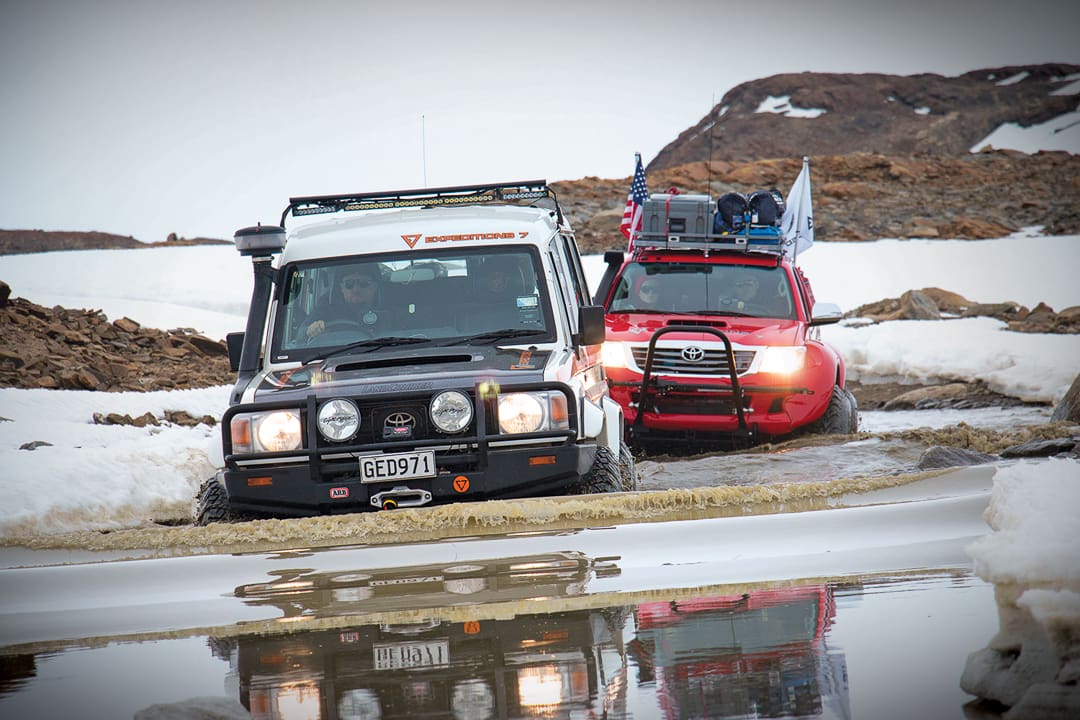
There were few 7-Eleven corner stores along our route. In fact, there weren’t any. We’d not seen a Starbucks, McDonald’s, KFC, or Taco Bell—it was magnificent. Fuel stops, however, were required at least once during each driving session. The first would be a remote fuel depot at S83°. Arctic Trucks, which is based in Iceland, has spent decades perfecting the art of polar travel. Our two vehicles, an AT44 and AT6x6, ran on Jet A-1 fuel with two-cycle oil added for lubrication. Each was fitted with extended-range fuel cells (280 liters and 600 liters, respectively), and carried additional 200-liter fuel drums in the bed (we had six total). With a combined reserve of 2,080 liters and an average fuel economy of 48 liters per 100 kilometers (about 5.1 mpg) for each vehicle, we had a range of approximately 2,100 kilometers. Regular stops included transferring fuel from the drums to the vehicles via a 12-volt pump. We would also require two refuels while en route to and from the South Pole.
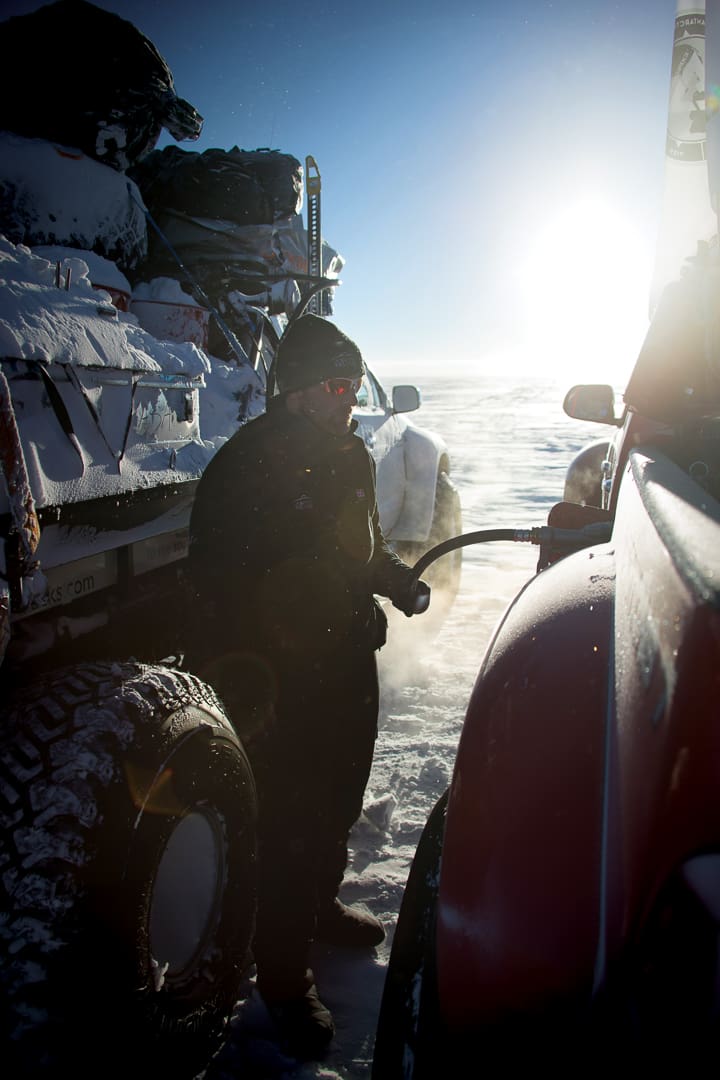
We arrived at Camp 83 to be greeted by Andre, a Russian national and the camp manager. The extent of the facility was a few tents, an open-air latrine dug into the base of a snow pile—and that was it. In the distance were thin marker posts lined up across the ice and another airstrip. If you’ve ever wondered why Antarctic travel is ungodly expensive, it’s because everything has to be flown in. If a product is needed in the interior, it must also be flown to that location and airdropped. Andre and his team of four would spend three months in this remote outpost to support the season’s few expeditions. The day prior to our arrival, 208 barrels had been pushed out of the tail of the Ilyushin and parachuted to the airfield. Andre’s crew was in the process of collecting the payload and burying it under a few feet of snow for future retrieval.
We stepped into their mess tent; it was warm and smelled of coffee and herbs. Sleeping cots lined the sides, and wooden planks provided a solid floor free of snow and ice. They shared hot bowls of solyanka, a Russian soup of sausage, potato, and spice, and we sipped coffee and talked about the weather. Chatting about weather is not simply small talk to pass time, as it is relevant to what work can be done and when. Andre received a report from Novo that conditions looked favorable for our next leg to Camp 89, where we were to rendezvous with the WWTW crew. I pulled out a bottle of Captain Morgan and shared it with our hosts. They produced a small container of Russian vodka, which we politely sampled; all except for Greg, who doesn’t drink and graciously abstained. It was an odd mix for breakfast, or dinner, or whatever mealtime it was, but what the hey. After a nap, we made our way out to the fuel depot, dug up a few drums, topped off the tanks, and headed south, of course.
The minutes, hours, and days were beginning to meld together into a cyclical and never-ending dream of drive, refuel, eat, sleep, and drive. When the sun was directly ahead of us it was midnight. When it was at our “six,” it was noon. A blurry moment later it was directly ahead again. For those of us who live outside the polar regions and have regular periods of darkness, adjusting to continuous daylight can wreak havoc both physically and psychologically. This falls into the realm of a circadian rhythm sleep disorder. After 20 or 24 hours of consciousness, the body becomes exhausted, and the mind finds it difficult to shut the system down. In a world without night, do you awake at 0500 hours to have an omelet or a cocktail? Nonetheless, I was becoming semi-acclimated to the routine, catching some shuteye while bouncing over sastrugi and listening to cyclical rounds of Eric Clapton Unplugged (I think this was Gísli’s only album).
The skies were clear for the first 10 hours, and we were making good time. The hours were passed discussing our optional leg to the Ross Ice Shelf and admiring prismatic arrays of light reflecting off 360-degree snowbows, or rainbows. If we maintained our current pace and didn’t have any delays, not only the Pole, but a full crossing of the continent might be possible.
Snow conditions on the plateau vary from firm to very soft. In some places our boots hardly broke the surface; in others they left a 6-inch-deep impression. If you’ve spent much time driving in snow, you know that success is all about flotation. Our vehicles were fitted with massive 44-inch Dick Cepek Fun Country tires on custom, 14-inch-wide Arctic Truck wheels. This combination created a broad, flat footprint and excellent flotation. Air pressure ranged from 7 psi on firmer snow to as low as 1 psi in the softest conditions or when we got stuck—which did happen occasionally.
Camp 89: The Call
Latitude: S89°
Elevation: 2,691 meters
Temperature: -23°C
Time en route: 76 hours
Distance: 2,075 kilometers
Gísli received “the call” on the satphone midday. It was the Walking With The Wounded team. They were hunkered down in a whiteout at S88°, one of the members had frostbite, and they needed assistance. We jotted down their coordinates and gave them an ETA of four hours. Their condition wasn’t dire, which was good, but we were excited to meet the crew and be able to provide help where we could.
WWTW’s charter is to support wounded veterans in gaining skills needed to integrate into the civilian workforce. With the help of a wide cast of volunteers and generous contributors, and notable patrons such as Prince Harry of Wales, they raise funds and develop public awareness, highlighting the fact that the leadership skills a soldier possesses in the battlefield can be a great asset in the business world. The South Pole Challenge Alliance was made up of mentors, guides, and veterans from the UK, Australia, Canada, and the US. They were a hysterically good-natured lot.
We arrived to find them loading skis, sledges, and gear onto their support vehicles. Our job was to assist in moving their camp about 100 kilometers to S89°. I grabbed my camera and crawled into a tent with Ivan Castro, a US Army officer who was blinded while serving in Iraq when a mortar hit his platoon. Considering he was completely sightless, Ivan had a very clear vision of the world. He enlightened me on the virtues of women, the Army, governments, and sports teams. I left Ivan’s tent humbled yet uplifted, and feeling a bit guilty for the trivial things I sometimes whine about.
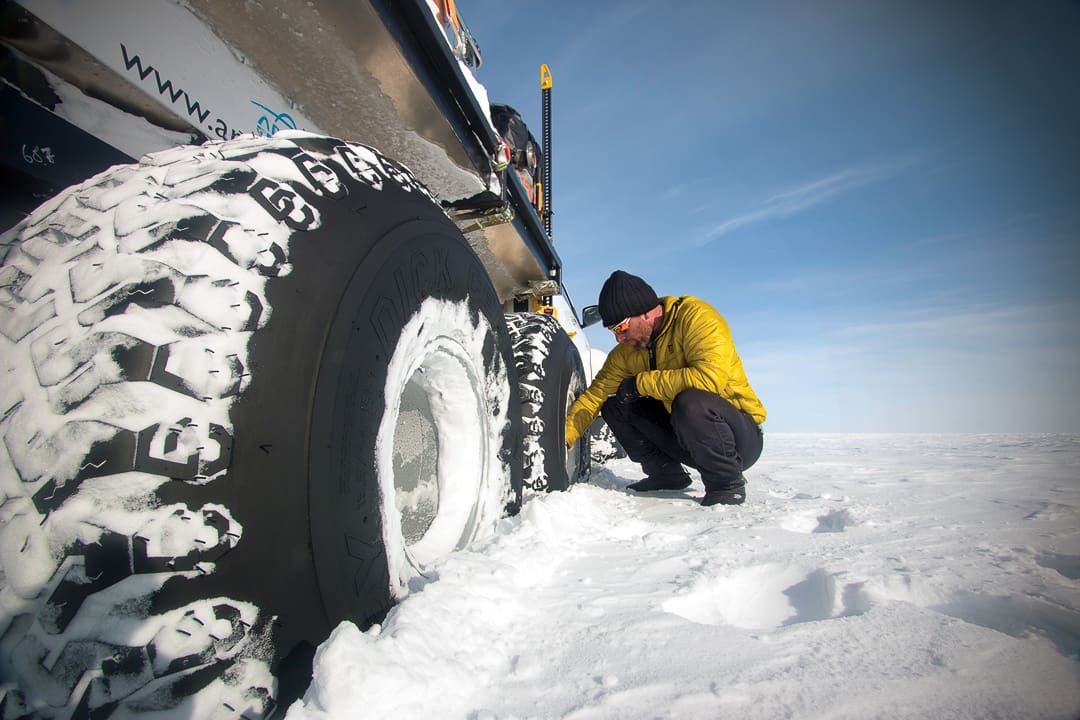
Extremely soft conditions required lowering air pressure from 3 psi down to 1 psi.
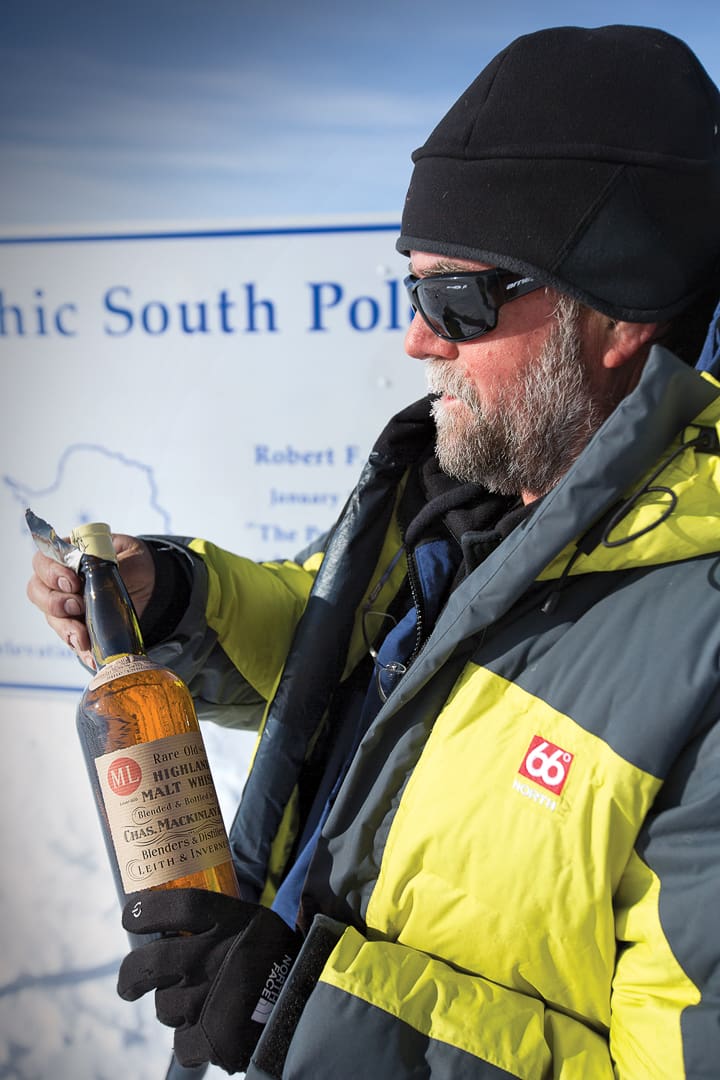
With gear piled high in the bed and hanging off the sides of the roof rack, we resembled a Saturday Night Live spoof of The Beverly Hillbillies in Antarctica. I climbed in to find Duncan Slater, a Scot, and Englishman Guy Disney in the back seat. Both had lost legs to IEDs and RPGs in Afghanistan, and were more entertaining than a barrel of monkeys. As can be expected with a Scot and Brit aboard, the conversation quickly distilled itself to the attributes of fine whiskey and one of the WWTW sponsors: Glenfiddich. They had a 29-year-old single malt that Glenfiddich had prepared for their team, and I’d brought a bottle of Mackinlay’s Rare Old Highlands Malt, a reproduction of the whiskey found under Ernest Shackleton’s Antarctic research hut. Duncan was an expert on the subject (as any Scot worth his salt should be), and though we would wait to crack the seals until we reached the South Pole proper, we vowed to save each other a few drams. The storm lifted, visibility improved, and we maintained a reasonable pace during the four-hour drive to Camp 89. It had been nearly 24 hours since our day had begun, and we were all ready for the sack.
In the morning, we extended our appreciation of their service by walking around to each tent with a thermos of hot water. We said our goodbyes and began the short, one-degree push to the Pole.
Amundsen-Scott South Pole Station
Latitude: S90°
Elevation: 2,835 meters
Temperature: -27°C
Time en route: 80 hours
Distance: 2,204 kilometers
Standing at the geographic bottom of Earth is surreal. As one who feels he’s pretty good at dead reckoning navigation, the Southern Hemisphere has always rendered me a bit off. The sun at any time of the day is analogous to any other time of day. Set me on the confluence of all meridians, and I’m seriously discombobulated. Step left and go north. Step right and go north. If all roads lead to Rome, all meridians lead to the very spot we were standing. Pick one, any one, and follow it in a great circle for about 25,000 miles and end up in the exact same spot: ground zero.
Greg had pulled in a few favors and secured a personal tour of the Amundsen-Scott South Pole Station. The facility, which is firmly planted (on adjustable stilts) in the middle of emptiness, is right out of the film 2010: A Space Odyssey. It is a life support system in a place void of life. There are dining halls, recreation rooms, living quarters, and a greenhouse. The environment outside would render an unclothed person a human Popsicle in a matter of minutes. Inside, scientists and maintenance personnel stroll long corridors in shorts and T-shirts. The Russians at Camp 83 said, “Station big, everything America do big.” They weren’t kidding. The current structure, which replaced a variety of renditions since the station’s opening in 1956, can house up to 200 people. The ice airfield, which is slightly more straight and level than the sausage-shaped one we landed on, hosts a daily C-130 Hercules load of tourists and supplies from McMurdo Station. Accordingly, there is a small store with sundries and souvenirs. It is also the only terrestrial place on Earth where the sun is continuously visible for six months, and likewise out of sight for six months.
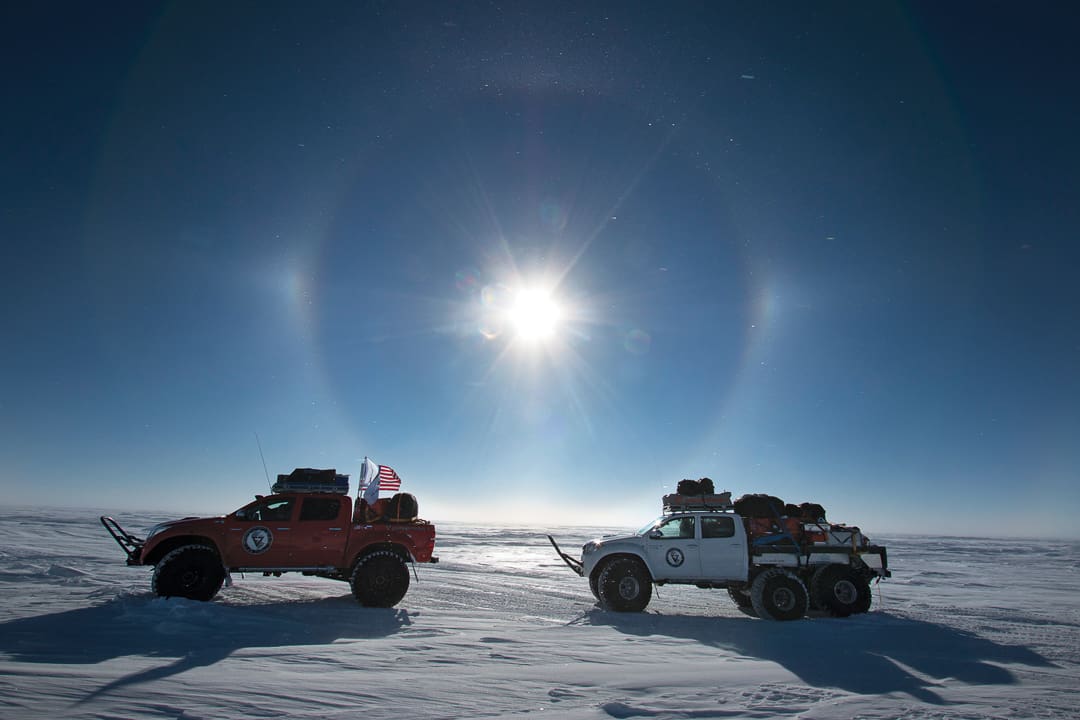
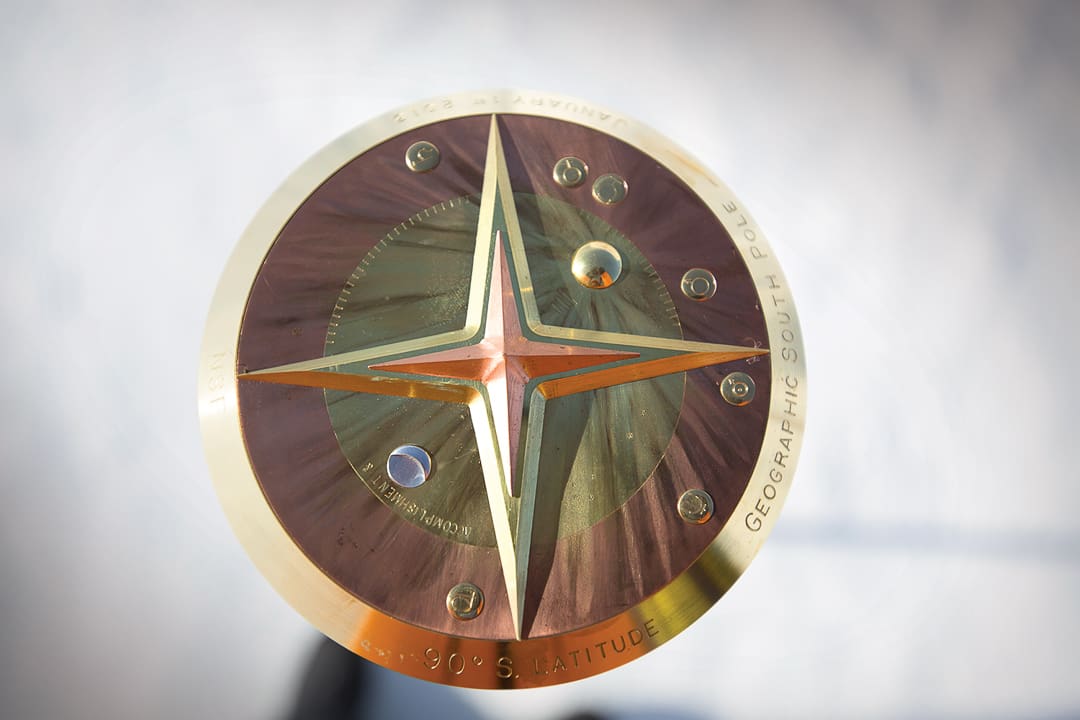
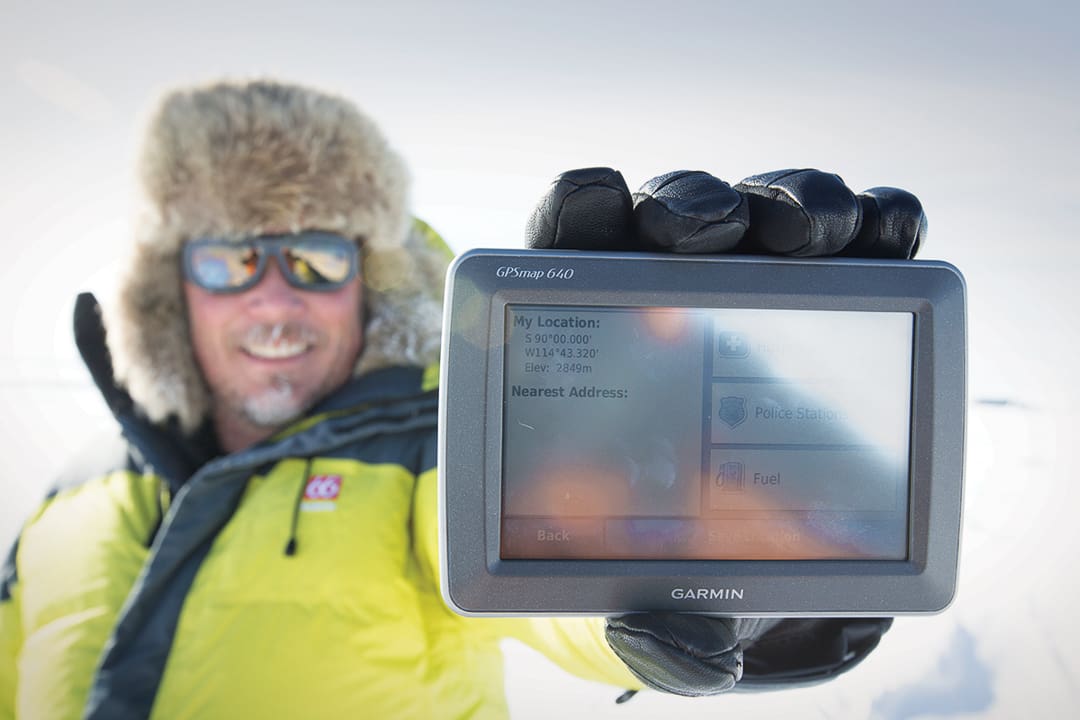

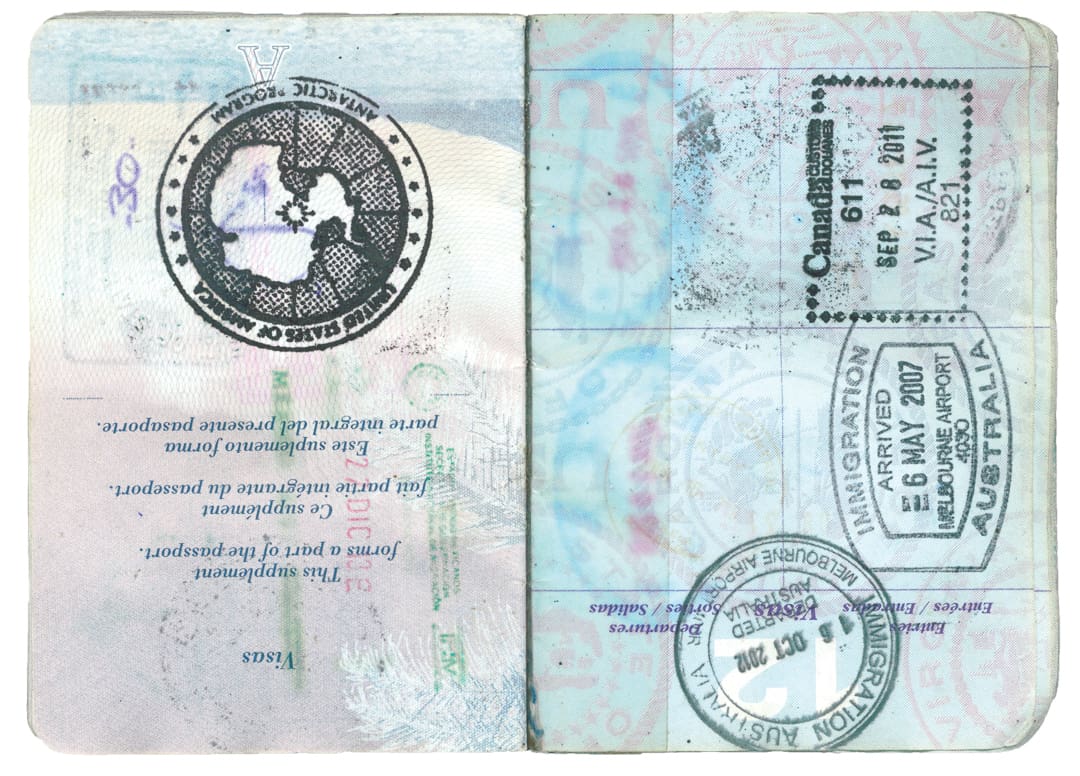
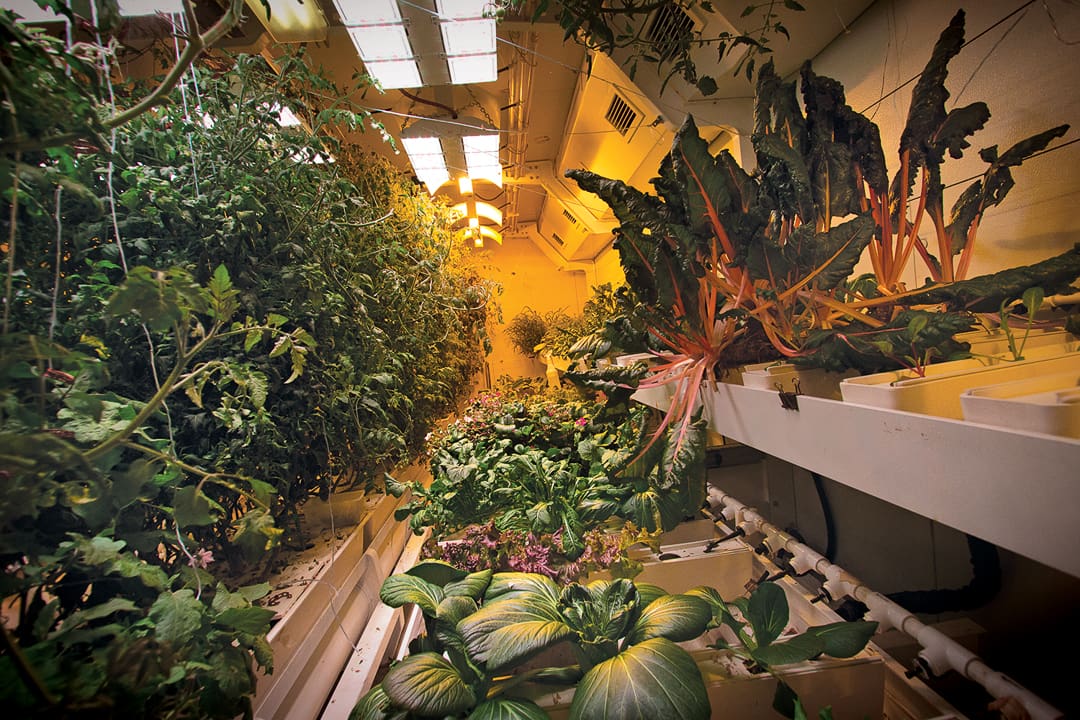
.
While all this sounds quite exotic, the station’s primary function is scientific research: geological, meteorological, astronomical, and biomedical. The most recent is the IceCube Neutrino Observatory, a square kilometer array of subterranean sensors placed up to 2,450 meters deep in the ice. The project’s goal is to detect extraterrestrial neutrinos buried under millions of years of accumulated ice. Yes, very technical stuff that went over my head like a satellite. Before bidding our adieus, Greg, whose family owns the Utah Jazz basketball team, presented the facility manager, an ardent sports fan, with a specially made #1956 Jazz jersey in honor of the station’s founding. And though we’re not passport stamp geeks, we did take great pleasure in inking an Amundsen-Scott South Pole Station stamp and giving it a good press on a now highly coveted page.
The day was still young, and after popping the cork on the Shackleton’s single malt and indulging in a celebratory nip, we shifted to phase 2. The Ross Ice Shelf and the western edge of the continent lay a mere 600 kilometers away. Considering the distance we’d traveled thus far, the Ice Shelf was no more than a short jaunt. Time would still be of the essence, but the track across the plateau and down the Leverett Glacier was established and well used. Greg, who prides himself in being an endurance driver, took the lead and set a commanding pace. With any luck we could make the Southern Ocean and still have time for the return trip to Novo, barring any issues.
Ross Ice Shelf
Latitude: S85°
Temperature: -12°C
Elevation: 281 meters
Time en route: 100 hours
Distance: 2,784 kilometers
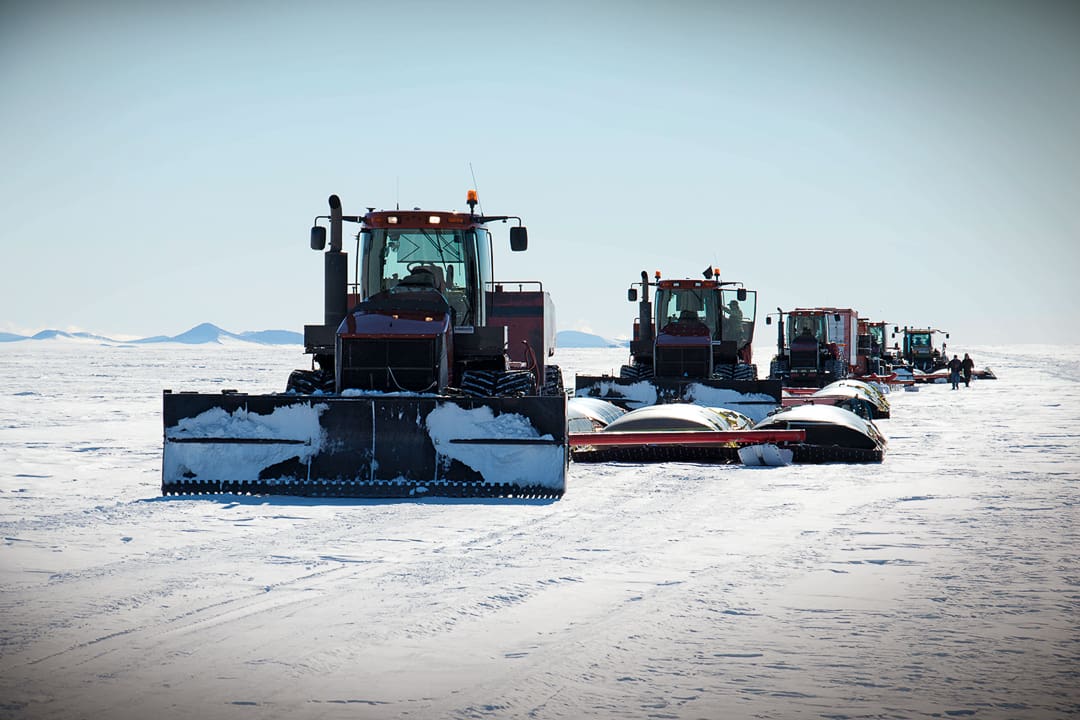
Considering the fact that we were 10,000 miles from home and in a region visited by few, it seemed odd that I would run into someone from near my hometown in California. While descending the Leverett Glacier, a procession of ants, marching black specks on the horizon, came into view. As we grew near, the apparition morphed into a land train of tracked vehicles towing box trailers and sledges. Keith Hall climbed down from his warm cocoon atop a Caterpillar MT865C. He smiled and said, “We don’t get much traffic down here!” and queried us about our pursuit. His team, which began at McMurdo Station, was heading to the South Pole for a semi-regular fuel drop. Behind his Cat was a sledge burdened with eight 3,000-gallon bladders of diesel and jet fuel, a total weight of 168,000 pounds. His posse was reminiscent of a steam engine train crossing the Great Plains in the 1860s. There were supply cars, sleeping quarters, and a dining coach. The journey would take 22 days one way, and they would make two such trips during the summer season.
Standing on the confluence of the Ross Sea and continental Antarctica we scanned the horizon to the north, another infinite breadth of white. Technically at the water’s edge, the shelf’s 640,000-kilometer2 expanse eliminated any chance of seeing the ocean. I reflected on accounts I’d read about the Amundsen and Scott expeditions and how they used the Ross Ice Shelf as a staging point for their pursuit of the South Pole. On December 14, 1911, Amundsen and his team became the first humans to reach the geographic bottom of the earth. Scott’s arrival a month later was bittersweet. Though they had successfully reached the Pole, they were in dreadful shape and grievously disheartened by the presence of a Norwegian flag. In late March of that year, somewhere in the distance, Scott and his companions breathed their last breath.
We savored the sweet taste of victory, the sense of accomplishment, elation, and exhaustion. As we recorded our location and autographed the signpost marking the union of land and sea, Gísli informed us that he believed we were the first Americans to cross Antarctica from coast to coast by vehicle. While this was sinking in, I remembered a famous quote by mountaineer Ed Viesturs: “Getting to the top is optional. Getting down is mandatory.” We turned away and headed inland, south, to set up camp in the lee of the Transantarctic Mountains.


Camp 85: The Last Flight to Cape Town
Seventy kilometers from the signpost, Gísli got a funny look on his face and said, “Something is wrong; we need to stop.” To this point, the only mechanical issue we’d experienced was the water separator on Greg’s HiLux freezing up, which was a quick fix. Crawling under the 6×6 revealed something none of us wanted to see: a broken coil spring. A sheared axle or scattered differential would have been much worse, but this was still a major issue. We went about removing the spring, setting up a mobile shop, and repairing it as best we could. Though Gísli is an accomplished welder, coil springs are formed with spring steel, and spring steel does not take kindly to being welded. Gísli and I reassembled the vehicle while Greg and Scott set camp and prepared another scrumptious feast of dehydrated backpacker meals, freeze-dried meat, and vegetables. We’d been semi-awake for 30-plus hours, and it was time to crash.
With the 6×6 back together, we kept our collective fingers crossed in hopes that if we drove with care, Gísli’s repair would hold. We passed the fuel train: all was good. Then skier Parker Liautaud and his crew: still good. It was at the top of the Leverett that the weld gave way with a nearly inaudible ping. A call to Arctic Trucks CEO, Emil Grímsson, who was part of the WWTW support team, revealed that they too had broken a coil spring (apparently caused by the extreme cold and type of metal used on a new suspension design). Good fortune was with us this day. There were two spares at Novo, and a regularly scheduled flight would depart for the Amundsen-Scott Station the following morning.
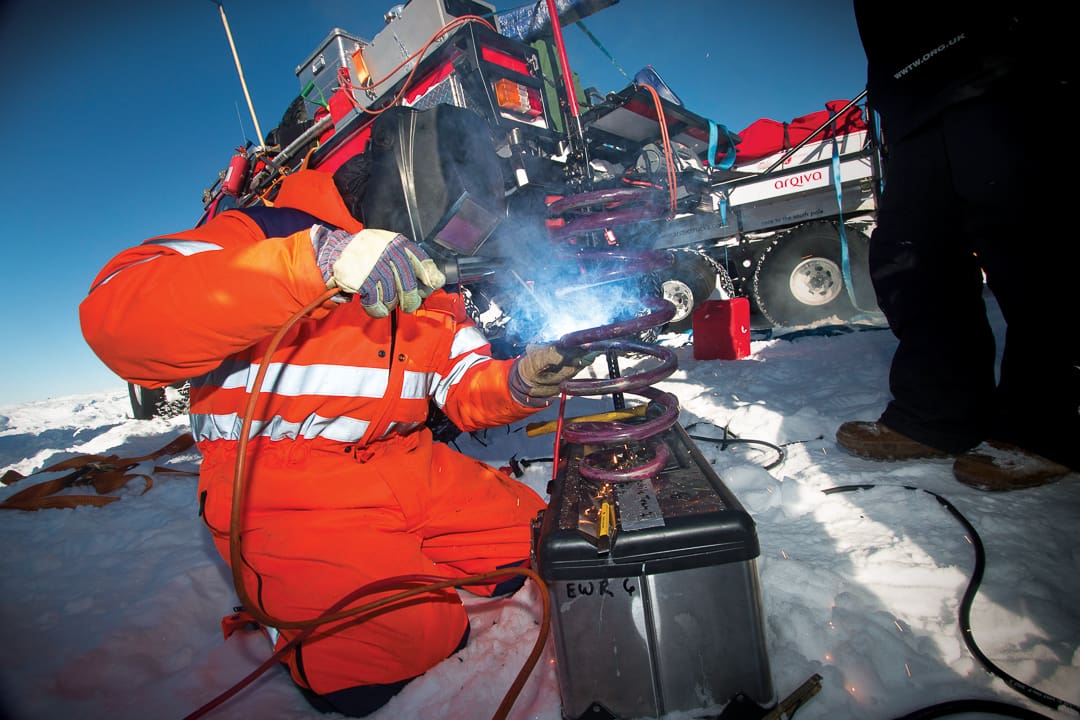
One of Arctic Trucks’ mechanics makes a second attempt at welding our broken coil spring.
We had achieved the Pole and Ross Ice Shelf and set forth new goals. Greg’s son Oakley and the Expeditions 7 Land Cruiser had arrived in Novo. Given our current pace, and if we could expedite the spring swap, we might reach Novo with enough time for a few days of local exploration on the eastern coastline. We were now, as Greg put it, “in rally mode.” The South Pole, which had been such a monumental accomplishment just a few days prior, passed with barely a nod. WWTW was still making their way to the Pole, where the soldiers would fly back to Novo. We met them en route, swapped in one of their good springs, which they would replace when the flight arrived from Novo, and resumed our dizzying routine: drive, refuel, eat, sleep, and drive.
Retracing our tracks to the fuel depot at Camp 83, we loaded up Andre and his crew with candy bars, cookies, and food we would not need. We then pushed hard to Camp 77, slept, and moved on toward Camp 72 and Thor’s Hammer. Just shy of Thor’s is when the hammer dropped. The sky closed in and visibility was reduced to a few meters. I was soon hanging out the window in a futile attempt to find traces of our previous tire tracks. Piloting the lead vehicle with hazy eyes glued to a 3.5-inch GPS screen was taxing. Gísli and I led until we were semi-delirious, traded point duties with Greg and Scott until they were nearly comatose, and then assumed the lead again. Several hours passed before the veil slowly lifted to reveal the monolith we’d camped below 10 days earlier. We’d made it.
Within 24 hours we would be reveling in the palatial accommodations of the Oasis, a Russian guesthouse near Novo. Oakley and the Land Cruiser had arrived safely, and we spent the next two days soaking in a Russian banya, feasting on home-cooked meals, and exploring the local area.
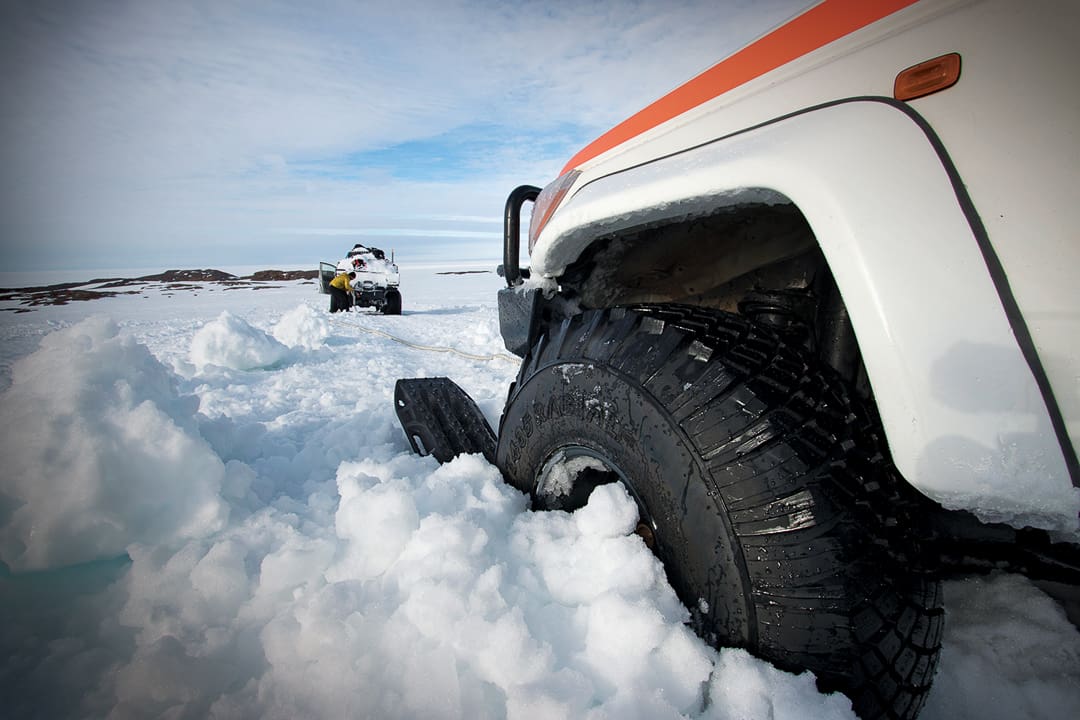
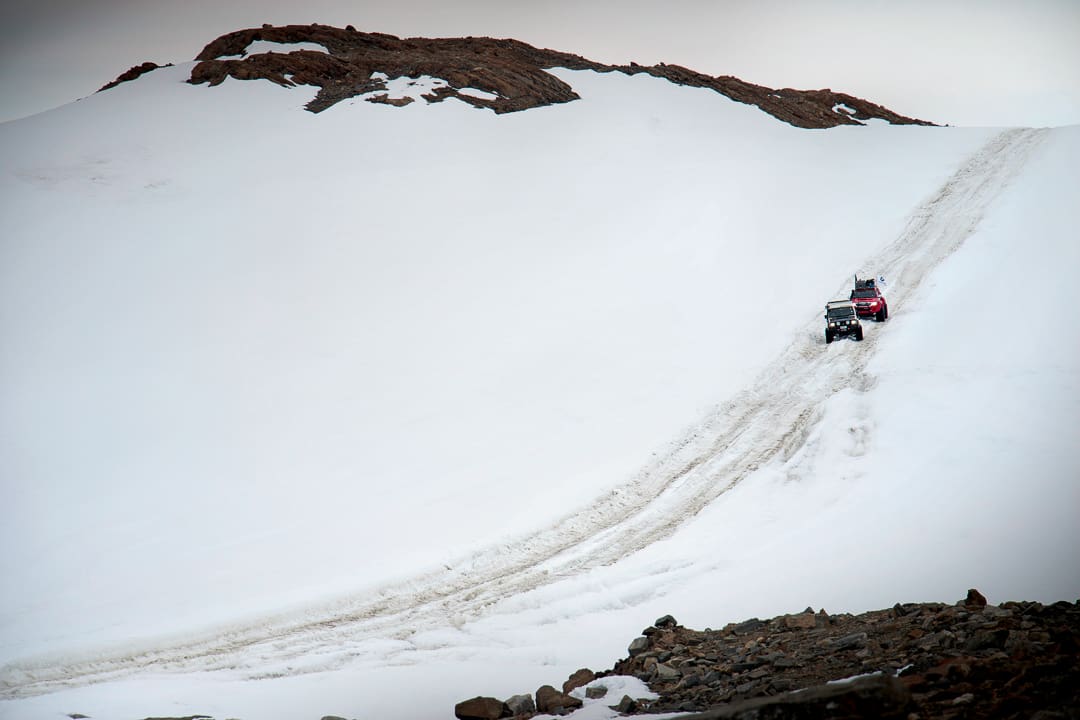
One might ask why three crazy Americans and an Icelander would risk all to drive to the South Pole, or still yet, drive across Antarctica. It is really a pointless endeavor, one to which I cannot provide a logical reason. The Pole, whether north or south, is no more than the confluence of tangents, where each is rendered to their lowest common denominator. Collectively, all 360 of them equal zero. Maybe Antarctica’s draw is a bucket list thing; Machu Picchu, check; Great Pyramids, check; South Pole, check. To me it was more than the pursuit of bragging rights and passport stamps. Pitching my tent on the Antarctic Plateau, walking where no human had trod before, and standing at the bottom of the world, at ground zero, was about the sensation of being thoroughly alive, while in the same moment grasping my lack of significance on this blue planet we call home.
The Ilyushin landed in a blizzard, a near whiteout—again. We piled our gear on a sledge and were ferried behind a snowmobile through dense fog and blowing snow toward the gray silhouette of an airplane. Climbing up the ladder I looked back at this land of extremes, the White Desert, resting place of many less fortunate adventurers. Visibility was about 100 meters when the pilots climbed in and closed the door. I pulled my lap belt tight as we taxied into the fray and said to myself, “Don’t worry, they do this all the time.”
Arctic Trucks AT44 and AT6x6
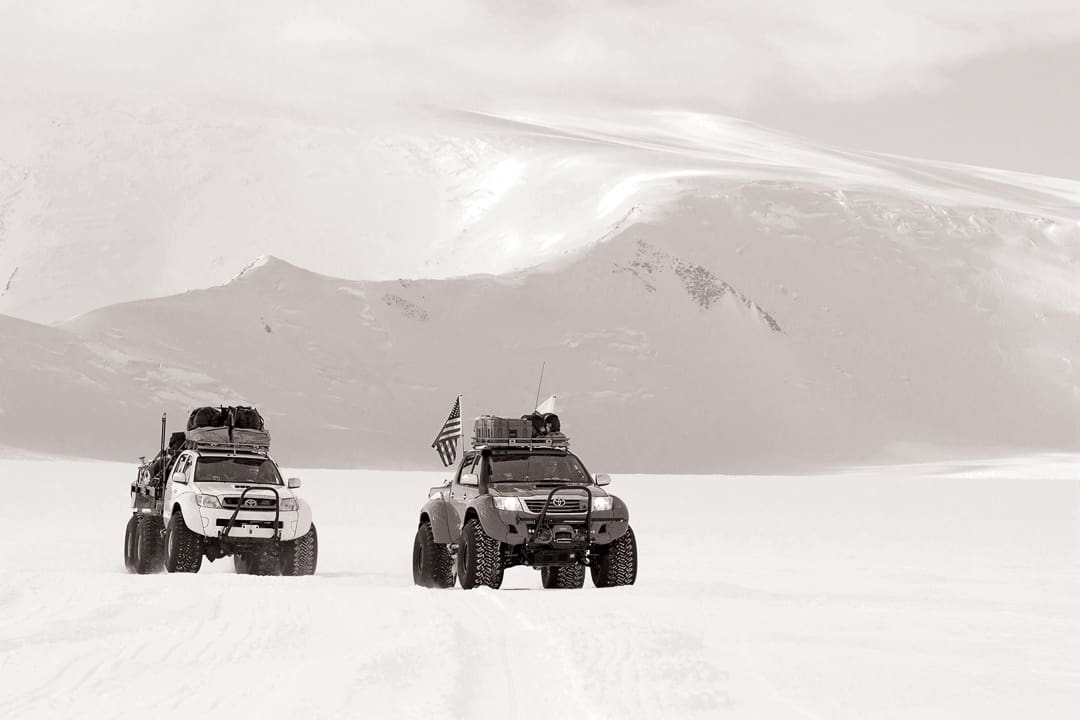
- Vehicle: Toyota HiLux KUN26
- Engine: 3-liter diesel, turbo intercooler
- Output: 169 hp, 252 pound-feet torque
- Engine pre-heater: Webasto
- Transmission: 5-speed automatic
- Transfer case: Part-time, 2.56:1 low range
- Axles: 8.2-in front, 9.5-in rear
- Differentials: ARB air locker, 4.88:1 gears
- Tires/wheels: Dick Cepek 44/18.5/15, Arctic Trucks 15×14 steel
- Suspension: Custom, Arctic Trucks
- Bumpers: Custom, Arctic Trucks with crevasse bar
- Winch: ComeUp 9.5i on multi-mount
- Roof rack: African Outback
- Air compressors: ARB/Viair
- Utility bed: Arctic Trucks
- Fuel capacity: AT44/280L AT6x6/600L
- Water heater: Arctic Trucks custom
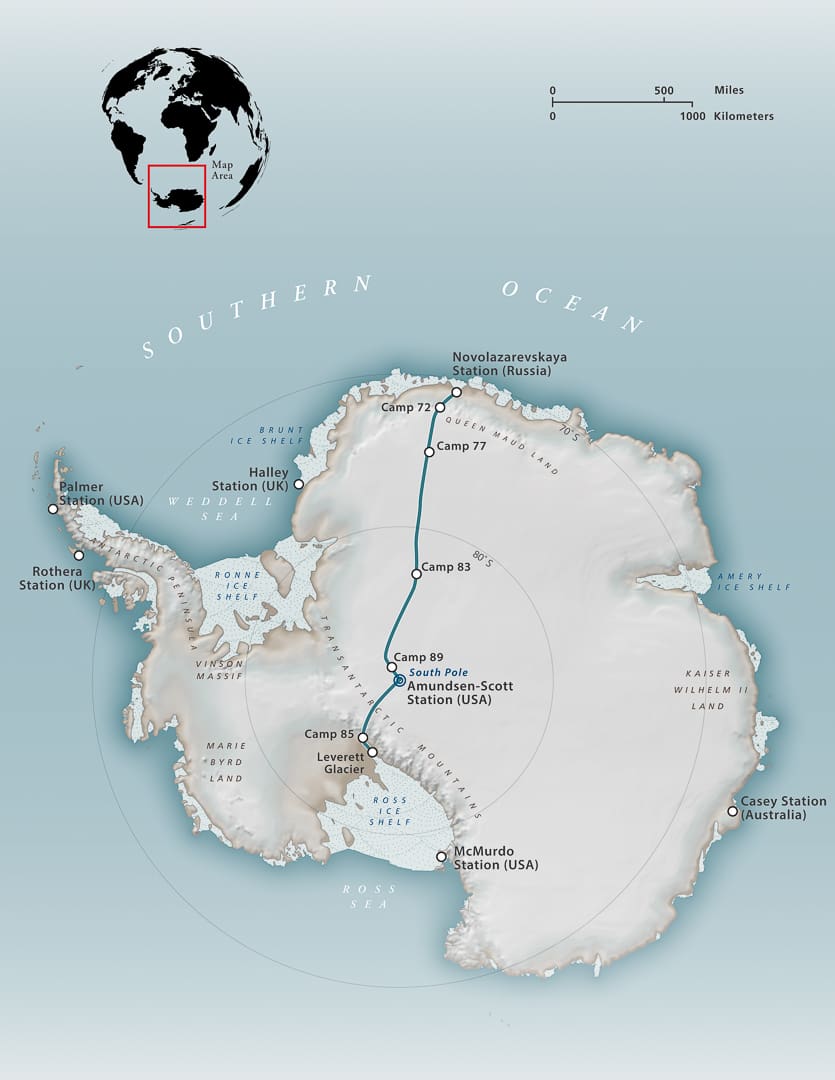
Cartography by David Medeiros (mapbliss.com)
Our No Compromise Clause: We do not accept advertorial content or allow advertising to influence our coverage, and our contributors are guaranteed editorial independence. Overland Collective may earn a small commission from affiliate links included in this article. We appreciate your support.
