

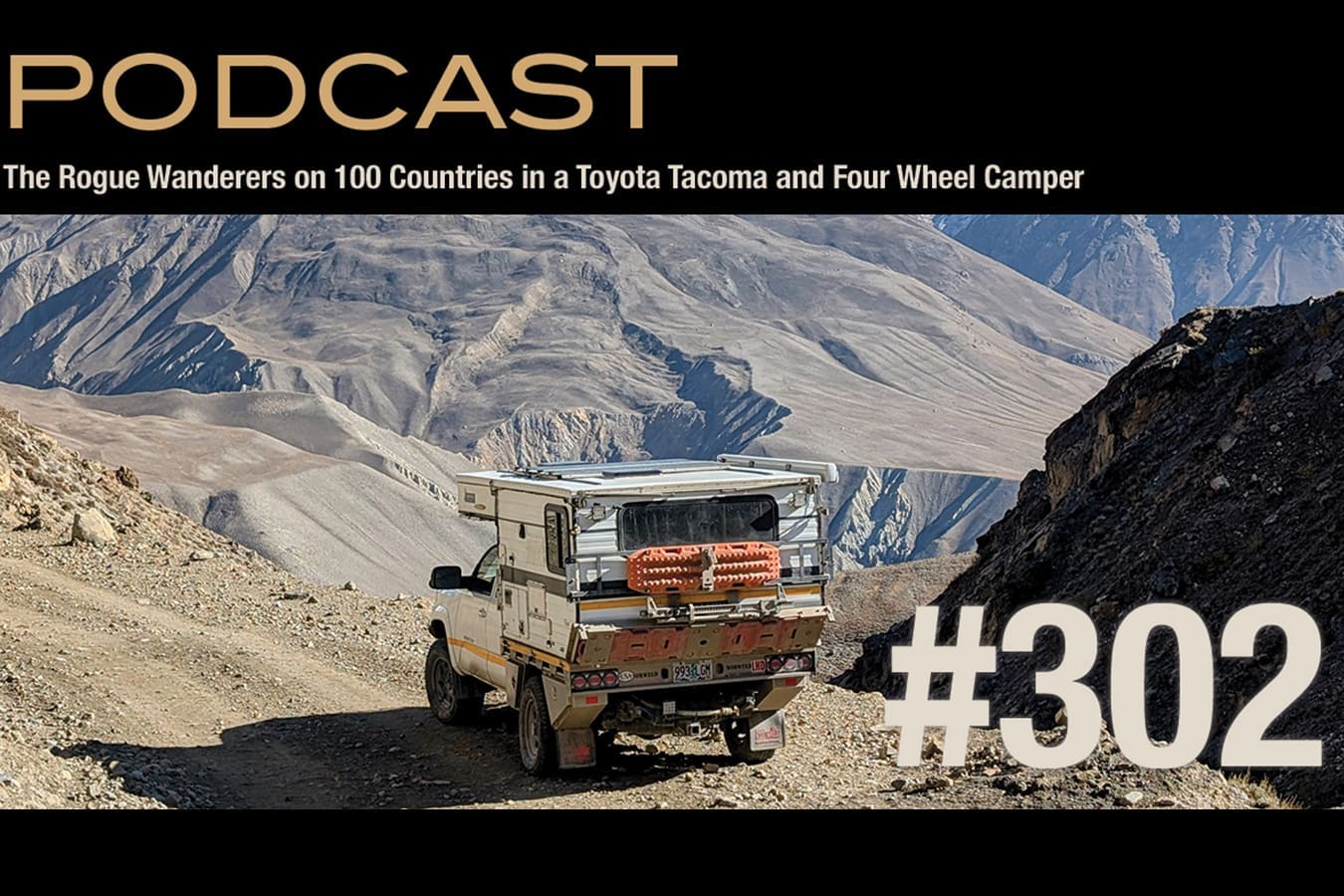
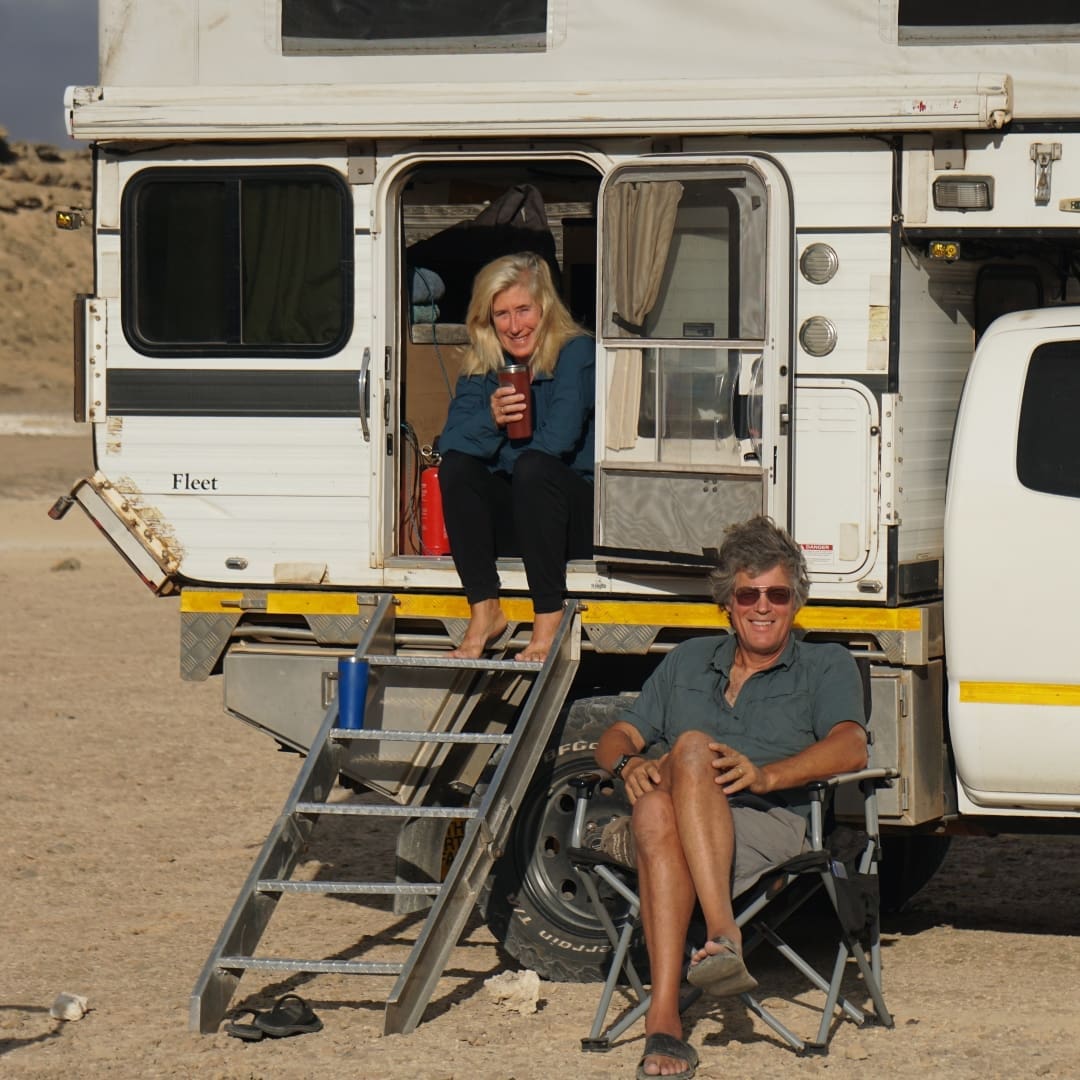
Overland Journal Podcast host Ashley Giordano welcomes American overlanders Dawn and Andy Elsbree, the Rogue Wanderers, to dive into their 2019 Toyota Tacoma and Four Wheel Camper build, why they chose it as their global overland platform, and how it’s held up after six years of travel and 100 countries later. Dawn and Andy share their favorite moments from the road, what it was like overlanding through China, and the highs of having their kids join on various legs of the journey.
Overland Journal Podcast Episode #302
The Overland Journal Podcast is brought to you this week by Overland Journal Magazine
Bio:
Andy and Dawn met 38 years ago and built a life of adventure, raising three children and eight Labradors while enjoying annual trips, backpacking, and rafting. In 2019, honoring a long-held promise to explore the world, Andy planned a global driving expedition. Though Dawn initially imagined traveling by plane or train, she supported his year-long effort to design their ideal overland vehicle. Six years ago, they retired from careers in forestry and arts administration in Oregon to begin their journey.
Rogue Wanderers
Website | Instagram | Expedition Portal: The Best Laid Plans – Overlanders Share Their Trip Planning Tips
Host Bios:
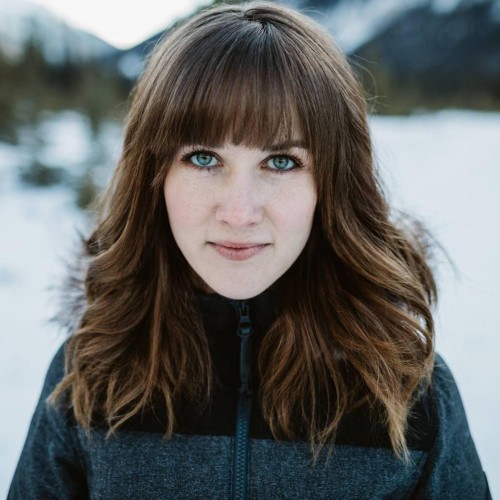
Ashley Giordano
Ashley Giordano’s first foray into overland travel involved a 48,800-kilometer journey from Canada to Argentina with her husband, Richard, in their well-loved but antiquated 1990 Toyota Pickup. Currently cruising along the iconic Silk Road in a 2008 Toyota Tundra, her full-time navigator duties are rewarded with bowls of plov and lagman noodles, hikes in the Tian Shan, and countless cups of fragrant Tashkent tea. As senior editor at Overland Journal, you can usually find Ashley buried in a pile of travel books, poring over maps, or writing about the unsung women of overlanding history, including her enduring inspiration, Barbara Toy. @desktoglory_ash
Tune in Apple Podcasts | Spotify | YouTube
Transcription
Ashley: [00:00:00] Hello, and welcome to the “Overland Journal Podcast.” I’m your host, Ashley Giordano, and today I’m joined by American overlanders Andy and Dawn Elsbury, who are on a grand tour of the world. Welcome, you two. So happy to have you here on the podcast today.
Andy: Thank you for having us here.
Ashley: Yay. So let me know, where are you now and what have you been up to?
Andy: Dawn, do you wanna answer
Dawn: that? We’re cur- currently taking a little break in Bend, Oregon, which we’ve decided will be our future home when we’re finished traveling, and we’re in the process of building a house here.
Ashley: Oh, nice. A little place to come back to while you travel and then a home to come back to after you’re finished up.
Are you from Bend originally or is this a special place for you?
Andy: This is a place that our [00:01:00] family has been coming to… Well, s- I’ve been coming here since 1976, so it’s a special place for us for the skiing and for the outdoors. It’s just a wonderful place.
Ashley: Great. So you guys have been gone for a few years now, quite a few years.
Dawn: Six.
Ashley: Six years. Wow. With little trips back to visit family, et cetera, through, hopefully I get this right, US, Europe, Africa, Arabian Peninsula to Israel, Greece, through to Georgia, Armenia, Azerbaijan, into Central Asia, China, Tibet, Southeast Asia to Taiwan, and then shift to Chile.
Andy: That’s right. Wow. And currently- Yeah, that’s a- And currently our truck is parked in, uh, Montevideo, Uruguay right now.
Ashley: Awesome. I have to say I’ve really enjoyed your website and your blog, and we’ve used it for a lot of different, um, [00:02:00] reasons for our own travels. So your blog is “The Rogue Wanderers,” and, uh, your trip sort of write-up of the Pamir Highway helped us a, a lot, uh, when planning our own and looking into the future to see what we need for logistics.
So you have a great blend of storytelling, history, what you’re experiencing on the road, but also those kind of logistics details that for some of those more difficult countries are really useful. So yeah, that’s been great.
Andy: We’ve learned, uh, a long time ago when we were traveling in England that we need to document our journal simply because we almost went to visit the same city twice.
So then we realized that we need to start write- being more formal about it and start writing about these places, and so we do it for ourselves, but we also do it really f- to help out fellow travelers.
Ashley: Nice. Yeah, and you’ve been successful. It does kind of go in a blur, doesn’t it? You’re like, “Where am I?
What day is it?” So that’s great. [00:03:00] Um, I wanted to ask you about your life before you left six years ago and what that looked like.
Andy: So we started, uh, we were living in Ashland, Oregon, and Dawn worked for the Oregon Shakespeare Festival, and I worked for a private timber company in Klamath Falls and commuted over from Ashland every day.
Uh, we had successfully raised three children who are now, um, in, um, working in great fields. And so we started to realize that, uh, we had hit the pinnacle of our careers and we were super happy, but we now wanted– I needed to fulfill a marital obligation of 36 years ago of s- promising Dawn that we would travel the world.
And so we started in 2018 to decide on a vehicle build, and it took us a year to do that. And so by the time COVID was just starting to rise its head, we had our truck parked, ready [00:04:00] to go, and that was February of, I think, 20, uh, 2020, and the world collapsed about two weeks after we announced our retirement.
Ashley: Oh, no. So
Andy: yeah, so it really kind of, um, messed up our situation because we were planning to ship to Eu- uh, Europe, and we couldn’t do that because the world was closed. And so instead we, uh, traveled around the US in our COVID, uh, quarantine vehicle and also went to Baja, Mexico during, uh, COVID as well.
Ashley: I mean, you had an opportunity for a significant shakedown run in that vehicle.
Andy: Yeah, we did. We
Dawn: did. It was perfect.
Andy: And it was, uh, in San Diego we had our first repairs on the truck to, uh, to alleviate some of the, uh, excessive weight that’s on, in it,
Ashley: so. Ooh, I love talking about alleviating excess vehicle weight. It’s great. Well,
Andy: we did everything possible from a synthetic line in our winch to an aluminum bumper to removing the back seats of our [00:05:00] extra cab Toyota Tacoma.
We did everything we could there, and still there was some slight growing pains in Baja that we experienced there. And we’ve experienced, uh, jumping ahead into Africa when we– uh, Europe was super easy. The roads are great. The people were wonderful. But then going into West Africa, driving from, uh, Morocco down to s- uh, South Africa, the roads started to pound us pretty hard.
And so we had some moderate repairs there on the pieces of the suspension, so.
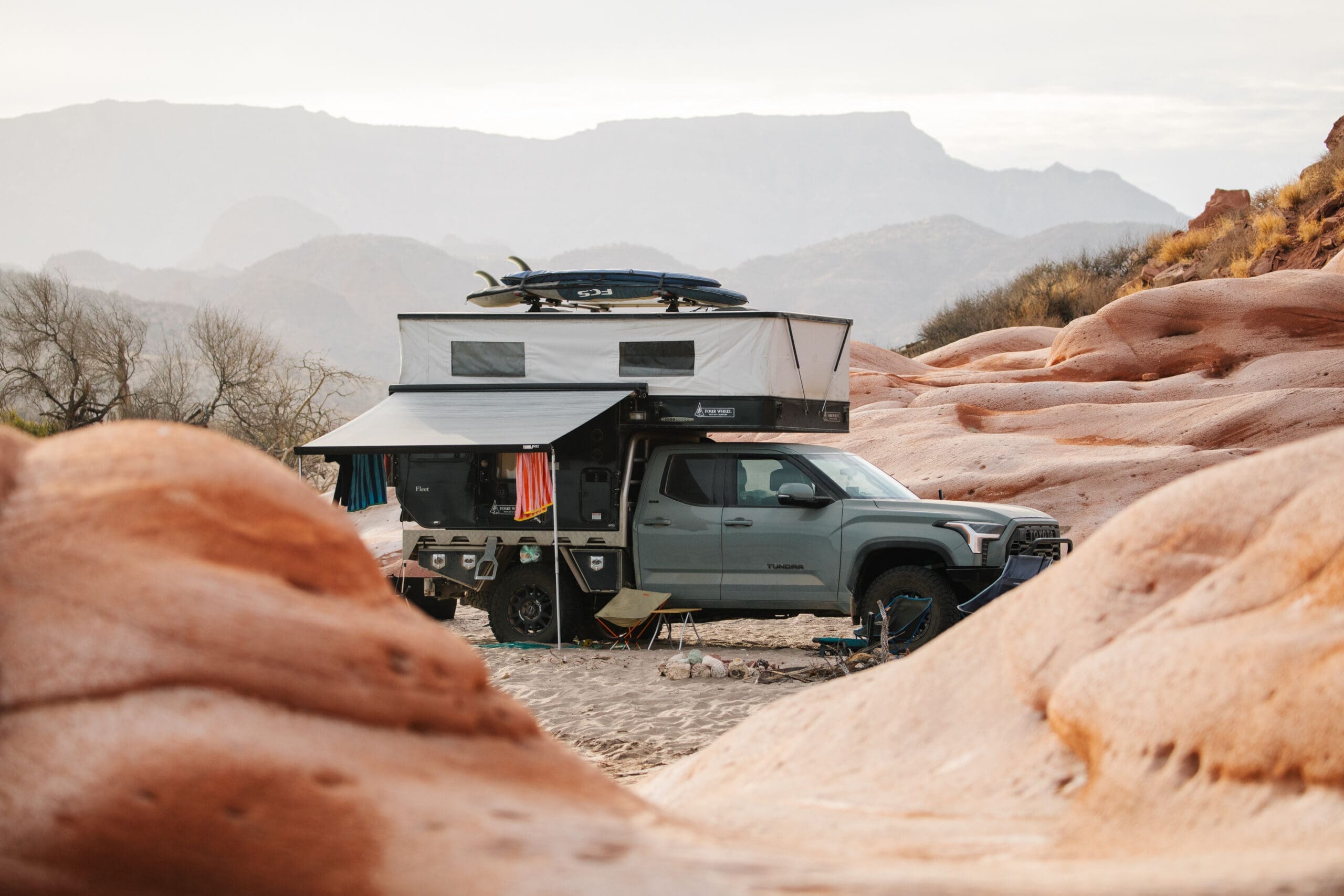
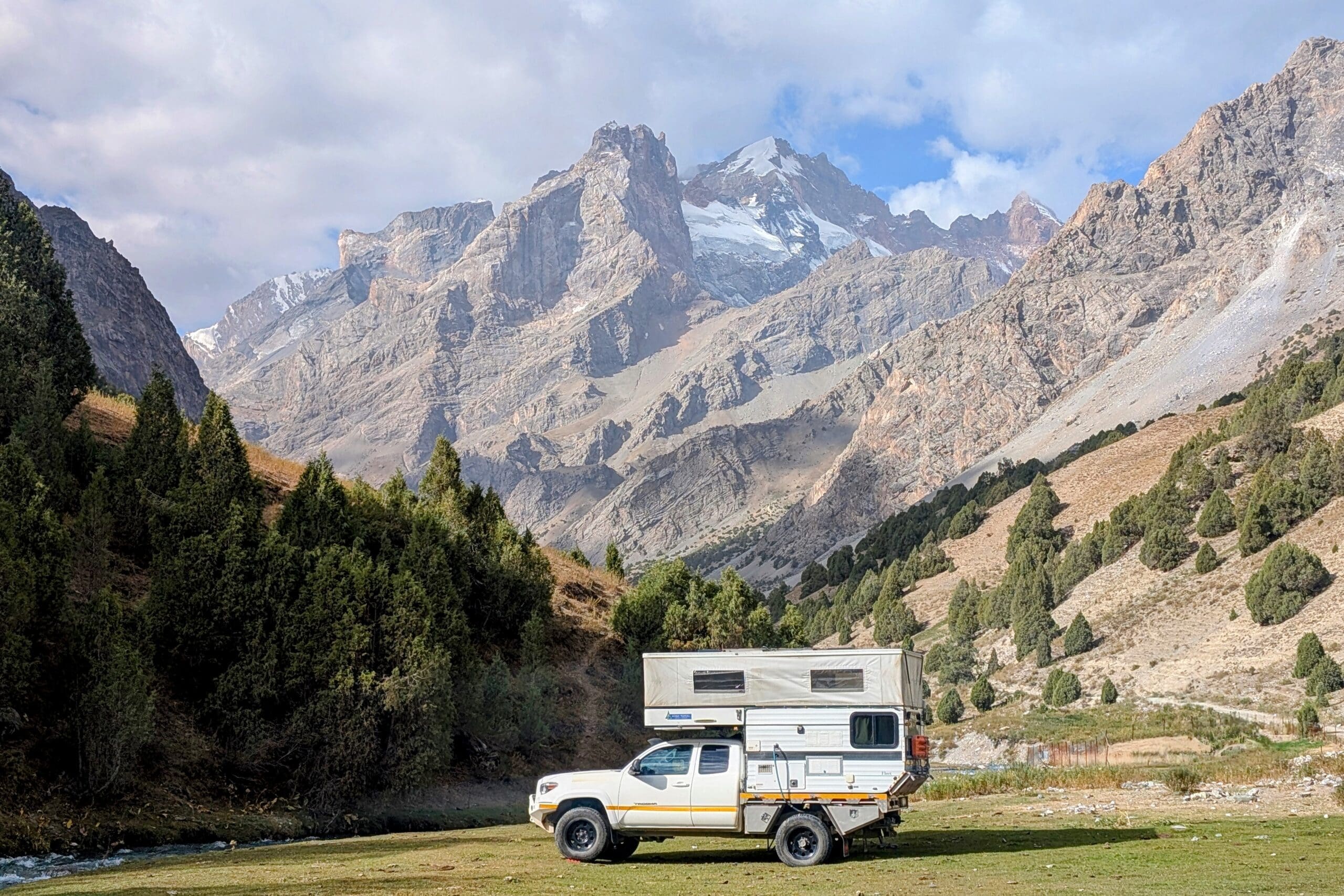
Ashley: Gotcha. And your build is a 2019 Tacoma TRD Sport long bed access cab with a Norworld flatbed and four-wheel camper. I love this setup so much. We have a lot of similar aftermarket accessories. You have OME- Old Man Emu BP 51 shocks front and rear, rear Total Chaos upper control, upper control arms, ARB Snorkel, Warn winch, and a Long Range Automotive tank.
Just a [00:06:00] few things in a longer list, uh, of modifications. But, um, how did you decide to go with this platform and, um, yeah, what were the decision– what was the decision process like for these additions?
Andy: It was really tough. In 2018, we were trying to figure out the size of the build, what we would happily live in for the next six or seven years, although I told her it was only supposed to be three, maybe five years, but, or we’re kinda stretching it out.
But we deci- we looked at vans, we looked at full-size vehicles because of their, um, greater, much greater payload. But the key thing for us being, uh, expending, spending much time overseas on small roads, we wanted to try to copy the Hilux. And we would’ve loved to have had a Hilux, but they’re, as we, as everybody knows, they’re not available in the US.
But so we wanted one, uh, similar to that [00:07:00] because we had experience driving a larger vehicle in Botswana on a self-drive in 2017, where because the vehicle was bigger, it didn’t fit in the ruts, and therefore we would ca- we would get stuck more often. And so a full-size vehicle, F-150 would’ve been great.
I think it is one of the pinnacle vehicles for North America roads. I just don’t think it was right for us, especially driving in Europe and Africa and Asia. I mean, every place except for North and South America. That Toyota Tacoma mid-size truck with its, uh, legendary reliability was important for us.
Um, we went with the flatbed version of the four-wheel camper because of the, uh, extra storage that we really like in there as opposed to the slide-in version. Uh, it’s a little bit heavier, but for us, that was, uh, the big concern. Uh, we’ve thought about going with a diesel motor in like a Sprinter van, but the problem with the diesels, the modern-day diesels now is that they require [00:08:00] diesel emission fluid, and that is not available, and neither is the ultra-low sulfur diesel available.
For example, in Africa, it’s available in Morocco and South Africa. That’s about it. So in between there, how do you deal with your modern-day diesel with putting in what they call them today is now a dirty diesel, um, um, mixture in there. You can’t do it, or you can do it, but it’s gonna destroy the emissions.
So diesel, unfortunately for us, was out, and so we focused on gas, and gas doesn’t get as good a gas mileage, but at least it’s mostly readily available, uh, throughout the world.
Ashley: For sure. And Dawn, did you have anything that you wanted included in the build specifically, or were you like, “Whatever, I’m just happy to go?”
Dawn: I was pretty focused on the shower and the toilet,
Ashley: which- That’s fair …
Dawn: we, uh, haven’t used either as much as we thought we initially would, um, ’cause we tend to, you know, [00:09:00] like every four to five days we might find a, a campground or a campsite or access to water so that we can take a shower without taking a shower inside the truck, which is possible, but it’s not the most comfortable or easy situation.
You’re kind of in the little dinette area with a shower curtain around you so you don’t get the whole inside wet and, and then the toilet felt really important, but it actually ha- hasn’t been as important in the long run as I thought it would be.
Andy: But in driving in, uh, West Africa, there are people everywhere, so if you’re thinking that you’re alone, you’ll be very surprised when all of a sudden someone will just pop up out of the bushes and be very friendly and come up and hope- sometimes you even see them doing their, the bus- their own business, and it’s just like that’s just the way Africa is, but w- it’s not the way that we, we are, so.
Ashley: Yeah. The toilet, I imagine, came in pretty handy at that point.
Andy: It, it did. Yeah. It did.
Ashley: Nice. Um, how [00:10:00] is the truck doing now? How’s it going so far? Is there anything you would change? Is, are there things you love?
Andy: We l- we’re laughing because of our very most recent experience, but up until our adventures in Argentina and Chile, going through Europe, Africa, and Asia, the Toyota Tacoma has lived up to its, uh, legendary reliability.
130,000 miles on it. We have the manual transmission and it’s been, it has been great. We’ve done a little bit of welding on some pieces on the side of the frame, not the frame itself, that had to get welded because either I drove on… I drove too fast or the roads are too bad or the truck was too heavy.
You can do two out of three of those, but three out of three occasionally you hit a, you know, enough 10-inch potholes that you’re gonna damage something, and we had a little bit of problems with that a couple of times in Africa for that. We actually broke a custom leaf spring that we special ordered for our weight.[00:11:00]
We broke that in Uganda and had to limp our way to Nairobi, Kenya. But I don’t know why that broke because it wasn’t supposed… It was b- designed to handle the, uh, the weight on that side of the vehicle. So other than that, uh, there’s– we’ve had some, a l- a few electronic gizmos like our emergency braking system will sit there and say, “Oh, there’s a vehicle ahead.
Brake im- immediately.” And sometimes you’ll go, “There’s no problem.” So there’s been minor, minor glitches like that So everything was been great up until we hit Chile when we started to feel some softness in our brake pedal. And I have been driving with this since, where was it? In the, Nepal. We noticed it when Dawn and our son Trevor came with us to cross over the China through Tibet and, um, and into Laos.
They started driving it and they went, “Whoa, wait a minute. The brakes are way soft. There’s– You don’t have any brakes in this thing.” And it’s like, “What do you mean? I’ve been [00:12:00] driving this thing for a long time.” So it’s kinda snuck up on us, this little spongy brake pedal thing. So that was a problem that we addressed, we thought, in Chile.
We replaced one piece of it and that didn’t work, and so now we’re going to be flying back with a master brake cylinder, uh, to hopefully repair it this, on this go-around. We’ve also had some problems. Holy Toledo. What else have we, uh, broken? S- Our fuel tank. Fuel pump. Our fuel pump. All of a sudden we have a check engine light come on, and the check engine light in Chile says that, “Hey, your, y- you have low fuel pressure.”
And so we pull into a Toyota dealership, which is the other reason why we cho- chose a Toyota Tacoma, because they may not understand what a… They’ve heard of a Tacoma, but, uh, many of the parts that are available for the Hilux are also the s- uh, the same part for the, uh, Tacoma. So we pulled in there, sure it was a low pressure, uh, fuel, and so here we are heading up into the Atacama Desert [00:13:00] in northern Chile, and we’re thinking, “What are we gonna do?
There isn’t a fuel pump.” So this time the fuel pump is not the same as a Hilux. So we elected to wait about six weeks for our son to, uh, meet with us. He’s flying down with a fuel pump and now he’s bringing a, uh, boost, a brake booster, which we, uh, we’re gonna stick in in, in Santiago. So we’ve brought those parts in, replaced the fuel pump, and then our problems began.
Ashley: Oh my gosh.
Andy: Yes.
Ashley: It’s like, oh, six years. Ugh. Yeah.
Andy: It’s long. Now our problem’s beginning. Oh. And so all of a sudden I’m noticing that we’re s- we’re smelling, we’re out in the middle of the Argentinian, uh, pampas visiting a national park, and we smell gasoline, and we’re like, “Uh-oh.” And I look, crawl underneath the, uh, the truck and look at the fuel tank, and there’s gasoline pouring out.
Not just, not just leaking. It’s like pouring and making a big puddle about 18 inches across. We’re like, “Holy Toledo. We’re 50 miles from the [00:14:00] nearest 2,000-person town.” So we skedaddle into town and we drive into, we look on iOverlander, which is a fabulous resource, people, for finding things like mechanics or grocery stores or any, any kind of- Needed item.
And we rolled into our first of, I think, six mechanics where he replaced the fuel line. He brings it out, shows us it’s ruptured, and we’re like, “What is going on?” And so we drive the next day, another rupture. We drive for a week and had six broken fuel lines, and these are rubber designed for fuel. And we finally realized that what people were installing were diesel fuel lines, and we have, of course, our gasoline, and gasoline is a solvent, and it dissolves fuel lines.
So that was- Oh, yeah. And so I think it was between fix four and fix or breakdown four or breakdown five, all of a sudden the [00:15:00] clutch started feeling funny. And now we’re out on the, uh, again, we’re at a, a marine reserve looking at orcas and, uh, sea lions and penguins, and all of a sudden the clutch is not work- is not, is not working.
There’s a problem. And so now I’m learning how to shift, uh, clutchless shift, which can be done, believe it or not, even in a modern-day vehicle. I haven’t done it in, like, 20 years, but I’m shifting without the clutch, and we rolled into a town with our leaky gas tank and our now clutch that doesn’t work, and we, uh, had our truck repaired in a backyard of a, uh, of a- Of
Dawn: somebody’s house
somebody’s
Andy: house. He tears it apart. He doesn’t speak English. He’s tearing it apart. We’re not sure what’s going on, and it come, uh, uh, ends up being not the, the clutch plates, but it’s the throwout bearing, which is part of the clutch. But at least it’s just a, a, a throwout bearing, and that part, oh, yes, thank you, Hilux, is the same as a Hilux.[00:16:00]
So we- Oh, wow … put that in, and we’re driving along. We’re doing great. And so now when we fly back, uh, we have to fix our spongy brake pedal. We also have to fix, uh, there’s four other things that have, uh-
Dawn: Radiator … and then- We’re taking the radiator back …
Andy: in the meantime, when we’re replacing the clutch in between gasoline fuel line break number four and five, our radiator starts leaking, and it dumps all the radiator fluid out.
And so now he says, “And typical,” this is the typical third world wonderful fix is that he says, “Ah, no problem. I go to, we go to the store,” and they bought some pimienta, and pimienta is, is, uh, red pepper flakes. And you just put them in the radiator, and it plugs… It’s like Stop Leak. It plugs the radiator, and it plugged it for, like, almost 1,000 miles until it didn’t.
Ashley: Wow. Oh my gosh.
Andy: So we’re gonna fly a new radiator and that master brake cylinder. We also have to fly some, um, some frame [00:17:00] bushings because our truck is squeaking a lot. The bushings have shot. We also have to fly some, some tie rods because our, those are wearing out. So we have four, um … And do you call these repairs or do you call them maintenance?
It’s like, uh, the, I mean, the, the radiator’s plastic and it just, they say it breaks after 100,000 miles. And so I’d call them repairs, but still, we’re still saying that the truck is, is reliable, but it’s not like it, it’s kind of not living, living up to its legend. But maybe after 140,000 miles, maybe these type things are, are part of it, so.
Ashley: Could be. What was it like in your mind, because you’ve gone from traveling for years and years with this vehicle that’s h- hardly giving you any issues, and you’re like, “This is great.” You probably think about it a little bit less at that point, and then you start to have all these issues. How does that affect you mentally as you’re [00:18:00] traveling along?
Dawn: It was hard. It was really hard ’cause we aren’t used to it, and we were in places where it was difficult for us to communicate. We speak a little bit of Spanish, but when you start to get into mechanical issues, you know, we’re, we’re not competent there. Um, and we just did not know what was happening. I mean, in our minds, we replaced the fuel pump, the problem should’ve been fixed, and yet every single day we were losing our fuel, and it’s just, we just felt a little lost.
Like, what do we do? We keep going to mechanics and they keep doing the same thing, and the same thing keeps happening. We didn’t feel like we had the resources or information to really solve the problem, which was difficult. Yeah. But it’s also, you know, like so many other places that we travel, it’s like the people are incredible.
Every single time we’re broken down on the side of the road, somebody stops. They’re bringing us water. They’re giving Andy rides into the next mechanic. They’re making phone calls for us. People are calling us tow trucks. I mean, we never were in a situation where we felt like we don’t have the help we need to get out of this [00:19:00] somehow.
I mean, we slept one night in our tow truck driver’s backyard … because, because he offered it to us, and it was great. You know, we spent the night there, and then the mechanics came the next day.
Ashley: That’s a totally different type of adventure,
Andy: eh? Yeah, that’s, that’s the reason why we bought a brand new vehicle, and re- the reason why we bought a brand new Toyota is that we wanted to go
We just didn’t wanna to break down and have those break down, what people like to call adventures. And so now we’re having it, and so at, at one point I was telling Dawn, I said, “Dawn, I wanna sell this thing. I’m done because I’m…” And when I, when we say we have a fuel leak, that means with our long-range America fuel tank in there, it’s 33 gallons.
We’ll go 60 miles and the fuel’s empty. So that’s how much gasoline is pour- it’s pouring out. At one point the fuel line just broke and it’s like it was just dumping on the ground. Luckily we didn’t have a fire. That’s the one thing that I was really wor- I was really worried about. [00:20:00]
Ashley: Yeah. Yeah. That’s a good point too, safety.
Safety concerns with all that. I love– I bet the Land Rover listeners are like, “Well, you ain’t seen nothing, my friends. Welcome to the club.” Yeah. But yeah, yeah. I, I totally respect that. You know, choose the vehicle that is gonna get you there.
Sponsor: reach out to ask how, uh, they can help support the podcast. Uh, we are, uh, supported entirely by, uh, Overland Journal, the magazine.
So when you become a subscriber to the Overland Journal print magazine, you get this beautiful book, uh, that comes in five times a year. It also gives you access to our digital archive. Uh, and it’s well over 100 pages of, of gorgeous images and detailed testing and adventures from around the globe. So if you go to overlandjournal.com and you subscribe to the magazine, use the code OVERLANDPODCAST, and that’ll get you 20% off.
It’s only available to our podcast [00:21:00] listeners. We don’t advertise it anywhere else. Um, and then you help us to maintain that independent employee-owned journalism, um, that we have been famous for. So it allows us to conduct those tests without any advertorial. Another way you can help out too, I produced a book, uh, last year with Simon & Schuster called “Overlanding 101.”
You can find it on Amazon or Barnes & Noble or even your local bookstore. And that encompasses my decades of travel around the world, all of my mistakes and failures and, and the lessons that I’ve learned in traveling around the globe. Um, many of those, um, that you hear on the podcast have been distilled down into print form with great lists and beautiful imagery.
Uh, so you can find that, uh, at your local bookstore, “Overlanding 101.” And thank you all for listening and for supporting us so much throughout these years.
Ashley: And some people choose vehicles that they’re gonna have a wonderful, a different type of adventure with. And I, I think it’s all, all great. It’s all individual preference.
So hopefully [00:22:00] that’ll all get sorted out on the other side after you fly all those things down.
Andy: One last thing about our build is that what we really wanted– We’re naturally introverts, and so we really wanted to drive the world and have a place for us to get into. And, uh, the four-wheel camper provides that.
Having a wedge tent or a pop-up tent is great, but we’re in our 60s, and we like a nice soft mattress that our four-wheel camper has. And it also gives us that refuge because, like in West Africa, we would sometimes we’d wake up, we’d hide, find this road that didn’t go to a village, and we’d camp on it.
And we’d be really quiet, and we’d wake up, and there’d be a dozen people staring at us outside. And if we had a camping situation where we would be– where we’d have to cook outside, it, it would be impossible to do that. And so that’s why we like this, but we’re also paying for it with the, um… I mean, the truck weighs about 6,800 pounds empty [00:23:00] Without us in there, so it’s heavy.
But that’s the trade-offs we have. We certainly could go with a, a wedge-type tent and stay within our, um, gross vehicle weight rating, but we wouldn’t be able to escape the malaria mosquitoes, for example, is another big thing. Don’t wanna be cooking outside in the dark in, in Africa. It’s just not worth it.
Ashley: Yeah. 100%, yes. I hear you. And it’s important to have that recharge as an introvert ’cause it’s a lot of stuff coming at you every day, a lot of scenery, a lot of people, conversations, new things, and, uh, like you’re saying, weather is another factor, too, that’s so nice to escape to that inside living space.
Great. So you’ve been to over 100 countries?
Andy: We just hit 100.
Ashley: Oh my gosh. Is it possible to tell me what your favorite five have been so far?
Dawn: We, we’ve, we’ve had answers that have changed over time a [00:24:00] little bit, but we always say it really depends on what your interest is. Like, we think for people and culture, Morocco was amazing.
If we’re looking at geography, Iceland was incredible, an all-time highlight. For animals, I don’t know. It’s hard to choose between Botswana and Tan- and Tanzania. They were both highlights. And then y- I think recently, you know, driving across Tibet was just extraordinary, and also Tajikistan and the Pamir Highway- Mm-hmm Yeah
would have been yes.
Andy: Um- I think
Dawn: that’s more than five …
Andy: that’s more than five. Oh, it doesn’t matter. O- other, other ones that come, come into there, the runner-ups are, like, the little country, West Africa country of Benin. Benin, as they call it. It’s the home of voodoo, so you get to learn, like, a totally different culture, and for once, the police there are honest, and they’re not harassing you.
So that was a highlight for us as well. Uh, Chile has [00:25:00] turned out to be, uh – Chile was our recent… It was like w- we’re still getting wowed by all these, that southern Chile, and northern Chile with the Atacama Desert was, like, was amazing.
Ashley: Phenomenal. I wanted to ask you about that, going through China, and you went through more than once.
Mm. Yeah. And what the experience was like. Was it different each time? I know you were going through different regions, so obviously there would be some changes, but what were your experiences like there?
Andy: Do you want me to do
Ashley: it?
Dawn: We have, we have slightly different opinions.
Ashley: Ooh, I like that. We’ll hear both of them.
You go ahead. So
Andy: I find that, uh, we’ve driven twice now from Uzbekistan into Pakistan via the Kunar Pass, which is about 15,000 feet. So we drove, drove through the Uyghur region of extreme western China, where they’re suppressing the, uh, the Muslim, uh, minority there. I felt China, it [00:26:00] spooked me. Uh, the, the, the amount of cameras, the amount of fakery, like they have fake villages that are like set up kinda like Disneyland, where they, uh, in the Uyghur region, they’ll, they’ll have a downtown that has been completely destroyed, rebuilt, and so that the majority Chinese people can come there and they’ll go, “Oh, wow, this is what it’s like,” and it’s really not.
So it, it kinda spooked me there. But, um, go ahead, Dawn. You tell me what you’re… Say what you’re thinking.
Dawn: Well, uh, there’s also– I mean, this is like the great political debate, right? There’s a certain level of uniform prosperity, so you don’t see the income disparities. Everybody seems to have enough.
Everybody is, is living their lives. They’re gracious and friendly. There are aspects that feel like a police state, but I also feel like as a tourist, we were welcomed by the people there. Um, [00:27:00] and just the, the scenery in- Mm-hmm … in the Tibet region especially, and, and going over the Karakoram Pass, it’s just those mountains are so beautiful.
Going into the small villages in Tibet and meeting the people there and seeing how they live, it was just a, a lifelong dream really, and a travel highlight.
Ashley: Totally. And you can go through China independently now. Were you surprised to hear that based on your experiences there, that they would open it up so that you can drive yourself?
Andy: Without a guide? We haven’t heard that.
Dawn: It’s just- Oh, yeah … it’s just switching. I feel like when we were there, the guide service that we went with, they were just starting to branch out and say, “Okay, we can sponsor people, and you can drive on your own.” And they even did … I mean, like we, we would drive for the day by ourselves, you know, and they would kinda tell us how to navigate the different police [00:28:00] stops.
But I think it felt very safe. I’m not surprised that it’s opening up. I think it makes it easier for people, ’cause if you don’t have to pay the cost for a daily guide, it makes it more accessible for travelers and overlanders. I mean,
Andy: the, the infrastructure is really super well-built. Uh, you know, there’s gas everywhere.
The roads have orange and white lines. Wow, that’s, that’s pretty amazing to have that. But some of the drivers are the worst in the world. They’re absolutely … I mean, the, the wrecks, the like one of the 10 most dangerous roads that we’ve ever driven in was the major Highway 66 through western China, through Tibet.
The, um, there’s a highway there that is famous that, uh, people drive, and they… I don’t know. Maybe it’s because they’ve never driven on mountainous roads before, and they’re, it’s like you’re out in the middle of the p- most of China’s flat, but they drive crazy in there. There’s all sorts of accidents that happen But so there’s this conundrum of, of different things that are happening there.[00:29:00]
Like in the Uyghur region, you can’t even pull into a gas station without– The gas stations are all locked up. So it’s-
Ashley: Interesting …
Andy: they weren’t in Tibet, but it’s– So it’s like there’s, there’s– It just spooks me is what it does, but that’s, but yes, Tibet, uh, Tibet was like a wonderful place.
Ashley: What were the differences in terms of like scenery or food or culture that you noticed in the different regions that you went through in China?
Dawn: Oh, well, the first region we went through was all about the hot pot.
Andy: Yeah.
Dawn: Nice. And-
Andy: Yak meat …
Dawn: a lot of yak meat in Tibet, which was good.
Andy: Overall, the food was like compared to Tajikistan, holy Toledo. Tajikistan has the worst food in the world. I’m sorry. But it has, China overall had some amazingly good food.
But in terms of differences, there wasn’t a whole lot of difference betw- in the foods that I can recall.
Dawn: Yeah, I mean, it was what you would expect, [00:30:00] a lot of kind of rice and noodle dishes stir-fried with different vegetables and meat if you wanted it. Kind of-
Ashley: Nice. And then the landscape, as you said, was very mountainous, obviously, uh, going through Tibet and from Tajikistan into, into China.
I imagine that section was quite mountainous as well and beautiful.
Andy: Yeah, Tibet, uh, almost every day, I would say f- four or five or six days in a row, we’d hit a mountain pass that was 15,000 feet plus.
Ashley: What?
Andy: And we were traveling- Nice … we were traveling in a group of about 12 vehicles, what was it? Roughly four motorcycles and eight, um, eight four-wheel drive or four-wheel vehicles.
And, um, even with our loaded weight, there was only one or two cars that would outrun, besides the motorcycles, that would outrun the Toyota Tacoma at 15,000 feet over weight.
Ashley: Oh my gosh. What was it like traveling with a [00:31:00] group after being solo for so long with that many vehicles? Or were you kind of allowed to branch out and go on your own, but you have to meet up in the same place at the end of the day?
Dawn: Yeah, we were allowed to branch off, although we ended up pretty much staying with most of the group and meeting up for lunch, and it was very sweet. I think there’s a kind of person who chooses to travel overland is, is somebody that we’re automatically going to want to have conversations with and want to spend time with.
And people were from all over, well, mostly Europe. Mm-hmm. We were the only Americans, which is typical. We rarely see other Americans overlanding. Uh, we’re seeing more now in South America- Yeah … but definitely not throughout Africa and Asia at all. We did have one challenging couple on the trip. They were-
Andy: Challenging is an interesting word.
Dawn: They were older than us. They were in their 80s, and they had a very large vehicle that was challenging for them, and they were kind of angry, and they took out their [00:32:00] anger on a lot of the younger people in the group, which was disturbing. Uh, so they ended up kinda splitting off on their own as much as possible, which was a strange dynamic, but-
Andy: So we would, we would be doing 45 miles an hour up the mountain passes, and they would be doing about 25 in their Unimog with a huge black soot cloud coming out the back of it as they’re lum- they’re lumbering their way up the n- yet another mountain pass.
So it’s like they got frustrated because they wanted to stay with the group and they were doing 25 miles an hour and everybody else was, you know, averaging 35 to 45.
Dawn: And the motorcycles- Yeah … needed to go faster because they were cold, so they couldn’t go slowly. They needed to get their ride done, you know, in as much, in a short time possible in the day.
So the guide did well kind of navigating all of that and trying to make everybody happy. But that’s the only time, I mean, there’s– that was our second time that we’ve had to hire a guide and do a [00:33:00] crossing, and the first time we didn’t have that situation at all. It was just a fantastic group- Yeah … and everybody got along.
Ashley: Nice. And how were the guides in that experience? Did you get to have some good conversation and learn some things, or what was that like?
Andy: It st- they started off being very, you know, standoffish a bit.
Dawn: I would say they were– they wouldn’t really share, like their job was to portray a certain view of the national government and what was going on, especially in Tibet.
But over time, as we got to know our guide, there was more sharing and more information that came as we built trust.
Andy: For example, we asked him, “What do you feel first? Are you first Tibetan or are you first Chinese?” And he said, initially he said Chinese, and then later on in the trip it was like he’s Tibetan is what he is.
So but that’s, you can see there’s this party line that they [00:34:00] have to follow or they’re expected to follow, but then after a while it kinda breaks down. Your friendship is created and they, there’s more trust, uh, generated, but it’s, it’s sad to see
Ashley: Interesting. Yeah. What about, um, you have a female guide as well?
Dawn: Yes. In the first part of our first Chinese crossing. She was much more just kind of cut and dry professional. We didn’t get to- Yeah … know her as well.
Ashley: Right. Interesting stuff. Yeah. Thanks for sharing about that. I want to take you on some rapid fire questions, which they’re like not rapid, but it’s just basically I’ll say a word and you answer.
And it’s gonna be great. So my first one is most ingenious repair, which I feel like you’ve kinda touched on already, but what’s been your most ingenious repair so far?
Dawn: You have to take this.
Andy: Oh. Well, you, uh, you tell me.
Dawn: Well, there was the pimiento, but I- Oh yeah, the
Andy: pimiento was definitely the, uh, was amazing thousand, [00:35:00] thousand-mile repair in the radiation.
I love that.
Ashley: Yeah, I love it. Uh, best food? Turkey.
Andy: Yes.
Dawn: Turkey. We love the food in Turkey.
Ashley: I love the food in Turkey too. Worst illness?
Andy: COVID in Saudi Arabia. Oh,
Dawn: yeah. Oh, no. We had to self-quarantine. Were you in your camper? Yes, we were in the camper. Luckily, we had COVID tests, so we just took ourselves off into the desert for a week and-
Andy: Very luckily, it was wintertime, so it was only about 70.
Ashley: Thank goodness. Yeah. I can’t imagine having COVID in a camper and it’s like summer or you know- Oh, yeah … super hot. That would be awful. Next up, highest high?
Dawn: Ooh, I don’t know. Maybe the mountain gorillas.
Andy: Yes, the mountain gorillas in Uganda.
Dawn: What
Ashley: made that so special? [00:36:00]
Dawn: I think the whole experience of you’re, you’re hiking into the jungle with a guide for hours and, and then you come upon just these magnificent animals, and looking into their eyes and just being able to sit and watch them, and they’re watching you.
It’s like who’s, who’s, who’s real- who’s more interested in who? But they’re so beautiful. They just… You know, they’re so close to us, right? In terms of DNA, they’re, they’re one of the closest animals, and you can just feel that when you’re with them.
Andy: Definitely. You see it in their face.
Ashley: Wow. Incredible. Okay, we’re gonna go to the other end here.
Lowest low?
Andy: Definitely the, the fifth breakdown on our fuel tank.
Dawn: I would say the other time was when we were stuck in Cambodia trying to figure out- Mm-hmm … how to get our truck across Thailand, ’cause we happened to hit Right at the time that Thailand was [00:37:00] really coming down enforcing the rule about no foreign camper trucks without a very expensive permitting process that was, you know, at the time about $2,000 and took six to eight weeks.
So that did not fit into our plans. We had shipping buddies that we were meeting up with in Malaysia to ship to South America. Luckily, we had about four to five weeks slop, but we basically spent that in Cambodia spending day upon day just emailing shippers, emailing freight forwarders, emailing whoever we could to see how we could get ourselves across the border.
And, you know, literally we’d spend days just waiting for the last 15 emails to be answered and the uncertainty of… And it was hot, you know? Yeah. We were hot and we were in cities that we were like, oh, you know, like Sihanoukville is not our favorite place, and we were there because we were trying to visit the port.
That was a hard time. How
Ashley: did
Dawn: you get through
Ashley: that?
Dawn: We actually ran [00:38:00] into an Australian coupler- couple at the border. We had made multiple attempts just to talk our way across the border, which is what people had always done in the past. And they had found, uh, a woman who agreed to take their truck on a flatbed across Thailand.
So they gave us the contact information and we reached out to her and she, she took care of it for us. They drove our truck across Thailand to Malaysia, and then we met it at the border in Malaysia. Oh,
Andy: wow. Well, they put it on- Yeah … they put it on a flatbed and they drove it. They drove the flatbed across.
And that is not possible now because there was a border con- there is still a border conflict between Cambodia and Thailand, so the borders now are shut. And so now people who are trying to get to a port other than Sihanoukville or Vietnam, I’ve– we’ve heard that that’s not a great port to ship out of either.
Oh, you can’t drive your private vehicle there either, from what we understand. So it’s pretty limiting. Uh, shipping out of India, we’ve heard, is also [00:39:00] pretty, uh, uh, pretty challenging doing the logistics out of that as well.
Ashley: Hmm. I’m like, “Where are we going to ship out of? I wonder.” Maybe one of the next podcasts in six months or so will be me coming back with the next version of this, this story through Southeast Asia.
We’ll have to see. Best budget tip.
Oh,
Dawn: best budget. I mean, it’s a minor thing, but I love the fact that we filter all our own water, so we never have to buy water. That saves a lot of time and effort, and also all the plastic bottles.
Andy: The other thing that, um, we also do is even though we get about 14 miles per gallon in our truck, the– that’s only a drop of about from 18 to 14 with all that extra weight.
And so what we do is we, uh– I drive slow Um, 45, 50 miles an hour on the freeway unless it’s, uh, [00:40:00] uh, unless I’m in the autobahn, which I, I would try to avoid. But we try to sa- believe it or not, gas is our busi- biggest expense, and just driving slow, shifting, shifting in the low RPMs, just trying to economize that is, is the other way to do it.
Dawn: The other thing that just popped into my mind is that, and to be honest, we don’t always do this, but to the extent that you can, eat like the locals. Like if you’re trying to find your special food from back home, it’s gonna cost you five times as much as if you’re just shopping in the local markets, especially eating the fresh fruits and vegetables and the, the foods that local people are eating rather than trying to eat like you eat back home.
Ashley: Yeah, that’s a really good tip. Really good tip.
Andy: And when in India, eat Indian food. It’s wonderful. It’s… Do not try to cook in India. It’s just not worth it. The food, you can p- buy food. I mean, you can go to a sit-down restaurant for what, $3? Yeah,
Dawn: and just, and you get enough food to eat for three meals.
Andy: Yeah.
It’s like, and it’s amazing. It’s [00:41:00] just like North American Indian food. It’s really, really good.
Ashley: Yeah. Bring your little Tupperware container. Yeah. Take it away. Love that. Last rapid-fire question is current favorite piece of gear? Oh, that’s you. What’s your favorite piece of gear?
Andy: Favorite piece of gear. Our MaxTrax.
Ashley: Nice. Nice. Love it.
Andy: Those, those have saved us, uh, s- saved us probably about three times, uh, out in there. Uh, the winch has worked, has saved us and some other people a couple of times. But the MaxTrax, being able to, uh, just use them as a shovel and, uh, just, uh, you know, we, I t- temper– I don’t try to air down first, and so I drive on the beach, and sometimes you get in a soft spot and oops.
Then it’s just dig ’em out, and 10 minutes we’re out and we’re traveling again. So it’s like, I think that’s a-
Ashley: Yeah …
Andy: a good one.
Ashley: Perfect. I love that. So your kids come to visit you- Mm-hmm … and it [00:42:00] seems like pretty frequently, which is amazing. How does that change the dynamic of your trip?
Dawn: Well, there’s, there’s two different ways that they come.
Sometimes we all meet up as a family, and then we just kind of honestly discard the truck at that point, and it just becomes like any other traveler where we’re staying in hotels and Airbnbs. But then we have the trips where One of them will come and travel with us for a f- a few weeks. And that’s just, it’s so sweet, and it’s honestly something that we don’t think we could do with anybody that wasn’t one of our children because it’s a very intimate experience.
I mean, one of the three of us is wedged in our little half seat in the cab during the day, and then, you know, we all sit and we eat, and then typically what they’ve done is they bring a tent and sleep outside. But sometimes when the weather’s rough, they’re sleeping inside with us in, um… But, you know, we love our children, and having that time with them as adults is [00:43:00] really precious and special, and so we’re up for it whenever they wanna come.
Ashley: That’s so fun. Where have your kids come to visit you so far? So our
Dawn: oldest son went through the Pamir Highway with us and then through into Pakistan, across China into Pakistan, and our middle son has come twice. He came to Oman, and then he came and went from Nepal through China with us, and then our daughter came when we were in Spain and Portugal.
Ashley: Cool. Very cool. And it’s nice that you have enough space that you can kind of cram into the camper if you need to, but then also escape into the tent, ground tent in some situations. Yeah.
Andy: It’s gotta be about, uh, about 5’10” is about the maximum size to sleep on our dinette.
Ashley: And how tall, tall are your, are your boys or daughter?[00:44:00]
Yeah. Six foot
Andy: and 6’1″, 6’1″ and a half or 6’2″, so-
Ashley: Oh my gosh … so they,
Andy: they… Yeah.
Ashley: They curl up a little. They
Andy: curl up.
Ashley: That’s so great. I love that they come visit you and you have that shared experience of travel and yeah, that’s a really fun, fun dynamic. And it’s probably nice for you too to have a familiar face drop in once in a while and- Yeah
have, have a chat and yeah, spend that time together. So I’m curious, I wanna take it back to before you left and you were talking about what you were doing before you embarked on this journey, um, and you went about your life. You had your career and kids and a house. When you removed the structures of career, home ownership, routine, what parts of your identity disappeared and which ones emerged?
Dawn: Hmm. That’s a good one. [00:45:00]
Andy: For me, for me, my career was always wanting to be a forester. I ended up being a vice president, general manager of a private forest, so I hit, uh, what I really wanted to do, but I knew that my, the job was not my identity, and I enjoyed it. I enjoyed being the boss and that was, that was a good challenge.
It was great. But I, uh, would I wanna go back? No, I don’t wanna go back. I’m, I’m enjoying doing what we’re– our, our travels and building a house. Actually, we’re gonna build two houses. But I don’t miss the, uh, I don’t have an identity, um, problem because I have lots of work to do. And how about you, Dawn? Um,
Dawn: I would say what I miss is not so much the specifics of a job, but that sense of I, I always work- worked in the nonprofit and in the arts communities, and for me, it was always important to be doing something where I felt like I was [00:46:00] contributing.
So there’s a piece of that that is missing for me right now. And we’ve talked about it and thinking about different ways for me to fill that void of how I can feel like I’m still somehow contributing to the world. And we’ve talked about volunteering different places, but, you know, a little bit of, uh, that is, like, how we’re introverts and also how we’ve just kind of been on this, this path, like we’re gonna drive around the world.
And so we just keep going, going, going. And maybe that’s something we’ll get back to in the future, is to, to find somewhere to go back to and volunteer. But I think what’s interesting as a couple, you know, we’ve been married 30… And yet being on the road together in this intense experience, we’ve learned more and we’ve learned how to build on each other’s strengths and skills.
So, you know, I am not a mechanic. I’m never gonna be a mechanic. Like, Andy can show me how to do something and I’ve forgotten it the next day. But I can, like, [00:47:00] figure out how to make a meal out of, you know, rice and whatever we can find, and, you know, that’s no problem. So we each have… We bring our own skills to the table, and they’re, they’re very complementary.
I think it works. You know, Andy does the macro planning, like, “Okay, we’re gonna hit West Africa when it’s not monsoon season.” And I will say, “Okay, we’re gonna go to this voodoo festival in Benin on this date,” and we’ll figure out how to make that happen. So-
Ashley: Nice … it works. Yeah. Have you noticed that certain skills have developed from this lifestyle that you were unexpected?
Dawn: It takes an amazing amount of planning. That’s, I think that’s a really a big surprise. I mean, how every day, I mean, because we tend to just keep moving, every day we have to figure out where are we gonna sleep, where are we gonna, where are we gonna get food? What are we gonna do? And if there’s some [00:48:00] key tourist attraction, um, do we need to book that?
You know, some things you need to book months in advance, and we have missed out. We didn’t get to do the exact trails we wanted to do in Torres del Paine because we only thought about it five months in advance, not seven months in advance. And- Oh, man. You know? So things like that, you have to stay on top of that.
Um, and I think that we’ve developed that ability and also learned how to like, “Oh, well, it didn’t work,” you know, “That’s too bad.” And, and sometimes we forget and we get overconfident. We got stuck in Uruguay because we didn’t research the fact that we needed to apply for our Brazilian visas 10 days in advance.
We thought we could just apply online and get it the next day, and that’s not the case. So sometimes there’s reminders about how we need to get maybe more fine-tuned in our planning.
Ashley: Oh man, it’s a work in progress every [00:49:00] day,
Andy: eh? Yeah, we were, we were overconfident once we arrived in South America thinking this is gonna be easy compared to Africa.
Africa and the visas are so challenging. In Asia, the visas were– we had to fly from Kazakhstan to India to Delhi, get our visas stamped in our passports, fly back to, uh, Kazakhstan, and then drive into the country with the multi-entry visa in the passport already. Th- those type of planning were super complicated.
Going into Nigeria, visas were the almost, they were basically the same. We had to get a police escort from the, from the border all the way to the, uh, airport. And so then you get tripped up when you, when you relax a little bit, uh, like with Brazil. We almost missed Carnival, so.
Ashley: Yeah, and then you’re like, “Well, I don’t wanna plan too far in advance because-” Yeah.
things could all change,” but then you don’t wanna not plan too far in advance. It’s definitely a dance. That is for sure. Mm-hmm. Uh, yeah, [00:50:00] go ahead.
Andy: We probably, or we, I probably planned too far in advance. So right now I have us planned all the way through Ecuador, and that is, uh, about a five-month journey f- through, uh, Brazil and Paraguay and Peru and Bolivia.
And so we, we plan that out like that, and I plan out every day of what we’re gonna, where we’re going, what city we’re going to do, and how much time. In Cusco, we’re gonna spend four days hiking the Inca trail. But I do that so that we can, so that we can see for things like the West Africa monsoon season.
We really didn’t wanna dri- I didn’t wanna drive through two feet of mud. We already experienced 18 inches of mud in there, so we didn’t wanna hit the bad season. And we also don’t wanna hit the bad season going through Peru and Ecuador, um, in terms of the rainy season. So it’s like we do those planning, realize that things are gonna change, and so we just change the [00:51:00] spreadsheet that I use.
Ashley: I love it. Such great insight. And what is next? You’re talking about going up to Ecuador. Are you planning on heading up through Central America, Mexico into the US, back home, or what’s coming up?
Andy: So our next leg of our journey is to spend a couple of months in Brazil and then head back south to hit Paraguay and Bolivia and Peru, and that’ll be about a four-month, um, adventure there.
We will fly back this November to pour the foundation on our main house, spend a little bit of time there and Christmas here, and then we fly back to Ecuador on the 1st of January and start heading north to Colombia and ship around the Darien Gap and do Central America.
Dawn: We are slowing down a tiny bit.
When we first started, we would just… Like, we didn’t come back for the first couple of years. We were just going, you know, um, [00:52:00] ’cause we felt like we needed to just drive around the world without stopping. And then we kind of took a pause and said, “Well, why?” Like, “Why can’t we stop?” So over time, we’ve spent more time coming back, seeing family and friends, and then going back.
So it’s a bit of more of a balance than just the full-time, full, full-time overlanding.
Andy: We find ourselves different than most overlanders, where we’ll read on iOverlander where someone will just be camping, wild camping at a spot, and they’ll say that they stayed there for three or four days, and we’re like, “Are you kidding me?
Why would you spend three or four days here? It’s just a dusty bowl. There’s nothing here.” And it’s like, so it’s like we are, we realize that ourselves that we’re kinda unique in that we like to just push on the next day. And so gas- Always on the
Ashley: move. Always on
Andy: the move, and gas is our biggest expense. I mean, we spend- Yeah
roughly, uh, we’ve been tra- uh, we’ve been tracking our expenses throughout Europe, Africa, and Asia, and each one of those [00:53:00] continents we spend about $100 a day, $3,000 a month. And our biggest expense usually on it is gasoline because we travel so much. And we could save a bunch of money if we just learned to slow down, but it’s like, I guess that’s not who we are.
Ashley: Fair enough. And it’s been six years, so that’s pretty good. Over 100 countries. That’s a lot. Yeah. Yeah. Very good. My last question is, what are your favorite books, each of you?
Andy: Ooh. My favorite book is “1491,” which is about the day before C- uh, Christopher Columbus, uh, happened in North America and what, what changed over, uh, over the period of time.
But Dawn, what’s yours?
Dawn: It’s so hard for me. I read a lot, so, um, I just, I go back to- You can suggest more than
Ashley: one …
Dawn: my most recent books are the ones that I just, I think of. Like I recently read “A [00:54:00] Thousand Splendid Suns.” Suns? Yes. Uh, which was- Yeah … a beautiful book. Right now I’m reading a book I love called “James,” which is a rewrite of the Tom Sawyer, Huckleberry Finn story from the perspective of James, the, the Black slave in the story.
So- I mean, my favorite books would change every month, I think. So it’s, I don’t, I don’t look back and say, “Oh,” but those are my current favorites. That’s fair.
Andy: All done on the Kindle.
Ashley: Yeah.
Andy: I love–
Ashley: I don’t know if you guys have the Libby app. It’s like the library app that you can- Yes. Yeah, of course. It’s like w- my favorite overland accessory is the Libby app because it’s just so easy to get all the books that you could ever want and more, um- And you can-
for free … you
Andy: can a- and you can access it throughout the world. I mean, that’s just amazing that we can download these books and wow.
Ashley: Yes. Yeah, an incredible, incredible thing to be able to do when you’re traveling. So, so great. [00:55:00] Um, yay. Well, thank you guys so much for chatting with me on the podcast today and bringing us into your overland world.
It’s been, it’s been a ride. It’s been great. So yeah, thank you again.
Dawn: Thank you. Thank you, Rachel. Thank you for a- for asking us.
Ashley: Of course. Uh, also I’d like to give you guys a shout-out. You were talking about trip planning earlier, and I wrote a trip planning collective article in Overland Journal Fall 2025, and you shared a lot of your tips on trip planning in that article, so we’ll share the link below.
It’s also on Expedition Portal, so, uh, readers can be super jazzed about that. Um, but yeah, thanks again so much and I look forward to seeing where you guys go next, and I’m sure we’ll have you back on to chat more.
Dawn: Thank you. Thank you. Have a good rest of your day. Thank you. You’re welcome.
Ashley: And shout out to the Overland Journal podcast listeners for tuning into today’s [00:56:00] episode.
I hope you enjoyed it, and we’ll catch you next time
Our No Compromise Clause: We do not accept advertorial content or allow advertising to influence our coverage, and our contributors are guaranteed editorial independence. Overland International may earn a small commission from affiliate links included in this article. We appreciate your support.