

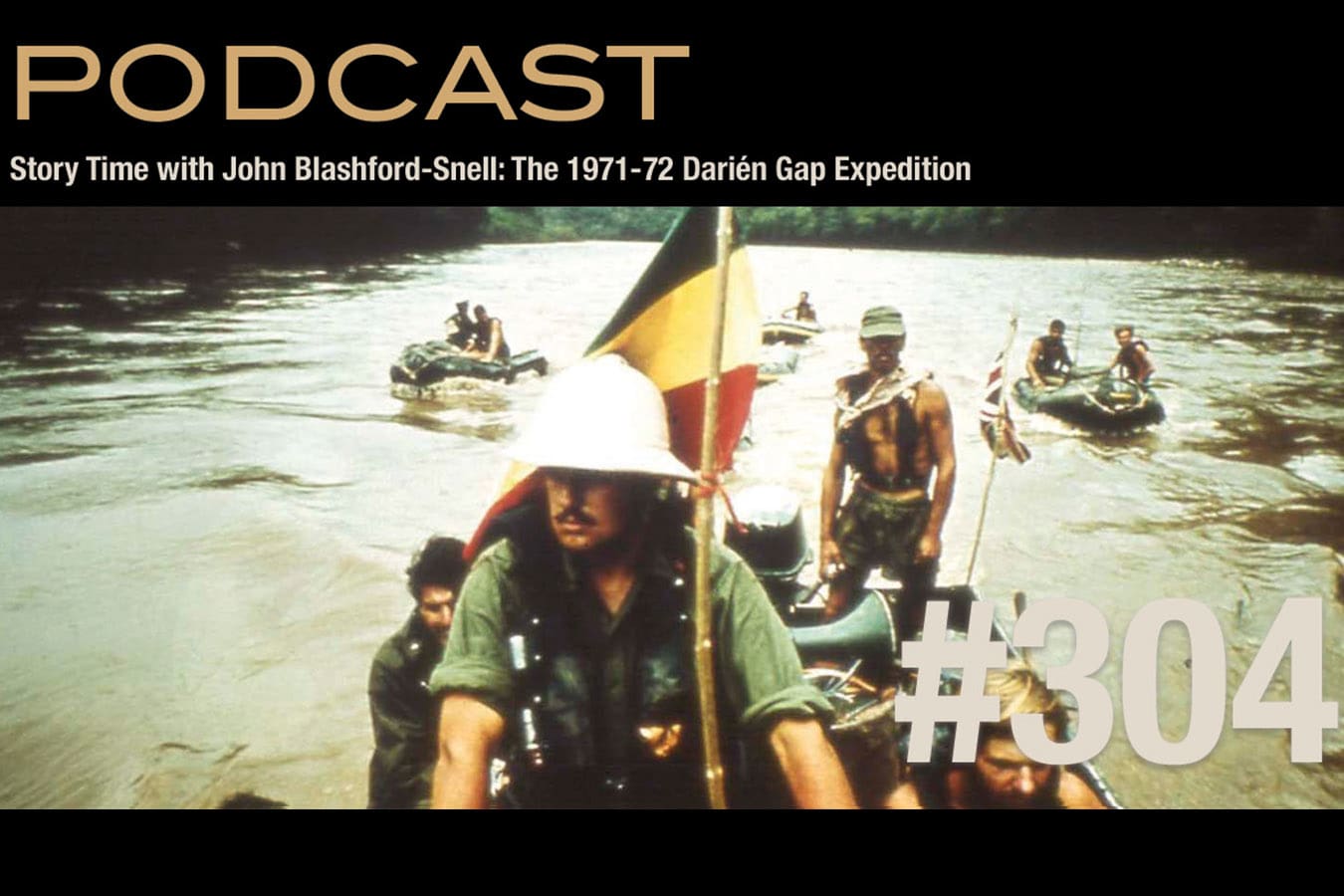
Overland Journal Podcast host Ashley Giordano welcomes John Blashford-Snell, a British explorer, author, and former army officer known for leading pioneering scientific expeditions to some of the most remote regions on Earth. Born in 1936, he served in the British Army’s Royal Engineers before turning his focus to exploration and conservation. Blashford-Snell tells the story of the 1971-72 Darién Gap expedition, why he founded the Scientific Exploration Society, and how it and other organizations are helping to support young explorers with field research and conservation projects worldwide.
Overland Journal Podcast Episode #304
The Overland Journal Podcast is brought to you this week by Overland Journal Magazine
New to Overland Journal and want to grab a subscription! Visit Overland Journal and enter code: overlandpodcast at checkout for 20% off. We thank you for being a subscriber.
Bio:
Holder of almost all the top awards for exploration, Colonel John Blashford-Snell is one of the world’s most eminent and seasoned explorers. With the support of commerce, the British, US and other Armed Forces, he has organized and led over 100 expeditions to far corners of the world, including the first descent of the Blue Nile, the first vehicle crossing of the complete Darién Gap and the navigation of the 2700 mile Congo river. The objectives of his challenging ventures have always included scientific exploration, wildlife conservation and aid to local communities. At the same time he has sought to develop leadership in young people through Operations Drake and Raleigh and assist the less privileged youth of urban areas. Broadcaster, public speaker and author of 16 books, John Blashford-Snell is regarded as an authority and as President of the Scientific Exploration Society, continues to explore today, and gives lectures world wide.
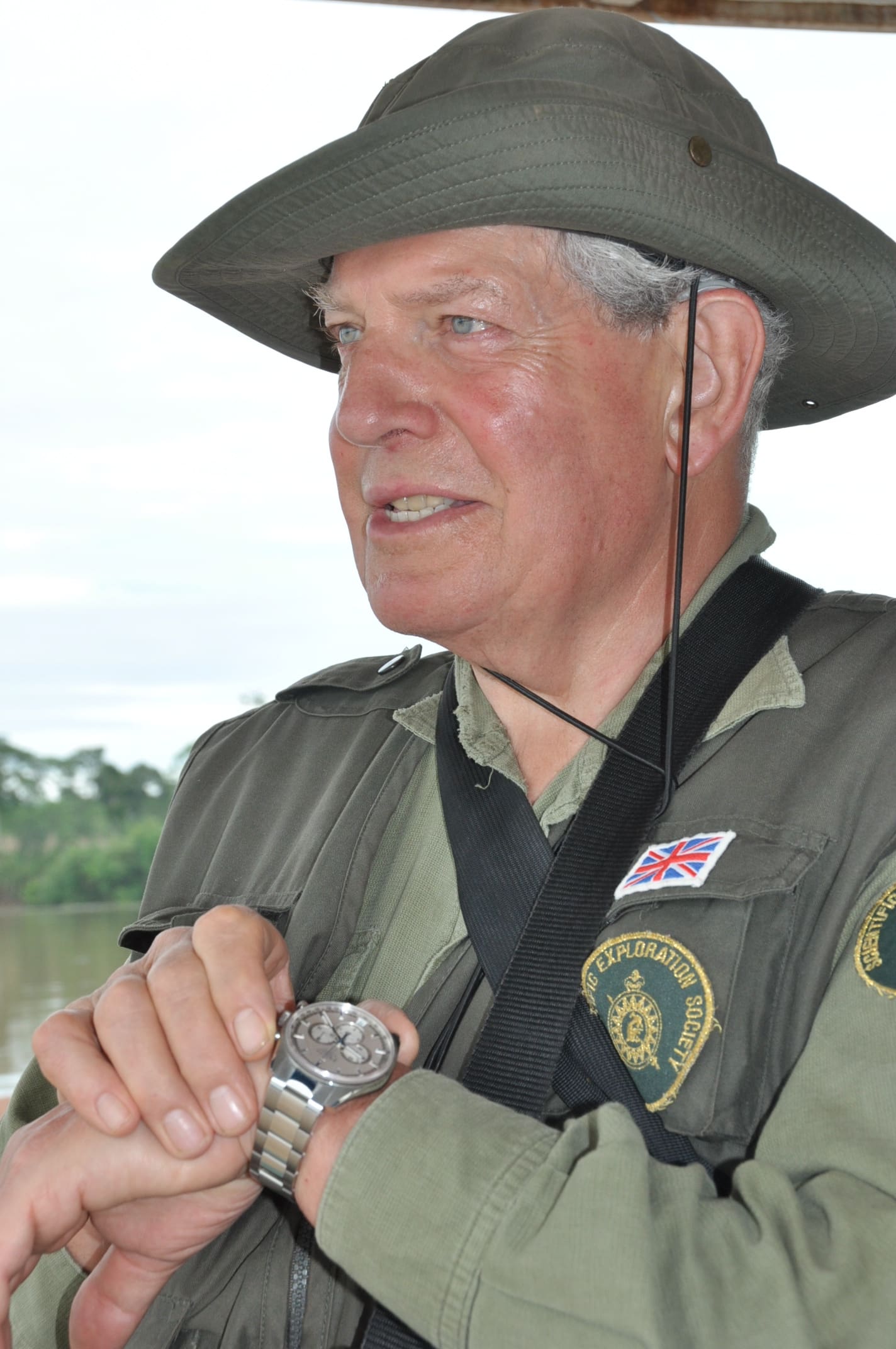
John Blashford-Snell
Website | YouTube | SES Website | OV Conservation: The Scientific Explorers Society | Living Legends: John Blashford-Snell
Host Bios:
Ashley Giordano
Ashley Giordano’s first foray into overland travel involved a 48,800-kilometer journey from Canada to Argentina with her husband, Richard, in their well-loved but antiquated 1990 Toyota Pickup. Currently cruising along the iconic Silk Road in a 2008 Toyota Tundra, her full-time navigator duties are rewarded with bowls of plov and lagman noodles, hikes in the Tian Shan, and countless cups of fragrant Tashkent tea. As senior editor at Overland Journal, you can usually find Ashley buried in a pile of travel books, poring over maps, or writing about the unsung women of overlanding history, including her enduring inspiration, Barbara Toy. @desktoglory_ash
Tune in Apple Podcasts | Spotify | YouTube
Transcript:
Ashley Giordano: [00:00:00] Hello and welcome to the Overland Journal Podcast. I’m your host, Ashley Giordano, and today I’m tuning in from Kyrgyzstan, and I have a very special guest here, Colonel John Blashford-Snell. Welcome to the podcast, John. So happy to have you here.
JBS: Good morning.
Ashley Giordano: Um, so you’re in the SES headquarters, which is the Scientific Explorer Society, and, uh, you’re joining us from England today, so welcome.
JBS: Yes, I’m sitting, I’m sitting in, uh, at my secretary’s desk where his computer is. I’m not an expert on computers, so I hope this works all right.
Ashley Giordano: I think it’s gonna be great. But speaking of being an expert, so you are an explorer extraordinaire, author of numerous books, [00:01:00] and founder of what I just mentioned, the Scientific Explorer Society.
And when I say explorer extraordinaire, I mean you’ve mounted over 100 expeditions over the past 50 years all over the world, concentrating on scientific research and community aid. So, um, you have such a wealth of experience, and I can’t wait to chat with you about some of those expeditions.
JBS: Well, I had a, a very wonderful visit to the Overland Journal display a few years ago in North Carolina.
And I’ll always remember that, um, because we arrived at the time of a, um, a hurricane, and we had to give the lecture on the Darien Gap in a tent. And people had to hold the tent down while I spoke. It was quite an epic, epic lecture.
Ashley Giordano: Oh, wow. What an experience. I think from an off-road perspective, although you’ve had so many [00:02:00] other expeditions that you’ve mounted, the four-wheel drive community has been the most enamored by the Darien Gap expedition that you did in Range Rovers 1971, 1972.
Uh, walk us through the background, maybe like the geopolitical situation during that time that made that trip possible. What were they looking at? There are a few countries interested in learning more about that region.
JBS: Well, the Darien Gap in 1971 was the 250-mile, uh, blockage in the route of the, the Pan American Highway, which runs from Alaska to Cape Horn.
Um, the various South American countries were keen to get the road completed so that they could, uh, open up trade with, uh, Central America and the United States [00:03:00] To do this, it needed to put a road or a track through the 250 miles of dense jungle, hills, mountains, swamps, snakes, bugs, bandits, you know, it was everything.
It was one of the most impossible barriers in the world, and they wanted to get vehicles through there to show that it was possible to put them through from a commercial point of view. Several expeditions had tried. One, a Canadian one, actually got most of the way, but they didn’t complete the journey through the Trato Swamp, which is a very big piece of swamp about the size of Texas, um, which, of course, you can’t motor across.
So this committee, which was formed in Bogotá, Colombia, came to London and threw down the, the gauntlet, so to speak, to the British and said, “Why [00:04:00] can’t you guys do this, your explorers?” And, um, lots of, uh, well-meaning Englishmen said, “Yes, yes, yes, of course, we can do it.” At that point, I was working in the Ministry of Defense in London, and I received an invitation to have lunch with these illustrious gentlemen to see whether this expedition was feasible.
Now, I went to lunch, and I always remember the chairman of the lunch wore a, a purple bowler hat, and he had a monocle. A rather extraordinary looking chap. But, um, he said to me, “Do you know where the Darien Gap is?” I said, “Oh, yes, it’s in the middle of Russia.” “No, no, no,” he said, “it’s in South America.” And that was I had my first lesson.
Now, I’d never been to South America. I didn’t know much about Central American jungle. Most of my experience had been in Africa. [00:05:00] And, um, when they explained the problem to me, I said, “Well, it’s obvious you’re going to need a reconnaissance before you take this on, because from what you tell me, it’s going to be a, a very difficult problem.”
So he said, “Well, who do you suggest?” I said, “Well, by g- good fortune, I’ve got a, an Irish friend who recently overtook a police car at 70 miles an hour in the middle of London, and, uh, he’s quite keen to be outside England for a little while before his court case comes up.” And they said, “Well, if we give him 100 pounds, do you think he’ll go out there and do the recce?”
I said, “Well, I’ll try him.” So I got hold of Brendan O’Brien and, and I said, “Brendan, how about a trip to Central America?” “You’re on, you’re on, you’re on,” he said, and with that, he left. When he got there, he said to [00:06:00] me, “I must have a gun.” And I said, “I’m not gonna give an Irishman a gun. You know something might happen.”
“Oh,” he said, “I must have a gun.” He said, “There are lots of dangerous animals and people in the Darien Gap.” So I refused to give him a gun, but he got one anyway, and he set off with two Indians, and they walked through the Darien Gap, doing this recce to see whether it was possible to make a track for vehicles.
When they got to the far end, they walked into a village in Colombia, and there was no one there except a little dog, and the little dog came walking up towards him, and Brendan quite liked little dogs. The two Indians who’d been with him had fled. And when he looked at the dog, he realized why. It was foaming at the mouth.
The dog had rabies. And somewhere in his backpack, he’d got his [00:07:00] revolver, but the ammunition was in a pair of socks somewhere else. So imagine the sight of this chap standing in the middle of the village with a dog coming at him, and he’s having to unpack his backpack, get the revolver, find the ammunition, load the revolver, and bang, he shot the dog.
And of course, the villagers then poured out and carried him on their shoulder because they said he had saved the village from the rabid dog. A few weeks later, he got back to England and he came to see me and he said, “You can do it. Here’s a map, but don’t ask me to come with you.” So I went back to the planning board and I said, “Yes, but I think you’re going to need an enormous amount of backing from the British Ministry of Defense, from the Panamanian and Colombian governments, and hopefully from the [00:08:00] American Armed Forces,” who were then occupying the Canal Zone.
So a plan began to evolve. First of all, of course, it needed some cars to get through, and the Rover Company in England had just produced this brand new all-singing, all-dancing four-wheel drive called the Range Rover, and they wanted it tested. And they said, “If we lend you two of our brand new Range Rovers, would you drive them from Alaska to Cape Horn?”
“Oh, yes,” I said, “That sounds pretty well straightforward. For most of the distance, there’s a road, except for the 250 miles in the beginning, and for that, we’re going to have to make a track.” The Ministry of Defense said we will support it, and the British Foreign Office agreed, the Panamanian government agreed, the [00:09:00] Colombian government agreed amazingly, and the United States forces in the Canal Zone also agreed.
And the problem was that the Panamanians didn’t like the Colombians didn’t like the Panamanians. Neither of them liked the Americans, but they didn’t understand the British, so we had a slight opportunity to do something there. However, uh, I then recruited an expedition of soldiers and servicemen and scientists because it was pointed out, quite rightly, that if we were going to, uh, put a road through this pristine bit of forest, we were going to disturb the indigenous people, the wildlife, the environment, and one must give a thought to what’s gonna happen to the Darien Gap once a road goes through.
So there were 60 in all of us, and there were some Americans, some British, and Colombians, and [00:10:00] Panamanians, and it was a good mixture of people. This- it was decided that a team of cavalry soldiers from the British Army would drive the Range Rovers from Anchorage to Panama. Then they would drive it through a track that we were making into the Darien Gap with teams of royal engineers, and then they would pick up the cars again in Colombia and drive down to Cape Horn.
It was estimated this would take us about six months. Um, and so the team assembled, and I went out with, uh, the most of the party in, um, December, January of 1971, ’72. The Range Rovers duly arrived in Panama, having had, uh, one accident on the Pan American Highway coming down, but they had repaired the vehicles, [00:11:00] and there was a problem It was due to stop raining in January, but the rain hadn’t stopped, and so the, the jungle was rather like the battlefield in the field of the Somme during the First World War.
Mud, thick, deep mud was everywhere. And of course, once the vehicle started to move in this terrain, they got stuck. They only not only got stuck, the transmissions couldn’t stand the stress of the wheels being stuck on the engine, which was very powerful trying to turn, and so the transmissions blew up.
And they blew up with such force that the teeth from the transmission came through the floor of the Range Rover. Luckily, there was no one sitting in the back. And eventually, we broke nine back axles. [00:12:00] But of course, we meanwhile managed to communicate by radio with the Rover company and said, “You have got to design a better transmission system.”
And they did. And they flew these out, and the United States Air Force, uh, brought them in by helicopter and parachute, and were dropped to where the Range Rovers were now stuck in the jungle. Whilst all this had been going on, we wanted to get ahead with the track, so my second in command purchased a battered old Land Rover in Panama City.
It had been rolled, and so it was in a bit of a mess, but he took off the top, the doors, the tailgate, everything you could remove to make it as light as possible, and then he loaded this scaled-down Land Rover into a, a huge [00:13:00] American helicopter, um, called a Jolly Green Giant, and he flew this into the Darién Gap to join us We then went ahead using this battered old Land Rover as a tool carrier, so the engineers could march with it, and the Land Rover could carry all the tools, explosive, and so on that we needed to get the track through.
Originally, they had planned to use a couple of vehicles called Hillbillies. Hillbillies were little tracked, um, uh, sort of wheelbarrows, and they were going to be used to go through the Darling Gap carrying the tools and equipment for the engineers. But although they’d been tested perfectly in England, where they worked well, when they got out into that mud, the mud [00:14:00] oozed up between the tracks and it set like concrete.
So the Hillbillies were glued to the jungle floor, and they’re still there. Meanwhile, the old, uh, battered old Land Rover pushed on ahead with the sappers, the engineers, and with support from the United States Forces and the Panamanian Guardia Nacional, we pressed on. The weather conditions, although the rain dried up, but the weather conditions were pretty awful, and we were wet all the time, and our feet began to rot.
And when they rotted, of course, we couldn’t really walk properly. And although we had the best jungle boots that you could provide and various ointments to put on, about half our people were taken sick with jungle foot Um, which meant we were losing people like [00:15:00] mad. At one point, we were running out of people and I went to the local prison in a place called El Real, and I did a deal with the prison warden, and I said, “If you can let me have six of your prisoners, I will give you a case of six bottles of whiskey.”
And he agreed. So I, I purchased half a dozen murderers and smugglers, and a few more from the prison to come and work for me. I put them into a group, and I put in charge of them a Gurkha. I don’t know whether you know what a Gurkha is, but they’re Nepalese and very, very tough professional soldiers.
And this chap took them in hand, and he showed them his kukri knife, and he said, “You see this? It is very sharp. You do what I tell you, everything fine. You disobey me, I use this knife on you.” They were terrified of him. However, [00:16:00] they agreed to go because we’d said, “Once we get to Colombia, we will release you, um, and give you a few dollars, and you can go home to wherever you’ve come from.”
Some of them had come from Ecuador and Chile and so on. And so they do j- did join us, but then we found a problem. One of my sergeants came up to me and said, “By the way, sir, have you realized that one of the prisoners is a girl?” I hadn’t. And so I sent for this lady, who didn’t look very lady-like. She was a pretty disreputable-looking girl, and I said, “Are you happy to come with us?”
“No,” she said, “I don’t trust soldiers. I’ll be raped or something. I know what’ll happen.” I said, “No, no, no. We’re British. We don’t do that to ladies. We look after you.” So she said, “How do I know?” I said, “Well, look, we have, we have some ladies in our team.” And we [00:17:00] did. We had two girls who were looking after the horses.
So I got hold of one of the girls, who was a fairly tough-looking lady, and I said, “Look, would you mind taking this girl behind the hut and convince her that you’re a woman and that she’s safe to come with us?” So they went and had a, a private ch- chat, and when the girl realized that there were women with us, she agreed to come with us.
And later on, after they’d reached Colombia, I always remember going there to meet the local mayor, and I flew over in the Beaver aircraft that the Army Air Corps had sent with us. And when I landed in, in Colombia, I went to the mayor’s house. I was greeted by a very attractive girl in a short skirt and high boots and long black hair, and she smiled at me and she said, “You remember me?
It is Esmeralda.” And there was this girl who’d been a most disreputable-looking person in [00:18:00] the jungle, and she’d now become the mistress of the local mayor. So that was quite useful. Meanwhile, the vehicles began to push on. The Range Rovers with their new back axles, uh, started to move quickly through the trail that had been cut by the engineers on the, um, way ahead with the Land Rover, which we called the Path Finder.
And eventually, on the 23rd of April, 1972, uh, they reached, uh, Colombia Before that, they had reached the border with Colombia and been greeted by the Colombian army. We arrived at the border slightly early. There was no one there. And then suddenly at 1:00, the jungle moved, and into the clearing came 30 heavily armed [00:19:00] Colombian soldiers, and the sergeant major came forward with a citation.
It looked like a sort of lavatory roll, which he unrolled, and he read out and he said, “In honor of Simón Bolívar, the liberator of Colombia, and the assistance given in 1819 by Lord Wellington of England, who sent soldiers with the British Legion to help the re- rebels in Colombia, you are permitted to enter our country with drums beating, flags flying, uh, and bayonets fixed.”
Well, we had a little shotgun, and we, we had, um, um, some, some machetes. We had a Union Jack flag, and we had a tin can that we could beat as a drum. So we marched into Colombia with the Colombian, uh, [00:20:00] soldiers, and we were greeted by local villagers who brought their children to show them to us and pointed at the children’s blue eyes and said, “English.
English.” But I’m not sure whether the English soldiers or, and they were probably Irish soldiers, had actually left behind all these children in Colombia. Anyway, we were given a huge welcome by the Colombians, and a whole series of parties took place. At the end, we went to Bogotá, to the incredible statue to Simón Bolívar in the capital, where we had a ceremony in memory of the Colombians who died assisting us.
Six of them were killed by bandits in the mountains. These were the FARC terrorists who were just starting in operation. And a number of them, six again, were drowned when a boat turned over, uh, in the Atrato River, [00:21:00] trying to come into our system. So the Colombians had lost 12 people helping us. We didn’t lose anyone, but we had a lot of sick people.
And at that point, the Range Rovers went on down to, uh, Tierra del Fuego, uh, and they reached, uh, in June of 1972. They arrived there having completed the 17,000-mile journey We had a great many close calls, mainly with things like dangerous snakes that, um, caused us great problems. And of course, a lot of the time we had to carry stores using horses.
So we took, uh, 26 Panamanian pack ponies in, carrying the petrol for the, um, Range Rovers, and we also later picked up some Colombian mules, who were pretty sturdy animals, to carry at the other [00:22:00] side. We had parachute drops throughout, um, from the Army Air Corps Beaver aircraft, and also we had helicopter assistance from both the Panamanians and the Colombians and the Panamanians.
So it was a real joint international venture. Um, and the Range Rover was now launched. It had been a very close call, ’cause it damn nearly didn’t make it. We marched into Colombia on St. George’s Day, uh, which was appropriate, as the patron saint of England, and we crossed into this huge welcome. So the Range Rover was now new.
We went back, various movies and films were produced by the film crews. The Canadians shot a very good movie for the Canadian Broadcasting Corporation. We had another one made for an Army cinema theme, and they… One of those films [00:23:00] is still on, on YouTube. Books were written, stories told, and we went back to get on with our normal work in England
Ashley Giordano: And now you’re here telling us the story again.
So thank you for sharing all of that with us, and it’s great to hear it from you. I’ve read your, one of your books, and I know you have multiple, so we’ll talk about those after, but, um, it’s really great to hear it coming from you directly. Um, I have a question for you. So, um, you mentioned being horrified by the destruction of the rainforest and the spread of disease from outsiders to the d- indigenous people coming out of that trip, and strongly committed to the protection of wildlife, fauna, and flora.
You were in the midst at this point of starting the SES. Uh, tell me a little bit more about that.
JBS: Yeah. Well, we, we, we had with us various biologists, zoologists, geologists, [00:24:00] um, and scientific experts who wrote reports on the, the wildlife. And in fact, partly due to our efforts, a wildlife reserve was established on the borders of Colombia and Panama, which is still there to this day.
Of course, it’s not easy to get in and out there because of the problems with the illegal immigration of people coming up from South America trying to get into Central America and the United States. Um, that I think has, um, slowed down quite a lot thanks to President Trump’s activity on the border. And at one time, there were hundreds of thousands of illegal immigrants pouring into the Darién Gap.
However, as I say, I think that has slowed down now, but still, it’s not an easy piece of territory to go through. And so if anyone wants to go through it again, I don’t [00:25:00] recommend it
Ashley Giordano: Why is that?
JBS: Well, it’s just, it’s, it’s full of a lot of… There are large numbers of, uh, communist guerrillas, particularly the ELN operating on the border.
FARC have more or less packed up now, and they’ve become the government of Colombia. Um, but, uh, i- if you start going through the Darien Gap by yourself, you’re quite likely to be taken prisoner or made into a hostage. Um, and, um, a number of people have come to us to ask advice on going through, and I’ve said I wouldn’t do it, not at the moment.
Also, I think it’s rather good to try and leave the indigenous people who are there, uh, to have a peaceful life. They don’t want constant just being disturbed by outsiders. And of course, the more people who troop through, the more wildlife will be disturbed. The road itself was [00:26:00] completed as far as a place called Yaviza, but that still leaves today 60 miles of, uh, swamp and mountains that have not been crossed, and I don’t think ever will be, because getting through that swamp is extremely difficult.
Some years ago, I talked to the then virtual dictator of Panama, General Omar Torrijos, who was very helpful to us on a later expedition. And I said, “General, when are you going to complete the Pan American Highway?” And he shook his head and he said, “I would rather have a road along my frontier rather than across it.”
Because he was- Yeah … particularly concerned about foot-and-mouth disease, and also even then, about illegal immigration. Um, so anyway, some good did come out of the expedition to help the local people and the wildlife[00:27:00]
Ashley Giordano: That’s awesome to hear. Um, yeah. Sure. I think it’s, it’s super important sometimes that things just be left how they are, and we don’t have to- Mm-hmm … always be going through everywhere, right? Mm-hmm. So fantastic stuff.
Sponsor: A week goes by that someone doesn’t reach out to ask how, uh, they can help support the podcast.
Uh, we are, uh, supported entirely by, uh, Overland Journal the magazine. So when you become a subscriber to the Overland Journal print magazine, you get this beautiful book, uh, that comes in five times a year. It also gives you access to our digital archive. Uh, and it’s well over 100 pages of, of gorgeous images and detailed testing and adventures from around the globe.
So if you go to overlandjournal.com and you subscribe to the magazine, use the code OVERLANDPODCAST, and that’ll get you 20% off. It’s only available to our podcast listeners. We don’t advertise it anywhere else. [00:28:00] Um, and then you help us to maintain that independent employee-owned journalism, um, that we have been famous for.
So it allows us to conduct those tests without any advertorial. Another way you can help out too, I produced a book, uh, last year with Simon & Schuster called Overlanding 101. You can find it on Amazon or Barnes & Noble or even your local bookstore, and that encompasses my decades of travel around the world, all of my mistakes and failures and, and the lessons that I’ve learned in traveling around the globe.
Uh, many of those, um, that you hear on the podcast have been distilled down into print form with great lists and beautiful imagery. Uh, so you can find that, uh, at your local bookstore, Overlanding 101. And thank you all for listening and for supporting us so much throughout these years.
Ashley Giordano: But, um, obviously this is a memorable expedition for you and for a lot of people.
But is there one in addition to this that has fulfilled you the most or-
JBS: It was, it was the most [00:29:00] difficult expedition I’ve ever done. Um, um, I, I, um, I’ve done, I’ve done a few others, but th- that one was physically, I think, the most difficult. We, we, we marched an awful long way, and, uh, we had a great many adventures on the way.
Ashley Giordano: Is there another one that you find particularly memorable?
JBS: Well, the first, the first big expedition that I did was the Blue Nile in Ethiopia, and that was the piece of river that runs from Lake Tana in the north of Ethiopia down to an enormous deep gorge, a mile deep, all the way into the Sudan, where it joins the White Nile and becomes the Nile proper.
This is about 500 miles, and the gorge is a mile deep. And in 1968, uh, it had never been fully explored. Various people had tried [00:30:00] to explore it, and there had been various expeditions, but they’d never completely covered the journey. And I was then an instructor at the Royal Military Academy at Sandhurst.
That’s the, uh, uh, the British military academy, although like West Point. And, um We were looked after by the Emperor of Ethiopia, His Imperial Majesty Haile Selassie, a very powerful man. And at the end, we went to a reception at the palace. I’ll never forget the reception because, um, to get in to see Haile Selassie, you had to go through a certain procedure.
There were 60 officer cadets in that expedition, and each one had to march up the red carpet, bowing three times, once at the door, once halfway up the carpet, finally just in front of the throne, and the [00:31:00] emperor might shake hands with you. And when you left, you were not permitted to turn your back on such a, a wonderful person, so you had to walk backwards up the carpet, bowing as you did.
Well, you may say that’s no great problem, but the emperor was an animal lover, and in the throne room he kept an ever-circulating group of lions. So the chances of tripping over a ruddy lion as you went backwards down the carpet were quite high. I asked the minister of court what we should do about this.
Oh, he said, “It’s quite simple. When you’re bowing to the emperor, cast yourselves down low. Press your forehead upon the carpet.” I said, “Hey, hey. Steady. You know, we’re British. We don’t normally do that sort of thing, but a stiff bow is normally all that’s required.” “Oh, no, no,” he said, “I’m not suggesting you be obsequious, [00:32:00] but if you look…
If you bow low, you can look between your legs and you will see the lions behind you.” So we marched all 60 officer cadets in and out of the throne room, and, uh, Haile Selassie then took us into the garden and said, “Come and see some of my other pets.” And he showed us a most beautiful cheetah that was sitting there on a plinth very quietly.
Unfortunately, our lady manager had got a dress which had cheetah spots all over it, so we’ve got a wonderful photograph of these two what… looking at each other and the, and the, the cheetah much as saying, “Where the devil did you get that dress from?”
Ashley Giordano: Oh my
JBS: God … Anyway, the em- the emperor at the end said to me, “You know, I would love to have my Blue Nile fully explored and find out about the people, [00:33:00] the minerals, and so on.”
Well, I knew something of the reputation, and I knew there were a great many hazards. So I nodded, I didn’t commit myself. I smiled and said, “Of course, sir,” and backed away. But when I got back to England, my general sent for me and he said, “We’ve had a letter from His Imperial Majesty, Haile Selassie, King of Kings, Chosen Lion of the Tribe of Judah, and also a field marshal in the British Army.
He wants his Blue Nile explored.” And I said, “Yes, sir. Well, it’s very difficult and dangerous.” And he said, “What do you think about it?” I said, “Well, sir, it’s full of bandits who are heavily armed and shoot at people. There are lots of enormous crocodiles that are real man-eaters. There are lots of dangerous hippos.
And then the sides of the gorge, which is a mile deep, tend [00:34:00] to fall down into the gorge and leave behind deposits of radioactive gas He said, “Stop it, stop it. You’re being rather negative. I don’t like negative officers. What I want is to do something to be good for a soldier’s morale, challenging and worthwhile, and all to help Haile Selassie.”
So the expedition was formed. The general said to me, “We can form a committee.” He said, “I shall be chairman, and you can be the secretary. I see no need for anyone else.” And so the Blue Nile Expedition with 60 or so soldiers, mostly from Britain, with some assistance from the United States mapping mission who were working in Ethiopia, and some Ethiopian servicemen as well, and scientists again, who were to do the scientific work in the gorge and to study particularly wildlife conservation issues affecting the area [00:35:00] And off we went.
And of course, we had to get a boat to go down there. And in those days, a couple of United Nations Scandinavian employees had actually tried to go down in kayaks. They’d both been wrecked. A Swiss expedition had also tried to go down in kayaks, and they’d been shot up by the bandits and two of them killed.
So it was a hazardous area, but by taking soldiers, who were carrying weapons, of course, we decided that we had to go down using some sort of boat. And we reckoned that a rubber boat might have a better chance. And I went to the Avon Company, who produced them in England, and I said, “You know, we want to go down the worst river in the world, full of enormous cataracts, and we thought we might take some of your yachting tenders.”
And they said, “All right. Well, we’ll lend you one to try out.” [00:36:00] And we took the yachting tender to a weir in, in Wales, and we put the boat over the weir about 30 or 40 times, and we didn’t manage to puncture it. So to be really certain, we designed a rubber boat, um, with very thick skins, and we also, we also put football bladders inside the tubes through specially large valves so that there were, like, tubes within tubes.
So this thing was virtually unsinkable. And we got six of these, uh, inflatable boats from the Avon company, and we would use those, and also on some stretches of the Blue Nile where the rapids were not quite so dangerous, we took Royal Engineer aluminum assault boats powered by 40-horsepower engines. And this expedition went off in, um, [00:37:00] July of 1968.
What we knew would be a, a problem, of course, happened. We ran into the bandits. We ended up having a couple of gun fights with them. Very luckily, we survived. Um, we also had problems with crocodiles, and it was the most adventurous expedition I’ve ever done. Sadly, one of our members was drowned and several others were injured, but the Nile was surveyed, and we went back to Haile Selassie and told him that his job had been done And again, the film- Wow
the film is, the film is still on YouTube about the Blue Nile.
Ashley Giordano: I loved in your, in your books, some of them have the QR code that you can scan, and it’ll take you from the story to YouTube to see the video. Mm. The video of the, the expedition, so that, that’s really helpful to be able to read your words and then go and see it in motion.[00:38:00]
Yeah. Yeah. Wow. What advice do you have, like expedition advice in terms of leadership? Because you’ve led so many expeditions, and managing that number of people, what are your top tips regarding expedition leadership?
JBS: Well, you have to pick your team pretty carefully, and you want people who are compatible.
So we have a formal selection tests and so on. And later on when we created Operations Drake and Valley, we enlarged all these tests to make sure that people were compatible, and also that they were fit and they could communicate and so on. But I think it’s the first thing is to get a good team, and then obviously you get the best equipment you can.
Well, I know the Overland Journal is always showing new equipments being tested and so on, and I always read the Overland Journal with great care, looking at this, all this new equipment, wishing I had some of it. So I think it’s good equipment, good [00:39:00] clothing. For instance, in the Danakil Gap, we had the best clothing and boots that were available at the time.
But of course, when we did the Blue Nile, and to make the map, uh, the, um, we didn’t have sat navs and things in those days. We used to use a theodolite. I remember in the Danakil Gap when we, the surveyor was using the theodolite, I said to him one night, “Where do you reckon we are?” And he looked at his readings.
He said, “Well, according to me, we’re about two miles south of Hawaii.” And I said, “No, we’re not.” Oh, he said, “I better get back to my reading.” So he was… We were doing all our, um, the map, uh, map-making using theodolites and the stars. Now, of course, you have sat navs and GPS and so on. Um, so techn- technically things have moved forward a great deal.
But, um, I would say good equipment, good people, and [00:40:00] so on. People often ask me, would we have taken Range Rovers through the Danakil Gap of choice? Well, at the time, we believed the public relations, you know, story that these were the finest four-wheel drive vehicles in the world. In fact, probably something very, very light and portable, like a, uh, a, an early Jeep or a Land Rover would’ve been a better vehicle to have tackled it with because you could, could’ve handled it.
Um, and, um, certainly the Land Rover was, um, a much easier vehicle to handle getting through the Danakil Gap. We had to have various items of equipment with it, of course, and we did have a special raft made by Avon again, so that this raft could be folded up and put in the back of the Range Rover And then inflated and the Range Rover could be put on top of the raft and to cross the many rivers that we had to cross.[00:41:00]
We also had ladders made of aluminum that could be used to create bridges, and so on, for getting up ravines and across some of the chasms. But again, it goes back to good equipment and of course, the inflatable boats on the Blue Nile. And the Scientific Exploration Society has a reputation for testing out new equipment and using it, and writing very honest reports about whether it’s good or not.
And even today, we’re getting new equipment and so this can vary from simple things like watches. We had a watch with us on the, on the, um, Darien Gap made by Zenith, a Swiss company, and they sent six of them with us. They were automatic El Primero watches, and they proved to be really excellent. And again, it’s helped to launch this new watch.
Um, other items of equipment we tested, of course, in the recent years was clothing, like GORE-TEX. [00:42:00] One of our early expeditions, some of the first to test GORE-TEX which we still use to this day. And then there were things like boots. Boots are terribly important. And we’re still using a very similar jungle boot to the one we used in the Darien Gap, which was an American design, and the one I wear at the moment is actually Japanese but, uh, the American Army jungle boot is still one of the best.
And then there’s various other items of clothing, equipment. Um, I always wore a pith helmet, which is a very useful helmet to wear. People think it’s a bit showy, but when I was riding a, a mule through the end of the Darien Gap, the mule tripped on, uh, a vine, and I was thrown over the head of the mule into a tree, headfirst.
And if I hadn’t had a pith helmet on, I would’ve cracked my skull. [00:43:00] And as it was, the pith helmet acted as a crash helmet. Um, they also keep the sun off you and, um, they, uh… I found them very good for carrying things too, like eggs or even if you were collecting snakes, you could put the snake in the top of the pith helmet.
Um, the, um… One problem occurred to us on one occasion when we were signaling to our army air corps Beaver aircraft to drop some supplies to us, and they said, “How will we know where you are?” And I said, “It’s all right. I shall be standing in the middle of a clearing. You’ll recognize me because I’m wearing the white pith helmet.”
So they said, “Fine. Okay. Yeah, we can see you And they didn’t come. And that’s why I said on the radio, “Where were you?” And they said, “Oh, we saw you. We dropped the supplies down to you.”
We then discovered that a number of local people in the Panama area wore pith [00:44:00] helmets as well. So lots of people got some free beer thanks to that , and not me.
Ashley Giordano: No way
JBS: But there were, let’s say, all sorts of things. Radio equipment, of course, was very important. We didn’t have very good radios. Everything had to be done with sky wave aerials, uh, and communication was really a problem. There were no mobile phones in those days, and of course, um, when you went back, uh, earlier into the Blue Nile expedition, we had SAS radios, um, that would send like a, um, a Telex message.
You had to type this out on a tape and put it through and then zip, you sent the message through. Uh, that way we couldn’t do it directly by voice. I remember doing on, on another expedition on the Congo River in [00:45:00] 1974, w- we had an enormous radio set, uh, that with a 100-foot aerial, uh, that had to be set up on top of a hill to reach England.
We could then talk by, um, uh, talk by radio to England, but it was quite a business setting all this up. And the BBC wanted to do a broadcast, so they arranged for us to call them, and I climbed up the hill, got on the radio, and got through to the Royal Signals detachment somewhere in England, and, uh, then they said, “We’re gonna connect you now to the BBC.”
So after the clicking and squeaking, we got through to the BBC in London, and the girl said, “BBC.” I said, “Would you connect me to the Today program?” “Ah,” she said, “the line’s engaged. We’ll have to call back.” I said, “Madam, I’m in the middle of Africa, standing on a hill in a rainstorm.” And she said, “Well, you’ve still gotta [00:46:00] call back.”
So all that’s changed, of course, now with, uh, satellite phones and so on
Ashley Giordano: Yeah, even speaking to you now from Kyrgyzstan via- Yeah, I knew … satellite, wow. Times have changed. Yeah. I’d like to ask you about the SES, and for those listeners that aren’t familiar with the SES, what it is, and what do you do, and what are some expeditions that are coming up?
JBS: Well, the Scientific Expedition Society was set up after the Blue Nile because we had been passing charitable donations through various army funds, and my general said to me, “You know, you can’t keep doing this. You must seek proper charitable status.” So we set up the SES as a registered company and a charity with the permission of the charity commissioners in London, and aimed at really bringing together the [00:47:00] servicemen of the various nations who were doing expeditions with the scientists of those nations.
In particular, we were supported by the Natural History Museum in London, and we had links, of course, with the Smithsonian and others in America. And so a lot of these scientists were only too glad to have an opportunity to go to distant, difficult countries with all expenses paid and perhaps using service aircraft or service ships to get there and so on.
And so this brought together servicemen and civilians in the cause of the environment, in particular wildlife, and helping people. And this, of course, has gradually moved on. I’m also now the president of a- another charity called Just a Drop, which is a water charity that puts in wells and, um, various features for indigenous people all over the world.
They work here in the [00:48:00] headquarters of the SES as well. We do great work in helping people who need clean water, and after all, I always think that’s one of the greatest luxuries. Somebody once asked me, “What is the one thing you miss on an expedition?” And I said, “It’s being able to turn on a tap and drink the water that comes out of it without having to think about boiling and, and purifying and so on.”
And so water is one of our important aims. But the SES also, uh, backs young people. Um, in 1977, uh, the Prince of Wales, as he then was, of course he’s now our king, um, uh, had heard that we’d taken a couple of, uh, young people on the Congo River expedition. Actually, there were three of them. There were two from the island of Jersey and one from America, and we’d given these youngsters the opportunity of a [00:49:00] lifetime on condition that on return to their home countries, they went around talking and lecturing and inspiring other young people with the same sort of Eli- Elizabethan spirit of adventure and doing something for the environment and the people of the world.
The prince said, “If you can do this with two or three young people, why can’t you do this with two or 300?” He’d recently made a speech in London where he talked about young men and women needing to face the challenges of war in peacetime, and nobody wants a war. But if you can give young people those sort of challenges, perhaps you can do something for their character on condition that they come back and do something to help in their communities.
So he asked me if I would draw up a plan, and I decided that it was because we were coming up to the 400th anniversary of Sir Francis [00:50:00] Drake’s circumnavigation of the world, and we would call it Operation Drake. And the prince said, “Well, I’ll be a patron. What can I do to help?” And I said, “Well, perhaps you could write a few letters for me.”
And he wrote one to Walter Annenberg, who was, uh, had been the American ambassador in London and was a great Anglophile, and I went to see Walter Annenberg at his, uh, Rancho Mirage in California, and I told– showed him the letter from the prince, and it said, “I seem to remember that Francis Drake managed to elicit a little, a, a little royal support if the proceeds from his piracy were forthcoming.”
And Walter Annenberg thought this was a great story, and he gave me $100,000. And with that, we formed Operation Drake, which was to take young men and women aged, uh, [00:51:00] 17 to 25 in a, a beautiful brigantine around the world. Every three months, we would take in a new crew When we recruited large numbers of people from all over the world.
In fact, when the prince went on television and told everyone that if they were fit, compatible, could speak English, and could swim, they could have this opportunity of a lifetime, 58,000 applied. I could only take 400, and that’s what we did. And we took 400 for the period of two years, some from America, some from Britain, some from Canada, and all other countries, Australia, New Zealand, Europe, and so on.
And, and the prince launched it. His … The film is also on YouTube, and it was a great success. And the young, young people then went round the world giving this help and assistance, and coming back to do what they could to help in their communities. [00:52:00] Halfway around the world, His Royal Highness said to me, “You can’t stop now.
You must enlarge it. Make it bigger. Make it 4,000 young people.” And so Operation Raleigh was started, and we commemorated the founding by Sir Walter Raleigh of the first colony that was set up in the United States in what is now North Carolina. Sadly, didn’t, didn’t last long, but that was the first one.
So Operation Raleigh was set up. We had a, an office in, in Raleigh, North Carolina, an American committee, a Canadian committee, and a great deal of help from the, across the Atlantic. And this time we took 4,000 At the end of that, all the sponsors who’ve been helping were so pleased with it, they said, “You can’t stop now.
Make it bigger.” And so by this time it had outgrown the Scientific Exploration Society, and we formed [00:53:00] a separate charity called Rally International, which goes on today taking young people. And so far, 58,000 young people have been through the program from all over the world. It’s now very much an international body with committees in the States and committees in Canada and Central America, some of them being run by locals.
For instance, I visited one in Costa Rica the other day where the local leader is a Nicaraguan who’d been on a rally. And so the young people are coming back and now organizing things themselves. And of course, we’re having a great reunion next year in 2027, when we hope as many will get together in England, and hopefully the King might come, and, uh, then we will see some of these people, of course, now in their 50s who’ve gone on to life.
There have been tremendous success stories. One of them in particular I [00:54:00] remember was that the, the lady who is Britain’s representative at the United Nations named Barbara Woodward, she was an 18-year-old with us Another one I remember when I went to Alaska on one occasion to visit one of the teams that our American colleagues were running, and they’d just done a kayak trip down a river.
I congratulated them and said, “Now you’ve done this, you can reach for the stars.” And one of them did, and that is a chap called Major Tim Peake, who is an astronaut. So we have developed all these young people who’ve gone on to success. Another one won Oscars at, uh, with film production in Hollywood, and others have taken enormous steps in medical science, and this is out of the 58,000 who’ve been through it.
So SES today, uh, finds money to help young people to go on Operation Rally or Rally [00:55:00] International, as it’s now called, and also to help various other young people who are trying to do worthwhile expeditions, not necessarily on rally, but anything. And we’ve had young men and women going around the world doing worthwhile things with funding that we put up.
So that is our main aim now, is to assist the coming generations to, to do some work like we did as younger men. I’m getting on a bit now, and although I manage to do the occasional expedition, I did one last year in Costa Rica, um, and we’ve got more planned. But, um, what we’re trying to do is to encourage the new generations to do the same thing.
Ashley Giordano: Wonderful. Yay.
JBS: Mm-hmm.
Ashley Giordano: Fantastic stuff. Um, where are you going next?
JBS: Well, I’m not sure. We’ve just done this expedition in Costa Rica. The film has just gone on YouTube. It’s an [00:56:00] interesting one because some years ago we helped a, a program to use waste plastic in the beaches of Kenya to build boats, and that’s been a huge success.
So I decided, seeing the waste plastic on the beaches of Costa Rica, that maybe we could use some of that to do something for the conservation there. And as you probably know, the Costa Ricans are very keen Costa Ri- uh, conservationists. So we agreed to build a bridge, or rebuild one that had been built previously, and we used waste plastic, including waste Nicaraguan banknotes, which we made into planks.
And with that, we built a new bridge as an entrance into the Cocovola Park on the Pacific Coast of the Osa Peninsula in Costa Rica, and that’s been a huge success. Interestingly, started there by a young [00:57:00] girl who was on Operation Valley when she was 18, but she’d gone out to Costa Rica and she had founded a lodge called the, um, Luna Lodge in the Osa Peninsula.
And Lana Wedmore was with me in Australia all those years ago, but her one ambition was to do something to help in the rainforest, and she’s built this amazing lodge, which is now one of the top lodges in the Americas, where people can go and do yoga, and study, and eat herbs, and all sorts of things. Um, there’s a wonderful website about it, and the film of the expedition is on YouTube now.
Ashley Giordano: Amazing stuff. Wonderful. Thank you so much for sharing all this with us today. Yep. It’s been so interesting. I’ve loved the storytelling and, um, if folks are interested, where can they find more about you and the [00:58:00] SAS and all of the projects that you’re involved with online? You mentioned the YouTube channel, but…
JBS: Well, the SAS has a website. I, I have a website, and also there’s YouTube. And if you look up the JBS channel on the website, you’ll find a lot of information there. And there are, oh, over 40 films of our expeditions are there
Ashley Giordano: Perfect watching. We’ll have a little view party tonight in the camper in Kyrgyzstan and check those out
JBS: Well, I hope if some of your, some of your listeners want to join the SCS, and we welcome Americans in particular, we now have an, uh, chairman, Peter Felix, who is an Anglo American.
He lives in Miami, and he’s encouraging the friends of SCS in America. And we have got a number of American members. So if anyone in America wants to join the SCS, please get in touch with me. I’ll give them the right [00:59:00] details.
Ashley Giordano: Fantastic
Uh, what are some prerequisites that are required to join the SES?
JBS: They must like worthwhile, challenging adventure, I would say. The sort of thing that the Overland Journal people do. Um, I mean, it, it’s, as long as it’s w- doing something for mankind and w- you believe in the environment, the wildlife, fighting disease, um, you gotta be prepared to assist the world.
Not to think of yourself, but think, “What could I do to make the world a slightly better place?”
Ashley Giordano: And you have trips that some of the members can join. Is that right?
JBS: Yes. Well, the members join all the expeditions, and we have regular meetings in London, and we have some regular ones in America too. We’ve had various, uh, eminent Americans have joined recently, and, um, there’s a lady from Hawaii who whispers [01:00:00] at sharks who’s, uh, just become one of our keen members.
You probably know about her.
Ashley Giordano: Fantastic. Um, that’s great. So we’ll include all of those links in the show notes. And I just wanted to say thank you so much for taking the time to speak with us about your expedition experience, or a, a tiny sliver of it, and, um, what you’ve been up to lately, and all of the great, uh, causes moving forward for young people today.
So thanks, John, for so much for joining me and taking the time.
JBS: Thank you, Ashley. Well, let us know what the link is. I’d love to watch it when you, when you’ve done it.
Ashley Giordano: Of course.
JBS: But-
Ashley Giordano: Of course …
JBS: thank, thank, thank you for the magazines that arrived yesterday, and, uh, thank you for the review of our books.
Ashley Giordano: Of course.
Yeah, the listeners should definitely check out. You have a wonderful selection of books that goes through a lot of your- Oh, good … um, expeditions, and they are great reading. On the edge of your seat stuff. Great stuff. Um, well, shout out to the Overland Journal podcast [01:01:00] listeners for joining today’s episode.
And thank you, John, again, and we’ll catch y’all next time.
JBS: Okay. All the best to
Ashley Giordano: you.
Stop.
Our No Compromise Clause: We do not accept advertorial content or allow advertising to influence our coverage, and our contributors are guaranteed editorial independence. Overland International may earn a small commission from affiliate links included in this article. We appreciate your support.