

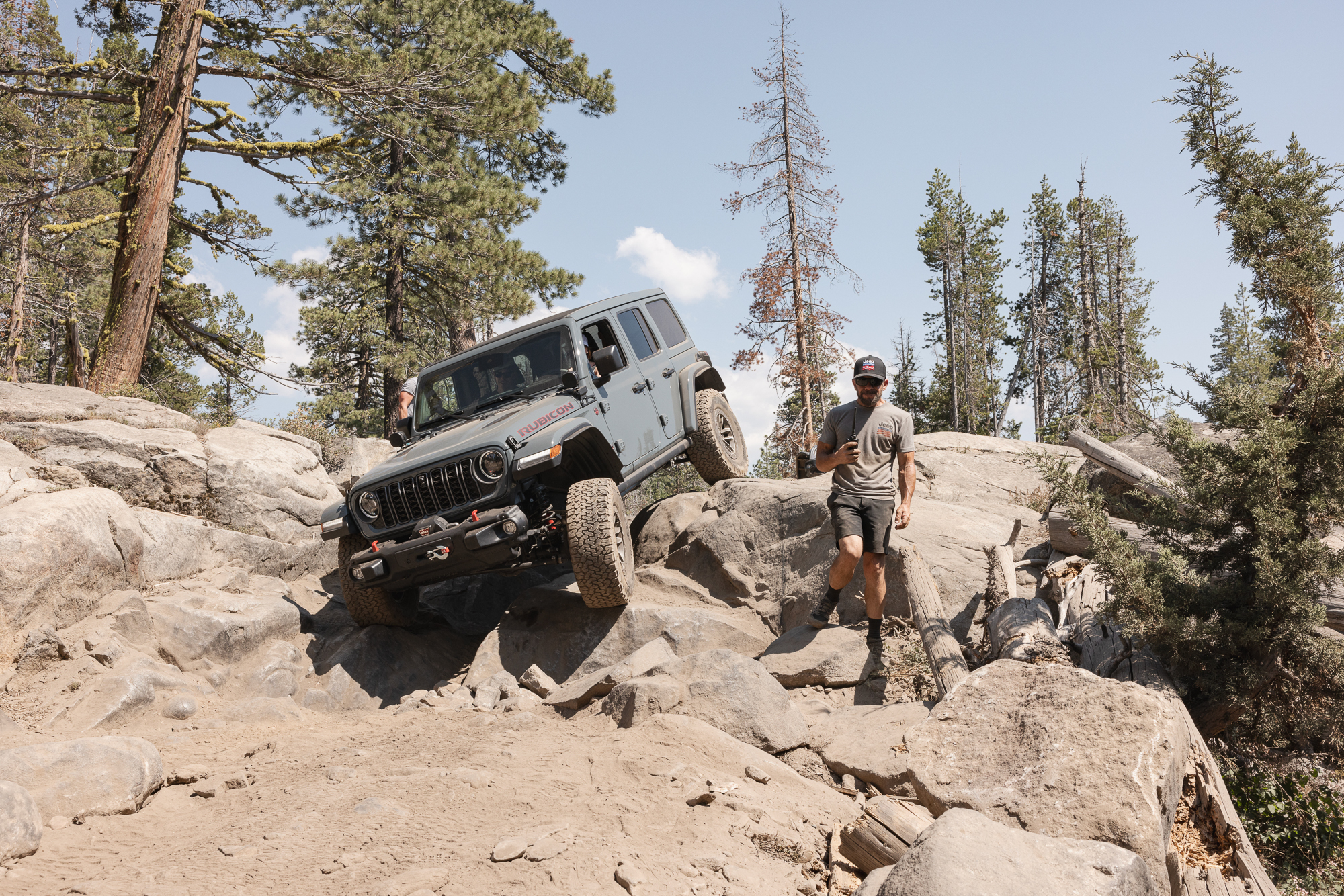
“It’s really gnarly up there,” trail boss Pearse Umlauf of Masor Performance (also president and CEO of Jeep Jamboree USA) tells us, over dinner. We’re high in the High Sierra near Lake Tahoe, a group invited by Jeep to tackle the most brutal stretch of the Rubicon Trail, the crown jewel of off-road routes. Umlauf’s voice is hoarse, the kind of grit that commands respect. He nearly lost it, managing his crew on the dusty trail all week to make sure we—and 200 others who are tackling the trail on their own—survive the drive.
Entertaining as Umlauf is, you can hear worrisome whispers from folks when he says two bears, “a big grumpy guy and a young troublemaker,” have sauntered into camp or how we’re going to hear screeching sounds coming from the vehicle that are “awful” as we rake the bottom of the Jeep across boulders. “That’s what the skid plates and rock rails are there for,” he says reassuringly. The Rubicon is a new experience for me since I’m a high-speed guy, having raced motorcycles off-road. And more recently, in the cockpit of light but mighty vintage buggies at the famed NORRA Mexican 1000, cars that are nimble enough to pass a trophy truck in a deep and loamy silt bed.
That’s what makes this route so interesting. It’s technical and meditative insofar that in some places, we can walk faster than we’re driving because every steering adjustment is intentional and every mistake has consequences. Umlauf is even careful to mention record snowfall that often shifts giant granite boulders, requiring them to be winched out of the trail, as well as how relentless erosion can even wash out entire sections of our route. It sounds like the occasional rattlesnake might be the least of our worries because the Rubicon itself is that intense.
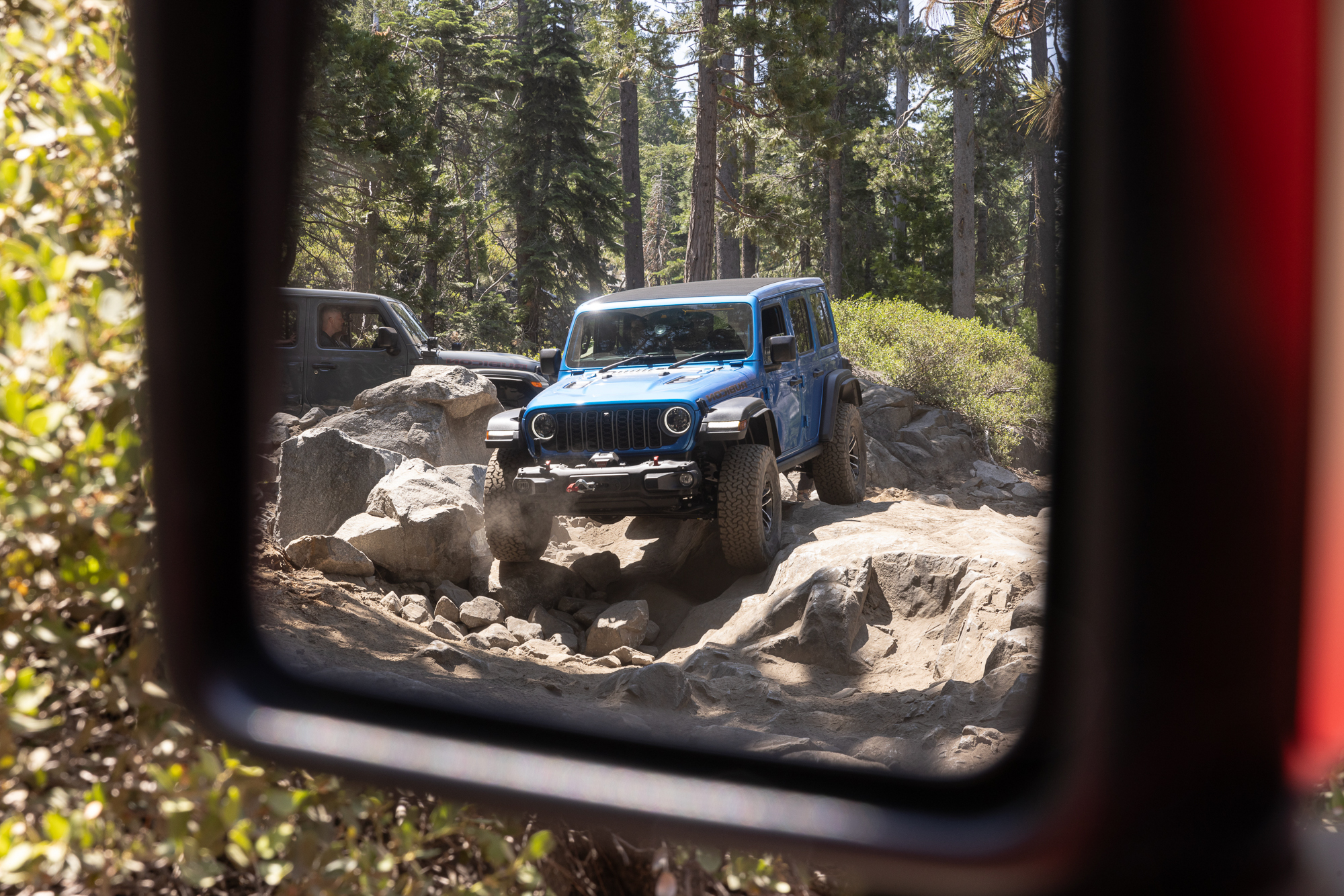
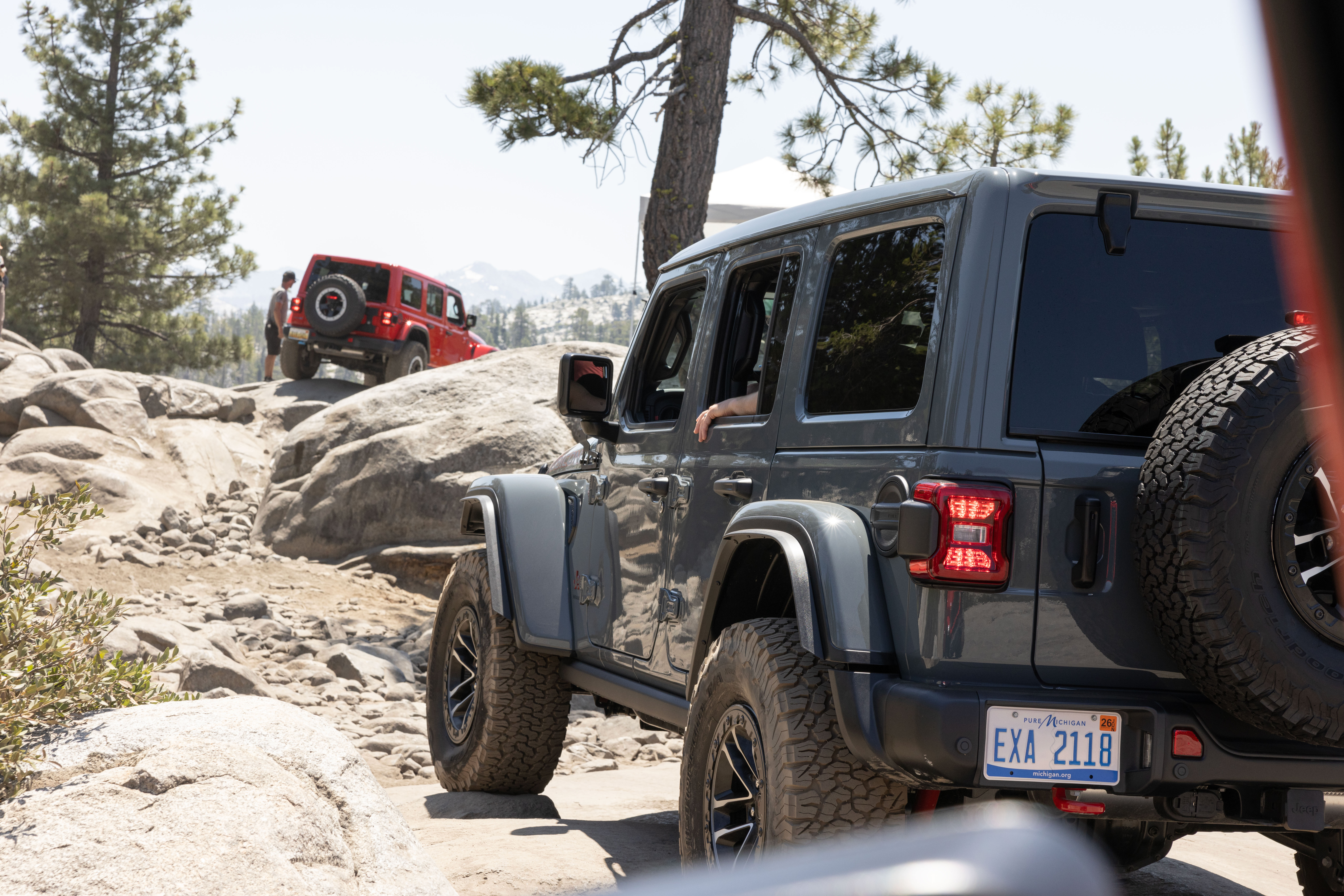
Objects in rear are gnarlier than they appear.
The Tahoe backcountry is a tapestry of emerald-green forests dotted with shimmering, glacier-fed lakes, stitched together by off-road and hiking trails as far as the eye can see. My small group has an awe-inspiring 360-degree view of this scenery as we fly a few hundred feet in a Bell 407 helicopter over this wild country on our way to Buck Island Lake, the rendezvous point where we’re to meet with our hosts, the Jeep brand. Before I left the hotel, I pulled up a map of the area to pinpoint exactly where we’d be dropping in. Since the Rubicon’s reputation precedes itself, my eyes immediately lock onto places like Hell Hole Reservoir and Devil’s Peak. I’m not a fatalist by any measure, but Umlauf’s brief the day before has me in awe, anticipating the worst in the most enthusiastic way possible.

Ty Devereaux and Shawn Gulling (both with Jeep Jamboree) greet one of our support team members in anticipation of the challenging day ahead.
Against this backdrop, a fleet of new Jeep models lights up the landscape like Christmas tree ornaments, befitting such a setting. Umlauf’s team is there to greet our band of journalists, content creators, and guests of Jeep as we eagerly find our rides, much like unwrapping a gift on a holiday morning. I’m thrilled to learn I’m driving the nimble, two-door, fire-engine-red Wrangler Rubicon with a shorter wheelbase. The vehicle is just as much a part of the experience. This one already feels right—a fun, capable companion for what’s ahead.
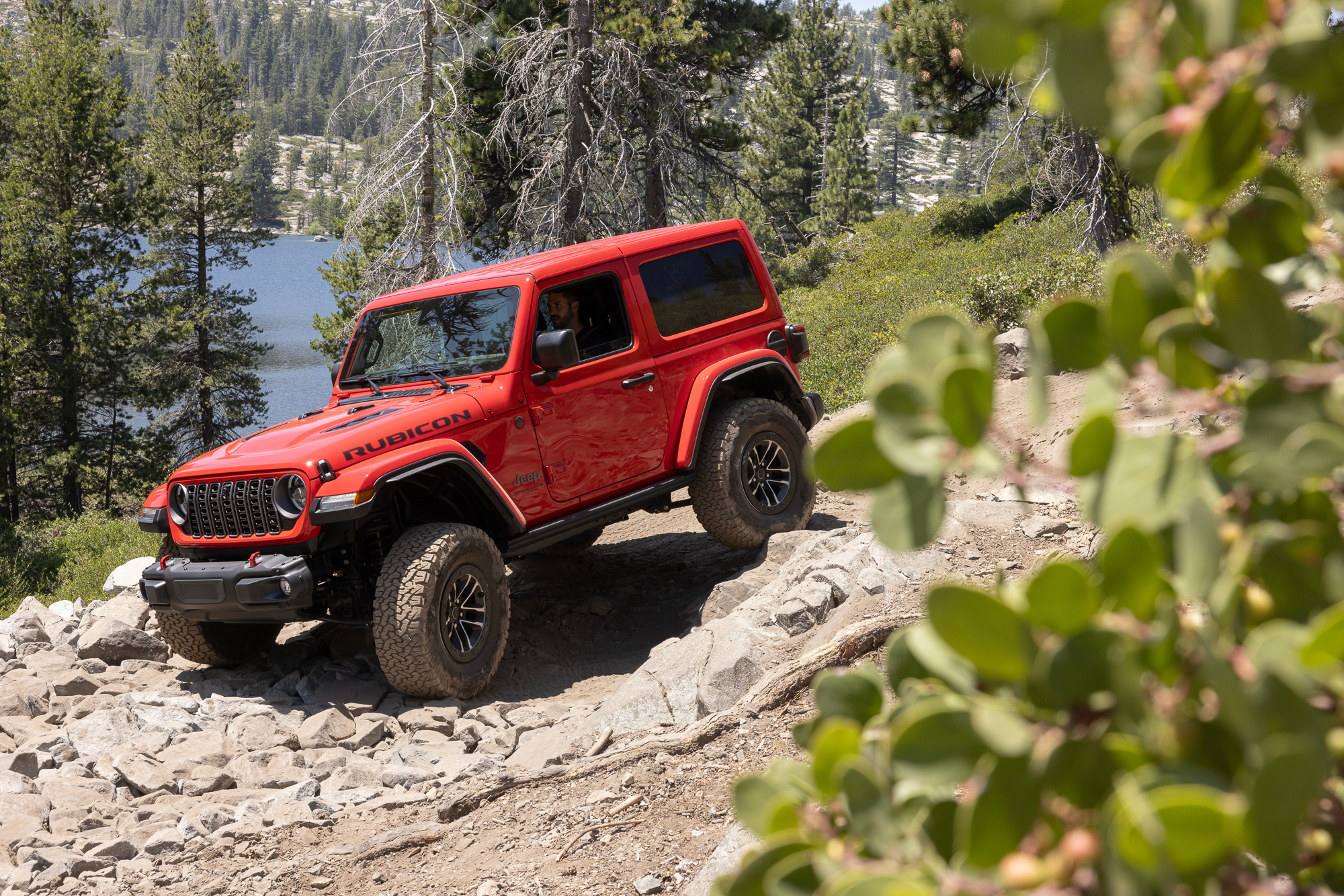
Backcountry views on the Rubicon Trail.
Legendary off-road specialist and Jeep Jamboree COO Ty Devereaux takes center stage as we all huddle intently to go through the paces for the day. We quickly learn that in a place as unforgiving as this, your ego is not your friend; in fact, Mother Nature is the great equalizer, pitting man against machine and both against hostile terrain. It’s clear that a few of the locals surrounding us might not heed the same advice, as I spotted a few crawlers where “Keep the rubber side down” does not apply. “Our intention is not to beat the vehicles up, but we are going to, period,” Devereaux asserts. “But we certainly want to keep that to a minimum, if possible. The number one thing out here is safety, and everywhere we go, we go ridiculously slow.” I later learn that there are a few fatalities on the trail each year, but Devereaux reassures all of us that those are usually caused by driving under the influence or foolishly not wearing a seatbelt.
I click mine in place before parroting Devereaux’s checklist to myself. On a motorcycle, I typically say a little prayer to whomever or whatever is up there to keep a watchful eye over. Once I say “Amen,” I turn off the sway bar so each wheel can move freely over rocks and boulders, check that I’m aired down to 20 PSI, and turn on the forward-facing camera, my second set of eyes for each spotter as the horizon disappears when the hood goes vertical.
As we slow our roll, trailing each other past a glistening Buck Island Lake, the Jeep wallowing as if atop a waterbed, I think to myself that while the Rubicon is famous for forging resilience in intrepid Jeepers and rock crawlers, it is, in essence, an overland trail. Families are out here. Kids are diving into the frigid alpine lakes while their uncles comb through their fly fishing gear, their wives waving and smiling as they dip their toes into the crystal rivers. I pass crowded group camps where Jeeps are adorned with every type of gear imaginable needed for a self-sufficient weekend away.
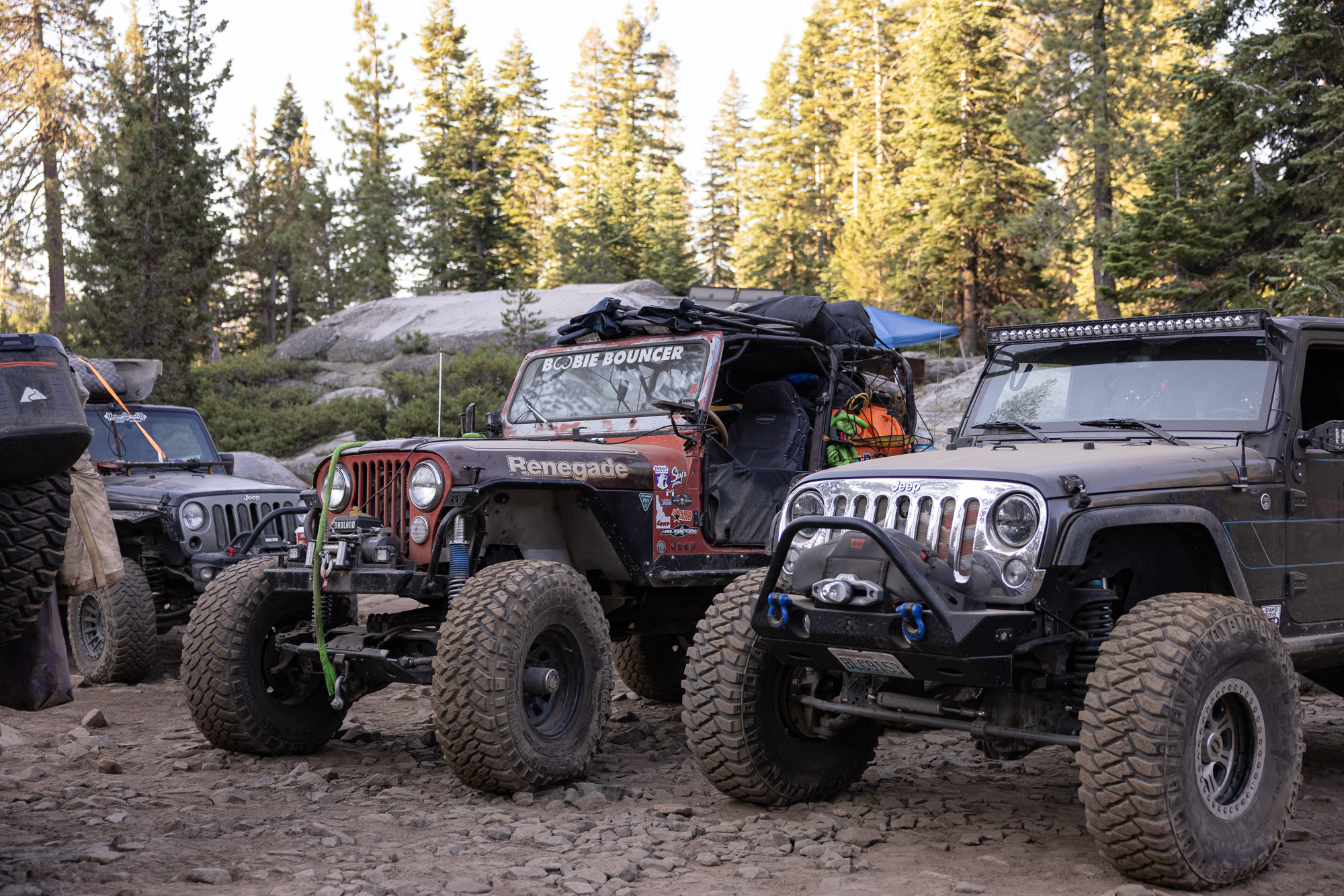
Over 200 drivers descend on the trail this time of year.
There’s no room for daydreaming on the Rubicon; one lapse and you’re metal on granite. But still, I can’t help thinking of that classic C.S. Lewis quote: “The further up and the further in you go, the bigger everything gets. The inside is larger than the outside.” I’m reminded of Umlauf and Devereaux’s lessons that it’s important to be overly cautious, not only to mitigate risk but to arrive at a place of appreciation where you have gone deep, both physically and spiritually.
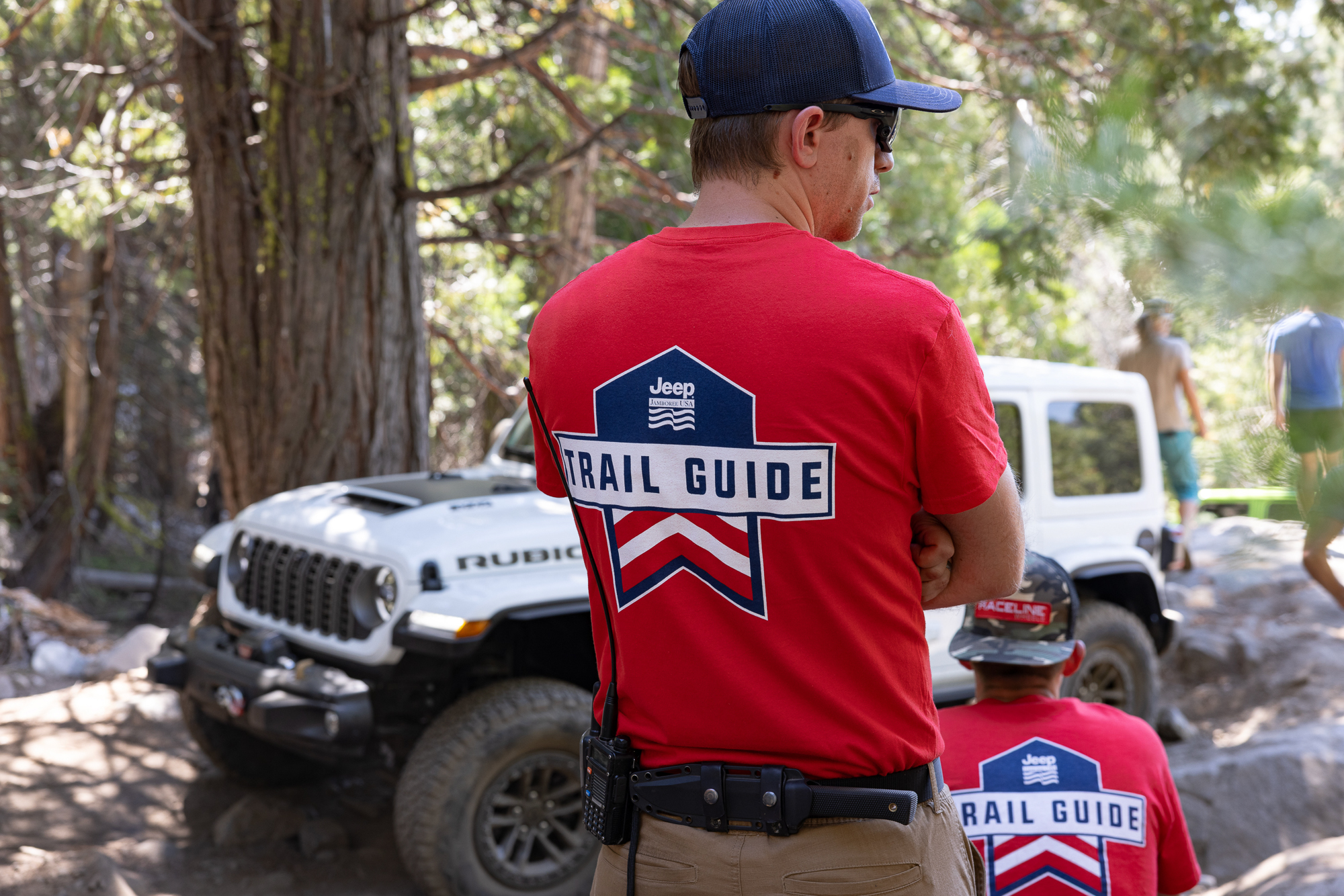
We leave the crowds and my thoughts behind as I start my descent into Big Sluice. It’s a feature that commands my full attention since we’re five miles in and camp is still two miles away. I look to trail guide Griffin Roper to mime the incremental changes I need to navigate my descent. Bam! There it is. The hard hit we were warned about, followed by a screech like those raptors in Jurassic Park. Gravity settles the Jeep into a natural position as I squint, feeling the pain vicariously for what I just put it through. I roll down the window, and Roper assures me it’s all good with a supportive thumbs up. “Gravity helps us down. You kind of just bounce your way down gracefully. Just walk your way through it,” he says with a validating smile.

“Gravity helps us down.”
It’s a vaguely familiar feeling since, during Covid, my wife and I took to the hills as our favorite social distancing activity, overlanding in our beautifully convenient local mountains. She’s also sat shotgun deep in Baja on surf trips, with me maxing out a safe speed to stay on top of the teeth-chattering washboard roads. As I bobble down Big Sluice, I think that maybe someday I can twist her arm to join me on the Rubicon as my bravery grows with each descent.
I spot Devereaux at the bottom of Big Sluice and roll down my window to ask about the most common problems newbies experience on this trail. “When it comes down to it, lacking confidence in themselves or lack of trust in the vehicle. And both are plenty capable. Not only the driver, but certainly the vehicle,” he says. I think I’m starting to get the hang of it, and the Jeep is right at home in this terrain.
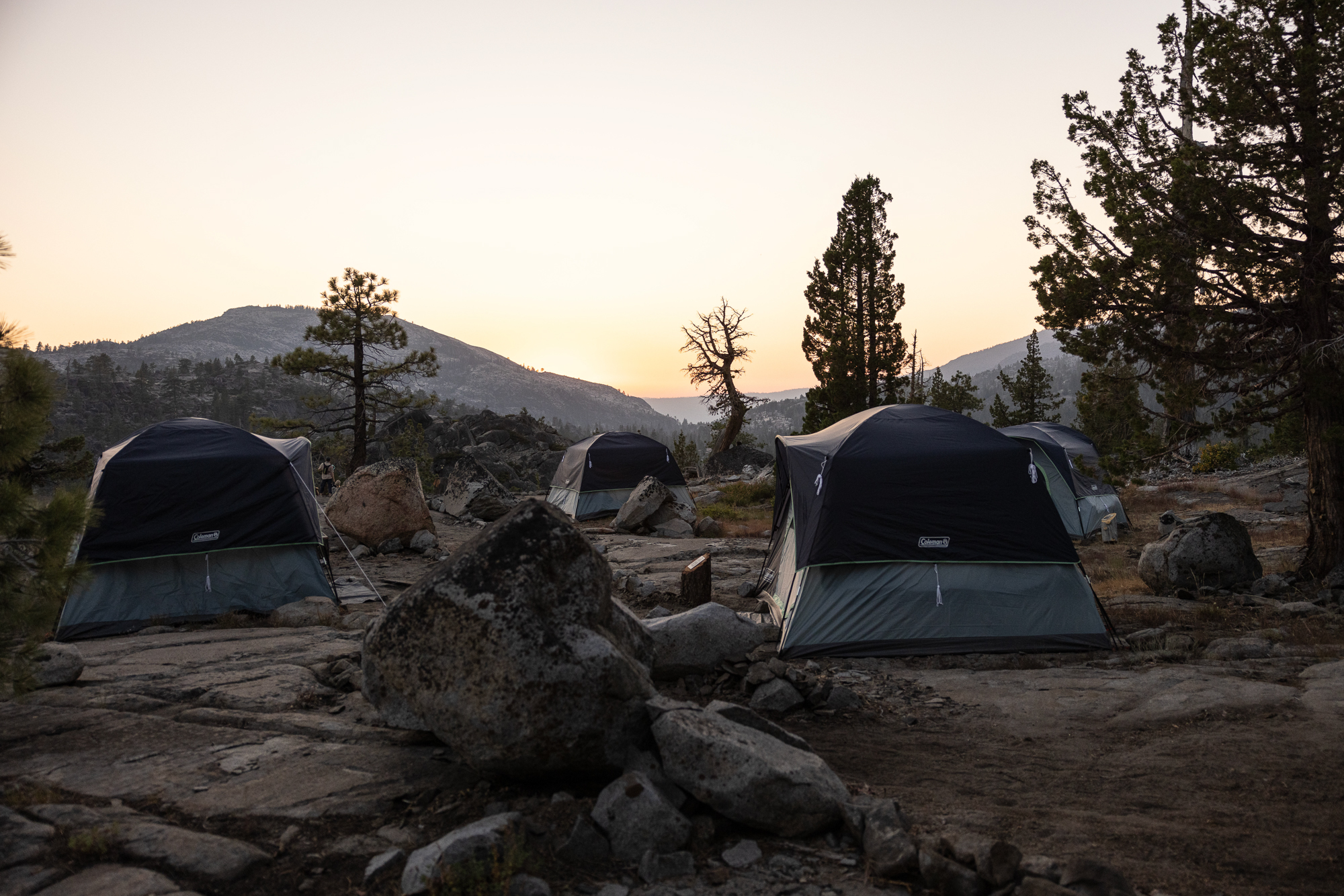
That afternoon, we rolled into Rubicon Springs, and it’s jumping. I envisioned a rough camp with similar bivouacs I had driven past earlier in the day, but I was quickly reminded that this gathering of enthusiasts was part of the famed Jeep Jamboree Umlauf and his team told us about. Surveying the crowd, everyone is all smiles despite their turbulent day, and there are even a few families gathered around the campfire scarfing down dinner. Umlauf and I find a quiet table to chat, so I can learn more about how these roamers and seekers are all united through the common connections of off-roading.

As we talk, I’m reminded of similar bonds forged off-road, like the time I snapped a chain deep in the Sequoia National Forest, and my friend towed me all day to camp. Or another instance where I grazed a tree at speed, opening up my finger to the bone, only to have five friends stabilize me while another friend gave me seven staples. I share those stories, and Umlauf nods with approval. “People are willing to take the shirt off their back for you to help somebody else,” he says. “And I think that we miss that in this day and age; we miss the basic dignity of just being a human. That’s what I see, whether it’s overlanding or the off-roading community. When you see someone in trouble, you ask: “How can I help you? I got an extra part. I got an air compressor. I got whatever it is. And there’s this kind of goodness.” I think of the families around the fire and how their time on the trail likely shows these values in action, especially to kids who soak up every single aspect of this experience, something you can’t mimic in a video game.
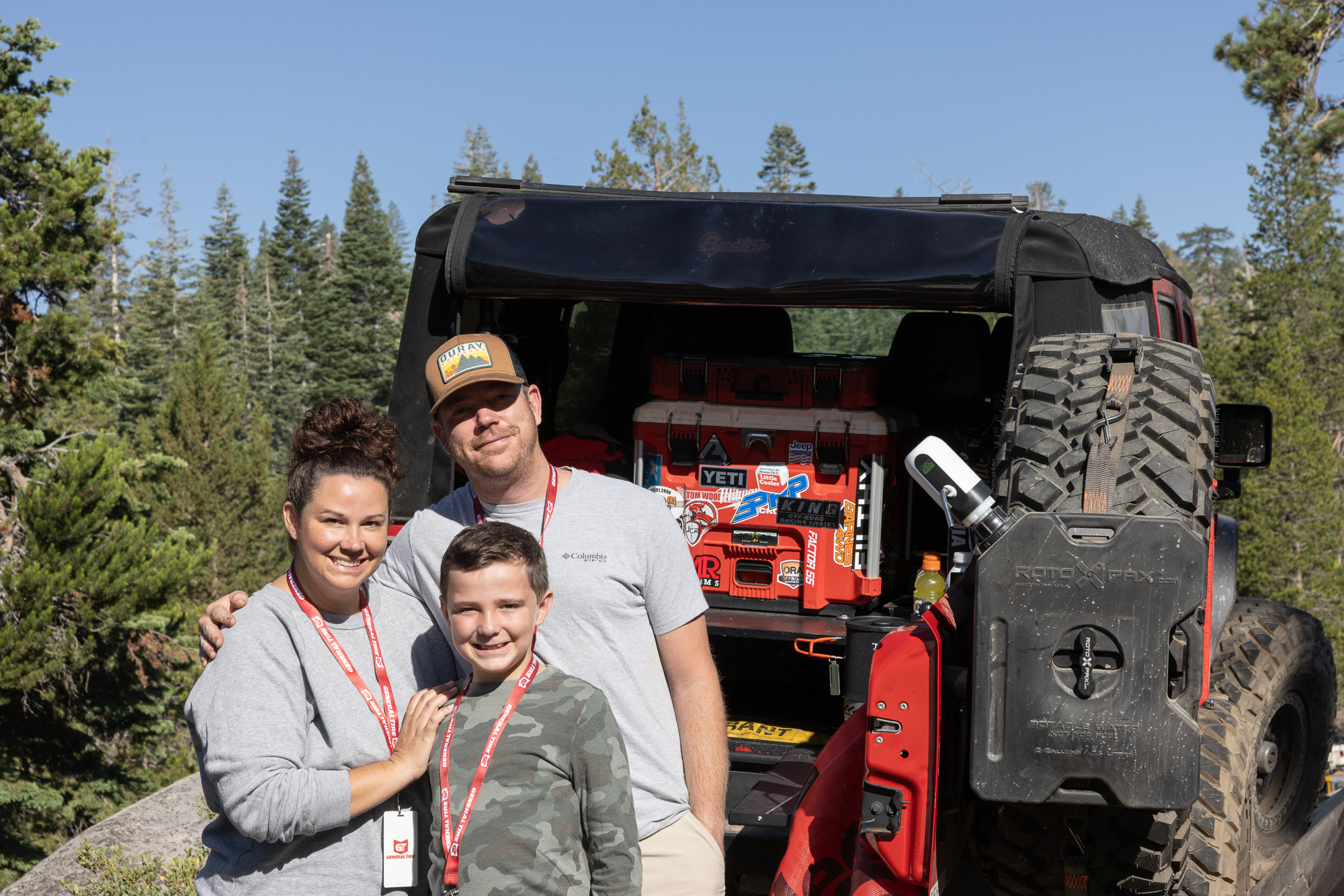
The next morning at breakfast, I meet an enthusiastic and confident nine-year-old overlander named Brandon Clark who was relishing in the spread with his mom and dad. I get his parents’ permission to interview him, and he lights up when I ask how many Jeep Jamborees he’s attended. “It’s my fourth one and second year!” he says. “My dad got the Jeep we’re driving six weeks before I was born, and we’ve been building it [together] for three years.” Clark and his parents made the trek from Destin, Florida, joined by his grandfather, making this a multi-generational adventure.
“We completely redid the whole Jeep. I taught him how to weld on it. He welded everything together, tacked everything together for me,” his father, Britt Clark, shares. I remember Umlauf telling me that he witnessed an explosion in family Jeeping when the four-door Wrangler Rubicons came out, and here I was witnessing this firsthand before we all hit the trail to head off in different directions.
After stopping to take a quick portrait of the Clark family, I reflect on how many memories were crammed into just two days, from the anxious energy I felt during Umlauf’s hair-raising trail brief to the new lens I now carry for overland challenges. Climbing back behind the wheel of a four-door Wrangler Rubicon on our final day, I feel more grounded, more confident. Together, our group engages front and rear lockers and tackles Cadillac Hill with ease, minus a few expected dings on the undercarriage.
As we make our way back to the staging area, I realize the Rubicon isn’t just a trail, it’s a proving ground for patience, trust, and the kind of quiet resilience that sticks with you long after the dust settles. I came here chasing the thrill, but I’m leaving with something better, a deeper perspective on the bond that off-roading builds between driver and machine, between strangers, and especially between families.
Our No Compromise Clause: We do not accept advertorial content or allow advertising to influence our coverage, and our contributors are guaranteed editorial independence. Overland International may earn a small commission from affiliate links included in this article. We appreciate your support.
