

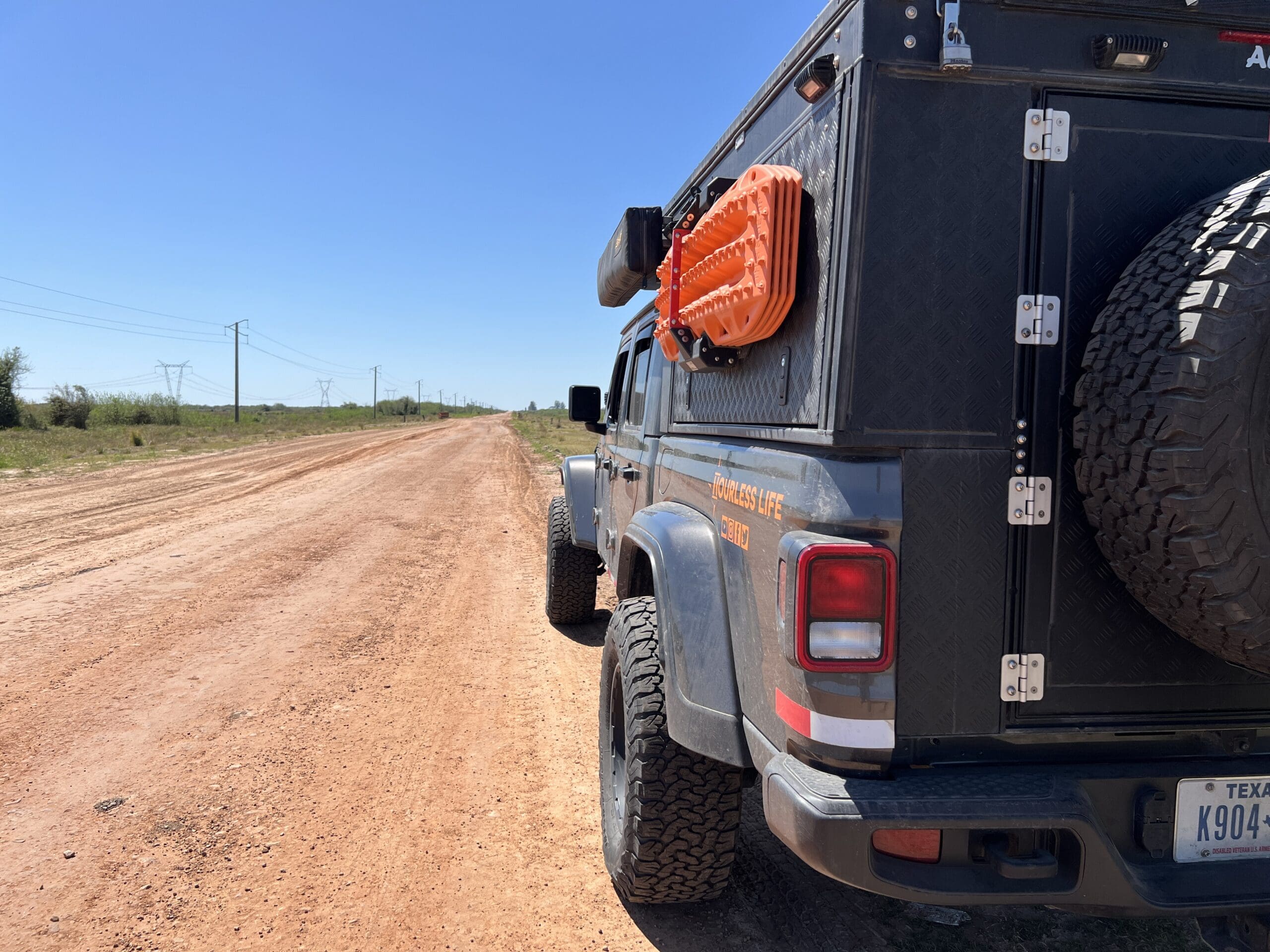
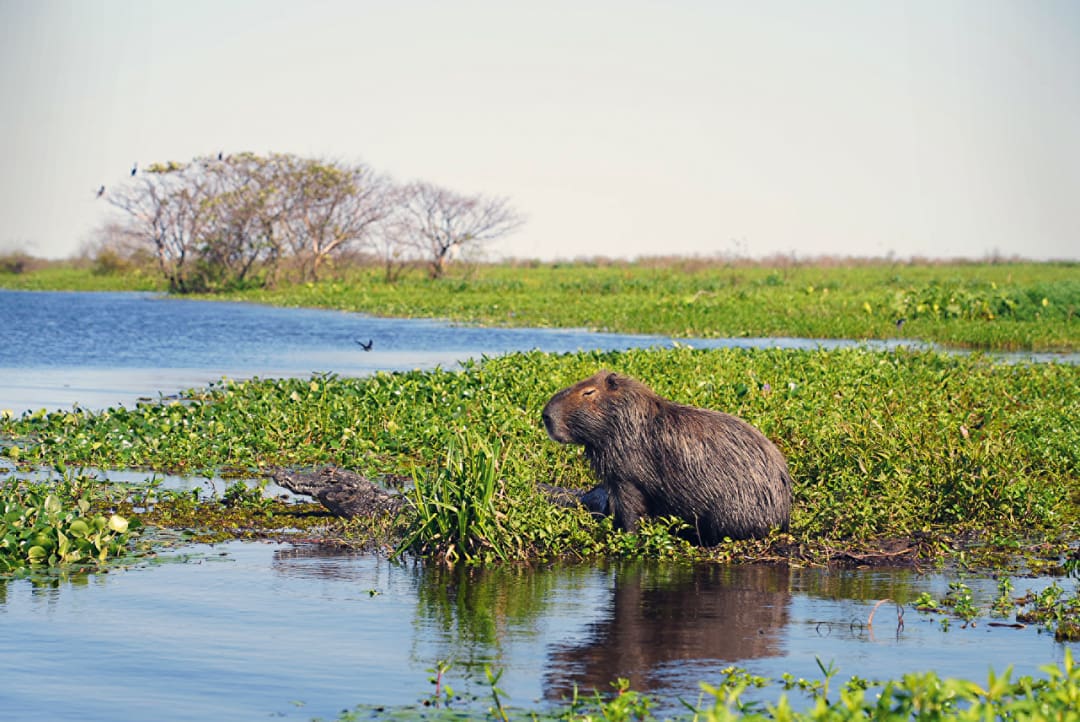
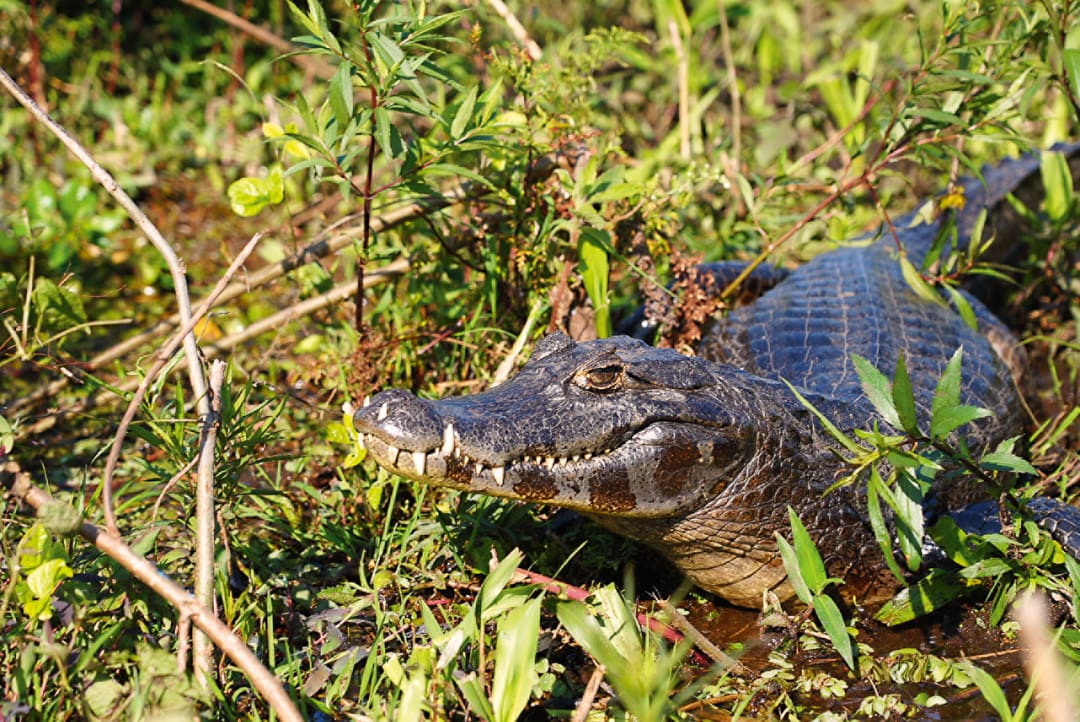
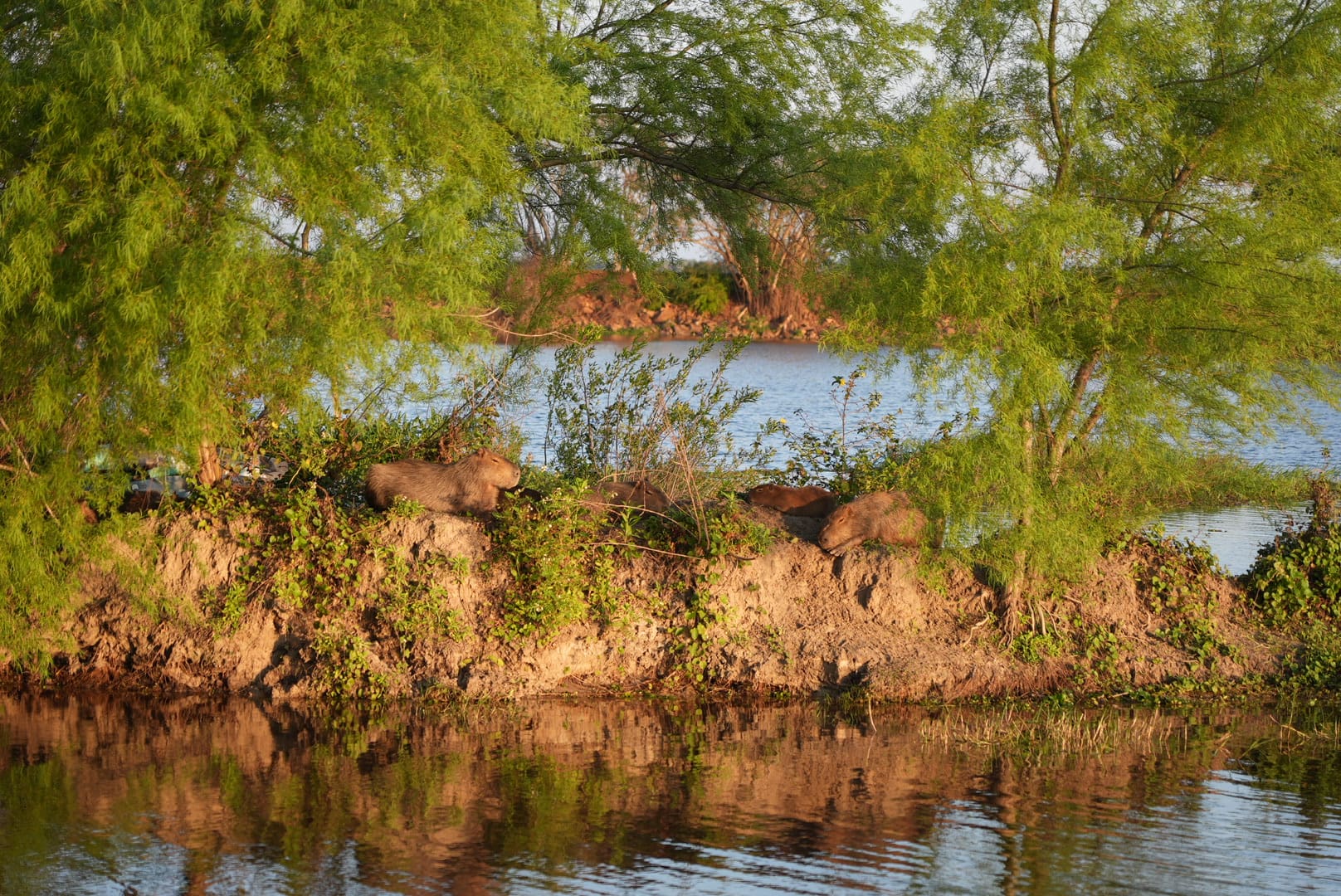
At the base of Argentina’s northeastern thumb of land, landlocked on two sides by Paraguay and Brazil, lies one of the largest wetlands in the world. Iberá National Park is co-located with Iberá Provincial Park, a combined two million acres of protected homeland for an array of earth, water, and sky creatures. From your camp’s front yard, you may see caiman, capybara, and countless birds—likely all at the same time.
In fact, Iberá is less than a 12-hour drive from Montevideo, Uruguay’s port, which is utilized by most South American overlanders at some point. And for those pointed north toward the astonishing Iguazú Falls, I suggest these wetlands are a required detour.
Camp on the shore of the laguna with amenities or in the wild on your own. See the glinting environment by boat, horseback, or kayak, or opt for any number of self-guided hikes through the park. Wherever you go, your wildlife encounters are sure to be among the most memorable of your travels across the Americas.
General Information: Iberá Park
Taken together, Iberá National Park and Iberá Provincial Park are known as Iberá Park. The name originates from the Indigenous Guaraní language: y berá means “shining waters.” The rewilding methods of the Tompkins Conservation foundation are on full display in this region. For those not familiar, after founding the outdoor brand The North Face, Doug Tompkins went on to work with his wife, Kris, to conserve vast tracts of land across Argentina and Chile. Though Doug passed away in 2015 after an accident, Kris has continued their shared mission.
Really, what Tompkins Conservation accomplishes is greater than conservation. Often, the lands purchased have been impacted by cattle ranching, agricultural use, or hunting. In some cases, there doesn’t seem to be much left to conserve. More accurately, the foundation is rewilding—restoring the land to its natural state, reintroducing species that belong there, and donating the burnished treasure to the Chilean or Argentinian governments as national park land.
Only two weeks after laying Doug to rest, Kris finally reached an agreement to protect the Iberá wetlands. Iberá National Park was officially established in 2018 and is today surrounded by additional safeguarded land, creating the largest protected area in Argentina. This ecosystem features open water, marshland, forest, and grassland. According to Tompkins Conservation, 4,000 species of flora and fauna live in Iberá, representing 30 percent of known species in Argentina.
The ultimate goal of species reintroduction is for the population to grow without human intervention, with animal births exceeding deaths. Giant otters (formerly extinct in Argentina), collared peccaries, giant anteaters, pampas deer, and red-and-green macaws have been reintroduced in Iberá. One of the most ambitious projects has been the reintroduction of the jaguar, an important predator for the balance of the ecosystem.
The Drive
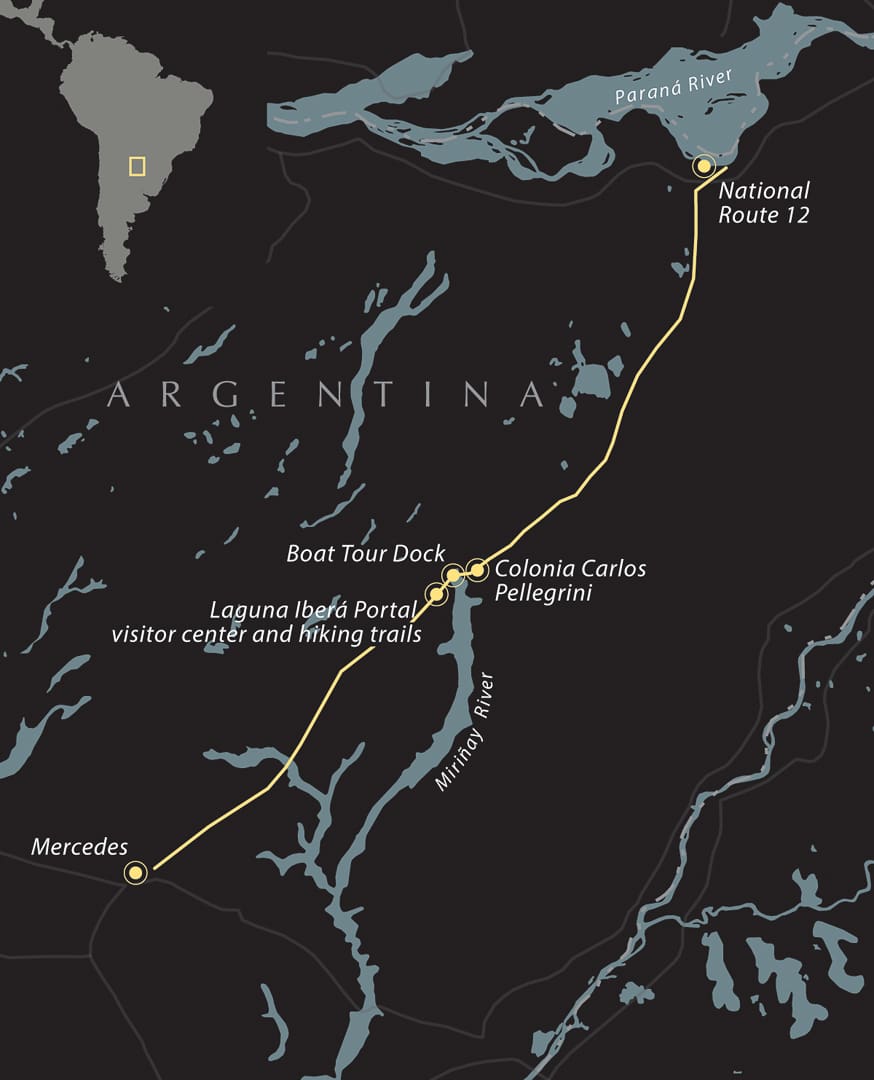
Access Iberá Park going north from the town of Mercedes on Provincial Route (RP)40 or by coming south from Puerto Valle on RP41. Before embarking on the 255-kilometer stretch between the two (much of it unpaved), stock up on fuel and groceries. While Mercedes has several fuel stations, including YPF and Shell, there is no fuel in Puerto Valle. It will be 285-310 kilometers total, not including detours, before you reach fuel again in Ituzaingó or Posadas.
Fifty kilometers after Mercedes, where the paved road ends, you may choose to air down your tires for a more comfortable drive. While the dirt road is fairly tame when dry, it can be rough and rutted. After rain, when the road is wet, aired-down tires are little help. But we’ll get to that.
Much of the 119 kilometers to Colonia Carlos Pellegrini, the primary access point for Iberá Park, is through grassy grazing land. This contrast intensifies the brilliance and importance of the protected, restored land once you arrive at the park. Even so, groups of capybaras begin to appear beside the road, encouraging motorists to slow down and observe.
There is a visitor center on the left side of the road, just before Puente Estero del Iberá, the long bridge stretching across the laguna. Stop to register and pay the park fee. Capybaras roam the parking lot and around buildings like grazing sheep, with complete disregard for everything around them. Friendly employees can answer questions about park activities and camping, and supply a map. There are guidebooks provided in a side room to help you identify local bird and animal species.
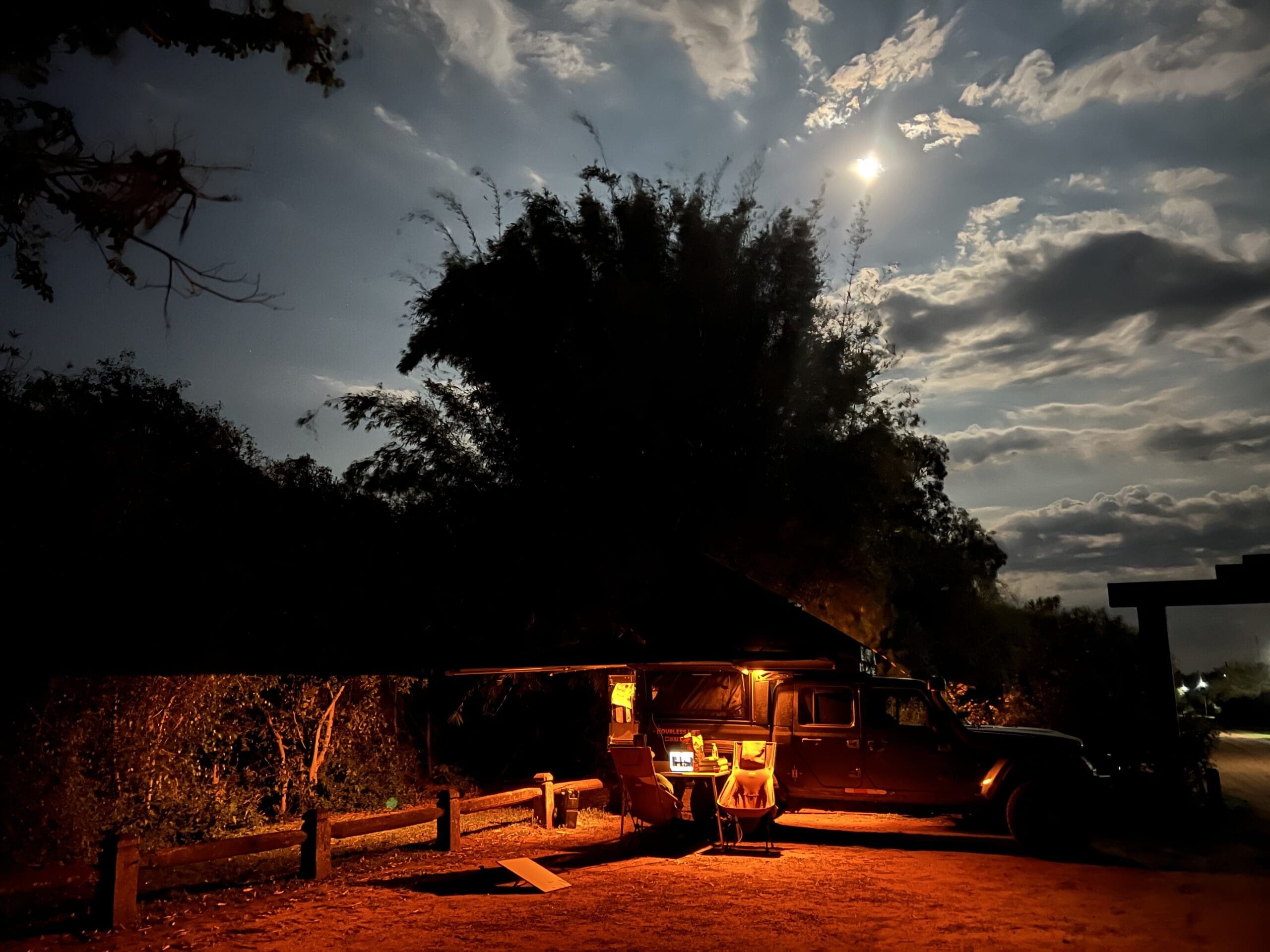
You can choose from several informal campsites along RP40 and RP41, mostly roadside pull-offs. Many visitors want to cross the bridge to camp in or near Carlos Pellegrini, allowing easy access to recreational activities. Camping Camba Cua is a private campground with a large, grassy area, while Camping Municipal Carlos Pellegrini is located right on the water where the boat tours depart. The latter is small and popular, and may be full when you arrive. We were able to camp in the overflow area, essentially a parking space, until a spot opened up. Oversized vehicles over 3 meters tall cannot enter through the gate, but they are sometimes permitted to camp outside, depending on which employee is working that day.
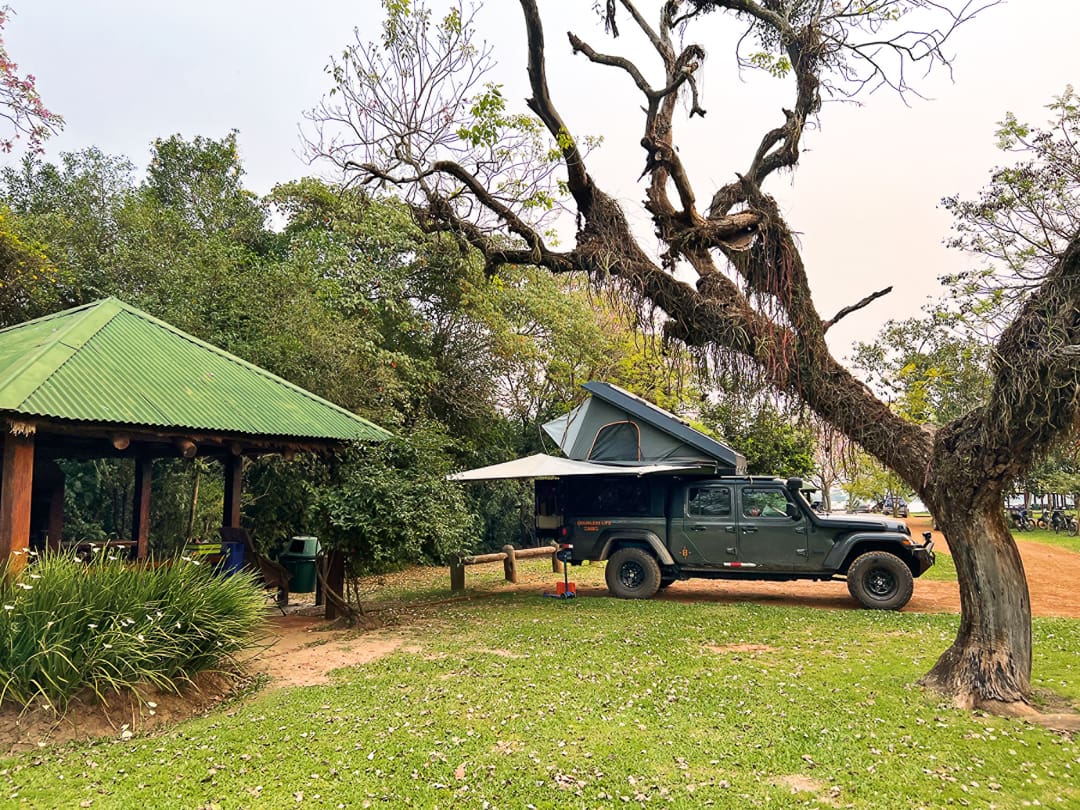
There are many ways to immerse yourself in the biodiversity of Iberá Park, including by horseback or kayak. As I mentioned, you can book a boat tour from the municipal campground office, sometimes for later the same day or more often for the following day. Tours typically last two hours, and it was the highlight of our visit. A Spanish-speaking guide took our group of five across the laguna and into the marshes, where we saw capybaras, male and female marsh deer, southern screamers with nesting young, the exotic-looking maguari stork, and came within a meter of a 20-year-old, piranha-fueled caiman.
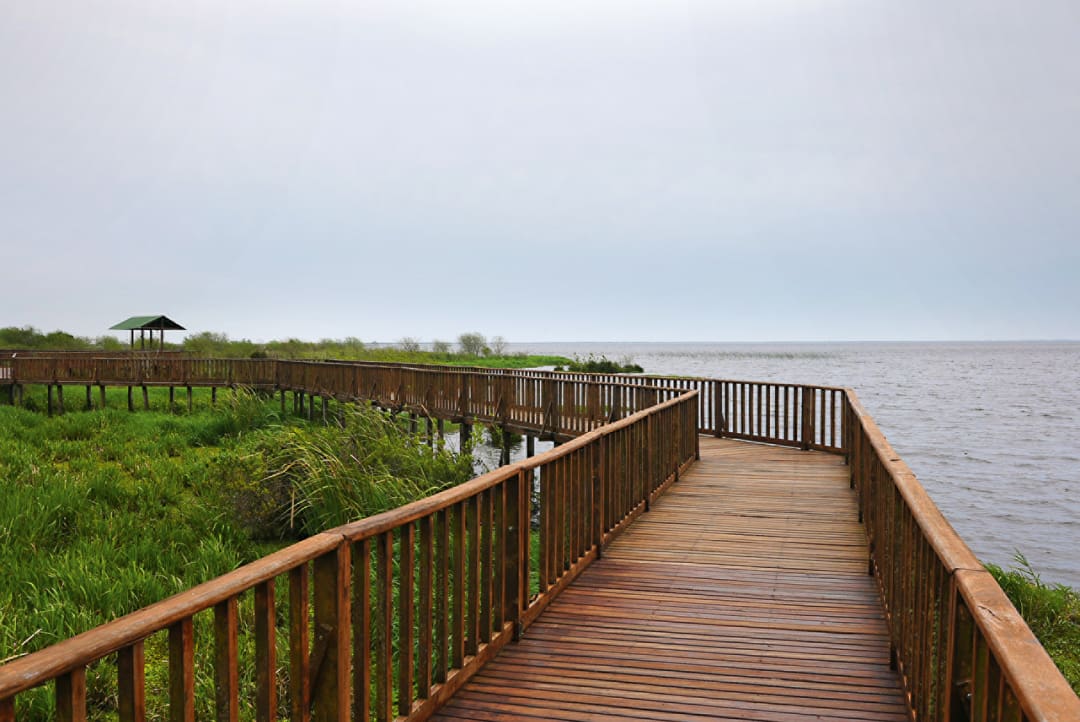
What surprised me most was how many species I spotted in Iberá Park without even trying. At one point, I was relaxing outside our Jeep and counted seven different bird species within a 5-foot radius. Egrets, kingfishers, red ovenbirds, and woodpeckers graced the landscape, plus many others I couldn’t identify as an uninitiated birder. From the municipal campground, it’s a two-kilometer walk back across the bridge to the visitor center. A network of walking trails threads through the area, beginning with a boardwalk along the laguna where aquatic plants create a marshy patchwork, then leading into dense foliage reminiscent of equatorial latitudes. I wasn’t expecting to see much wildlife with the number of hikers around. But once again, I was surprised and delighted. In addition to more caiman and marsh deer, including a fuzzy fawn, I had my first confrontation with the gray brocket deer, a slight animal with rod-straight, pointed horns. Traveling with a young child, we don’t always get as remote as other travelers. For me, Iberá Park was the fulfillment of so many wild dreams, and I cherished every moment.
Colonia Carlos Pellegrini is sleepy, its dirt roads laid out in a careful grid. The shops are small with unreliable stock, as everything must be transported in by the same dusty way you arrived. In one store, we received our change in the form of a wrapped candy. We enjoyed lunch at Yacaru Pora, a local restaurant, with pechuga con ananá (chicken with pineapple) and bife encebollado (steak with onions). Under the midday sun, this shaded spot served as an oasis. While the town does not have a proper fuel station, gasoline is rumored to be available for motorcyclists if you ask around.
The exit route north to Puerto Valle is similar to the southern stretch, with the addition of tree stands across the landscape. Our journey was treacherous after a heavy thunderstorm. Local knowledge dictates drivers should wait two or three days after a rain to attempt to drive out of Colonia Carlos Pellegrini. Having passed an Audi sedan on our journey north, we assumed the two-day recommendation was for them rather than our equipped 4×4, and we left after one day. We were mistaken. In several long stretches, we lost traction in deep, viscous mud and very nearly slid off the track. Though we didn’t get stuck, it was close. The threat of rain is another reason to make sure you’re well-supplied with groceries before undertaking this trip.
Access
From Mercedes Travel north 119 kilometers on RP40 to Colonia Carlos Pellegrini. Though it looks rickety, Puente Estero del Iberá has a load rating of 20 tons.
From Puerto Valle Travel west to RP41, then south 138 kilometers on RP41 and RP40. Provincial Highway 41 dead-ends into RP40, where you will turn right and continue to Colonia Carlos Pellegrini.
Do not attempt the route if it has rained in the past two days. If you are already in Colonia Carlos Pellegrini when it rains, then consult local officials for their expertise.
Logistics
Total distance 255 kilometers
Suggested time 3-5 nights
Longest distance without fuel 285-310 kilometers
Fuel Sources
Mercedes 29° 11’3.072” S, 58° 4’50.545” W
Posadas 27° 24’28.395” S, 55° 58’27.969” W
Ituzaingó 27° 36’19.093” S, 56° 41’4.224” W
Difficulty (1.0 out of 5.0)
The road is corrugated dirt and can be negotiated without high clearance or 4×4 capability when dry. When wet, mud makes for a treacherous drive for even the most capable vehicle.
When to Go
September through November are best due to milder temperatures and lower rainfall. December to February is the hottest and most humid, while rain is heaviest from March to May. The winter months of June to August are the coldest.
Permits and Fees
Register at Laguna Iberá Portal’s visitor center, currently 30,000 pesos per adult (non-Argentinian) and 15,000 pesos for children 6-16. Six and under are free. Credit cards are accepted, and the pass is good for five days.
Two-hour boat tour, 30,000 pesos per adult. Credit cards accepted.
Suggested Campsites
Camping Municipal Carlos Pellegrini
Five vehicle campsites plus overflow, located right on the water where boats depart, 41,000 pesos per night, tent-friendly, electricity at sites, water available, toilets and hot showers (limited hours)
28° 32’16.49” S, 57° 11’11.679” W
Camping Camba Cua
Private campground with many campsites and a large grassy area, 13,000 pesos/person plus 18,000 pesos per vehicle, tent-friendly, electricity available, toilets and hot showers, located inland
28° 32’1.721” S, 57° 10’50.282” W
Resources
Iberá Park parqueibera.gob.ar
Tompkins Conservation tompkinsconservation.org/explore/ibera-national-park/
It is recommended that the traveler utilize redundant GPS devices (like a phone and a dedicated GPS), along with paper maps and a compass. This track, along with all other Overland Routes, can be downloaded on our website at overlandjournal.com/overland-routes/.
27 Overland Route descriptions are intended to be an overview of the trail rather than turn-by-turn instructions. We suggest you download an offline navigation app and our GPSX track, as well as source detailed paper maps as an analog backup. As with any remote travel, circumstances can change dramatically. Drivers should check road conditions with local authorities before attempting the route and be ready to turn back should extreme conditions occur.
Editor’s Note: This article was originally published in Overland Journal’s Summer 2026 Issue.
Our No Compromise Clause: We do not accept advertorial content or allow advertising to influence our coverage, and our contributors are guaranteed editorial independence. Overland Collective may earn a small commission from affiliate links included in this article. We appreciate your support.
