
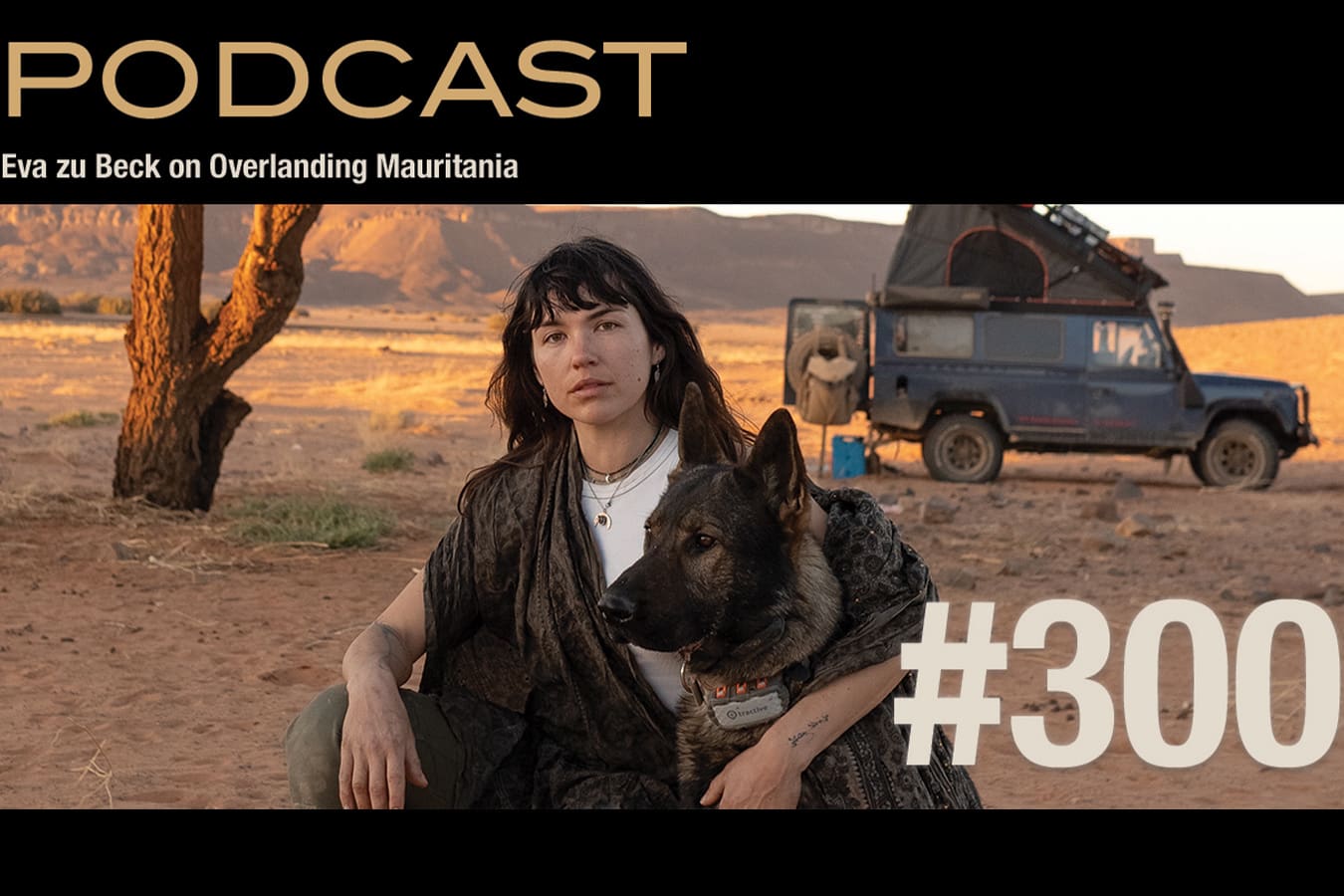
Overland Journal Podcast host Ashley Giordano welcomes adventurer, storyteller, author, and National Geographic Host and Director Eva zu Beck to discuss Eva’s recent overland trip to Morocco and Mauritania in her Land Rover Defender 110. In this episode, Eva shares more about the inspiration behind her National Geographic SuperSkilled series, and how, in life and in travel, it truly is about the journey rather than the destination.
Overland Journal Podcast Episode #300
The Overland Journal Podcast is brought to you this week by Overland Journal Magazine
New to Overland Journal and want to grab a subscription! Visit Overland Journal and enter code: overlandpodcast at checkout for 20% off. We thank you for being a subscriber.
Bio:
Eva zu Beck
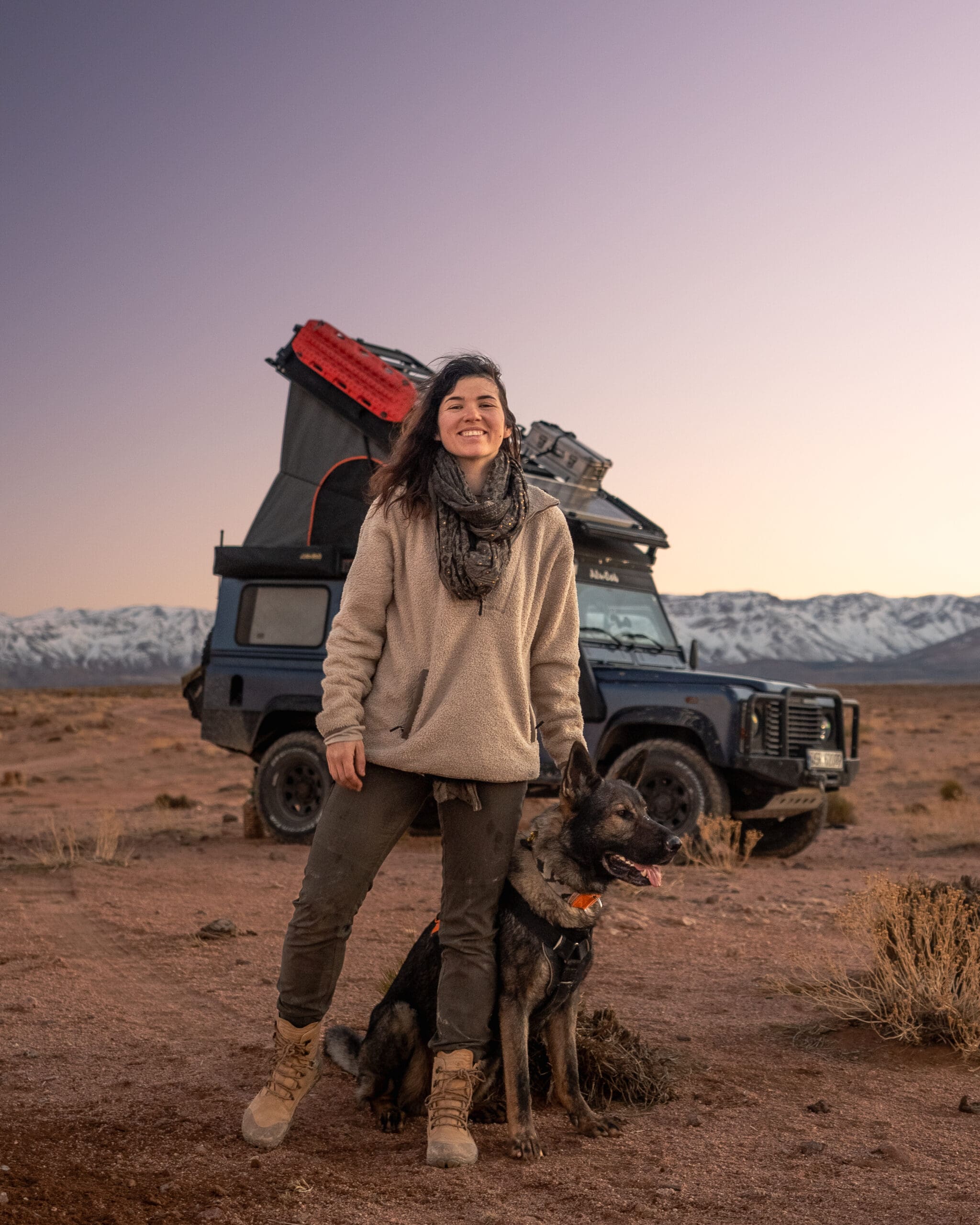
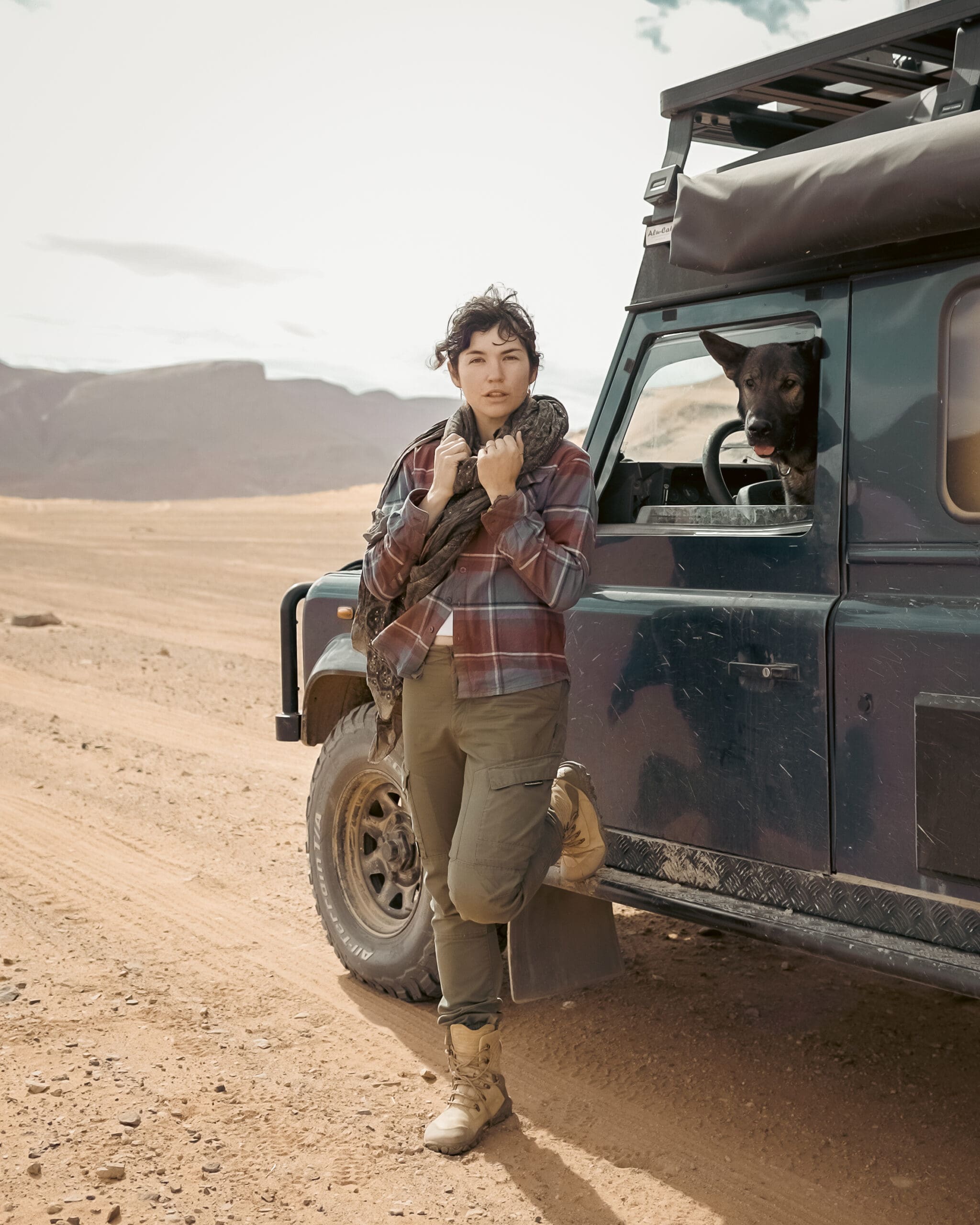
Eva zu Beck is one of the world’s leading female adventure YouTubers, with 4 million followers and a reputation for bold, authentic travel storytelling. She has run ultra marathons in remote corners of the world and embarked on solo overland expeditions with her dog Vilk, inspiring millions to live free and adventurous lives. Alongside her YouTube and Instagram channels, Eva is the host and director of her own National Geographic show, Superskilled.
Website | Instagram | YouTube | The Wilder Way | Polarsteps: Expedition Sahara | Feature Vehicle: Eva zu Beck’s 2006 Land Rover Defender 110
Host Bio:
Ashley Giordano
Ashley Giordano’s first foray into overland travel involved a 48,800-kilometer journey from Canada to Argentina with her husband, Richard, in their well-loved but antiquated 1990 Toyota Pickup. Currently cruising along the iconic Silk Road in a 2008 Toyota Tundra, her full-time navigator duties are rewarded with bowls of plov and lagman noodles, hikes in the Tian Shan, and countless cups of fragrant Tashkent tea. As senior editor at Overland Journal, you can usually find Ashley buried in a pile of travel books, poring over maps, or writing about the unsung women of overlanding history, including her enduring inspiration, Barbara Toy. @desktoglory_ash
Tune in Apple Podcasts | Spotify | YouTube
Transcript:
Ashley Giordano: [00:00:00] Hello, and welcome to the OVERLAND JOURNAL podcast. I’m your host, Ashley Giordano, and I’m joined today by Eva zu Beck to chat all about her recent travels in Morocco and Mauritania in her Land Rover Defender, her new book, The Wilder Way, and about her National Geographic series, Super Skilled. Now, this is podcast number 300 for us.
It’s incredible to believe we’ve done 300 episodes. The podcast began in fall of 2019, and it has been an absolute joy to connect with so many folks about all things overlanding. Scott, Matt, and I enjoy the interviews that we do, and we most enjoy sharing all of this knowledge and these experiences with you.
So thank you for being a listener. And of course, we’re especially thankful for Paula Burr, our producer, for all of her tireless work in helping to bring these things to production. Thanks for coming along for the ride, and we’ll see you after another hundred. And today we have [00:01:00] adventurer, YouTube storyteller, speaker and writer, and National Geographic host and director, Eva zu Beck with us.
Welcome. Yay. I’m so stoked to have you back.
Eva zu Beck: Yes. I’m so happy to be here. I, I was just thinking how amazing it is that I can be in my shepherd’s hut in the Carpathians in Poland, you can be in Kyrgyzstan, and we have the ability to talk over the internet, over the Starlink. Isn’t that just amazing?
Ashley Giordano: It still blows my mind.
Even though it’s been- Yeah … a few years now, I’m still like, “
Eva zu Beck: Wow.”
Ashley Giordano: Yeah. It’s incred- incredible. Incredible stuff. You look very cozy. I’m loving the cabin and the lights- Yeah … and everything. So yeah, thanks for taking the time out of your schedule to chat with me, and I’m excited because this is your second time on the podcast.
Yeah. And so we have some different things to chat about this time.
Eva zu Beck: Pleasure
Ashley Giordano: So I wanna talk about your Nat Geo series, it’s called “Super Skilled,” uh, your new book. But first- … let’s [00:02:00] dive into your recent overland trip through Morocco and Mauritania with your Defender 110. Uh, what was the- Yeah … vision for the trip when you were thinking about it ahead of time?
Eva zu Beck: So, I mean, I’ve been living in Europe these last couple of years, and, you know, there’s a lot of great options for some amazing trips out of Europe, like long-distance trips. And for a while now, I had this, like, image in my head of being alone with my truck and my dog in the desert. I don’t know, it just haunted me, that image, you know?
In, like, a good way. Like, I just imagined the solitude and the silence and the kind of, like, mental reset that I could get from a trip like that after a very busy couple of years. So I was like, “Okay, where do I go?” And there was a couple of options, you know. I could’ve headed, um, east towards Saudi Arabia and, and the Middle East.
Um, thank God I didn’t go. I mean, for, it was a pretty bad time in the end, at the end of [00:03:00] this winter to go there. Um, but the other option was to head south to the Sahara. And as soon as I thought, “Okay, the Sahara,” that name just started, like, ringing in my head. So I started doing a little bit of research around, where I could go, um, where it might be difficult to go, and yeah, decided to just scout it out this year.
Do an easier kind of trip, um, see what it’s like out there for a solo female traveler with a dog, and that’s why I decided to go to Morocco and Mauritania, and really kind of get off the beaten path in, in those countries. You know, a lot of people go to Morocco from Europe. There’s a lot of camper vans.
It’s kind of like our version of Baja California in a way. So if you stick to the tarmac roads, it’s pretty boring. It’s pretty uneventful. Um, but I was like, “Okay, I’m gonna avoid tarmac as much as possible and stick to the dirt.” So, uh, my goal was to do as much dirt as possible, as much driving through the [00:04:00] desert as possible, and wild camping and just being out there in places where nobody el- where nobody else was.
So that’s kind of what happened. Ended up going deep into Mauritania, where it was just, it felt like it was just me out there in some places, you know, without seeing anyone for a couple of days. What an amazing feeling that is. So that was kind of the thinking, to be alone in silence,
Ashley Giordano: I love that.
Yeah. And, um, you had been to Mauritania before on the iron ore train. Mm-hmm. How different was this trip from that experience? I’m sure it’s-
…
Ashley Giordano: Quite different, but…
Eva zu Beck: Yeah, I think when we travel overland, it is always a very different kind of experience, you know? Um, a few years back, I went to Mauritania for the first time, and yeah, I got to ride the iron ore train through the desert, which was so fun and so messy, and we got to hang out with some of the nomads living in the desert there as well.
But I felt like going there with the car this time [00:05:00] was … I, I saw a completely different country in so many ways because I had access to places that I didn’t have access to before, you know, with a guide or via, like in a minibus. I was, this time I was there with my pretty capable truck, and so it felt like it had just opened up all of these opportunities.
I was able to reach desert oasis that I didn’t even know existed, that weren’t even marked on Google Maps, you know, that I had just simply spotted by scrolling through Google Maps on, you know, the satellite maps. I got to drive across landscapes that I didn’t even know that there were roads there, because again, there were no roads that you could, there were no roads marked for those places on Google Maps.
So it’s amazing the kind of freedom that you have when you have your own vehicle that can go anywhere, maybe not very fast, but it can go anywhere. And you’re able to create that route that completely independently, uh, and make it your own. [00:06:00] So I, I just completely fell in love with, um, Mauritania this time around.
I, as it’s just one of the most amazing places, um, and I really wanna go back.
Ashley Giordano: So good. It’s fascinating when you go to a country you’ve been to before in a different way like that- Mm-hmm … and you learn so much more and can go deeper and, and find different things- Yeah … like that. Was this trip for you more of a reset, or was this work-related?
Did you go there to- Mm … get some space? You were talking about being away from people and being in the silence and being solitary.
Eva zu Beck: Yeah, you know, it’s always a bit of a work trip for me because I’m always filming. It’s, it’s never like just for pleasure. I’m not sure if I could even do that at this point.
I would just feel like, like, “Oh my God, where’s my camera? I need to hit record.”
Ashley Giordano: Can relate. But, uh- Can relate …
Eva zu Beck: yeah. Um, but it was definitely, I think it was a bit more challenging actually than I had expected it to be. Um, [00:07:00] again, I just came with this image in my head of, you know, of the silence and the solitude and things going well.
I always try to picture things going well because what’s the point of picturing things going badly? You know that they probably will at some point, and obviously you wanna come ready, but I don’t wanna preoccupy my mind with things going badly in advance. Why worry in advance? But I guess that also led to me underestimating some of the challenges that I would encounter, you know?
So it didn’t fully allow me to reset. Like for example, the fact that my truck did break down several times in the desert, and these were not like… There was only one breakdown that was quite major. Most of them were minor things, but things that nevertheless required the presence of a mechanic to get them fixed You know, I’m, I’m one of those overlanders that do not have a great deal of mechanical skills.
I can do the basics, I can change a tire, um, I [00:08:00] can change the oil, like things like that I can do. But there’s, but the more kind of advanced stuff I’m honestly just not very good at. And, and, um, I figured that generally speaking, there’s always gonna be someone within a day’s travel radius that could probably help out.
And maybe perhaps that’s naive, but I feel like in a way it’s almost, it’s actually very realistic because even if you do have mechanical skills, you’re not always gonna have all the parts to fix your car. So you’re, you’re still probably gonna need some help at some point. So I guess there was, I mean, there was one part of the, of the route that I took that was, I would say probably like the most challenging out of the entire trip, and that was…
So you’ve got the iron ore train tracks in Mauritania. They kind of take you from, yeah, like deep in the Sahara all the way to the coast of Mauritania, and that’s where this really long train one of the longest trains in the world that transports [00:09:00] iron ore, that’s where it crosses. And these train tracks are almost like a straight line, basically.
Just kind of a straight line on a map. It looks quite funny when you look at it on maps. And you can take the train, some people take- hop on the train, which is a pretty hardcore experience, um, which I, yeah, did a few years back. And this time I was like, “Can I, I wonder if I can drive this track?” And as it turns out, you can.
You can actually drive alongside the train tracks, so you’re basically just keeping a little bit south of them, but you’re following the tracks all the way from the Sahara to the coast. And it’s a, so navigationally, it’s a pretty straightforward challenge. You just have to go west. But for many other reasons, it’s actually quite a difficult route because there’s sand dunes along the way.
There’s, there’s no actual track. A lot of the time it kinda splits off into various different directions, so you always have to make sure that you’re going the right, the correct way west. [00:10:00] There’s- I think, I believe it’s about 300 miles of no tarmac, just sand, and there’s only a couple of very, very, very small settlements en route, settlements that actually service the train.
So I decided to do this route after my truck had already broken down a couple of times, and I, I was kinda ready to go home, and I was like, I just… I could just go home on the tarmac road, or I could take this route as one final challenge, like one last hurrah. And so I did, and, uh, I was met by a, a pretty big sandstorm that lasted the entire three days that I was doing this track.
And there were points where I could not see anything, um, 10 meters ahead of me, where everything, the world just disappeared. It got engulfed by all this sand. And that’s also when I, uh, had another breakdown um, pretty much, very much in the middle of, of nowhere, but I was extremely, extremely lucky that there was a [00:11:00] settlement that I had just passed a few minutes before.
So I kind of left this tiny little settlement, kept driving, and then I felt my truck lose power. I, you know, I pressed the gas pedal, nothing happened. It just lost power and then switched itself off. I’d never experienced that. No. My truck had never done that before. It literally just switched itself off.
That was it, and stopped. And yeah, um, I ended up kinda running back to that settlement with my dog and, you know, asking around for help. I found someone who had a truck, and then they knew a mechanic, and then, you know, 15 minutes later, this local village mechanic comes in a very old Series and, and drives up to me, and then for the next hour proceeds to check all the little wires, you know, under the bonnet, and eventually gets the truck started.
It’s been… And it’s, you know, it’s just moments like this where you’re like, you’re in the middle of the Sahara, and there’s someone there who could help you. It’s [00:12:00] incredible. Yeah, I probably wouldn’t, wouldn’t, uh, recommend this kind of approach. But yeah, it’s been, it was an amazing trip and definitely, yeah, a, a bit of a reset but also a, a little bit of a, travel anxiety I suppose.
That’s probably quite normal for overlanding, isn’t it?
Ashley Giordano: For sure. And good timing on your part that you were close to a village.
Eva zu Beck: Uh, many serendipitous moments like this. Uh, I call them travel magic, where you really have to believe that things will work out somehow, and I think this kind of, having this attitude also helps you find solutions to problems quickly, um, because you truly believe that, yeah, I’m, I am gonna get this sorted sooner or later.
So yeah, travel magic in the Sahara.
Ashley Giordano: Speaking of travel magic in the Sahara, what were some of the best moments of that trip?
Eva zu Beck: The best moments, gosh, I would have to say, I’m probably not gonna rank [00:13:00] them, so this is in any random order, but I think my top three would be finding this, like, hidden oasis in the middle of the desert.
There was nobody there. It wasn’t on Google Maps. Um, it genuinely felt like I was the only person in the world in this oasis, and I sat there for two days, and I couldn’t get away. I was like, “This is… I think this is what paradise would look like.” Waterfalls, greenery, palm trees, a massive blue-green pool, just astonishing.
That was probably one of the best. Another one was when I was hanging out with– So I was actually driving through, m- again, a pretty rough kind of off-road track, and then these two ladies stopped me along the way, and I was like, “Where the– Where’d you come from?” And they were just hanging out there, and I got to chatting with them in, like, a mix of broken French and, and Arabic, and they were just two ladies who were literally sitting there by the side of the road waiting for, like, the [00:14:00] one or two cars that would pass by that route every day, and they were just selling things, all kinds of things, food, fruit, like local dresses.
And we had a bit of a chat, a bit of a laugh. Again, just a complete mix of languages, really more, like, gestures than words. And, um, yeah, just hanging out with them for, 15, 20 minutes was definitely one of the highlights. And then, gosh, I think the third would be every single night out there in the desert, every single night was so incredibly peaceful.
You would look out your rooftop tent, and there’s, you know, this amazing blanket of stars up in the sky, and I had some of the best sleep of my life out there in the Sahara. So yeah, that was so peaceful
Ashley Giordano: Ah, I love it. I wanna go. I love the desert too. Good. Those deserts, the desert sleeps there-
Eva zu Beck: Yeah …
Ashley Giordano: the best.
Eva zu Beck: You know what I’d really love to do though, [00:15:00] like having been there now, but I feel like I would need to level up my mechanical skills in order to do this other leg, would be to complete this Sahara leg by going, like taking the ferry from Europe to Tunisia, and then going into like Algeria, Libya, back into Algeria, and then into Mauritania, and then back up through Morocco.
That’s what I would love to do. That sounds like there’s so much there
Ashley Giordano: Same. I am stoked on that route, like 100%. Well- And we had Henriette, who has a motorcycle, and she’s done parts of that. We had her on the podcast recently, and wow, it just looks so incredible.
Eva zu Beck: Yeah. Yeah. She’s so badass, Henriette.
Highly recommend checking her out for anyone that doesn’t know her. She helped me find a route via Western Sahara, so we were in touch because she had done it already. And, you know, in, in Western Sahara, like most people just go straight line on the tarmac road from kind of Morocco to Mauritania. [00:16:00] But there is another route, um, that fewer people know about that’s…
Sorry, a route that’s more in the desert that takes you through a literal minefield. Sounds pretty gnarly, and it kind of is. But you can quite safely make your way through it because, you know, people do. There’s a military dirt road that leads through it. And so Henriette shared her GPX tracks with me, and I took her route, and it was marvelous.
So yeah she’s so badass.
Ashley Giordano: She is. She’s great. Mm-hmm. I loved following her trip and her, all her trips. Mm-hmm. But yeah, she’s very… You can see the joy in her face, and it’s so wonderful. And also, that’s great. You know, I live, also love sharing resources. And touching on that point, you have a Polar Steps journey that you kept track of- Mm
during this trip through Morocco and Mauritania. So that’s available- Yeah … for people if they’d like to follow along in your- Yeah … tire tracks as well.
Eva zu Beck: Yes. I didn’t publish the entire, like [00:17:00] every single meter, kilometer, and mile of, of the route, but I did publish all of my campsites. So every single campsite that I spent, like a night at, it’s all up there.
So you can see pictures, and you can see the exact GPS coordinates as well, which I think is, is quite a nice resource, especially for people who maybe are like, who wanna make the trip but are a little bit worried about it or anxious or just would rather see what it actually looks like in, in kind of in real life before.
I’ve also added some tips like is it four-by-four accessible, uh, sorry, non four-by-four accessible, which, yeah, most places are only four by four. Um, is there cell signal? You know, things like that. So hopefully that’ll be of, of use to people.
Ashley Giordano: Travel inspiration. We’ll include the link in the show notes as well.
Great. So thank you for sharing that with us. I’m wondering also in terms of planning ahead of time, did you do quite a bit of planning, a little bit? Did you reach out to folks? How did you put this trip together?
Eva zu Beck: Yeah, I’m, you know, I’m one of those people who [00:18:00] don’t plan very much. I’m not a major planner.
I don’t like planning. I like to have a general idea of what’s coming up. Um, some, like, plan Bs and, and contacts. I think honestly, to me, that’s the most important thing, is having contacts and being able to get in touch with people, either people who have done the trip and can give you some tips, or people who are there on the ground.
So I just knew that I wanted to go into the Sahara and do as much of that as possible. And along the way, I just got chatting to people who were able to point me in the right direction, who were able to share some route tracks with me that they had done or that they simply had from someone else. But you know how it is in the overlanding community, right?
You get to chatting to someone, you get to chatting about destinations and routes, and they’re… You know, you’re always sharing both ways. So there was a lot of that. And yeah, I, I just kind of went along with what the route threw at me. I had to… The re- [00:19:00] part of the reason why I don’t like planning so much is I, because I know that the plan always changes.
And, you know, after I had a couple of breakdowns in Mauritania, my time there got shorter, and I wasn’t able to execute my entire plan. I was planning to go to the Richat Structure and, and beyond, and kind of around. I would’ve needed 10 days for that, but because of my breakdown, I ended up having five.
So, you know, you’re kind of adjusting your plans as you go along. But I think for me, the most helpful resource and the thing that always kept me sane, despite some of the challenges and the remoteness, was being in touch with locals. So I always seek out local, often it’s guides, people who work in tourism, who you just get chatting to, and you have them in your WhatsApp.
You’re not traveling with them necessarily because that’s not… You know, when you’re overlanding, I think a lot of us like to be alone and independent, but you do have them in your WhatsApp. And if you have a Starlink, then that’s almost enough, and you know that you can always reach out to them if something [00:20:00] happens, ask for help, you know.
And, and there is that relationship, I think, and, and it’s important to have locals that will look out for you. So that’s kind of, that’s my, one of my strategies for traveling alone, um, is you’re not really alone, like, in spirit, so to speak
Ashley Giordano: Yes. That’s great advice. I like that a lot, and people know where you are, but not totally all the time, so it’s a really nice balance.
Eva zu Beck: Yeah. And I do actually share my live location with some trusted people who then I know if something were to happen, I know that they would, you know, act. So, um, that’s my mom and one of my friends. So yeah, I think that, that’s always a good trick to have up your sleeve.
Ashley Giordano: Absolutely. I’m always sending my mom our camp every night.
Oh. Usually if I can try every night just to be like, “Hey, we’re here.” And then I think- Yeah … also it’s fun for them because they can see where you are in real time and they’re like, “Oh, that’s what that place looks like.” [00:21:00] Really-
Eva zu Beck: Yeah, absolutely …
Ashley Giordano: really cool. Yeah.
Eva zu Beck: Yeah.
Ashley Giordano: Great.
Eva zu Beck: I, I mean, I remember my, my mom looking at my, like, Life360 location, um, on her app, and she was like, “Where the hell are you?
Like, there’s no road there. There’s no towns there.” Like, “What is this place?” I’m like, “Yeah, that’s kinda the point.”
Ashley Giordano: How fun. Thank you for sharing all those fun facts and your experiences in those areas. Uh, yeah, it’s, it’s been so fun to watch that trip and gain some insight as to what was going on behind the scenes with you there.
Um, yeah. Great stuff. Yeah. We’ll have to go back. We’ll both have
Eva zu Beck: to
Ashley Giordano: go. Yes.
Eva zu Beck: Yeah, if, if you ever feel like doing that other side of the Sahara, let me know. Maybe there’s- Ooh … a trip in there for us.
Ashley Giordano: I love it. Definitely. Definitely. So let’s switch gears. Let’s talk about Super Skilled. So it’s your National Geographic two seasons now, I [00:22:00] believe.
Hopefully I’m right on that front. Yes. Yes. And maybe- Yeah … just explain to the listeners who don’t know what Super Skilled is, what it’s about, and what the vision was behind the series.
Eva zu Beck: Yeah, Super Skilled, um, is a show where, you know, we travel to some of the world’s most remote locations to meet people who have extraordinary skill sets.
And these are perhaps not the kinds of skill sets that a lot of us, you know, would learn in school or in university. These are, you know, skills that are often tied to their cultures. For example, barefoot running with the Tarahumara tribe in Mexico. You know, these are… This, this culture, this community, these are people who, are shepherds and run, run very long distances across the mountains, so they’ve developed this incredible skill of basically running around in, like, these sandals, and have become exceptionally good ultra-endurance runners.
So we kind of go out there to really explore the hidden power of, of the human potential [00:23:00] and see if we can learn some of these skills, and what it would take to learn some of those skills. Um, so it’s a really beautiful show in the sense that it has really allowed us to explore places that few adventure shows have ventured into, and also explore a very different kind of format for a travel show.
I’ve been doing this kind of travel film thing for, gosh, nine years now, and I’ve always looked at travel shows that we’ve traditionally watched on television, and I’ve always felt a little bit disappointed by them maybe. You know, some of them are really amazing and, and there’s many who, that are great, but most I felt lacked something.
They lacked this certain perspective, and that I thought was something that perhaps we could change with Super Skilled. So I wanted to create a show where it wasn’t just, you know, the host goes to a destination and then talks about the place and it’s just their [00:24:00] perspective. I wanted to create a show where we go and spend time with the people who live in that place, you know, the actual native inhabitants of that place.
Where we go in and really we show that place and that culture through the perspective and the lens of the people who live there. Like, I wanted that. I wanted for my presence to just be like a vehicle to communicating the, the, the, you know, that culture and that community through the perspective of the locals.
And I think we, I think we did that quite well, you know, through, you know, we just hung out with them. We learned from them. We showcased the, their excellent skills, their amazing abilities. And I think through interviews and through just spending so much time together, I really feel like Super Skilled does communicate the amazing power of human potential and the human spirit all across the world.
And I think it’s, it’s quite an inspiring [00:25:00] show. You know, I’ve, I’ve had so many messages from people saying that, you know, they took up various kinds of amazing hobbies because of the show, whether it’s running or, um, archery, ’cause we did an episode on horseback archery in Mongolia. So that’s been quite inspiring, quite fun to see.
Sponsor: Not a week goes by that someone doesn’t reach out to ask how, uh, they can help support the podcast. Uh, we are, uh, supported entirely by, uh, Overland Journal, the magazine. So when you become a subscriber to the Overland Journal print magazine, you get this beautiful book, uh, that comes in five times a year.
It also gives you access to our digital archive. Uh, and it’s well over 100 pages of, of gorgeous images and detailed testing and adventures from around the globe. So if you go to overlandjournal.com and you subscribe to the magazine, use the code OVERLANDPODCAST, and that’ll get you 20% off. It’s only available to our podcast listeners.
We don’t advertise it anywhere else. Um, and then you help [00:26:00] us to maintain that independent employee-owned journalism, um, that we have been famous for. So it allows us to conduct those tests without any advertorial. Another way you can help out too, I produced a book, uh, last year with Simon & Schuster called Overlanding 101.
You can find it on Amazon or Barnes & Noble or even your local bookstore. And that encompasses my decades of travel around the world, all of my mistakes and failures and, and the lessons that I’ve learned in traveling around the globe. Um, many of those, um, that you hear on the podcast have been distilled down into print form with great lists and beautiful imagery.
Uh, so you can find that, uh, at your local bookstore. Overlanding 101. And thank you all for listening and for supporting us so much throughout these years.
Ashley Giordano: Yeah, I was gonna ask you what the experience taught you about learning new skills because- You’re going into these situations, some of them you do have a bit of experience with, some of them no- Mm-hmm
not at all. Yeah. [00:27:00] And as an adult, learning new things can be uncomfortable sometimes. What did you learn? Mm-hmm. And how did it humble you or not? Who
Eva zu Beck: knows? Yeah, many, many of the skills that we learned humbled me a lot, and I just remember, you know, we traveled to Kenya to the so-called Home of the Champions.
It’s a small town in Kenya. Well, not, maybe not so small anymore, but it’s a town called Iten that not many people know about, which is kind of like the, the capital of marathon running in the world. This is where most of the really famous marathon runners are living and training. So you’ve got just this, like, incredible, like, excellence per capita.
Like, it’s just out of this world, you know? These are people who are running marathons and, like, within the two hour, two hour 10 range. Incredible. So fast. So there we tried to learn how to do a fast marathon, which as it turns out, is not a skill that you can learn in seven days. Surprise.
Um, but it [00:28:00] was extremely humbling because I just remember setting off on my first training run with our, um, with our host, Rosemary, who’s a, very skilled, very accomplished marathon runner. And, you know, we’re, we’re kind of running along the track with her and her team, and they are just jogging along.
Literally, they’re just doing … It’s you know, it’s a jog for them. It’s one step above a walk, and it’s just a very easy training run. Meanwhile, I’m trying to, I’m really doing my best to keep up with them, but I’m finding it really difficult because for me, this is not just a jog. For me, this is like, this is like just something just under a sprint.
So this is like a proper fast run for me. So I’m kind of there, like, in the back of the group, just really struggling to keep up. Meanwhile, they’re just breathing through it. Um, so yeah, have … Kind of watching people who have these incredible skills do their thing is so very inspiring. Um, it can definitely feel a little bit intimidating.
You’re like, “Oh, my God, I’ll never get to that [00:29:00] level.” But I think part of kind of my learning process, um, for Super Skilled has been this is not about me becoming excellent at these skills, and y- we don’t have to become excellent at everything that we do. But what an amazing joy it is to just dip your feet in these worlds, in these skills, and experience what it’s like, experience the people who truly are excellent and get inspired by them across other areas, other walks other parts of your life.
So yeah, very, very humbling, but also incredibly inspiring. So yeah, my kind of challenge was to do … I’m not a very f- I mean, I, I love running and I run long distances, but I’m quite slow. I’m, I’m not a very fast runner. So my kind of challenge for that was to run, um, uh, within a set, like a run ma- a marathon within a set time, and I actually failed that challenge.
That was the one challenge across the show that I failed, and I, I just didn’t manage to, to do it on time. But that’s kind of part of it. It’s kind of part of the experience [00:30:00] is, is learning things, being able to fail, and picking yourself up and just keep going, right? Isn’t that what life is all about?
Ashley Giordano: Yeah.
You learn more from failing than succeeding, so I’ve-
Eva zu Beck: So true …
Ashley Giordano: so I’ve heard. Um, but I’m also like but I don’t want to
Eva zu Beck: But it’s, it’s always, of course, always nice to do, to get things done and succeed at them once in a while if you can.
Ashley Giordano: Absolutely. And also, what a, what an incredible privilege to be in a situation with somebody from another place with this super skill, and they’re teaching you about what they know.
Sponsor: Yeah.
Ashley Giordano: And yeah, like the whole culture component, and if you’re driven by curiosity at all- Yeah … what an incredible situation to be in.
Eva zu Beck: Yeah. The most technical, I think, of all the skills that we’ve, uh, attempted to learn on the show was horseback archery in Mongolia, and now [00:31:00] that is something that really requires so much focus and, and so much technical prowess.
So, you know, kind of being there and learning something that, that is very technical was like a whole other kind of experience. Uh, we learned from this amazing female horseback archer, and in, in cases like that, you- you’ve got, people who can really teach you skills that nobody else can in the world.
She’s one of the very few, you know, female horseback archers in, at her level in the world, and one of the few in Mongolia. So, you know, also meeting people who just have these really rare niche skills, who are, making an- creating an entire lifestyle, an entire career off of those, that’s also very inspiring ’cause it really teaches you that, oh my God, there’s like all these worlds out there, um, that, you know, you could become part of.
And yeah, it’s, um, it’s been a very inspiring journey.
Ashley Giordano: It was incredible watching you. I saw that episode, and the whole [00:32:00] process behind it, and then watching her and watching you, and all that it required- Mm-hmm … to ride on a horse with i- and obviously you aren’t holding onto anything but your bow, and then trying to hit a target.
It’s incredibly- Yeah … difficult, but also so- You’re lit- … so cool.
Eva zu Beck: It’s so cool. You’re literally on a galloping horse, um, reinless because you can’t hold onto the reins, ’cause as you say, you’ve got to be able to hold your bow in both of your hands. So yeah, c- you’re not, just not holding onto anything, galloping along at, you know, 30 kilometers an hour and trying to shoot at a very small target at the same time.
So it’s a pretty wild skill. And, you know, I mean, I just, I did it for a few days, but the people who, you know, if you look at the people that we were learning from, this Mongolian crew that we had there, they’ve been doing it for years, and when they’re out there shooting, they’re just so incredibly graceful.
It looks like they’re flying, so very, very just like epic. Oh my gosh. They looked [00:33:00] like they were out of they just came straight out of some kind of fairy tale.
Ashley Giordano: Incredible. Incredible to watch. Um, I love that part of travel. Learning about those things or trying or, yeah, it’s great. So it’ll be fun and exciting and informative.
So I would like to take you through some rapid fire questions, and these apply to your traveling history. So any time, could be last year, could be years ago, doesn’t matter.
Eva zu Beck: Mm-hmm.
Ashley Giordano: Most ingenious repair
Eva zu Beck: Ooh. Okay. Yeah. Uh, Mauritania, Sahara, 2026. So X, I’m out there in the desert. All the kind of the- a lot of the wires under my bonnet get a little bit clogged up because I’m driving through a very big sandstorm in the sand for many, many days, and there’s dust covering everything.
The car [00:34:00] stops, doesn’t wanna start again. A mechanic comes, eventually asks me if I have perfume, and I say, “I do not have perfume.” And he somehow manages to find perfume from someone else, and suddenly sprays Dolce & Gabbana perfume some- on the wires under my bonnet, and the car magically starts again.
So I think, I think this was some kind of cleanup job, but I never, never expected Dolce & Gabbana perfume to come to my rescue in the middle of the Sahara. But it did.
Ashley Giordano: What? Are you gonna carry perfume now on your journeys?
Eva zu Beck: Apparently. Apparently I should, yeah.
Ashley Giordano: That’s a great one.
Eva zu Beck: Uh-huh.
Ashley Giordano: Okay, next one is best food.
That’s gonna be maybe difficult, but…
Eva zu Beck: Best food, I think Lebanon, Lebanese cuisine. Halloumi. Who doesn’t love a bit of halloumi cheese? Great hummus, tabouleh. I think Lebanon would have to be it. Though-
Ashley Giordano: Good choice …
Eva zu Beck: I’m sure if I, if I traveled to Japan, I would probably change my mind.
Ashley Giordano: [00:35:00] We’ll see. Maybe on the next podcast episode we will know if Japan- Mm-hmm
has the best food.
Eva zu Beck: Uh-
Ashley Giordano: Worst illness is the next one.
Eva zu Beck: Worst illness. Thank God I have not really been that ill on my travels. While filming Super Skilled, we were in Bolivia, high up in the Andes, and you know, when you’re up there at high altitude, I think your, maybe your immune system weakens a little bit.
And on my way back from Bolivia, uh, after the shoot, I developed a really horrific infection on my thumb. And it was so bad that it ended up being this, like, big ball of blood that covered my entire thumb. One of the most painful experiences of my entire life. I couldn’t sleep because the pain was so intense.
I couldn’t sit down because the pain was so intense. I just had to stand up and keep walking around just to distract myself. Um, and that was a, yeah, ended up being a staph infection on [00:36:00] my thumb, and my nail ended up coming off, and it’s only now growing back kind of after eight months.
Ashley Giordano: Oh my gosh.
Eva zu Beck: Yeah.
It’s pretty horrific, pretty gnarly, pretty disgusting to look at.
Ashley Giordano: Okay. Next is highest high.
Eva zu Beck: I think my very first proper solo venture into the wilderness, about seven years ago now, I bought two horses in Mongolia and went off alone into the wild for a couple of weeks. And I think it was the highest high I’ve ever had because it was the very first time that I experienced what it really meant to be alive.
I remember being out there, just me and my two horses, nobody else all around, camping, completely wild place, wild nature, and I’m looking out onto this vast, enormous landscape, and I, for the first time in my life, I felt truly free. Like, I didn’t have to answer to anyone. I didn’t have to speak to [00:37:00] anyone, think about anything, do anything.
I was just there, so incredibly present in, you know, in, within the majesty of the natural world. And I think, I just felt so alive, so free, and it was the first time that I’d ever felt that in my life, and, you know, I was in my late 20s by then. So it’s amazing that I had to wait for so long to experience that moment.
Ashley Giordano: Beautiful.
The opposite end, lowest low.
Eva zu Beck: Lowest low ever was probably, um, a couple of years preceding that highest high, and that was when I was living in London. Had, a very different life, corporate job, stable relationship. I was married back then, climbing the corporate ladder, but also feeling the most miserable ever of my entire life.
I f- you know, I was just so deeply unhappy living that life, and I think that was probably my, the darkest time in my life, which eventually led to me leaving everything behind and going traveling. So it had [00:38:00] a very positive end effect, but that’s probably what it was. And I, and I talk about this a lot more in my book.
Um, you know, where I kind of describe what it was like and, and exactly what happened and just how dark it was. But again, it’s, it’s amazing where these really, really deeply dark moments can take you and how they can bring you back into the light.
Ashley Giordano: I wanna touch on that in a bit- … about how travel can lift you out of those things, but it’s not a cure-all necessarily.
Eva zu Beck: Mm-hmm.
Ashley Giordano: And how some things are deeper or deeply rooted, and travel isn’t necessarily going to be the cure-all for that. But I wanna talk about that in a second.
Eva zu Beck: Sure.
Ashley Giordano: Yeah. We’re almost there, but, uh, yeah. Best budget tip is the next rapid fire question.
Eva zu Beck: Best budget tip Wild camping. I feel like that’s probably a good tip, is camping as much as possible.
If you’ve got a vehicle, wild camping in, you know, all the [00:39:00] amazing places that we have in the world. Make your own food. Cook your own meals on the road. Really immerse yourself in the kind of the spirit of, like, roughing it. It’s so much fun. Um, you do not need a shower every two days. You really don’t. Um, so I would say just, like, yeah, just go deep into the, into the raw and, and rugged kind of spirit of overland travel.
Ashley Giordano: Whenever I come back home, like say we’re flying back for some reason, which we try to do, just keep it to a minimum, I’m always shocked at hotel prices, because I guess we’re coming in once a year or something, and I, I’m honestly like, “I don’t know how people do this.”
Eva zu Beck: No.
Ashley Giordano: They can book- No … a trip staying in hotels and Airbnbs, because we’re traveling on a budget as well, and so yeah, wild camping is a great tip.
Eva zu Beck: Absolutely.
Ashley Giordano: Last question. Current favorite piece of gear?
Eva zu Beck: See, I’m not very good [00:40:00] on gear stuff because I try and really keep gear to a minimum to really kind of keep the traveling pure and focused on the travel and not the gear. But if I had to pick something, it would probably be, I’m, I’m just gonna put something completely random out there, a silk pillowcase.
There we go, a silk pillowcase. That’s an essential piece of gear for me now. It’s really good for your skin, it’s great for your hair, and it’s very comfortable. Why not?
Ashley Giordano: That’s great. I always think of my favorite pieces of gear are always we- like, I think kinda weird, like maybe my little vacuum. I love-
Eva zu Beck: I
Ashley Giordano: love that
my vacuum. I really love it a lot. And just things like that, that… Anyway.
Eva zu Beck: Yeah. Mm-hmm. Good stuff. Yeah, or like a nice, like a nice lotion that makes you feel a little bit like, “Oh, this is, this feels lovely.” You know, you’re out in the desert, everything is really dry, and you’re like, “Oh, but my skin is so soft.”[00:41:00]
Ashley Giordano: It’s like the little luxuries, right?
Eva zu Beck: Yeah,
Ashley Giordano: absolutely. It’s powerful. Yeah. Let’s get back into your new book called The Wilder Way, just released. You’re on a book tour. What inspired you to write this book?
Eva zu Beck: You know, I’ve always wanted to be a writer ever since I can remember. And since I started traveling and, and s- storytelling around my travels, I’ve kind of come to realize that a lot of the, the books that I’ve read, a lot of the narratives that I’m sure we all know, like, you know, Eat, Pray, Love and Wild, like all the classic travel books that are directed at women and written by women, I’ve noticed that a lot of them, you know, they’re, they’re great adventures.
They’re so fun to read. They’re really, you know, really beautiful books, but they seem to end with, “Okay, well, I’m done with my travels now, and now I found, um, a, a h- a husband, a partner, and, and this is it, and this is it for me. I’ve [00:42:00] achieved nirvana, basically, and this is my life complete.”
And I guess I didn’t fully agree with that narrative, and I just wanted to provide a slightly different perspective for someone who, like personally, I like, I don’t wanna have kids. I, I don’t think about having a family. I’m single. I really don’t mind. And I kind of live this very wild life, you know, up on the top of a mountain with no running power and off-grid.
So I thought I would really like to show that perspective of, you know, kind of a more independent person doing their thing, someone who doesn’t really stop seeking, you know, always who just wants to make adventure and, and nature part of their life going forward beyond the kind of travels that are in the book.
And I just really wanted to give that perspective because I felt like I was lacking it when I was younger. I didn’t even know that this kind of life was possible, that this kind of life was sustainable, and I kinda wish I had role models like that to show me that there is a different way to live [00:43:00] life, that there is a different way to achieve success, um, and happiness.
It doesn’t have to end with a white picket fence. So that’s kind of why I, I wrote the book. That was a huge motivation for it, was to be like, “Okay, well, this is also possible, you know?” And it may not be conventional ’cause it’s a tiny little hut in the woods, but, so yeah, but happiness could take on so many forms, and there’s not one way to live life.
Ashley Giordano: Absolutely. And a lot of people probably look at that little cabin and they’re like, “That’s my dream too, but I’m not necessarily living that dream right now.” So yeah. Mm-hmm. I think the role model piece is super important. Mm-hmm. And I think also with your book, we were just alluding to it, but th- this concept of travel as a cure-all, because it- Mm-hmm
can be in some ways for sure, but then in other ways, there is deeper work to be done. Do you have thoughts on that?
Eva zu Beck: Yeah, absolutely. I think it’s such an important point, and we [00:44:00] do, I think, assume that travel will heal us, and that will solve all of our problems. And I think that’s also been propagated by this narrative that, like, travel is a great education.
I don’t know, I think it was Anthony Bourdain that said this, that, you know, travel teaches you, it’s the great- the greatest teacher, which I don’t fully agree with because I do feel like you could spend a lifetime traveling and not learn a thing, and come back the exact same person- Correct … with the exact same limited beliefs.
Um, I think the trick and the magic is when you allow yourself to open your heart, open your, your mind to other ways of living, to other people, to other perspectives, people that you may not agree with, people whose lifestyles you may think are completely alien, or things that you could never, ever pursue yourself, but that’s the whole point, that you’re exposing yourself and you’re opening your heart and your mind to things that you never thought were possible.
And so I do feel like I went in there originally nine years ago, started traveling [00:45:00] with this idea, with this hope that I would find enlightenment on the top of a mountain at some point very soon, and that travel would help me find myself. And it’s quite funny because nine years in, I’m like, I can see very clearly now that I never did find myself, and I’ve really searched far and wide.
I’ve been to all the continents, over 90 countries, did all the modes of travel, climbed all kinds of mountains, ran all kinds of ultramarathons. I really searched, but I never did find myself, and I realized, I think writing this book, that’s the whole point. That’s actually the whole point, that I never do want to find myself.
I’ve been finding little pieces of myself along the way, little bits of myself that kind of shape who I am right now. But how boring would it be to completely stop searching? How boring would it be to actually find yourself and be that for the rest of your life, you know? So I love that travel takes us on this journey, but I think it’s very, very important that we open ourselves [00:46:00] up to it, and that’s probably the, the piece that a lot of people don’t really think about or miss out on.
Ashley Giordano: if you let it. Yeah. I love what you said there because it’s almost like, it’s like overlanding too, it’s not the destination, it’s the journey. I don’t wanna be cliche, but that’s what it sounded like.
Eva zu Beck: Yeah. I mean, if there’s a any cliche that is 100% right, it is, it’s, it’s all about the journey, not the destination.
Like, yeah, cliche, but it’s so true. It is so true. And I was reading recently somewhere that if you see the journey as the, the… If you see the experience as the whole point, the journey is the whole point, then you can never fail, right? Because you’re, even if you don’t reach your final destination, that doesn’t matter because the whole point is the experience that takes you towards it.
So I love that.
Ashley Giordano: I love that too. Mm-hmm. And I feel like sometimes [00:47:00] that really applies when people are like, “Are you driving around the world?” And I’m like, “I guess, by accident, kind of, but maybe not if we decide to backtrack at some point and don’t get around- Yeah … the world completely,” you know. But it’s not, it’s okay- Yeah
because it doesn’t matter, but yeah. It’s
Eva zu Beck: so true. So- It’s so true … great And, and you, and you are driving around the world. You’re driving across so many worlds and so many places and so many landscapes, and you’re doing it in your own way, and that’s beautiful. Because I think, you know, a lot of us, we, we have this pressure that like, okay, you’re gonna go overlanding, so you have to do this massive trip all in one go, and you have to complete the Pan-American, you know, Highway in the scope of one year, and that’s, that’s an overlanding trip, whereas that’s not really the case at all.
The whole point of this is, is not to reach some arbitrary goal that is set by a map. The whole point of this is to have that experience, right? To let that experience transform you, to see places that [00:48:00] most people don’t get to see, to meet people, have conversations, and let them change the way that you see the world and the reality around you.
The whole point is learning, right?
Ashley Giordano: 100%. Mm-hmm. On that note, you have been on a book tour, and lots of people have been coming to see you. What is it like being engaged with that many people in real life? After- Yeah … you know, you’ve had a lot of online interaction, I’m sure, but it must be so incredible to have a lot of people face to face and having that interaction in person.
Eva zu Beck: Yeah. It’s very surreal. I think for both, I mean, from what I’ve gathered, it’s surreal for me, but it’s also surreal for the people who come to these events because, you know, they, they’ve been following me on, on social media. They just see, like, a, a face on a [00:49:00] screen, right? Yeah. They don’t, like, they don’t see you in 3D.
So a lot of people came up to me during the book tour, and they’re like, “Oh my God, you’re you’re an actual real human being.” And I’m like, “You too, you’re also an actual real human being and not just a DM,” so it’s, it’s been crazy, but very it just makes you feel like, “Oh my God, what I’m doing actually reaches people, and people actually, like, actual people, real human beings, you know, who also have their own lives and their own realities.”
And so it’s, it’s been very, um, empowering in some ways, like, just to know that, oh my God, like, we are an actual community of humans. How cool is that? So yeah, truly wonderful, and writing the book was a pretty solitary experience in many ways ’cause, you know, you have to be there in your head very focused for a long period of time.
But sharing the book with the world has been extremely uplifting and very social. Yeah, one of, probably one [00:50:00] of the absolute highlights of my life, I would probably say, actually.
Ashley Giordano: That’s so wonderful because I… Were you nervous because it’s, like, a vulnerable place to be in to share these personal details of your life with everybody?
Mm. Or were you like, “I’m ready”?
Eva zu Beck: Yeah. It took me a while to figure out, like, how much I wanted to share in the book, like, how much of my personal life. I wanted to dive deeper than, than I do on YouTube and on social media, of course, and I wanted to make that book quite vulnerable because I just knew that I needed to say certain things that I had never shared on socials.
So, um, yeah, it felt a little bit scary, and it still does a little bit ’cause there’s things in that book that, you know, I know people might not like or might make me unlikable in their eyes, but that’s the point, i’ve, I guess I’ve come to realize that you can’t please everyone, um, you shouldn’t even try, and there will be people out there who dislike you, uh, for any reason.
Um, and that’s [00:51:00] okay. Um, I think that’s totally fine and legit, and that just makes you a real person. So yeah, it’s, it’s a little scary, but I think, you know, knowing that people are reading the book and that it’s already making even, like, a small difference in their lives, that’s, that’s, that just kind of makes it all worth it.
Ashley Giordano: Fantastic. Congratulations, by the way. That’s very exciting, the book coming out. And I’m wondering what’s next for you and where can we find you online?
Eva zu Beck: Well, next up I’ve got… Well, I’ve got the, I need to finish up the book tour. Um, so I’ve got that coming in the US and then Germany and Poland later in the year.
But I wanna spend the summer at home. I have two horses, and I really wanna spend time with them. Um, you know, I’ve, you know, I’ve been doing a lot of overland travel, but I think I wanna get into horseback travel a little bit now. So I wanna be here in the Carpathians, cultivating my land and working with my [00:52:00] horses.
But yeah, if, if you guys wanna follow that, then you can go to my Instagram or my YouTube. Um, it’s Eva zubek on both of those platforms. Or, yeah, or you can read my book, “On The Wilder Way.”
Ashley Giordano: Awesome. Thank you so much for taking the time to chat with me on the podcast. It’s so great to check in, get updated- Yeah
and I look forward to hearing more about your future overland via horse plans.
Eva zu Beck: Isn’t so much fun. Thank you so much. It’s always lovely to chat with you.
Ashley Giordano: Yay. Thank you so much to the Overland Journal podcast listeners for tuning in to today’s episode. We hope you enjoyed it, and we’ll catch you next time.
Our No Compromise Clause: We do not accept advertorial content or allow advertising to influence our coverage, and our contributors are guaranteed editorial independence. Overland International may earn a small commission from affiliate links included in this article. We appreciate your support.