

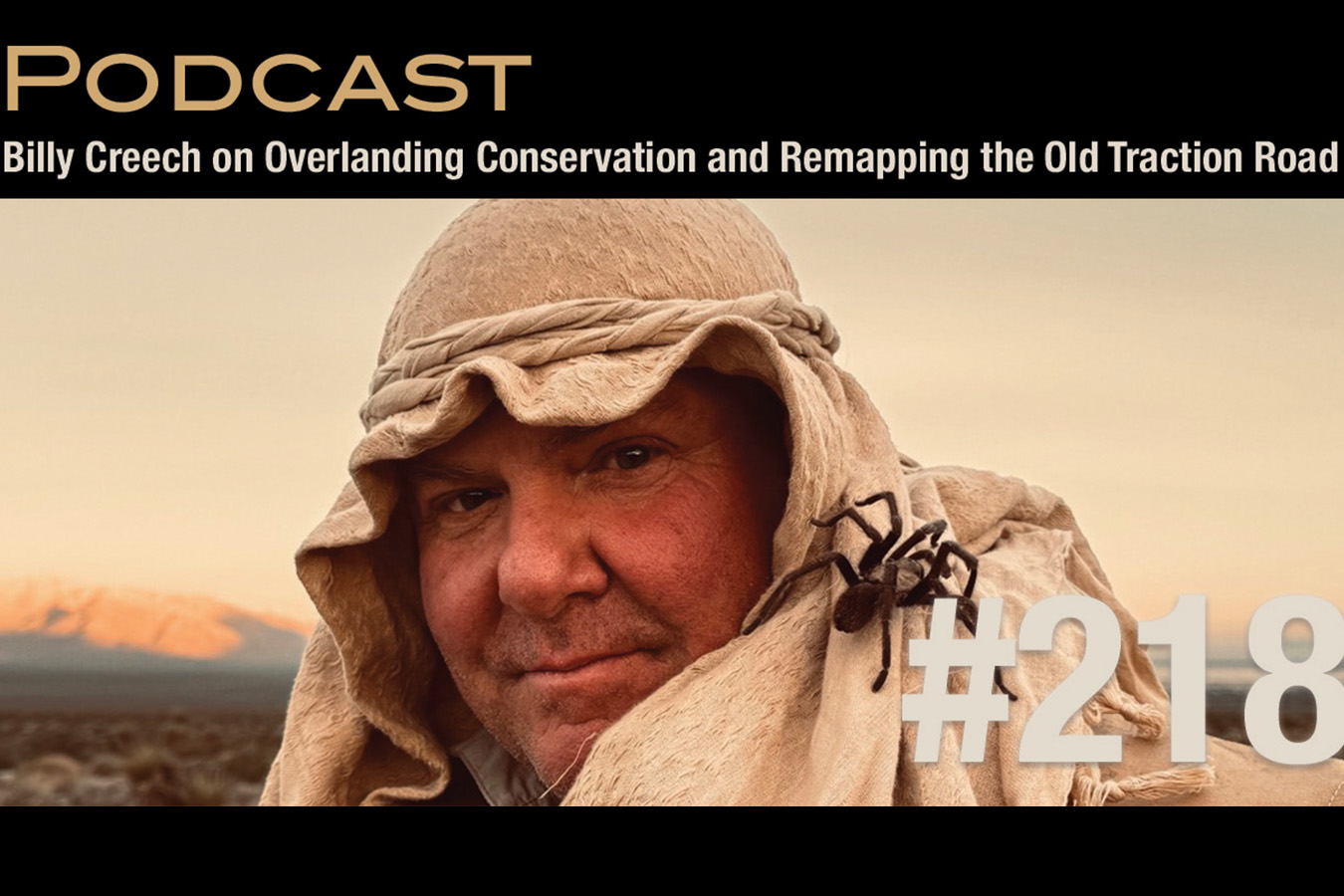
The Overland Journal Podcast is brought to you this week by Overland Journal Magazine
New to Overland Journal and want to grab a subscription! Visit Overland Journal and enter code: overlandpodcast at checkout for 20% off. We thank you for being a subscriber.
Special thanks to our sponsors this week, Hankook Tires and Overland Explorer Vehicles.
Guest Bio
Billy Creech
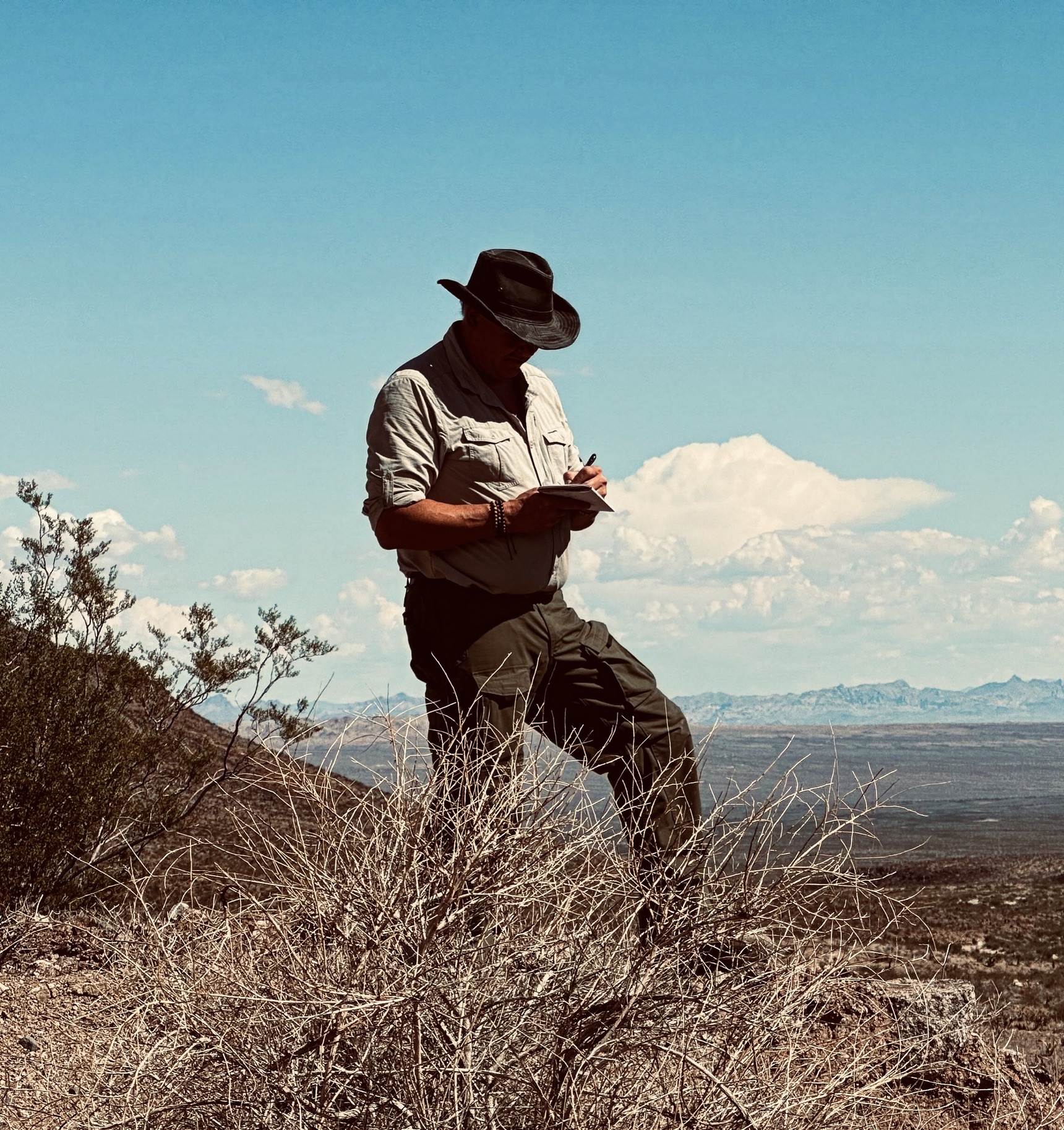
A Fellow of The Explorers Club since 2019, Fellow of the Royal Geographical Society, and former President, as well as Explorer in Residence of the Mojave Desert Heritage and Cultural Association, Billy Creech is a conservationist who has remapped historic exploration routes, conducted numerous explorations and scientific expeditions as a leader and selected team member; and has worked with numerous government agencies on conservation and preservation matters.
He has taught four-wheel-driving techniques, expedition planning, adventure writing, and navigation. Billy has overland exploration experience on four continents and is a former divemaster and rescue diver. Creech holds an MBA from Cornell University and is a senior product manager for Oracle, Inc.
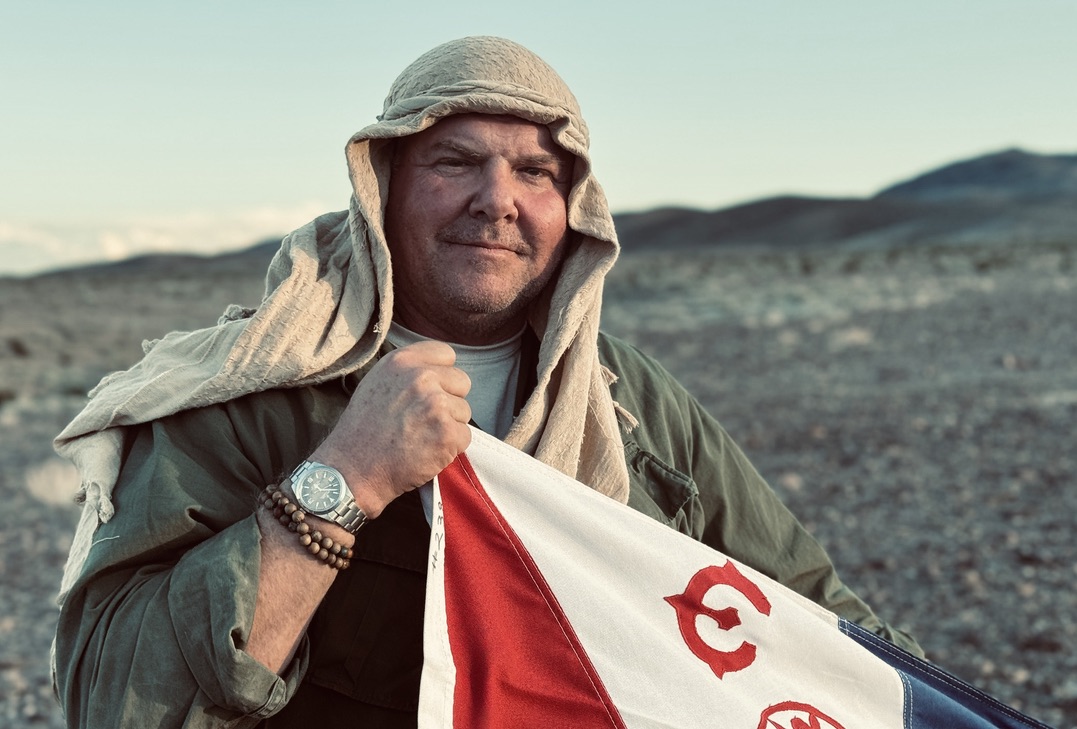
He has championed a concept he terms “fractal exploration”: breaking the world into smaller pieces for more intimate analysis and netting more meaningful and sustainable results, including his role as executive producer and key subject in the conservation short film documentary Mojave Roads: Preserving the Unknown. In the field, he has carried The Explorers Club Flag No.238 on two separate expeditions and been awarded the honor of wearing the Rolex Explorer Watch No.1.
Host Bio
Ashley Giordano
Ashley Giordano
Ashley Giordano’s first foray into overland travel involved a 48,800-kilometer journey from Canada to Argentina with her husband, Richard, in their well-loved but antiquated 1990 Toyota Pickup. Currently cruising along the iconic Silk Road in a 2008 Toyota Tundra, her full-time navigator duties are rewarded with bowls of plov and lagman noodles, hikes in the Tian Shan, and countless cups of fragrant Tashkent tea. As senior editor at Overland Journal, you can usually find Ashley buried in a pile of travel books, poring over maps, or writing about the unsung women of overlanding history, including her enduring inspiration, Barbara Toy. @desktoglory_ash
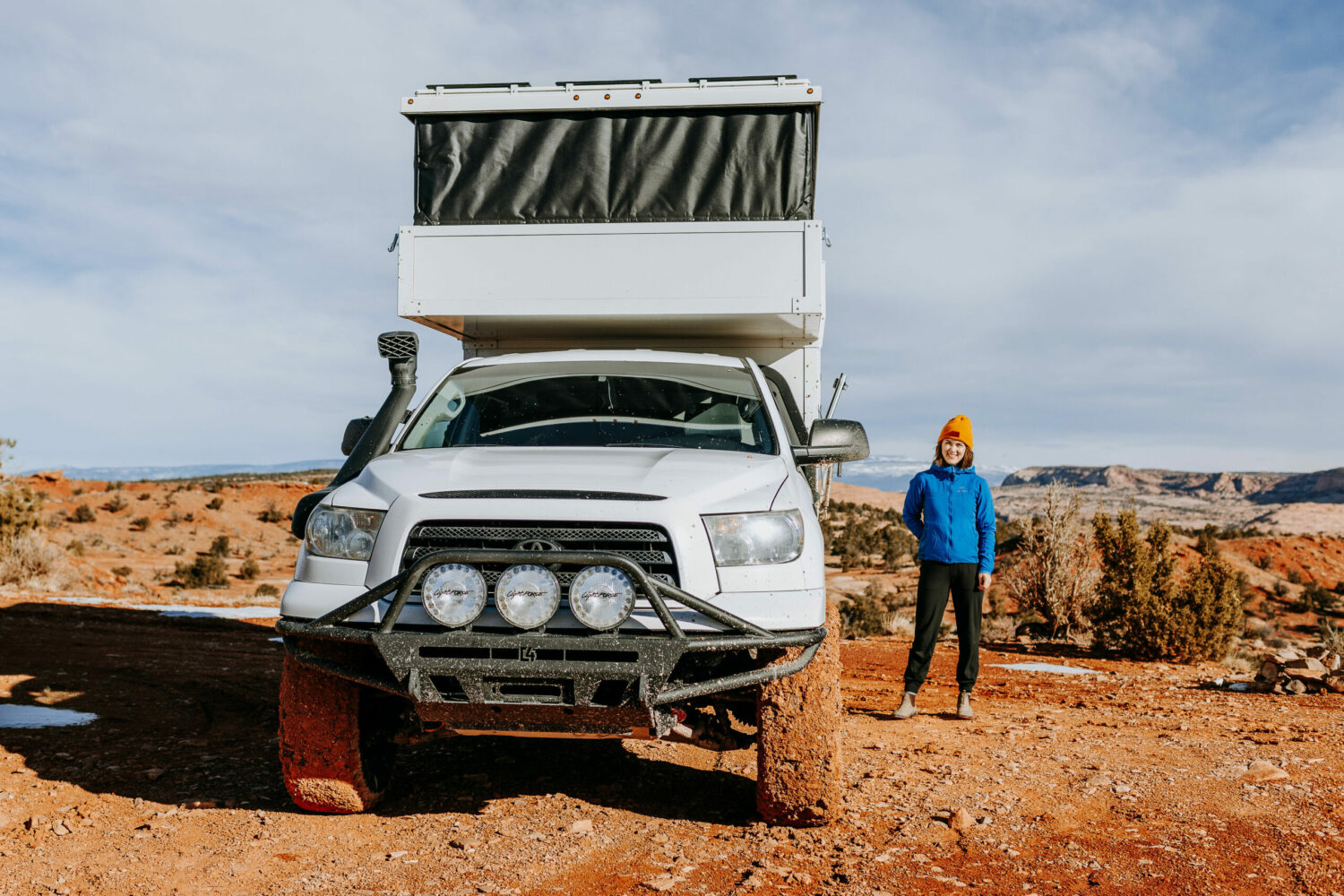
Images: Billy Creech, Richard Giordano
Listen: A Morocco Masterclass with Mark White
Our No Compromise Clause: We do not accept advertorial content or allow advertising to influence our coverage, and our contributors are guaranteed editorial independence. Overland International may earn a small commission from affiliate links included in this article. We appreciate your support.
Transcript
Ashley : [00:00:00] Hello, and welcome to the Overland Journal podcast. I’m your host, Ashley Giordano, and today I’m joined by Billy Creech, who is the former president of the Mojave Desert Heritage and Cultural Association, an Explorers Club fellow, and member of the Royal Geographical Society. In this episode, Billy and I discuss one of his latest projects, the Old Traction Road Expedition, and how overlanders can contribute to conservation efforts during their travels.
So sit back, relax, and I hope you enjoy this episode featuring Mr. Billy Creech.
Sponsor: I wanna take a moment for a special announcement of our newest video series on the Expedition Portal YouTube channel that features exploring the Smoky Mountains and the East Coast. This multi-part series is presented by Hankook Tires and is hosted by renowned explorer and photographer Sinwai Xavier.
This series will start at the end of September and run through all of [00:01:00] October, featuring a trail scout episode, a Jeep Gladiator feature vehicle, trip planning and preparation, and some installments showing the local artisans and places to visit around the Smoky Mountains. We appreciate Hankook’s ongoing support of the Overland community and this podcast.
Ashley : Billy, thank you so much for joining me on the Overland Journal podcast. And before we get started, I have a question. Billy, William, or Bill? What’s your preference?
Billy: Most of my friends know me as Billy. My name goes with how I’ve met you in my life. Billy is as a kid, high school, close friends. William is my pissed off mother or a Cornell professor.
Bill is professional corporate stuff. But now I’m on a team with so many Bills that I just decided to change it to Billy at work because it was just easier.
Ashley : Love it. So Billy Creach. Awesome. So you describe [00:02:00] yourself as a conservationist, an adventurer, an expedition leader, author, poet, and dad. Is there anything we’re missing that you’d like to add?
Billy: Wow. Did I do that?
Ashley : And can you tell me where you’re sitting right now? Because it’s very ambient, if that’s the right word. Yeah. So
Billy: this is-
Ashley : You have some plants in the background and some maps, and it’s very suited- Well- … on the Overland Podcast.
Billy: This is my work office from home. I’m in here 16 hours a day, and so I make it my favorite place to be.
So whether I’m, I’m working or doing nonprofit stuff or expedition stuff or writing an article, this is where I’m at doing it all. So I make it my favorite room in the house.
Ashley : What are some of your favorite items in there?
Billy: The typewriter was Michelle’s grandfather’s. And the radio behind me, that is a 1922 H&K that if you were a high-end [00:03:00] expedition, this would’ve been your receiver that you would have had on your expedition back in the 1920s.
If you were super well-funded, this is the piece of kit you would have been carrying. I’ve got my knives, some maps, journals. The one that doesn’t get to stay here, it has to get sit- sent back, but I have it right now because I just finished another flag expedition, is the Explorers Club flag sitting in the back.
You can see the rosette. They manage and monitor those very hard, very rigidly. So those all get sent back. Nobody’s allowed to keep them. So you can if you’re- Have a worthy enough expedition, get a flag award, and carry it into the field, and then, uh, you have to return it when you write the report and send it back in.
Ashley : Yeah. That- So … it’s very rare that the Explorers Club will give a flag out these days, right?
Billy: In the 120-year history of the club, it was founded in 1904, only 800 explorers have ever carried the flag. It’s only ever gone out on 1,400 total expeditions. [00:04:00] This flag is pretty new, so last year when I took it out, I was only the second expedition to have it.
It’s… This is a newer flag. The first one, it was in a airplane doing microbial DNA in the air to find out how far microbes will travel at alt- at various altitudes to impact other parts of an environment. So when I got it, this thing had only ever been in an airplane, so it was crisp and white and I drug this thing all over through the desert and I used it as a pillow in the sand and the rocks and…
Right? When I applied for a flag for this expedition, I requested if it was in the office, I wanted the same flag, and so I could keep building to its history. And when I got it and I looked, in the year that went by since I had it, it’s been to South America, it’s been to Antarctica, but now it came back to the desert with me.
So yeah, it’s, it’s getting around. So it’s building a pretty cool history.
Ashley : Seeing some… That’s really great. I wanna talk a little bit more about the [00:05:00] expeditions and the Explorers Club and that flag. But before we do that, I really wanna talk to you a little bit about your background and how you got into overlanding and how you got into this world of m- exploration and adventure and off-road recovery and a love for the Mojave Desert.
So bring me back in time- All right … with you to the beginning.
Billy: Part of this, part of this is gonna sound like an Overland Journal pitch because it’s true, but going way back, I’m Gen X, right? We were, to coin a, a phrase that I saw, we were the generation that was raised on neglect and, and hose water. We were latchkey kids.
We were self-reliant, self-sufficient. We entertained ourselves all day. Plus I was an only child, so I could make up my own best friends and go on whatever adventure I wanted. Um, when I was 10, when I was younger, my grandfather helped build the harbors and stuff at Salton Sea, so we would go there and camp, and so we would travel a lot into the deserts in Salton Sea, which is more the [00:06:00] Sonoran Desert But we would go and camp and do that.
But mostly I grew up with drag racing, right? Race cars and, and I was a race car driver for a long time. Not anybody you would ever heard of, but it’s expensive still. Let’s see. When I was 10… This is funny ’cause we just drove through this area and I hadn’t been through there since, and it just triggered flashbacks in my head.
When I was 10 years old, unbeknownst to me, my, my parents were having marital problems. My dad says, “You wanna go for a motorcycle ride?” I was like, “Yeah, sure.” This was August 1977, right? So no, it’s not an adventure bike, it’s a street bike. No, no rear leaning bar or anything else, just a straight seat. So put a helmet on.
We just had sweatshirts on, that’s it. No jackets, no nothing. We get on the bike and we take off, and 500 miles later we’re in Lee Vining. So we leave from Riverside, we end up in Lee Vining at night, and it’s August, and there’s no ho- hotel rooms available, and it’s freezing [00:07:00] outside, like in the 30s. And we don’t have any jackets, no gloves, no nothing, and there’s no rooms.
So we are literally in a parking lot. And like I said, I just drove by this parking lot and looked right where it was We are up against the wall trying to get the heat off of the cinder block wall and our hands on the engine of the motorcycle to try to, to get the warmth off the engine. And around 4:00 o’clock in the morning, the guy that owned the laundromat, the, the wall that we were by, opened the door and let us in so we could sleep in the laundromat, at least be warm.
So I curled up on a laundry folding table, and that’s how we slept that night. Then the next, that morning we took off and we watched the sun set in Las Vegas and then we’re back in Riverside that afternoon, 30 miles or 30 hours. And, and actually not even 30 hours. It was more like 22 hours and 1,100 miles.
That was the first … Somebody goes, “Did you ever do an adventure bike trip?” I’d be like, “Yes.” Then, right, the Indiana Jones [00:08:00] movies, the Camel tr- the Camel, Camel Man ads, Bob Back with the Jeep in the river, the Camel Trophy stuff with Land Rover. Um, and then in 1985, I graduated high school and I had turned down a football scholarship and said I was supposed to go to Alaska, work on a crab boat, and the boat sank before I went, so that got shot.
So I got a one-way ticket and luggage to Hawaii and I moved to Oahu. Had an uncle with a briefcase full of South African krugerrands and, and moved over there and explored the heck out of that island. Came back, went to college, played football. Met Michelle, my other half. We started dating in ’87 and her parents camped and they overlanded, what you would call it today.
But they had a, a pop-up trailer and things like that, and their big trip every year was Death Valley, going somewhere in there. And so I went and oh my gosh, it was stunning, right? Geologically incredible. And then I’m an idiot, so we broke up and we both went separate ways and have great kids and our lives.
And [00:09:00] then funny how life works, and we ended up back together and, and she had always remained a camper and I had got back into the drag racing and went to Cornell and did my MBA and all that. So I was doing corporate America. I would camp at the racetrack, right? Sleep in a tent and all that at the racetrack.
We got back together and we started camping again, and as we were camping and doing stuff, I was like, “Ah, doesn’t it get irritating always coming back to the same place, right?” ‘Cause trailer’s in a camp- in a campground and we leave and hubbin’ and smokin’, goin’ out and comin’ back, goin’ out and comin’ back.
And she really liked that and I was like, “I wanna go further. I wanna go see what else is out there.” So one day, went, we went to a Barnes & Noble, and walking by the book rack and I see this brown cover. I was like, “Overland Journal? What the heck is that?” Opened it up and the letter from the editor was Chris Collard, and it just grabbed me by the throat and went, “Yeah, go do this.”
And so that’s how it all started, and then it took off from there.
Ashley : It’s, it really am incredible how many people have picked that magazine up and [00:10:00] a big journey, adventure, or career has started because of it. It’s … So many people have said that to me. It’s pretty incredible and- It’s also strange because they have, the magazine is carried at the bookstore in my hometown.
So sometimes I’m at the bookstore in my hometown and Overland Journal’s on the shelves, and I’m like, “This is so weird.”
Billy: I’m the type that I don’t wanna waste my time with people who I don’t think know what they’re doing. If I wanna learn something- Yeah … I’m gonna learn it from somebody who I think knows And- Yeah
reading the story is amazing. I emailed him. He didn’t know me. I’m like, “Hey, you don’t know me. I just got your magazine,” blah, blah, blah, blah, blah. “You seem like you know what you’re doing. Teach me how to do this.” And to his credit, he replied, “Okay.” And so what I started doing is because of his words that Overland Journal was, “We don’t do advertorials, we’re not recommending stuff that doesn’t work.
We will tell you if it fails,” I started going straight for the editor’s choice in the gear [00:11:00] reviews. I was like, “Okay, that.” And even that’s how I have an EZEE ON tent that has s- we’ve been in that thing in 65 mile an hour winds and everybody else’s $10,000 tents are shredded and ours is still trucking ’cause it’s heavy canvas South African.
But it was, the recommendation was if you could only ever buy one tent in your life, that’s it. They weren’t kidding. It was ironic that one year I ended up on a trip with Chris and didn’t know we were each gonna be on this trip. And so when they’re like, “Oh, Chris Collard.” And I was like, “Where?” And then so you spot the hat.
And so I was like, “Okay.” So I walked up, introduced myself and I said, “We’re about to put my money where your mouth is.” When some things on that trip happened and it started to really forge this into a really tight friendship that has lasted and grown, and I’m really happy to say that I consider him one of my best friends.
He was my, the first person I called when I did the flag expedition last year. He was the first person I [00:12:00] called to be on the team. So to have that kinda come full circle from his words, that kinda got me more into the overlanding piece of things, and then that morphed into the expedition and exploration side of things.
To have him be on that team with me was just special. Th- that’s, I don’t know, people get inspiration from all over, right? And mine tends to come from, I’ve always been drawn to things that other people w- not a lot of other people see or do, right? And I’m the type that if I’m gonna do something, I try to find out where my limit is.
How far can I go? W- whether it’s academically, professionally, exploration world, expedition world, where do I top out at? I’ve always been that way, and I just like to push things, uh, from that perspective.
Ashley : How did you move from recreational overlanding to more of the expedition side or the [00:13:00] conservation side?
Billy: Roll back the clock to 2016 and a half, 2017. I was researching for a trip that we were gonna do out in the Mojave Desert, and I came across this reference that said EMHT. And I was like, “What is that?” And I just, I wr- literally wrote it on the corner of my map, EMHT question mark. And a few months later…
And, and I didn’t think much more about it. And then a few months later, a friend of mine was out in the Mojave, and he posted a picture on Facebook, and I just happened to be on Facebook, and this thing pops up, and it’s a mailbox out in the middle of the desert, and it says EMHT on it, mailbox three. Ah. I was like, “Where have I seen that before?”
And I was like, “Holy crap, my map.” So I got my map. Yep, this is something. This is a real something. And so I pinged him, and I was like, “Send me the coordinates to where you are right now.” And then the next weekend, Michelle and I trekked out there to find this thing, and found the log book, and it [00:14:00] was the original log book from the late ’80s.
So I was like, okay, that started me, what, what really is this route? And so then I started doing some homework, found that there were some guidebooks that you couldn’t buy anymore because they had been non-compliant with the Desert Protection Act of ’94. I found a set of them and got my hands on them and started reading this thing and researching it and, and found out that Dennis Casebeer, who had created the Mojave Road, he knew instantly that the Mojave Road was going to get heavy use because it was a single through route, and so he wanted to create something that would disperse people into the other parts of the desert.
So essentially, the Tread Lightly principles before it was a noun, back when it was a verb, he would- wanted to disperse that impact. So he creates this, spends years creating this East Mojave Heritage Trail that when he did it, it was 660 miles long. They wrote the guidebooks. There’s four segments. They completed it in late ’89, early 1990.
By 1991, he [00:15:00] starts hearing rumblings of the Desert Protection Act. He starts lobbying against it unsuccessfully, and the Desert Protection Act happens, and it, and it takes away the route because it cut it in multiple places and made the guidebooks useless. So they quit selling the guidebooks ’cause they weren’t compliant, and he quit doing backcountry exploration at that point because he had given more than 20 years of his life at that point to doing it, and he was just like…
And plus, he paid all the money to print the books. They, they spent over 100 grand on that. So he just focused on the history side of it. And here I come, you know, 2016, 2017, and I start looking at it and I’m like, I’m– I connect dots for a living. I work for Oracle, and I’m a product owner.
Ashley : Uh, what does Oracle do?
For the listeners out there who don’t know what
Billy: Oracle is. We run the planet. Seriously. So cloud, so we’re one of the bigger clouds. We do enterprise-level hardware, software. So your Java applets that are on your phone, we’re Java. So none of your stuff works without us. So we’re one of– [00:16:00] we’re the, one of the big hitters on the planet, and we have a really cool race boat, too, for the America’s Cup and all that, when that used to be a thing.
I started looking at this, where this route was cut, and I– like I said, I connect dots for a living. And so I started looking at it and went, “I think I could reconnect this. I think I could remap this.” And the wilderness areas, the Mojave Desert, right? I grew up in Riverside, California, so the Mojave Desert’s my backyard.
And there are 13 endangered or threatened species out there. So most notably that most people would know is the desert tortoise, Gopherus agassizii, and the bighorn sheep. There’s several others, but those are the two most prominent ones, along with multiple endangered flora species out there. That’s why these wilderness areas were put in place and, there’s arguments on both sides about whether they took too much land or whatever.
The point is, they did it, and it cut off the recreational routes. And what you had was because you had traces of a route, you still had people in doing incursions into the wilderness areas. I figured, hey, I think I could remap this thing. I could do some good for the environment. I could [00:17:00] do some good for the animals.
I could help the federal land managers with their mission and charter out there, and I could provide something for not just recreationists, but for conservationists and field scientists to be able to get out there compliantly and do research, and not have to pick their way through areas they’re not supposed to be in.
We can get them close enough to where they can do it on foot. ‘Cause nobody’s walking 150 miles across the Mojave Desert to get to a particular area. Nobody’s doing that. So that’s how it started. And so as I started researching this thing, I went out to the BLM regional office, which at the time was in Moreno Valley.
I started talking to them about it and saying, “Hey, I, I think I can do this.” And are there any other projects out there you would like me to do since I’m gonna be in these areas nobody’s been in for 30 years? And so then it became a, yeah, can document any tortoises that you come across, measure them, document their coordinates.
Mylar balloons, there was a project at the time, it was a really cool project, and I don’t know whatever happened with it, but National Parks out of Death Valley was running a project where mylar balloons, people buy mylar [00:18:00] balloons, they let them go, they fly forever, they land out in the deserts, and the bighorn sheep and the tortoises are attracted to them.
They eat them and they die. And there’s been lots in the crop scenes, all the, that the balloons are found in their stomachs, um, ’cause they’re shiny, and so they get attracted. So National Parks had this project where you took the coordinates of a mylar balloon that you found, and they would put it into a database and map that against prevailing wind conditions to find where that balloon likely originated from, because they had very limited education funding, and they would target their education efforts in those areas to say, “Please don’t use a mylar balloon.
It’s horrible. They’re literally killing the endangered animals out here.” So, and I have yet, to this day, in fact, the last expedition that I just did earlier this month, I got six mylar balloons, and I have yet to go out there and not get at least one. So, you know.
Ashley : Something that I would think about as a, you know, as a human, oh, my mylar balloon from my birthday party, whatever-
Billy: [00:19:00] Yeah
Ashley : has drifted off and is killing wildlife. It’s these things- Yeah … that you don’t even know are impacting wildlife or impacting- Yeah … plants or impacting the earth in some way that you don’t even realize. Right. So it’s good to bring that up.
Billy: There was that, and then there was check on the conditions of sensitive cultural anthropological sites and archeological sites, and document, right?
So I ended up, when I ultimately mapped out this route that I thought I could do compliantly, when I went to actually prove it out and drive it, I had six other projects with BLM that I was doing, things that they wanted me to check on. I ended up writing the report and, and you learn a lot as you go.
Experience matters a lot. So just a, a case in point, that route ended up being 733 miles. The original was 660, so a pretty big increase to make it compliant, but pulled it out of over 100 miles of wilderness incursion, the balloons and documented tortoise and all that stuff. But the report that [00:20:00] I turned in for that was 12 pages long.
The, the report to BLM was 12 pages, and I went and I presented to their archeology team, and I presented to their conservation team, and their land, their law enforcement and all that. When I just did the old traction road expedition last year, so fast-forward five years, and the difference in what I’ve learned, that route was 125 miles long, so a fifth the length of the EMHT.
But the report I turned in for that one was 100 pages long That’s the d-
Ashley : Wow …
Billy: that’s the difference in the details of what I now know to look for and what I’m investigating.
Ashley : Who told you? Like, did, what, what were you submitting? Was it to the Explorers Club or BLM and they said, “We need more details such as this and this,” or did you just pick it up-
Billy: Yes
Ashley : as you were going along to look for?
Billy: When you do a flag expedition, this was a flag expedition, the traction road, and it was also, I was awarded the Rolex [00:21:00] Explorer watch, so the Explorers Club and Rolex awarded me a watch to wear on this, which is a really rare thing and a really cool honor But when you take a flag, you’re obligated to write a detailed report on the expedition, right?
The, into the Explorers Club archives. Because BLM and the MDHCA were sanctioning the expedition, they also got reports, and the Royal Geographical Society, because it was a geographic expedition, they requested a copy of it, so they got it. They got submitted a report as well. But, and it’s right for future researchers to use, and you never know how things are gonna get used.
After I did the EMHT, and when I got into the Explorers Club and the story got out there, I had written a couple articles in the internal publications. A guy reached out to me who is a Navy oceanographer. He’s a, he’s also in the Explorers Club. But he was a Navy oceanographer, but he’s also a geologist who specialized in the Mojave Desert.
And [00:22:00] he- Oh, wow … he had this really cool… He had spent 15, 20 years mapping out the geology of the whole desert. And so what we did was we took his research and overlaid it on top of my remap of the compliant route, and we just handed geologists a compliant roadmap of how to go find specific soil types that they’re looking for, and not have to go across sensitive wilderness land to do it.
Ashley : More about, you were talking about compliant, like the route being compliant. What does that look like?
Billy: When the federal government creates a wilderness area, it’s restricted access. You cannot take any mechanical advantage in there whatsoever. No vehicles of any type, no machinery on the ground of any type.
You can’t even land a helicopter in there, ’cause the skids can’t touch the ground. You can take anything natural, your feet, a horse, a camel. Believe me, I was looking at doing a camel expedition in the [00:23:00] Mojave Desert for another one. Turns out they need really soft sand. They can’t do rocks very well. But when they do that, you’re now taking big swaths of land and saying, “Vehicle can’t go in there.”
So when it cuts off a previous open route, right? So here’s the route, here’s the new boundary. You can’t go in there anymore. So that route is no longer compliant. Um, and the way the federal government works, this is backwards. I’ve had lots of conversations about this with them because I completely disagree with the approach.
They have to specifically tell you something is open, otherwise you are supposed to assume that it’s closed. If you don’t see a sign that says it’s open, you have to assume it’s closed. And I said, “Who’s gonna be driving through the desert, one sign, and then 20 miles later you don’t see any other signs that you’re just supposed to assume that it’s closed?”
I said, “Nobody’s gonna do that.” You need a sign that says, “Wilderness [00:24:00] area, don’t go in here,” or the route, a better approach that I’ve taken with signing the EMHT, ’cause I, I got grants to do that, is EMHT with an arrow that way. So you’re not going straight ahead on the old trace, you’re following the new route.
Those areas are very heavily restricted. The problem is the budget for the federal land managers is such that you have roughly one ranger per one million acres. To put that in perspective, and I talked about this when I was at the Explorers Club because on the east of the Mississippi River they really don’t have a concept of what the Bureau of Land Management is, ’cause it’s mostly west of the Mississippi.
Um, but to put this in perspective for them, if you took all of New York City, all of the boroughs, not just Manhattan, but the Bronx, Queens, everything, Brooklyn, multiplied it by 5.25, that’s one million acres, and you [00:25:00] would have one cop for the whole thing. That’s what you have with our federal land managers.
That’s their budget. And so what you have today in these areas, you have not a lot of policing, you have not a lot of people, and that creates a situation for bad guys to go set up shop. Illegal grow farms, narco trafficking, meth labs, because they will bring in water, they will bring in soil, they will bring in all these things because they don’t really care about the environment.
They wanna set up shop where nobody can see them. And so that’s why it’s important to establish these routes, sign these routes so it’s obvious that people are coming out here, and the one thing they don’t want is a witness. If they’re like, “Hey, people are gonna be coming through here, this is not where we wanna be.”
And that’s another purpose for doing this. Unfortunately, it’s, it’s actually a real thing in today’s day and age. Uh, it’s a real consideration And in fact, a guy, a guy [00:26:00] that was doing… I was with him a couple weeks ago and he was doing the EMHT, um, this past Sunday. He diverted off the trail to go climb up the top of a mountain for the view, and there’s a microwave tower up there, and he came across somebody that was trying to break into it, and they rammed his vehicle to get away.
So there are bad guys out there.
Ashley : But part of the premise of remapping the old traction trail is to get people onto these trails for a variety of reasons. Mm-hmm. And that’s one of them. And-
Billy: Mm-hmm …
Ashley : from what I understand. And also to make the trails clear so that people will stay on the track so that there isn’t damage done to, for-
Billy: Yeah.
So it’s to reestablish the route. So the traction road, let’s talk about that one for a second ’cause another part of-
Ashley : Yeah …
Billy: my, the main thing that I like to do is find the history of a route, find the history of an area, and combine that [00:27:00] with the practical experience of traveling on that route, and educate people on what that history is so that you’re actually reliving that history.
If you’re on the Mojave Road, like most people know what the Mojave Road is. Do you know that you’re actually on a Native American trade route? Do you know that you’re on the original wagon trail west? Right? Do you know that you’re on a route that Jedediah Smith did, one of the early pioneers of, of this country and Western expansion?
When you start looking at that and, and along that route, you’re in the… You’re… When you go through government holes, that’s the place of the last gunfight in the Wild West. Two gunfighters met up there, and the one was, had his wife and kid in the car, and it was a rancher hired a guy to, to bully his way around the area, and the other ranchers hired this other guy to make sure that didn’t happen anymore.
And they met up there, and the guy gets out of the car, leaves his wife and kid in the car, goes inside. She hears a gunshot, and nobody comes out of the house. [00:28:00] She goes in and they’re both laying on the floor dead, ’cause they were both just as fast and they were both just as accurate, and they took each other out.
So, you know, when you’re doing these routes, that kind of stuff you’re traveling through. The traction road was developed in… So in the late 1800s, Borax Smith. So you know what Borax is, right? So your laundry detergent- Yeah … soap, and all this stuff. Francis Marion Borax Smith, he’s the guy that was the main Borax mining magnate of the day, and you…
If you’re buying anything with Borax in it, you’re still getting it from his company today. The town of Boron, that’s what it’s named after. And he gets his hands on this mine called the Lila C just outside of Death Valley, but they had to get the, they had to get the minerals to a railhead in order to get them to market to process them.
And when you’re 110 miles out in the middle of a desert, that’s a challenge. And so they were using what were called 20 mule teams. They were slow, they took a lot of resources, and a lot of manpower. [00:29:00] So he decides that, “Hey, I’m gonna u- I’m gonna revolutionize the transportation industry. I’m gonna utilize this new technology called gasoline, and we’re gonna build…
But we have to have this road. We’re gonna do this traction engine that this diesel engine spins motors, spins gear drives that turn motors that generate electricity on each of the wheels for these ore carts.” Sound familiar? This is in 1900. That becomes the precursor to the diesel locomotive. It also becomes the precursor to what you know today as a hybrid, and this is 120 years ago.
So he spends three years, $3 million in today’s money to build this route, and the technology doesn’t work. It completely fails before it even gets there. So then he gets a s- he’s, “Okay, I’m gonna try a steam traction engine.” Same concept but with steam, and tries that. The thing makes it [00:30:00] 14 miles and blows the boiler flute.
So then he’s, “Screw it, I’m gonna go build a railroad,” and he gives up on it That road was such a prominent piece of potential industry transformation because it was literally going to transform how these minerals all got to market, that it was in the press all the time. Like, there were articles after articles on the progress of this thing.
And so the USGS put it on their maps as a road. This is the road, and it was on those maps up until 1912, and then they took it off once it was like, “Hey, this thing’s not coming back.” And when I started looking at this, so Dennis Casebeer, when I remapped the EMHT, he asked me a couple of things if I would do for him.
One was save his organization, so did that. The second thing was would I map, remap the old traction road, because I was the only person that was successfully able to remap the East Mojave Heritage Trail. [00:31:00] Spend a lot of time figuring… ’cause these things take a long time, right? Years. Figuring out where the maps are.
He thought it was on maps up until the 1940s. Couldn’t find it. Couldn’t find it. I had to go all the way back to 1912 to find it And then start to retrace, and then you start finding where it’s in. Now there’s a freeway, now there’s a solar farm, now there’s wilderness areas, now there’s cities. There’s all these things that you now have to deal with.
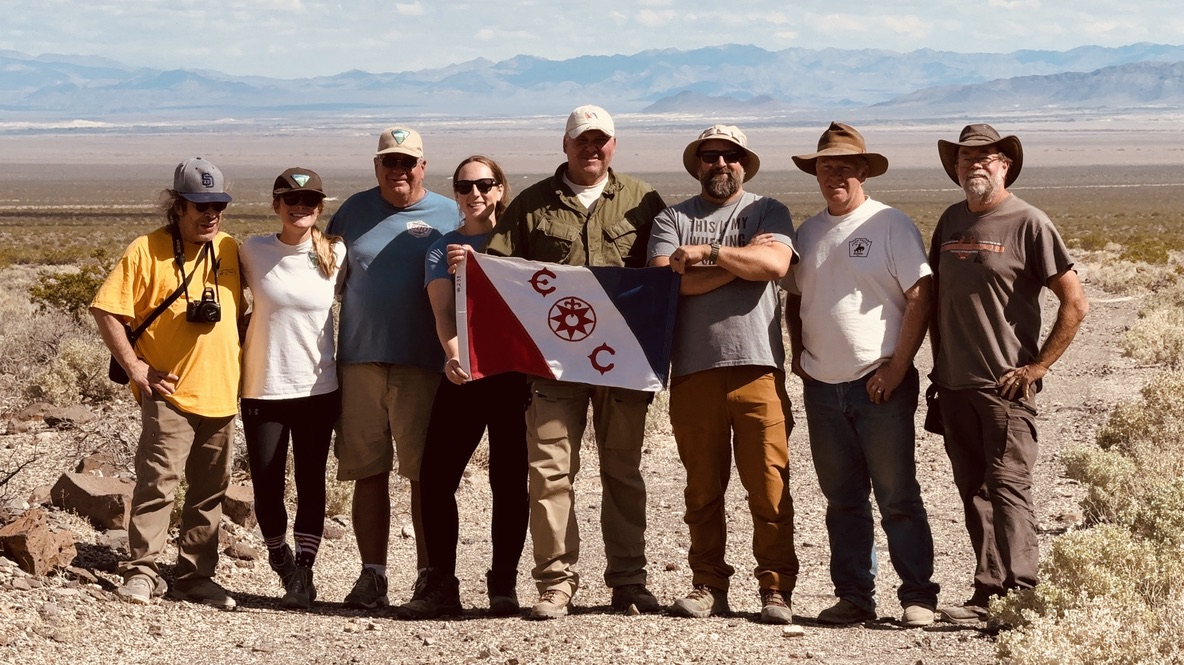
And as I remapped this route, I started talking to BLM about it, and BLM was interested in it. Like, “Hey, we can get another compliant route out here. We can get something for people to do.” My goals were, it’s historically significant, it can be another compliant recreational route, long distance route, it’s 125 miles now, to connecting signi- significant historical points of interest, and it also would, the remap would remove 53 miles of wilderness incursion across these lands.
Partnered with BLM, brought their field [00:32:00] scientists, ’cause they hadn’t been out there, ’cause the area is so remote and rugged that they hadn’t been out there. And their vehicles are stock, and they can’t carry extra fuel.
Ashley : That’s limiting.
Billy: We have it.
Ashley : Yeah.
Billy: Yeah, so when we did this… Now they have Rubicons, so they’re very capable, but still stock.
And so I brought… They ponied up resources for me, a geologist, a biologist, a archeologist, and so I had these field scientists on the team, plus the field manager, plus my own guys, Chris Collard, Will Corbett, Sean Holman, because I needed expert drivers because we did not know what we were in for. And thankfully we had that because it was rugged.
We were using a lot of pick and shovels. It took us 10 hours to go 10 miles, and just digging and, and picking the whole way. And the, the route itself though when… And again, we, Mylar balloons, it’s a thing. But the route itself [00:33:00] is pretty spectacular because you get into this time travel, and what I mean by that is geologically this earth is 4 and a half, 4.8 billion years old, somewhere in that range, and the oldest exposed rocks on this planet are about 4 billion years old.
They’re up in Canada.
Ashley : All right.
Billy: Yay. Right? Up in the Nova Scotia. So anything over a couple billion years old that’s exposed is really old, right? This route, in 125 miles, you get rocks that are 400,000 years old all the way to 2.8 billion. So you’re traveling 2.4 billion years in time in only 125 miles geologically speaking.
So it’s, it’s pretty cool. That’s- Pretty
Ashley : neat … very cool. That’s really cool. So fun. What do you think is… I have two questions. First one, what’s the importance of knowing the [00:34:00] history behind these trails? Like why is it these trails you’re gonna go in your 4×4 or go camping or overlanding along these trails, why is it important to know the history behind them?
Billy: Because it’s gonna change your experience, right? Anybody can drive down a dirt road. If, if you’re just driving down a, a dirt trail, okay, I’m enjoying nature. If you know the history of it, now you can look at it, what was it like if you were in a buckboard wagon? What was it like if you were on horseback?
What would it be like if you… What were they seeing, right? And when you’re looking at the rocks, you’re seeing the exact same things. You look at the s- the rocks and the night sky and you’re seeing the same stuff. You’re feeling the same heat. There’s a lot of really cool things. But for me personally, I have this belief that if people understand the history of an area and the routes that they are [00:35:00] recreating on or exploring on, then they’re gonna…
It’s gonna naturally make them care about it, ’cause they’re gonna have done some research, right? If you’re gonna understand the history, you’re gonna have done some reading, you’re gonna have done some looking things up, and that’s gonna take some effort. And it’s gonna make you want to then care about that area, and you’re more likely to wanna conserve it, so it doesn’t end up with people dumping trash out the window or throwing a sofa out there.
‘Cause the idea is if we- can get people to think in those terms when they’re out there. If you understand the history and you appreciate the area that you’re in and you take care of the area that you’re in, you can start turning that into the majority of the people. And peer pressure is a real phenomenon, and people won’t be as likely to disturb it and tear it up, and they’re more likely to care for it and conserve it if they understand it and appreciate it.
So that’s how [00:36:00] I think about it and, and so far I’ve had a lot of success with people going, “I had no idea that that was out here. I had no idea that this place was special.” Just think about this, the, the, the sliver of the Mojave Desert that’s between the 15 freeway and the 40 freeway. So the 40 goes from LA to Flagstaff, the 15 goes from LA to Vegas, right?
So all of that desert around that is the Mojave Desert. But just that pie piece between those two, think of all the millions and millions of people that go by there every year, that all they see is a brown wasteland. They have no idea of the history that’s out there and the really cool things that are right there and within the reach.
And here’s something that’s really cool. On the last flag expedition that I just did, which was a follow-up to the Traction Road, ’cause the Traction Road expedition was supposed to be eight days, um, [00:37:00] but I got told the night before we were… So we’re camped and we’re leaving at 5:00 AM, and at 8:30 PM, the BLM field manager tells me, “Hey, there’s a looming government shutdown on Monday, and if that happens, we all have to leave your team.”
So I was gonna lose my sanctioning government body. I was gonna lose all my field resources. I was gonna lose my scientists. I was like, “Criminy.” And I was gonna lose the stock vehicles that we were trying to make it passable for to make sure they could do it in the future to inject conservation resources into that area.
Um, so I had to replan this whole expedition between 8:30 PM and 5:00 AM, uh, to do everything in three days instead of eight And mind you, I had been planning this expedition for months. ‘Cause when, when you’re doing that, when you’re planning an expedition, it’s everybody on the team has a job, right?
Everybody’s got a role to play. It’s not necessarily fun. You’re there… Fun is in the success, and fun is in the c- camaraderie, but [00:38:00] you’re there for a purpose. You have a job on this team. And I had to do for the Explorers Club, because I had a flag, I had to do medical plans, blood types, evacuation plans, envenomation plans, ’cause there’s a really nasty little snake out there called the Mojave green that it- it’s a rattlesnake, which those are hemotoxic.
Cobras are neurotoxic. Well, this one has both. And so you get two for one. So it’s bonus prizes out in the Mojave. And, yeah. But, so we had to hurry. So anything we came across, we would have to document it and then not, we couldn’t, didn’t have time to stay and investigate. So on this trip, we found three sites of interest.
One was a Native American spirit portal, one was an anomalous cave complex, and another was another ground sleeping complex. But none of them were documented at all. There’s no record of them. So I labeled those for follow-up. And so this [00:39:00] expedition that I just did, this flag expedition, was a follow-up to go investigate that cave complex up in the side of the mountains.
And what… And, and we found, interestingly, where we thought, “Oh, that’s for sure gonna show habitation,” the main complex that I- was my target did not show any habitation at all. But on the perimeter of it, there was a couple of caves that did have smoke up in them and agave roasting pits, and things like that.
I’m documenting all of that for BLM and for the Explorers Club and stuff. But what I think I found of interest is these caves look to have been formed by water, and some of the pictures I took show material being pushed out of them. And then this little guy I got, this is about 600 feet above the desert floor in the cave, and this is the inside of it.
So that is a crinoid, um, fossil. So think of a sea lily. So this would be like a vertebrae cross-section of a stem, right? So like vertebrae stacked like that, so you’re looking at it [00:40:00] dead on. And it would be like a lily flower. It’s like a sea urchin, but somewhere around 500 million years old. But this is 600 feet above the desert floor, and this is a sea creature.
So this is just more evidence that was all under an ocean because I’m a former master diver and rescue diver, and I spent a lot of time in the ocean, and people were like, “How do you go from the ocean to, uh, the desert?” And I’m like, “It’s the exact same terrain. One just has water on it. The other one just- Right
hasn’t locked water yet.” And the… But this, what’s important about this is this rock is fossil- fossiliferous limestone. Well, you only get limestone with water. And looking at the shape of the caves and, and looking down, you can see the water was coming out of them. So I think, I don’t know, so this report’s gonna have to go to somebody who’s now an expert in caving and geology, but I think that mountain is hollow.
I think it’s a limestone cavern [00:41:00] system Um, because all the signs are there that it is, and there’s only… What’s significant about that is there’s only one other limestone cavern system in the California State Park system, and that’s at Mitchell Caverns, also in the Mojave Desert. Could be interesting, but these are the things when you stop and you start looking at the details, and you start, when you start looking at the project side of what a overlander could do, you start finding that you could do a lot of good.
You can help, and it- it’s a feelgood, it really is, that you help out. You help an animal. It’s … Desert tortoises, they’re cute little guys, right? They’re really, they’re fun because they’re faster than you think, and when you come across them on a trail, a lot of them will just stand there and they just look at you like, “I’m not moving, and I’m federally protected and I know it.”
Sponsor: And special thanks to Overland Explorer Vehicles, also known as OEV, for their generous support of this week’s podcast. The OEV is one of the most respected camper builders in our industry, using premium [00:42:00] four-season construction and the highest quality components to manufacture campers capable of traveling around the world.
Even the Overland Journal podcast host Ashley Giordano uses one of their tray model pop-up units on their Tundra for traveling throughout Europe and Northern Africa.
Ashley : Just, just hanging with the Rebelle Rally, and there were specific days where, uh, Emily Miller, who’s the founder of the event, gave, uh, a talk and demonstration if you come across one of those te- desert tortoises what you should do.
Uh, ’cause it’s really important that they are taken care of properly.
Billy: You shouldn’t … So number one, I will tell people you shouldn’t do anything if the tortoise is safe. If it’s not in a safe place, then you pick it up from the sides very slowly from behind it. You keep it parallel, low to the ground, and you move it very slowly.
If it’s, like, heading across a road, then don’t [00:43:00] take it where it came from ’cause it’s just gonna go across the road again. Move it to the other side where it’s going to. Put it in some shade, and be really careful. A lot of people- Yeah … I’ve heard people say, “Oh, it…” They’ll say, “It peed on me.” No, it’s not.
That’s … It holds water. It stores water, and what it’s doing is you scare it, and it’s dumping its water when it gets scared, and then they dehydrate and die. And desert tortoises, they take a really long time to sexually mature, like 15 years. So they have a high mortality rate when they’re young because of ravens and other predators and, and their t- their shells are soft, so they’re easy to eat.
Anything that, that kills a desert tortoise is really hampering the population growth
Ashley : So if you’re pulling along the road and you went in the middle of the road, you’re, you’re basically like, you s- you wait
Billy: Stop. I stop and wait. Until it- The longest I waited for one for 45 minutes before, and I just– and I was in a hurry, but I was like, “You know what?
I’m gonna let you [00:44:00] do your thing.” And so I sat there, took pictures of him, hung out, ate lunch, he’s still sitting there looking at me. But I’ve come across them before where one– so there’s a lot of, there’s a lot of rules that people don’t know because they don’t need to know them. But when you see graded stuff through the desert, right?
When you see like power line roads that are graded and things, they have to, by law, they have to grade those with a certain angle on the edges so the desert tortoises won’t fall and roll. So it has to be a climbable grade for a desert tortoise. And we came across one last year, I was out, and it was bladed straight up and down, no angle to it.
The desert tortoise had come down it, and it was on its feet, but it had come down on a rock, and so it was high centered on the rock, so its feet weren’t on the ground, and so it was just sitting there struggling. So I moved it, and then I documented that road and I drove the full length of it, and it was bladed that way the whole way.
And I drove [00:45:00] s– My first phone call when I got a signal was to the BLM field manager to say, “This road, they bladed it with a vertical angle and I already rescued one desert tortoise off of it. You, you guys need to get them back out here.” And, and they do. They follow up on that pretty aggressively
Ashley : That’s great.
That’s great. Yeah, those are really interesting things because some people are coming into the Mojave, they haven’t been there before, but they know it’s a great place to go, or those little kind of minutia that you would know because you’ve been there so many times.
Billy: Yeah. When I was in New York and at, at the Explorers Club, people were telling me, they’re like, “Till we talked to you, we didn’t even know there was anything in the Mojave Desert worth conserving.”
And I’m like, that’s understanding the history, understanding what’s out there. And it’s a communication thing, right? Because it’s really sexy, and you’ll know this based on what you’ve done. It’s sexier to say, “I wanna go to Africa.” Okay? It’s sexier to go, “Hey, I’m [00:46:00] gonna go do Australia,” versus, “Hey, I’m gonna go out in the Mojave Desert.”
The Mojave Desert is the size of the country of Jordan, right? You wanna say you overlanded a desert? It’s the size of the country of Jordan. If you wanna do the East Mojave Heritage Trail in one go like I did it when I remapped it, that’s 733 really rugged miles. I welded my truck back together on that route twice.
Survivability is a thing. It’s not necessarily technical, but it’s very rugged, very remote, and you need to be able to repair, recover, and survive if need be because people die out there.
Ashley : On that note, what do you think that What do you… What advice do you have for overland travelers that are… They wanna take their first steps.
They wanna do more of this stuff. Like, they wanna look into things or help or participate in- [00:47:00] Like- … conservation efforts …
Billy: their first steps as far as being an overlander, or their first steps as far as doing a project?
Ashley : Yeah, I guess I’m sure there are very, like, different levels in terms of wanting to contribute to a conservation effort or learning- Mm-hmm
about the history of a place. Because I think- Yeah … the basic overland skills are pretty well documented, but I wouldn’t say that it’s easy to know how to get involved in certain conservation efforts as an overlander. Like, how the two kind of mesh together.
Billy: I would say, first off, most… Let’s be careful with the term overlanding, right?
‘Cause a lot of people say it. I, I don’t use the term off-roading, I use the term backcountry exploration. A lot of overlanding is done on pavement. It never leaves pavement. A lot of it is done on fire roads. So a lot of the stuff that I do is, if you’re gonna remap a historic route, it’s a historic route for a reason.
It’s remote and it’s… Right? It’s not a fire road But [00:48:00] people that in general, the overland community, they have the equipment, they have the skills, they have the vehicles, they have the knowledge, most of them to one degree or another of how to operate and behave responsibly in the backcountry. Most of the people in this community are not knuckleheads.
Some are, but not… Most are not. That’s why when you and I were talking before, I was like, “Most overlanders are conservationists at heart. They’re out there to enjoy nature, not to destroy it.” Using what they already have, then it’s a matter of you got a cell phone, you got the internet, call your local BLM office, call your local national park.
A lot of overlanders are solo travelers. Contacting those federal land management groups is a great way to, “Hey, I’m gonna be in this area. Is there something you want me to look for? Is there something you want me to do?” Or just what we were talking about with the Mylar balloons, pick them up, document where they are, and then contact the federal land manager and [00:49:00] go, “Hey, I just wanna let you know, I’m gonna send you an email that I was out in this area and I picked up these balloons at these coordinates.”
And then you start a relationship with them. You start a dialogue that they can trust you. The reason that there’s rigid permitting requirements and stuff for groups and events is because they don’t trust everybody, right? They’re not sure why you’re there. Have you ever heard the phrase, “Here’s your public lands.
Keep out”? That, that happens in a lot of places because they get sick of dealing with people that are just out there tearing it up. I, I literally had the conversation with one of the federal land managers. They’re like, “We’ve got people that are utilizing trails, mostly motorcycles, that are not compliant.
They’re going into wilderness areas. How do we stop them?” And I was like, “You need to put up, put like a natural rock barrier or something there that naturally keeps them on the right route.” We were thinking about stringing a cable And I was like, “You wanna string a cable across a trail that motorcycles are using.
Can we talk about what could go [00:50:00] wrong?” But most people that I’ve run into out there don’t know they’re in the wrong spot because again, they don’t… They do that if we don’t tell you it’s open, you have to assume it’s closed. And, and most of the people I have run into did not know they were doing something wrong.
And it’s just a polite conversation that, “Hey, just so you know, the route’s over there.” But I think overlanders have this untapped skillset and this untapped desire to be out in the wilds in the first place, that if they just, if they got together just collectively and started doing this, getting involved, looking for what are the nonprofit groups in the areas that are, that are chartered with protecting those areas.
What are some even… Like I said, most overlanders aren’t traveling in groups, but there’s a lot of, I’m gonna use the term because it’s gonna be descriptive of them, off-road groups, [00:51:00] Jeep groups, four-wheel drive groups that are out there to explore and do trips. Okay, so if they’re out there gonna do a trip, what’s wrong with joining the trip and then bringing up, “Hey, could we do some cleanup while we’re out here?”
Contacting a national park and saying, “Hey, do you have an area that needs to be cleaned up? We have a group that’s interested in getting together and going out there and, and helping you.” There’s lots of ways you can do it. I, I started doing when I was the president of the nonprofit, uh, we would have an event and we would do educational field trips, field runs, and I contacted Dave Druck who owns Trasharoo and said, “Hey, Dave, will you give me…
I’ve got eight trail runs going out there. Will you give me eight Trasharoos? And the person who picks up the most trash, we, we give them a Trasharoo as a reward.” He said, “Yeah, sure. Absolutely. That’d be great.” And doing stuff like that, people are out there having fun, they’re enjoying nature and they’re, they’re trying to get a prize, and at the same time they’re, they’re cleaning up a trail.
My guys will do trail repair work also, right? We, we’re authorized to do pick and shovel work. If it involves heavy equipment, we’re writing a report and submitting that [00:52:00] in ’cause that goes through environmental compliance and all that. But we’re authorized to do minor stuff to keep people safe and keep people from widening the trail.
‘Cause that’s the other thing that they’ll do, right? A, a Joshua tree down across the trail, people will go around it instead of pulling the tree back, and so they start widening the trail, and that’s not a good thing either. Instead it could just take you 15 minutes to move the tree to the side and then continue on your way, and the next person would stay on the trail.
So there’s a lot of things overlanders can do. What I would say, if somebody wants to get more serious into the project world, it’s a slippery slope because it starts small and then it gets big. You start wanting to do more, more and more, and pretty soon you’re in the Explorers Club and the RGS.
It’s, it’s a very slippery slope. Um, but you can make it as small or as big as you want. Me, I saw something that interested me and I c- saw something that caught my eye, and then a buddy posted a picture, [00:53:00] and that’s how it all started for me. And then I just started thinking, “Hey, there’s a whole bunch of wins here.”
And that was how I got the government relationships was I found what the win was for everybody involved, and there was no downside to anybody saying no to me, right? It was they’re all gonna benefit, so it, it took away the no, and they all supported it.
Ashley : We chatted before for another article that will show up in Overland Journal soon, and the project, it’s really cool because it’s like you’re saying, encompassing.
The outcomes of it- Mm-hmm … were so well-rounded for so many people, and I think that was-
Billy: Mm-hmm …
Ashley : one of the things that I thought was just really incredible about that project.
Billy: It hits in ways that are obvious, and then it hits in others that are not, right? So obvious, compliance, preservation, conservation.
But then you start getting into the not so obvious. Now you have an opportunity for historical education. You have an opportunity for practical experience. You have an [00:54:00] opportunity to do additional scientific field work, which is what I just did with this follow-up one, right? Was geology into the caves versus the original one was a geographic expedition to remap.
You get… There’s… You can really… There’s… It’s almost like tentacles on these things, that when you look at a project, you can almost do this and go, “Okay, here’s my main project,” and then you start looking at everything else that starts coming off of it. And it can go as far as you’re willing to take it. I have been working what was an idea for me in 2016, the East Mojave Heritage Trail I’m still doing it, and here it is eight years later.
I’m still doing… I got a grant from the state of California and a grant from General Tire to sign that route because there was no proper signage. So 733 miles, and 400 miles of that is bordering wilderness land. So we– I designed a logo, I designed the signs, got the Carsonites all approved by BLM, worked with them.
And we just had some of the [00:55:00] more famous overlanders in the world do the route, and they were like, “This is the best signed route I’ve ever seen in my life.” Because they’re cool. They’re nice to look at, right? It’s got a cool logo. It’s got the General Tire logo because they paid for it. And we did reflective decals so people can see them at night.
The segment decals are color-coded so you know what segment you’re in. It’s color-coded to the books, for the guidebooks. And what I did not do, I’m not a fan of what they call confidence markers, right? Oh, we’re gonna let you know you’re still on the right route even though you’ve been on a straight trail with no diversions for 20 miles.
There’s no way to get lost and there’s no way to turn. Every mile you’ll see a marker because they want you to feel good that you’re on the same route. I’m like, no.
Ashley : Right.
Billy: People need a skill. That skill is navigation. They need to know how to navigate. You know this. Navigation is important.
Ashley : Very.
Billy: I’ve watched you grow in that skill.
And the… [00:56:00] So what I do is I only put markers where they have a decision to make. I don’t give people a confidence marker. If that route, if you have a marker and then you don’t see another marker for 10 miles, it’s because you didn’t have a choice. You should not have gotten lost. And if you got lost at that point, you shouldn’t be out there.
And that’s how I do it. I don’t want it to look like a freeway. I want people to keep that natural experience, but I also, a big purpose for doing it is to keep people out of the non-compliant areas, the sensitive wilderness habitat areas, and so I have to put a sign there. And that’s why, that’s how I do it
Ashley : Yeah.
I can’t wait- And- … to do both trails one day. I really want to. I think it would be …
Billy: I’m saying nothing.
Ashley : Yeah.
Billy: The-
Ashley : We’ll get there. We’ll get there …
Billy: hon- honestly, what I recommend to people for the Mojave Desert specifically, if you’re new and you’re … Afraid is a bad word, ’cause everybody says, “I’m not afraid.” But [00:57:00] if you’re new- I’m sure … and you’re, you’re, you have some trepidation about getting into that environment because the Mojave Desert is consistently listed as one of the top 10 most hostile environments on the planet.
Death Valley is part of Mojave. And what I tell people to do is cut your teeth on the Mojave Road, right? It’s not technical. It’s east to west. It’s pretty much a straight line. It’s really hard to get lost, and it’s well-trafficked enough that if something happens to you, somebody’s coming by within a day or two.
The East Mojave Heritage Trail, on the other hand, gets you into areas, it’s 733 miles. It’s a loop trail. It goes all over, and it gets into every type of terrain there is in the Mojave Desert, and it can break you off. It … I also would not call it very technical. It has some technical sections, but not rock crawling technical But you need to be able to navigate, you need to know how to survive, and you need to know how to repair and recover your vehicle because you can get into [00:58:00] some stuff that help is not coming for eight months, 10 months.
That’s where skill sets matter, and there are ways for people to get out there into that environment and build those skill sets and build their comfort level and be able to go, “Okay, I can tackle this thing.” The other thing they can do is because of the way the Mojave Desert is laid out, you’ve got major population centers around it.
You’ve got Las Vegas, you’ve got the Inland Empire, you’ve got Barstow, you’ve got, you’ve got Lake Havasu. So you’ve got major population centers around it, and you’ve got major freeways that run through it, the 15, the 40. Um, so you can tackle these things in segments and in bits and pieces while you build up your confidence level and skill level before you head off into the really remote areas.
I think people, this community specifically, and, and Overland Journal tends to attract the more serious because it, it, it is… it’s a very high-end publication. [00:59:00] Scott and Jonathan and Chris and, and everybody, Tina, Stephanie, everybody has done a great job with consistently putting out a very high quality, high-end product that is appealing to a more serious backcountry explorer and overlander.
The folks that are gonna be hearing this, I would say you have the skill sets, you have the discernment to figure out what kind of project you can do, um, versus what kind of project you may want to do, and reach out to the federal land managers and, and make a pitch and just ask them where they can help.
And if, if you don’t wanna call them or you don’t know who to call, you can call me. And, and, and it doesn’t have to be the Mojave Desert, right? It could be, “Hey, I’ve got an idea for something in Connecticut.” “Okay, let’s talk about it and, and I can help you figure out who to talk to to make that project happen.”
Because part of this… One of the reasons that I’m– I spend a lot of time on the phone and on Messenger with people giving them advice [01:00:00] because They’re doing what I did years and years ago with Chris Collar, right? And so Chris did that for me. I am absolutely gonna do that for whoever asks, because that’s what this is all about.
And I, I just did the expedition, flag expedition for the two little girls that have an interest in history and archeology. And so I was like, “You know what? We’re gonna take their little spark, and we’re gonna ignite that in a big way.” And maybe they will do something with it, maybe they won’t, but at a minimum they’re gonna have a really cool memory.
Ashley : Absolutely.
Billy: You know? Hopefully they do, and that’s what this community is all about, is helping and assisting and passing on the knowledge that you have to help pe- people build their own skill sets and get out there and, and do some good.
Ashley : Absolutely. We’re very grateful for everything that you’ve shared and done, and-
Billy: Thanks.[01:01:00]
Ashley : Yeah. You’ve been a busy guy. I asked you earlier when you sleep, and you said that you don’t, and I can see that- … because you’re always, like, onto the next thing. What keeps that energy going for you? What underlies all of that?
Billy: Eternity is long. I’ll sleep when I’m dead. I had this conversation, right?
Because I don’t sleep a lot. The, my job mandates I deal with all the time zones, so I can work crazy hours. And then running the nonprofit was 30 hours a week on top of my j- job, plus then my own expedition work, plus the whole family’s work. And I said this to somebody one time. I actually did the math.
Somebody, if we were born at exactly the same time and died at exactly the same time, and they did the prescribed nine hours a night of sleep versus what I get, when we both die, I will have actually been conscious and lived almost 20 years more than they have.
Ashley : What? I need my nine hours, Billy, though.[01:02:00]
Billy: Okay. So, so that you’re taking out the shorter, but you’re a lot happier and you’re well-rested.
But that’s just how, that’s what works for me. And I’m the type that once I latch onto an idea, my brain starts going and I can’t shut it off, so then I’m up and writing or working or doing whatever. I’ve had a lot of in the middle of the night trying to figure out how to make a remap work, and then wake up at 2:00 in the morning and go, “That’s it.”
And get up and pull out the maps and start drawing lines and go, “I got it,” and then go back to bed two hours later.
Ashley : Yeah.
Billy: It’s just, it’s what works for me.
Ashley : And that sense of curiosity as well.
Billy: That’s a common trait for anybody, and I will call most people are explorers. And people get hung up on terms and terminology and all this stuff.
The overland… Just say, “What’s an overlander?” And you will get a gajillion answers. Most of them very heated and almost all of them very wrong. If you’re moving overland, foot, bicycle, [01:03:00] motorcycle, vehicle, you’re overlanding. That’s the very definition of it. You are doing something overland. But Explorers, people, what I try to tell them is like, “Oh, that you’re not an explorer, you’re not a this,” to other people when I hear them saying that to somebody.
I look at exploration as when you’re somewhere for the first time, you’re there for the very first time, you’re seeing it with your eyes, with what your life experiences have been, and with what your purpose is, that’s an exploration for you.
Ashley : Yeah.
Billy: And the difference between exploration and an expedition is an expedition has a specific purpose, a specific goal.
It has tasks. Exploration, you’re out there to see what you can find, and typically an exploration leads to an expedition, right? “Oh, hey, I’m out here. I saw this. I wanna come back and follow up on that specific thing.” And to [01:04:00] me, everybody, especially the overland community, everybody’s an explorer because you’re out there searching for things to see the first time, and that’s where if you go back over and over again, maybe you’re not exploring anymore.
Now you’re more adventuring. What was Clay Croft saying? “Adventure is the intentional pursuit of trouble.” I put it that it’s an adventure when something goes wrong, and because something always goes sideways, and then it’s on. But this last one, I put a knife through my leg. There you go. Seven staples. But the, the terminology that people get hung up on, it makes people miss the point.
I don’t wanna say I’m on an exploration ’cause I don’t want somebody to go, “Ooh, you think you’re an explorer.” You’re out there exploring an area when you’re out there for the first time. You’re checking it out, and you’re seeing, and you’re bringing your own perception to it. You’re bringing your own point of view, and you may connect dots that nobody else has.
I can tell you right now, I did not know this at the time. Dennis [01:05:00] Casebeer, who created the, the East Mojave Heritage Trail, when I remapped it, I had talked to him. He never said a word about it, but I found out after he died, ’cause I have the two notebooks sitting right over there on the shelf, he tried to remap it twice, 2008 and 2011.
He had people try to do it, and they could not put the dots together. They couldn’t figure it out. Me, I look at it with my eyes and my brain and am able to figure it out. So you never know what somebody’s gonna come up with, right? They could go to a place that a million people have been before and see something that nobody has ever considered
Ashley : A, a lot of people say there’s nothing else, in quotes, there’s nothing else to be discovered or that place is already- we’ve already seen it.
We’ve already been there. There’s so many people- Yeah … that have passed through there already. So I like this- Yeah … idea that, and I agree, even if you’re writing an article [01:06:00] or you’re making a video or et cetera, like the, the list goes on and on, but you could say- Yeah … that article’s been written about that place already, but they haven’t seen it.
You haven’t written the article through your perspective before. You haven’t created the video through your perspective, like you’re saying.
Billy: Two things, right? One, we’re coming back to the article thing and the detail thing. The curiosity thing, though, I wanted to close out, I wanted to finish the thought on that because curiosity is why we all do this.
You’re curious. You wanna s- if you said, “Hey, Ashley, you wanna get married and sleep on an air pad in the back of a cold truck forever?” And the answer is no, but you’re curious enough of what you’re gonna see and what you’re gonna experience when you do that, so you’re like, “Okay, Richard, yes, I will do that, and then we’re gonna get a house.”
But like- … you know, and [01:07:00] that was always my fight with Graham and Louisa, right? They’re like overlanding and I’m like, “I will stay in my vehicle, but I am not living in my vehicle.” I am nostalgic, right? True. I still have, I still have some of my toys from when I was a kid because I’m nostalgic and sentimental.
But curiosity is what drives all explorers. It’s what drives scientists. It’s what drives expedition. It’s what drives discovery. And I was at an event, I think we… you and I may have talked about this, Josh Gates, right? You know him, Expedition Unknown, all that. He’s an Explorers Club member. And this little girl, and I, I have four, four daughters, so whenever there’s a, a girl involved with something, I take particular note of it.
This little girl, she’s probably 12, she gets up in front of this entire theater of people and asks him, “What gives you the courage to [01:08:00] go on these adventures around the world? I would be so scared. I would never be able to do that.” And he said, it was very poignant, he said, “Curiosity. Curiosity gives me that courage.
I am so curious about what’s out there that I have to go see it, and that gives me the courage to go on these adventures to go see them, because I just can’t not do it.” And she sat down and I wondered, I’m just sitting there looking at her more than him and wondering, does she realize that’s exactly what she just did?
She just displayed enough courage. She was so curious about that answer to that question that it gave her the courage to stand up in front of this entire theater of 3,000 people and ask that question And she’s already doing it and doesn’t even realize it. And people do that every day, and they don’t realize how much courage they [01:09:00] have because of their innate curiosity.
On your perception thing, I wrote an article for, I think Tina put it on Expedition Portal, but it was called Did You See That? And essentially, we were out in Arizona, and it was winter, and it was snowy. And we’re going out to this area. We’ve got two vehicles in front of us and us, and, and I see this vehicle parked on the side of the trail.
And this is a well-trafficked OHV area. And the kids were just wanting to go out to tow their snowboards behind their Jeeps. I see this vehicle, it’s a two-wheel drive Chevy, and it’s in the snow, and I’m looking at it, and something wasn’t right. So we drive off, and we’re parked about a quarter of a mile away, and I– we’re on a rise, so I keep just looking at this vehicle.
And the more I looked at it, the more details were popping out. There were no tire tracks. The vehicle had been there before it snowed. So I looked, when was the last time it snowed? Wednesday. This was a Friday. I looked, and there’s [01:10:00] no footprints coming out of that vehicle. And so right, I started looking at it more and more, and I’m– as I’m watching this for a couple of hours, like 30 vehicles went within eight feet of that car, and nobody even slowed down.
Nobody even stopped. And so I called the kids over. I said, “Hey, we need to go look at that vehicle.” And Dustin, my now son-in-law, goes, “Why? Why would we do that?” And I said, “Because I think there’s a dead guy in it, and here’s why.” And so I laid out all the stuff and of course, them being young, and I’ve been in police reports before, I– it– the allure is lost on me.
So they go flying over there, and all of a sudden I hear him screaming, “There’s a dead guy in here.” And he was frozen to death. And the lesson there is pay attention to the details, right? There’s people just– when you want to do expl- exploration and you wanna do especially an expedition, but if you’re doing project work or any of that kind of stuff, paying attention to the details really matters a lot.
And [01:11:00] naturally, because I’ve been doing these projects and stuff for so long, my eyes just started picking up on things that looked not right to me, and my brain connected those dots and went, “Something bad has happened here.” And as you do this enough, that’s how you’ll start seeing things. You start picking up the details and going, “Oh, that doesn’t make sense,” or, “That does make sense.”
You know? And I think that’s one of the, the benefits of the Overland community because- At least the more serious ones, you have to pay attention to details on your vehicle, right? Any little change in the sound of your vehicle, something just changed. Something’s not right, you stop and you find it, and you fix it.
So it’s that kind of attention that, that applies to all aspects when you’re out in nature, and especially if you’re gonna be doing projects. Yeah. So it’s a good skill set that-
Ashley : Agreed. I think it’s something that we’re losing as well because we’re distracted, we’re on our phones, things are happening quickly, we’re becoming [01:12:00] overstimulated.
And the other thing too is that if, to take notice of the details no matter what you’re doing takes extra time. And we’re such a time- Mm-hmm … sensitive culture. We want everything faster and faster. Things are taking too long, time is money, but slowing down, you have to if you’re gonna notice the details.
So that’s a good-
Billy: Yeah …
Ashley : that’s a good thing to practice for sure. For sure.
Billy: It is. Always use a paper map. Always have a compass. You just did the Revelle so you understand the value of that.
Ashley : I was there.
Billy: Learn how to-
Ashley : I would- can’t take credit for it.
Billy: Oh.
Ashley : But yeah. I was there
Billy: when you did it anyway. You were covering.
You were covering. I
Ashley : was, yeah.
Billy: So, so the value of being able to navigate with paper and compass is really beneficial. Electronics go bad. I work in the tech industry. Electronics go bad. I have a, in my Avalanche I’ve got not just my iPad, but I also have a Lowrance because, and I put stuff in cards and put it in there, [01:13:00] because a Lowrance is shockproof, dustproof, waterproof, ’cause they’re made for boats, and that’s why Baja race trucks use them, because they’re not going to fail and it, it’s got 13 satellites locked on it, and it updates 10 times a second.
Could thread a minefield with it. But people get too reliant on the easy technology and, and that can bite you in the butt, you know?
Ashley : Redundancy’s super important.
Billy: Yeah. So I force myself to slow down because we all get, we’re all… I think one of the biggest I don’t know what the right word is, vices of overlanders is distance.
How many miles can I cover? They measure a trip in how long was it versus what did I see or what did I do, what did I feel? It’s how far did I go.
Ashley : How many countries, how many countries did I
Billy: go? How many countries. Yeah. And it’s, and I’m guilty of that also because I’ll be like, “Hey, if I’m driving hours to get to a [01:14:00] place, I wanna try to see everything in that place ’cause I don’t know when I’m coming back.”
Yeah. And so I become guilty of that as well. And one of the things I’m doing right now to force myself out of that is I’m building out a 1996 Land Rover Defender. No electronics and, right, the top speed on it’s about 60. That’s probably downhill with a tailwind. It’s gonna force me to slow my roll and take my time because I do have a tendency to
My Avalanche really, with the gearing and everything else, really likes about 57, 60 miles an hour, but I drive it at about 72 because I wanna get there. And the Land Rover’s gonna force me to say, “Hey, that 14-hour drive is now two days.”
Ashley : Yep.
Billy: Slow down.
Take a break. That’s assuming it doesn’t break. It could be a week. It’s breaking enough in the garage as it is, so my conversations with Nigel is, it’s Nigel, um, named him after a guy to, to keep the two girls in the garage from battling it out. That’s not working [01:15:00] out so well.
Sponsor: I also wanted to take a brief moment to thank all of you for listening to the Overland Journal podcast.
By listening to this podcast and subscribing to the Overland Journal magazine, you’re supporting our employee-owned and veteran-owned business. Impartial reviews and in-depth content like this would not be possible without your support. If you enjoy the podcast, I think you’d really love the print magazine as well.
And 100% of that subscription price goes back into creating the content like you’re listening to right now. And as a special thank you for your loyalty, we’re giving 20% off any subscription, and that even includes our special lifetime subscription, which includes numerous lifetime only benefits. You can go to overlandjournal.com and use the code OVERLANDPODCAST at checkout.
Again, that’s code OVERLANDPODCAST at checkout, and that’ll give you 20% off. [01:16:00] I sincerely appreciate your support.
Billy: Overland community can do so much good if they just stopped and thought about the skills they bring to the table. Because I guarantee you, most of the people in this community, if they sat down and wrote down their skills versus sat here and just talked to you about them, if they really thought about them and then you talk them through how they actually did something and you start pulling skill sets out of them, the list of what they think they have versus what they really have Night and day different.
People have way more skill sets than they believe, than they understand that they do. And then once you pull it out of them and then you say, “This is how you can apply that,” then I think this community really could rally around I don’t wanna say conservation [01:17:00] because too many people in the backcountry exploration communities equate conservation to trail closure- Right
because that’s what they’re used to. Right. When I say rally around conservation for the purpose of keeping trails open, right? You wanna help, so you help keep people on a compliant route. You help clean up those routes. You help show the federal land managers that the majority of the people can help you with your limited budget, and your budgets are driven by people using your routes.
The routes stay open by people using them because routes that aren’t used get closed. This community has a tremendous number of people in it, and a lot of resources. And I don’t mean that just financially, I mean that mentally and physically- Yeah … resources that they can bring to the table when it comes to trail conservation, land conservation, historical preservation, all of those things.
And it starts with understanding that they actually can [01:18:00] do something. They just need to take the first step. A federal land manager’s not really gonna reach out to them, right? They’re too busy.
Ashley : No. Yeah.
Billy: They’re too trained. But if you reach out to the federal land manager and say, “Hey, I’m gonna be out in this area.
Anything you want me to keep an eye out for? Anything you want… Do you want a trail report? Do you want, do you want me to look at anything for you while I’m there and give you a report on it?” If it’s a good federal land manager, they’ll say yes. They may require some follow-up conversation because they wanna get to know you a little bit, and that’s where, for mine, I drove out to their office and introduced myself and sat down with them, let them know how serious this really was, that I was gonna do this, and would they like me to help them when I did it.
Ashley : Yeah.
Billy: So-
Ashley : Face-to-faces.
Billy: Mm-hmm. Yeah, and now, now Zoom is a really popular thing, so this makes it a lot easier for people, right? So Zoom or Teams or Meets or whatever. That’s where I think Overland Journal, where Scott has brought a lot of people to the table. Clay and, and Shelly [01:19:00] have brought a lot of people to the table.
Clay is an amazing cinematographer, right? And, and his skills have really translated to inspiring people to get into the community. They don’t understand that a lot of the stuff he’s using is because he’s driving camera trucks, right? He’s gotta have positive air pressure and all that. But they have brought and recruited a lot of people into this, and now this community has the ability to say, “Okay, it can rally itself and do a lot of good- Agreed
because it, it’s global, and everywhere on the planet could use some help.”
Ashley : For sure. Yeah, we were just in- Bosnia and, uh, I think a few months ago. I don’t really know. Time, what is it? But yeah, we spent a lot of time picking up garbage in beautiful camp spots, picking up a lot of cigarette butts. Yeah. That’s what we do.
And I know that statistically the studies have been done that show that if [01:20:00] you roll up to a clean campsite, you’re more likely to leave it clean, so, um, just continuing- Yeah … that is good. And I appreciate the tips that you’ve given. I think that’s gonna give people, if they’re interested in some of the stuff we’ve talked about, some great first steps for me as well.
So yeah, that’s, those are such great tools for overlanders to use wherever they are in the world, so I think-
Billy: Yeah. I mean- …
Ashley : people are gonna-
Billy: Yeah …
Ashley : have a good start there. Mm-hmm.
Billy: Yeah. I, I wish… Unfortunately, it’s the 2020s and everybody has trademarked what used to be practices. So you got tread lightly, leave no trace, pack it in, pack it out.
You got all these things that used to just be descriptions for how you behaved, not the name of something. That, I think, has been lost, right? When you go back and you read books from the 1970s, guidebooks and things like that, literally the words are in there, tread lightly, leave no [01:21:00] trace, pack it out, right?
Because it was a behavior expectation, not a ideology and, or a trademark. And so I think that has been lost a little bit, ’cause right as soon as you say leave no trace, people think of an organization. Tread lightly, they think of an organization versus the practice of doing it. And that’s something that I think this community could be better at understanding and getting back to its roots of why you’re there in the first place.
Why do you wanna go out there in the first place? And then treat it that way.
Ashley : That’s a really good question to ask yourself. Yeah. Why do you wanna go out there in the first place?
Billy: Yeah. And then- Yeah … go. Just go. That was my thing, Chris’ words, right? Were quit wasting time and go. Just go. And I was like, “Okay.”
And so I went, and been going ever since. [01:22:00]
Ashley : And look, now we’re here.
Billy: Now we’re here. Now we’re, now we’re, we’re here. And it was really cool. I was talking to Michelle earlier today about the podcast for tonight, and I was like, it’s this kind of full circle with Chris and this is full circle with OJ, is me diving into this level started with picking up that Overland Journal issue at a Barnes & Noble and going, “What is this?”
Here we are being somebody that Overland Journal actually wants to talk to and listen to my opinion on something, is actually pretty special for me to say that this whole journey has been meaningful ‘Cause you hear this stuff all the time, it’s not the, it’s not the destination, it’s the journey. It, it’s really, yeah, okay, to a point.
I would say journey more than the destination, unless it’s an expedition, then your destination is the goal. But it’s [01:23:00] the people that you meet, and the relationships that you form, and the friendships that you build, and the bonds that, that, that get just become so strong given some of the circumstances that you find yourselves in.
It’s amazing, and I wouldn’t trade the relationships that I’ve built through this community with, for anything. So-
Ashley : I agree.
Billy: Mm-hmm … I’ve got my best friends, people that I could call for anything on a moment’s notice. The, the Traction road, the second expedition, the, the cave one, that came off with, like, literally five days notice because it just came out of the blue, the opportunity in the Explorers Club.
I applied for a flag, and they literally got it to me within five days. The normal process is at least two months, and they took every day of that two months the first time. And the guys on my team from the year before when I sent out that, “Hey, I’m getting down there to do this,” and they’re like, “Okay, when are we meeting?”
I’m like, “We’re not. I’m already on my way.” They’re like, “What do you mean? Like [01:24:00] we would’ve come. You should’ve just, just called us. Right now we would’ve come.” It’s those kind of friendships and those kinds of relationships you can’t replace. And this community, because you do have that self-reliance, you do get into to adverse situations, fortunately and unfortunately, and your skill sets are constantly on display for everybody around you.
And you’re either, in this world, you’re either learning from somebody or you are teaching somebody. You’re never stagnant, ever. And I don’t know, for me, it’s special that you asked me to do this particular podcast. I’ve done a bunch of other podcasts and stuff, but OJ was always the full circle one for me.
Ah,
Ashley : I’m so glad to hear that. And thank you so much for coming on and speaking and talking about Explorers Club and your history, and I think the projects you’re doing are so fascinating and really important, and making four-wheel drive [01:25:00] vehicles as a tool for conservation essentially, and discovery-
Billy: Yeah
Ashley : is, it’s pretty special. Yeah.
Billy: Yeah.
Ashley : So thank you for
Billy: sharing. Try to change the image of them. Mm-hmm. Too
Ashley : often
Billy: the image of a four-wheel drive vehicle is tearing up the landscape rather than the opportunity to actually get out there and protect it.
Ashley : Um- That’s why I love this story so much because I hike a lot and- You, there is the narrative out there that these vehicles are associated with harm and in all different ways.
And yeah, that’s another reason why- Yeah … this story’s been so fascinating, so.
Billy: And it- Yeah … it’s, it’s educating. I, I know we had a conversation with somebody who’s very anti-vehicle about tire size. They’re like, “Oh, y- your gigantic tires.” And I’m like, “The bigger tire, the wider tire, we reduce the air pressure and it actually does less damage than a skinny tire because it spreads the weight of the vehicle out over a broader footprint so it impacts the soil.”
So as you start [01:26:00] talking they start going, “Oh, I didn’t know that. Oh.” Like yeah, and we reduce the air pressure so we don’t spin the tires, so we don’t dig up the soil. And so as you start educating people on this stuff, you use the transfer case to, to use the mechanical advantage so you’re not on the throttle as much.
And as you start talking to people that don’t understand or even if they have an adversarial, uh, viewpoint of it, they start understanding that, oh, maybe these really aren’t as bad as… Okay, how do you expect to get conservation resources out here? If not my vehicle, our vehicles can go out here because they are…
We have a permit with Fish and Wildlife or whoever, and okay, what does your vehicle look like? It’s a stock vehicle with… They start describing, “Okay, so you have seven and a half inch wide tires. You’re digging into the soil. I’m floating on top of the soil,” right? So you start doing the comparisons, and they start instantly they, they, “I didn’t know that.
I didn’t know that.” And it’s, it’s an education process. And so the more-
Ashley : Those [01:27:00] conversations.
Billy: Yeah.
Ashley : Mm-hmm.
Billy: And the more good behavior that they see, the more likely they are to internalize those viewpoints and that education versus you talk to them about it, and then the next thing they see is somebody ripping and, and tearing up an area that they’re not supposed to be in, or they see a vehicle commercial that’s ripping through sand dunes and stuff, but they don’t clearly say, “Hey, this is an OHV area, not a trail.”
I don’t know. I think there’s a lot w- a long ways to go still, but I’m in the Explorers Club, and I do expedition work, and I get asked to be on other expedition teams, which I am. And so one of the next ones after I finish up the traction road stuff is trying to find a woman missing World War II pilot, uh, that’s in, that I think is in the ocean.
And several expedition teams have looked for her before, and they’ve all come away empty. I got asked to look at it, and I started connecting the dots and pulled together [01:28:00] some other information that they hadn’t found in 10 years, and I went, “I think she’s over here. I don’t think she’s over there.” And they’re like, “How did you come up with that?”
And so I laid it out for them. They’re like, “We’ve been on this for 10 years, and we didn’t know that. You’ve been on it for three weeks. How did you do that?” I connect dots for a living. That’s why you asked me to be on the team. But seriously, when you start looking at more than just the surface level, you start getting the backstory of things, and other dots start making sense, and that’s how you have to do it with the backcountry exploration, right?
You start connecting dots that are all around it and go, “Here’s the actual picture. Here’s the actual history. Here’s the actual route.” And I think I can give somebody a really cool experience, and at the same time, do a lot of good for the animals, for the land managers, for conservation in general because now- BLM can get their vehicles out there.
They can now get people out into those wilderness areas to investigate them and check them.
Ashley : Really looking forward [01:29:00] to seeing what’s next for you and following along on these projects, and yeah, it’s great. Can you tell us where the listeners can find you on the internet if they are trying to look for
Billy: you?
You can find me on Instagram, it’s fractal.exploration. The first Overland Journal senior editor, Jonathan Hanson, co-founder, he coined that phrase. I, with his permission, champion that concept, which is breaking things down into detailed level and getting more intimate with them so that you understand more of it.
So fractal.exploration on Instagram. On Facebook, it’s, I’m Bill Creech, and you’ll find, see the guy with the keffiyeh and the tarantula on his head, and that’s me. Um, the, the, uh, I also run an East Mojave Heritage Trail group on Facebook so people can… The whole point is sharing information, sharing knowledge, and helping people do this safely and [01:30:00] responsibly.
I manage that page, and people can get ahold of me anytime. They can email me. It’s, I have an old-school email address because too many people have it. I can’t change it, and Gmail won’t let me merge it, but [email protected]. I hate that email, but it is what it is. And anybody can find me. I’m not hard to find.
You can, they can call me, they can email me, they can DM me, they can text me, they can whatever. I will answer questions. I will help people with, help them with projects, help them with ideas because that’s what this is about. And like I said, if Chris hadn’t been there for me, I don’t know what I would be doing, but he was there for me, and he helped give me the confidence of my choices and that I was on the right track and gave me the mental lift to just go do it.
Just go.
Ashley : Thank you so much, Billy, for coming on the Overland Journal podcast. It’s been an absolute pleasure. Thanks for listening to this episode of the Overland Journal podcast. [01:31:00] We hoped you enjoyed it, and we will catch you next time
