

To honor the 20-year anniversary of Overland Journal, we are revisiting special heritage content in the upcoming 100th issue of the magazine. Originally published in Overland Journal’s Spring 2018 issue, this article is part of that celebration.
The salted traveler accustomed to the South African Bushveld, swampy Okavango Delta, or the savanna plains of East Africa will be struck by the parched earth and seeming desolation of the Kalahari. What could possibly survive here?
The Kalahari Vortex
Located on the southeastern border of Namibia is the Kgalagadi Transfrontier Park, the first Peace Park of its kind. It stretches from South Africa over to the southwest of Botswana, covering an area of 38,000 square kilometres, creating a considerable protected area.
Meaning Place of Thirst in the San language, this vast ecosystem has been my sabbatical stomping ground for many years. Like most national parks in South Africa, it has an enduring and profound history. From its inception in 1931 as a national park to its present-day status, it has been loved by locals and visitors from around the world who have been daring enough to look and travel beyond the more popular destinations.
Finding the Rhythm
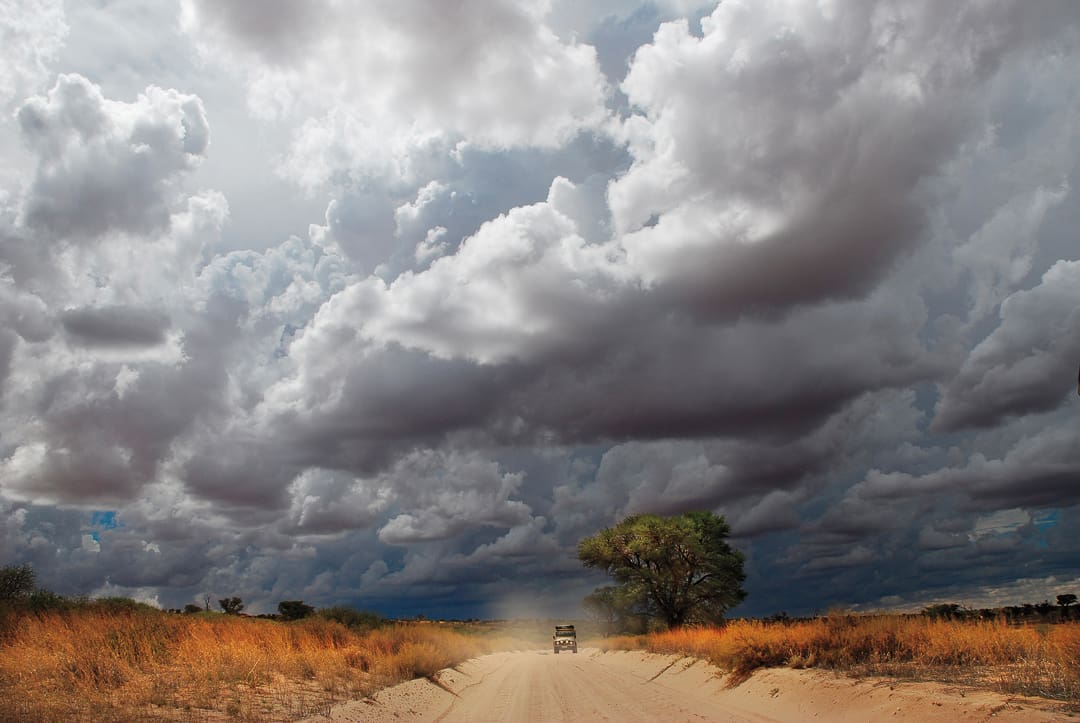
My first visit to the area was in 1995, when it was known as Kalahari Gemsbok Park. Not knowing what conditions to expect, I’d packed my Defender to capacity for three weeks of travel and was undoubtedly overpacked. As I drove through the gates, my heart sank with my first impression. It was so arid—suffocatingly hot and completely different to what I was accustomed to. Within hours, though, the murmur in the sweltering air, the sudden rush of dust devils sweeping over the sand, and clouds moving across the sky, their bellies tinged with the reflection of the red dunes, had captivated me.
It was the middle of December, the hottest period of the year when temperatures range from 35–48˚C in the shade, and ground temperature can reach a blistering 70˚C—an egg can easily fry on the car bonnet. Yet, there was something enthralling about this parched landscape, which seemed to breathe to a different rhythm.
Heading Out
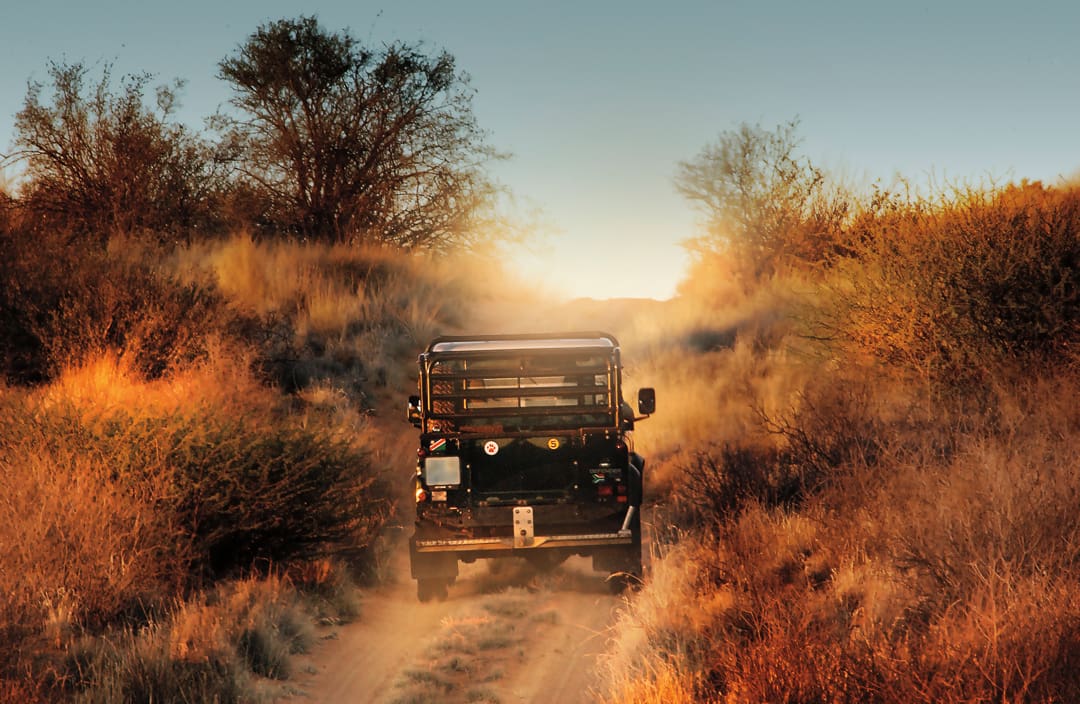
This is no fly-in, fly-out destination. To get the real feel and value of the wildlife and ecosystem, it is self-drive territory, preferably in a four-wheel drive, as sightings are difficult in lower vehicles due to high banks in areas. The Kgalagadi is intersected by the Auob and Nossob Rivers, dry riverbeds which mostly serve as the two main dirt routes, a mixture of packed corrugated sand, and soft, shifting sand. The last time the rivers flowed was in 2000, and it was an exceptional sight. Recently, the northern portion had flash storms which caused the Nossob to flow up to the Polentswa area. Two weeks later, it soaked into the earth, leaving no trace. However, the result is always phenomenal.
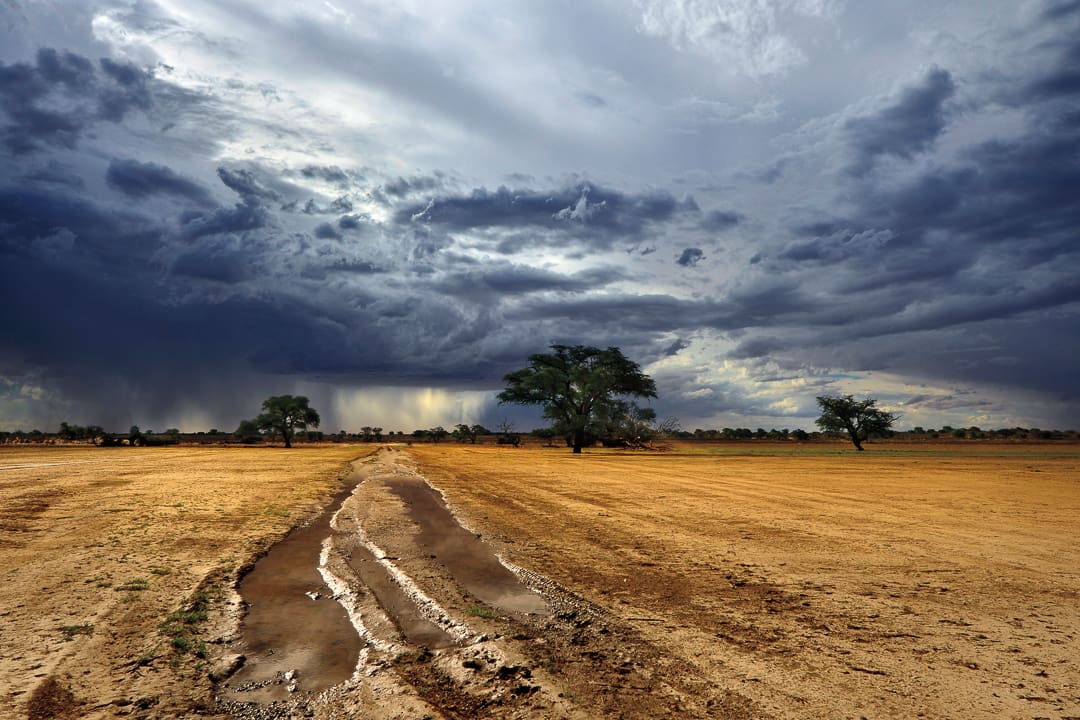
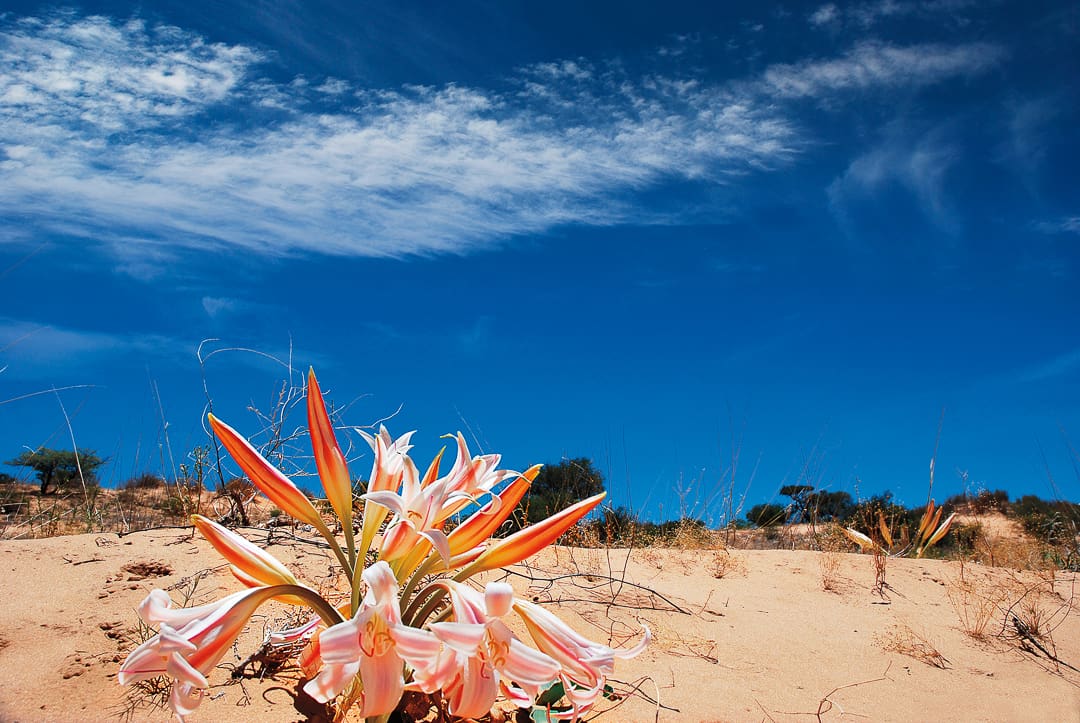
The bone-dry acacia trees will suddenly shoot leaves, and desert flowers present themselves in all their glory. The Devil’s thorn runners on the sand banks start producing thousands of bright yellow flowers, and small creatures lying dormant beneath the dried-up earth such as bullfrogs, brown shrimp larvae, and terrapins stir and steer their way through to the surface. At times like these, driving through the water when it is not entirely necessary is thoughtless and potentially harmful—the wet pockets become temporary access points for a myriad of creatures besides those living in the water.
Lifeblood
The waterholes are man-made, the lifeblood of the wildlife. In earlier days, they were driven by windmills which were affectionate symbols to the park regulars. Over the years, these proved to be inefficient and have been replaced by modern solar panels. However, they retained their names, a mixture of Afrikaans, San, English, and a peppering of Scottish: Cubitjie Quap, Kwang, Gharagab, Kij Kij, and Dalkeith amongst them, each with its own rich past of enigmatic characters.
Marie se Gat, or Marie’s Hole in Afrikaans, is named for a relentless, determined wife whose husband started drinking and was too incapacitated to finish the work on the borehole. Marie then pulled up her sleeves and continued with the drilling herself, or so the story goes. On a recent trip, I found it amusing that someone had marked the GPS coordinates as the Bum of Marie.
Leeudril, Afrikaans for “lion shiver,” is apparently the spot where a desert dweller called Matthys climbed over the dune only to be faced with a huge lion. He stood his ground without any protection, and the lion eventually turned and walked off, leaving the poor man shivering in his boots, but alive.
Curious Hans Schwabe
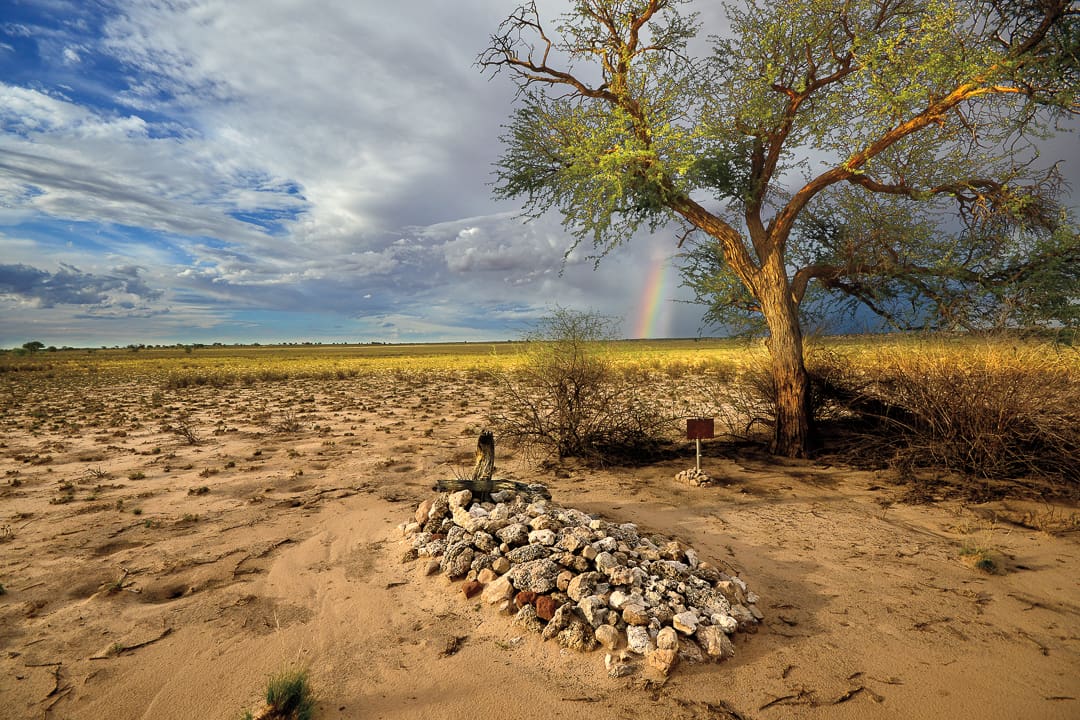
The tale of Hans fascinates many, and his humble gravesite is close to one of my favorite camping areas. In 1958, this German geologist from Namibia (then called South West Africa) asked to prospect for diamonds in the park. The warden refused, rightly so, but Hans surreptitiously hid his Oldsmobile and went for a walk anyway. A day later, the Botswana police contacted the warden, informing him that they had found a car with a note which read: “No water for the car, no water for myself, no food, follow this road. Monday, 8 a.m. H. Schwabe.”
The warden, Joep Le Riche, agreed to do a search with a San tracker, and they discovered a couple of curious things: Two sets of tracks led from the car, indicating that Hans had left and come back again; the radiator was still full of water; and close by there was a waterhole, but no sign of Hans. They decided to follow the second set of tracks leading away from the car and found areas where he had done a bit of prospecting. Eventually, in the distance, they saw a vulture sitting in a tree—below they found the remains of Hans, fairly mutilated by predators. They decided to bury him right there, covering the grave with some stones. Joep roughly scratched the words, “Here lies Hans Schwabe. Died 22.10.58.”
Every time I drive past the site, I salute Hans and wonder what happened in those last hours. His resting place near a camel thorn tree overlooks a wide plain towards Polentswa, where the clouds sweep low across the horizon. His presence was my only company for three days on a trip when I was trapped on the Botswana side after torrential rain. In a bizarre manner, it was comforting.
A Harsh Life
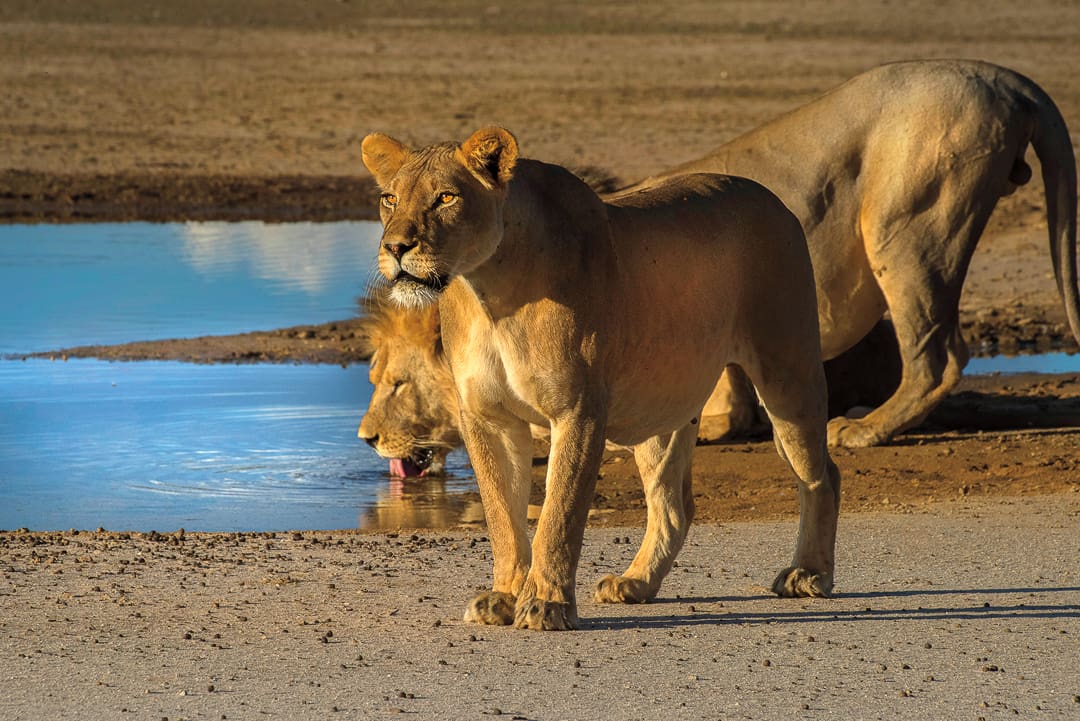
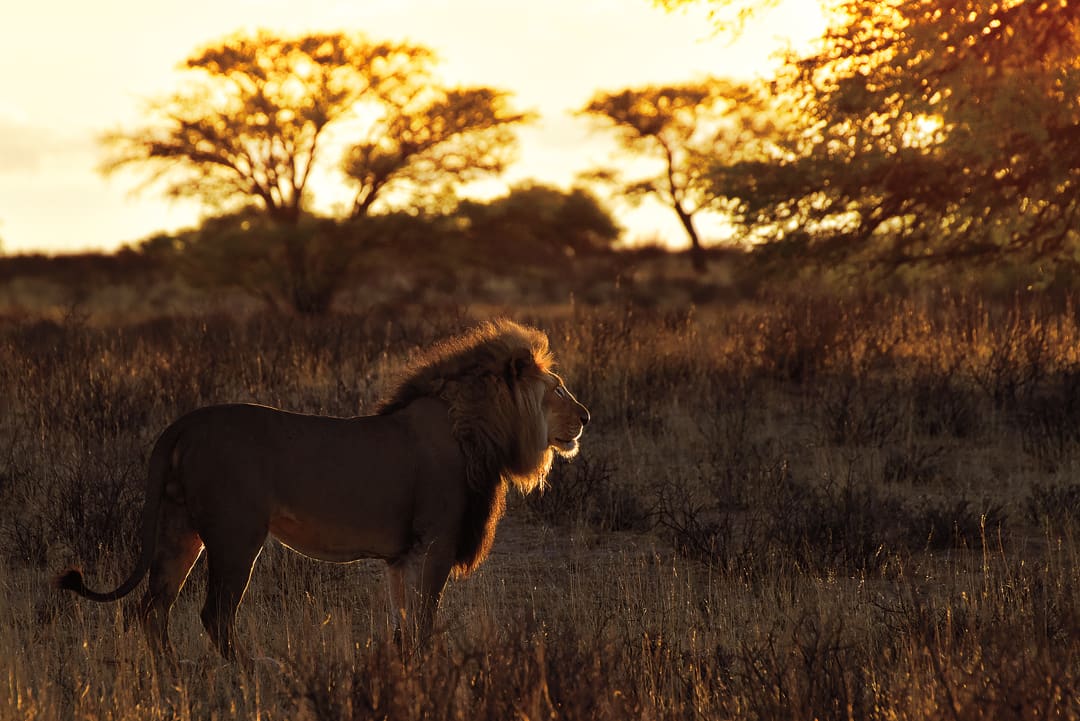
This is lion country. Beautiful and immensely powerful male and female specimens with not a trace of fat live in this ruthless climate. To some, they are known as the brunettes; their blonde counterparts reside in Namibia’s Etosha National Park.
Looking at these creatures through my lens, it always strikes me how severe they appear in contrast to the seemingly coiffed lion populations in other parks. The cub mortality rate is very high; though hidden when the lioness goes out to hunt, quite often she does not get back in time—they then starve or are sniffed out by another predator. Over a three-day period, I watched four cubs not yet able to hunt; they were achingly thin and patiently waiting for their mom to return. Every day I felt sick with anticipation when I arrived at the same spot and saw them still there. Finally, she arrived, and I could leave them in peace.
The great call of the wild has to be the deep-throated roar of a lion, a sound inherent to Africa. This haunting sound can travel between 8 and 10 kilometres through the air—there is nothing like it. Everything holds its breath for this super predator when this broadcast announces his presence.
Not So Common
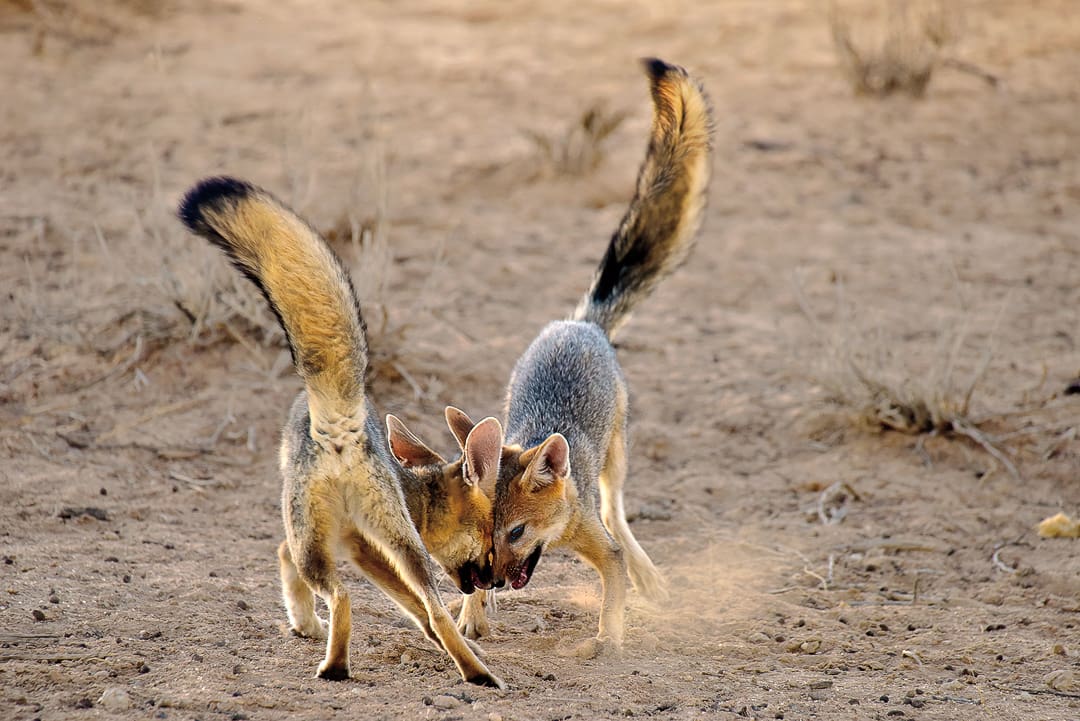
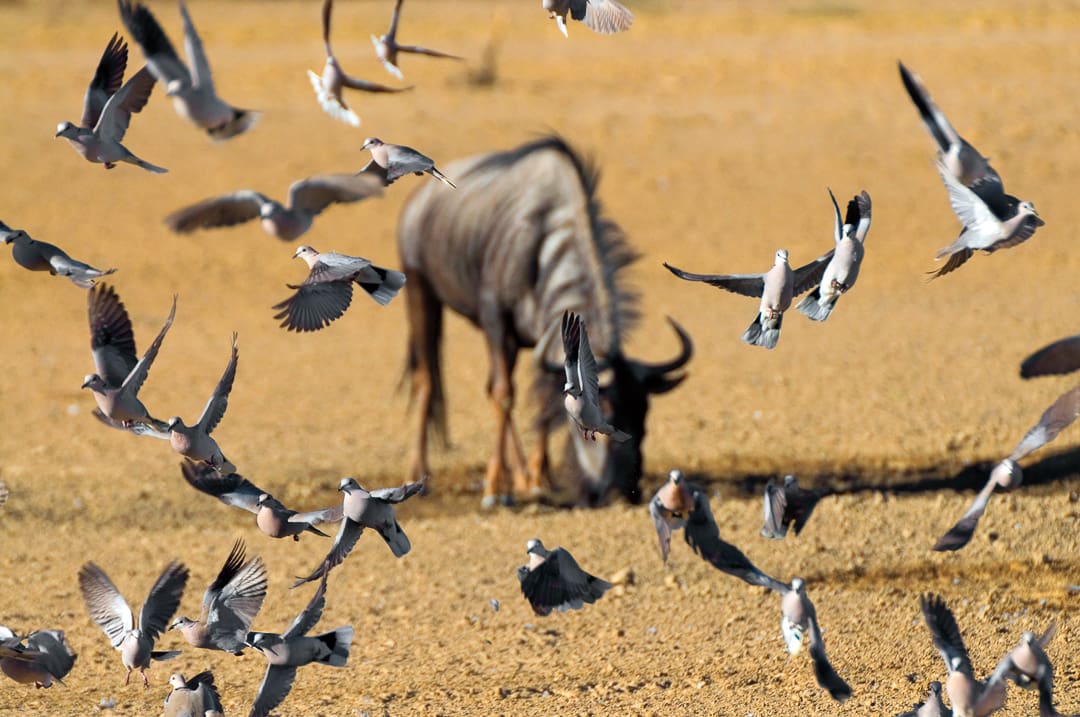
The common species are the gemsbok, springbok, and wildebeest, which move around the park searching for food and water. One of the greatest gifts given to me came from my father when I was very young. He presented me with a pair of binoculars and said, “Keep quiet and observe. Watch everything; there are signs being given all the time.” Initially, this was an enormous task, but I think of those words when I notice something spectacular.
During the wildebeest calving season, I was watching a small herd moving back and forth, and it occurred to me that there was a pattern to their movement. Wildebeest have a terrific social system, from lookouts, flankers, nursery attendants, and even midwives. Clearly, this was a training camp unfolding before me. The older females were herding the new mothers and their calves at a gallop down the riverbed and back again, following and urging them on. Within minutes of their birth, a calf needs to get up, suckle, and endeavor to keep up with the herd—predators are constantly watching for the weak and young. What I was observing was the distinct instruction to strengthen their legs.
Lens Culture
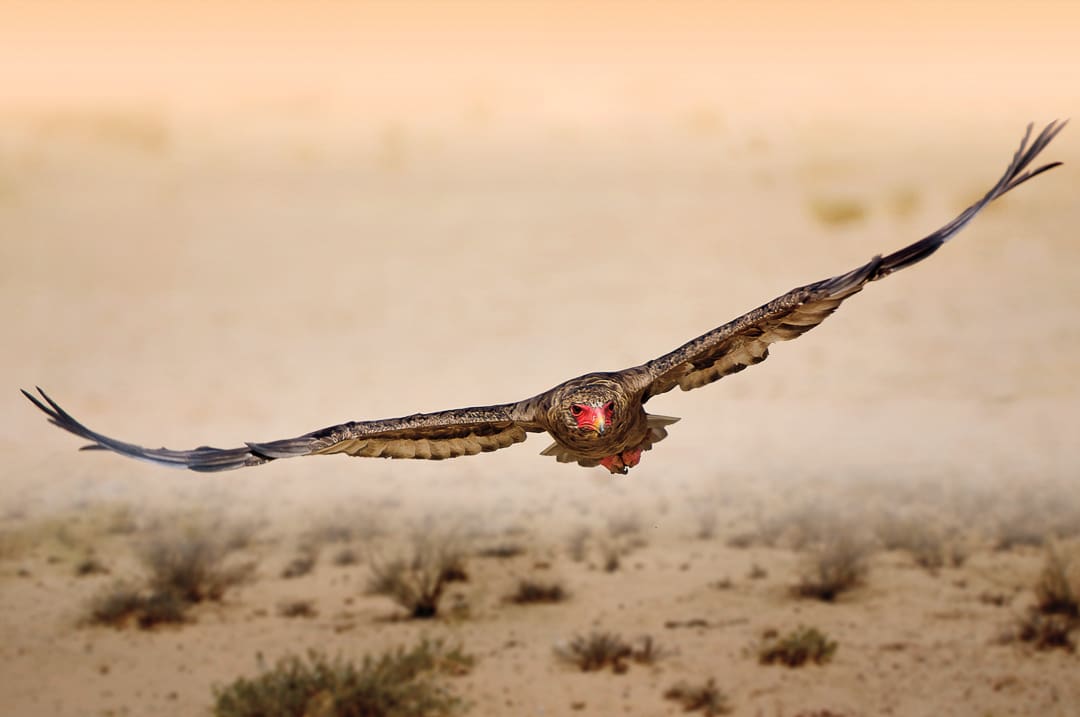
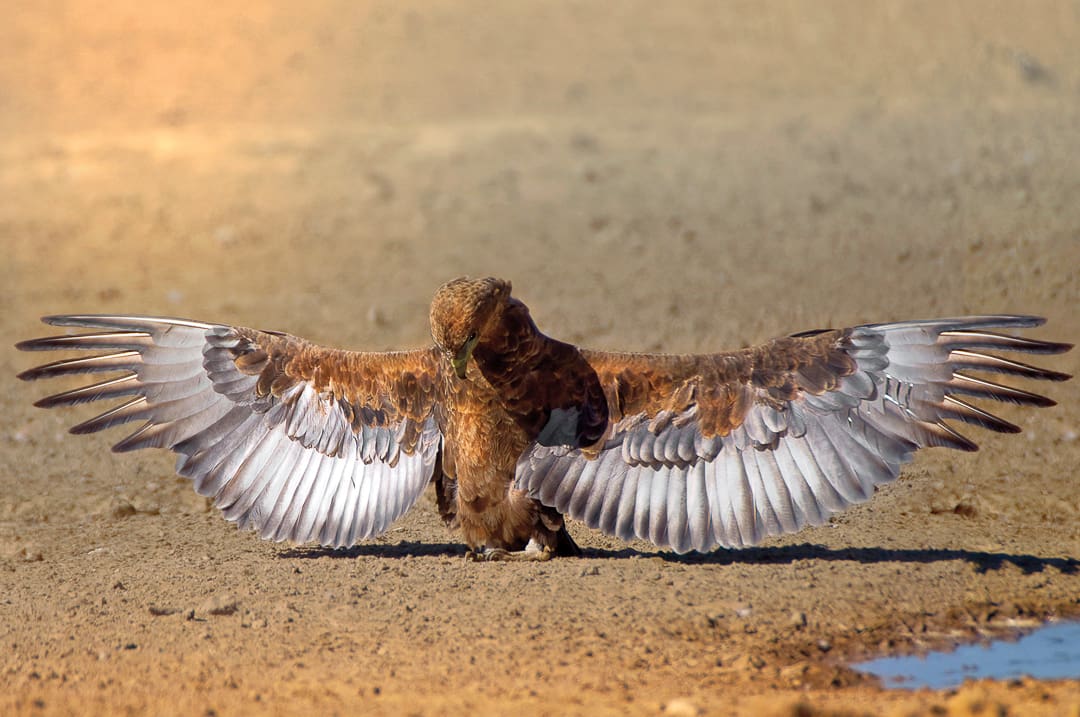
As a destination for wildlife and avian photography, the park is superb. If you’re a committed landscape photographer, this area offers haunting, breathtaking images. The Kalahari is part of a raptor belt, home to 40 raptor and vulture species in South Africa and seven owl species nationally.
At a waterhole on the Botswana side, I once witnessed something quite extraordinary. I call it a raptor convention. Perched in the surrounding camel thorn trees, drinking the water, sunning themselves, flouncing, prancing, preening, presenting, and confronting, was every conceivable raptor species in the park—all converged on this spot for no apparent reason. I told one or two of the avian photographers I saw at the camp, and they were off in a cloud of dust. Discussing it with them later, no one had an answer.
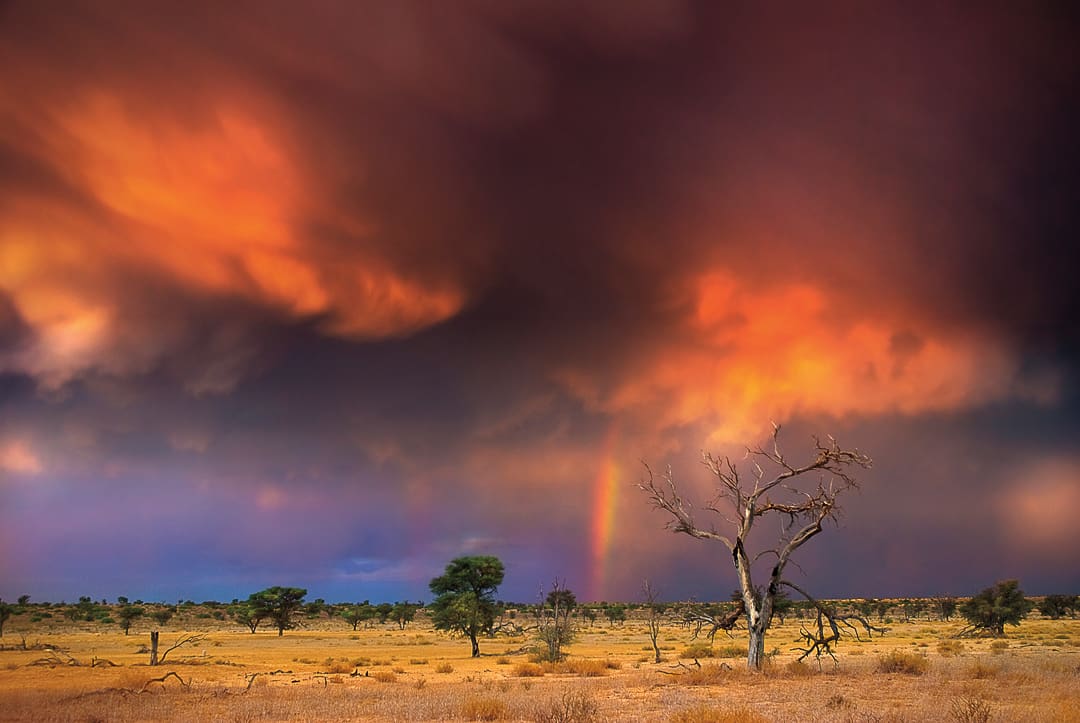
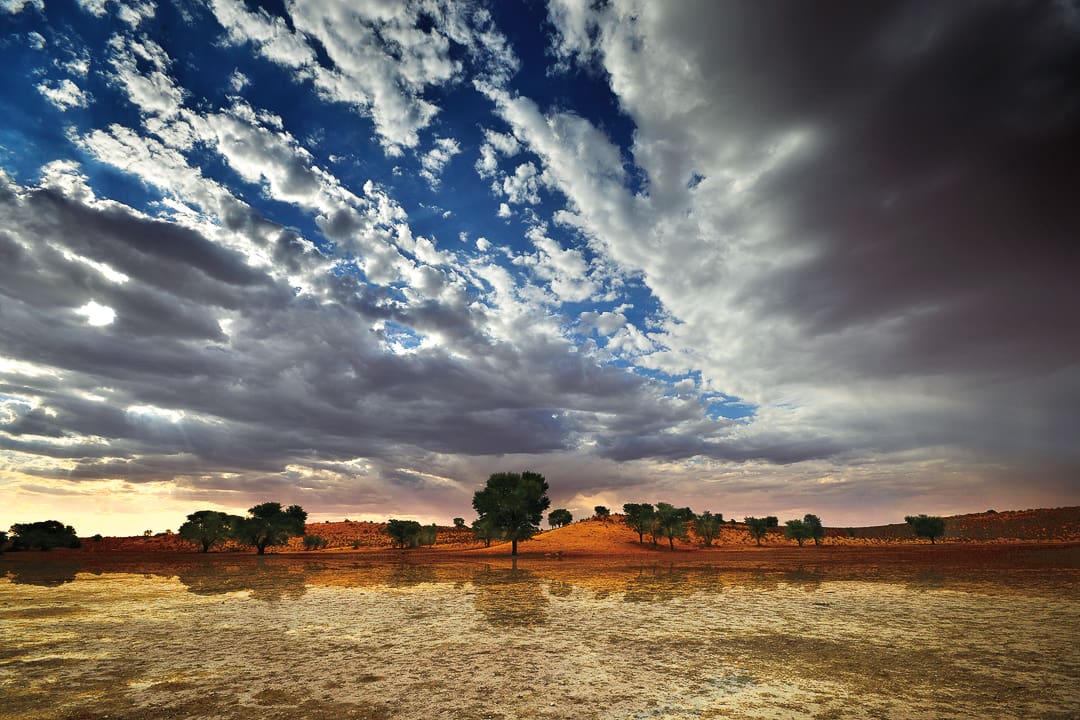
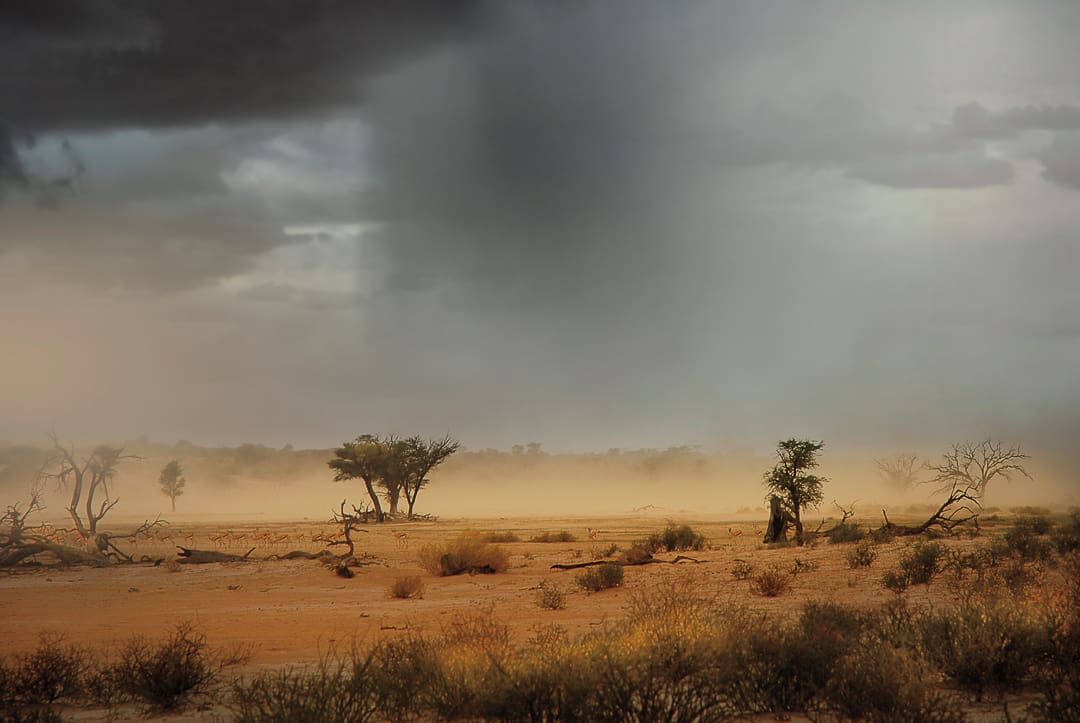
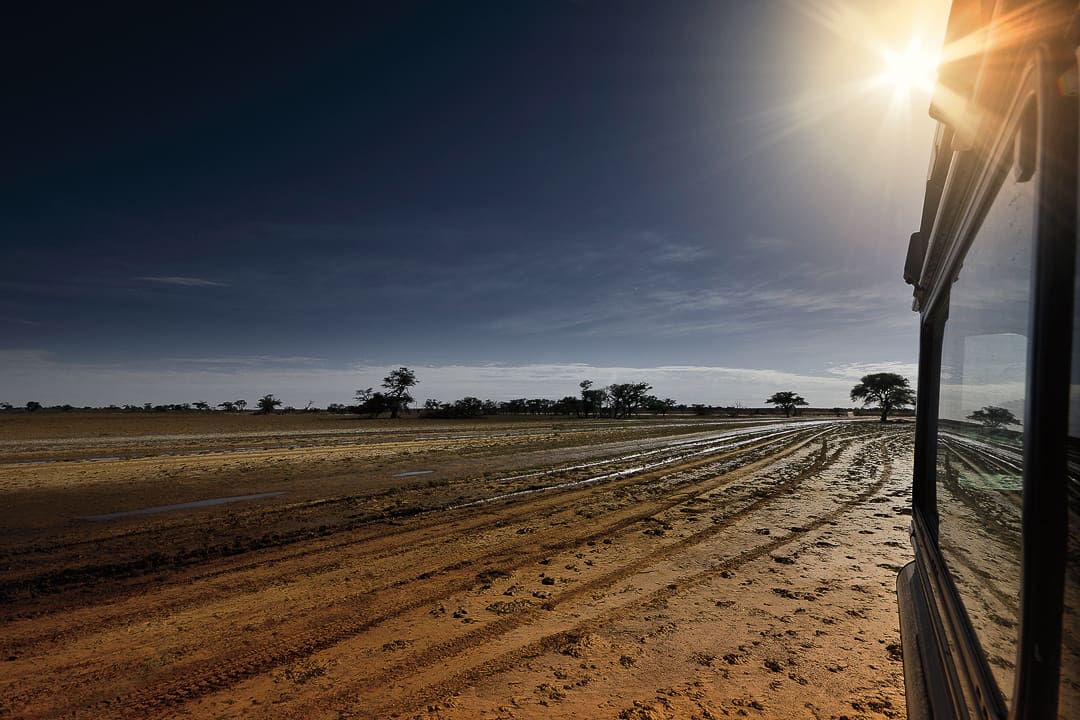
It’s a place where your camera needs to be on standby; the unpredictability of what you could see is the beauty of it. Although the scorching season with volatile storms and dust devils creates mayhem with camera equipment, I love the contrasts of the heavy clouds and the reflections and dust in the air, when a muddy track can become a work of art, and a landscape filled with drama tells a story.
Quintessential Fright Night
Each adventure is a learning curve. Spending about three weeks in the park gives one the opportunity to visit various areas, crisscrossing from South Africa to Botswana. I often leave my main tent at Nossob and take a small hiking tent to use at the other camps. This is fine at the camps in South Africa that have fences, but in Botswana, there are no fences.
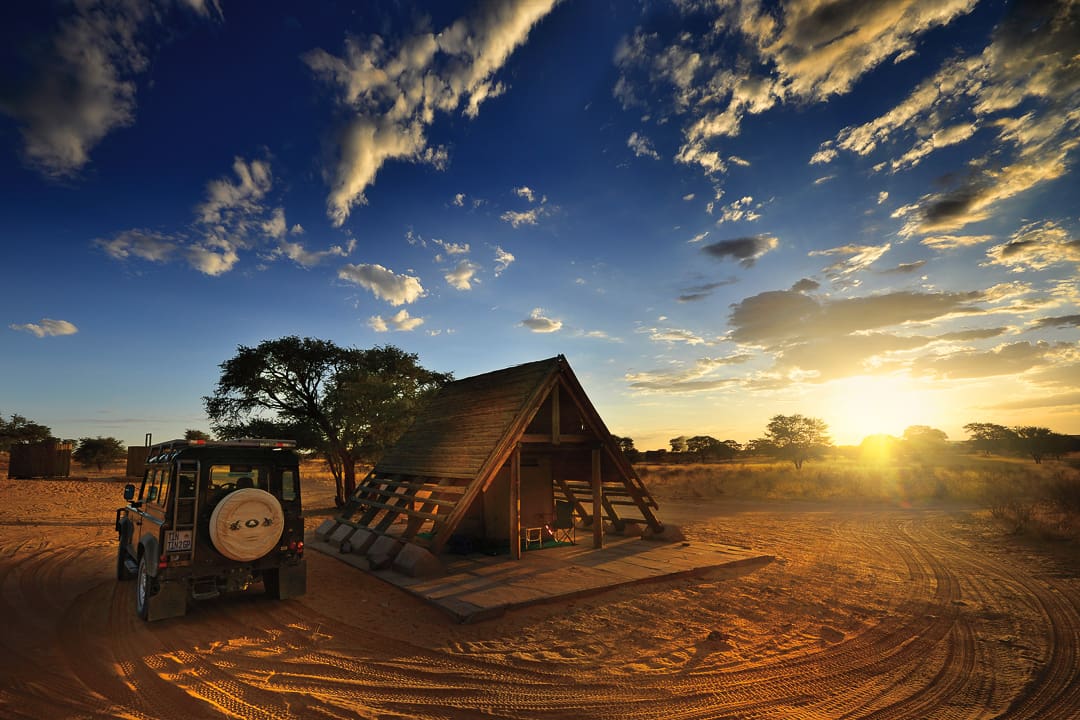
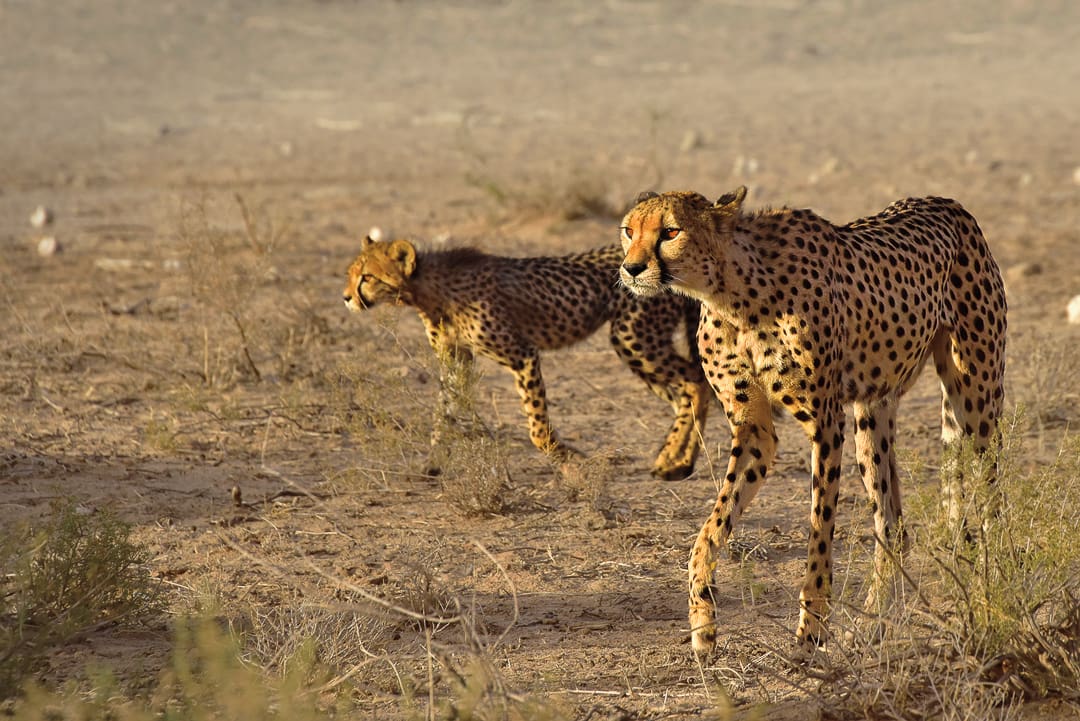
A couple of years back, two family members accompanied me to the park for the first time. They had arrived with a 4WD camper trailer and their Defender. After a smart operation of putting the tent structure up, we settled in for the night. My hiking tent took seconds to pitch nearby, and we said our good-nights. I told them earlier in the day there were likely no lions around as we had a cheetah family close by. Wrong.
The roaring started and within minutes got louder, then deafening, interrupted by a jackal wailing. For what seemed like hours, two male lions were around my tent; their intense roaring went straight through me as I lay sweating in what must have been a fetal position. The more I sweated, the more I assumed they could smell me and would extract me like a sardine out of my petite tented abode. My family watched in horror from their perched trailer. Suffice it to say, never again would I camp in a small tent on the ground in Botswana.
Camp Character
There are three main public camps with some rustic accommodation in the form of chalets and huts, comfortable enough for those not camping. Camping is part of the culture, though, and over the years I have watched Nossob and Mata Mata grow from having a couple of regulars to becoming much more popular.
These camps, with their ample character and stories, are delightful. Years ago, the manager at Nossob started what was known as the Wailing Wall at the gate. Here all the hubcaps, registration plates, and whatever else had been shaken off and found on the route were presented for all to see. If you had lost something, you would sheepishly go and claim it as yours, amid the clapping of amusement.
Sand Between Your Toes
Part of the exhilaration for me is packing, checking gear, and preparing camera equipment. With every trip, I learn something more: what not to bring, what I should have packed, what needs to be adapted, and what was a complete failure or success.
Loaded and ready to roll, driving out my gate, my heart always beats faster, and my hands sweat a little in the delicious anticipation of what is to come. When I leave after a couple of weeks, after experiencing another slice of life in this arid and remarkable place, I wonder what I’ll be missing—the creatures that will be born, live, and die without me ever knowing or witnessing them. The park seeps into your psyche as you become more familiar with its pulse on each journey. Once the red Kalahari sand gets between your toes, it stays forever.
TRAVEL TIPS
The trend has grown for overseas visitors to fly into Upington, the closest town to the park, and hire a 4WD vehicle with a rooftop tent and all the camping equipment needed. Grocery shopping is done in town, and the drive is an easy distance to the park entrance at Twee Rivieren, which is approximately 265 kilometres.
The best time to go is in March, April, May, September, October, and early November. The winter season is June, July, and August; temperatures fall below zero at night and warm up during the day. The summer season is December, January, and February; it is very hot, with unpredictable storms.
The park is not a high-risk malaria area, but be cautious of scorpions and snakes. Bring your own drinking water, and be sure to deflate your tires for the soft surfaces—two essentials best not forgotten.
RESOURCES
Main camps in South Africa: Twee Rivieren (entry, restaurant), Nossob, Mata Mata (camping and chalets), power points at most camping sites.
Wilderness camps in South Africa: Kielie Krankie, Urikaruus, Bitterpan (4WD access only), Grootkolk, Kalahari Tented Camp, Gharagab.
Camps in Botswana: Two Rivers (camping and chalets), Rooiputs (camping only, no fences, no children), Polentswa (camping only, no fences, no children), no power points, must be self-sufficient.
Four-wheel-drive routes: Nossob 4×4 Eco Trail, Bitterpan Trail, Mabuasehube Wilderness Trail, Wilderness Trail, direct route from Nossob Riverbed to Mabuasehube, direct route from Kannaguass to Kaa.
Park website: sanparks.org
Upington car rentals: kalahari4x4hire.co.za , drivesouthafrica.co.za
Maps from Tracks4Africa: tracks4africa.co.za
Our No Compromise Clause: We do not accept advertorial content or allow advertising to influence our coverage, and our contributors are guaranteed editorial independence. Overland Collective may earn a small commission from affiliate links included in this article. We appreciate your support.
