

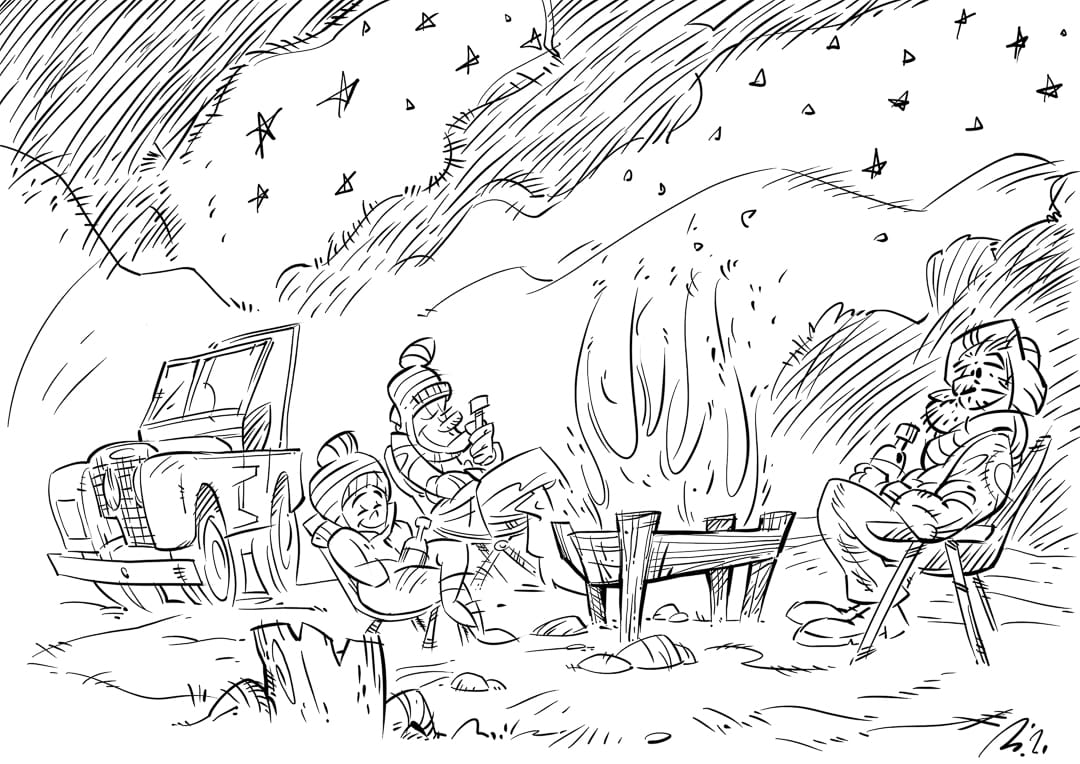
Illustration by Michele Dallorso
To honor the 20-year anniversary of Overland Journal, we are revisiting special heritage content in the upcoming 100th issue of the magazine. Originally published in Overland Journal’s Fall 2021 issue, this article is part of that celebration.
I stepped out of the airy hall of Durban’s King Shaka International Airport with my wife, Jenna, blinking in the midday glare. The warm air carried the familiar scents of dry earth, diesel exhaust, sweat, and the ocean. These were the aromas of home, and it felt good to be back in South Africa.
A middle-aged man wearing faded and torn jeans, a floppy cloth cap, and sandals sauntered over to us. The sleeves of his rumpled henley shirt were pushed up and a gleaming Breitling watch dangled from one wrist. His stubbled face broke into a beaming grin. Thus I met Kenneth Jones, at once a stranger and friend.
Having spent the best years of my childhood in Zimbabwe and Kenya before settling in Michigan, I moved to South Africa after finishing university in 1998. Work and graduate school called me back to the States the following year, but I was determined to return one day and to introduce my wife to the wonders of the Rainbow Nation. In 2015, while researching 4WD rentals for the trip, I contacted the KwaZulu-Natal Land Rover Owners Club. Kenneth responded, offering me the use of his Defender 110. Over email, we got to know each other. Soon Jenna and I were club members and registered for its annual trip to Tembe Elephant Park.
It didn’t take long to figure out which car was Kenneth’s.
We loaded our kit into the back of his green, canvas-topped 1956 Series One Land Rover and clattered away, Jenna astride the gear shifter. Our indirect route to Durban’s leafy neighborhoods took us along back roads bisecting rolling hills of verdant sugarcane plantations. Traversing these vestiges of colonial influence, we learned more about our generous host.
Kenneth was a commercial property surveyor by trade, traveling around Africa and the Middle East to estimate valuations on land destined to become offices and shopping malls. His work took him across the province, as well, and he usually drove to sites in his ancient Land Rover.
“Everyone loves an old Landy,” Kenneth explained. “It’s slow, but it makes it easier to connect with people. It sets a more relaxed tone than if I show up in a posh new car.” He gave us the rundown on the rest of his Rover fleet: a Series One 107″ pickup, a Series IIa rock crawler, the Td5 Defender, and a scarlet red 101 Forward Control ambulance converted to an off-road rally racer. “My wife wants me to get rid of the 101,” he confided with a smile, “but I might get to keep it if I turn it into a taco truck.”
A few days later, Jenna and I pitched up at Kenneth’s house at dawn, packed and ready for Tembe. We were surprised to find that despite the long drive ahead and warning from the club chairman to reach the park before the gates closed at 4:00 p.m., Kenneth was nowhere close to being ready. A family of monkeys watched us from their perch atop a neighbor’s fence as we transferred our gear into the vehicles. I bit back my impatience as Kenneth haphazardly gathered his camping equipment.
A phone call pierced the morning’s creeping heat. A fellow club member, already at the entrance to Tembe, had correctly guessed that Kenneth would not yet have left and relayed a request from a game warden. Could we pick up a new car battery? Happy to help, we took a detour to a parts supplier. As we headed in the opposite direction to the park, Kenneth observed that they’d have to let us in if we arrived late.
We merged onto the N2 motorway hours behind schedule. The Defender was no speed machine, but our pace behind the laden Series One felt comically slow. Kenneth had cautioned us about the myriad hazards of the chaotic road. “It only has two lanes, but drivers make five lanes out of it. Keep an eye out behind you and move over onto the verge to let faster cars go by. But watch for the bicycles, donkeys, taxis, and pineapple sellers on the side of the road. Oh, and mind the sugarcane lorries and the potholes. It’s good fun.”
I gripped the steering wheel with white knuckles as BMWs rocketed past us on the right, taxis careened on and off the road, and the sugarcane lorries showered us with vegetation. Kenneth flashed an easy grin when we stopped to fill the jerry cans at Hluhluwe. “We’ll make it no problem.”
Dusk was upon us as the anxious park ranger unlocked the entrance gate. “You must go straight to the camp,” he instructed. “Vehicles are not allowed to travel after dark; it’s too dangerous. Do you know the way?” “Yeah,” Kenneth replied. “I’ve been here before.” Half an hour later, the arms of night had embraced the park. Jenna recognized a sandy intersection we’d passed 10 minutes earlier. “Kenneth, do you reckon we should have a look at the map?” “Who needs maps?” came the jaunty response. When the warm pool of our headlights finally splashed across the camp, I breathed a sigh of relief. Laughter reverberated around the fire as other club members settled their bets on how late Kenneth would arrive. Thankfully, they had saved us some antelope stew. “See?” he said, handing me a cold beer. “It all works out.”
In 2017, Jenna and I returned to Durban. Our plans included a drive across the roof of Africa with Kenneth on a traverse of the mountain kingdom of Lesotho. This time he drove his latest acquisition: a 1949 Series One Land Rover. True to form, we made a casual start. I loaded the Defender with my Pelican cases, dry bags, and expedition duffels, all secured with nylon cam straps.
A realization dawned on me as I gripped the steering wheel with white knuckles as BMWs rocketed past us on the right, taxis careened on and off the road, and the sugarcane lorries showered us with vegetation. Kenneth tied a canvas sack, wooden crates, and leather satchels into the Series with sisal rope. He wasn’t just driving a 68-year-old Landy; every single accessory was period correct. With the exception of his smartphone, Kenneth was a living museum display.
That night we had the entire bunkhouse to ourselves at Sani Stone Lodge, perched at 9,200 feet near the edge of the Drakensberg escarpment. Although it was the beginning of summer, the clear night was bitterly cold. I heated soup on my miniature gas stove and came outside to watch the stars with Jenna and Kenneth. Huddled around the glowing coals of the braai while our boerewors sausage cooked, we stared up into the sky. Jenna and I shivered slightly in our synthetic-fiber-insulated-mountaineering parkas. Kenneth looked positively snug bundled up in his knee-length woolen overcoat and scarf.
Awakening to ice on the ground, we drank tea from enamel mugs and prepared the Landies in the feeble sun. Lashing down his relics, Kenneth looked perfectly at home in this landscape. Windswept, sparsely populated, and rugged, eastern Lesotho seems little changed in 60 years. Here Kenneth was in his element, experiencing the present as if it was the past in his battered British time machine. We bounced after him over the plateau, ascending steeper climbs in low range and pausing as flocks of sheep crossed the rocky track.
Out here, the roads were unmarked and the villages sparse. This time I didn’t worry about a map. “One of the magical things about Lesotho,” Kenneth explained over tea, “is that distances are deceptive. You think, ‘It’s only 180 kilometers to Katse Dam,’ but that will take us more than six hours to cover because the roads are so poor.” When we eventually reached the dam, the young gate officer came running out to marvel at the Series One, asking Kenneth to take a picture of him with it. “What did I tell you? Everyone loves an old Landy.”
As we wound deeper into the mountain kingdom, I grew less concerned with time. The days stretched out, and the destinations faded in importance. We stopped and chatted with locals, always greeted with warmth. Letting go of my need for structure, I felt more in tune with the landscape. It grated against my “plan ahead and prepare” mindset, but there was something refreshing and serendipitous about Kenneth’s nonchalant approach to travel.
Back in the States again, I miss that feeling. Sometimes I close my eyes and hear the contented putter of the Series One; I smell the hot, dusty air and feel the jarring road through creaky leaf springs. My anxieties unravel, and I’m comforted knowing that Kenneth Jones is out there, taking life as it comes with a smile—even if he did run out of petrol in the middle of Lesotho. The world needs people like him to remind us to drive a little slower, to let the adventure unfold on its own without trying to create an experience to match our ideas of what it should be. I don’t think I could live in his museum, but it’s always a pleasure to be a guest on his antiques off-road show.
Our No Compromise Clause: We do not accept advertorial content or allow advertising to influence our coverage, and our contributors are guaranteed editorial independence. Overland Collective may earn a small commission from affiliate links included in this article. We appreciate your support.