

To honor the 20-year anniversary of Overland Journal, we are revisiting special heritage content in the upcoming 100th issue of the magazine. Originally published in Overland Journal’s Summer 2010 issue, this article is part of that celebration.
Home, they say, is where you hang your hat.
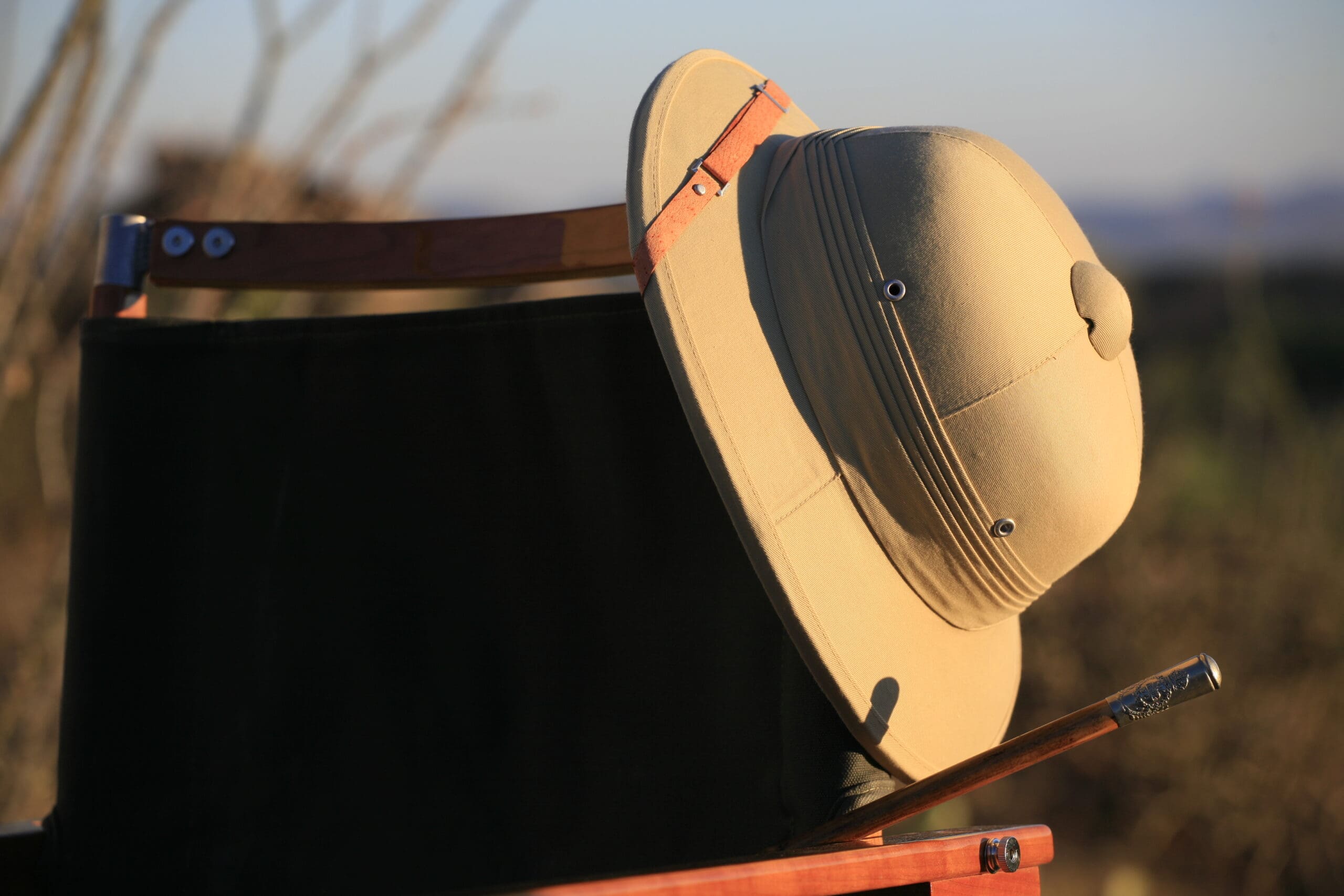
If that hat happened to be the legendary pith helmet, and got hung at all, it might have been over the arm of a campaign chair, while on campaign, or off the thorny branch of an acacia tree while you shaved with your bush knife. There is no more powerful visual symbol of adventure, and to retrace its storied 150-year history is to revisit the age of empire and walk in the footsteps of countless soldiers, big game hunters, and explorers on the leading edge of discovery. Conjure up the image of a British explorer pushing through the tall grass of the Savannah, or hacking through the dense jungle with a line of porters in tow, and most certainly that image will include a pith helmet.
It’s difficult to pin down the exact genesis of the pith helmet. Historians agree the first rudimentary versions began to appear in British Colonial India in the mid-1800s. Born of the need to protect fair-skinned British soldiers from the fierce sun of the Indian subcontinent, the first pith helmets were likely a collaborative effort between British and Indian hatters. The name of the helmet, unimaginative as it is, refers to the material from which it is made. Molded from the dried cork-like pith of the sola plant, the helmet is then covered with a thin layer of cotton and fitted with a leather chin strap. Variations on the design often include decorative headbands, distinguishing insignia, and a narrow range of colors from white to olive drab. It’s been suggested that the hard form of the pith helmet initially appealed to the tidy nature of the British military, as it kept its shape in the most challenging of conditions, even after being soaked in water for evaporative cooling effects (other reports claim the genuine article turns to mush if soaked).
Soon after its inception, the British issued pith helmets to their troops around the globe, making it part of the lasting imagery of the Anglo-Zulu and Boer wars, among other British military exploits. It must have been dear to the troops in those early years, as they sacrificed their beloved tea as a means of dyeing their white pith helmets a more camouflage-appropriate khaki.
Before you read any further in your best British accent, it must be pointed out that the pith helmet took but a few years to become the adopted headwear of nearly every fair-skinned military force serving in regions of the globe sunny enough to bronze a nose. It wasn’t long before Dutch, German, and American forces were wearing their own pith helmets, sometimes introducing new shapes to the original design. There are as many shapes of pith helmets as there are nationalities who use them. During the second French colonial period, most French forces in Southeast Asia were issued pith helmets. It was the reach of the colonial era in the late 1800s that gave the pith helmet such widespread acceptance. Nearly every corner of every colony was either a place where pith helmets could be manufactured, deployed, or both. Pith could be grown in French Indochina and the helmets sent to troops in Algeria.
By the onset of WWI, the pith helmet had become standard issue for nearly every serviceman in warmer theaters. At the Battle of Ngomano in East Africa in 1917, German infantry defeated Portuguese forces and in the aftermath claimed uniforms—and specifically the superior Portuguese pith helmets—as spoils of war. Years later, as Hitler’s Afrika Korps rolled into North Africa, production of pith helmets had to be quickly ramped up to meet the demand. With mass production came alternative, inferior materials to natural pith. British helmets during World War Two were so disliked by the troops that upon first sight of the British coastline on their return home, most British servicemen threw their helmets into the sea. It was reported that thousands of them floated ashore with the arrival of each troop transport, making pith helmets of that era scarce and highly sought by collectors. American servicemen in warm war theaters also used pith helmets. It was just as likely to see one on the head of a shovel-wielding Navy Seabee building a landing strip on the Solomon Islands as it was to see Admiral “Bull” Halsey wearing one as he addressed his landing parties.
As is the case with most quintessential pieces of military kit, the pith helmet was equally well received by civilian users. Many of the early colonial officers exited the rank and file of armed service and slipped into the bush to explore the uncharted corners of the globe, and they often took their pith helmets with them. The list of aficionados is essentially a who’s who of adventure and exploration. In 1871, when Henry Morton Stanley finally found Dr. David Livingstone in the heart of Africa, he was wearing a pith helmet made on Savile Row. That very helmet is on display at the Royal Geographical Society in London. One of the finest photos of Stanley, albeit staged, is of him wearing his helmet, gun at the ready, steely eyes peering off into the “bush.” The US Library of Congress has fascinating film footage documenting Teddy Roosevelt’s 1910 hunting excursion in East Africa, showing every member of his party wearing a different variation of the pith helmet. Teddy looks magnificent in his jodhpur pants, tall boots, and infantry-style pith helmet shading his round spectacles. Other photos of that same trip reveal that Teddy must have packed several helmets—perhaps one for hunting big cats, another for spectating native dances, and so on. In the early 1920s, renowned big cat hunter turned conservationist, Lieutenant Colonel James Corbett, was photographed relaxing in his Roorkhee campaign chair, wearing his Indian-style pith helmet after a day on the hunt. As the cliché goes, the hat doesn’t make the man: Corbett, the author of Man Eaters of Kumaon and several other best-sellers, was heralded as having saved 1,200 human lives by killing as many as 33 confirmed man-eating tigers and leopards.
With the age of empire behind us, the source of the Nile found, and Jim Corbett now the namesake of a national park in India, where does that leave the pith helmet today? Surprisingly, it’s alive and well. Vietnam inherited an affinity for the pith helmet from their no- absent French colonizers, and it remains popular wear there for authorities and civilians alike. Vietnam is one of the largest manufacturers of authentic, hand-made, sola pith helmets in the world, at very reasonable prices.
Other manufacturers are still producing fine-quality helmets worthy of the most forward-serving officers of the British Empire. James Lock & Co. of London has been making a variety of hats since 1676 for the likes of Lord Nelson, Winston Churchill, and other historic notables. Their authentic pith helmet can be yours for a paltry $325. Hobson & Sons, also of London, has been manufacturing pith helmets for the British military for over 100 years, and continues to provide the Home Service pith helmet for the British Royal Marines. The pith helmet is far from obsolete. It’s possible your postman might deliver your mail in the comfort of a pith helmet (albeit an ersatz mesh or Styrofoam version) if you live in the sun-soaked regions of the US. The pith helmet is very much alive, and as practical today as it was in those early years during the British Raj. No one says you have to take down a man-eater or discover the headwaters of the Nile to wear a pith helmet, but to rest one atop your head is to ready yourself for a grand expedition, even if it’s just to the far corners of your backyard.
Resources
villagehatshop.com, 888-847-4287 (Vietnamese pith helmets)
Editor’s note: Since this article was published in Summer 2010, Lock & Co. no longer sells pith helmets and Hobson & Sons was officially dissolved in 2025. Lead photo by Jonathan Hanson.
Our No Compromise Clause: We do not accept advertorial content or allow advertising to influence our coverage, and our contributors are guaranteed editorial independence. Overland Collective may earn a small commission from affiliate links included in this article. We appreciate your support.
