

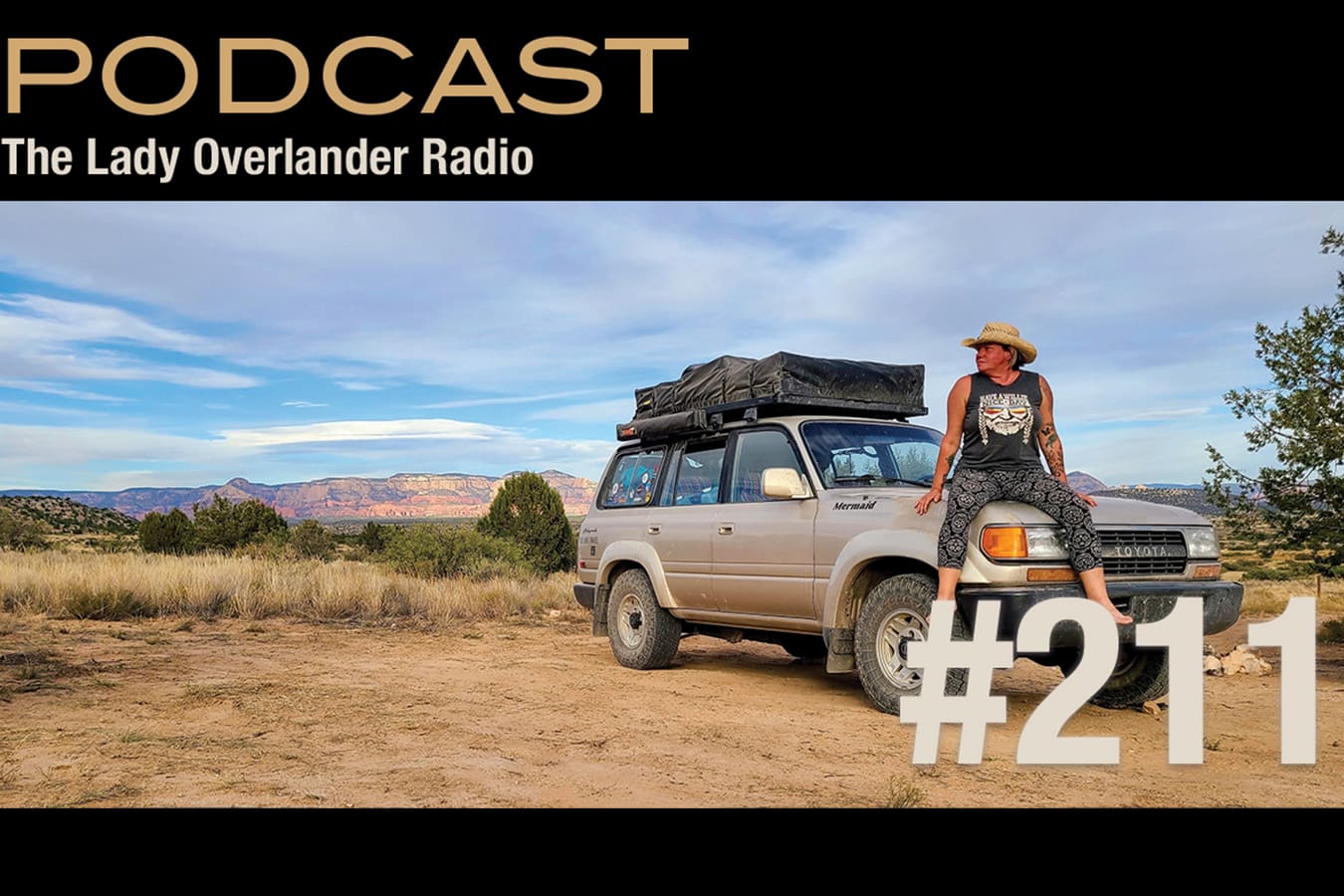
Overland Journal Podcast host Scott Brady interviews Misty Tokarski, co-host of Ladies Overlander Radio and a retired Coast Guard traveler, about lessons from military life, international travel, and overlanding with family using a Jeep Wrangler and a Toyota 4Runner. Misty discusses learning navigation skills like paper charts, dead reckoning, and using an alidade, and shares goals like eventually doing the Rebelle Rally. The conversation focuses on supporting women in overlanding through women-centric training spaces, addressing common concerns like safety and hygiene, and encouraging vendors to speak directly with women. Misty offers practical safety advice (trust intuition, move camps, use car alarms, share location via inReach/Life360) and emphasizes knowing how to use gear. She also highlights her women’s overlanding event, Feralosophy, in northwest Arkansas, and how to connect via ladyoverlanderradio.com and the Ladies Overland Lounge group.
Overland Journal Podcast Episode #211
The Overland Journal Podcast is brought to you this week by Overland Journal Magazine
New to Overland Journal and want to grab a subscription! Visit Overland Journal and enter code: overlandpodcast at checkout for 20% off. We thank you for being a subscriber.
Guest Bio:
https://ladyoverlanderradio.com/about-us
https://ladyoverlanderradio.com/
https://www.youtube.com/@ladyoverlanderradio
https://www.instagram.com/ladyoverlander.radio/
Social media handles:
@barefootoverlander
@ladyoverlander.radio
@thedaywemake
Host Bios:
Scott Brady
Scott Brady is an adventurer, author, and publisher, and the first person in history to cross all seven continents. Brady is executive publisher of the Overland Collective, home to Overland Journal, the Overland Journal Podcast, and expeditionportal.com—the world’s largest vehicle-dependent adventure community. Scott wrote Overlanding 101 (Simon & Schuster) and is currently riding around the world on his BMW GS. He also led Expeditions 7, the first expedition to drive the same vehicle on all seven continents. Brady’s polar crossings include Antarctica and a south–north crossing of the Greenland ice sheet. Scott is a fellow of the Explorers Club and lives in Prescott, Arizona.
Tune in Apple Podcasts | Spotify | YouTube
Our No Compromise Clause: We do not accept advertorial content or allow advertising to influence our coverage, and our contributors are guaranteed editorial independence. Overland Collective may earn a small commission from affiliate links included in this article. We appreciate your support.
Transcript
Scott: [00:00:00] Hello, and welcome to the Overlanding Journal Podcast. I am your host, Scott Brady, and I’m joined today by Misty Tokarski. Now, Misty is one of the hosts of the Ladies Overlander Radio, which is a podcast that’s available on all of the popular podcast outlets. Now, this is a really cool podcast ’cause they spend the time interviewing ladies from around the world that are exploring, traveling, and learning, and they’re sharing that with each other on the podcast.
Misty’s an accomplished traveler herself, has traveled internationally. She’s also spent a career in the Coast Guard, and she travels in an interesting way. She, she uses two separate vehicles to travel around the country, uh, with her family, and she shares some of her insights around that. She also shares some of her insights around travel in general.
A very cool podcast. It was really a pleasure to get the time to spend with Misty and to learn more about their [00:01:00] podcast, which we recommend that everyone listens to. So please enjoy my conversation with Misty
Misty: And a special thanks to onX for their support of this week’s podcast.
Scott: Going further on your adventures is about having the right tools.
The onX Offroad app’s intuitive maps make it easy to find trails and disperse camping, and their offline maps give you full GPS navigation capabilities even without cell coverage. Personally, I use onX for every trip in North America because I always know who owns or manages the land that I’m traveling on.
It also makes for a reliable track recorder, and I can filter the trails based on the four-wheel drive or motorcycle that I’m using. On my most recent trip in the Quartermaster, I used the onX to find trails near where I was staying in Joshua Tree. I used the difficulty rating and the elevation to, to determine [00:02:00] which trails are best suited to the vehicle and the weather.
Thanks again, onX, for your support of the Overland Journal podcast So Misty, thank you so much for being on the podcast with me today. I’m so excited to have you because I’m just a big fan of what you’re doing with Lady Overlander Radio and your podcast. You’ve had some amazing guests on there, people that I really respect.
And I’m just, I’m looking forward to hearing about your story, maybe some of the things that you’ve learned- Mm-hmm … on from your podcast guests, and if you’ve consolidated your own experience plus all of those amazing travelers that you had on the podcast and how you pulled them all together. So thanks for being with us today.
Misty: Thank you. Yeah, I’m very excited.
Scott: Awesome. Let’s start off with, as I understand it, you and your husband were in the National Guard.
Misty: Coast Guard.
Scott: Coast Guard. Coast Guard. Difference. Yeah. So Coast Guard. Apologies. How did that feel going from a career in the Coast Guard to now traveling full-time [00:03:00] on the road?
Misty: I think that the Coast Guard spoiled us and damaged us a little because we’d moved around so much. Every two to three years we would go to a new duty station.
Scott: Sure.
Misty: We just kept that travel bug where- Travel
Scott: was in your
Misty: blood … nowhere was home. Sure. Just wanted to continue that after we retired and-
Scott: That’s cool.
Yeah. And what was one of your favorite duty stations that you were stationed at in the Navy?
Misty: Ironically, one of my favorite duty stations was my very first one, and I really didn’t think I was gonna like it when I first got there, which was Rockland, Maine.
Scott: Oh, cool.
Misty: So I’m a Florida girl, born and raised.
Oh. And my first duty station was up in Maine, and I thought the- Oh wow, talk
Scott: about a difference …
Misty: yeah. I really thought it was the end of the world.
Scott: Yeah.
Misty: Like-
Scott: In some ways it is, it’s pretty far up there …
Misty: yeah. So I tried to adjust my thinking and said to myself, “I’ve gotta make the best of this.” I’m young, I’m, I was young and single at the time, didn’t have a lot of money, doing the non-rate brand-new military person thing.
Scott: Sure.
Misty: And just had to adapt to that environment and persevere and I ended up [00:04:00] finding a lot of, I found a love for hiking, I found a lot of things in that area that I never expected I would be interested in or, or enjoy. Sure,
Scott: sure.
Misty: And it just changed my perspective on things. And I put that mindset in where every place is gonna be what you make of it, so you can either have a really good attitude about it or you can have a poor attitude and it’s gonna be that way either way, so.
Scott: Isn’t that true? It seems like in life, if you think about it, the only thing we actually have any control over is our response to things. Mm-hmm. Is our attitude. Uh, because our money can be taken from us, our health can be taken from us.
Misty: Yeah.
Scott: But, and you just never know what circumstances can arise in life, but- Even our, in our last moments, the only thing that we have any control on is how we react.
Misty: Totally.
Scott: Our attitudes. And I think that the military does help with that. I know that in my time in the service that I went from being at home, I had such supportive parents and, but I was also, I felt like I [00:05:00] was without a rudder. Like I didn’t really know what direction I wanted my life to take me. And the military, because it removes a lot of decisions- Mm-hmm
it helps you see what’s most important
Misty: It, it does, yeah …
Scott: that you can really see which direction that you wanna go. And it gives you some self-confidence, teaches you a little bit of leadership, gives you a little bit of a backstop if you make some mistakes.
Misty: Yes.
Scott: So it’s pretty-
Misty: Definitely …
Scott: pretty interesting how that makes a difference.
So, one, I mean, I would think one of the things about, cool about being in the Coast Guard is that you’re always on the coast. So did you start off preferring more, like boats and sailboats and things like that, and then you slowly got into vehicles? Or at what point did you kinda transition towards wanting to be more vehicle-based travel?
Misty: 20 years in the Coast Guard, being around the water and being on and around boats made me realize that I don’t wanna go on cruises. I
Scott: don’t- You got the T-shirt. You’re done …
Misty: I got, yeah. I, I’m over the boats. I probably will never sail around the world or anything like that. Uh-huh. Just so everybody’s aware of [00:06:00] that.
Yeah. I do still enjoy the ocean. Sure. That’s one of my favorite places, but I just really wanted to be able to go to all of those places I watched on TV or heard about as a kid. For example, my bucket list continent is Africa. I cannot wait to go and explore.
Scott: My favorite spot.
Misty: So I did the water and the ocean thing.
I’ve been to the Caribbean. I’ve been to South America and Central America by ship. I’ve been through the Panama Canal by ship.
Scott: How was that?
Misty: It was long.
Scott: Was it? It was long. Like longer than you expected?
Misty: Because it took, I think it was like 12 or 13 hours, and I was standing out on the side of the bridge, and I was taking bearings with an alidade.
It was one of my additional duties on the ship. Yeah. Everybody had extra duties they had to do. And so we had to set sea detail, and I had to stand out there and take bearings, and it was just a really long day.
Scott: Hmm.
Misty: We were following a cruise ship through the locks and you just have to wait to move to the next lock.
And it was a neat experience, but very long day.
Scott: So for, to help those that are listening, why don’t you explain what an alidade is?
Misty: Okay. So it is a [00:07:00] nautical piece of equipment that, that helps with navigation. It helps take bearings off your location and, and other s- fixed objects.
Scott: Mm-hmm. And so- So you triangulate your spot-
Misty: Right
Scott: on a map?
Misty: Mm-hmm.
Scott: And what other navigation principles did you learn when you were in the Coast Guard? ‘Cause you probably learned a lot about dead reckoning- Mm-hmm … and triangulation.
Misty: Yeah.
Scott: Probably GPS as well?
Misty: Yeah. So later on in my career, I got in- more into GPS and, and things like that. But when I first started, it was a lot of paper charts, a lot of- Sure
drawing your bearing and figuring out which direction you needed to go. And at my first duty station, when I was up in Maine, I was at a small boat station, so we had to, as part of our qualification process, we had to go and they would tell us, “We want you to go to this position or this location,” and we had to navigate ourself there, be ourselves there as part of the qualification process.
Scott: That’s cool.
Misty: Yeah.
Scott: And that probably is quite helpful in even overlanding today. You- You’re able to take all those dead reckoning skills and map [00:08:00] reading skills and all of that-
Misty: Yeah …
Scott: apply it to your own travels.
Misty: Mm-hmm. One day I hope to apply those skills in the Rebelle Rally.
Scott: Have you done that yet?
Misty: Haven’t done that yet. Oh, you’d be a per- But we are talking about
Scott: doing it … you’d be a perfect fit for that.
Misty: Yeah.
Scott: Anyone who I have talked to that has participated in that event has said it’s either life-changing or one of the most fun things that they’ve ever done. So our producer, Paula, got to do a couple days as part of a media group last year, and now she can’t wait to get, um, with a team to do it with the whole event.
Misty: Yeah, I’ve interviewed several Rebelles, and they all tell me the same thing. Once you start doing it, you’re gonna wanna do it every year.
Scott: And Emily Miller is just incredible. Incredible business person, very successful driver, and the… I would say that the quality at which she has executed that event is really without peer in the United States.
Mm-hmm. I mean, if you were even to compare it to the Baja events, it’s at a whole ‘nother level of execution. So it just really shows her skills in so many areas.
Misty: And I [00:09:00] got to hear her speak up at the NorthWest Overland Rally a couple months ago as well. Nice. I’ve had her on the show as well, but she is just very inspirational.
She’s a… She definitely comes off as a great leader, very self-confident.
Scott: Absolutely.
Misty: You- Rock star … to me, when you look at her, you’re like, “Okay, everything’s gonna be okay,” because she knows what’s going on. So.
Scott: What are some of the things that you learned from her, so?
Misty: She just talked, she did a little round table thing with Patty Upton and, and another one or two women, and she just talked about trusting yourself- Yeah
and leaning into your own, your own confidence and just, just really focusing on believing in yourself and empowering yourself, and I just thought that was pretty, pretty awesome. Awesome. She’s very… You can tell she’s very well put together. She’s very smart. Yeah. And she’s-
Scott: Very bright.
Misty: Yeah. And she’s not afraid to compete in a mixed gender type of environment at all.
Do
Scott: you think that’s something that, uh, needs to be a, a more consistent message, is that travel is [00:10:00] available to all? There, there is- I do … no limitations. What do you think are some ways that as an industry you feel like we could improve that messaging, so?
Misty: So I think that starting with some of these shows, a lot of them are, are embracing doing women-centric programming.
I, I think that it’s not meant to be exclusionary. It’s meant to provide a smaller, safer environment for women to ask questions that they may not feel comfortable asking in front of a mixed crowd.
Scott: Sure.
Misty: So that’s one of the reasons why I embrace it so much. That’s why I started the podcast. That’s why I love to come and teach at these class, at these shows- Yeah
because I feel that it’s important if a woman wants to ask about a hygiene- Yeah … situation or wants to talk about her fears about traveling by herself, and she doesn’t want someone else to be there downplaying that or- Yeah … saying, “Oh, you’re fine.” She wants to be able to express those concerns, I think, in a welcoming environment, and that’s what I see starting to happen in the, not only the overlanding [00:11:00] world, but o- the off-road and automotive industry as well.
I see them realizing, hey, these women are purchasing vehicles as well. They’re- No question … they’re spending money. They’re buying rooftop tents, or they’re sleeping in their rig. They’re asking these questions. It’s the fastest
Scott: growing segment- Yeah … in travel, with solo female travelers.
Misty: Totally.
Scott: I, I really appreciate you sharing that because it’s, we, everybody needs their own way of connecting in with their hobby.
And, and it doesn’t matter how it needs y- it’s whatever they need in order to feel successful- Mm-hmm … in order to learn, and we need to continually adapt as an industry to meet the needs of people that are coming into the overland space. So I really appreciate your podcast. I appreciate what, what the Rebelle has done.
I appreciate the fact that those kinds of trainings are available at the Overland Expo- Mm-hmm … because we need it. We need even more of it. So how are some ways that businesses can support women travelers in [00:12:00] overlanding? What are some things that you think are maybe missing or where they’re missing the mark?
What are- if you had the opportunity to wave a magic wand, how would you see things improve?
Misty: So I think that I, and I have seen a little bit of that at this show, I think that these different vendors need to walk around and speak to women travelers- Yeah … face-to-face. See what works for them, what doesn’t. Oh, sure.
I, I know two of the biggest things that I encounter when I speak to other women, that they’re concerned with is safety and hygiene.
Scott: Sure.
Misty: Those are the big things. A guy, a lot of the times, like my husband for example, he can go and he doesn’t really necessarily care about showering. He’s, “I’ll shower when I feel like it,” or whatever.
Whereas some women-
Scott: Yeah …
Misty: are very much, “I can’t do anything about having clean hair every day. Maybe I don’t have to shower every day, but I have to have hair-” I definitely don’t have the
Scott: hair problem. Yeah.
Misty: Yeah.
Scott: Well, I think that there’s, I think it’s important also that there’s also a lot of men that like to shower- Sure
every day, and I think we need to keep, we need to provide solutions and help people feel comfortable saying, ’cause I would think that [00:13:00] because it’s this traditional perspective of you can go a month without showering, then that makes even the men that want to shower more often feel like they can’t even speak up- That’s true
about their needs. But I, I think that it’s so important, to your point, that we find ways to meet the needs of travelers wherever they are.
Misty: Right.
Scott: And hopefully that inspires more innovation within the marketplace. What are some things that you’re seeing on the product side that are doing a good job of addressing hygiene for your audience?
Misty: So a lot of the companies that create wipes, they’re making them more … I don’t wanna s- I don’t wanna necessarily wanna put things in genders. Yes. Yeah, yeah. More floral type scents or more- Sure … peppermint or things like- Yeah … lemon, things like that, where- Nice … might be more appealing to females.
Scott: Sure.
Misty: A lot of these companies, there’s a little company here that has a tiny little shovel for digging cat holes and-
Scott: Yeah, I saw that.
You can put some pellets in there that it’ll-
Misty: Yeah. There’s some kind of mushroom or something that- [00:14:00] Yeah. Yeah.
Scott: Oh, I didn’t know what it was, but it looked like a little pellet that would-
Misty: But I
Scott: th- That’s, that’s smart.
Misty: Yeah. I think a lot of
Scott: it- And there’s some much better toilet options now.
Misty: Yes.
Scott: And I like having a toilet just as much as anybody else, and I think that just removing that stigma of it’s the woman that wants the toilet, I think we should just take that off the table- Right
because y- yes, absolutely if you need one, get one, but everybody benefits. So let’s take that away so that way people aren’t feeling concerned about having one in their vehicle. Like, I was just talking to a composting toilet company here, ’cause I like having a composting toilet- Mm-hmm … in my camper. I’ve been sick in my camper, and having a toilet is really-
Misty: It’s really important, yes.
Yeah.
Scott: And being able to have good hygiene when you’re living on the road is really nice. Yes. Well, that’s good. I’m glad to hear that you’re finding that there’s opportunities to give that safe environment for people to express what they need, and that you’re starting to see the industry respond a little bit [00:15:00] to that.
Misty: Yeah. It’s really nice. And again, like you said, though, things can be gender neutral. Everybody wants a toilet. Everybody wants to be able to- Yeah … shower, that kind of stuff. I’ve just seen a lot of the comments that I get for, especially for women that are just starting out. Sure. It’s either they’re scared to do it-
Scott: Yeah
Misty: because of all of these different reasons or fears or f- past traumas or whatever it is.
Scott: Of course, yeah.
Misty: And then they wanna make sure that they can Take care of business if they need to and be clean and all of that. So that’s where I try to make a lot of my focus, and I also do a beginning overlanding class.
So- Awesome … because people, sometimes they get overwhelmed when they look at all of the stuff that they have here, and they don’t know where to start. I tell them to start small, start with inexpensive items at first. Just go somewhere locally. Keep it close to home.
Scott: What are, what are, like, uh, just at a higher level, when you have one of these classes, what do you talk about around selecting a vehicle?
What are some things that we can share with the audience around what you recommend [00:16:00] or what you’ve Chosen to, to share with your students
Misty: I tell them initially whatever vehicle they have currently, they should start with that-
Scott: Good place to start …
Misty: because if they hate it, they haven’t just went and spent a lot of money on a vehicle.
Yeah, on a
Scott: $700-
Misty: So we start simple … car. A lot of people talk about Jeeps, and I’m not saying anything against Jeeps. Mm-hmm. Jeeps are wonderful. They’re very capable. They don’t have a very big payload.
Scott: That’s true.
Misty: So it depends on if you’re gonna be traveling by yourself and you don’t have to take as many things-
Scott: Mm-hmm
Misty: or if you’re somebody like me that’s traveling with a husband and children- Yeah … and you have to bring a lot more with you. So we do have a Jeep, but we also have a 4Runner because- Mm … a lot more payload. So those are the kind of things we just talk through. I don’t think that, I don’t vehicle bash or anything like that.
We just talk about if you want to go to those further out, um, places, you might n- need a little more clearance or you might need a four-wheel drive, those kind of things. I’ve known other people that have traveled all over the place in two-wheel drive.
Scott: So true.
Misty: I, I, I guess it’s like-
Scott: The important thing is to go.
Misty: Yeah. [00:17:00]
Scott: And then figure out what it is that you really need.
Misty: Right. ‘
Scott: Cause some people do find that I like going a little further back in, away from the crowds.
Misty: Mm-hmm.
Scott: Maybe I feel safer that, or I really enjoy being connected in with nature and I wanna get a little further away from the highway. And that’s when having four-wheel drive or maybe a little bit better tire- Right
can help you do those things, get a little further away from the crowd.
Misty: Absolutely. But I think it’s a process. So when we first started out, we had canisters from Walmart, basic, a cooler, very basic things, and we slowly, as we’ve done it for over time, we’ve changed out those items and upgraded those items and really thought about our purchases before we invested the money to make sure it was going to work for our situation, and that’s another thing that I tell people, “Just because your overland build works perfectly for you, it may not work perfectly for me.”
So true. I may need something completely different.
Scott: Yeah, true.
Misty: So.
Scott: Yeah, you couldn’t fit five people in this Hummer.
Misty: Not well.
Scott: Barely, right?
Misty: Yeah. [00:18:00]
Scott: I guess they could have dinner in here, but that’s about it. You couldn’t sleep in here.
Misty: Yeah.
Scott: What are some of the questions that you find that you get in those classes that we could share with the audience?
What are some of the ones that you see come up regularly around start, first starting overlanding? What are some of the questions you get?
Misty: So specifically with the women that come to the classes, a lot of it is, “What do I do if somebody comes up into my campsite and-“
Scott: Sure. “…
Misty: how do I handle that situation?
How can I escape? What if I’m sleeping in my tent and I can’t get down to my driver, to my driver’s side to, to leave?”
Scott: Yeah.
Misty: So we talk about trusting their intuition. If you pull up to a site or an area t- that you’re ready to camp and something doesn’t feel right, there’s no shame in moving on- Yeah
somewhere else. That’s good advice. There’s no shame in getting a hotel for the night- Yeah … if you’re really just in an area that- Isn’t… You just have a bad feeling.
Scott: Sure.
Misty: With my kids, all five of us, when we pull up to an area, if anybody has a bad feeling about it, we don’t stay there. We move on.
Scott: Yeah.
Misty: So I, the big thing I talk to women specifically about is trusting that [00:19:00] gut, trusting that intuition, being aware of their surroundings, even putting up a drone if they need to just to check the surrounding area.
Scott: That’s smart. That’s great- I mean- … advice. Throw the drone up and then look and see if there’s, maybe 200 meters away there’s another campsite, and look, looks like it’s been there a while and-
Misty: Yeah …
Scott: that’s really smart. That’s a good idea.
Misty: And I tell them to try to avoid major metropolitan areas.
Scott: Yeah.
Misty: Because like for example, right outside of Portland, there’s a lot of homeless popula- population, there’s a lot of drugs that are happening in the- Yeah, sure … forests around there. I personally am the, of the belief the further out you get away from everybody else, the safer you are.
Scott: What do they say? Bad roads brings good people?
Misty: Yeah.
Scott: I like that quote.
Misty: Yeah.
Scott: What are some other pieces of advice that you give around security?
Misty: One of the biggest things is your alarm. Your car alarm is your best friend. Good. It’s the middle of the night, something’s moving around outside, you don’t know if it’s an animal or a person, set off your car alarm.
The, the lights will go off, the sirens will go off.
Scott: Draws attention.
Misty: You know, draws attention.
Scott: Smart.
Misty: Yeah. That’s smart. Um, [00:20:00] another thing is just making sure somebody knows where you are. Do you have an inReach or a ZOLEO or Spot, whatever? Just let somebody out there in the world know where you’re gonna be located if you possibly can, just so-
Scott: Have a point of contact.
Misty: Right. Somebody with a lifeline. Somebody to check up on you. Yeah. And I think that’s a big thing for women. Like we started a Life360 group just for women overlanders. So if they wanna join, I, I’ll make a- What’s the
Scott: name of that so people can find
Misty: it? It’s, uh, actually when they join my Facebook group, Ladies Overland Lounge-
Scott: Okay
Misty: we give them that option if they wanna join the Life360 group. Awesome. And that way, we’ve had women that were in Central and South America that joined as well. One of them was in a motorcycle accident, so it was alerted. Possible we can provide assistance or help them get help, call EMS for them or whatever.
Sure. Just so they know somebody is out there.
Scott: A, a more active community-
Misty: Right …
Scott: with each other. So that’s on your… And what’s the name of your Facebook group again?
Misty: Ladies Overland Lounge.
Scott: Okay. And so if they join Ladies [00:21:00] Overland Lounge, then they’ll get some communication about the opportunity to connect with the
Misty: Life360.
Life360, correct.
Scott: Got it.
Misty: That only works if you have cell signal, so there’s still…
Scott: Yeah.
Misty: But it is an extra little comfort.
Scott: Yeah, that’s a good idea. And then if you have an inReach on top of that or a Starlink or something- Mm-hmm … that has an ability to connect while you’re remote, that oftentimes can… It certainly helps me feel more confident when I’m in the backcountry that I have a way to communicate if I had a problem.
Misty: Right.
Scott: For sure. What are some of the other things that you recommend around, uh, safety or security that you think has helped your members?
Misty: I think the biggest thing that we try to push is whether you’re, whether it’s recovery gear or just your vehicle or a first aid kit or trauma kit or anything that you have in your possession, make sure you know how to use it.
Because I think a lot of times people- People think- … go out, they go out and they do these things, and they don’t even know the full capabilities of their [00:22:00] vehicle. They don’t know the limitations. They don’t know how to even change a tire, some people. They don’t know how to correctly use their winch or all of those things.
I, I just feel like knowledge is power. Yeah. So if you’re gonna be going out there, especially by yourself, whether you’re a man or a woman- Yeah … you should absolutely know how to use the equipment that you have with you.
Scott: Lets you see if it works properly. Maybe there’s a part missing or what- When you’re doing it in a training environment, you can really test a lot of that gear and see what’s working or what’s not working.
If there’s, if it’s broken or if the seals have failed or-
Misty: Right …
Scott: could be expiration date or something like that. No, that’s really good feedback. What are you finding that are areas of interest? Is there areas of, that people want to travel, or is there areas of training that you’re finding more interest or less interest?
What are some of the topics that you’re finding on your podcast are more popular than others?
Misty: So we’ve had a couple of round table discussions on the [00:23:00] podcast, one of which was should you travel with a firearm, and the pros and cons of that. I know when we was traveling internationally, that’s not really an option.
Scott: Not really.
Misty: That’s more of a United States kind of thing, but you know. What
Scott: was the result from that?
Misty: So I think the consensus abo- among the panel was if you, if that’s what you feel comfortable doing, sure. Sure. But there’s lots of other ways to handle situations that don’t necessarily involve a firearm.
Scott: No.
Misty: And you need to make sure that you know each state’s requirements and regulations and laws- Sure … regarding that firearm. Yeah. So if you’re gonna carry it, you’ve gotta be able to deal with all of the other things that come with it.
Scott: You do have to take on a lot of responsibility- You do … if you carry a firearm, for sure.
And, and like you said, get training.
Misty: Mm-hmm.
Scott: Absolutely. Be feel comfortable using it, and that applies to everyone that’s listening, for sure. So that’s a cool topic. So what were some of the other ones that you found were really popular that-
Misty: Women Should Never Travel Alone, and I named it that on purpose because it got quite the response.
So that was a very, we had, I [00:24:00] think, seven different women on that show, and it was very animated discussion. It was great. And one of the things that I would like to mention is most of the time when I travel by myself, it’s other women that tell me I shouldn’t be doing that or why am I doing that. Mm. And that’s a little bit- Defeating
Scott: Defeating
Misty: Because it, it feels, you, you really want other women to encourage you and empower you and make you- Yeah
feel confident.
Scott: Right.
Misty: But when another woman is telling you, “Hey, that’s really dangerous. Why are you doing that? That’s … You shouldn’t do that,” it, it takes the wind out of your sails a little. So I think that why I bring that up is to tell women definitely encourage others. Don’t- Yeah … we have enough things in this world, enough people, and everyone does, that are telling us we shouldn’t do things or can’t do things or whatever, but-
Scott: Yeah, don’t add
Misty: to that
you know, don’t add to it …
Scott: to that narrative, for sure. When you had that panel when you were talking about if women should travel [00:25:00] alone, what were some of the outcomes from that or some of the, what you felt were the takeaways from that conversation?
Misty: I don’t know if I’m able to share this, but one of the commenters was a male, and he, he actually said, “My penis has never made it to where I can or can’t do something like traveling or whatever.
It- that’s irrelevant whether I’m a guy or a girl. I can, I should be able to travel by myself.” He just said- Smart … “I’ve never been in a situation where that benefited him or helped him in any way, shape, or form with traveling.” So it was a funny- Yeah … comment that everybody laughed about, but-
Scott: Sure …
Misty: it’s true.
I think the women have a little bit of an advantage because of that- I, I guess maybe in their nature they think through different scenarios Mm-hmm And, and I’m not saying men don’t either, some men, but- Most don’t … a lot of women, a lot of men are just like, “Let’s go.” Women will think through different scenarios.
What do I do if this happens? What do I do if that happens? And I think that it’s just naturally in our nature to keep us safe-
Scott: Sure …
Misty: for whatever reason. And we talk about at times even traveling to [00:26:00] different countries and the different cultures, and safety factor for women is different than men in a lot of those other countries.
So those are all things- From my experience … that are, yeah, that you’ve gotta keep in your mind.
Scott: I think everything that you’re talking about is valid, and that’s the most important thing that needs to be acknowledged in the industry, is that everything that you’re experiencing and everything that the women that you interview are experiencing is valid.
Misty: Mm-hmm.
Scott: And it, it can’t be dismissed. We have to listen, and we have to learn where is the consistencies within those stories so as an industry we can begin to help provide support. And that starts with just acknowledging that everyone’s gonna have their own experiences, and they’re all valid. Uh, I, I have seen shocking differences in the way that people are treated around the world, and it can vary significantly between men, women, or even other groups- Mm-hmm
where they can be really treated differently. And we need to acknowledge that that can happen, and start to provide tools [00:27:00] and support to enable women or anyone to go out and travel safely, have an amazing experience. That’s how we have an industry, is if everyone feels comfortable doing that. ‘Cause otherwise you’re missing out on- Right
I think as an industry, we’re missing out on a lot if we don’t listen to the needs of women or anyone else.
Misty: I agree.
Scott: I think it’s really important for us to be listening to those stories and those experiences so we can improve things. No, that’s really good feedback, and I appreciate that. And it’s a reality of travel.
It, it’s absolutely a fact. So some of the women that you’ve had on the podcast, I think about, have you ever had Lois Price on?
Misty: I have not yet.
Scott: Yeah, she’s my hero. Just incredible traveler, and the places that she has gone is just absolutely incredible. But some of the well-traveled individuals that you’ve had on the podcast, has there been a couple things that you’ve had yourself as takeaways?
Oh, that’s an [00:28:00] interesting lesson, or is there some consistency across those well-traveled, international travelers, that you think you could provide to the, the audience here that they can hear?
Misty: I think a lot of it centers around children- Okay … because I am a mother and I have three children that I travel with.
Scott: Sure.
Misty: So a lot of the takeaways that I’ve received from other women travelers regarding children is that it’s been a, an, a great experience for those kids. They’re much more open to anyone from any kind of background. Oh,
Scott: cool.
Misty: They’re able to speak to anyone about anything. A lot of times they’ll bring people in to a conversation that normally maybe they would’ve been hesitant to do.
Scott: Yeah, sure.
Misty: I think that it builds confidence. I think that it shows them how good we have it here in the States.
Scott: Yeah, sure.
Misty: Because honestly, we have it-
Scott: We’re pretty fortunate …
Misty: yeah, very. And so that’s something that I learned from a young age when I first joined the Coast Guard. And then when I went to other countries was, wow, the way that women are [00:29:00] treated, the way that they, people live and the environments that they live in, and you just, if you haven’t been to other countries, I don’t know that you can necessarily grasp the difference.
Yeah. Sure, you can see things on TV, but TV is definitely, as we all know, not accurate.
Scott: Not really the reality.
Misty: And over-sensationalized. Yeah, so-
Scott: You need to experience it to know it.
Misty: Right.
Scott: Um, and the more experience that we have, the more that we have an understanding. The more that we have an understanding, the more that we have confidence in what we need to do to, to be successful with travel or whatever else that we’re trying to do in life.
For sure. I also wanted to take a brief moment to thank all of you for listening to the Overland Journal podcast. By listening to this podcast and subscribing to the Overland Journal magazine, you’re supporting our employee-owned and veteran-owned business. Impartial reviews and in-depth content like this would not be possible without your support.
If you enjoy the podcast, I [00:30:00] think you’d really love the print magazine as well. And 100% of that subscription price goes back into creating the content like you’re listening to right now. And as a special thank you for your loyalty, we’re giving 20% off any subscription, and that even includes our special lifetime subscription, which includes numerous lifetime-only benefits.
You can go to overlandjournal.com and use the code OVERLANDPODCAST at checkout. Again, that’s code OVERLANDPODCAST at checkout, and that’ll give you 20% off. I sincerely appreciate your support. To improve the experience for either other women travelers or the women that are traveling with them, what would be, if you could pick your top five- Mm-hmm
of things that you would challenge the audience to think about to make things better in our industry for women traveling solo, uh, for the partner that may be traveling with the, the [00:31:00] male, uh, listener? So
Misty: I think the, the first thing would be to empower your significant other. Trust her. If she says she’s hesitant about certain things, trust that.
Don’t diminish that.
Scott: Listen
Misty: to her. Talk to- Yeah … talk through that. Listen to her concerns. When you’re, when you’re out talking to vendors, I, I know that at times some vendors speak directly to the man, right? The, the woman standing there, maybe that’s her rig that she’s there to buy something for.
Scott: Totally.
Misty: You don’t know So changing that mindset if someone starts speaking to you, like I’ve had people come up to my husband and say, “Hey, I love your rig.” And he’s, “Thanks. That’s my wife’s.” So just changing that mindset and, and if someone does come and approach you and your wife is standing there and it’s about her- Mm-hmm
or for her, direct them over to her-
Scott: Mm-hmm …
Misty: and force that interaction. Trust her intuition.
Scott: Powerful.
Misty: Women’s intuition is very powerful. It’s a real
Scott: thing.
Misty: It is.
Scott: It’s a real
Misty: thing. If she does not feel comfortable in an area, try not to diminish that or brush that to the side. Talk through it. Maybe her [00:32:00] concerns are unfounded.
Maybe it is just or- originating from fear.
Scott: Mm-hmm.
Misty: But still talk through it.
Scott: It’s not exactly on the surface. There’s all of these non-verbal cues that we encounter. I, when I talk to couples that are getting ready to travel, I just say that you have, need to have a hard and fast rule. If either person says they don’t feel comfortable- Mm-hmm
there’s no discussion.
Misty: Yep.
Scott: You move on.
Misty: Exactly.
Scott: That way it isn’t about, and it doesn’t matter if that same person says it five times in a row. If the, if you’re, if the person you’re traveling with isn’t feeling comfortable, why stay? Even if you really wanted to go see that waterfall, is it that important?
It’s the relationship that’s the most important, important in my mind, and it helps us learn more about each other. And like one of the things that I would encourage is any training that either person gets, they both need to get.
Misty: Absolutely.
Scott: They both need driver training. They both need to work on the car together.
They both need to get medical training together. Because what happens if either person falls [00:33:00] off the roof rack and breaks their leg? Very, very
Misty: true.
Scott: Someone’s gotta drive, someone’s gotta drive the car.
Misty: Mm-hmm.
Scott: So both people need to know how to pull a winch cable and do spotting. And the more training that the couple gets, the more effective they’ll be together, and the less likely they are gonna have an argument, I think.
Misty: And I also think the more buy-in you have from your significant other, if you can get her on board with doing these things and learning these things, she’s going to feel more a part of the experience as well. Mm-hmm. So even if she’s not driving that day, maybe she’s helping to navigate or maybe, you know, you get a flat tire and she changes the tire, or she sets up camp and you break down camp and you share those responsibilities.
Scott: Mm-hmm.
Misty: I think that’s a very good thing to
Scott: have. For me, like when I get to travel with my partner, she’s an awesome driver, and it’s fun for me- Yes … ’cause then I get to take photos and she’s, and I get to experience her getting pulled over by the cops in Tanzania
Misty: Yes.
Scott: Make it where everybody’s getting to have those, that rich experience no [00:34:00] matter what it is, driving the vehicle or- Definitely
doing a daily inspection on the car. Learning those things together I think just enrichens the relationship-
Misty: For sure …
Scott: in so many ways. Let’s continue on that same thread. Is there anything else that comes to mind that you’d love for this audience to hear, ways that they can improve the experience either for their partner or for a solo female traveler?
Misty: I think that, like we were just talking about, encouraging her to go and take additional training, maybe a women’s wilderness or first aid class or recovery. We are doing a event this fall where we’re having a whole weekend experience where we’re having a recovery instructor come- Cool … and teach about that vehicle safety and recovery and dynamics.
Just anything from… There’s just so many different things. Any- basically anything that a guy can learn how to do w- regarding vehicles, and overlanding, and travel, and all of that, a woman is able to do as well. If not, if not better. She just needs to build that confidence.
Scott: Women have a higher matriculation rate than men, so I think they can learn it all.[00:35:00]
Misty: Yeah.
Scott: I don’t think there’s any limitation there. Tell me about this event that you got coming up. I, I wasn’t aware of that. So you have an event coming up. Where is that gonna be located?
Misty: That’s actually going to be in northwest Arkansas-
Scott: Okay …
Misty: this year. Cool. Next year we’re planning on trying to do it out in the desert in Arizona.
Scott: What’s the name of the event?
Misty: It’s called Feralosophy.
Scott: Okay.
Misty: So it is a woman’s overlanding experience. Okay. And it’s basically a lot of different classes, beginning overlanding, hygiene, safety, all the things I normally cover at the shows. Sure. But also vehicle recovery, first aid. We’re gonna be doing some yoga in the morning just to get everybody in the right mindset.
Awesome. Yeah. It’s just building that network and that community, meeting other wom- like-minded women, that kind of stuff.
Scott: And where do they find more information on the event?
Misty: They can find that on our website, ladyoverlanderradio.com.
Scott: Ladyoverlanderradio.com- Mm-hmm … is where you can find that information. So when, on the training side, do you have two or three trainers that you like to recommend to your audience?
And who are those individuals?
Misty: So my go-to person for [00:36:00] off-road recovery is Aaron from Switchback Outdoor Safety.
Scott: Okay.
Misty: It’s his own business. He works out of Missouri.
Scott: Okay.
Misty: And he is excellent. He is former law enforcement, very much into empowering women. He’s done several women’s classes for us before.
Scott: Awesome.
Misty: He’s just a great person. He’s, he has a wife and four… three and one child on the way.
Scott: Wow.
Misty: So he’s- A full gathering. Yeah. Sure … family man and very in- passionate about what he does. Yeah. He’s very… This, from the moment you arrive for training, he’s in training mode and you’re in training mode. It’s just like being in the military where- Yeah
you’re on the second you get there.
Scott: Yeah.
Misty: He’s teaching you hand signals. He’s telling you, he’s giving you directions, telling you where to park. He’s telling you how fast or slow to go, all of that stuff.
Scott: Awesome.
Misty: So.
Scott: One of the ones that we like to recommend is Nina Barlow for anyone- Oh, she’s amazing
Misty: as
Scott: well
to get training. She’s incredibly capable. One of the most successful Rebelle Rally competitors. Works a lot with the OEMs at the highest levels of skills both in driving and in recovery. [00:37:00] Mm-hmm. Yeah. Nina’s an awesome one to, to recommend as well. Is there anyone else that comes to mind that you’d like to recommend for training?
Misty: Not many anyone else I can currently think of
Scott: Yeah You
Misty: have a really good rapport with Aaron, and Nina is amazing as well. I’ve heard wonderful things about her. I-
Scott: And she’s
Misty: in Arizona … haven’t had the, the opportunity to meet her yet
Scott: So we need to get her on the podcast.
Misty: Oh, yes, definitely
Scott: She’s a r- total rock star
Misty: We tried.
There was some scheduling stuff on both of our ends- Okay … but yeah, she’s a m- awesome
Scott: Let’s talk a little bit about what you got coming up next. What do you have coming up next for your own travels? Tell us a little bit about the vehicles that you use.
Misty: Okay. So my husband has a Jeep Wrangler, 2018. He has a r- rooftop tent on there, a kitchen in the back, drawer system, onboard water, all of that stuff.
I have the Toyota 4Runner where- Oh, I love it … I used to sleep, I used to have a rooftop tent, but on the back of the 4Runners, they have that little, like, fin that sticks out of the top there. Mm-hmm. It’s hard for me to get up on [00:38:00] my tailgate and get around that and push- Oh … do that upward motion because of some shoulder issues.
Scott: Sure.
Misty: So I’ve moved into sleeping inside my rig.
Scott: I like sleeping inside the vehicle.
Misty: I like it a lot, too. I’m, I feel a little spoiled now, but-
Scott: You get all the insulation. Yeah It’s quieter. It’s raining right now. Unfortunately, we’re not, I don’t think we’re getting wet. Are you
Misty: getting wet? No.
Scott: But it’s starting to rain here in Colorado at the Overland Expo, but yeah, you’re just a lot out of the, you’re out of the elements.
You have all that insulation and sound deadening-
Misty: Yeah …
Scott: inside the vehicle, which I think makes a big difference. So what’s the next big trip that you guys are planning?
Misty: So initially we were going to be going to Spain for our 20th anniversary. We were gonna rent a little camper van.
Scott: That’s awesome.
Misty: Yes, some life things have happened, so we’re- Sure
putting that on hold for now. Okay. And now we’ll probably be going to Greece in the spring.
Scott: Fun.
Misty: Yeah, so I’m pretty excited about that. Yeah, I
Scott: was just there not that long ago, and I super enjoyed it.
Misty: Yeah.
Scott: Oh, that’ll be a great adventure. So tell everyone who’s listening, let’s do a recap on how they can connect in with you.
So [00:39:00] give us your website, all your social media, how people find out more information on that. Anyone else that you recommend that others follow that could be a good resource?
Misty: I will give a little shout-out about the fall edition of the Overland Journal. I interviewed Patty Upton. She is Phenomenal world traveler.
She and her husband went through the Darién Gap, all land crossing of Darién Gap. They’re in the Guinness Book of World Records for that. Yep. There’s a great article on her in the- That’s right … magazine that I wrote. So- Thank you for
that …
Misty: yeah, she is just a joy, a wonderful, wonderful person.
Scott: I need to get her on the podcast.
I really do.
Misty: And as a matter of fact, she’s, she’s told me I could tell this, but I’m helping her write her book.
Scott: Oh, awesome.
Misty: Very excited about that as well. Um- I’m
Scott: glad you got a chance to work with Tina. She is just an- another rock star.
Misty: She has been
Scott: amazing and- Just absolutely, yeah, incredible- … learned a lot
individual, and she keeps me in line, which is a big job, you know?
Misty: Yeah.
Scott: I always feel bad for all of my missed deadlines with, with Tina, but she’s, uh, gives me a [00:40:00] lot of grace, so.
Misty: Yeah. She- Yeah … she was very helpful through the whole process.
Scott: Super competent.
Misty: Yes. Patti Upton, Kristen Weten, or Badass Brunette, she’s an amazing…
Her story is so wonderful. Yeah. She first got into overlanding solo. There’s so many. There’s so many women that I just really admire. Carol Van Stralen. Yeah. L- as a mother, fellow mother, I love her.
Scott: Sure.
Misty: Brittany Highland. Yeah. Very good friend of mine. We- Amazing … share very similar philosophies on homeschooling, road schooling.
Scott: Sure.
Misty: There’s a lot.
Scott: And we could probably add some more in the show notes, but even more importantly- Yeah … people can tune in to the, or e- to the Lady Overlander Radio, so you can listen to your podcast- Mm-hmm … and listen to all of these incredible guests that you’ve had on your podcast. So I really encourage people to subscribe to your podcast and listen to those epis- episodes.
There’s a lot of fun content that’s covered in there. Some really good humor, and you bring in a l- a, a lot of unique guests onto the podcast. So I just would really encourage people [00:41:00] to subscribe.
Misty: So- Thank you …
Scott: awesome. Is there anything else you, that we can do for you? Any call to action for the audience that we can do to support what you guys are up to?
Misty: Really just subscribing to the podcast, coming on when we’re, when we go live, and commenting and interacting with us will do- Sure … great things for us.
Scott: Awesome.
Misty: And just support each other and build, keep continuing to build that network with other women.
Scott: Cassie, thank you so much for your career of service in the military.
You and your husband have both done, uh, so much to help our nation, and now you’re getting a chance to travel the country and around the world. Uh, thank you so much for being on the podcast.
Misty: Thank you.
Scott: And we thank you all for listening, and we’ll talk to you next time.