

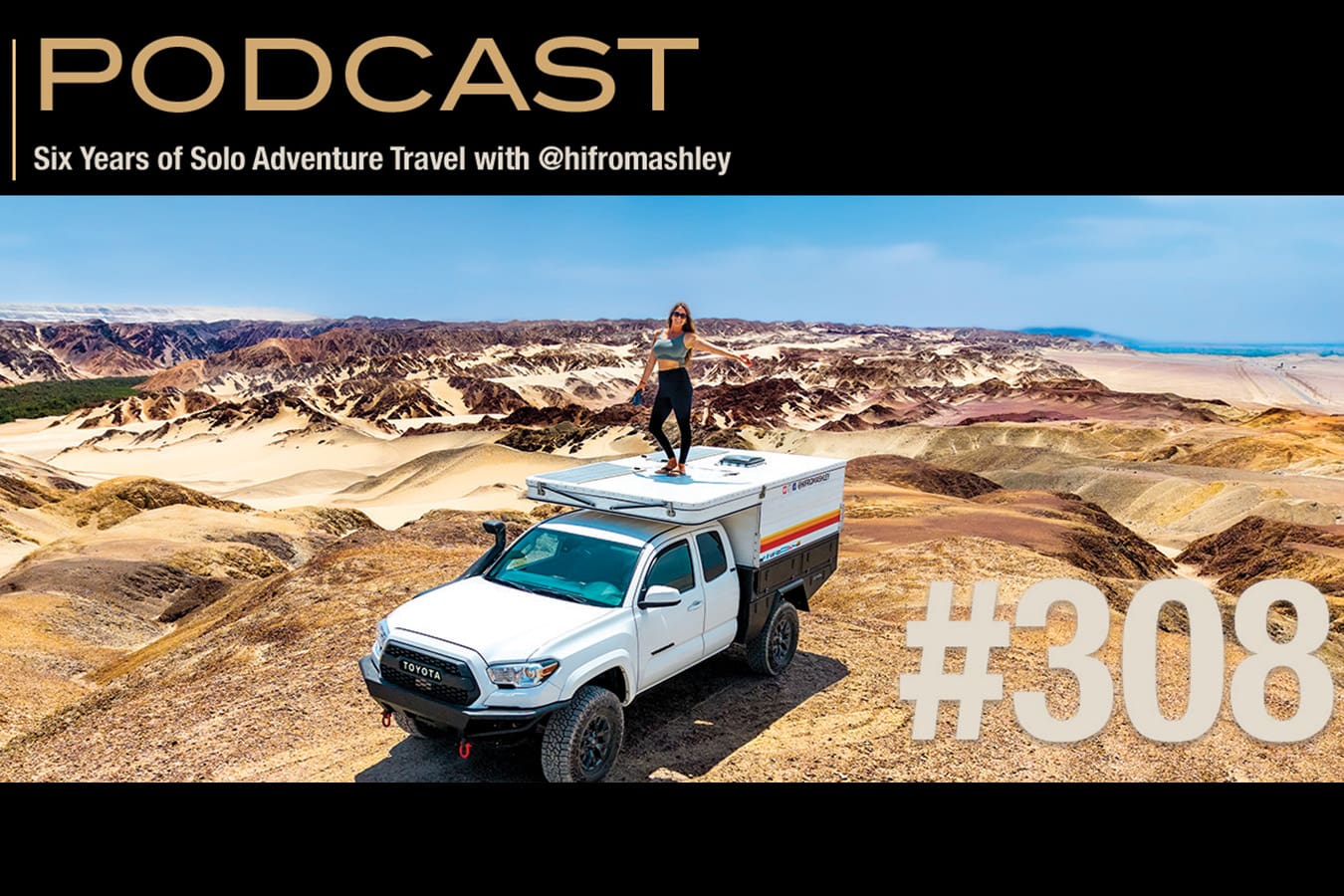
Overland Journal Podcast host Scott Brady interviews Ashley from Hi From Ashley about her six-year solo journey, including overlanding the Americas in a Toyota Tacoma. Motivated by personal loss and injury, Ashley transitioned from corporate healthcare to a life of slow travel. She reflects on the challenges of traveling with her dog, Porter, through international borders and his eventual passing in Colombia. Highlights include celebrating Día de los Muertos in Mexico, exploring remote Guatemala, and reaching Ushuaia on Christmas Day 2025. Ashley offers advice on prioritizing personal goals over societal expectations and discusses potential future adventures in Europe and Africa. Her story serves as a testament to the “if not now, when” philosophy of exploration.
Overland Journal Podcast Episode #308
The Overland Journal Podcast is brought to you this week by Nitto Tire and Overland Journal Magazine
New to Overland Journal and want to grab a subscription! Visit Overland Journal and enter code: overlandpodcast at checkout for 20% off. We thank you for being a subscriber.
Guest Bio
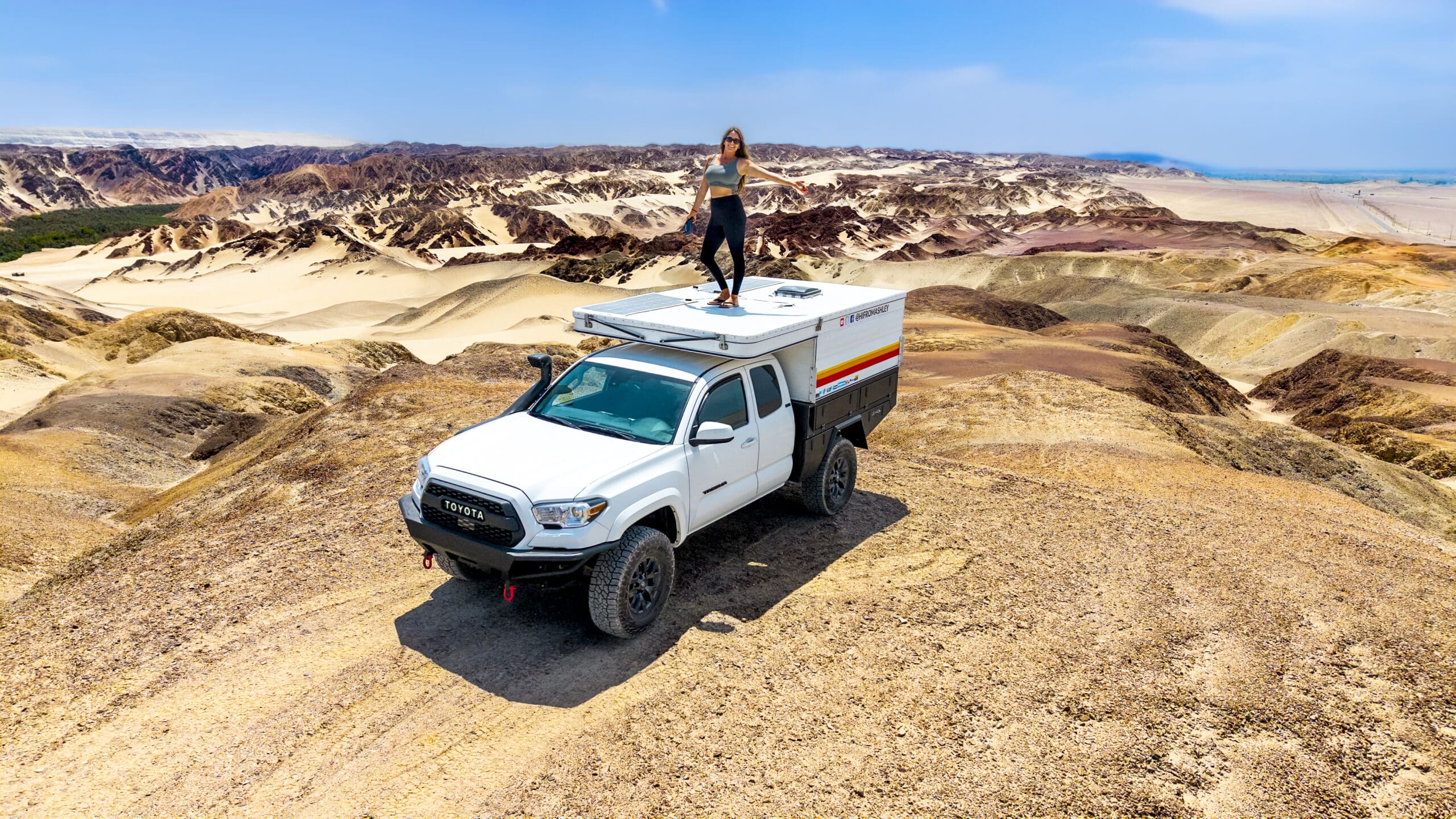
Ashley from @hifromashley
Ashley is a full-time traveler of seven years. She swam with sharks and whales, photographed lions in South Africa, and got lost in the Bermuda Triangle. After selling her house, she got a Toyota, promised her dog there would be tacos, and drove toward the end of the world. Her desire for a different life started after her dad died. Stories kept him alive and fueled Ashley’s dream to travel and create her own. In Colombia, her dog lost his battle with cancer. She paused to grieve, then on Christmas Day reached her goal: Ushuaia, Argentina. Through her socials she shares stories and photos that inspire others. Ashley’s story proves adventure nor life stop when grief starts; sometimes it is the way forward.
Host Bios:
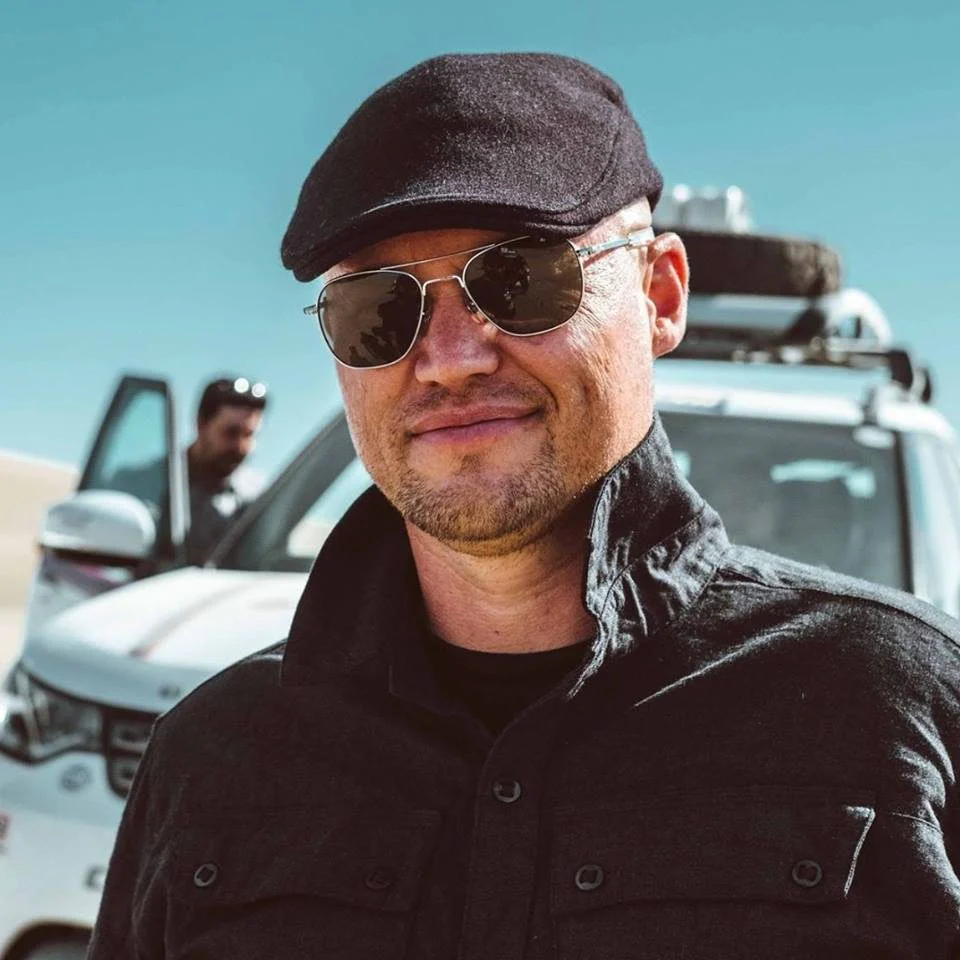
Scott Brady
Scott is the executive publisher and co-founder of Expedition Portal and Overland Journal and is often credited with popularizing overlanding in North America. His travels by 4WD and adventure motorcycle span all seven continents and include three circumnavigations of the globe. His polar expeditions include two vehicle crossings of Antarctica and the first long-axis crossing of Greenland. @scott.a.brady
Tune in Apple Podcasts | Spotify | YouTube
Transcript
Scott: [00:00:00] Welcome to the Overland Journal podcast. I am your host, Scott Brady, and I am here with Ashley K. Now, Ashley has traveled solo around the world for six and a half years. Three and a half years of that was flying and traveling, and the last three years she’s been cruising around the Americas in her Toyota Tacoma, uh, with a camper on the top, bow in bed, like a lot of the stuff that we would all love to travel on.
And you have seen a lot of things and you’ve be ab- you’ve been able to travel slowly and really explore the Americas. So thank you for being on the podcast today. Thank you for having me.
You’re welcome And a special thanks to Nitto Tire for supporting this week’s podcast. The Terrain Grappler G3 is the third generation of one of overlanding’s most trusted all-terrain tires.
A new compound and tread pattern delivers [00:01:00] improved wet traction and a three-peak mountain snowflake certification. Improved uniformity reduces road noise while still ensuring performance on the road and in the backcountry. And for even bigger news, the G3 is now available in up to 37-inch sizes. But my personal favorite is the new 255/80R17 that I’m testing on my Quartermaster.
This is the first all-terrain available in that size. And since payload matters, the G3 is lighter than most competitive all-terrains. Nitto backs the G3 with their best treadwear warranty ever. That means 70,000 miles for hard metric sizes and 55,000 miles for LT and flotation. For more information,
Ashley: visit nitotire.com.
Thanks, Nitto.
Scott: So like first question, I remember a [00:02:00] little bit of your story of how you got started. You basically sold some stuff and decided to go take that time and travel. Uh, what was that impetus for you? What was the thing that really fired you up to say, “I’m gonna change my life completely and start traveling”?
Ashley: I think there’s a lot of pillars as to why I wanna travel, like the basics of seeing beautiful places, love to learn, love to eat new foods. But the ultimate, like, driving force was my dad passed away when I was 27. Hmm. And just like every Sunday at the dinner table, stories about him traveling all over on his motorcycle- Oh, wow
and I just got so many phone calls after he passed from people all over the United States. They’re like, “I met your dad here,” and like just all these incredible stories, and it just started to snowball. And like what are you waiting for? Hmm. Like d- you [00:03:00] just go, start making your own stories, and just felt this burning Like I have to, and I can’t let go of it.
Scott: Yeah.
Ashley: If not now, when? And just this urgency, like, if I don’t do this now, I’m never going to do it.
Scott: And we have no idea what tomorrow holds, regardless- Yeah … of where we’re at in life. Let’s talk a little bit about your dad. So what were some of your dad’s travels that you found the most inspiring?
Ashley: Oh, I don’t think many of them are PG.
So, but he’s just wild, crazy, free spirit. Yeah. But as a kid, I grew up with my dad. He raised me. I was the only girl on both sides of my family, so grew up doing all boy things. Yeah. Pit bikes, dirt bikes, boats, jet skis, literally anything with a motor, we drove it and broke it. Okay. And my dad raised me as his favorite son, so we would go camping randomly, [00:04:00] and it was just, like, my favorite childhood memories, come home on Friday, pack your bags for, “Where are we going?”
I have no idea, just get to an intersection, pick a direction, and we would end up on, like, Amish farms- Oh, cool … learning from them, camping in Minnesota or way up north or down in Illinois, and just never knew where we were going, what we were doing. Mm. But just the greatest memories.
Scott: What were some of the, you would say, the top two, three, four, five things that you learned from your dad?
It sounds like he wasn’t afraid to just go, but what were some of the other things that you learned from him that are PG?
Ashley: Everything. Humanity.
Scott: Mm.
Ashley: Not judging anybody. Everybody’s the same. And then as far as, like, overlanding, traveling by vehicle, I wasn’t allowed to drive my first car until I could change the oil, change a flat tire, [00:05:00] rotate the tires, and honestly just being, like, a little bit of a MacGyver. Yeah.
Like, sometimes if something breaks, you might need to take a bolt from something that’s optional to replace it on something you need. And I don’t think my dad answered a single question I ever asked him- Mm … my entire
Scott: life.
Ashley: Like, why is this happening? He’d be like, “Why do you think this is happening?”
Scott: Oh, okay.
Ashley: I was like, “Can you please just answer this one question for me this one time?” But really forcing me to critically think all the time, stop and pay attention- Mm … observe what’s happening and yeah.
Scott: That would be an incredible amount of confidence to- Yeah … set off on a trip like you’ve done.
Solo in a truck driving through the Americas.
Ashley: Yeah.
Scott: The fact that you overcame all of these smaller challenges earlier in life showed you, ah, I can do the big stuff, too.
Ashley: Yeah. And I think that was really confirmed for me at, it was probably [00:06:00] 2020, 2021. I went on a three-week road trip through the United States with a friend of mine from England.
And he’s a sailor. Yeah. Highly skilled critical thinker, and we quickly sorted out, like, I’m the driver, I’m the navigator. And we got a flat tire on that trip, and yours truly changed the tire. Love it. So I was like, oh, yeah, I can do this. You could totally do that. Easy. Yeah. That, that’s amazing.
Scott: And, and what made you decide to not go with a motorcycle since you’d seen your d- your dad travel so much- Oh … on a motorcycle? What made you decide to do a four-wheel drive as opposed to a motorcycle?
Ashley: Because I was traveling with my dog in the beginning.
Scott: Okay. Yeah.
Ashley: So pretty much built everything around the comfort of my dog.
Scott: Mm.
Ashley: I just wanted to travel. I think we
Scott: all do that, though, with dogs. I think… I mean, I don’t know that dogs really need that, but we think they do.
Ashley: They do.
Scott: They
Ashley: do. Yeah, they do. They do. They’re the best.
Scott: Yeah.
Ashley: They really are amazing.
Scott: So you, you left on this trip with your dog, if I remember correctly.
Yep. [00:07:00] Yeah. And then talk… ‘Cause a lot of people would like to travel with their pets. So traveling through the Americas, how did you set that up? Like, what kind of documentation did you need? What kind of, um, vaccinations did you get for your dog?
Ashley: It’s a lot.
Scott: I
Ashley: had every single medical record for him printed out from the day I adopted him until the day we left.
And unfortunately, Porter had seizures starting the trip, so a lot of documentation. He had three medications that he required every single day. Mm. Uh, so it was a lot to navigate. Crossing into Mexico is very easy. Nothing is required. Once you get into Belize, Guatemala, you need to go to the vet, get a health certificate.
They just wanna make sure that all the vaccinations are up to date. Some countries do require a rabies vaccination within 30 days- Okay … or one year.
Scott: Okay.
Ashley: So there [00:08:00] was a couple of times he got vaccinated for rabies twice in one year.
Scott: Yeah.
Ashley: But it was really tricky with him going to the vet, ’cause he also had to have extra checkups and medication management, which was Honestly, really difficult in a lot of countries.
Mexico and Colombia specifically the medication that he took for seizures was a narcotic, and that required special vets with special paperwork and- Oh,
Scott: interesting …
Ashley: yeah, it was a lot. But were you
Scott: able to ultimately find it?
Ashley: Oh yeah, for sure.
Scott: Yeah, I could see, uh, buying narcotics of any kind in Colombia might be challenging.
Ashley: People think that it’s really easy- Say the least. … and that you can just walk in, but that’s just really not the case. It couldn’t be further from the truth.
Scott: Oh, interesting. It’s
Ashley: very, very difficult. Nicaragua was the absolute best.
Scott: Okay.
Ashley: Stocked up on all of his medication and that was happy days.
Scott: And did you, did you find that there was any difficulty traveling from through the borders with those medications for your dog as long as you had [00:09:00] proper documentation?
Ashley: No, they never looked at him at the border.
Scott: Mm.
Ashley: Nothing, just the health certificate. That’s it, and payment if it was required.
Scott: Yeah.
Ashley: I think the only actual vet who really examined him was the health certificate, uh, leaving Panama going to Colombia.
Scott: Mm.
Ashley: Other than that, they just wanna check his records to make sure he has his vaccinations, they’ll weigh them, maybe check the temperature and-
Scott: Okay
Ashley: take your money and you’re on your way.
Scott: Like- And, you know, I’ve, I’ve never traveled, uh, through the Americas with a dog, but I’ve talked to people who have, and they, they actually found that it was beneficial-
Ashley: Oh, yeah …
Scott: uh, in a lot of ways. I mean, security of course, but it seems like, a lot of folks in Central America are a little bit intimidated by dogs.
Um- Yes … or they view them … Like, maybe they had a bad, bunch of them had a bad experience when they were kids or whatever, but, um, how did you find, um, locals interacted with [00:10:00] you around dogs?
Ashley: Everywhere is a little bit different, for sure. Some parts of Central America, some parts of Mexico, they are really afraid of dogs, especially black dogs.
Mm. And Porter was a black lab mix.
Scott: Yeah, those
Ashley: black labs- So- …
Scott: are so dangerous.
Ashley: Yeah, looks very, very, very dangerous. Yeah. But in a lot of those areas, they use dogs as a security system.
Scott: Sure.
Ashley: So if a dog barks, danger is near. Mm. Somebody’s near your property. But overall, honestly just the best experience.
It’s such a conversation starter.
Scott: Mm.
Ashley: Porter was a very, very well-behaved dog, not aggressive, never barked.
Scott: Mm.
Ashley: But, like, if there was food, he was there. Loved people, loved children, super friendly, so I met so many more people because of him.
Scott: And I would think that other travelers that are, like, from the US for example or even from Europe, they probably loved- Getting a chance to see a dog [00:11:00] and to-
Ashley: Oh, yeah
Scott: to like a safe dog to pet and everything. Yeah.
Ashley: I have so many videos of Porter sitting underneath dinner tables of other families.
Scott: Yeah.
Ashley: And he’s just, like, looking at me like he doesn’t know me, and he’s like, “I’m gonna get some steak over here. Leave me alone.” “I don’t know you.” And he did. He had brown eyes, and he would just sit and just stare at people.
Scott: Cool.
Ashley: One time caught him, took a ferry from, uh, Playa del Carmen to Cozumel.
Scott: Yeah.
Ashley: And friend of I… Friend of… A friend and I went, got our tickets, came back. Porter was sitting at this lady’s truck, and she was feeding him her whole entire steak torta. And I was like, “Porter!” And he just, like, side-eyed me like- Like, “What?”
“What are you doing, lady? Get out of here. I’m getting steak dinner.”
Scott: Can’t you see what’s happening
Ashley: right now? Yeah, I’m busy. Uh, but he was really incredible to travel with. Yeah. Just the best.
Scott: Yeah, and that, and that ended up being, like, a really challenging time [00:12:00] for you because his health continued to decline, as I recall.
Yeah. Uh, how did you work through that? And I know that he was such a big part of your experience. How do you help others, uh, work through that fear of losing their animal when they’re traveling?
Ashley: I think the biggest thing for me is, like, I’m so incredibly grateful that he got really sick in Colombia.
Dogs are family members in Colombia, so the vets were incredible there. Like, he- They understood … fought for, like, eight to 10 weeks before he passed away, and I’m gonna start crying, but- Yeah …
they had, like, a whole- Well, we love our dogs.
Scott: We love our dogs,
Ashley: yeah … they had a whole funeral for him.
Scott: Yeah, wow.
Ashley: Um, like everything. Nice display of flowers all around him, candles. Like- Yeah … they said a whole prayer for him. I’m just like-
Scott: Mm …
Ashley: so much thought and [00:13:00] care. I was like, “That would have not happened if we just stayed in the US.”
Scott: Probably not.
Ashley: So I was really grateful for that. Um-
Scott: And is that where he’s at now, is in Colombia?
Ashley: No, he’s in the truck.
Scott: Oh, he’s in the truck. He’s with you.
Ashley: Yeah.
Scott: I love that. Uh,
Ashley: so he cont- He sits on the center console.
Scott: Oh, I love that. Yeah. He continued to be able to travel with you.
Ashley: Yeah.
Scott: Well, let’s pivot a little bit from that. Sorry.
Ashley: No, it’s good. It-
Scott: But it’s also
Ashley: re- It’s fine ’cause it’s a reality of traveling with your dog
Scott: and we all get it because we love our animals. One of the hardest days of my life was when I lost my Malamute, and it was just like- Oh, yeah. It, it’s, it’s indescribable. Yeah. You understand it.
Ashley: Yeah.
Scott: Um, and many that are listening understand it. They become a part of our family, a part of our life. Uh, but how cool to be able to experience all of that- Yeah
with him, so.
Ashley: And I’m so happy because if I would have dragged my feet and waited until I, like, checked every box, bought every single piece of gear-
Scott: Yeah …
Ashley: he would not have been able to live his last years just out in [00:14:00] nature loving life. E-
Scott: exploring the world.
Ashley: Yeah. Like-
Scott: Getting steak
Ashley: for days … so cool for him.
Yeah. Oh. He, I feel like by the end, he barely ate any dog food. It was just, like, beef liver, chicken liver, liver pate- … steak, chorizo. Yeah. He ate everything-
Scott: Oh, that’s awesome … and
Ashley: loved it so much.
Scott: Living his best life.
Ashley: Absolutely.
Scott: Yeah, and it sounds like you were, too. Um- Oh, yeah … let’s back up a little bit.
So talk to us about, like, what was that one moment where, you know, you’re in your corporate job or whatever, and you’re doing the regular day-to-day American life. Um, something had to have flipped. Um, certainly inspired by your dad, but something had to have flipped. What, when did that change happen?
How did you make that happen?
Ashley: chairs. Okay. Like office chairs.
Scott: Okay.
Ashley: So I worked in corporate healthcare, and at the time it was the seventh largest US healthcare system.
Scott: Okay.
Ashley: And every year we would [00:15:00] get a raise, and then budget would come. You could submit a request, what you would like for your department.
Yeah. Education, work party, pizza party, stuff like this. Sure. And I would ask for chairs every single year, ’cause our office chairs were maybe 28 years old, wrapped up with duct tape. We have to sit in these for eight hours a day. Right. And I was just like, “Okay, I’m asking for chairs again, respectfully.” And September rolls around, you start getting the emails, what’s approved, what’s not approved.
We got further education, zip-up jackets, and a pizza party, and no chairs. And it was very bad timing, because that same exact week there was a PR campaign going out about how we spent almost $800 million on charity, which is great-
Scott: Mm-hmm …
Ashley: but I feel like you should also be taking care of your employees that allow you to donate [00:16:00] millions of dollars to charity.
Scott: Um- Especially sitting, like you said, eight hours in a chair.
Ashley: Yeah. And I was working at home before COVID, and that was really popular, so half at home, half in office. Mm-hmm. And it’s like, if I can afford a sit to stand desk and a nice chair on my salary, I think that can happen at work for all of us. And that was just kind of the last straw, like we are not valued here as employees.
Why am I sitting here every day in an office working, working? Like I just need to get living my life- Yeah … and seeing places. Um, another major factor for me is I was in a really bad car accident when I was 21.
Scott: Hmm.
Ashley: Um, so the technical term, I have avascular necrosis of my right talus, which means the bone in the center of your ankle that controls all of your movement, mine is just dead.
Scott: Oh, wow.
Ashley: [00:17:00] So osteoarthritis really restricts my movement. Like I can’t hike long distances- … do a lot of that stuff. So I have a really deep fear That by the time I retire, I won’t really be able to walk well.
Scott: Mm.
Ashley: So that is like, if not now, when?
Scott: Yeah, sure.
Ashley: Um, yeah.
Scott: And I do love that concept of like that earlier life or mid-life retirement phase- Yeah
where, because the reality is, is you’re not guaranteed retirement. No. You know, I think about my parents, you know, my dad worked for 40-plus years. They were married for 50 years. Um, and they finally retire, in their 60s, late 60s, and my mom gets Alzheimer’s. And then they never got the chance- Yeah
to do all of those things that they had worked so hard and saved so hard to be able to do.
Ashley: Yeah.
Scott: Uh, so I-
Ashley: Sorry to hear that.
Scott: Thank you.
Ashley: That sucks.
Scott: [00:18:00] But what a reminder in my mind, um, that take the time when you can.
Ashley: Yeah.
Scott: And it looks like you made the decision that you’re gonna find a way.
Ashley: Yeah.
Reverse retirement. Now I have to figure out what I’m gonna do when I grow up.
Scott: Like- I don’t know. Grow- growing up’s overrated.
Ashley: It is.
Scott: 100. I’ve avoided it. 100%. I’ve avoided it at great cost.
Ashley: 100%.
Scott: Yeah.
Ashley: Um, but yeah, my dad was the same way. He never… He passed when he was 57.
Scott: Yeah.
Ashley: Never saw a day of retirement.
Scott: Sure.
Ashley: And that’s… I don’t want that to be my story.
Scott: Yeah.
Ashley: So.
Scott: Well, so you t- but you took the initiative to do it.
Ashley: Yeah.
Scott: So how did you, how did you go from- You know, they aren’t valuing me as an, an employee. They’re not valuing my employees. They’re not sending us what we need. I need to make a change in my life.
What came next? How did you get from there to starting to fly around the world? I feel like I just started selling [00:19:00] everything. I had a whole house full of items. Attic, three-bedroom house, full basement- Sure … garage, boathouse, full of everything you could possibly consume. Just started selling everything.
Ashley: I got a consulting job. I would bartend major events, weddings, football games, stuff. I’ve worked 15 hours a day every day for almost four years. And saved all your money. Yeah. I was just like, “I don’t actually know what I’m gonna do with all of this money.” And just social media, watching other girls who were traveling the world full time, and I was like, “Okay, maybe I’ll do that.”
Scott: It’s possible, yeah. Yeah. Saved a bunch of money, put in my letter of resignation, and the week, the last week of work, I almost took it back. I was so terrified. Like, am I really doing this? Mm. I went to college for this. [00:20:00] Right. Am I gonna leave my whole life behind? Mm. I was like, “Okay, let’s just do one year.
Ashley: We’re just gonna go to French Polynesia, sail around the islands, go scuba diving, free diving. If it doesn’t work out, just come back home.” Mm-hmm. And what worst case scenario is, you got to go live a little island life for one year. And then you go back to work. Or no. Yeah. Yeah, and then you go back to work.
And then I go back to work. Yeah. Not anything so scary, and then, yeah, one year- Did you decide, did you decide to sell your home or rent your home for income? What was your plan on that? So when I left the first time, my aunt and my dog stayed in my house. Okay. And I feel like I always knew I was eventually gonna sell the house, but that was my childhood home.
Scott: Okay. Sure. So it was really hard. That would be difficult, yeah. Yeah. So many memories, and I grew up in a time where kids were not really allowed inside. We [00:21:00] had to be outside playing. Mm-hmm. So my whole neighborhood, very small, we live on a peninsula. Everybody knows everybody. Everyone in that neighborhood helped raise me- Yeah, sure
Ashley: take care of me as a kid. And yeah, it was a really, really hard time, and I was in South Africa doing, like, a three-month photography course through the parks and stuff like that, and my aunt got really sick, ended up in the ICU. So I had to fly all the way back home. Mm. And on that flight, that was it.
I was like, not a single ounce of my being- Feels like this is home
Scott: Yeah, sure
Ashley: And it’s time- Yeah … to sell this. Like, prepare everything, sell it, and figure out the next adventure.
Scott: But it also sounds like your dad, the way that you describe him, he would’ve wanted you to do that.
Ashley: Yeah. Yeah. He would
Scott: be so
Ashley: proud.
Scott: He would’ve wanted you, he would’ve wanted you to see the world.
Ashley: Yeah.
Scott: That’s [00:22:00] incredible. Uh, so you make this big leap. Is there anything that you would’ve done different, or other than maybe doing it earlier? Like, what, what would be- Yeah … what would you have done a little different that, that might help others that are listening navigate through that process?
Ashley: I feel like the only thing I would have done differently as far as overlanding would be to buy a toilet and a cooler, or an electric cooler fridge.
Scott: Yeah.
Ashley: Because I left with nothing.
Scott: Okay.
Ashley: Like, I had a little mini made vintage cool, like lunch box. Sure, sure. And a truck bed tent.
Scott: Gotcha.
Ashley: I didn’t get a toilet or a Dometic- Yeah
until Colombia.
Scott: Okay.
Ashley: So, I know I’m obsessed with them. So just-
Scott: No, toilets are nice to have in your vehicle. There’s nothing wrong with that. Oh, my God. Everybody, everybody can appreciate- Life changing. Yeah, yeah. You get some bad food or you, you know, just- Oh … it’s so helpful. Or you gotta camp in the gas station parking lot, which you have to do sometimes.
Mm-hmm. It’s so nice to have a toilet.
Ashley: [00:23:00] It is life. And I got really sick in Peru, and I could not have imagined that experience without a toilet.
Scott: Exactly.
Ashley: Um, but yeah, that is a definite game changer. I’m not- Like, just go with absolutely what you need, the bare minimum.
Scott: Yeah.
Ashley: But just go.
Scott: Yeah. That’s
Ashley: the most important part.
But timing-wise, do I wish I would have left earlier? Possibly.
Scott: Yeah.
Ashley: But I have to trust- Hindsight, yeah … the timing of life- Sure … and the path that it presented. I’m a really big believer that everything happens for a reason.
Scott: Yeah.
Ashley: And yeah.
Scott: So then, so you, did you do the trip around French Polynesia sailing?
Ashley: I was there for three months.
Scott: Okay.
Ashley: Traveled to three different islands. The sailing plan didn’t really work out, so contingency plan B went into effect. I rented a room from a lady $200 for three months.
Scott: Wow. [00:24:00]
Ashley: Yeah. The catch was- You can live for a long time on that. It came with her son as a roommate.
Scott: Okay.
Ashley: So he was supposed to take care of the outside, and then I took care of the house.
Scott: Sure.
Ashley: She was really OCD, wanted to make sure her house was clean while she was gone.
Scott: Yeah.
Ashley: And that worked out really well. I left, went back to the States, had to apply for my visa, send my passport- Mm-hmm … all of that stuff, and literally the day after they accepted it, everything in the world shut down.
Scott: Mm, ’cause of COVID. So…
Ashley: Yeah.
Scott: Gotcha.
Ashley: So they held my passport and application until the end of June. Originally, they said that- And you were
Scott: still in country, you were still in French
Ashley: Polynesia? In the US. Oh,
Scott: in the US, got it.
Ashley: Yeah, I had to return for that. Um- Gotcha. Originally, say, they said that they would send us our passports back and keep the application.
But at a certain point, they were like, “If you want your passport back, we’re gonna have to cancel your application.”
Scott: Got it.
Ashley: Bermuda opened up July 1st, so I was like, “Passport, [00:25:00] please. I’m out of here.” I just quit my whole career. I can’t- Yeah,
Scott: sure …
Ashley: even still be at my house. But it was really good being home.
I got to do so many projects that were on my to-do list-
Scott: Sure …
Ashley: which in turn helped me sell my house.
Scott: Yeah,
Ashley: sure. So it all worked out, but- Yeah
Scott: So then you went to the Caribbean
Ashley: I went to Bermuda- Bermuda, got it … and then back to French Polynesia for another three months diving, free diving, swimming with whales, the wall of sharks, all that really cool stuff.
Scott: Now, at, when you were doing that, was your goal just to have as many experiences as you could or were you thinking about, “I wanna start to document this,” or it sounds like you have a love for photography as well.
Ashley: Yeah.
Scott: So how did that all… Was that just part of the experience, or were you thinking, “This might be something that I could do professionally,” or what was your thoughts around the photography?
Ashley: I’m not really sure, to be honest. I had a camera before traveling, but never had time to actually [00:26:00] use it.
Scott: Yeah.
Ashley: And I feel like going to French Polynesia, that was the first time I actually got to even learn how to use my camera properly.
Scott: Sure
Ashley: And really fell in love with underwater photography. And-
Scott: That’s very challenging.
Yeah I’ve never done it, but I mean, other than with my pho- iPhone, but
Ashley: I love it. It’s just such a different world that, I mean, maybe 1% of the world population gets to experience. Mm-hmm. And it’s so peaceful, and I love sharks and whales and stuff like that. Was
Scott: that s- was that scuba diving or-
Ashley: Scuba and free diving
Scott: Okay.
Yeah. Amazing.
Ashley: Yeah.
Scott: And then did you end up doing any sailing at that point in time? Not very
Ashley: much- Not very much … at
Scott: all,
Ashley: no.
Scott: Yeah, there’s a lot… It’s been interesting to see how many folks in our industry have either come from sailing into overlanding- Yeah … or from overlanding into sailing,
Ashley: the skills kind of overlap a little bit.
It
Scott: seems like it.
Ashley: Yeah.
Scott: Or just the general wanderlust, I suppose, but-
Ashley: Yeah. Navigating, all of that stuff kind of ties together. Nice. You [00:27:00] have to be very self-reliant.
Scott: Totally. Yeah. Yeah. Especially when you’re in the middle of the ocean. Yeah, you gotta figure it out. Yeah. There’s, there is no AAA. There is no AAA.
Ashley: Starlink helps.
Scott: Yeah, that helps a lot. That’s
Ashley: a game
Scott: changer. That helps a
Ashley: lot. But-
Scott: It does help a lot.
Ashley: Yeah.
Scott: So, uh, k- let’s kinda round out your travels that you were doing before you got into your Tacoma. So you did, sounds like some of the Caribbean, French Polynesia. Where else did you… A little bit of Africa it sounds like maybe.
A little
Ashley: bit of Africa, Egypt, Germany, a lot of Mexico. Mm-hmm. And then a pretty extensive trip around the US doing, like, national parks and stuff like that. Okay. And-
Scott: Still before you got your truck.
Ashley: Yeah.
Scott: Okay.
Ashley: Yeah. Moving pretty slow. I think I spent six, seven months in- Mexico, six months, eight months in Bermuda, and then I went back to French Polynesia four times.
So one year.
Scott: Yeah, sure.
Ashley: But yeah. I’m a slow traveler so I try to max out every country. If you give me three months, I’m gonna stay three months.
Scott: [00:28:00] It’s ra- it’s, it’s rare though to find travelers, especially Americans traveling, that travel slow. Yeah. It’s very, very rare.
Ashley: I just love living in a place. I like knowing where everything is in the grocery store.
The guy at the local tienda knows my name. I like feeling comfortable and really living where I’m vacationing.
Scott: The coffee shop finally figures out how to make your order- Mm-hmm … perfectly every morning. Yeah.
Ashley: Yep, and it’s like, “Go to this place, not this place. This place has better breakfast.” “This place has good lunch specials.”
Like, I love that. Yeah. I love knowing all of that stuff.
Scott: Well, and it sounds like, it sounds like food and cuisine is a part of the joy of travel for you.
Ashley: Big time.
Scott: So, um… And is… And what spurned that? I mean, ob- other than the fact it’s great to eat good food. But, um, is that something you specifically look for?
Or is it just another part of the trip?
Ashley: I think in the beginning it wasn’t really something that I looked for because I was a [00:29:00] vegetarian for, like, a decade.
Scott: Okay.
Ashley: I would try dishes that were local. Like, if they had meat or fish, I would still try them.
Scott: Yeah.
Ashley: You know, like, I’ve had guinea pig, grasshoppers- Sure, sure
all of that unique stuff.
Scott: Yeah, sure.
Ashley: But I wouldn’t go to McDonald’s or Burger King.
Scott: Yeah.
Ashley: And I feel like after I started eating more meat again, I was just like, “Where can I get a steak?” “Where can I get a really good burger?” Yeah. And then just really dove in more. But I’ve always been obsessed with finding, like, the best French restaurant in every place that I go to.
Peruvian, Mexican, like, who has the best tacos? And-
Scott: Yeah, and-
Ashley: Like, my maps are out of control. …
Scott: Lima ended up being, like, a quite- Oh, my God … the little foodie scene. That’s crazy. Yeah. Where else did you find that was like that? I mean, I found some great food in Bogotá and of course Argentina- Yes … has got a bunch of great food.
But, like, where else did you find… Were there any surprises along the way of, like, really great food?
Ashley: Sometimes you would find, like, a [00:30:00] really small town, and there’s, like, a Peruvian chef or a French chef and you’re like, “Okay, I’m gonna eat good.”
Scott: Yeah.
Ashley: And it’s really random. But I feel like my top three for food, Mexico, Peru, Colombia.
Yeah. In that order.
Scott: Yeah.
Ashley: And Mexico spoils you with good food.
Scott: And super cheap. Everywhere. Like, really, really fair prices.
Ashley: Yes.
Scott: Great tacos.
Ashley: Peru as well.
Scott: Mm.
Ashley: Peru and Mexico are on the same… You can be in the middle of no- nowhere, hours away from a city, and there’s just somebody selling- Lunch of the day
Scott: What is it, lomo saltado or whatever they
Ashley: like- Yeah, lomo saltado So, and
Scott: w- Pollo saltado W- and that’s basically like french fries and chicken, but it’s super- It’s-
super good …
Ashley: a mix between Peruvian and Asian. Mm. So it’s like a stir-fry-
Scott: Mm …
Ashley: beef or chicken-
Scott: Yeah …
Ashley: with tomatoes and onions, but it’s the sauce that they put on it. It’s like crack. I don’t know what- You have to have it … is in it, but you’re just like, “More, please. More, please.” Mm. [00:31:00] And then a side of rice and fries usually.
Scott: Yeah, sure.
Ashley: But amazing. But you can get Lunch of the day, soup, salad, that dish, like $5.
Scott: Mm.
Ashley: And I’m like, “Yes, please, every day. This is making my life easier and amazing.”
Scott: Have you, have you found … When you went through Central America, did you find that the food was pretty good? When I went through, I went through a long time ago, and I did not find that the food was so great.
What was your experience in Central America?
Ashley: Yeah, it’s pretty boring food.
Scott: Yeah.
Ashley: Rice, beans, rice, beans, rice, beans- Some chicken … plantains. Yeah,
Scott: some chicken.
Ashley: Um, breakfast can be pretty good. Costa Rican breakfast was really good. In Guatemala, the absolute best corn tortillas, corn tortillas I’ve ever had in my entire life.
Okay.
Scott: Okay.
Ashley: Corn is religion there.
Scott: Mm.
Ashley: Um, amazing. I also had a lot of really good traditional food. Was, like, invited into a local’s home-
Scott: Yeah …
Ashley: around Lake Atitlán, and that was [00:32:00] a really, really cool experience. I can’t remember the names of the dishes, but they catch these, like, little, tiny sardines- Okay
from the lake, and the whole process is cooking them for almost 24 hours in a soup. Yeah. And oh, it was amazing, and you would never be able to find that in a restaurant.
Scott: Yeah, how amazing to have that experience. And did you find that because you were spending so much time, that you really started to learn the language and the culture and starting to get into, you know, some of their celebrations?
Were you able to experience a lot of that?
Ashley: Oh, yeah. There’s always a celebration going on- It seems like it … in Latin America, and it’s really amazing.
Scott: And Día de los Muertos, I mean, I’ve never really- Oh, yeah … I mean, I’ve been tangential to it, but I’ve never been able to really dig into it. Were you able to experience some of that?
Ashley: Yeah, that was a key highlight of the trip and, like, I really prioritized timing that correctly.
Scott: Mm-hmm.
Ashley: Um, many people think that it’s like [00:33:00] Halloween- Mm … but it’s not. It’s a very special holiday and-
Scott: It’s about remembering your family members that
Ashley: you lost, yeah … and honoring, yeah, and honoring the ones who have passed and celebrating them.
It’s not a sad holiday overall. It’s really about celebrating them and- Yeah … inviting them back into this world. I feel like it was really cool for me because I was driving and I just got to drive through all of the fields. All of the time and preparation it takes for this holiday. They are planting flowers, growing them for months, harvesting all of them.
Scott: Wow.
Ashley: It’s so much time, energy, and dedication. It’s really mind-blowing. And I went with a friend of mine. Um, his wife had passed away, I think it was about two years. Mm. So I lost my dad. He lost his wife, and it was really more of an emotional, spiritual experience for us- Mm-hmm … just to [00:34:00] observe and be more or less part of it.
Scott: Mm.
Ashley: But yeah, I really loved that. Having
Scott: your own bit of healing from that.
Ashley: Yeah. Little cry and-
Scott: That’s … We all need that …
Ashley: celebrate
Scott: and- That’s import- that’s important.
Ashley: Yeah.
Scott: Yeah, absolutely.
Ashley: Yeah, it really is important to cry. I feel like people kind of shy away from that, but- Mm … like, I almost cried on stage today- Mm
and here now, but it’s important.
Scott: Yeah.
Ashley: Yeah.
Scott: Not a week goes by that someone doesn’t reach out to ask how they can help support the podcast. Uh, we are supported entirely by Overland Journal, the magazine. So when you become a subscriber to the Overland Journal print magazine, you get this beautiful book, uh, that comes in five times a year.
It also gives you access to our digital archive. Uh, and it’s well over 100 pages of, of gorgeous images and detailed testing and adventures from around the globe. So if you go to overlandjournal.com and you subscribe to the magazine, use the [00:35:00] code OVERLANDPODCAST, and that’ll get you 20% off. It’s only available to our podcast listeners.
We don’t advertise it anywhere else. Um, and then you help us to maintain that independent employee-owned journalism, um, that we have been famous for. So it allows us to conduct those tests without any advertorial. Another way you can help out, too, I produced a book, uh, last year with Simon & Schuster called Overlanding 101.
You can find it on Amazon or Barnes & Noble or even your local bookstore. And that encompasses my decades of travel around the world, all of my mistakes and failures and, and the lessons that I’ve learned in traveling around the globe. Um, many of those, um, that you hear on the podcast have been distilled down into print form with great lists and beautiful imagery.
Uh, so you can find that, uh, at your local bookstore. Overlanding 101. And thank you all for listening and for supporting us so much throughout these years. Well, it’s part of the human experience, and we [00:36:00] don’t wanna shut that down.
Ashley: No.
Scott: It’s a way that we express memory, loss, all those things. Joy.
Ashley: Yeah.
Scott: So many things can be expressed in that way, for sure.
Ashley: And I think loss and love are probably the two things that connect all human beings- Mm-hmm … throughout the entire world.
Scott: Yeah, we can all relate to that.
Ashley: Mm-hmm.
Scott: For sure. Absolutely. So you, you do all these cool trips, Asia, Caribbean, Africa, all of that, and then what was the switch that flipped that made you think, “I wanna get a Tacoma and I wanna start driving through the Americas”?
What was the switch that flipped on that? How did that start?
Ashley: I don’t know. Just life. I put my house up for sale, had a bunch of showings, walk-throughs, open houses, and no offers. I was like, “Oh, am I making a mistake? I don’t know.” And then I actually wanted to tr- just travel around the US in some [00:37:00] type of van.
So I found, like, a Ford E- Econoline or something? Yeah, sure. The E-Series?
Scott: Yeah, sure.
Ashley: A guy in Vermont was selling it, and everything was done to it mechanically, Dana 60-
Scott: Yeah …
Ashley: built.
Scott: All the things, yeah.
Ashley: Four-wheel drive, and I was like, “I want that van.” It wasn’t very pretty. I didn’t care. We kept in contact.
I had enough cash to buy it, but it would be all of my cash.
Scott: Sure.
Ashley: And I didn’t know when I would get an offer, how long it would take to close. Mm. So we were just waiting to see what happened. He sold the van on Sunday afternoon, and Monday morning, I got a cash offer on my house. So I was like, “Okay.” You just have to trust the timing of life-
Scott: Mm
Ashley: and everything is happening for a reason. I don’t know if you know Don and Andy. Um, Two Rogue Wanderers, I think, is their Instagram. I think so. Yeah,
Scott: I think so.
Ashley: They have a Tacoma. They’re traveling around the world. They’re in South America now. They’ve done [00:38:00] all of Europe, Africa-
Scott: Yeah …
Ashley: Asia. They went to China.
Scott: Yeah.
Ashley: Shipped over to Chile. They followed me on Instagram and I think sent me a message from my South Africa post, and I was like, “What is this? Truck and camper. What is overlanding?”
Scott: Yeah.
Ashley: So it’s like on YouTube, down the rabbit hole. Okay, like, what is this? Four-wheel drive? Yeah, I like getting as far away from people as possible, so we’re gonna need four-wheel drive.
Yeah. And where can I change my residency to? How can I do this? What do I need? Mm-hmm. Just consuming hours and hours and hours and hours of YouTube content, reading blogs. I changed my residency to South Dakota. My truck was the only four-wheel drive, six-foot bed Tacoma within 800 miles. Oh,
Scott: wow.
Ashley: So bought that, gathered up a tent and just all of the basics that we would need, and went to [00:39:00] Baja.
Kept doing a little bit of research, found Four Wheel Camper in Wisconsin was the only dealer. Talked to him. He recommended the Bowen bed. And yeah, everything kinda just fell into place.
Scott: I mean, your truck looks super cool.
Ashley: It’s beautiful.
Scott: It really… I mean, it’s, it’s a rad truck. Yeah. For those that are listening and watching let, we might as well give your Instagram out right now so people can check it out.
What’s your Instagram?
Ashley: It’s hifromashley, H-I from Ashley.
Scott: Yeah, so she’s got lots of cool photos of her truck. It’s a rad Tacoma, super cool Bowen bed, great Four Wheel Camper on the back, and photos of it all around the Americas, which is really neat. Yeah. So that, you know, that’s a… it’s cool that it shows you did a bunch of research, ’cause you ended up with, in this community, what would be one of the most ideal combinations.
Very common for people to use Tacomas ’cause they’re so reliable, very common for people to [00:40:00] use Four Wheel Campers ’cause they hold up.
Ashley: Yeah.
Scott: And they also have good resale when you go to sell one. And then Bowen would’ve been really new- It
Ashley: was- …
Scott: on the
Ashley: market
Scott: when you- …
Ashley: pretty new at the ti- that was 2023. So I, I don’t even know how long they were in business.
Uh, Sean from 4 Wheel Camper in Wisconsin was like, “Yeah, check them out.” He gave me the name. I wrote it down. I went and I looked at their Instagram, and I was like, “This is amazing.” Yeah. “And look at all of this storage.”
Scott: Mm-hmm.
Ashley: I am, like, OCD, organization, I love numbers, data, research. Like, I, that’s my brain.
Scott: Sure.
Ashley: So I was like, “This is incredible.” I had a meeting with them over the phone and sent them, like, an $11,000 deposit. I never even saw it.
Scott: Wow.
Ashley: That’s great. That was probably the scariest part of
Scott: the whole thing. I would think, I would think so, yeah. Sending someone 11 grand? Yeah, totally. Yeah. I was like, “Okay.”
Sending a new company 11 grand.
Ashley: Well-
Scott: Yeah …
Ashley: yeah,
Scott: it turns like that, turns out that was a good decision. So- Works
Ashley: [00:41:00] out …
Scott: so you get, you get all this squared away. You start moving through Mexico, and is that, how long do you spend with your truck in Mexico?
Ashley: I think we were in Mexico for only three, four months.
Scott: ‘Cause you had already spent a lot of time there.
Ashley: Yeah. I have kind of lived all over Mexico for a good amount of time. Mm. So I, I had done Baja before. Mainland is a little bit trickier versus Baja. Like, 80% of Baja is public, wild, free land.
Scott: Yeah, sure.
Ashley: 20% is owned, and then mainland is the total opposite. Yep.
80% is owned and private, and 20% is free. So-
Scott: It’s difficult to find camping there.
Ashley: Yeah, especially going south. It’s hot, it’s humid.
Scott: Yeah.
Ashley: Uh, you just want some air conditioning- Yeah, for- … and a nice shower …
Scott: for sure. And fortunately, accommodations are pretty cheap.
Ashley: Yes.
Scott: So, like, if you need to get into an air-conditioned hotel, it’s not-
Ashley: Yeah
Scott: not a big deal.
Ashley: They are everywhere. That’s a good thing. And you can find a [00:42:00] lot of pet-friendly Airbnbs and hotels all over Latin America.
Scott: And by this point in time, had you completely stopped the consulting stuff, or- Yes. So now you’re just traveler.
Ashley: Yes.
Scott: Focusing on travel.
Ashley: I pretty much stopped consulting as soon as I left the US.
Scott: Okay.
Ashley: Um, and that was both a combination of a personal choice, and I was doing consulting for level one trauma centers in the United States, and- There was a hack on London’s healthcare system- Mm … in the mid 2000s to late 2000s, and after that US hospitals didn’t really want independent contractors or consultants working outside the US.
Scott: That makes sense.
Ashley: Yeah.
Scott: That makes a lot of sense.
Ashley: But it worked out really well because I was able to be fully present for every moment of traveling.
Scott: Mm.
Ashley: I didn’t have any other obligations. Mm. I could just, “You wanna go have beers with the guys on the dock?” Yeah. [00:43:00]
Scott: Yeah.
Ashley: I can do that. I can do whatever I want any time of day.
Scott: Yeah.
Ashley: And that was really, this is the best chapter of my life.
Scott: I think they, I love this definition of wealth, ’cause of course society defines wealth usually around having really expensive things and lots of money. But I actually love this one definition of wealth, which is being able to do what you wanna do when you wanna do it.
Ashley: Mm-hmm.
Scott: I mean, that is
Ashley: truly wealth. That is the richest rich you can possibly be. I- I
Scott: think so …
Ashley: I know a lot of very wealthy people, and they have to answer to other people.
Scott: Yeah.
Ashley: And they cannot do whatever they want. Or just even their own
Scott: stuff.
Ashley: Yep.
Scott: Their own stuff and their own, uh, you know, stock market ticker.
They’re, like, paranoid over all of it. Um, so how- Yes … wealthy are you? I mean, certainly you could be rich but not wealthy.
Ashley: Mm-hmm.
Scott: And I think there’s lots of people that are rich that aren’t wealthy. So it sounds like you found a way to be able to do what you wanna do when you wanna do it, and that is, I think, the rarest form of freedom.
Ashley: Yeah. [00:44:00] Complete freedom.
Scott: Yeah.
Ashley: Uh-
Scott: And you’re doing it with your dog, which is pretty rad.
Ashley: Yeah. That was really rewarding.
Scott: Yeah.
Ashley: Yeah, I’m really happy I got to do that.
Scott: Yeah. And then so now you move through Central America. Was there any, what were some of the highlights of Central America? I try to bring it up in all of these podcasts because I didn’t…
It’s not that I had a bad experience in Central America, I just found that Mexico I liked so much more, and South America I loved even more than that. Um, so I always try to, like, draw out a couple of the high points to make sure we talk about Central America.
Ashley: I feel like we’ve chatted about this before.
Scott: Yeah.
Ashley: Where, like, every continent you either enjoy or you endure.
Scott: Yeah, sure.
Ashley: And Central America is absolutely beautiful. There is a lot packed into a small space.
Scott: Mm.
Ashley: I do think for overlanding, it’s just the climate. Mm. You can’t escape it very many times. Like, there are not a lot of mountains to-
Scott: Mm-hmm …
Ashley: get out of the heat.
I do [00:45:00] think it is well designed for backpackers.
Scott: Mm.
Ashley: Overlanding, I probably still would not skip it- … overall, even though there were challenges with the climate.
Scott: Yeah.
Ashley: Because there’s so many parts of the country you would never see as a regular tourist.
Scott: Sure.
Ashley: And I think that’s the coolest part.
Scott: I, I had a great experience in Guatemala getting to this super remote Mayan civilization of Kaminaljuyu.
Uh, and it was like a proper four-wheel drive route. We camped, like, in the big, uh, square between all of the pyramids, and the pyramids still had vines and trees growing out of them. I mean, that was absolutely magic, but it was, you know, like this one-week moment in- Yeah … what was months of travel. So yeah, it’s always good to find those little spots that people love in Central America.
Ashley: Guatemala has a lot of four-wheel drive only trails-
Scott: Totally …
Ashley: that I could not even go [00:46:00] on- Mm … with my truck. They were like, “You are too big.”
Scott: Yeah.
Ashley: Too heavy. “You will sink in the mud- Yeah, yeah … and we will not be able to recover you.”
Scott: Yep.
Ashley: And there are a lot of really amazing overlanding guys from Guatemala.
Scott: Yeah.
Ashley: Um, some of the kindest, coolest people I’ve ever met.
Scott: Nice.
Ashley: Honestly. Yeah. Yeah,
Scott: great, great country, great travelers, and surprisingly, like, a lot of people from all over the world. Like, I… Like, one of my better friends is, he’s French, but he lived in Guatemala for, like, you know, 15, 20 years or something.
Yeah. So you get kinda that little melting pot that Guatemala is.
Ashley: I think anybody that really travels around the world and has been to Guatemala, it’s just, like, the hidden gem of Central America. Yeah. It’s so relaxing.
Scott: Mm.
Ashley: There’s just an energy throughout the country where you wanna just stay and press pause.
Scott: Yeah, I found that to be the case, for sure. And Costa Rica has some of that, but it’s just much more [00:47:00] expensive and much more gentrified. It’s-
Ashley: Yes …
Scott: got a, got a lot of, like a heavy dose of America in it,
Ashley: and
Scott: Canada- Which isn’t a bad thing,
Ashley: it’s just different … and Australia and Europe Yeah, it’s just different.
Yeah. I found Costa Rica overall, like don’t get me wrong, it’s beautiful. There’s a little bit of wildlife, beautiful beaches if you surf. It’s really designed for tourism. Mm-hmm. Fly in, see it, check it out, leave.
Scott: Yeah.
Ashley: I love- Meeting locals, indigenous people, and I found Costa Rica to be a bit sad-
Scott: Mm
Ashley: with all of the gentrification. Basically there’s only two roads that the indigenous people live on south of San Jose- Mm … and the road doesn’t connect.
Scott: Oh, wow.
Ashley: Yeah. And I met a guy in Costa Rica who wrote a whole book on it.
Scott: Oh, wow.
Ashley: Um, so yeah.
Scott: What’s that one peninsula on the Pacific side? Omo Peninsula?
Oso, Osa Pe- Peninsula?
Ashley: Yes, like the- Did you- … southwest region?
Scott: Yeah, that’s-
Ashley: Yeah …
Scott: [00:48:00] really beautiful …
Ashley: way better.
Scott: Yeah, really
Ashley: beautiful. More local, low-key.
Scott: Yeah.
Ashley: A lot more wildlife as well.
Scott: Just south of that I did a, a really remote, um, eco lodge called Rafiki. There were some South Africans that started a cool-
Ashley: I was gonna say, that’s-
Scott: Like, right on the, right on the river and, you know, you get to ride horses and, you know, d- but it you couldn’t do it with a r- as a regular tourist ’cause it’s, like, a mission to get back in there.
Like, and some people- Yeah … do that. They fly in and then it’s, like, days of travel to get finally back into this place. That’s an adventure. But it was awesome. Yeah. Like, it, and so there d- there definitely were some highlights in Central America. So how did you, how did you ship around, uh, the gap, the Darien Gap?
Ashley: Uh, container ship. Container shipment? Yeah. Into Barranquilla or into Cartagena or…? Uh, yeah, went from Colon, Panama to Cartagena, Colombia. Okay. Nice. And that was another aspect of the whole build. Mm. It’s like, how big am I gonna be? Height, [00:49:00] width, length, will I fit in a container? Yeah. It’s a major expense to this type of a tra- For sure
trip. So that was another major factor before buying the truck and camper and everything. And you hid in a, you fit in a high cube- Yes … container? Nice. Oh, yeah. I’m only 2.2 meters tall- Okay … with the fan cover. Nice. Yeah. So you make it to Colombia. Your pop starts getting a little bit sick, so you, you sh- you shifted gears to focus on him.
Yeah. Um, and how long did you end up spending in Colombia total? I was there just under six months. So extended my visa and permit for the truck to stay for Porter- Yeah … to get, like, vet care, and then, yeah, pressed pause after that and returned to Colombia again for, like, another three months after that, I think.
Scott: Hmm. And then where did you head to next? Ecuador, Galapagos. And Ecuador had gone through some stuff. Yeah, it’s always [00:50:00] going through some stuff, I feel like. When I was there, it was, like, not going through some stuff. Yeah. So it was super chill. It was really nice. Beautiful roads. Yes. And there was a lot of optimism in the country.
Like, the Ecuadorians are, they’re definitely like, “Can we get through this stuff so we can…” ‘Cause they’re all, like, very industrious and- Yeah … like, they… Really wonderful people. They’re on the dollar. It’s really easy to travel there. Did not have a bad time at all, and I was there during a state of emergency.
Ashley: Hmm. So I can’t remember exactly how many states they have in Ecuador, but 11 of them were under state of emergency. Hmm. So you had a curfew, lot of military checkpoints, but it really didn’t impact- Hmm … my travels at all. But yeah they’re kinda going through, through some stuff. Also, southwest Colombia is always going through a little bit of stuff as well.
Uh-huh. Like-
Scott: Did you do the Colombian Death Road?
Ashley: Yeah, Trampoline of Death.
Scott: So
Ashley: cool. Yes. Loved that, though. What’s that, what’s that crazy- That was such a beautiful drive … that crazy desert?
Scott: It’s the, um- Tatacoa? [00:51:00] Tatacoa.
Ashley: Yes. Amazing.
Scott: It is so small, and it’s so unusual. It’s like it’s surrounded by jungle.
Ashley: Yeah.
Scott: And then it must be just a, like, a, a rain shadow or something because it’s a desert with cactus- It used
Ashley: to be water- …
Scott: cactus and everything … at one
Ashley: point.
Scott: Was it?
Ashley: Yeah. That’s
Scott: a cool
Ashley: spot. There is so much, like, digging and studying and research going on there. They estimate that they could have people studying that, that desert for, like, the next 2,000 years.
Scott: I believe it.
Ashley: It’s incredible. And is a Dark Sky Zone, so all the stars every night.
Scott: And there’s cool little campsites and eco lodges and- Yes … like, pretty chill. Like-
Ashley: Yeah …
Scott: like, cool little spots that, yeah, I rode through there on a motorcycle, so it was nice to find accommodation and everything. But I was super impressed with how beautiful that was.
Ashley: Yeah. That was one of my favorite parts of Colombia
Scott: for sure. And isn’t it, it’s kind of close to the Trampoline of Death Road, kind of-
Ashley: In between there and Bogotá … it’s…
Scott: Yeah, right, right, right.
Ashley: Yeah. It’s about seven, eight hours south of [00:52:00] Bogotá, I think.
Scott: Mm-hmm.
Ashley: But yeah, you can either take the Trampoline of Death, or if you’re going from Cali to Popayán down to Ibages, there’s a lot of conflict going on there.
Right. Protests, bombs in the street. There’s a lot of stuff happening. When I did that, when I did the Trampoline of Death- Spicy. … it was… Yes.
Scott: When I did the Trampoline of Death, it was the day- Either before or after that boat that they did around the FARC and all- Okay … like, so it, like it was chill.
Ashley: Yeah. ‘
Scott: Cause nobody knew what was gonna happen. So like it was that one moment in time where it was super safe to just be cruising- Do whatever
Ashley: you want …
Scott: cruising around.
Ashley: Yeah.
Scott: But that trampoline is, of death is really beautiful, and w- I have a funny story about that. Like I dr- I rode this motorcycle like all around Colombia, all the way down to Peru, l- like all the way, you know, Lima and back and everything like that, and I’m on the trampoline of death, and I have the closest to getting run over in the entire trip.
It was a Ford [00:53:00] truck from Idaho.
Ashley: Of course.
Scott: Like there are these trials, and he like blew the corner, like way out into my lane. I know, I’m like literally-
Ashley: Wait, what are you doing? Yeah,
Scott: it’s like either I’m gonna eat the front of your truck or I’m going off the cliff of death.
Ashley: Yep.
Scott: And fortunately that didn’t happen.
He like swerved at the last second. But I’m like, isn’t that-
Ashley: Come on …
Scott: like what are the odds that like the one car that actually almost kills me on this trip is from Idaho?
Ashley: And I feel like that’s pretty accurate. I
Scott: think you’re right.
Ashley: Like-
Scott: I think you’re right …
Ashley: it’s never the locals that you need to worry about.
Scott: Yeah, ’cause they get in their flow.
Ashley: Yep.
Scott: And if you get into their flow, everything works.
Ashley: Yeah.
Scott: Yeah, everything really works.
Ashley: But I didn’t have any problems driving like that though. Like I love crazy driving.
Scott: Mm.
Ashley: And You just have to pay attention to everything. I’m a really firm believer that everybody should at least have to ride on two wheels before they’re allowed to have four wheels.
Scott: Yeah, to have some empathy for motorcyclists.
Ashley: Yeah. Yes. Oh, I use my truck to block the road for bikes all the time- Yeah, sure … and make [00:54:00] sure that they’re safe. But when you’re on two wheels, you have to pay attention to everything.
Scott: Yeah. You have to be
Ashley: hypervigilant. Forward, back, every direction. What’s on the road five cars ahead of me?
What’s the weather doing? Yeah. What’s the wind doing? Everything.
Scott: Yeah.
Ashley: And, like, you should have to do that before having the privilege of being in a four-wheeled vehicle. I’m all
Scott: about it. I think if we, yeah, if we were president for the day, we-
Ashley: Yes …
Scott: that’s what we’re gonna, that’s what we’re gonna do.
Ashley: If I ruled the world.
Scott: That’d be your first declaration. This is it. First declaration. Yeah. Yeah, I like that. Okay, so you make it, you make it out of Colombia into Ecuador, and did you go into Bolivia or Peru next?
Ashley: Peru.
Scott: Okay.
Ashley: Peru. And- Yeah …
Scott: and that sounds like a foodie zone for you, which was cool.
Ashley: I just loved everything about Peru.
Scott: Yeah. The people are wonderful, and tiny.
Ashley: Amazing.
Scott: Some of them are so-
Ashley: Very …
Scott: it’s like I, it, uh, like, they’re portable people. Like, you just, like, pick a couple of them up, you know?
Ashley: Very- They’re so tiny … very short, close to Earth.
Scott: Yeah. Yeah.
Ashley: But [00:55:00] I was just so blown away by Peru. Colombia, you have a few places where you get into, like, La Guajira, Tatacoa.
Yeah. You have wide open, vast spaces of nature again. Yeah. Ecuador, a little bit. Central America, none- Yeah … of that so much. But Peru, I was like, “Oh, yes.” Big spaces. Like, I can breathe again.
Scott: Big
Ashley: spaces. I can look out, never-ending horizon. These mountains are insane.
Scott: Yeah.
Ashley: Like, camping at this glacial lake, I’m like, “How is this real life right now?”
I would never imagine I could ever do this in my life.
Scott: Wow.
Ashley: It was just so beautiful. I cried.
Scott: Yeah.
Ashley: Just like, “I love this. This is incredible.”
Scott: When you get those moments where you’re so overwhelmed by the nature of a place that it does bring you to tears, I’ve, I’ve had that happen many times-
Ashley: Yeah …
Scott: in my travels, and usually it’s on a motorcycle, because there’s just something that’s much more visceral about it.
Maybe ’cause you work for it- ‘Cause the smells and the… Yeah … a
Ashley: [00:56:00] little bit more,
Scott: too. Maybe. That might be what it is. Like- Maybe you’re a little more- … ’cause they’re physically
Ashley: demanding …
Scott: maybe you’re a little more exhausted and a little bit more- … open about- Yeah … a lot, had a lot of life changes happen on motorcycles, so yeah.
Ashley: Yeah.
Scott: Yeah. No, they definitely, they stretch you a little bit, for sure.
Ashley: They push you.
Scott: Yeah.
Ashley: For sure.
Scott: So, um, you loved Peru, and then where did you go next?
Ashley: Down to Chile.
Scott: Okay.
Ashley: And at that point, I was kind of- Trying to beat winter
Scott: Mm-hmm
Ashley: So I didn’t spend very much time in northern Chile, which is why I didn’t go to Bolivia.
Scott: Mm.
Ashley: Also the fuel-
Scott: Yeah …
Ashley: in Bolivia.
Scott: It’s a challenge, yeah.
Ashley: Yeah. I had a friend, Charlie, who was on a moto. He was in Bolivia as I was entering Chile thinking about, “Mm, maybe I’ll go there and do the salt flats.” And people probably know Charlie on Instagram pretty well. He is a crazy moto adventure guy from the [00:57:00] UK living in Canada, and he was like, “Oh, mate, it’s no problem.
You just drive past everybody and pull up to the front of the pump. You’re a foreigner. They’ll fill you up.” And I’m like, “Yeah, maybe that’s easy on a bike.” Mm. I’m a whole unit.
Scott: Yeah.
Ashley: I can’t do that. I’m a guy on four wheels, yeah. Yeah. I cannot do that. So I- The group chat on WhatsApp at the time, the instructions were, “If you have four wheels, you have to park around the corner out of sight of the cameras, take jerry cans-
Scott: Mm
Ashley: fill them up, go back.” And I was thinking, “Hmm, I get 12 miles to the gallon. I’m absolutely not doing that.”
Scott: Yeah.
Ashley: That’s gonna be half my day. Sounds like a lot of,
Scott: a lot of fuel hauling.
Ashley: Yeah. That’s gonna be half my day. I’m gonna be spilling it all over the place. Yeah. I’m not-
Scott: Yeah …
Ashley: messing around with that.
And I was trying to beat winter. Went down to Mendoza and then stored my truck for about six months, and then came back.
Scott: Yeah, Mendoza’s a great place to- When I, when I left- Mm … Mendoza, I [00:58:00] just parked the truck at the airport.
Ashley: Oh.
Scott: I liter- There was no daily fee.
Ashley: What?
Scott: So I was driving a Land Cruiser. Just pulled the, pulled the Land Cruiser into the airport parking lot, parked it underneath a shade cover-
Ashley: Yeah
Scott: and came back, like, two and a half months later, fired it up, and kept going on my trip.
Ashley: I did not know that was an option.
Scott: Uh, yeah, I, I found… I don’t remember how I learned that, but that was really helpful. But Mendoza’s great. That is helpful. Mendoza’s great. Love. Yeah. Love. Great food. Good wine. Incredible wine.
Yeah. I dr- Oh. I think, yeah. I was supposed to be there for the Dakar, but there was s- it was so hectic with all of the people, the locals wanting to see the Dakar, that I skipped it and I just drank, um, Malbec until my teeth were purple. So,
Ashley: yeah. I definitely OD’d on steak dinners-
Scott: Yeah …
Ashley: with some delicious wine almost every night.
Scott: Yeah. So good.
Ashley: It was amazing.
Scott: So good. Yeah, and great, great food. Wonderful people in Argentina.
Ashley: Yeah.
Scott: You know, just, like, so warm and hospitable, and you really [00:59:00] hope that they’re on the, on the right track as a country. You really hope so. They deserve that. You know? They’ll
Ashley: get there.
Scott: They deserve that.
Ashley: They sure do.
Scott: So, um, and then did you end up making it all the way down to Ushuaia?
Ashley: Yep. I returned and then started Patagonia, bouncing back and forth between Chile, Argentina, crossing the border-
Scott: Yep …
Ashley: you know, half a dozen times between the two, and made it to Ushuaia, Argentina, end of the world, on Christmas Day.
Scott: Oh, wow.
Amazing. Yeah.
Ashley: Yeah.
Scott: Amazing. And did you, did you put any thought to hopping on one of the cruise ships to Ant- uh, um, Antarctica or anything like that? Did you think about that? I
Ashley: did. I really did think about it, and actually a really good friend of mine was hosting a trip. I think it started January 20th.
Scott: Okay.
Ashley: And I was like, “Well, I could go,” and I got f- you know, mates rates, little bit of a discount to go. Yep I just felt [01:00:00] done
Scott: So when you say Christmas, you mean just like a couple months ago was when you wrapped up. Yes.
Ashley: Yeah. Yeah. Christmas Day 2025.
Scott: That’s crazy. Yeah, ’cause I finished the west coast of Africa on the 14th of December.
Ashley: Nice.
Scott: So we were about the same… Made, we made it to the southern … southernmost points of two different continents within a couple weeks of each other. That’s so cool.
Ashley: Yeah, it was really cool, and I really loved Ushuaia.
Scott: Mm.
Ashley: It
Scott: was not- It’s a
Ashley: cool… It’s a city … what I thought it would be. Me
Scott: either.
Ashley: Yeah.
Scott: Had no expectation.
I didn’t know. But like, yeah, there’s like great coffee shops, great restaurants- Amazing … nice hotels. Yeah.
Ashley: Oh, the pastries were so good. Yeah, really.
Scott: Very much so.
Ashley: And then I went to, like, the overlanders end of the world-
Scott: Yeah, sure … and stayed there for about a week. Make that an extra little chunk.
Ashley: Yeah, nice.
Yeah, soaked it up. It was really cool because there’s, there’s moorings out there.
Scott: Yeah.
Ashley: So like cruise ships, tall ships were coming through. Yeah. There was like a Nat Geo research boat that parked out front, and I was like, “This is really cool.”
Scott: That is
Ashley: really cool. And I’m just gonna soak this up- Yeah
because when am I ever gonna do this again in my life? Yeah. [01:01:00] And it was really amazing. I really loved it.
Scott: You know, Ashley, you’ve been a huge inspiration to so many people. L- you know, let’s talk a little bit about, you know, you’ve you took a huge risk to change your life, and, you know, in hindsight you can s- you’ve mentioned how much it’s made a difference in your life.
What kind of… How, what advice would you give to people? How would you help encourage them to have their own version of that life-changing moment? Um, and maybe what are some things that you’ve learned along the way that you’d like to share with others?
Ashley: Very good question. Very good question. I feel like no matter what you wanna do in life, it doesn’t have to be travel.
Like, if you wanna start the business or anything- … you have to prioritize it. You have to make sacrifices. Y- don’t listen to people, the naysayers. I feel like we are all raised the same. [01:02:00]
Scott: Mm.
Ashley: Your parents, your aunts, your uncles, you know, “What do you wanna be when you grow up?” Yeah. And, “Think big, dream big, reach for the moon, shoot for the stars.”
And then you turn 18 and you have all these ideas and people are like, “Why would you wanna do that?”
Scott: Mm. Or, “That’s not responsible”
Ashley: or whatever. Yeah. “You can’t do that. That’s not realistic.” Mm. You know, I don’t know. Like, just tell those people to shut the F up. And honestly, like- Go
Scott: do your
Ashley: thing … you cannot surround yourself with people who are gonna hold you back.
Scott: Mm.
Ashley: And you really need to surround yourself with people who are supportive. Find whatever area you wanna go, find the grumpy old man, “Get off my grass”- Yeah … type of guy or woman and ask them. If you are keen to learn, people are really willing to share their knowledge with you. Mm. So find the people who have done it, and genuinely ask, learn, appreciate, [01:03:00] and just go.
Scott: And you’ve been… You’re now that person that’s done it. Yeah. So you get to help others- Yeah … others learn how to overcome those challenges and reach out for their own goals.
Ashley: Yeah. And I’m happy to help. I really feel like I’ve done a lot- Mm-hmm … and I haven’t really shared a lot over the years, ’cause I wanna know what I’m talking about when I talk about it.
Scott: Well, and you do. I mean, you spent three years traveling the length of the Americas. You know, I think in total I’ve probably spent three years traveling the length of Americas over 20 years, so you know- Wow … y- you have really gone slow.
Ashley: Okay, Scott. Rookie numbers. Yeah. Bump those up. So
Scott: I need to. I need to step my, step up my game.
Ashley: No. You’re incredible. You’ve traveled all over the place.
Scott: But in a lot of cases I’m that stone skipping across the surface. So I have, I have experienced a lot, but I’ve not been able to go as deep. Okay. Um, so you being able to stop and, and really soak up the Dia de los [01:04:00] Muertos or, or get into an area that you really love and saying, “Hey, I’m gonna rock up in an Airbnb for a couple months.”
Ashley: Yes.
Scott: Um, and those are things that I haven’t, uh, been able to do. And so seeing you do that is an encouragement to me. It’s an inspiration to me. Um, what’s next for you now that you’re back?
Ashley: To be determined
Scott: Yeah?
Ashley: To
Scott: be determined. Are you, are you thinking about selling the truck, or
Ashley: what’s the plan? Yes. All right.
I have a couple of ideas that I’m mulling over. Um, I’ll probably keep the truck for maybe one year. There’s really a lot of places in the US that I wanna see.
Scott: Mm-hmm.
Ashley: I have a, like, a collector’s edition for the national park passport.
Scott: Awesome.
Ashley: So I’m really keen to get back to my storage unit and get that, and hit all of the national- Fill that out
parks that I haven’t seen yet. Nice. And then I will most likely establish residency in Spain, and my ideas for Europe [01:05:00] are, number one, Porsche makes a rooftop tent.
Scott: Okay,
Ashley: there you go. So maybe get a spicy little Porsche, and then I would have an apartment, like a home base- Mm-hmm … and just do two, three-week trips-
Scott: Mm-hmm
Ashley: around Europe, or possibly a Toyota HiAce van, and live in- Which are
Scott: cool …
Ashley: live in that and travel around.
Scott: Yep.
Ashley: And also being based in Europe, I can wait for really good flights down to African nations. Mm-hmm. ‘Cause I really, really, really wanna get back to Africa.
Scott: Yeah. It-
Ashley: It’s just the motherland …
Scott: doesn’t it pu- doesn’t it pull at your soul?
Ashley: It does. Yeah. It, it is life-changing in so many ways.
Scott: Mm.
Ashley: And I wanna get back there.
Scott: So how do people follow you? You’ve already shared your Instagram. Let’s share that again. So what’s your Instagram?
Ashley: My Instagram and all of my social media is hifromashley, and that is H-I from Ashley.
Scott: Well, keep doing what you’re doing.
Let us know how we can support. We look forward to seeing your, some of your photography, and hopefully having you [01:06:00] submit some of your stories to Overland Journal.
Ashley: Yeah, that
Scott: would be incredible. We’d love to have, we’d love to have you in the magazine. Um, and we look forward to having you back on the podcast after you go move to Europe, get your HiAce-
Ashley: Yes, or
Scott: Porsche
truck or, or Porsche. Yeah, the Porsche would be pretty fun too. Pretty fun too. Yeah, I’m
Ashley: really leaning that way.
Scott: I get you. My… Like you said, mine as well. I mean,
Ashley: I’m still in my 30s. Yeah. So I don’t know if it’ll be cooler in my 40s or 50s, or if I should do it now.
Scott: I think it gets less cooler.
Ashley: Do you? No,
Scott: I do.
I do. Ah. Yeah, I mean, especially if it’s a guy. A guy buying a Porsh- a Porsche in his 50s, that’s pretty cla- pretty classic Cliché … cliché and classic, yeah. Exactly. So well, thank you so much for being on the podcast. Yeah. We really appreciate it. Thank you so much for having
Ashley: me.
Scott: You’re welcome. I really
Ashley: appreciate the
Scott: opportunity.
And we appreciate you all listening, and we’ll talk to you next time.
Our No Compromise Clause: We do not accept advertorial content or allow advertising to influence our coverage, and our contributors are guaranteed editorial independence. Overland Collective may earn a small commission from affiliate links included in this article. We appreciate your support.