

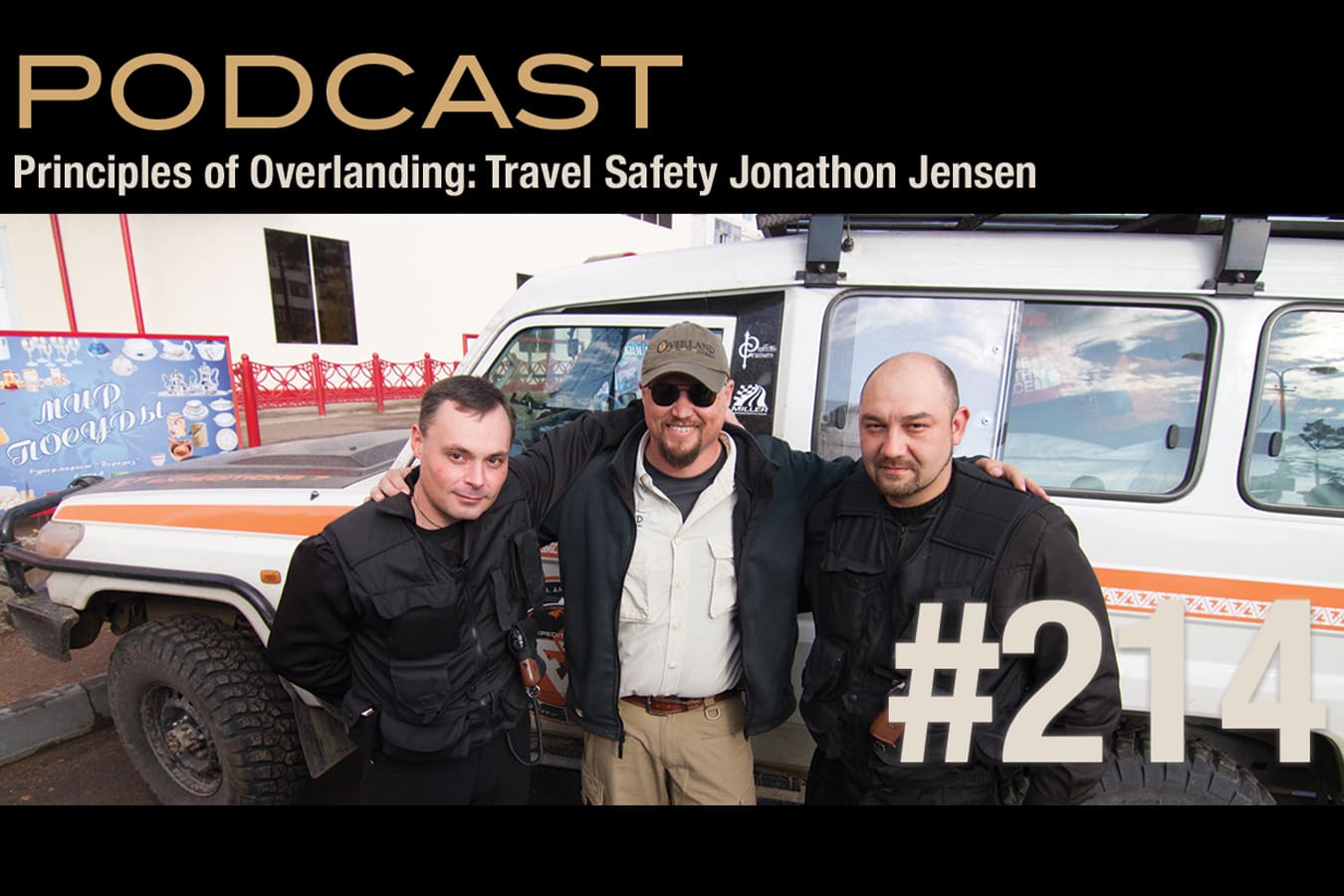
Overland Journal Podcast, hosts Matt Scott and Scott Brady join Bryon Dorr to explore choosing an overlanding “home on wheels.” They compare truck campers, expedition vehicles, vans, and trailers, highlighting truck campers as an affordable, configurable, and underrated choice. The discussion reviews brands like Scout, Four Wheel Campers, and Supertramp, while contrasting flatbed and wedge campers. The panel also covers international travel factors—like fuel and drivetrains—and essential livability features. After reviewing expedition vehicle manufacturers and the pros and cons of vans, they pivot to trailers as a family-friendly solution. Ultimately, they stress the importance of selecting the right platform based on your specific use case, budget, and travel goals.
Overland Journal Podcast Episode #214
The Overland Journal Podcast is brought to you this week by Overland Journal Magazine
New to Overland Journal and want to grab a subscription! Visit Overland Journal and enter code: overlandpodcast at checkout for 20% off. We thank you for being a subscriber.
Guest Bio:
Host Bios:
Scott Brady
Scott Brady is an adventurer, author, and publisher, and the first person in history to cross all seven continents. Brady is executive publisher of the Overland Collective, home to Overland Journal, the Overland Journal Podcast, and expeditionportal.com—the world’s largest vehicle-dependent adventure community. Scott wrote Overlanding 101 (Simon & Schuster) and is currently riding around the world on his BMW GS. He also led Expeditions 7, the first expedition to drive the same vehicle on all seven continents. Brady’s polar crossings include Antarctica and a south–north crossing of the Greenland ice sheet. Scott is a fellow of the Explorers Club and lives in Prescott, Arizona.
Tune in Apple Podcasts | Spotify | YouTube
Our No Compromise Clause: We do not accept advertorial content or allow advertising to influence our coverage, and our contributors are guaranteed editorial independence. Overland Collective may earn a small commission from affiliate links included in this article. We appreciate your support.
Transcript
Scott Brady: [00:00:00] Hello and welcome to the Overland Journal Podcast. I’m your host, Scott Brady, and I’m joined today by my good friend JJ. Now JJ works for the State Department, which is why we only refer to him by his nickname, but we have a great opportunity to go into the principles of overlanding security. Now, there are some things that we need to keep in mind while we travel.
The reality is is that the world is an incredibly safe and hospitable place, but there are things that we can do to minimize our risk, including how we park our vehicle, how we set up our accommodations, a mindset around paying attention to the things that are going around in the area around us. So in our conversation, we cover a broad range of subjects around security, [00:01:00] and JJ brings a lot of his experience in working at embassies around the world and sharing stories of other travelers and challenges that they’ve had, and ways that those issues may have been mitigated.
JJ, thanks again for being on the podcast. Round number two. I like that.
JJ: I feel special.
Scott Brady: You are, and we’ve had some nice adventures since the last time that you were on the podcast. So we did a trip in Kenya where we went out to the coast. We went to Diani.
JJ: Yep.
Scott Brady: And we g- got out towards the port city and, there in Kenya.
Went along the border of Tan-
JJ: Did cross the border
Scott Brady: Through Arusha. Yeah … which was awesome. Not Arusha. That w- Amboseli. Amboseli. That’s right.
JJ: National Park. Yeah.
Scott Brady: And then what was the other one that we went to? Tsavo.
JJ: Tsavo. Tsavo. Yeah. The man eat- That
Scott Brady: was incredible …
JJ: Man-Eaters of Tsavo, that’s that book- Right
about the lions eating people.
Scott Brady: Incredible. It was beautiful. That [00:02:00] one moment that we had with some of those folks, Kenya, where we were out there with a couple of grenadiers.
JJ: Mm-hmm.
Scott Brady: And the sun was getting low. Yep. And there was those giraffe just hanging out.
JJ: Yeah, yeah.
Scott Brady: That was awesome.
JJ: Magical, like a magical evening.
Scott Brady: It really was.
JJ: And then the nighttime camping on a dry lake bed.
Scott Brady: That was so cool. Yeah. Had a nice barbecue.
JJ: Very special, yeah.
Scott Brady: Yeah, that was incredible. We just- Yeah … slept out there on the playa. Yeah. Until
JJ: Yeah, absolutely. They knew where we were.
Scott Brady: That’s right.
JJ: And then the, the other adventure up in a place that looked like it was the moon almost.
Scott Brady: Yeah, that was really neat to be on that other side of Lake Turkana. The last time that I was there I was on the west side of Turkana. That was pretty rough and tumble. Mm-hmm. And then when we went as a little team, grenadiers Then we had Abed with us. Yep. And then we go up the east side of Lake Turkana, and that kind of ties into this whole security thing.
But we were [00:03:00] really paying attention- Absolutely … because we needed to, and there was even some reports of banditry- Yep … which is still, uh, an issue in that region. And it’s oftentimes for reasons that people don’t expect. So it seems as if banditry can happen when There’s a drought, for example. Yeah. And people are trying to- Yeah
provide for their families. A lot of times it’s conflict between tribes- Yes … between areas. Maybe think of the Western US- Yeah … in the late 1800s. There was cattle rustlers, and there were bandits, and people were stealing cattle.
JJ: Yeah.
Scott Brady: Yeah. And it’s the same thing that’s happening there.
JJ: Yeah. The cattle or the, the livestock is worth a lot of money, and also being able to provide for the livestock.
So if it’s land and water usage as well in some of these areas where they can get some water and eat, and that’s gonna guarantee a better sale at market down the road, [00:04:00] you’re gonna take the risk. And that’s a lot- Yeah … of source of conflict as well, and there’s, there’s a lot of dynamics that we’re just not totally aware of all the time.
Scott Brady: Yeah, and it seems like it can just vary depending on the time of year.
JJ: Yeah.
Scott Brady: So- Yeah … some of these places… And that’s why it’s so good to do that little bit of research and to reach out to, for those of our listeners that are Americans, to reach out to the embassies and let them know- Right … what you’re doing and see if there’s any information on the website.
Like we talked about in the last podcast, making sure you get enrolled in the, the various programs that are available. Yep.
JJ: Yeah, the STEP program is key. And even since I had left Kenya, there were a number of protests that were breaking out. If you’re enrolled through that program, you’re gonna get the notifications.
You’re gonna know about the areas that the US Embassy is advising our people to avoid or be mindful of, and so you’ll get that same information. And so it’s key that you’re just in tune with that. I wouldn’t just travel with… just on a whim, not [00:05:00] doing- Right … any research. And I’d say, too, we took a lot of calculated risks, checking with each other and making sure that we both were good with, uh, the movements.
Scott Brady: Yep.
JJ: And sometimes you have to make a decision. Do we drive when it’s a little bit darker or not? Do we ra- little s- drive a little slower, or do we take this route? And just felt really good about us as a team working together on the-
Scott Brady: And we, we didn’t have to drive at night, which was good. Maybe you guys got a little bit of darkness when you were heading back into Nairobi, but by then you’re pretty much within the safety and security of- Yeah
a larger city. But, uh, yeah, we made sure that we were keeping an eye on each other. We were keeping a fairly tight convoy, and we were paying attention to the locals. You… Every time we’d stop at a checkpoint, you’d check in with them. “How are things going? How’s the situation?”
JJ: Yeah, absolutely. But that was a really fun trip, and, uh, then even on that northern route we took along the lake- Driving through the, the desert, that was a really great experience, and it was good to, [00:06:00] to ground truth also areas of the country that even some areas that I hadn’t been to.
Scott Brady: I want to take a moment for a special announcement of our newest video series on the Expedition Portal YouTube channel that features exploring the Smoky Mountains and the East Coast. This multi-part series is presented by Hankook Tires and is hosted by renowned explorer and photographer Sinwai Xavier.
This series will start at the end of September and run through all of October, featuring a trail scout episode, a Jeep Gladiator feature vehicle, trip planning and preparation, and some installments showing the local artisans and places to visit around the Smoky Mountains. We appreciate Hankook’s ongoing support of the Overland community and this podcast.
JJ: I also thought it was interesting, we did the, uh, sundowner, um, there and just hanging out as we saw the sunset, and we had a bunch of people from the local community, not really nice guys that wanted to come over, and they wanted to sell us like [00:07:00] fossils and- Right … German artifacts. Yeah. Yeah,
Scott Brady: that was such a great trip.
That was really beautiful being out on that little peninsula in the lake. We’re gonna go into, last time we talked a lot about- Security and traveler and programs that are available for American travelers. But this time we’re gonna talk a little bit more about some practical ideas- Yeah … around safety.
And I thought it would be good to go through some of the ones that you had talked about, and one that’s really interesting to me, let’s start off with it. What’s the leading cause of death, um, for travelers overseas oftentimes?
JJ: Yeah, you know, a lot of times, um, people think it’s crime related, uh, or maybe even terrorism related.
But the truth is it’s generally traffic accidents. It’s people just getting in accidents, um, uh, because they don’t understand, you know, how people are driving necessarily, and they make a bad judgment. Maybe they’re driving on the other side of the road and they’re not [00:08:00] used to it, and perhaps they’re pretty far away from any medical attention, and they end up becoming a fatality due to that distance.
It just speaks to what y- you’ve said so many times on the podcast about really being mindful when you’re driving, and it’s probably a combination of traffic accidents and drug use sometimes, different sorts of health related incidents.
Scott Brady: Or even, like it is here, somebody that’s been out drinking.
JJ: Yeah.
Scott Brady: You can easily be…
I can see it. You’re in Kenya, they drive on the other side of the road, you go out and have a meal, have a couple drinks, next thing you know you’re impaired already- Mm-hmm … and now you forget which side of the road you’re supposed to be on.
JJ: Yeah.
Scott Brady: You can just really easily see how that could cascade into a real serious problem.
It was probably good for you to see when we were traveling together just how conservatively I drive.
JJ: Absolutely, yeah.
Scott Brady: After all of these [00:09:00] years, I don’t push it. Yeah. I just don’t push it.
JJ: Yeah, and, and to what you were just saying, even sober, right? I don’t drink. Yeah. Uh, and just coming back and driving on the other side.
I love that everyone always says it’s the wrong or the right side of the road. I think that’s really funny because for people that drive on the right side, they say the left is the wrong and the… anyway. But, um- It’s all
Scott Brady: perspective, isn’t it?
JJ: A couple times I had to check myself to say, “Oh, it’s actually on the other side of the road.”
But, you know, that, uh, then drinking and driving, and it’s not only… It, I’m, I’m, I’m not… I’m assuming that a lot of overlanders, they’re gonna be responsible enough not to drink and drive, but it’s the other people on the road as well, right? That’s a problem in places like here in the United States.
Scott Brady: Absolutely.
JJ: At certain times of the night. There’s, uh, people that are under the influence. Happens overseas a lot, too.
Scott Brady: And it’s good to know which countries… That’s one of the positive things about traveling in many Muslim countries, is that you’re much less [00:10:00] likely to encounter someone- Mm … that’s intoxicated.
JJ: Yeah.
Scott Brady: Uh, because they typically do not drink. Yeah. Sometimes they do, but typically they do not. But it’s a really good idea to know if drunk driving is a problem in that country, or how well it’s enforced. Yeah. Like I remember in Central America, you talk to the locals and they’re just like, “Don’t be out at night.”
And it’s not like they’re worried about banditos. They’re like, “People are drunk.” I’ve
JJ: s- seen people just drunk walking, not even- It’s
Scott Brady: terrifying …
JJ: drunk driving.
Scott Brady: That’s also terrifying. Someone, a drunk stumbles into the road right in front of you.
JJ: Mm-hmm.
Scott Brady: And next thing you know, you’ve hit somebody.
JJ: I, I think it was in, I was in Central America one time, and we were driving on a road at night, ’cause we were trying to…
We had a very specific mission that we were trying to accomplish. There was a guy laying in the road.
Scott Brady: Yeah.
JJ: In the middle of the road, and it was a, it was like a S- it was like a Saturday night, so I think he was just like, he had just gone full force on the beers. And he was just hanging out, and he was totally out of it.
It would’ve been really easy to just run over [00:11:00] him if you-
Scott Brady: No doubt …
JJ: weren’t paying attention.
Scott Brady: I’m sure that happens often.
JJ: Yeah,
Scott Brady: absolutely, yeah. And some of these countries also have extreme weather. So you hear about in Russia, it’s very common for people to be drunk, and they fall asleep or they fall over in the snowbank, and-
JJ: Mm.
Scott Brady: And everybody- Yeah … comes out in the morning, they’re an icicle.
JJ: They would get swept away or something like
Scott Brady: that. So you really do wanna watch. One of the simplest things we can do is the same things that we would consider here is- Don’t drink and drive. Know if other people are out drinking and driving.
JJ: Mm-hmm.
Scott Brady: Don’t drive at night. Yeah. Difference.
JJ: And I think about that a lot, that if I’m gonna go out e- even just in the city, and I’m going out at nighttime, and it’s a Friday night or something, higher chance that someone out and about is possibly under the influence. I guess you just have to calculate that, uh, depending on the country, it may be a long time until police can get to you.
Scott Brady: [00:12:00] Yeah.
JJ: So in some countries I’ve served in, we had rules, uh, about driving at night outside of the major populated areas because maybe in that country, the laws stipulated that a police officer had to arrive at the scene and had to process the scene. So when you end up staying… If you’re out at night and get in a simple fender bender, all of a sudden you’re out there, you have to wait till they arrive- Sure
otherwise you left the scene of an accident- Sure … and that could create another issue for you. And then all of a sudden you’re exposed- Mm … to other situations that you weren’t anticipating and just were trying to maybe get somewhere. So I think it just comes down to planning. Of course, there’s necessary times when you have to do some of these things.
Scott Brady: That’s right.
JJ: And, and then maybe that’s when you work as a team as you have everyone focused on a specific thing to keep you as safe as possible.
Scott Brady: Yeah, and, and I think at the end of the day- It’s all a matter of statistics or Russian roulette, depending on how you wanna look at it. So you just don’t wanna spin that cylinder very often.
JJ: Yeah, absolutely.
Scott Brady: It doesn’t mean that you never [00:13:00] drive at night. There have been times that I’ve had to drive at night, but I avoid it like the plague. Mm-hmm. Just because n- no good comes from it usually. Yeah.
JJ: Yeah.
Scott Brady: And plus you don’t get to see anything. Yeah. E- e- exactly. You don’t get to see all the cool places when you’re driving at night.
JJ: And I’m thinking when we drove through that lava field-
Scott Brady: Yeah …
JJ: in Tsavo. This is just… And it, I… It’s hard to describe it, but y- you’re driving and all of a sudden you hit this big black patch and then you look up the mountain and that it was this huge ancient lava flow that came through that area. That’s right.
You’re driving at night, at nighttime, you don’t get to see that.
Scott Brady: You would totally miss that. Yeah, yeah. Absolutely. That whole route was incredible.
JJ: Yeah.
Scott Brady: Yeah.
JJ: Or the… We got… We can’t forget the elephant on, in the middle of the highway.
Scott Brady: Yeah.
JJ: Like, he was in the median, right? That’s
Scott Brady: right.
JJ: And, and that was a…
I’d never seen that before. But I think he was in between the Tsavo East and West- That’s right … and
Scott Brady: he was just checking things out.
JJ: Yeah. So yeah, uh, definitely gotta keep an eye out for things like that.
Scott Brady: Wildlife in general can be a real issue for travelers that we need to be careful of. That’s a good [00:14:00] reminder.
When we used to do work with the Marines on, uh, n- non-tactical vehicle training, the reason why they hired us to do that was because of injuries and fatalities related to vehicle accidents. Mm-hmm. They were trying to gain, um, awareness and experience in the soldiers around driving off highway, uh, so that they would understand the risks and to better not only pilot the vehicle, but if they had a flat tire or anything else, that they could do that expediently.
Um, obviously in the military s- setting or e- even in the settings that you encounter, um, having a flat tire, um, leaves you stranded. You, you’re no longer mobile, um, and the risks go up quite a bit with that. And that also happens with travelers, so making sure that we’re not overstressing the vehicle, we’re not pushing the vehicle too much.
Mm-hmm. We’re paying close attention to our tire placement. Because when you have a flat tire, now you are [00:15:00] immobilized, and if someone has ill intention, you really can’t go anywhere-
JJ: Yeah, you’re- …
Scott Brady: till you get it fixed …
JJ: given the opportunity. And I really am not comfortable at all when I’ve had to change a, a flat tire or something on a highway.
You know, of course, here in the US, right, like it’s… Or in a lot of countries, ’cause the high speeds, you don’t want someone not paying attention. They’re looking at their phone distracted and they end up… Happens to police officers all the time where they’re struck. But in some other countries, people are very creative with uses of the road.
Scott Brady: Yeah.
JJ: So they’ll, they’ll just pass people anyway on the medians- Yeah, that’s right … or side of the road. And the speeds are slower. And I’ll say that speaking the language of driving i- in every country you go to, you learn the language of that, driving in that country. I would say sometimes they’re aware of obstacles-
Scott Brady: Sure
JJ: looking around, but I- it’s just not comfortable. I don’t want to give any opportunity for either a robbery attempt or just getting hit by something.
Scott Brady: Yeah.
JJ: You know?
Scott Brady: It does seem that the more dynamic the driving is in the [00:16:00] country, the less likely they are to be distracted- Yeah … ’cause you just can’t be.
JJ: You can’t.
Scott Brady: Like, here in the US, we’re lucky to have four, five, six, seven, eight lane divided highways, whatever.
JJ: Mm-hmm.
Scott Brady: And so I think that gives a lot of complacency to people, and then very high speeds. But when you’re dodging potholes all day- Yeah … you can’t be distracted. Destroy your car.
JJ: So the story, I mean, I told you As I was ending my tour
Scott Brady: That’s a good one
JJ: and this is bad on me, I was distracted, right? I was coming through this small little Maasai village, and then all of a sudden I see this kind of brown thing kind of hop in front of the car, and it was a goat. I’m glad it was a goat.
Scott Brady: Yeah,
JJ: sure. Right? ‘Cause there was kids running around. Of course. And I struck this little goat, and it was a medium-sized goat, and it was not really great.
My kids were in the car. They were unhappy with me, and it was totally on me. “Hey, whose goat is this?” It took about 10 minutes for people to figure out whose goat it was, so I- I-
Scott Brady: Yeah …
JJ: maybe it’s a street goat, right? Yeah. [00:17:00] Had no owner, but figured out who it was, negotiated the compensation.
Scott Brady: Sure.
JJ: Paid them on the spot, and I got out of there.
Scott Brady: Yeah.
JJ: And so, um, they were happy. The funny thing was all my, uh-
Scott Brady: But that’s so … It’s what we have to do as travelers.
JJ: Yes, absolutely. Because you leave … Uh, it was quite obvious I wasn’t local, and so you don’t want, again, give the bad impression. You want to be a good impression. Yeah. Give a good impression, if you can- Yeah
about who you
Scott Brady: are- And take res- take responsibility … where you’re from. Yeah. ‘Cause we’re out recreating. Yeah. In this case, you were out having a, a nice trip with your family. Yeah. You weren’t doing it for work. It wasn’t a professional endeavor. Mm-hmm. Mm-hmm. You’re a traveler through that region, and the loss of an animal like that can be significant for a family.
JJ: Yep. Yep. Food source, and I, we did the right thing, and, again, I’m sure I paid more than I should have, but I was okay with it, and I was- What
Scott Brady: does a goat go for nowadays?
JJ: Let me say, they wanted $150, and I said, “That thing’s not worth more than 30.” And I think we [00:18:00] settled on, like, $80. It probably is worth about 50 at market- Yeah,
Scott Brady: yeah, sure
JJ: depending on the size. Then it went to the community. Yeah, of
Scott Brady: course.
JJ: Their … All my Kenyan colleagues were said … They told me, “Did you bring the goat with you?” I said, “No. I left the goat.” And I’m like, “They should have brought it. They usually cook. You paid for the goat.”
Scott Brady: Yeah. Fresh goat meat. And- That’s so funny.
You paid them, and they got the goat meat.
JJ: Well, it, it would have made the trip not so great if I hit a goat, and then- Pop it in the back of the truck on top of the luggage. That would not have gone well with my family. It would’ve been a story they never would’ve
Scott Brady: forgotten. I think even now they’re not gonna forget that one.
Yeah. But the community was probably super happy. Yeah. They got paid for the goat and they got to keep the goat. Yeah.
JJ: Um, they, people were gathering around me and so I, I know a lot of travelers would be scared of that situation, but I, I wasn’t ’cause I knew that, uh, they, they weren’t angry. I just was looking at everyone and, and I knew what I was gonna do.
Yeah. And, and I did what was right. If [00:19:00] I had just driven through and, uh, they probably would’ve held me up at the next community actually. Yeah, sure. And it would’ve been a worse situation.
Scott Brady: Much worse.
JJ: And I learned about this just really… Another colleague had accidentally hit a sheep or something and, and he told me how he handled it and, and I’d been to some livestock markets in Kenya, so I knew the going rate and that things are worth things to folks.
Happy to do it.
Scott Brady: Yeah. It is a store of wealth for those families. I remember when I was in, uh, Malawi and a place that I stayed, the guy who was running the operation, he gave me a tour of his village. He was someone of modest means by our standards, but fairly significant means by their standards. He showed me his home and in the back he had this pen And it had maybe five or six cows in the pen.
Mm-hmm. What he explained to me was, he said, “You have a savings account that you save for when things go bad.” He’s like, “This is literally- Mm-hmm … my saving. This is the [00:20:00] bank.”
JJ: Mm-hmm.
Scott Brady: And he says, “If I need to buy a motorcycle, I sell a cow.”
JJ: Yeah.
Scott Brady: If I need to expand on my home or if my child needs to go to the hospital or whatever, I sell a cow.
JJ: Yeah,
Scott Brady: yeah. And they build their savings account like an annuity by having more cows- Yeah … baby cows, and then they get to m- get a dividend on it-
JJ: Yeah …
Scott Brady: every month with milk. And-
JJ: Yeah …
Scott Brady: so it’s pretty interesting. Yeah. And that’s how humans did that for a very long time.
JJ: Yeah, yeah. It was a good experience that happened.
I learned- Yeah, sure … a lot from it. Unfortunately, I hit the goat. I used to raise goats when I was growing up. I felt a, a special loss. Of
Scott Brady: course. It was
JJ: a poor animal.
Scott Brady: Of course. Yeah. Yeah, you never wanna create any unnecessary suffering- Yeah … if you can help it, but it was also an accident.
JJ: What it really taught me though is, man, you gotta be on point.
Scott Brady: Yeah.
JJ: When you’re going through these places, just, you know, make sure you’re completely focused.
Scott Brady: Yep.
JJ: The worst thing would’ve been that I hit a small child or, or a person, and it can happen. There’s this game sometimes in, in some of these countries where they, like, they’ll look [00:21:00] at you straight in the eye, and then they’ll wanna race across the road.
And, and you just gotta really be on point with things, and I also will never forget it. And so I’m prepared from this point forward to just refresh, hey, just be aware. Yeah. Be totally aware, on point, and paying attention.
Scott Brady: Yeah. We … Many years ago in Overland Journal, we published a story from a husband and wife that did hit a child- Mm-hmm
somewhere in Africa.
JJ: Mm-hmm.
Scott Brady: And it went through their journey of taking responsibility, not paying off the police. They had a chance to pay off the police- Yeah … and leave.
JJ: Yeah.
Scott Brady: But they actually stayed and met with the village elders and met with the family. The, the negotiation was, at the end of it, was that they were gonna pay for their other children to go all the way through school and into post-secondary-
JJ: Mm-hmm
Scott Brady: education. It was a way to give back to that family. Could never replace the child that was lost, but it’s a way to give opportunity to the other children [00:22:00] that they may not have had otherwise.
JJ: Absolutely. That’s the right thing.
Scott Brady: But it was a tragedy for all involved. Yeah. But because they didn’t just take the easy way
The local police comandante was like, he was happy to take a couple thousand bucks- Mm-hmm … and make it go away.
JJ: Mm-hmm. Yeah, unfortunately, that’s the way things work a lot of times.
Scott Brady: And the family wouldn’t have gotten any of it.
JJ: Yeah. And again, by you doing the right thing, doesn’t matter where you’re from.
Scott Brady: Yeah.
JJ: You’re speaking to the values of your family, your community where you’re from, ’cause that’s the way a lot of these places view things- Yeah … one community to another. But you’re representing well everything about you.
Scott Brady: Yeah.
JJ: And so let’s take that opportunity and do the right thing. I think that’s always what we should do.
Scott Brady: And that’s a good lesson. And it was, it sounds like it was a good lesson for you.
JJ: Mm-hmm.
Scott Brady: A reminder that we gotta be on point all the time. And for me, it gets exhausting at times. Yeah. Yeah. And it’s, uh, e- anymore when I travel, it’s why I [00:23:00] take more break days than I used to. Is because I think it’s the cumulation of having not had something bad happen and realizing that it’s statistics.
JJ: Yeah.
Scott Brady: And then also that I just need to be more and more… I have more and more responsibility. I have other people in the vehicle, I have people that I’m representing. You know, I just need to be- Yeah … more, I have to be more and more mindful of… And I, and I have to be a good example to others.
JJ: Yeah, and I, and I’ll do another plug, too, that if you do find yourself in a situation that, you know, potential legal issues, that’s when your pre-work for going out to, uh, a certain country, having the right numbers to call.
If you’re from the United States, calling American Citizen Services, or if you’re from another country, they have a version of that usually for their country with that embassy or consulate. And that being, like, the first call you make, because there could be other things coming down the road in terms of legal…
If you just need to be prepared, what you should do next- [00:24:00]
Scott Brady: Yep …
JJ: and get that advisement. It doesn’t mean they’re gonna pull you out of jail, it just means that they’re gonna make sure you get the proper treatment, and make sure that you have a list of people you can call to help you through, work through that issue.
Scott Brady: And, and not only that, but then someone knows where you’re at.
JJ: Yep. “
Scott Brady: Hey, I’m, I am in this community, this thing happened.”
JJ: Mm-hmm. ‘
Scott Brady: Cause you may not get that next phone call. Yeah. It’s very common for phones to be confiscated, identification to be confiscated by the police, and then you don’t have that opportunity.
Yeah,
JJ: yeah.
Scott Brady: So yeah, make it be your first call for sure.
JJ: And have your family back home also advocating for you.
Scott Brady: Yeah, that’s right.
JJ: So then you may get held up and not have the opportunity to make further calls. Explain the situation to someone, some point of contact back home. They can continue to make those calls to follow up on your case and make sure you’re getting the attention that you need.
Scott Brady: That’s right.
JJ: And hopefully, again, hopefully that everything works out fine. And these are not new issues. Things happen all the time, so people are used to working through these issues, the [00:25:00] local authorities and, and the embassies and consulates, so you’re not the first person usually.
Scott Brady: Yeah.
JJ: It’s just, again, just be prepared, make the calls, be decisive.
If it, you hit an animal or something, you need to do it, it’s a negotiation.
Scott Brady: Yeah.
JJ: It’s not just, “I’ll just pay you whatever you need me to pay you.” And know who you’re paying, make sure you’re not paying a bribe.
Scott Brady: Yep. ‘
JJ: Cause when you pay the bribe, once you pay the bribe, you’ve technically broken the law.
Scott Brady: Yeah.
JJ: You’re now susceptible to anything else-
Scott Brady: Yeah,
JJ: that’s right … that can come along, ’cause then they could, you actually paid a bribe, if they really wanna use that against you. So the best is to try to you just avoid that.
Scott Brady: That’s right. Keeping your tracker running. If you have a spot tracker, make sure it’s running, it’s in the vehicle or it’s on your person.
They may not know what that is, but they would know what a phone is. Mm-hmm. For example, when I’m traveling, I always have a point of contact back in the United States that happens to be Brian McVickers, who’s on our team. And if I’m going into an area that’s… I’ve got a little higher concern, I’ll let him know, “This is where I’m at.”[00:26:00]
Make sure that he can track me on the tracker So that way someone at least knows- Mm-hmm … where I’m at. It’s been very helpful in Africa recently because you got to be that guy. Like, I felt like I got Captain America- … in the backseat, which was cool. Yeah. Yeah. But, uh, it’s really helpful to just know that someone outside of your vehicle has got your back.
JJ: Yeah, absolutely.
Scott Brady: It’s really helpful.
JJ: And a special thanks to Dometic for their support of this week’s
Scott Brady: podcast. I have personally used their fridges on multiple continental crossings and find them to be lightweight, durable, and efficient. Dometic has just upgraded their CFX5 line with their new VIP insulation panels, which improve efficiency and reduce power draw.
They have also introduced a variable speed motor to reduce unit noise by up to five decibels. That makes a big difference when you’re [00:27:00] sleeping next to the fridge. The USB port is now 18 watts for even faster device charging. The CFX5 will cool down to minus seven degrees Fahrenheit and has a three-stage low voltage cutoff to protect your battery while running on either 12 or 24 volts DC and 110 or 240 volts AC.
These
JJ: fridges are durable and even won our most recent Overland Journal Editor’s Choice Award. Find out more information at dometic.com.
Scott Brady: We talked a little bit about the hazards to be aware of, uh, when traveling on roads internationally, but there’s a couple things that came to mind for me when I read this bullet point for you is, uh, making sure that your tires are in good condition and that they’re at the right pressures.
Mm-hmm. So much of what we’re gonna talk about today is about prevention because an ounce of prevention, it goes so much further. So making sure that the tires are in [00:28:00] good condition, that your spare tire is properly inflated as well, that you’ve got the tools in the vehicle to- Correct … change a tire out.
The number of times that I’ve come across someone in the backcountry, um, that could not remove their tires because a- aftermarket wheels-
JJ: Mm-hmm …
Scott Brady: and then aftermarket lug nuts. Mm-hmm. Um, or maybe they forgot the key to the… There’s things that happen so easily. Um, so you wanna make sure that you, that… Or the, maybe the jack, the vehicle’s lifted now.
It’s 100. The jack no longer works.
JJ: Yeah.
Scott Brady: So making sure you test all that stuff. Make sure that the vehicle’s in good working order, as good a working order as possible.
JJ: Yeah.
Scott Brady: When it comes to vehicle issues, we can prevent a lot of it.
JJ: Yeah. I just got a refresh on some training using high-lift jack and other types of tools like that, and-
I realized that I have some of the tools, but not all the tools I need.
Scott Brady: Yeah.
JJ: Right? So I have a high-lift jack, but I was missing some of these, like, soft shackles or things that would’ve made it easier. [00:29:00] Sure. It still would’ve technically- been able to do it, but I may have ended up damaging the vehicle and so I saw with some professionals, proper training Them use some of these soft shackles in different combinations and configurations, and I was like, “Oh, that’s really good.”
And these guys were all experts in the field, and so I said, “Okay, I actually- I’m actually missing some equipment.” Right? I have the, the, the high lift jack there. It looks cool. I, I have a high lift jack mounted on my Defender, but I also carry a bottle jack with me- Sure … as well. But you gotta make sure that, uh, it’s tall enough, right?
That’s right. And so it’s true that i- if you don’t test your equipment out before, then you’re just asking to be in a situation down the road that you’re like, “Oh, I actually don’t have what I need,” and then you gotta ask for help, and then you’re out there a longer time. Yep. But with work, every time… With work, we do drills a lot, and every time we would do a drill, we would find little things that weren’t working, some batteries that went bad.
Scott Brady: Gosh.
JJ: All the time. With the folks that were working [00:30:00] with me or underneath me, I’d say, “This is why we drill, because we figure out that stuff doesn’t work, stuff went bad-” That’s right … the batteries went bad. This piece of equipment doesn’t work the way that you wanted.”
Scott Brady: Interface with the vehicle properly.
JJ: Exactly. So those preventive… I think just getting familiar with your equipment. If you buy something new, first thing, just make sure it works for your application, ’cause until you use it, you’re not gonna know. Um-
Scott Brady: You know, like when I would work with the Marines, I’d tell ’em, “When you go into the motor pool and you grab that Hilux, make sure that they put the right spare tire.”
JJ: Yeah.
Scott Brady: Because it- Yeah … could be a completely different bolt pattern.
JJ: Yeah.
Scott Brady: But they use the same size tire.
JJ: Yeah.
Scott Brady: It would be very easy for the motor pool to put the wrong spare-
JJ: Yeah …
Scott Brady: with the wrong vehicle.
JJ: I just bought another vehicle to use around town, and before my travel, I went to check and no spare tire.
Scott Brady: Yeah.
JJ: Who got rid of the spare tire? Yeah. I don’t know who would get rid of a spare tire, but then I’m like, “Okay, great. Now I need to figure this out, get another spare.” But there’s workarounds, [00:31:00] right? Yeah. Um, you can, uh, make sure you have a… If you’re finding ways to support your travel, if I had a, uh, plug kit- Yeah, sure
and end up having just a simple… Okay, I know how to plug a tire. I don’t know how to use that spare. That’s right. Actually would be quicker. And so all right, I’ll get a plug kit, and I’ll have that ready. And so there, there’s different combinations of ways that we can work through problems. Again, though, if you don’t ever practice, then you’re gonna just be figuring out the first time when it’s happening, and that’s- Yeah
just not ideal. Right now in the States, it’s a little hot out here and, uh-
Scott Brady: Yeah …
JJ: not so much in Prescott, but in Arizona and the Vegas area, and I don’t wanna be changing a tire at 120 degrees- No
Scott Brady: way …
JJ: out there, you
Scott Brady: know? No way.
JJ: Um, so.
Scott Brady: Yeah, brutal. Or having a vehicle break down or anything else. Yeah. I showed them how to plug a tire.
JJ: Yeah.
Scott Brady: They were like… A couple of them were like, “You can do that?” Yeah. Or change out the valve with a Colby valve.
JJ: Yep.
Scott Brady: They wanted me to show ’em how it worked- Yeah … because they’re like, “I don’t… I’ve never seen that before.”
JJ: Yeah.
Scott Brady: And it was a pretty cool thing-
JJ: And it’s
Scott Brady: qui- … to be able to show ’em. [00:32:00] That’s right
JJ: it’s quick as well, and there’s always someone willing to teach those techniques, and there’s some- always someone that maybe is a little better versed in it. But, uh- Had trained the trainer and-
Scott Brady: Yep …
JJ: and it’s a great skill to have. It feels great to be able to help someone in need, to be the person that can help them when they actually need some help.
That’s great.
Scott Brady: I remember when I did the trip- Mm-hmm … through the Stans years ago on the Silk Road, and I was in Uzbekistan, and we were eating at this little restaurant. The family w- they were so sweet, and they just served us this wonderful meal, and there was another family, and they spoke some English, and they wanted to see our photos, and it was just a really wonderful exchange.
I’m trying to expl- ask them where is a good place for us to stay that night, a hotel to stay. I couldn’t quite understand what they were saying, but basically they were saying, “No, you shouldn’t even leave the restaurant. You can stay here.” Mm-hmm. “You can sleep here in the restaurant.” Mm-hmm. And they let us sleep right there on the…
‘Cause they eat and recline and hang out. Mm-hmm. It’s a big [00:33:00] production, so the restaurant little booth was perfect for sleeping too. But then the next morning when we got up, the guy who let us stay there overnight, he had a flat tire- Oh … on his Lada or whatever .
JJ: And like, “I got you, man. No
Scott Brady: worries.” Yeah.
Totally. Yeah. Plugged the tire. Yeah. Had the compressor. The dude’s eyes were this big around. Fixed the tire, compressor, aired it up- Yeah … and he was good to go. It is a way to give back.
JJ: And even on our trip, the guys with the motorcycle in the ditch- Yeah, that’s right … or it was like a motorcycle… I
Scott Brady: don’t know what that thing was.
JJ: You stopped right away, we jump over, and they were actually just happy to see, you know- … we stopped by to help them out. They had it though, but it was pretty cool.
Scott Brady: It’s a good thing to do, to just… Especially fellow travelers- Yeah … ’cause we all just wanna know that somebody’s got our back a little bit. Yeah.
You got some other good stuff on here, like potholes, for example.
JJ: We talked about the animals on the road, and I, and I al- I was just thinking about our trip. And at, at the most basic level, engineering of roads is different in different countries.
Scott Brady: Yeah, sure.
JJ: Right? All those sorts of specs. So [00:34:00] roads are built in different ways, and we saw on that road we were on that the big trucks had started to wear into the road and there was…
So you actually couldn’t go too fast on that road because-
Scott Brady: No …
JJ: you’d be bouncing around because the trucks had worn and there was almost like a divot sort of thing.
Scott Brady: A groove. Trucker’s grooves,
JJ: yeah. Um, truck-sized potholes- Yeah … that happens. That’s a thing. And so they’re not meant for you to drive that fast.
When I first came back to the US after so many years, it, it was a little overwhelmed by how fast things felt- Yeah … because used to driving slower. But those big holes, and it just, you gotta be paying attention, right? Big holes, random speed bumps in the middle of a highway. They, they’re not painted or marked.
The shadows can confuse you. Oh, that’s right. And, um, but if you’re not exceeding the speed, then it shouldn’t be too much of an issue, but how do you react when you hit it too hard, it could incapacitate your vehicle.
Scott Brady: And a, a lot of times people will complain about the speed limits in Africa, but they’re that way for a reason- Yeah
[00:35:00] because they have limited medical support.
JJ: Yeah.
Scott Brady: The road conditions change constantly. Uh, the condition of vehicles on those roads vary widely. At the end of the day, just realize, like, the reason why you’re doing 50 kilometers an hour is because it’s the safest speed for you to be- Yeah … traveling at on that road.
JJ: Yeah. And the, and the roads may not be built for, again- Mm-hmm … the engineering isn’t set to take a car at excessive speeds, and there’s other little surprises that could come up. Even these big trucks that you may be traveling in front of and around, the maintenance n- may not be up on that truck, so the brakes go out- Oh, yeah
sometimes, and I don’t like to be right in front of a big truck. I like to be behind the truck because then you get away from them because then the brakes could fail at some point, or oversized loads. All types of things that almost, that almost-
Scott Brady: Absolutely …
JJ: and, and so that stuff-
Scott Brady: Or there’ll be rebar coming out the back with no flag on it- Yeah
and you’re like, “Whoa, that’s a chunk of rebar right there.”
JJ: So it’s a bit of a Frogger game a little bit, what [00:36:00] you need to be paying attention to. And as you said- Your nearest medical facility may be pretty far away. Even down in Baja, I did the drive several times from Tijuana to Los Cabos. You would need to have a sat phone- Yep
because you lose signal when you start to leave the ocean. Very remote, and it’s almost like the road is up on a high kind of tiered, and then it falls off to the sides. Boulders, no bars, so if you’re just not paying attention, you could just roll off, and then you gotta call help. How are you gonna call help?
And no cell signal. In situations like that, time’s of the essence. Where’s your nearest hospital that could support you?
Scott Brady: Yeah.
JJ: It may be back in Tijuana, Mexico City. In Kenya, that may have been Nairobi.
Scott Brady: Yeah.
JJ: So you don’t, simply don’t have the time to drive six to eight hours to get to the nearest facility.
If you can’t treat it there, and you don’t have those medical supplies with you, because there may be experts nearby that could help you, but they just don’t have the supplies- Yep … but you need to be airlifted So best is to [00:37:00] prevent it. Just prevent that situation from happening.
Scott Brady: Re- remove the speed from the situation.
Yeah. That- that’s the most important advice that I can give when it comes to vehicle travel, is remove as much speed from the situation as possible. The more that you’re rushing, the more that you’re speeding… You can get away with it in a lot of times in North America because you come around a corner and you always expect that corner to be what you expect it to be.
Mm-hmm. But when you come around a corner in Africa, it could be filled with bricks that just fell off the truck in front of it. Mm-hmm. Half the road can be gone, washed away. A tree stuck in the ground to try to give you some- Yeah … warning. The most important thing that we can do as travelers is to remove as much speed from the situation as we can.
We wanna make sure that we have as much sight distance as possible when we’re passing. We can increase our speed slightly when we have sight distance, but the less sight distance that we have, the lower the speed needs to be.
JJ: Mm-hmm. Absolutely, yeah. [00:38:00] And the conditions as they develop, fog and other things- That’s right
and just like you said, it’s all about visibility- Yeah … sight distance. And I’ll, I’ll say also paying attention to what people are doing around you. Now, a lot of people are very comfortable and so they’ll speed excessively and they’re not the best examples.
Scott Brady: Yeah.
JJ: But if you see other people on the road doing certain things, there’s probably a reason why- Yeah
they’re doing it. Maybe to save a couple minutes, but maybe because of different hazards-
Scott Brady: Sure …
JJ: that exist. Even just before I left Kenya, there was a lot of flooding caused by- Big time … different rains. Big time. It was impacting communities, taking roads out. But I did notice that the Google Maps even was tracking flood-affected areas.
Scott Brady: Oh, wow.
JJ: So sometimes, the… I was… It was an unexpected surprise for me ’cause we’re trying to gather information from different communities and contacts, but the mapping software was actually showing little kind of flooded areas and said, “This area may be affected by flooding.” And, you know- Yeah,
Scott Brady: it seems like it was pretty significant.
JJ: It was, yeah. And [00:39:00] it, it was sporadic, just affecting different comm- it was, but several sections of the country.
Scott Brady: Yeah, sure You’ve got another one here that I think is really good: how do transportation regulations differ? And I have tried to download some of the equivalent of our motor vehicle division regulations in other countries, and you usually can’t find it.
And there were actually some that I did find, and they were so onerous that you would never think that you’d even wanna drive there. The amount of equipment in s- some of the ones I were able to, I was able to download for Africa, ’cause when we did the Expedition 7 trip, we had the resources to be able to actually look for those kinds of things, like- Mm-hmm
what is the regulations for vehicles in that country? And it was shocking, some countries, what they expected you to have in the vehicle.
JJ: Yeah.
Scott Brady: You had to have a first aid kit. You have to have a certain number of road flares or road [00:40:00] triangles. You have to have a certain number of safety vests. It’s interesting what, like some countries require you to have spare bulbs- Mm
in the vehicle. And you don’t… Now, but there are things that are interesting. One of the ad- ad- advantages of the EU now is all of the signage is now the same. Yeah. So, like, when you go through Croatia, it’s exactly the same road signage as when you go through Luxembourg. You gotta look it up ’cause they don’t always make sense because you can go down a road and you think, “Oh, shoot, am I going the wrong way on a one-way?”
JJ: Yeah.
Scott Brady: Because it has an X with a circle on it, but no, that actually just means no stopping.
JJ: Yeah. Yeah.
Scott Brady: And if there’s one slash through it, it means no parking.
JJ: Yeah.
Scott Brady: They’re fairly consistent now throughout Europe, but in other places in Africa, you have no idea what some of these signs mean.
JJ: Yeah, there’s the signage or just how the rules work.
Scott Brady: Yeah.
JJ: You could be in a country where [00:41:00] if, if you enter a roadway, and let’s say another car is coming, you’re entering the, a moving roadway and the other car is speeding, they’re coming over hills, excessive speeds, and there’s, there would’ve been no way to avoid the accident. If you get hit by that other vehicle, since you entered the roadway, you’d be 100% at fault.
Scott Brady: Sure.
JJ: And then if there’s people in that other vehicle that are injured, sometimes the rules may be that you go to jail until their hospital bills are completely settled or you made the commitment that you’ll settle those fees. Sure. So you’ll say, “I was… They were speeding. They came over a hill. They were in the opposite lane of traffic.”
Sure. The way the rule worked is if you got hit, then you were at fault. If there’s an accident, sometimes the first vehicle to move, you just admitted fault- That’s right … ’cause you’re the first vehicle to move, so you leave the vehicle where it is until police show up.
Scott Brady: That’s right. Yeah, that’s true in Russia.
If you get in an [00:42:00] accident, you cannot move the car until the police arrive.
JJ: Yeah, so the traffic laws can be a little quirky, and sometimes it is really hard to find the rules. Um-
Scott Brady: Very difficult …
JJ: thank you. If you have a trusted source in country, you might ask them, “Hey, what do I do f- if I’m in an accident?
What am I supposed to do?” And they’ll say, “Don’t move the vehicles.”
Scott Brady: Yeah.
JJ: The other point I was thinking of is the insurance piece. Yes. Man, it’s so important because- If you get proper insurance for a vehicle to drive in country, first of all, make sure that your license works. So many countries, they’ll accept licenses from other countries as acceptable to drive in that country, first of all.
Um, I, I one time rented a car in the US with my Kenyan driver’s license ’cause my other one- Yeah … had expired. The point on the insurance, if you get in an accident and, um, you don’t have insurance, then it’s basically you against the world in terms of what you gotta pay.
Scott Brady: That’s right.
JJ: And you’ll be paying for people’s college maybe.
Scott Brady: That’s right.
JJ: [00:43:00] But if you have insurance, then the, the insurance companies have to fight with each other and negotiate the settlement. You’re totally out of the picture. That’s right. You’re totally fine. If there’s a suggestion, and, and all that information is usually on embassy webpages, like about insurance, get the insurance from a reputable company, and then if something happens, then you’re covered.
Scott Brady: Africa, there’s something called COMESA insurance. Mm-hmm. If you’re in Europe, it is a Green Card insurance. Yeah. Another one for those that are listening, most people, their aspirations for international travel would be probably to start with going on a trip down to Mexico.
JJ: Yep.
Scott Brady: It’s interesting, but in Mexico it’s not the law to have insurance.
Mm-hmm. But you wanna have it because they have Napoleonic law- Mm-hmm … in Mexico, which means that you’re guilty until your innocence- Mm-hmm … has been proven, uh, which is exactly the opposite of what it is in the United States. So that means that if you have insurance, then again, you have this insurance company that’s gonna be advocating [00:44:00] on your behalf.
They’ll be settling up any of the damages. They’ll be making sure that the person’s vehicle gets repaired. If you don’t have that insurance, they’re gonna impound your vehicle, and they’re gonna hold you- Yep … until you can provide financial resources. And to your point, you’re just this one individual that’s going against now someone who wants a new car, as opposed to- Yeah
the one repaired, whereas the insurance company in Mexico is gonna know how to interact. They’re gonna know what’s appropriate, what’s fair- Absolutely … and they’re gonna have the lawyers and everything else, the influence- Yeah … to be able to make sure that it is fair.
JJ: Yeah. It takes you out of the picture.
Scott Brady: That’s right, the key. Yeah. You’re not under… You’re not being detained.
JJ: Exactly.
Scott Brady: So you’ve got some other good ones here to talk about, but let’s pop up to some of the other stuff that we wanted to talk about, which, uh, includes evacuation insurance- It’s something that I always have. There are- there’s one called Ripcord, a whole bunch of different ones out there, MedVac Assist, [00:45:00] couple others.
But do the research on that. We’ve got some good articles on that on Expedition Portal. But it’s a good idea to have evacuation insurance in addition to your own medical coverage that you have in the United States, because what that’s gonna do is get you to first world care. That’s right. So if you’re in Azerbaijan and you’ve got an acute appendicitis or whatever, they’re gonna evacuate you to Germany.
Mm-hmm. They’re gonna get you to first world medical care, and they’re gonna use helicopters, they’re gonna use planes, they’re gonna use whatever it takes to make that happen very quickly. Whereas if you don’t have those resources, then you’re gonna n- need to get those procedures done in those countries.
And it’s not that they can’t do an appendix surgery in Azerbaijan. They can.
JJ: Mm-hmm.
Scott Brady: But it may not be orthoscopic. Yeah. So you’re gonna have a big slice across your belly-
JJ: Yeah …
Scott Brady: when they do that.
JJ: Yeah. The- the idea is that they … The insurance, which is … And it’s usually not as expensive as [00:46:00] you might think it is.
Scott Brady: It’s a couple hundred bucks a year.
JJ: Yeah. It’s gonna get you airlifted to the- … airlifted or ground transportation or however- Yep … the combination works to the nearest facility that can first possibly treat your condition. So if it’s something that’s pretty serious, then it’s gonna get you to a place, like you said, some first world care option.
And if you plan on being in some remote areas, you’ll be surprised at how many remote airstrips-
Scott Brady: Yeah …
JJ: there are. Bush pilots. That’s right. I’ve landed in several of these places. They’re like, “There’s an airstrip there, and we’ll land.” And so what that means is that you’re now within reaching distance of getting actual medical care if you really need it, something serious.
And so it’s invaluable. It’s a requirement, actually, for all of us. Like, we’re covered with the government. We’re all covered with a, a, a form of insurance that g- that gives us those benefits. Totally necessary. And- One other sort of point where if we’re… Lot of local folks are, they’re gonna be there to help you and, and try to help you.
[00:47:00] But I, I have also seen fatalities where it was a fa- fatality or serious situation, and sometimes people were not able to help because if you take a person to the hospital, they end up dying at the hospital, you’re financially responsible for that person in some countries.
Scott Brady: Yeah, sure.
JJ: So it’s, a lot of times as foreigners, we get the benefit of the positive, we’re gonna be able to compensate that person- Yeah, sure
and help reward them for that help. But I guess just again, another point that it’s you, you want all options available to you if you can use them to get that care as quick as possible.
Scott Brady: Yeah, and a lot of times people travel with their partner, they travel with their kids. Just get the insurance. Get the family plan, and then if you do have a medical emergency, you’re gonna be able to get out of there quickly.
Mm-hmm. You’re gonna be able to, again, have them, they’re gonna land that helicopter. These organizations are well-suited to providing that kind of care. One of the ones that I’ve used recently is called DAN, which is the Driver- Divers something Network, and [00:48:00] it applies to both sailing-
JJ: Mm-hmm …
Scott Brady: which is something that I also do, and land travel.
Mm-hmm. So it’s actually like a super version-
JJ: Yeah …
Scott Brady: of that kind of service. And the one thing that I really liked about it is that you actually had a phone number to call to talk to an emergency room doctor. So when we were on the sailboat, we worked with a couple different doctors, uh, to come up with all of the medications, the things that we could have with us on the boat to address most problems.
But some of it would be I’d have to call the doctor and say- Mm-hmm … “Is this medication the right one to run for the symptoms that he’s having?” And so being able to call a doctor oftentimes can put you at ease. Yeah. Or they can say, “Oh, that sounds like that it’s this kind of a problem. You’ve got a couple days, or maybe you need to get help immediately.”
Yeah. And that’s, even today I’m a little bit under the weather- And my girlfriend [00:49:00] all of a sudden started getting clammy and everything else like that. She’s, “Oh, you just broke your fever.”
JJ: Mm-hmm.
Scott Brady: And I didn’t know that was a thing. But she’s a, a trauma nurse. Yeah. So she knew exactly what was happening.
Yeah. And she’s, “Oh, your fever just broke.” And I was like, “That’s amazing.” When someone has that level of skill.
JJ: Yeah.
Scott Brady: So being able to call a doctor and describe the symptoms that someone’s having, if you’re very remote, it could provide you with, uh, the opportunities to provide at least some interim care to help stabilize the patient until they can get some additional- Mm-hmm
support through these rescue operations. Yeah.
JJ: I think something, uh, pretty cool about some of these plans too is that they cov- they actually cover you domestically. So y- y- we’re thinking overseas.
Scott Brady: Yeah.
JJ: A lot of times your medical insurance will cover, like, an airlift.
Scott Brady: Yeah, sure.
JJ: Right? You have, uh, some sort of condition.
But a lot of overlanders are self-employed or something- Yeah … and they don’t have… Maybe they don’t have a plan that covers fully, but a lot of these pretty affordable plans can cover airlift to a nearby [00:50:00] facility if you have a-
Scott Brady: That’s right …
JJ: high-tiered need.
Scott Brady: It, it is, and you just wanna make sure you do the research because some of them exclude your home country.
Mm. So just make sure that… Because there are some that do include your home country, and there’s some that exclude your home country. Good
JJ: point.
Scott Brady: Yeah. So it’s just important to know w- what service do you have. At a minimum, get something like a GEOS that you can get, uh, in addition to an inReach. But make sure that you’ve got some kind of evacuation insurance if you need it because it’s financially…
It could be a endgame. A lot of people have had to go bankrupt over those kinds of recoveries, so. Something to think about- Yeah … on the evacuation insurance side. On the preventative side, we talk a little bit about hygiene. It’s something that we wanna be mindful of when we’re traveling, is doing that self-care, staying on top of ourselves.
And part of the reason for that is if you’re not paying attention, that tick has been [00:51:00] there for a couple days.
JJ: Mm-hmm.
Scott Brady: So pay attention to your body. How are you feeling? Staying on top of if you’re starting to feel a little under the weather, get some rest.
JJ: Yeah. There’s, uh… it’s those little bugs that will get you.
Yeah. I just had a friend that came out with malaria, and he lives back in Kenya. Those preventative measures with, we always say, like, sunscreen. Kenya’s on the equator. You and I go to the same barber.
Scott Brady: Yeah,
JJ: that’s right. If we go out for more than five minutes, our heads are fried. Um, and make sure, again, you’re using that proper sunblock, you use that repellent, if it’s, like, DEET or-
Scott Brady: That’s right
JJ: because that little guy will get you, and then you’re totally out. Some of the sickest times I’ve been from earlier travels were from drinking water. Someone gave me a drink. I was out doing some service work. I was out there working, and they gave me a cold drink. It had ice in it. I was so sick, and it was from the ice.
I, I should’ve just maybe not accepted it or… I guess I didn’t know-
Scott Brady: Yeah …
JJ: what was gonna happen, but… A lot of times with my work, I have limited time on the [00:52:00] ground. I wanna enjoy my time-
Scott Brady: Yeah …
JJ: when I’m in a place. I can’t be out for the count. So I’ll take a little bit extra preventative measures, some of those things I just talked about.
Or I’ll just brush my teeth with drinking water. Yep. I just won’t risk it. Or if I’m gonna eat at a place, I go to a place where I see a lot of people moving through, they cook the food at high temperatures. So it’s like all those little kinda preventative pieces really pay off because you’re not gonna be out for the count.
Scott Brady: Like, even when you and I were traveling, in the mornings we made protein shakes.
JJ: Mm-hmm.
Scott Brady: The reason- one of the reasons wh- one, one reason why I do it is I, I like them. They feel, I feel good when I have those. But it’s also removes an entire meal-
JJ: Mm-hmm …
Scott Brady: out of the possibility of getting sick.
JJ: Mm-hmm. Yeah.
Scott Brady: It’s, like, I, I have all of the ingredients in my vehicle.
Yeah. I’m controlling the process. Yeah. And it’s a way to keep me from getting sick.
JJ: Yeah, I know. I eat locally a lot, but we were even eating less meals too. Yeah. We were eating two meals a day, and it w- it worked out really good. We went to [00:53:00] good, established places to eat.
Scott Brady: That’s right.
JJ: Sometimes you gotta say no to protect yourself.
Scott Brady: Yep.
JJ: Because you get sick, then you gotta stop everything, or you’re not operationally sound. Mm-hmm. You can’t help others around you, or you’re just a drag on the entire team.
Scott Brady: They call it the three Ps, right? So you wanna peel it.
JJ: Mm-hmm.
Scott Brady: So if it’s fruit, you wanna peel it. You wanna eat it out of a package- Mm-hmm
which, and I don’t like a lot of processed foods, but, or heavily processed foods. For me, the packaged food would be maybe the whey protein shakes that we were having. Or you want it piping hot. So l- think about the three Ps when you’re eating internationally just to reduce the chance. And it’s not to say that I don’t take a risk, and I made a decision long ago that I’d rather deal with some GI issues than to offend because it’s a wonderful human opportunity to have that interaction.
So I choose to not offend unless it’s very clearly gonna get me sick. Mm-hmm. But I remember getting [00:54:00] offered fermented mare’s milk. And I think I said no to that
JJ: one. I said yes to that in one country, and I didn’t… The, the guys assured me it was delicious. And I, and I’m sure you get used to it, but it was a shock.
I thought- I was thinking like it was a horchata or something like that. Yeah. It
Scott Brady: was not. It was not a horchata. It was
JJ: not horchata at
Scott Brady: all. Yeah. All right. And then we also… One of the foundational things that we look for in basic equipment and mindset, we call it the ABCs. So we wanna have aids for navigation, which means we wanna have a primary, secondary, and a contingent form of navigation.
So we wanna have our primary form of navigation may be a Garmin GPS- Mm-hmm … with tracks for Africa, a GPS that’s in the vehicle. And then we wanna have backup apps on our phone. Yep. So that would be our secondary form of navigation, maybe on a tablet. You wanna have multiple apps, too, because sometimes apps need to be updated.
You don’t know it, and you go to open it up, and it doesn’t work. Now you’re away from cell coverage, and it’s requiring you to log [00:55:00] in or whatever. So have a couple different forms of navigation apps on your phone so that way it works offline in the backcountry. And then you wanna have your contingency, which your contingency when it comes to navigation should always be analog.
So we wanna have paper maps. Mm-hmm. We wanna have a magnetic compass that’s appropriate for the hemisphere that you’re in. And you wanna have time that you take every day to break that map out and just get a reference point of where you’re at. That way if those, all of those navigation aids were to stop working or the batteries were to fail or the vehicle was to get burned down and you’ve lost your, all of those expensive pieces of equipment, that you’ve got a way to navigate yourself to safety.
Aids for navigation’s the first thing. Then we wanna have basic emergency equipment. So this is also part of being prepared Is what we want to have a first aid kit. We wanna have medications in the vehicle that can treat basic conditions that occur, like [00:56:00] GI distress. Mm-hmm. There’s gonna be antibiotics for that.
Then there’s gonna be for cuts and stings and everything else, there’s gonna be other treatment for that. One of the most common things that people experience in overlanding is burns. Yeah. So it can be from a fire or it can be from hot fluid, hot liquids, and that’s especially true in sailing. Burns are very dangerous, so you wanna have ways to treat burns, you wanna have bandages that are appropriate for burns.
You wanna have that in that kit. And so you wanna have emergency supplies available in what I would call a ditch bag. Some people would call it a bug out bag. Yeah. It’s not some form of survivalist. It’s really just about if the vehicle was to catch fire-
JJ: Mm-hmm …
Scott Brady: or if you were to, like the flooding that just happened in Kenya.
Mm-hmm. You’re in a flooding situation and the vehicle is being swept away, and you have just a moment to grab supplies, it should all be in one bag.
JJ: Yeah.
Scott Brady: So it should have your satellite communication tools. [00:57:00] It should have your backup form of navigation. It should have basic first aid. It should have drinkable water inside of it.
You can’t last very long without water. So you need to make sure that you’ve got water available and maybe a couple high protein or high energy bars that give you a little bit of a sense of wellbeing, but you probably don’t need that. But have all that stuff in one kit. Mm-hmm. In that kit, I like to keep a rain jacket or a secondary form of insulation Uh, it’s good to have some form of shelter, and that can be a very simple bivy sack, and this can all fit in a very small backpack.
Yeah. So it’s a good idea to have that ditch bag in the vehicle at all times. For me, it was just right behind the driver’s seat in the Grenadier that had all that kit in it.
JJ: Yeah, I, I like to have all that stuff packaged together. And once you really think it out and have it put together and you have it in a nice little smaller bag that you can move in and out, [00:58:00] you, you don’t need to think about it next time.
Yep. A lot of, a lot of times my kinda similar work bag I had for in my work vehicle, if I did a family trip, I’d just take that out and just put it in the car, and it was done. That’s
Scott Brady: when we went… You had all the stuff you needed in there.
JJ: It, it was all packaged together. Yep. I didn’t… And I just… You go through it every time you’re about to go out to make sure that everything is fresh, and you don’t need to re- Yep.
But I didn’t need to look for a flashlight or a flashlight and a headlamp ’cause you need that if it’s… Or a little, a poncho if it’s raining outside. That’s right. Put that on you and you can work on the car. It, it’s good to just have it all there, set it, set it and forget it type of- Yep … not really forget it, but set it f- for that opportunity that you’re gonna need to use it, and then you don’t need to really reinvent the wheel every time.
Scott Brady: Yep.
JJ: I, I like to think in terms of what’s the most likely thing that can happen as well. So any time I’m putting that emergency equipment together- And so like we talked before about plug kit, things like that. Yeah. The most likely thing that’s gonna happen is flat tire, man. That’s [00:59:00] right. So have… Don’t be the guy that doesn’t have your flat tire kit ready to plug that.
That’d be the worst thing, and then you got all this other gear with you. I do like to think in terms of, like you said, my communications, my medical, my security equipment.
Scott Brady: Yep.
JJ: Depending on what country you’re at, what you can bring and everything. When I travel, I like to just be able to self-sustain and-
Scott Brady: That’s right
JJ: make sure that I’m, I’m protected as well. Um-
Scott Brady: And that is the C of the ABCs, is communication- Yeah … tools. You need to have a primary, a secondary, and a contingent form of communication. Your primary form of communication for most people will be their mobile phone. I always maintain a backup mobile phone that had all of the critical apps that I needed on it.
So for most people, their primary f- form of communication will be a cellphone. Secondary form of communication for a lot of folks will be something like a Garmin inReach. Mm-hmm. Or it can be a s- a Starlink. It can be an Iridium sat phone. Yeah. Something like [01:00:00] that. And then the contingent form of communication, uh, we’re coming back to analog again.
JJ: Yeah.
Scott Brady: So that means we’re gonna be… We’re gonna need to have signaling mirrors. We’re gonna wanna be able to do signaling smoke f- smoke signals. We’re gonna wanna be able to do other forms of communication. Yeah. That can include radios. Yeah. So radios can be a really good form of contingent communication.
In Australia, it’s common for people to have very long range- Mm-hmm … radios that they use in the backcountry.
JJ: Could even be if you have masking tape in your kit- You can write a message on top of your car.
Scott Brady: Yeah.
JJ: Help or something like that. And I’ll even add in after that contingency emergency, it could be…
A- as long as it can do some sort of two-way communication, but I guess what I’m saying is even if it’s a, “Are you okay?” And you’re able to say yes, and I guess maybe the InReach falls in that category.
Scott Brady: Yep, that’s right. Or,
JJ: but that is a form of communication ’cause you’re able to respond back. Maybe not a ton of messaging, or maybe you have a, a system that allows you just to say, like, the, “I need help.”
Scott Brady: Sure.
JJ: [01:01:00] But, um-
Scott Brady: Which would be like a PLB, personal locator beacon. Yeah. Those are basically, they’re a one-way communication of, “I am in an emergency.”
JJ: Exactly. Yeah. Yeah. Not a whole lot. People know that you just communicated you need help.
Scott Brady: Yeah, and it means it’s usually life-threatening. So those are what we view as the ABCs.
In all of my years of travel, uh, I’ve only had a couple things-
JJ: Yeah …
Scott Brady: that were, that went bad, and I do this six months out of the year.
JJ: Yeah.
Scott Brady: So for the most part, I’ve never had an accident. I just, I’ve been very fortunate despite the fact that I’ve traveled so much. So it’s not like these things happen all the time, but I think for me, part of why I still take as much pleasure and joy from travel is the fact that I feel f- fairly well prepared.
Yeah. And then I have pretty tight guidelines that I keep in place while I’m traveling that helps keep me safe. So I think that we don’t want anybody to feel fearful [01:02:00] about travel. All of these things that we’ve talked about are rare to have happen. Of course. But they do… Statistically, they do happen.
Yeah. So the more prepared we can be for it, the better.
JJ: So
Scott Brady: In the developing world- Yeah … electrical standards can be a little different.
JJ: These are just things that- From traveling in different countries and from having little kids- Yeah … at the time, and you just notice these things, right? So you’ll be staring at a nice Airbnb or, or something, and you’ll walk up to the door that’s maybe on a second level, and you realize there’s no guardrail, or the guardrail’s perfectly sized to be higher than some small children.
But you could just be, like, maybe, uh, just not paying attention, step off and fall a story down.
Scott Brady: That’s right.
JJ: And, you know, a lot of parents will just figure these things out as they come into these houses, and be like, “Oh, that rail’s not there,” or, “The pool doesn’t have a proper locking mechanism.” Just basically a reminder to just be aware of these things, that not all places have to meet the same standards when it [01:03:00] comes to housing.
Scott Brady: Couple… It was a month or so ago in Mexico. Yeah. Two Americans died, or one American died and one nearly died in a jacuzzi. In a… They were at a hotel-
JJ: Yeah …
Scott Brady: in Mexico. Faulty wiring-
JJ: Yeah …
Scott Brady: in one of the jacuzzi lights.
JJ: Yeah.
Scott Brady: And it electrocuted the guy.
JJ: Yeah.
Scott Brady: Killed him.
JJ: Yeah.
Scott Brady: So just make sure that you’re paying attention to that stuff.
JJ: And we’ve had electrical things go off in the house, and, and then we removed the panel to look, and it was like a rat’s nest.
Scott Brady: Yeah.
JJ: And, and it was fixed and everything, but, uh, in some countries, the legal process is so strict that people have to meet certain requirements, otherwise they’re gonna be sued as a business- Sure
or things. And in some places it’s just not a, the focus of attention.
Scott Brady: No.
JJ: And, and so that means that when you go to a place, electrical could go out or… I, we were visiting, we were visiting one time South Africa, and there was rolling blackouts-
Scott Brady: Yeah …
JJ: and over every day.
Scott Brady: Yeah.
JJ: And so there was no generator, so we needed to plan.
“Hey, there’s no electricity [01:04:00] right now.” So just little inconveniences. The trip overall was still worth it. It didn’t really matter. But there can be little surprises with housing standards and things like that, that you just have to be mindful of and, and just make sure that you’re safe. Yeah.
Scott Brady: With, in those situations where you don’t expect it to be at the same standards all the time.
JJ: Or the, uh, was it the showers that, you know, the heater? I ne- Those are, those are always a-
Scott Brady: They’re terrifying. You al- And they always… Like, the wiring is always just- … tied together with those little caps, and you’re like, “I’m in the shower with 220 volts right now.” Yeah. Terrifying. I still take a shower- Yeah
but it’s still… I like… I’m, I know this is how I’m gonna go out.
JJ: Yeah.
Scott Brady: I’m gonna go out with- … 220 volts in some, uh, backcountry hotel. Yeah. Uh- You talk a little bit about this. I think we should touch on, uh, fire safety and water safety, too. Um- The fire safety I think is really important because again, it’s the standards.
Where are the [01:05:00] exits? Can you get out? Yeah. Can you get out of the hotel? Um, i- they’re just not gonna have the same standards. A lot of times, uh, the stairwells are blocked.
JJ: Yeah.
Scott Brady: Um, just taking a minute to make sure, uh, that you have a way to get out of the hotel if there’s a fire. And- Or in, in the work that you do, there’s been more than a few hotels that have had attacks.
Uh-
JJ: Yeah, and the good thing is that most, if you’re staying at a, at a recommended place, usually they’ve done the work in terms of making sure there’s enough exits. But there could be surprises like that exit is locked.
Scott Brady: Yeah.
JJ: Um, and so just mental note, quick mental note, where are the exits? Um, I am always thinking about- How f- have, have I ever seen firefighters around, right?
And where’s the nearest firefighting truck? Do they… You know, a lot of times they’re bringing the water, so there’s no fire hydrants-
Scott Brady: Yeah …
JJ: that they could just draw [01:06:00] from. And in some places I’ve been at, they, they don’t even have proper hoses. There- we may have the hoses- Yeah … or the water source, and we connect them, and they fight the fire.
Scott Brady: Yeah.
JJ: And so I saw a manure-type fire that was burning for four days, and they just… The water source isn’t really available, or maybe the firetruck… I’ve seen a lot of f- firetrucks that have been donated in some developing countries. Like, they’re from local jurisdiction here in the US, and they were donated and, and so firetrucks from the ’50s- Yeah, sure
’60s. I mean, really old stuff. Still works- Yeah … but doesn’t have the capacity. And so you will see fire, places burn down, and people get, get trapped. And so if you can make… If you can just think about ways to get out.
Scott Brady: If you can, get on the first floor.
JJ: Yeah.
Scott Brady: It’s- If you can’t, just pay attention to those kinds of things to, again, preventative, to reduce- Yeah
the likelihood. One of the things you’ve got here is water safety. I actually think it’s an underappreciated consideration because a lot of times when [01:07:00] we travel overland, we wanna take that boat ride, or we take the ferry ride. The sketchy ferries that I’ve been on- Hmm … you realize there is not a single life preserver on this entire boat.
JJ: Yeah.
Scott Brady: Are leaning pretty bad to one side ’cause they’re flooding with water.
JJ: Yeah. So in some, for some places, the f- that ferry is the main form of transportation. Like when we’re in Diani-
Scott Brady: Yeah …
JJ: main form of transportation for a lot of workers every day to go back and forth-
Scott Brady: Yeah …
JJ: to the mainland. So that means a lot of times they’re overloaded.
When sometimes the embassy will recommend against forms of transportation- Yeah … that’s usually based off of incidents that have happened.
Scott Brady: That’s right.
JJ: And so I would say if you’re gonna take a ferry, just Google them, and you’ll see when possibly the last incident happened. And you can just take a, make a judgment and look at it and just make a decision.
Right. I’ll take the longer route. It’s the safer route. ‘Cause these ferries, they, sometimes they do sink. Cars, people, they die. People don’t know how to swim, [01:08:00] or people all around you will become frantic.
Scott Brady: Yep.
JJ: And I don’t wanna be in a situation where I’m trying to fight people off of me or my family to- Yep
and they’re just fighting for their lives as well.
Scott Brady: Right.
JJ: I just prefer to take what l- take something that has good standards when it comes to safety-
Scott Brady: That’s right …
JJ: or something, and I’m… Storm’s approaching, and I’m like, “Oh, man. What did I get myself into?” It’s part of the fun to go to some of these places ’cause you can’t also hold the highest standard.
Scott Brady: No.
JJ: You’re not gonna meet it, but you can do a little research, and you can tell if,
Scott Brady: you know- Yeah, don’t go with the bargain boat tour. You know? Go with the nice boat tour. Spend the extra 20 bucks to-
JJ: Yeah …
Scott Brady: to get one that’s got the newer boat.
JJ: Make a judgment call. Look at the boat. Look at the people. Do they look like they’re trained?
Do they look like they’re- Yeah. Usually the, the, the exterior, if they have uniforms and everything- Yep … a lot of times they, the company goes through the efforts of training them.
Scott Brady: That’s right.
JJ: And so that’s maybe a better option.
Scott Brady: And even on our trip when we went out to the coast in Kenya, we made the decision not to take the ferry.
JJ: [01:09:00] Correct.
Scott Brady: And that was because of safety concerns. Correct. So we actually took a longer overland route to get there. It was very cool. Yeah. Yeah. Uh, but it was the right decision,
JJ: so. Yeah, absolutely.
Scott Brady: I also wanted to take a brief moment to thank all of you for listening to the OVERLAND JOURNAL podcast. By listening to this podcast and subscribing to the OVERLAND JOURNAL magazine, you’re supporting our employee-owned and veteran-owned business.
Impartial reviews and in-depth content like this would not be possible without your support. If you enjoy the podcast, I think you’d really love the print magazine as well, and 100% of that subscription price goes back into creating the content like you’re listening to right now You can go to overlandjournal.com and use the code overlandpodcast at checkout.
Again, that’s code overlandpodcast at checkout, and that’ll give you 20% off. I sincerely appreciate your support. We’ve [01:10:00] talked about most of the other things. Foodborne illnesses we talked about a little bit, but I think overall the theme for me when it comes to safety is an ounce of prevention, of course.
Mm-hmm. Be prepared. Have the things that you need in the vehicle to be able to address those safety issues when they arise. Focus on having the ABCs, making sure you have the right… Having antibiotics, having… I always bring a, a needle syringe kit with me. Mm-hmm. I bring a dental k- That way if I go into a small clinic, I can hand them an IV kit if- Correct
it was necessary. So I always have that stuff in the vehicle just as a preventative measure, and I don’t think about it again. I just know I’ve got it, and I- Exactly … just don’t worry about it- Yeah … after that.
JJ: Yeah. One other thing I think is very important is public transportation. Some countries have really nice rails and trains.
It’s a safe, affordable way to travel. It connects you [01:11:00] with the community. Back in the day when I was a missionary and I did s- we used public transportation, there were a couple times I feared for my life in that, in that. Yeah, sure. Because the thing was overloaded and the drivers were passing traffic uphill.
The- I thought I was about to die.
Scott Brady: Yeah.
JJ: So I think you just make that judgment call. A lot of times it’s affordable to rent a car or get a private driver or travel yourself.
Scott Brady: Yep.
JJ: Right? But I think that’s just something that, you know, if you just take a look at that public transportation option and you can tell if it’s right for you.
Is it jam-packed? Are they driving really crazy? I, there’s a lot of fatalities that happen locally, and it’s because the drivers are trying to maximize revenue.
Scott Brady: Yeah.
JJ: That means that they’re driving as fast as they can and with as many people as they can.
Scott Brady: Yeah, that’s right.
JJ: So.
Scott Brady: And don’t be afraid to get off the bus.
JJ: Exactly.
Scott Brady: If it’s, I don’t feel comfortable, don’t just sit there. Yeah. The next time the thing stops, get off the bus.
JJ: Yeah.
Scott Brady: And get a local taxi driver and pay the money you gotta pay to get where you’re going- Yeah … so that way you feel safe. This was great [01:12:00] advice, Jonathan. Absolutely. JJ. Yeah. Thank you so much.
We appreciate always you being on the podcast, appreciate your friendship- Absolutely … and all the adventures that we’ve been able to have recently. Absolutely. And you’ve got some stuff happening with your Defender, which is exciting.
JJ: I’m very excited.
Scott Brady: Sand Glow. Sand Glow for the win.
JJ: Its, its, its soul is Sand Glow.
Originally was, I think, a cream color. And it’s getting repainted and it’s getting a lot of other work done, and then it’s traveling to my next post, so-
Scott Brady: Yeah …
JJ: very excited, uh, about it.
Scott Brady: It’s gonna be awesome. Look forward to seeing that thing get finished up, and maybe we can go on a good adventure in that.
JJ: Absolutely.
Scott Brady: Thank you again for being on the podcast and, and all of this great advice. And just for those that are listening, when you go to travel, make sure you take advantage of, if you’re an American traveler, and, and other countries have these kinds of resources as well, but do make sure you, uh, take a look at the government websites, uh, f- that are being posted about the countries that you’re traveling to.
Get involved with the STEP program- Yeah … so that way they know where [01:13:00] you’re going- Yeah … and how to get in touch with you if there’s an issue that arises. There’s a lot of great resources out there, and an ounce of prevention goes a long way. Yeah.
JJ: And man, I’m honored again for, uh, having me on the podcast.
And, uh, again, we had some really great times-
Scott Brady: Absolutely …
JJ: good times, and I really appreciate your friendship. And
Scott Brady: fun here in Prescott this time.
JJ: Yeah, it’s just really, uh- … doing some college touring with one of my sons.
Scott Brady: We thank you all for listening, and we’ll talk to you next time.