

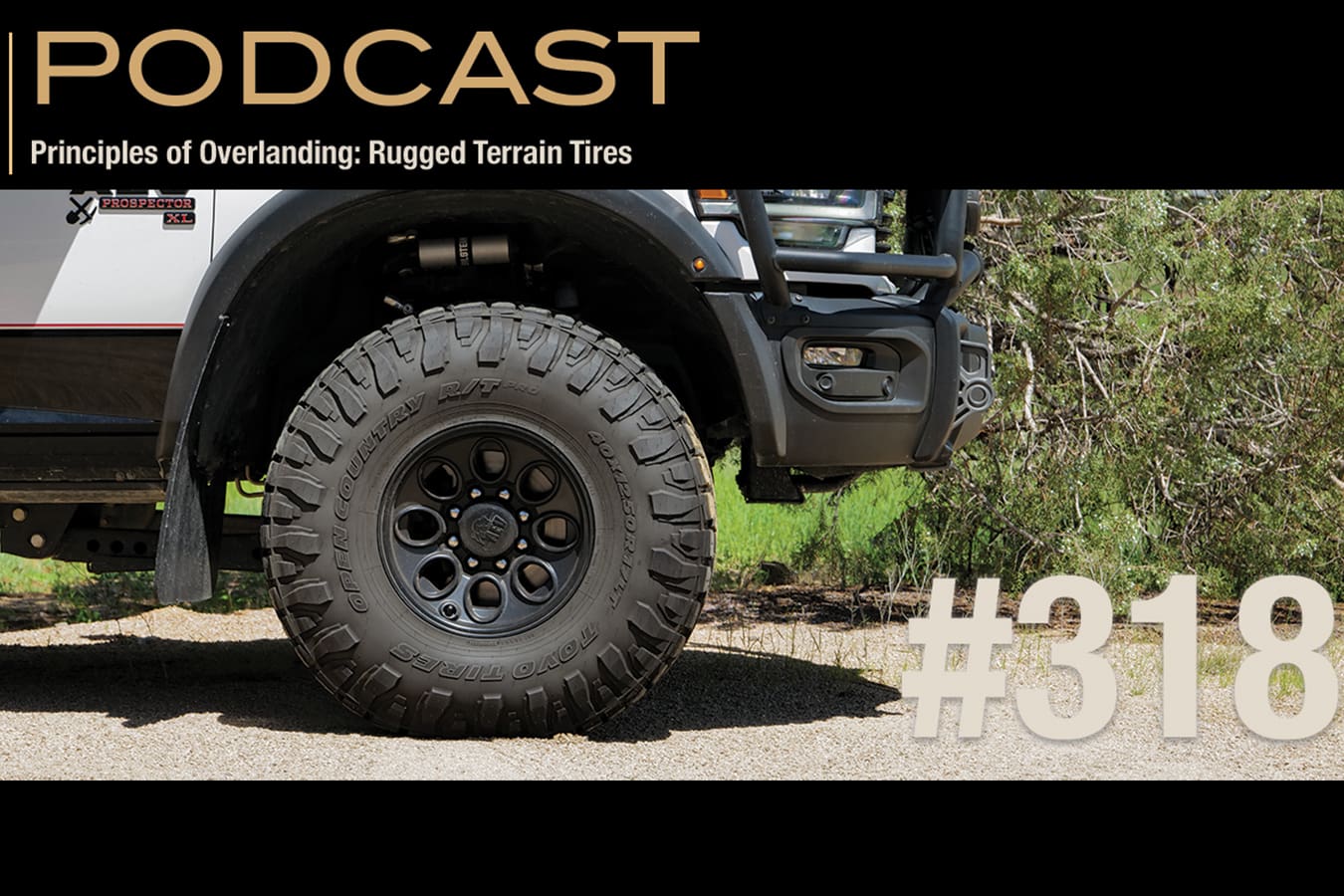
Overland Journal Podcast host Matt Scott and Scott Brady discuss rugged terrain (RT) or “hybrid” tires as a third category between all-terrain (AT) and mud-terrain (MT), arguing RTs let ATs and MTs stay true to their strengths while better matching overlanders’ highly variable use case. They compare void ratios, noise/vibration/harshness, tread life, snow and wet-road performance, fuel-economy impacts, and load capacity, with examples from Toyo RT Pro, Hankook XT, and BFG HD Terrain, and other models. They stress how subjective tire testing is and describe past double-blind, same-vehicle testing, hoping to run an RT test later. Key buying attributes include 3-peak mountain snowflake ratings, sidewall construction (not just ply count), siping tradeoffs, and tire width choices favoring taller, narrower sizes for fit and efficiency. They critique treadwear warranties pushing harder compounds and note rising tire costs.
Overland Journal Podcast Episode #318
The Overland Journal Podcast is brought to you this week by General Tire
New to Overland Journal and want to grab a subscription! Visit Overland Journal and enter code: overlandpodcast at checkout for 20% off. We thank you for being a subscriber.
Welcome to our latest exploration of overland essentials! This time, we’re delving into the world of rugged terrain (RT) tires and examining why they may be the perfect match for those epic adventures on and off the road. We explore the evolution and advantages of RT tires, how they measure up against traditional all-terrain (AT) and mud-terrain (MT) tires, and the essential factors to consider when choosing the right tires for your overland journey.
Rugged Terrain Tires: A New Category Emerges
Historically, adventurers had a binary choice between all-terrain and mud-terrain tires. Typically, the decision involved weighing the balance between on-road comfort and off-road capability. However, most overland journeys involve a significant amount of on-pavement travel, making a tire optimized for both environments critical. The introduction of rugged terrain (RT) tires, also known as hybrid tires, offers a much-needed middle ground.
RT tires aim to capture the strengths of both AT and MT tires, offering greater on-road comfort than MTs while surpassing ATs in off-road conditions, particularly in mud. As Scott notes, these tires allow ATs and MTs to remain true to their design intentions by creating a third, more versatile category.
Key Advantages of RT Tires
- Versatile Performance: RT tires are particularly appreciated for their ability to perform well in mixed conditions, effectively bridging the gap between AT and MT tires. They deliver sufficient grip on mud and rocky terrain while retaining a quieter and more comfortable ride on highways.
- Improved Durability: As Matt and Scott discuss, longevity is an essential consideration for overlanders, who often cover thousands of miles on varied surfaces. RT tires generally offer better tread life than MT tires, reducing the frequency of replacements.
- Noise, Vibration, and Harshness: RT tires provide a quieter ride than MT tires, essential for those lengthy drives to remote locations. The reduction in road noise contributes to a more pleasant journey overall.
- Fuel Efficiency: With a more moderate void design than MT tires, RT tires usually have a lower impact on fuel efficiency, conserving precious resources during long trips.
What to Look for When Choosing RT Tires
Choosing the right tire involves more than category distinctions – there are important specifics to consider:
- Three-Peak Mountain Snowflake Rating: This rating indicates a tire’s proficiency in severe snow conditions. For those frequently encountering snowy environments, this certification signifies better performance in ice and snow.
- Sidewall Construction: Understand whether you’re opting for a 2-ply or 3-ply sidewall. This affects durability, especially in rocky terrains.
- Siping: This feature enhances tire grip on wet and icy roads but may also contribute to increased tread wear; hence, the balance must be found.
- Tread Wear Warranty: Matt and Scott strongly caution against prioritizing extensive tread wear warranties over performance, as tire manufacturers may harden rubber compounds to meet high mileage claims, sacrificing grip and safety.
Conclusion
RT tires represent a pivotal development in the overlanding community, epitomizing a balance between aggressive off-road capabilities and essential on-road comfort. With myriad options available, choosing the right set involves careful consideration of individual travel needs and environmental conditions.
We hope this discussion helps inform your choice in selecting the best tire for your adventures. Our team is eager to continue exploring this category with potential RT tire tests and more content on Expedition Portal. We invite you to share your experiences with RT tires and join our upcoming discussions.
Happy adventuring, and safe travels!
Host Bios:
Scott Brady
Scott Brady is an adventurer, author, and publisher, and the first person in history to cross all seven continents. Brady is executive publisher of the Overland Collective, home to Overland Journal, the Overland Journal Podcast, and expeditionportal.com—the world’s largest vehicle-dependent adventure community. Scott wrote Overlanding 101 (Simon & Schuster) and is currently riding around the world on his BMW GS. He also led Expeditions 7, the first expedition to drive the same vehicle on all seven continents. Brady’s polar crossings include Antarctica and a south–north crossing of the Greenland ice sheet. Scott is a fellow of the Explorers Club and lives in Prescott, Arizona.

Matt Scott
Matt is a leading expert in automotive adventure. He has extensively explored the world’s most remote places by 4WD and is considered an industry authority on overland travel. He is the only American to ever become an editor of a major Australian 4WD publication and has over 15 years of competitive auto racing experience. @mattexplore
Tune in Apple Podcasts | Spotify | YouTube
Our No Compromise Clause: We do not accept advertorial content or allow advertising to influence our coverage, and our contributors are guaranteed editorial independence. Overland Collective may earn a small commission from affiliate links included in this article. We appreciate your support.
Transcript
Matt : [00:00:00] Hello, and welcome to the Overland Journal podcast. I’m your host Matt Scott, and I’m here with Scott Brady, the man who does all of the things and travels all over the world. So We’re talking about rugged terrain tires today.
Scott: Yeah, I really like this idea. Our Principles of Overlanding is one of the subjects that you and I really enjoy doing.
Yeah. It takes a lot more research. We have to do a lot more planning before we do these, and so I’m glad we’re sitting down, especially on this topic. I mean, it’s, it’s one of the most, significant growth opportunities in the space is, like, really good tires- Yeah … for travel.
Matt : Yeah, I mean, the choice of tire that you have has kinda…
you’ve historically had an all-terrain tire, and you’ve had a mud-terrain tire. So you’ve had, you know, zero to hero, kinda A or B option. And to be honest, most of an overland adventure is on pavement. Yeah. So that’s [00:01:00] why- Yeah … it has always been the intelligent choice to do an all-terrain tire.
Better-
Scott: Or your gravel roads, dirt roads.
Matt : Yeah, they’re completely appropriate for most for most things except for that, like, that final mile to get to that campsite in- Mm-hmm … Tajikistan or wherever, Yukon, where it’s muddy or something, and then you’re like, “Man, I wish I had that mud tire.”
Sponsor: For over 100 years, General Tire has delivered tires for your lifestyle, your adventure, your anywhere. From the aggressive all-terrain performance of the Grabber ATX to the ultra-high-performance Grabber APT, General Tire’s balance excellent on-road performance with off-road capabilities designed for all weather conditions.
General Tire delivers for whatever you do.
Matt : But now we have these rugged terrain tires, is what RT stands for, and I’ve been [00:02:00] taking a look at them. So they’ve been… I’ve never had one before. I mean, I got… No, I guess I had the BFG HD Terrain.
Scott: On your Grenadier, yeah. On my,
Matt : on the Grenadier.
Scott: Sorry I said the G word.
So- No, I think, I think these are, I think these RT tires… Now, they’re also called hybrid tires. Yeah. Th- um, they kinda kicked off with that naming convention, but I’m so glad that they picked a, a, like a universal describer
Matt : for it. AT, RT, MT.
Scott: Yeah. It just makes sense. It’s really helpful. I would say that the thing that I appreciate most about the RT is it allowed for the all-terrain and the mud-terrain to be more pure to what they were- Hmm
supposed to be. ‘Cause what we were finding in recent years was people did- didn’t like how loud mud-terrains were, so they started to make mud-terrains more quiet on the road. Which
Matt : makes them perform not as good in la mud.
Scott: In the mud. Or you were finding these really aggressive all-terrains- Yeah
that then have reduced tire wear, impact, so miles per gallon. You end up with a lot more noise vibration and [00:03:00] hard- harshness. So- Neither, none of the tire companies knew exactly how to meet the needs- … where they were trying to dif- differentiate themselves. Whereas the R/T now, it’s like now you can just make really great all-terrains or make really great mud terrains- Exactly
because you’ve got a third category, uh, that you can make great as well,
Matt : so most of my experience, I- I did the Toyo RT Pro on my Prospector. That car, w- which is interesting, it had Toyo, uh, mud terrains on it. I think it’s, like, their Open Country M/T or something, which is a fine tire.
Scott: Yeah.
Matt : They don’t, you know, like a mud tire, they just don’t last very long, so,
Scott: and they get loud.
Matt : They, they get loud, and they get choppy, but that’s every mud tire. Yeah. They’re a high void tire. Yeah. And when, when Scott and I say void, small void just literally means small void. That’s like a an all-terrain tire. Um-
Scott: Less space between the lugs, yep …
Matt : exactly. A mud-terrain tire is a high void tire, and these RT tires are somewhere in the middle.
And, you know, oftentimes it’s the thing [00:04:00] that’s in the middle that’s the best choice. But-
Scott: And I would say that where they tend to focus, the- they tend to tighten the voids on the center line of the tire- Yeah … at the crown of the tire, ’cause that’s gonna give you a quieter road behavior, and then they tend to make…
Compared to an all-terrain, then they’ll add some additional void in the side lugs, uh, which gives, I think, a ton of benefits.
Matt : I, I think tire testing is, like, so subjective. Like, unless you’re, you’re doing something that’s repeatable- Mm-hmm … in the same conditions, I mean, you can… If you test a tire, one tire A in the morning and tire B in the afternoon, you’re gonna get a different-
Scott: Oh, yeah
Matt : A, a different result, right? So-
Scott: Especially on track testing. Like, when we did our big all-terrain test many years ago using Joe Bacal, who tested tires for Toyota we had to do that. We had to do it at the same time every day. Yeah. W- they were all fitted to the same Jeep Wrangler, the same driver, and we…
It was double blinded, so he didn’t know what [00:05:00] he was testing.
Matt : Interesting. Yeah.
Scott: So that was the, that was why our, our test ended up being so significant was… And it was very expensive and very time-consuming. But I’d love to do one on the RTs at some point in time.
Matt : I think it’s interesting. I, I have so far been pretty happy with these tires.
Like, coming from the mud terrain for how I use that truck, the RT really just seems, like, suited for the Prospector. You don’t, you’re not really going mudding in a- Mm. You know, I just took that thing across the scale. It’s, like, 9,500 pounds or something- Yeah … or ni- 9,250 pounds. Uh, it’s
Scott: a- That’s really heavy.
That’s how much the Prospector weighs?
Matt : Surprisingly, ’cause I have a 1,600-pound payload on the door, and with me in it and fuel, there was… I think it was, I think it was 9,200 pounds. Now, we don’t know if that scale is calibrated. I was, like, at the local dump.
Scott: Yeah.
Matt : But-
Scott: But I think it’s pretty close. Y- the one right here by the shop- Exactly
I use that for t- for weighing everything. Yeah. Yeah.
Matt : Yeah.
Scott: I think it’s pretty close.
Matt : So it was interesting just [00:06:00] to… I mean, I’ve had three of those trucks now with the Toyo M/T, and to go to the RT- It’s quieter. What’s interesting about this tire is I was able to go from a 12… I was able to go to a 1250 width, section width tire, which is plenty of width.
Scott: Yeah, for
Matt : sure. Um, I actually gained a couple hundred pounds of load capacity per tire despite going wider, ’cause it’s, it’s air volume that holds weight, not,
Scott: so it was an inch wider, the new ones?
Matt : Inch narrower. I, yeah, that’s a good thing. So they came with 1350s. I
Scott: remember that, yep.
Matt : Which is fine, but I think that, I’m not saying this is a tall, skinny 40, but, you know, proportionally- No,
Scott: it is.
If you look at the aspect ratio- Yeah,
Matt : yeah … it
Scott: for sure
Matt : is.
Scott: And I l- I think it looks great on the truck.
Matt : I think it looks really good. You know, a lot of these vehicles, especially modern vehicles, I find, I find that they just look really good with the RTs. And, um-
Scott: Yeah, we were talking about the o- the other day, and I totally agree with you.
You said, like, new cars are a little more angular.
Matt : They’re a little bit more angular, a little bit more aggressive. Like, they don’t necessarily have, like, the happy [00:07:00] face. Hmm. I think the Grenadier has a little bit of a happy face. It does. It’s a little, little pleasant.
Um, but you know, you- Did you
Scott: just say the Grenadier
Matt : was pleasant?
I just said the G word. Yeah. Listen, I love the Grenadier, but I also want them to fix a few things. You know, think of, like, a Tacoma, right? Or a, or the new 4Runner. They are very aggressive vehicles.
Scott: Yeah, for sure.
Toyota has really done that. They’ve really, they’ve gotten away from the softer, more rounded, like if you think an 80 series, lots of rounded-
Matt : Yeah, exactly
Scott: curves and things like that. It’s very angular now.
Matt : Yeah. So I think that they, I think that they look very appropriate. You know, I’m only about 2,500 miles into testing these tires, but I think it is important. But the first impressions are good.
Scott: I think- And you had quite a few miles on those BFG H/Ts too.
Matt : Yeah, probably like 7,500 on those. Mm-hmm. Um, I, I- it’s funny, I was actually… Some of it may just be, again, this is why I say with the caveat, this is all so subjective, but the H/T terrains were very, like, squirmy. They had a v- like very large lugs. [00:08:00] Aesthetically, I loved them for the Grenadier because they kind of looked like that modern Michelin XZL- Mm-hmm
that we covet.
Scott: Yeah, sure.
Matt : But you could kind of feel that car move a- Yeah, I remember you mentioning that … move just a little bit. Uh- Yeah … and I’ve heard other people say that about the H/T terrains, but again, it’s so subjective. Like Michelin, which is BFG, they make good tires. Like it’s not like it’s a, a, a, a super issue.
Scott: I think what the point that you’re making is that it’s a little bit more aggressive R/T. It is, it’s also got fairly large side lugs, and the tires that you had on the Grenadier were very tall, narrow. Like, it was an 80-
Matt : I don’t think I had enough section width
Scott: on that Yeah, 255/80R17, right? So- Yeah
the aspect ratio was 80%, which is very tall-
Matt : Yeah. I mean, if you think about it- … for the width … the, the Defender 90 I just bought, I run a 255 section width on that, and the Grenadier weighs 2,500 pounds more than that thing.
Scott: Sure.
Matt : That is not a light vehicle. It is very- No … stout in its [00:09:00] construction and build quality, so.
Scott: I do find that the all-terrains just work really well on the Quartermaster. Like, it feels… And the Quartermaster’s also a longer wheelbase and all that other stuff, but, you know- Yeah … I, I do find that I don’t really tend to care for mud terrains for most applications, and that’s why we can talk about that right now.
Like, why go with an R/T over a mud terrain? Uh, the thing with a mud terrain is you’re gonna end up with a tire that has a, a shorter service life, which when you’re doing very long trips, it’s nice to not have to change out tires. Like for example, for the Milestones expedition, we weren’t able to get the mud tires into Europe, so we ended up running the same all-terrains that left- Bozeman, Montana, drove across North America, drove across Europe- Yeah
and then drove the entire length of Africa, West Africa, all on the same set of tires, and you can get away with that with an all-terrain. So a mud tire will have a shorter service life. Um, you’re gonna end up with a lot more noise, [00:10:00] vibration, and harshness. There are not mud-terrain tires that qualify as a three-peak Mountain Snowflake rating, so you’re gonna have very perf- poor performance comparatively in ice, snow, and on wet road conditions.
So there’s, there’s a lot… There can even be a reduction in payload that’s available on it. So a mud tire should be used if you’re in the mud quite a bit.
Matt : Yeah, and we were talking about this the other day, too. There’s this, like, 200-mile blinder that everybody have on. That’s something I learned from Dave Harriton, is like, what…
Your reality is kind of this 200-mile zone. So for us, an all-terrain is just probably the best tire for the Southwest. Yeah. We don’t really have mud. I mean, in Prescott we can get mud, but it’s really bad etiquette to-
Scott: Yeah, we
Matt : just don’t … drive on trails- Yeah, we
Scott: don’t do
Matt : it … because it dries out, and then it becomes like concrete- Yeah
and everyone hates you.
Scott: Yeah.
Matt : You know, so-
Scott: Yeah, don’t tear up the trails …
Matt : an all-terrain is a really great choice for us. But let’s say that you’re in the [00:11:00] Southeast, you’re in Georgia, or, you know, you’re in Vermont and you’re- Yeah … riding those Class 4… I think it’s Class 4 roads.
Scott: Yep, that’s right.
Matt : I mean- Class 4, Class 5 … you’re, you’re, you’re not only kind of rock crawling, but you’re rock crawling with mud and water on top of it. It’s like something that we have wi- in our 200-mile blinder, like, we cannot comprehend. Yeah. Right? The R/T, let’s say you’re a full-time traveler or you are, you know, doing a big international trip- Yeah.
Like we might start in the Southwest and we may go through Vermont, we may go through Guatemala- Mm-hmm … and we’re, gonna do a, a recreational four-wheel drive thing with, with a local club there or something. The RT’s gonna get you by, and that’s what I like about it, where, you know, the, the all-terrains, particularly in mud, seem to run out of talent quite quickly.
Scott: Yeah, you’re right. They just can’t because of the low void ratio. Yes. You just can’t evacuate the mud as effectively. In most all-terrains, that’s definitely been my experience, especially when you get into clay and stuff. It just [00:12:00] won’t, it just won’t evacuate that well.
Matt : Yeah. I mean, I just think they’re a good general tire-
Scott: Yeah
Matt : you know. Um- I mean- Not the brand, but, …
Scott: th- that’s why we’re talking about the RT today because, I mean, you’ve made the point, and I agree with you, Matt, is these just might be the perfect tire for overland travelers because- Yeah … and to be fair too, we also like it when stuff looks cool.
Matt : Mm-hmm.
Scott: A- an RT looks pretty good. They… I mean, they can really look a little bit aggressive.
Matt : Yep.
Scott: I think that they look the adventurous part too, which is, like, there’s nothing wrong with that.
Matt : Yeah. And there’s a lot, there’s a lot out there. I mean, like, I’m dipping my toe into this through, like, the Toyo world, and, they have three different RTs, so they kinda have a soft, medium, hard, so to speak.
Like- They’ve
Scott: done a good job of that. And even Nitto has done that. They’ve got- Yeah … two that I would say qualify as an RT.
Matt : Exactly.
Scott: And some of the manufacturers haven’t quite caught up with their naming convention yet. Like there’s a, a Nitto that is very much an RT that’s called an [00:13:00] AT. Um- Yeah … but maybe it’s just an older model.
Matt : Yeah. But it’s interesting to see the tire companies kinda grab ahold of this because they’re not bad to drive. They have more noise than an all-terrain tire. Mm-hmm. Like, noise, I think, is, is an important thing. I’ll tell you, like, with the, like in the EarthRoamer when I had those Continentals on there-
Scott: Oh, yeah
Matt : oh, my God, like, my ears would hurt at the end of the day. And I have been in, you know, maybe in the Prospector, which is, like, sealed like a-
Scott: Yeah …
Matt : hermetic bubble.
Scott: Yeah.
Matt : But in-
Scott: Yeah, Ram does a good job with
Matt : noise … in, in vehicles. On the Defender 90, I have KM3 BF Goodrich Mud-Terrains. KM2s And they’re chopped, right?
So they’ve been either not rotated or overinflated or whatever. Sometimes mud tires just end up- Yeah … doing that.
Scott: Especially after a little bit of, of miles on them. Yeah.
Matt : Yeah. And what I mean by kinda like that choppy thing is you think, again, with a high void tire, there is a point [00:14:00] where the lug of the tire is…
Like, there’s no lug on the ground, so it creates some interesting wear patterns. Mm-hmm. For sure. Like any moto riders will kinda know what I mean if they run a TKC80 on- Yep … an adventure bike or a, you know-
Scott: Yeah, they can scallop really bad … off-road motocross tire. Yeah. They can get really angled because of how it impacts the asphalt.
So yeah, I mean, it’s, uh… I mean, the, the mud, mud tires also take… You have an impact to your miles per gallon, so the RT is less of an impact to your fuel economy, which range is a real important thing for us. So if you take… If you can… Let’s say a mud terrain, in my experience, usually costs you around a mile to a mile and a half per gallon.
Let’s call it somewhere around 10 to 15% impact to your fuel economy. And it depends on the vehicle. Sometimes it can even be more than that.
Matt : Yeah. And also just, like, the longevity of the tire, like you were saying. Like, my Prospector, for example, I bought it [00:15:00] used. It’s on its second set of tires.
I know, for example, by the sticker, it was delivered with Cooper S/T Maxx’s- Sure … and 40s. And it has Toyos on, ’cause for a while AEV couldn’t get ’em, you know- Mm-hmm … during pandemic supply chain stuff. So that truck has 25,000 miles on it.
Scott: Yeah. It’s on its third set of tires.
Matt : And I just put its third set of tires on there.
Yeah. But they have a 45,000-mile tread life warranty.
Scott: Yeah.
Matt : So it’s like I’ve already blown through two sets of mud terrains, and they really don’t also, like… I don’t think mud terrains like heat, again, being high void, and they don’t like a lotta pavement. Yeah. Like, a mud terrain is something that if you are genuinely over 50% of the time you are off-road, a mud terrain is a great choice for you.
Mm-hmm. But you know- I mean, if you look at my Instagram feed, I’m a, I’m like, I’m in that crowd. I’m like 50% off-road, right? And I think that’s most people are probably relating right now. Sure. But the reality is, you know, let’s not [00:16:00] even talk about, like, global adventure. Let’s just talk about, you know, most people that are overlanding in North America.
You know, you live in Los Angeles and you want to go to Moab, you’ve got a, what, a 1,500 mile-
Scott: Yep …
Matt : drive on that-
Scott: About, yeah, just over 1,000 miles, yep … I
Matt : don’t know, 1,000 miles or whatever. Yeah. Yeah. On pavement, and that’s a big part of it. Like, that was the whole thing with overlanding, you know, when it really started to become a thing in North America, was that they were meant to be more practical- Mm-hmm
vehicles, right?
Scott: So I think it’d be good for us to talk through the attributes of an RT that we need to be considering when we buy one. So, and this doesn’t apply to every RT, which is why it’s important to talk about. So for example, three-peak mountain snowflake rating. If you live at altitude in Colorado or in Montana or even here in Prescott, you may want to have a tire that has that rating because it can mean that you can drive to your home without having to put chains on.
Matt : Well, and in some areas it means that you don’t have to [00:17:00] put chains on- That’s right … because you have a three- That’s right … peak mountain snowflake tire. Exactly. Like the snowflake rating in the Pacific Northwest. They love snowflakes.
Scott: What is the Pacific Northwest snowflake rating?
Matt : I think, like, in, if you’re in some of the, the passes in, like, Oregon and Washington, if you don’t have chains-
Scott: Oh, we’re talking about different snowflakes then.
Matt : Oh, okay. Gotcha. Okay. Yeah. There’s a lot of snowflake-rated in, uh- … Portland. They like that there. I don’t know.
Scott: So, yeah, I don’t know. That is just kind of funny to think about. But anyways, the, uh, the snowflake rating can be a big deal if you don’t wanna have to put chains on, if you live at, at altitude. And they also do perform better.
They work better. They also work
Matt : better- It’s a huge thing that I look for in a tire, to be honest. Yeah. Like, you just… Again, where we’re talking about you never know what kind of conditions you’re gonna come along on- Mm-hmm … whatever your adventure may be. I think, the, the, the, the broader performance envelope that you can have in a [00:18:00] tire, generally the better.
So if I see an RT tire, like the… It’s on the Hankook XT-
Scott: Yep …
Matt : Dynapro XT is a rugged terrain tire that has a snowflake rating.
Scott: Yep.
Matt : And that’s pretty-
Scott: And I’ve used those tires. I’ve driven actually across the country. I, I drove from Prescott to Florida and back.
Matt : Oh, those are the ones that were on
Scott: Tavius’ Jeep.
On Tavius’ Jeep, yeah. And they were super quiet. Um, they don’t have a big selection on sizes. I’d love to see some more sizes come out, but, um, they did great off-road. They did actually great in sand. Overall, I was super impressed with those. And they have the mountain snowflake rating. The, uh, the other thing that we wanna be looking at is does it have 3-ply sidewalls or not?
Now, this can be a bit of a misnomer. There are some extremely durable 2-ply sidewall tires. So you- Yeah,
Matt : they like fold them over or
Scott: something, right? That’s right. So you gotta know what’s the thickness of the sidewall, what’s the construction of the sidewall. Uh, but for example, a DuraTrac is [00:19:00] gonna have 3-ply sidewall plus Kevlar.
So it really depends on the tire, so you gotta do your research on the sidewall rating. B- but then there’s also gonna be, like, an E-rated tire that could be super thick and not even be three-ply sidewall, but s- just as strong. So you gotta do a little bit of research on that. Yeah. And then we also wanna be looking for the siping on the tire.
So if you are in an area with a lot of rain, ice, snowy roads, uh, siping is a really im- important and effective way of improving traction because it allows for the… And they’re across the face of the lug. It allows for that lug to splay open just slightly. It provides- Mm-hmm … additional biting edge, many biting edges sometimes.
Like, if you look at a Nokian or something like that, a true winter tire, um, they have incredible siping all over it. Yeah. And that’s how they’re able to get as much grip as they do, uh, which also applies in wet road conditions [00:20:00] as well. So siping can be very effective. S- but what’s the downside to siping?
You can have increased chunking and increased tread wear. So we wanna be making sure that these are really robust lugs, um, where the siping isn’t too deep, so you don’t get a lot of that chipping and chunking out of it. And then the last thing on this, and this is gonna be my rant for this podcast, because I think that the, the worst thing that ever happened to performance tires was a tread wear warranty.
I would love… And this is, this is the responsibility of the consumer. This is not anything that Toyo’s done wrong or Nitto or anybody else. What they recognize is that consumers are making purchases based upon tread wear. Yep. And I’ve talked to the engineers at many of these tire companies, and it doesn’t…
nobody gets 60,000 miles out of an all-terrain unless it’s on a Suzuki Samurai. You know? Like, y- like, if it’s on a Grenadier or a heavier SUV or a Land Cruiser or whatever, you’re gonna get 35, maybe 40,000 miles out of it. But because of that, they’re making [00:21:00] the rubbers harder.
Matt : Yeah.
Scott: They’re changing the compou- The durometer of the
Matt : rubber is what-
Scott: They’re ch-
Matt : really affects
Scott: this … yeah, they’re changing the compounds to try to meet these ridiculous 60,000-mile tread wear warranties. Yeah. And it is directly affecting our ability to purchase high-performance tires. So for everyone that’s listening, if you ever get a chance to go to an Overland Expo or the Big Thing or anything else where there’s tire manufacturers, remind them that you understand that your tires aren’t gonna last more than about 30,000 miles.
Don’t build us tires that are supposed to last 60,000 miles. We lose performance out of that.
Matt : I actually- That’s my rant … I guess, I guess it’s an all-terrain tire, but those… I had a set of those Falken…
Scott: Yeah. The Fal-
Matt : Wildpeaks?
Scott: Wildpeak
Matt : A/T-
Scott: Yeah …
Matt : s- sup- A- ATX- 2
Scott: or-
Matt : 3 … yeah,
Scott: 3.
Matt : It was their all-terrain tire. Yeah.
And now they have the 4, and it was the 3. Yeah. I’m sorry. I don’t know every tire known to man. I put a lot of dirt miles on that Jeep, went down Baja twice, a lot of highway [00:22:00] miles. I think I sold it at 30,000 miles, and that Jeep got used and it is still… I still see it running around. It’s gotta have 75,000 miles on these frigging Falken tires.
Now, they actually performed pretty good. They were decent on the, on the road. Yeah. I mean, I think it can be done, maybe as a little, kinda mud tire. No, it’s good
Scott: to have a c- it’s good to have a counterpoint. Yeah.
Matt : I don’t know
Scott: My, I guess the strongest point is-
Matt : You’re not getting that in an RT and you’re not getting that in a mud terrain
Scott: You have had a lot of high performance cars, Matt. Yeah. Have you ever seen a tire tread wear warranty on a high performance car tire? I haven’t.
Matt : You know, I really wish they came with that for my race car.
Scott: Exactly.
Matt : Instead of, like, three session, three or four heat cycles and you already start feeling the per- actually, one heat cycle and you feel the performance drop off, but-
Scott: But isn’t that a good point?
Yeah. So you’re s- we’re spending all of this money. We have these really advanced vehicles. Uh, we want the tire to perform [00:23:00] optimally, and tread wear of 60, 70,000 miles is not an attribute- Yeah … we should be asking for or encouraging the manufacturers to build tires for- Well, I, I do think it’s- … for overlanding
Matt : I do think,
Scott: 50,000, sure. Yeah. But, like,
Matt : 60, 70,000? I do think that it is, tires have just gotten so frigging expensive. Yeah. Like, I’m looking at 33s. They’re 16-inch wheels. Like, this is not a complex tire. 255/85 R16. Yeah. An LT tire. They’re-
Scott: They’re 300 bucks a pop, yeah.
Matt : Oh, no. They’re, they’re, like, more…
I mean, yeah, 300 to $450 a tire. That’s a lot of money. And then you gotta mount them, and then there’s the, all the whatever. For five tires-
Scott: Disposal …
Matt : for five tires, I’m looking at $2,500. You know, if you’re daily driving these things, I do think that tread wear is actually important to maybe kinda counter.
I think that’s one of the arguments you know, for the RT. I would like
Scott: to have options that don’t-
Matt : Options …
Scott: focus on
Matt : tread wear. Okay. Yeah. Oh, man, it- they’ve [00:24:00] become so frigging expensive, you know? Um- Yeah … but that’s where I think it’s really important to do your research, and again, where I like these RTs, because, like, let’s be honest, mud tires look really sexy.
Scott: Yeah.
Matt : They look good. Like,
Scott: they- That’s why people buy
Matt : them, yeah … off-road, they do have a higher performance. You know, they’re a higher void tire. But again, these, it’s that, that sacred middle ground is now this RT.
Scott: Mm-hmm.
Matt : And whether that is a reflection of people keeping vehicles for longer, things getting more expensive, so there’s more demand for, again, that, that tread wear, but I do think it’s nice that…
there’s a lot. Like, we’re looking at-
Scott: There’s a lot of options
Matt : now … I, we’ve got a list that we kinda came up with. You know, there’s the Goodyear Wrangler Duratrac. We put that one at the top, not ’cause it’s the best or anything, just, I mean-
Scott: It’s the OG …
Matt : it’s the OG. I mean, do you remember the, the Wrangler Rubicon when it first- Yeah
came out? Like, that was the tire it came with. The off-road tire package for a lot of the Land Rovers overseas- Yep … never got in the US, that was the Duratrac. You know, there’s- And they
Scott: made them in a 19, [00:25:00] which is a really rare size for Land Rover.
Matt : Super rare. Super rare We’ve got the HD Terrain.
There’s the Mickey Thompson Baja Boss H- AT. That one’s a little weird, ’cause that is-
Scott: It’s an aggressive… That’s one of the ones that’s kinda mislabeled
Matt : It’s kinda mislabeled. Like, it was- Yeah … maybe just before the RT thing really started to become
Scott: So there’s also a Nitto, so there’s a Nitto Recon Grappler, uh, which is a high void AT.
Matt : Yeah.
Scott: And I’ve had those on Tavia’s Jeep, and they’re great. Like, they, I really like those tires. Uh, they look aggressive from the side, pretty aggressive sidewall. They’re great for a Wrangler, but then they also make the Ridge Gl- Grappler, which is now their RT. So they, like, a more aggressive RT.
Yeah, and
Matt : the thing that’s interesting with Nitto is, like, in that Ridge Grappler, they actually do two different sidewall designs. Like, they have, like-
Scott: Yeah …
Matt : like a super aggressive one.
Scott: Mm-hmm.
Matt : I don’t know how I feel. I mean, I get that there is, like, a performance benefit when you’re aired down- In a rut or something like that
or you’re in a rut or [00:26:00] whatever. But yeah, Toyo has the Toyo Open Country RT, the Open Country RT Trail, and the Open Country RT Pro. So I’m using the Pros. That’s the most aggressive. I think m- if I was to try another one, this RT Trail, a little less void of a tire. That one looks kind of interesting.
Scott: I do like that one.
Matt : The RT has been around forever. Like, I don’t wanna say Toyo’s maybe the kinda, you know- They really were the first ones to run with the designation of RT. Yeah. I think in spirit, Goodyear is kind of the, the daddy of it all.
Scott: But- Yeah, they were certainly the first …
Matt : you know, I think that the RT terminology really stuck from Toyo.
There’s also the Wild Peak RT01. That is a tire I have, like, no experience with.
Scott: Yeah, I’ve not used it.
Matt : But I will say that- It
Scott: looks good …
Matt : if I’m not getting a set of tires for testing, like, I b- I buy Falkens. Like, they’re actually really good tires. They- th- it’s actually, there’s not a lot of bad tires.
It’s like we… There’s kind of like tier one, tier two, tier three, right? Like, [00:27:00] all of these tier one tire companies, which are the ones that have brand names that you recognize I mean, I don’t know if there’s necessarily bad tires in that category right now.
Scott: Yeah, you’re really looking for those attributes.
Like, it’s hard to find… if you wanna find a three-ply sidewall plus 3 Peak Se- Mountain Snowflake rating, you’re getting the Duratrac, for example. Yeah. And there are some other ones that, that qualify for that. Like for example, the Nitto Ridge Grappler is not 3 Peak Mountain Snowflake. Same with the Toyo Open Country, the Falken Wildpeak, the BF Goodrich H- HD, uh, the Cooper Discoverer.
So for example there’s some that are, though. So, like, you can get a Mickey Thompson, this Baja Boss that you mentioned, but it’s really an aggressive AT, but it’s, it’s available in 3 Peak Mountain Snowflake in the narrower sizes. So there’s not a whole lot of options where it totally overlaps with those attributes, but that’s kinda cool that the- But it is-
the, the Duratrac does … it is the [00:28:00] siping
Matt : that allows you- Yeah … the additional siping that allows you- That’s right … to have- Totally … that 3 Peak rating. So the more aggressive that you get with the tire, the more void you have, the less likely- Yeah … it’s gonna be able to perform to that standard. Yeah, there’s also the Yokohama Geolandar X-AT, which I think is an interesting way of saying RT.
It’s a little bit more than an AT.
Scott: Yeah.
Matt : Um, they just didn’t maybe jump on the RT naming bandwagon yet. Firestone makes some stuff. You know, Firestone’s a brand that I never really consider, but I’ve raced with those tires before, like their Indy 500 in a, a formula series, like a No Downforce-
Scott: Okay
Matt : a DOT tire, uh, series, the, uh, Lucas Formula series. And, uh, it’s actually… I mean, they work really well. Firestone has been around for a while.
Scott: A long time. Um- And Firestone and Henry Ford used to overland together.
Matt : Yeah. Yeah, they did.
Scott: It’s kinda cool. People don’t know that.
Matt : And then there’s the Maxxis Razr AT.[00:29:00]
I think that kinda- Again, you know, Maxxis, I’ve run them on dirt bikes. Mm. I’ve run them on motorcycles. Maxxis, I think, has some really interesting tire sizes. The, I think they do, like, a 35, 950-15. Mm-hmm. Yep. Like, they have some fascinating tire sizes that-
Scott: Kenda has one Kenda as well … that’s a RT that’s a 35 10.50-17-
Matt : Oh, yeah
Scott: which is a really nice size. It’s what I ran on the GMC.
Matt : Oh, is that the tire size that- Mm-hmm … that was?
Scott: Yep. Yeah. So really tall and narrow, so I k- I kinda love that one.
Matt : While we’re talking about, like, width of tires, like, to go a little bit narrower, I think, has some benefits. I know you literally wrote a white paper on this a long time ago.
Many years ago,
Scott: yeah.
Matt : But I find that, that a lot of the fuel economy loss, and also, like, steering. You know, one of the things I noticed when I went to the 12.50 from a 13.50 on the Prospector is despite that car having hydro assist steering, there’s just less footprint that it has to move all the time.
Scott: Right.
Matt : So the vehicle [00:30:00] feels a little bit lighter. You know, I noticed that actually on the Grenadier going to the 255, that car is notoriously heavy, horrible steering, and I think it actually got a little lighter-
…
Matt : You know, a little bit better return to center ’cause there’s less… there’s, there’s-
Scott: That’s why I run 7.5s on Scoot-
because it’s manual steering.
Matt : It’s also the coolest tire ever.
Scott: It is a cool tire, yeah.
Matt : Bring back XCO. Yeah.
Scott: So- But when we’re thinking about the n- the width of a tire, this could be helpful to the listener. So your vehicle came with a specific tire width, and so you have to think about the engineering that was done around the wheel well, the s- the steering sweep.
All of those things were taking into consideration around the width of the tire. So if your car came with a, a- A 265/70R17, you may wanna consider going with a [00:31:00] 255/80R17 so you can get a taller tire, but the width of the tire is essentially the same. It’s within 10 millimeters, so it’s gonna… When it articulates up into the wheel well or you get full suspension travel, it’s gonna still tuck into that open space that was designed by the OEM.
Sorry. Yeah. So one of the big mistakes I think people make is they’re like, “I need to have a wider tire.” Well, 80% of the flotation that we gain when airing down occurs from the tread lengthening- Length … not widening. So it’s a… Go with a tall, narrow tire. It… And there are limits to that. So what are the limits?
You know, we know that the co-efficient of, coefficient of friction is vertical load force and your tire width. So as the vertical load force goes up, your coefficient of, of friction remains the same as if you just went wider. But what happens is you hit the limits of mechanical integrity of the rubber.
So if you were to put a 7.5 wide tire on a Porsche [00:32:00] 911, you’re gonna, you’re gonna just- Have a lot
Matt : of fun. You’re…
Scott: Yeah, you’re just gonna, you’re just gonna burn the rubber off of the tire. So there- Yeah … there’s mechanical limits. Um, but we don’t… When you’re driving a Tacoma, you don’t have a high horsepower car, so you’re better off going a little bit narrower because you have less frontal resistance of the airflow, you have less rolling resistance for better fuel economy.
Again, it tucks up into the wheel well properly. It’s a lighter weight tire, so you have less rotating and reciprocating mass. So all of those things improve with, when you go with a slightly narrower, slightly taller tire. So think in those terms.
Matt : Yeah. Basically, look at the bro-dozer that you see going down the road that has those massively stanced, incredibly wide wheels with no sidewall but they’re mud terrains- Yeah
and do the opposite.
Scott: Yeah, don’t do that. Don’t do that. Yeah. Yeah.
Matt : Yeah. Don’t do that.
Scott: Yeah. Lots of benefits of not doing that, even in your personal life.
Matt : I don’t know. I think that whether [00:33:00] you’re a traveler or, you know, you’re kinda getting out on the weekends, and that’s amazing, I think that the R/T stuff it’s this nice sweet spot
Scott: I’m so glad it exists.
Matt : Yeah.
Scott: And for overlanders, I mean, if we come back to now just talking about R/T in the context of overlanding, you’re gonna end up with more tread life than you would from a mud terrain.
So these trips can be really long, um, so you wanna make sure that you’re optimizing for tread life. And then you also wanna make sure that you’re optimizing for noise vibration and harshness. Like Matt was saying, good example is I gotta drive from Southern California to Moab and back. I’m gonna drive over 1,000 miles on the road to get there and back.
Matt : Yeah.
Scott: So having it being a little quieter, that’s a good thing.
Matt : I think they’re a win-win. I’m really glad to see this category expand. It’s something that I think- I mean, I would love somehow to find more RT tires that have the three-peak snowflake rating.
Scott: Yeah. They’re just, they just really are limited.
[00:34:00] Um-
Matt : Uh, by design, right? Yeah. You know, i- that’s what- Yeah … an all-terrain tire is for,
Scott: yeah. I’m, I mean, there’s… I’ve never even heard of this brand before, but Kanati, the Kanati Overland RTX- Oh … is three-peak mountain snowflake, and it’s actually… Like, you can see it here, Matt. Like, it’s, it’s actually kind of a cool-looking tread design.
Matt : There’s a lot of these tires that are coming out of, you know… And I don’t say this in a bad way, and maybe this is another podcast, but there’s a lot of these tires that are coming out of China and, like- Yeah … rebranded for the United States. China is one of, if not the largest automotive market in the world now.
They have insane manufacturing capabilities. Mm-hmm. Maybe it’s worth, uh… If you’re on a budget, maybe it’s worth checking out. I don’t have any personal experience with them.
Scott: Yeah. That might be… I’ve never even heard of that brand before, but I, I looked at the tread, and I thought that was really int- interesting.
It even has stone retention ribs between the big lugs, so it helps eject stones. I don’t really
Matt : get these stone ejectors.
Scott: They work.
Matt : I… Voodoo [00:35:00] magic.
Scott: They, they work. If you look at between the lugs, it’s this rubber ridge that kind of… or appendage that goes between the, the lugs, and when the, when the rock gets pressed in, it actually gives some, like, spring force.
It actually helps to force- Okay. It doesn’t allow it- Push it out … to push all the way down into the void. Um, so it helps… Once you get the tire spinning, it helps it eject out of there. And then I u- I also like to look for lugs that are not so straight up and down, where they have a little bit of a taper to them, a chamfer to them, ’cause that also helps eject stones, and it also helps to eject mud.
And some of them, you’ll even see, are scalloped. Um, so it, it’s… Remember, like when you’d see in the old movies of, in the m- in the swords in the, you know, in the Middle Ages, you know, and it had the blood groove- … so you could pull the sword out of the q- out of the body? Um, it’s the same thing. They have these scallops or grooves in the lugs that help to reduce [00:36:00] stiction of the mud, and so that it can evacuate.
Same thing.
Matt : Oh, mud tires. Yeah. Again, it’s that tuner mile blinder thing. I just never-
Scott: Yeah …
Matt : I never really consider them. I think the last set of mud tires I bought was for my Discovery 1 in high school. Mm-hmm. And they were KM, not KM2, but KM mud terrains.
Scott: I like that.
Matt : Yeah. They kinda have that almost, like, f-
Scott: What did you have on your Wrangler?
I remember the thing I was most impressed about with your Wrangler is that you had driven it from Chicago to Prescott when you came to work here. I was like, “That thing made it here?” I
Matt : was impressed. I re- well, I do remember in, like, outside of Denver having to replace, like, two U-joints in a parking lot-
and then my front diff blew up in Dillon. I have a horrible track record of vehicles in Dillon.
I’ve blown an engine on an EarthRoamer in Dillon. I’ve blown a t- separately a turbo on an EarthRoamer in Dillon. I’ve blown a differential in Dillon, and I’ve only driven through there [00:37:00] four times.
Scott: Oh, let’s l- let’s avoid Dillon.
I,
Matt : I-
Scott: Where’s Dillon at?
Matt : It’s, uh, like- In
Scott: Texas?
Matt : No. No. Like, uh, Silverthorne, Frisco- Oh,
Scott: okay. Got it …
Matt : breckenridge.
Scott: Got
Matt : it. It’s, like, at the end of the Eisenhower Tunnel-
Scott: Got it …
Matt : or the start of the Eisenhower Tunnel-
Scott: Yeah, yeah, yeah …
Matt : depending on how you count it.
Scott: Hmm. Yeah, that road’s hard on cars. Yeah. That’s a big grade.
Scared. That is one big grade.
Matt : Like, I’m not scared of the Death Road in Colombia. I’m scared of- Of Dillon? … I’m scared of I-70 through central Colorado.
Scott: All right. So now if you were to pick… ’cause you’re looking for some tires for your Defender-
Matt : Yeah …
Scott: which one are you seeing that kinda stands out for you right now that would be a pick for you?
Matt : Well, there’s actually… I have a, uh- Classic vehicles, I think need a certain tire, right? Mm-hmm. I think that a lot of these, these RT tires, modern ATs, MT tires, they’re really designed aesthetically to look good on a modern vehicle. So that’s something that’s firstly weighing on my [00:38:00] mind is, I don’t wanna have something that doesn’t look the part, right?
Right.
Scott: Sure.
Matt : Not that aesthetics are everything.
Scott: So maybe like the BF Goodrich HD or the Toyo M55. Well,
Matt : this is the thing. In the 255/85, which is basically the size I have to run because there’s no reason for me to run a 285.
Scott: No. Yeah.
Matt : Um, you know, there’s basically two for a 33-inch tire on a 16-inch rim.
You have 255/85 or you have 285- 75 … 75/16s. So if I go to a 285/75/16, I have the world is my oyster.
Scott: Yeah.
Matt : But with these 255s, I don’t really have many options. I only have like one or two all-terrain tires.
Scott: Yeah, I don’t even know that there’s any in all-terrain.
Matt : And then the rest of them are, are mud terrain.
So, there’s the Toyo MT, which I do have a lot of experience with on the Prospector. I think that’s a good one.
Scott: But it looks a little more modern. A
Matt : little more modern. I mean, that one’s not so bad. Okay. There’s the, there’s the BFG [00:39:00] which looks very modern with its sidewall.
Scott: Yeah.
Matt : I, I don’t know if I just want a mud terrain, so I’m kinda looking at, you know, and this is an RT podcast, but I’m looking at the Toyo M55 ’cause it’s kind of-
Scott: It’s very RT-ish though
Matt : It’s a little bit more aggressive of a, of an all-terrain tire. It’s a commercial tire.
Scott: Sure.
Matt : Right? So I think it’s not, you know, it’s designed to have a long service life, never fail and- Yep … noise and a few other things are maybe, maybe secondary. Um, they’re incredibly durable. I think I’m gonna probably end up buying those.
Scott: It’s perfect.
Matt : Um, but there’s no, you know, maybe this is just a we’re seeing this category develop, but there’s nothing really available in an RT-
Scott: Mm …
Matt : for me. But I did just put those RT Pros from Toyo on the Prospector as we were talking about,
Scott: and you, I remember-
Matt : It’s expensive tire bill month this year, man.
Yeah. This year.
Scott: I remember you, after you put ’em on, you’re like, “The truck drives totally different.”
Matt : So much better. Yeah. I mean, honestly, like- I have had this [00:40:00] issue with all three of my Prospectors where they always pull to the right. And this is something that I’ve noticed with, like, the BFG KM2.
It also, I had those on my Troopy in Australia, and that thing would just always pull to the right. And no matter how many times I could a- I could not get it aligned to do anything different. And the same thing with my Prospector, but now this Prospector just goes down the road better.
Scott: Nice.
Matt : I think that’s the other thing with mud terrain tires is they all have some kind of, I’m not gonna say pull to them, but a lot…
they’re… How would you say that? Like, they-
Scott: Well, they, it’s hard for them to run true.
Matt : Yeah, and- It, and then when- They kind of, like, lead. Like, they all have some kind of… You know, they’re trying to do the harmonics, and they, they can’t… they don’t want them to be choppy, so they don’t have just, like, a, like a very choppy tires, like the Michelin X Forces that are on the- earthRoamer. They literally, it’s like they have almost they call it see-through. You can literally, like, see through, and it looks like a Lego-
Scott: Yeah …
Matt : i- if you think of it as such. Like, you [00:41:00] can kind of see the void completely.
Scott: Right.
Matt : So a lot of them for whatever reason, like, they just tend to kind of pull right.
But man, this thing drives so much better.
Like, I think a little-
Scott: It drove really good when I drove it with the mud tires on it. And
Matt : those things were chopped up. Yeah.
Scott: That truck is, it’s ac- it legitimately
Matt : I
Scott: mean, it’s way, it’s way t- it’s way too big for what I like to do. But man, a Prospector, like for everyday living- It’s my
Matt : big dumb truck
Scott: no, it’s like, it’s kind of a j- it’s a joyful … And the fact that I could go tow my, you know, that was like 7, 8,000 pounds of sailboat with it.
Matt : Like one hand on the wheel.
Scott: It literally could care less. Like genuinely could care less-
Matt : I really- … if it was backed up … I really like the Rams. You know, it’s interesting, the thing that got me started on the Ram 2500 was I had this, AEV built-up Gladiator.
And I was at the dealer and, I parked it next to another uh, Ram. Not another Ram, but I parked it next to a Ram, and then noticed they were both backed up to the [00:42:00] curb. And I realized like within six to eight inches they are the same size.
Scott: Yeah.
Matt : But I got like eight squillion pound feet of torque.
Yeah. And they’re still coil sprung they’re very similar chassis, just sized up. Well,
Scott: Jeeps just feel so much smaller because the body is narrower-
Matt : Yeah …
Scott: than the track width by a lot.
Matt : Exactly.
Scott: So- So you just, you’re basically within inches, but you have a, like it is cavernous on the inside. It is so comfortable.
Matt : Yeah.
Scott: That truck is insanely comfortable.
Matt : You gotta drive it, ’cause I regeared it as well. Oh, that’s right. So it is 444s, so now it has basically stock equivalent gearing on the 40s. AEV used to regear ’em. They, the gears just were not made during COVID, and now it’s an option. But y- they were saying anybody that could make ’em, they were like, “Nope, we can’t make the other stuff.”
Scott: Yeah.
Matt : So, but yeah, I basically regeared it and I did the Toyo RT Pros at the same time. Had Bobby at Red for Dead do both for me, [00:43:00] and they balanced out with like less than five ounces a wheel. One of them- That’s crazy … one of ’em required zero ounces. Wow. So there’s no tire weights on it. Wow. It’s
Scott: like- Well, and a lot of that is the AEV wheels, too.
They run very, very true.
Matt : But also a four, I mean the, the size- A foot … I mean look at the si- the sidewall.
Scott: It’s gigantic. Yeah, it’s gigantic. The
Matt : s- I mean it’s 17 inch. So what is that, 40 minus 17?
Scott: Yeah.
Matt : Like you have almost a foot-
Scott: Yeah …
Matt : of sidewall.
Scott: Yeah.
Matt : Well- Yeah. 11 … yeah, 11 and a half inches of sidewall- Yeah
on this thing. It’s massive. And to have something, like that is a really good indicator of quality on tires.
Scott: I agree.
Matt : And-
Scott: And a lot of people don’t know about tire segments. Like if you buy those really fancy Michelins for like a G-Wagon or whatever, that’s a 12 segment tire. So like they, they specifically make them run as true as possible in the manufacturing process, but that’s very expensive.
That’s why those tires are like 350 bucks a pop.
Matt : Look, yeah. Look again, ’cause I’m telling you, tires got-
Scott: [00:44:00] Yeah …
Matt : expensive.
Scott: Expensive. Everything’s gotten expensive it seems like.
Matt : Yeah.
Scott: Well, this was a great topic. If anybody wants to reach out, we’d love to hear what you’ve had great success with around the RTs.
Matt’s working on some content that you’ll see on Expedition Portal around it. Uh, we’re gonna be working on hopefully a RT tire test in the next year or so, uh, because we really feel like this is an important category to address.
Matt : Yeah, that would actually be a fun one, get some tires on the racetrack.
Scott: Exactly. Let’s do it. Let’s do it. Thanks, Matt. Appreciate you, man.
Matt : Well, cool. Yeah, for sure. It was a great one.
Scott: Yeah, and we thank you all for listening, and we’ll talk to you next time.