

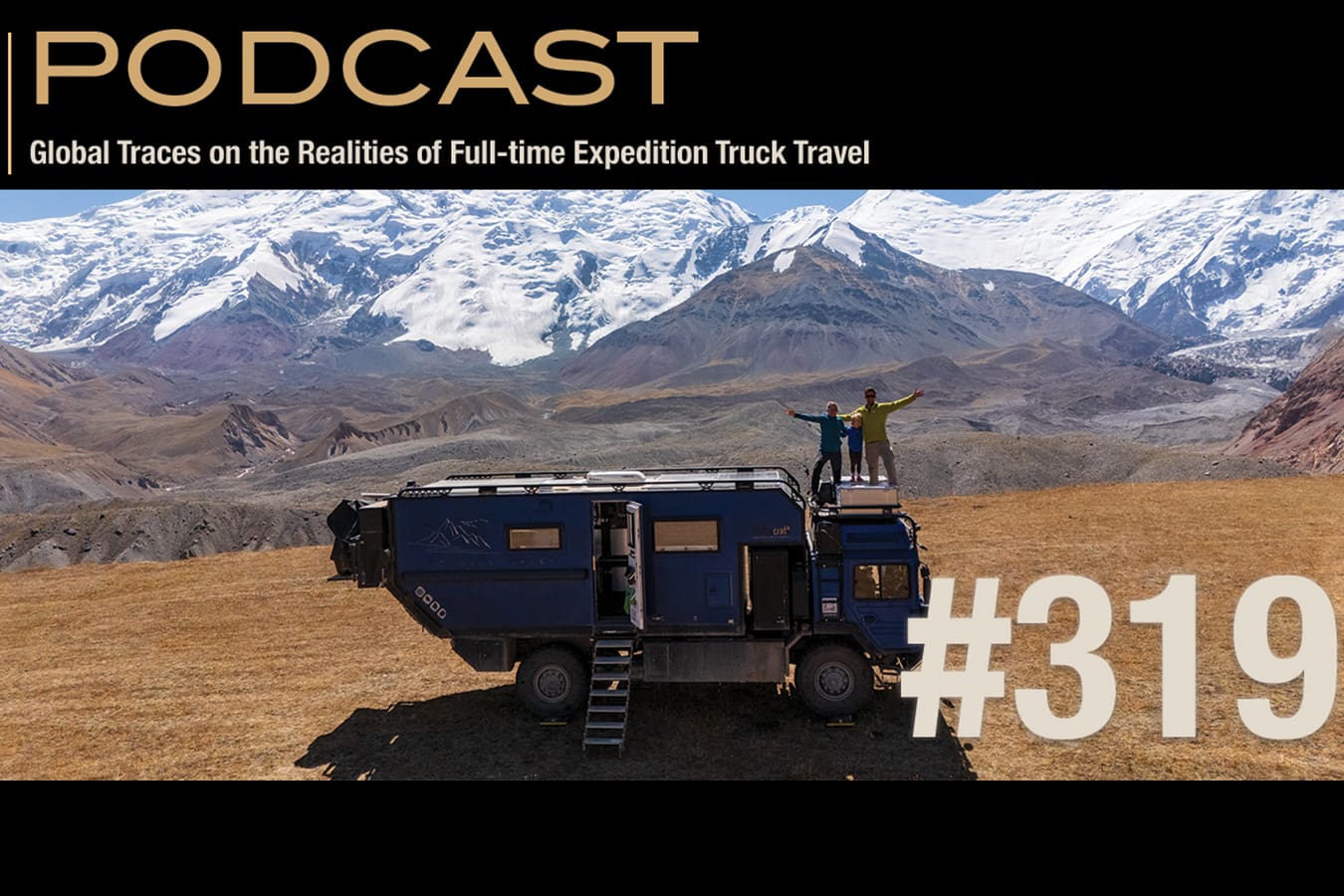
Overland Journal Podcast host Ashley Giordano interviews Jess and Dave of Global Traces from Lake Issyk-Kul, Kyrgyzstan, about five years of overlanding in their MAN HX60 expedition truck with their dog Otis and five-and-a-half-year-old daughter Isla. They explain why they chose a truck for long-term autonomy and comfort, how they bought an ex-British military HX60 cheaply with low kilometers, and how they designed and project-managed a split build to prioritize space, headroom, a raising/lowering bed, and essentials like a washing machine. They discuss tradeoffs of size and weight, common questions about cost, fuel (about 28–30 L/100 kilometers), and toilets, plus how they afford travel through savings and Dave’s photography work. They share lessons and community support from multiple recoveries, including a major winch rescue in Tajikistan, and outline revised plans after Mongolia border restrictions for animals.
Overland Journal Podcast Episode #319
Tune in Apple Podcasts | Spotify | YouTube
The Overland Journal Podcast is brought to you this week by Hankook Dynapro Tire
New to Overland Journal and want to grab a subscription! Visit Overland Journal and enter code: overlandpodcast at checkout for 20% off. We thank you for being a subscriber.
Guest Bio
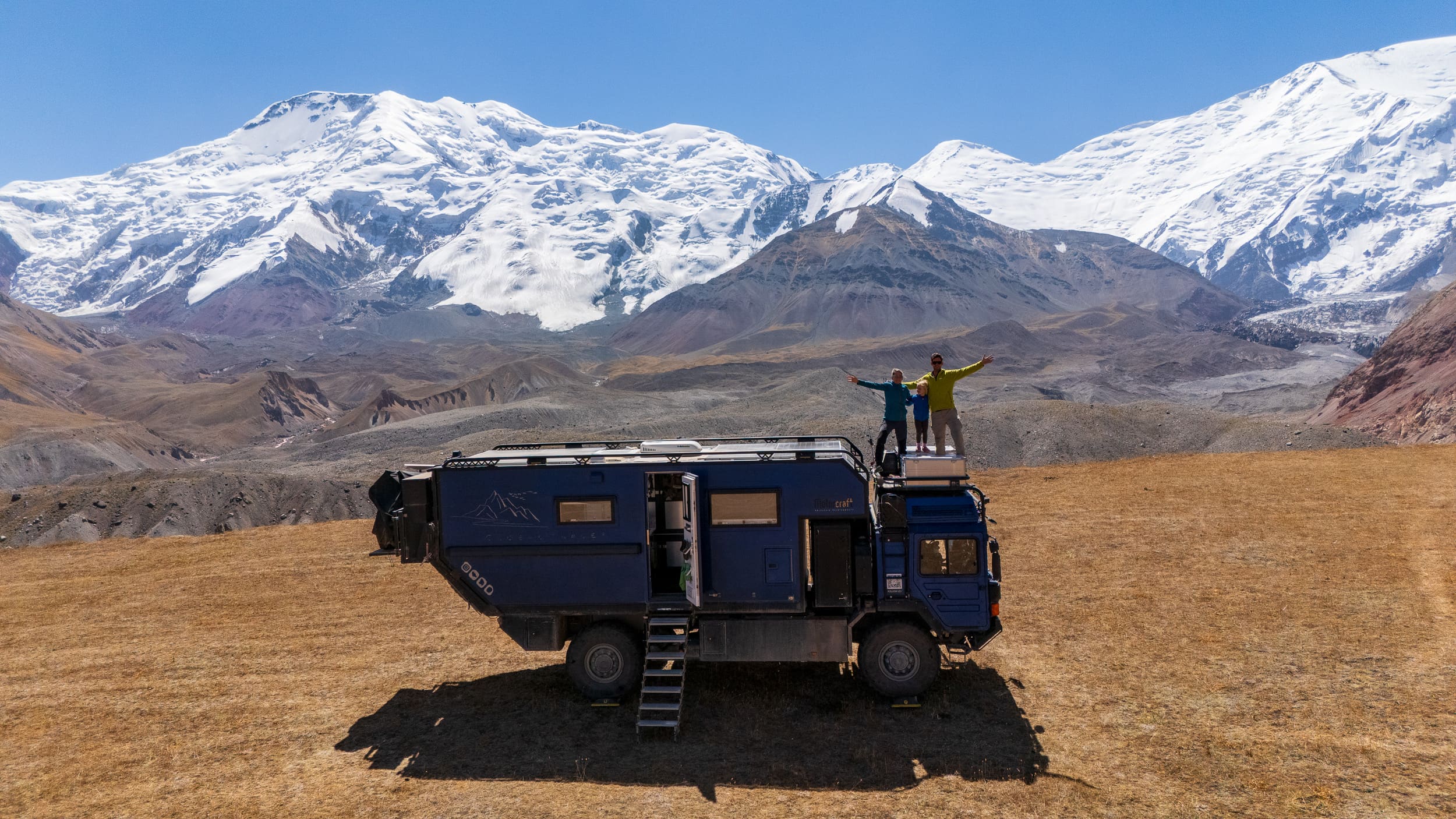
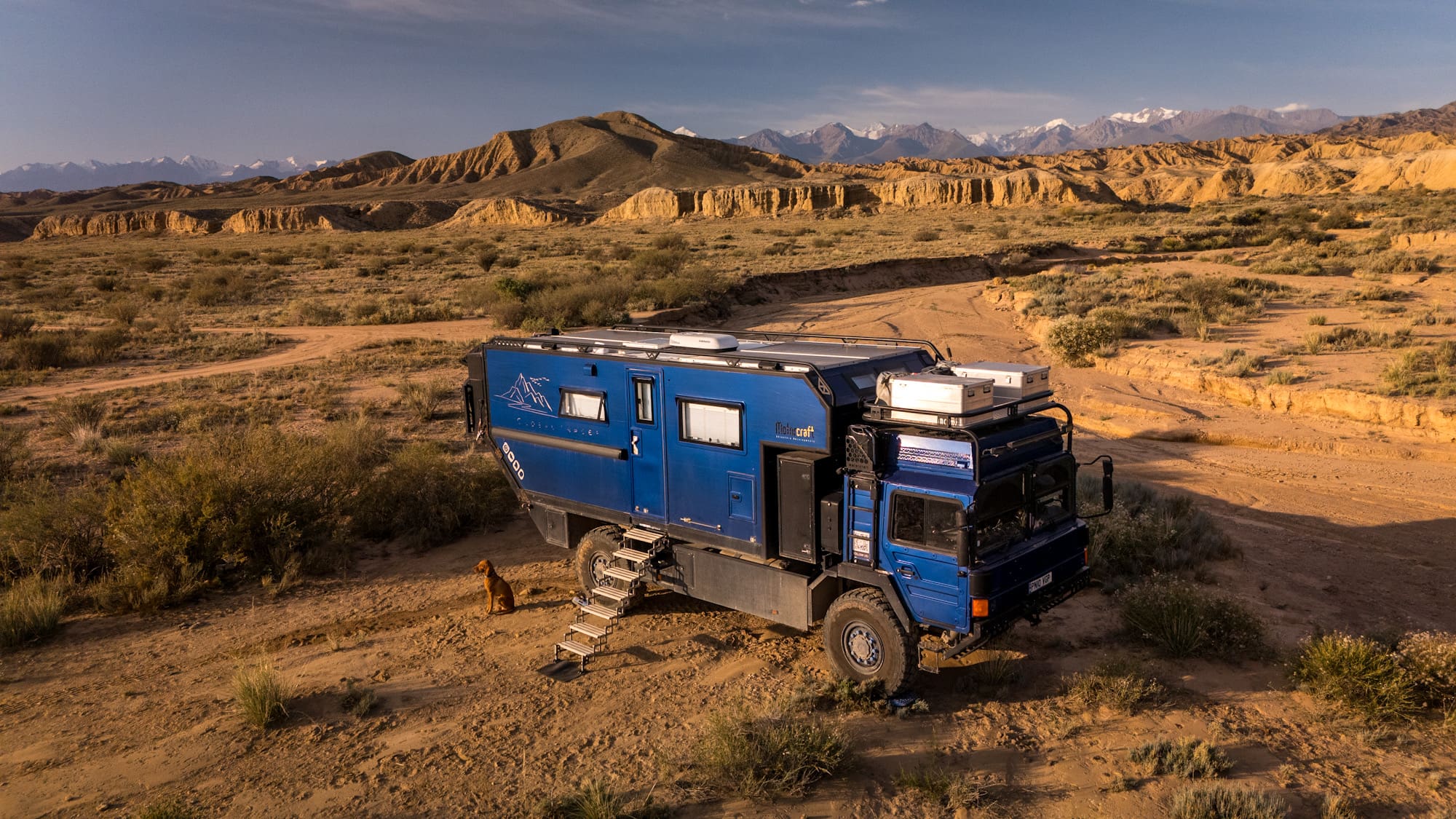
Jess, Dave, Isla and Otis are a UK family slowly exploring the world in their ex-military MAN HX 60, custom-built expedition truck. Dave is a professional photographer and Jess is full-time mum to Isla having given up her corporate city job in London. They’ve been living in their truck since Isla was eight months old; she’s now five and has visited 26 countries. Otis, their 6-year-old Hungarian vizsla is probably the most rabies vaccinated dog in the world! Currently exploring Central Asia, they’ve developed a particular love for the wide open spaces and natural beauty of Kyrgyzstan.
Global Traces: Instagram | Facebook | YouTube | Photopositive
Ashley Giordano
Ashley Giordano’s first foray into overland travel involved a 48,800-kilometer journey from Canada to Argentina with her husband, Richard, in their well-loved but antiquated 1990 Toyota Pickup. Currently cruising along the iconic Silk Road in a 2008 Toyota Tundra, her full-time navigator duties are rewarded with bowls of plov and lagman noodles, hikes in the Tian Shan, and countless cups of fragrant Tashkent tea. As senior editor at Overland Journal, you can usually find Ashley buried in a pile of travel books, poring over maps, or writing about the unsung women of overlanding history, including her enduring inspiration, Barbara Toy. @desktoglory_ash

Our No Compromise Clause: We do not accept advertorial content or allow advertising to influence our coverage, and our contributors are guaranteed editorial independence. Overland Collective may earn a small commission from affiliate links included in this article. We appreciate your support.
Transcript
Ashley : [00:00:00] Hello, and welcome to the Overland Journal Podcast. I’m your host, Ashley Giordano, joining from the Gobi Desert in my mobile podcast studio. And today I welcome Jess and Dave of Global Traces who are traveling Europe, North Africa, Central Asia, and beyond in their MAN HX60 expedition truck. Welcome both of you to the podcast.
Dave: Thanks, Ash. Good to be here. Thank you.
Jess: Hello.
Dave: Well, go on. I was gonna say, we’re joining you from, from the shores of Lake Issyk-Kul in Kyrgyzstan right now.
Ashley : Yes.
Dave: So
Ashley : yeah. And it’s been so great, uh, because we have met you guys along the way in various locations, um, Morocco, Italy, Kazakhstan. I’m sure there are a few more, but, um, it’s fun to have you on the podcast now after traveling together a few times and yeah, good times.
Presented by Hankook Tires: And a special thanks to [00:01:00] Hankook Dynapro Tire for supporting this week’s Overland Journal podcast. Be sure to visit expeditionportal.com to see our features on the recent Hankook experience at the fourth annual Bronco Stampede in Pigeon Forge, Tennessee. We took a look at the full line of Dynapro tires and some great Ford Broncos from all over the country as they gathered at this community event of enthusiasts and top brands.
Thanks again, Hankook. You
Ashley : guys are traveling in an expedition truck, and you have a dog, Otis, and of course, your daughter, Isla. How old is Isla?
Jess: Five and a half.
Dave: Yeah.
Jess: How did that happen?
Ashley : Time flies. And, uh, I wanna talk to you a bit about the truck first of all, and why you decided on the MAN HX60.
Dave: Uh, firstly why a truck, uh, and then why the MAN HX60.
I guess we actually sailed across the Atlantic in 2019, and we spent [00:02:00] the whole month crossing the Atlantic deciding whether we should buy a yacht or a truck. We’d already had a van. We had a, a sprinter van converted, uh, so we’d done sort of shorter trips away, and then we concluded we wanted something bigger that could get us to further afield to more wild places, but also have comfort and space so that we could be away for extended periods of time, that we could have autonomy away from having to find water, power, all of that kind of jazz, and actually explore the, the wild spaces.
So that’s why a truck. Basically, it’s a camper van on steroids with access to, you know, places we otherwise wouldn’t necessarily have got to, um, with all the comforts of home. So, you know, a 10, 8 kilo washing machine, tumble dryer, a full fridge, freezer, you know, a full toilet and shower, and it’s just like being at home but on wheels.
And then in terms of the HX60 At the time we were buying [00:03:00] a truck, the choices were either former commercial vehicles, which were probably 50, 60, 70,000 pounds as a base truck. Or the MAN HX60, which is an ex-British military truck, and the British military, for whatever reason, were deciding to get rid of a whole bundle of their vehicles.
They were downsizing, and now they appear to be upsizing again, or at least holding onto. So there was a glut of HX60s coming out. Huge supply, very low demand. People didn’t know much about them. Sidebar, it is basically just a MAN TGM. It’s a commercial truck with a military cab and a little bit of beefed up, beefed up running gear.
But people didn’t know much about them, so the prices they were commanding were not very high. So we got this, and we paid
Ashley : 20- 21 … 20, th-
Dave: no, 20,000. No- 19 … 19 and a half thousand pounds- Yeah … for the base truck, compared to equivalent ex-commercial vehicle would’ve been 60,000 pounds plus. Uh, and this only had [00:04:00] 6,000- 6,000
Jess: 6,500
Dave: kilometers on the clock. It had basically never been used. Uh, so it made a really good blank canvas for us to build onto.
Jess: And we love the look of it as well.
Dave: We do.
Jess: Very cool. Yeah. And it was different. Nobody had done anything with them yet. You know, it was a real kind of like, yeah, we could… We see something really special with this truck.
Ashley : Yeah. It does look very in place in, like, a Star Wars movie or-
Dave: It does …
Ashley : like, in the premiere when you guys were in the desert or wherever, it looks so at home.
Dave: Yeah. We should probably send you a picture from where we are right now, because there is BB’s clone parked next to us. Yeah. After, after… Our truck is called BB.
Ash obviously knows this, but for the rest of you, after this was built, everyone went, “Oh, we like the HX60, and we love that style of box on it.” So there is parked next to us an almost identical version. Mm. So now there are two of them side by side on Lake Issyk-Kul. It probably looks like an invasion or something.
Ashley : Amazing.
Jess: We’ve certainly, we’ve certainly had some looks driving along, that’s for sure. Yeah.
Ashley : When you were building out the interior, did you have somebody [00:05:00] else build it? And if so, what were the considerations for the layout?
Jess: So we didn’t personally build it inside, for a number of reasons. Number one was I was pregnant, and then we went on to have Isla, obviously.
We were living in London, in the flat. Uh, it was COVID as well, so there was a real restriction on what we kind of couldn’t do from a kind of movement, and also just, you know, we didn’t have the space to have the truck. Obviously, you’re not gonna park it up in London and build it there. We would’ve been incredibly unpopular with our neighbors.
Um, but so we had it built, uh, by Motorcraft Adventure Developments from the, the, the outside, the box, everything, the chassis, and many other things. And then the inside we decided we were gonna go with a company that we’d used for the Sprinter already for the interior, a company called Off Grid Campers.
And we did a… So therefore we did a split build, which was interesting at times. We project managed it, basically, between the two. But we as, as, as, uh, Dave said before, we designed everything inside, from every single minute detail, from, like, you know, the layout. We had 100 different iterations of the [00:06:00] layout and how we wanted it Through to, you know, the, the lighting, the, you know, the everything, the wiring, absolutely everything.
Like, I never wanna have another conversation about lighting ever again for a while. But yeah, we designed it, and the considerations were, number one, we had to feel that it wasn’t camping. Because we knew that we were gonna be doing this for a long time, or that’s the plan anyway, we had to feel comfortable, and we had to have a space where, you know, if we weren’t outside, we could all be inside, and we were comfortable.
We all had an area We had a really nice seating area. Everybody had their kind of space for their, for themselves and their things. Um, so that was a real consideration. And also, you know, we’re not short. We’re both… Dave’s 6’4″, I’m, you know, 5’9″. We needed to have the head height after living in a Sprinter, where the only space that Dave could stand up was, like, underneath the skylight in the middle of the Sprinter.
Otherwise, he was
Dave: hunched over. With my head sticking out the skylight.
Jess: Yeah. So we had to have space in height, and we also wanted to have the ability to kind of walk past one [00:07:00] another as well. So we had to have that space. We also had, at the point at which we took delivery of the truck, uh, and it wasn’t, you know, it wasn’t 100% ready, we still had to do stuff inside, get used to it.
We had an eight-month-old baby, and we have a, a dog that’s, you know, medium-sized. So, you know, we needed to have the space. And little things like being tall, we wanted, you know, a decent counter height, you know, so that when we’re washing up or doing something, you’re not stooping over and, you know, knackering your back.
So we were like, “Well, let’s make the counter height to the height that we want,” right? You know. What else did we do?
Dave: Oh, it was… I mean, it was, it was every little bit. Everything. As Jess said, all the details. So, you know, we, we spent weeks, months mapping out in our flat how big the shower space was gonna be.
Pieces
Jess: of cardboard on the floor. Like, yeah
Dave: Um, if the shower space, shower toilet space was this big, would that be acceptable? No. Could we snug it down a little bit, or is it better to make it a bit bigger? How much wardrobe space are we gonna have? Where are we gonna put, uh, you know, my camera kit, for example?
Mm-hmm. Jess was adamant that while she was giving up her [00:08:00] dishwasher- … with an eight-month-old baby, she was not giving up a washing machine.
Jess: No.
Dave: So we had to have space to f- fit a proper washing machine and- A
Jess: decent size one. Yeah. So we’re not doing, like, you know, three T-shirts and two, you know, sets of baby grows.
Uh, so yeah, it had to be a decent size one that… So, you know, we had to make, we had to make… What’s the word I’m looking for? We had to make- Compromises … compromises is the word. We had to make compromises whereby, you know, okay, you have a full-size washing machine, you only have one drawer for utensils, you know?
Or you don’t have, you know, underfloor more sp- more storage space than you maybe would’ve liked. But I feel it works. I feel- It does … you know, we’ve, we’ve… Some of the sacrifices we had to make, we’ve gained in other ways. Like, we’ve gained a really lovely seating area. One thing… Actually, yeah, we forgot.
One thing that was an absolute deal breaker for us, and this was from, you know, in the pre kind of, you know, two, three years before we went for the truck, looking at other trucks, going to overlander shows, you know, in the UK and abroad, looking at designs. You know, just literally, like, raking through people’s, you know, YouTube, Instagram, [00:09:00] speaking to people.
The big n- deal breaker for us was we had to have a bed above us here. Is that- Not, not this one. This is the alcove. This is Isla’s space here. We had to have a lowering and raising bed Like I did not, number one, I did not wanna be making a bed every day and every night, like categorically not. And I wanted to feel that there was a distinction between where we slept and where we sat and lived, and that the bed could go away and create this really lovely kind of open seating area.
Dave: But also Jess was adamant that, you know, you see a lot of expedition trucks- Yeah … and you have to climb over the seating area to get to the bed.
Jess: And that’s, that’s lovely. And I, I have seen, I have seen designs since that I’m like, “Actually, you know what? That does work in here for them. That, that works. It looks good.
You know, it has a really…” I’m not dead against it, but for us personally, I was like, “I do not wanna climb over my sofa to get in my bed.” Sorry, Ash. Like, so if you-
Ashley : It’s all good
Jess: Like-
Ashley : I’m also 5’3″
Jess: The wheel is lovely open
Ashley : I was thinking about that. I’m like, “Yeah, our OB camper I love- Yeah … and it’s perfect for my height [00:10:00] and Richard, but we are-
Jess: Exactly
Ashley : smaller
Dave: people, so- So you’re like 5’3″ and 5’6″ and you’re both, both slender. Yeah. Whereas Jess and I are like the opposite end of that scale at 6’4″ and 5’9″ and, and just big people. Big people, big truck, right?
Jess: And we have a child, you know, and she comes in the bed, and we have the dog toys, you know. So it all just kind of what is gonna make this as comfortable and as easy for us long term, basically, with, you know, minimum amount, minimum amount of sacrifices and compromises.
But under- but understanding that you can’t have everything.
Dave: I think Jess touched on it before, actually. Like, I … In my head, I was very clear, whether I said it to her or not, in quite so many words, that I’m, I’m probably, it’s fair to say, the slightly more adventurous outdoor one.
Jess: Initially.
Dave: Initially. But Jess has obviously grown into it quite a lot.
I mean, to be fair, she said yes to a truck, so she can’t have been that, uh, unadventurous. But I’m probably the one that would just, “Hey, this is great, and I’ll keep doing it because I love doing [00:11:00] it.” Mm. And, and I will put up with a little bit less comfort. I, in my mind, needed to make sure that the truck was so comfortable and so like being at home that Jess wasn’t gonna get bored of it after two years or go, “Oh, God, this is just a chore, this is uncomfortable, and let’s go home.”
So by having a bit more space, by having a few more creature comforts, it kind of made, in my mind- Made the- … it made the more lo- It made the transition- Gave it more longevity …
Jess: a lot easier and it gave it more longevity. Yeah. And now, actually, since, you know, we’ve been in the truck, what, we- Nearly
Dave: five
Jess: years
nearly five years. We’ve had, you know, a small break due to kind of, like, family reasons, whether that be back at home or, you know, in a, in a rental for, like, you know, a month or so when Dave’s away. I go into a house, house, something that’s not the truck now, and I’m just like, “Wow, this is, like, pretty annoying to have to keep this tidy,” and this really takes ages, you know.
And whereas in the truck you kinda, you know, sweep round or whatever, whack a cloth over the floor and, you know, hey, presto, you’re done. And- The
Dave: floor’s mopped in-
Jess: Yeah … [00:12:00] 20 seconds. And you get into a house and you’re just like, “How many rooms do I have to clean here?” You know, it’s, it’s actually … It’s gone the other way where I’m like, no, I, I, I, I never not loved being in the truck, but I, I really appreciate the truck more For all of those reasons.
And also, you know, having a little break from it after, you know, eight months of, you know, Central Asia, Europe, whatever, the Pamir Highway, really made me appreciate it even more.
Dave: It’s, it’s funny actually, I think everyone with vehicles does the same thing. You always look at other vehicles, and, and I’m sure you’re probably gonna ask us about the pros and cons of, of big truck life, but, you know, we look at other vehicles now, and sometimes you’re like, “That big one’s really nice.
Oh, but that small one’s really nice, and what could we do with that?”
Jess: We’re always thinking about, like, the next-
Dave: What, what might the next vehicle be? … vehicle. What might the next platform be? You know. Yeah. How might that look somewhere down the line?
Ashley : You should have- Spoken like true overlanders.
Jess: Yeah. Your first…
Well, your first one, well, you know, for us, this is our first big, you know, and main- First, first overland vehicle … overlander. You’re never gonna get the first one [00:13:00] right, uh, whatever right is, you know? And you’ll always have, “Oh, I could, you know, tweak that a bit,” and whatever. But to say that, I feel, and correct me if I’m wrong, but we don’t have many major things that we’re like, “Oh, we should’ve done that differently,” or, “Oh, would I do that again?”
Dave: You know, like that. There’s very few things that we would change on here.
Jess: Majorly, yeah.
Dave: Like, or, like, if we could go back in time, would we come up with different decisions to get us to a slightly different point? And I think the answer to that is no. There’s probably very little we would actually change for this.
That doesn’t mean that this is always right. And right, whatever right might be, changes over time, because your needs change, where you are in the world changes, what you want to go and see changes. You know, when you’ve got a child, they grow, so your requirements get a little bit different, because they’re no longer a baby you can just stuff in the corner of the, of the sofa area.
Not that we ever stuffed Isla in the corner of the sofa area. Maybe your alcove, perhaps. But, but now she’s, she, you know, she’s genuinely a [00:14:00] person who wants to do X, Y, Z, and she’s sassy as all hell, and she has her own ideas and her own personality, and that in itself impacts how you live in a vehicle or outside a vehicle, and maybe what you may or may not do differently next time.
Jess: And how you travel as well.
Dave: And how you travel.
Jess: It’s evolved. You know? It is. Like, we- We can do a little bit longer journeys now. You know, we don’t have to get her out. You know, we can, we can go to different places. Mm. It’s a little bit kinda easier now that she’s bigger.
Dave: We took her up a sand dune the other day.
Yeah. She hiked all the way to the top of the- She beat us … Singing Dune in Alton Emmels. Yeah. So, you know, she’s, she’s now, yeah.
Jess: A
Dave: little person. A little person. Yeah. So no, that, you know, to bring it back to the vehicles. Mm. That changes, I guess, what right is for you at any given time. But I don’t think there’s anything we would’ve done differently if we could go back in time and, and redo this platform.
Ashley : Nice. Yes, great success.
Dave: Yes. Yeah, absolutely.
Ashley : That’s
Dave: awesome. I mean, the fact we’re still in it five years later is probably- Yeah … enough of a testament to that. It’s
Ashley : proof. Are there any pinching [00:15:00] points where you’re like, “Ugh, like I can’t even with this. I wish it was…”
Jess: I would say that we’ve…
Dave: Yes, there are two.
Well, yeah. Two in my head. Well, I’m gonna let Jess answer, and then there are two in my head. Are
Jess: you talking about the size and weight? Si-
Dave: size and weight, yeah, basically.
Jess: Yeah.
Dave: Fundamental.
Jess: So we love our truck, and it again ties into the previous kind of things we’ve just said. It works for what we need.
But we have moments sometimes where we’re like, “It would be nice if she was a little bit smaller.” Like, you know, like for ex- example, we look at something like you guys drive and, and we’ve got, you know, friends of ours or whether that be a, you know, a troopy or whatever or… And we kinda think, “Oh, it would be nice sometimes if we weren’t quite so heavy,” or, you know, we…
For example, you know, like we couldn’t do the Wakhan Valley in, in, uh- Off the permit. The Wakhan or the
Dave: Bartang … off the permit, the Bartang … weren’t out for us. We’re just too big.
Jess: And they were out for us. And that was also, like a p- a personal choice from a kind of safety perspective as well. We saw that, you know, a couple people got into a bit of trouble and stuff, you know, with, with trucks bigger than ours, you know, even.
But we [00:16:00] kind of took the, the decision that that wasn’t the right place for us to be, you know, in the truck. And you know, we’re not massively city people, even though, like I’m a Londoner. But going into cities with a truck is, ugh, it’s just, it’s… We do it, we do it because we, we want to see them, you know, mostly and whatever, supplies and blah, blah, blah.
But it’s stressful. It’s stressful parking. It’s stressful, you know, some- finding somewhere to sleep, especially with a dog as well, you know. You can’t just let him out or whatever. Like it’s, it’s not really our thing in the truck. So we do have moments. And also from a kind of an off- off-road perspective, we’ve had to find river crossings as opposed to going over bridges sometimes because, you know, they’re either, we’re definitely too heavy or we’re not quite sure.
It’s got holes in it and where it’s a bit sketchy, so we’d rather kind of go through a river. And that’s fun and that’s great, you know. And touch wood, you know, we’ve never had any situation where it’s been, you know, from, from a dangerous perspective. But there have been times where we’ve gone, “Nice if we were a little bit smaller.”
You know, we could sneak off down there, you know, or do a-
Dave: Smaller forest tracks we could access. Yeah,
Jess: [00:17:00] without…
Dave: You know, we’re 3.85 meters tall, so low branches become a problem. Mm. I, I’m quite adept at standing on the door with a saw and chopping the odd branch down. But things like, you know, those, those slightly more technical Narrower tracks are probably out for us for the most part.
Also, I mean, just mentioned cities. Yesterday, we, we went into Karakol, which, uh, for those of you who want to locate it on a map, is at the east end of Lake Issyk-Kul, which is, like, the eighth-largest freshwater lake in the world- Deepest … I think, or eighth-deepest, 11th-largest, something. Anyway, it’s, it’s pretty…
It’s a massive lake. Ash knows it. You’ve been here. Karakol is, like, the big city at one end of it, city, and we drove in there ’cause we needed to go shopping, uh, to pick up some supplies ’cause we knew we were gonna be wild again for a while. And, um, we, we turn in, we follow Google Maps, and all of a sudden we get an eight-ton limit sign.
Now, there’s two of us in convoy, so there’s two 15-ton trucks.
Jess: There’s no hiding.
Dave: And we’re on the radio, and I’m like, “Uh, what do we do? We kind of need to go [00:18:00] down here, but we’re now stuck in this kind of eight-ton limit seemingly everywhere.”
Jess: With cables hanging down and, you
Dave: know- We’ll just go quietly- Yeah
and hope that nobody sees us. So we went through a few of them, and then we were like, “No, now it’s getting a bit too busy. Okay.” So then we took a veer off to the right and found a side road that didn’t have a, a weight limit on it, and then managed to, you know, park up there. But it then meant it was a bit of a walk to get into the supermarket, so-
Jess: Well, we stole a shopping trolley, let’s be honest.
Yeah.
Dave: Just stole… She’s such a Londoner. A Londoner, innit? She stole a shopping trolley to push the shopping back to the truck. I
Jess: took it back. I took it back.
Dave: No, you didn’t. Nick took it back. Well,
Jess: it went back.
Dave: It did go back. Anyway, so you know that- They do say,
Ashley : like, your, your, uh, what is it, how much of a jerk you are is related to if you bring your shopping cart back or whatever.
Jess: Yeah. She does So
Ashley : we brought it back Yeah. Someone brought it back
Dave: Yes …
Ashley : all good.
Dave: It’s all good Someone brought it back. We arranged for it to get back You have to, you
Jess: have to improvise when you’re,
Dave: you do overland You do
Ashley : Yes
Dave: All the time. Um, even if improvisation means stealing a shopping trolley, that’s, that’s an acceptable improvisation Borrowing Borrowing [00:19:00] Borrowing Borrowing Anyway, anyway Temporary borrow.
Anyway, uh, so yeah, that’s, you know, when you’re driving a big vehicle, there are those considerations that you guys in a Tundra with your OEV back on don’t think about. What are you, four tons, three and a half tons?
Jess: Yeah. Perfect example of
Dave: that Um, so there’s, you, you never really find roads that you can’t access because a Sprinter van can go anywhere, and that’s three and a half tons
Ashley : It’s funny because it’s like f- the perspective, so we’ve had a lot of Europeans say to us, “Your vehicle is huge.”
And we’re like, “In North America, I feel like it’s not.” And then looking at your vehicle, our vehicle’s small. But then sometimes we even wish that we had a vehicle that was a little bit smaller. So it’s all like from your own f- you know, your, the perspective- Perspective … of where you’re at. It’s so relative.
Uh, I’m curious though for you guys, like what some misconceptions are about expedition truck living or, um, the most common questions or c- people’s curiosities and assumptions about the [00:20:00] truck So-
Dave: So
Jess: do the most common questions first and then like the misconceptions There is one most common question Yeah
Dave: Like, I mean, we- What?
It’s funny actually, when w- when we started traveling in the truck, probably in the first year or two, we’d be driving along and we were like, “We should just write an FAQ of the top five questions,” ’cause we get the same questions every single time
Jess: Laminate it and stick it
Dave: to the window And we were like, “We just need to stick it to the window and go-“
Jess: Yeah
Dave: Okay, now ask.” And
Jess: it’s fine. Like we don’t mind. We really don’t mind, but sometimes when you’re like, you know, you’re trying to get, sort dinner or you’re trying to go somewhere quickly, well as quick as we go, and you’re like, “I just don’t need to answer this question right now.” Like, you know, but I will because it’s fine.
Dave: So okay, so num- number one question is
Jess: How much does it cost?
Dave: Well, how much does it cost?
Jess: Yeah.
Dave: Um-
Jess: Yeah. We’re close, number
Dave: one. Number two is like- Yeah, close, number two is that must use a huge amount- Yeah … of fuel
Jess: Just what’s your miles per
Dave: gallon Yeah, what’s your miles per gallon or, you know, liters per 100 kilometers Yeah And, and to answer that question, we do [00:21:00] about, slightly depends on road surface obviously and how fast we drive, but probably between 28 and 30 liters per 100 kilometers.
If we are off-road, obviously that’s gonna go up. But when we’re on road, we try and, you know, we drive quite conservatively. I don’t go racing anywhere. Jess-
Jess: She doesn’t
Dave: go fast anyway … doesn’t go racing particularly. She, I mean, she’s speed limited to 89 kilometers an hour, so we’re absolutely not fast. Um- Good.
Jess: So that’s quite a, that’s quite a-
Dave: So yeah, that’s- …
Jess: prolific question …
Dave: that’s
Jess: our-
Dave: Yeah … you know, that, that’s our fuel consumption Yeah Which when you’re back in Europe that’s quite expensive to fill the truck up. The further east you go, you know, when we got to Turkey, we were like, “Wow, this is pretty cheap.”
And then we got to Georgia and we’re like, “Wow, it’s even cheaper.” And then we got to Kazakhstan and we’re like, “this is ridiculous.” Fill everything. Like Morocco was also cheap. We, uh
Like filling up, filling up the truck in Kazakhstan, for example. So we went back to England for six months because we had some family stuff to sort out- Mm-hmm … [00:22:00] over this Christmas just gone, so Christmas ’25 to ’26, and we bought ourselves a BMW X5 secondhand. It had done- Yeah … you know, hundreds of thousands of miles.
Right. It was a beat-up old little tank, but big fuel tank. Diesel, obviously the whole fuel prices shooting through the roof because of geopolitical tensions, meant fuel prices were really expensive, and filling up the BMW X5 in England was almost the same cost as filling up the truck in Kazakhstan.
Jess: And how big is our fuel tank?
Dave: And our fuel tank here is 450 liters.
Jess: Yeah.
Dave: Like, diesel-
Ashley : Which I was gonna say, you can choose where you fill up-
Dave: Yes …
Ashley : at that point- Yeah … when your tank is that big- Yes … which is also very helpful. Oh, yeah. But yeah, go ahead, sorry.
Dave: I mean, we, yeah, well, to your point, we did that coming out of Morocco. We filled up our main tank.
We had a reserve tank built in Morocco, just like a, a dumb tank, sits under the side skirt. I think it cost us about 200 pounds, and it holds about 100 liters, and jerry cans. And then if you remember the little side [00:23:00] quest that Richard and I did in Western Sahara when we all thought we were going to Mauritania.
Ashley : Yeah.
Dave: And we went off and, and we went and bought those, uh- 油 drums … you know, 25, 30 liter oil drums. Yeah. And before we left Western Sahara, where it was really cheap, we filled them up, and then before we left Morocco, we filled everything up again, and that got us from Morocco through to Bosnia. Bosnia.
Jess: Yeah.
Dave: I think it was Bosnia before we had to put fuel in again. So I mean, that’s kind of a fuel consumption thing, but to your point, a big tank, and particularly with a few extra jerry cans and whatever, you’ve got the opportunity to decide where you’re filling up, and that’s not just I’m going to the next town.
It could be I’m going to the next country- Yeah … to
Jess: fill up. And that’s one of the things. Yeah. We’ll just skip a few countries. But that’s also one of the things about having a larger vehicle that is one of the pros, in that you have a large fuel tank, so you can go longer distances. You have a larger water tank, so you can stay remote for longer.
You have, you know, lo- more [00:24:00] space to put, and weight capacity to put more food, you know, dry storage, whatever. You can carry more stuff to enable you to be away out into the wilds for longer, which is what we love, you know. Whereas smaller vehicles, you know, will struggle with the fuel, the water, you know, the food, we- garbage, whatever, you know, waste disposal.
So that’s, that’s kind of where having a bigger vehicle lends itself to, you know, longer trips and further pa- like, more remote kind of spaces.
Dave: Yeah. Yeah. I think it’s easier when it’s a couple. Mm. Once you start adding a dog and a child- … obviously the things you need to carry multiply. Yeah. And- Children
you know, children are not great at turning taps off. So if you have 100 liter water tank, your water is gone in a heartbeat, whereas- Well, you
Jess: need more showers, you need to drink more water. You know, it’s all those kind of things where you just have to kind of- You really just have to think ahead, and there’s certain spaces or places that we’ve gone to where we thought we’ll fill up here in advance with, you know, more of this kind of food that [00:25:00] the five-year-old will eat, you know?
And ’cause we know we’re going here, or we need a bit more kind of fuel because we’re going there. And like dog food, you need to find the dog food that the dog eats, and you need to have enough of that to keep you going so, you know, you don’t have to go off and locate dog food in countries that probably don’t actually really kinda like dogs, a lot of them.
Yeah.
Dave: You
Jess: know? So there’s- And
Dave: we were supposed to be somewhere close to you guys- Yeah … right now.
Jess: Yeah.
Dave: In Mongolia, but sad face, obviously. The foot-and-mouth outbreak there meant that we couldn’t cross the border with Otis. Mm. They’d shut the border for anyone with animals. But we’d prepped for that, so we’d gone out and bought 45 kilos of dog food, which was gonna last us to get all the way back round to where we planned we were gonna- Mm
park for a period of time where we could then get back to that food. And having the payload capacity on the vehicle allows you to do that. You know, if you… If, if I said to you, Ash, you need 50 kilos of… You need to put 50 kilos of stuff in your vehicle-
Jess: Chuck [00:26:00] everything out.
Dave: Yeah. I mean, okay, you’ve got payload capacity to a degree, but 50 kilos is a reasonable percentage of it, whereas we weigh 15 tons and our maximum vehicle weight is 18 tons, so we’ve still got three tons- Mm
of payload capacity if we needed it 45, 50 kilos of that is, it- it- Mm … it’s an infinitesimally small percentage of it. And that’s one of the things the bigger vehicle gives you, but then the downsides are the access in the cities and-
Jess: Swans and roundabouts …
Dave: when big trucks get stuck, they get really stuck.
Jess: Yeah.
Ashley : I wanna talk about getting stuck- And we normally meet,
Jess: yeah …
Ashley : at some point. But- Yeah. I wanna jump- Okay, we’ll go, we’ll go back to
Jess: that …
Ashley : yeah, we’ll go back to that. You were talking about the FAQs, and I think we had cost-
Dave: Cost, cost of the truck …
Ashley : fuel-
Dave: Fuel … or
Ashley : fuel range and cost
Dave: What else? Where do you…
I’m g- I’m gonna try and make this as polite as possible. Where do you go to the toilet?
Ashley : Yeah. Common question.
Dave: That’s a classic. Yeah. Yeah. Do, do you- Yes … do you poo in a box? [00:27:00] I mean, effectively- Kinda … you kinda do.
Ashley : Yeah.
Dave: Yeah, it kinda is really. That must be really disgusting. Not really. That’s
Jess: it. What else? Um- What else?
Dave: The, the funny thing is actually, as we’ve come further east, where you’ve got more of a language barrier, we still get the fuel questions and we still get the cost questions. Arguably, the cost question overtakes the fuel question now. But the other questions seem to have kind of fallen by the wayside.
Where are you going? Why are you doing this?
Jess: How do you, uh, afford it?
Dave: How do you afford it? Yeah. What, what do you do for work? How, how- How do you afford it? … how do you afford to do this? Well-
Jess: Well, we saved a, a lot.
Dave: We did. We
Jess: planned a lot. We saved a lot beforehand, even though, you know, obviously kind of spent a fair bit doing it.
But we then made sure we always have a buffer, we save, saving whatever. D- so, uh, if there’s like, you know, we need to go home, or heaven forbid, something happens or whatever, so we always have a kind of buffer for that. So Dave is a professional photographer, videographer, and has clients that he works for whereby he has to, or has to, [00:28:00] does go away- Does
for one month at a time, kind of, you know, throughout the year, normally about two times a year, and works, you know, solidly for the month, and then comes back. And that then enables us to, you know-
Dave: Travel some more …
Jess: travel some more and pick and choose kind of-
Dave: Effectively, you know- …
Jess: what you wanna do …
Dave: one or two of those trips a year gives us enough money to keep going without dipping into our savings.
Yeah. So yeah, it’s, it’s probably one or two months of work a year, and then 10 months of- Mm … clear travel time
Jess: And then I’m full-time Isla. So I was, I was working in the corporate world for 15 years beforehand, and then, you know, when we decided we were gonna do this, and then obviously have children and, and, you know, it was like, well, I was like, “Well, I’ll stop at my job.
Yes, you know? I don’t need to work in the corporate world anymore, thank you very much.” And we had to do that because it was always gonna be that your profession enables you to go and, you know, either here and do kind of, you know, photography and whatever and work, but also then to go. So when Dave does go away for the month, we normally, you know, we plot up somewhere for the month that’s kind of stationary, either in the truck or, [00:29:00] you know, we rent somewhere- Rent a house or an Airbnb or something
or rent a house on Airbnb, whatever. And then I’ll kind of base myself there with Isla and Otis. You know, family members might come out and visit or friends come and stay, you know, things like that. And then Dave’s able to therefore go away and work, you know, knowing that we are kind of safe and plotted up, and then come back and then we continue.
Yeah. I would- Which is a really… I mean, it is a luxury kind of position- It is a luxury position … to be in, but we’ve worked really hard in the lead up to it to, A, get that client, you know, that situational- To be able to buy the truck, for a start … kind of to buy the truck, number one, and to be able to be in a situation where Dave’s worked incredibly hard to have those kind of, you know, clients and work opportunities.
Dave: Yeah. I think, and, you know, in essence, my job, I could… can be done from… I mean, I take pictures as we travel and, you know, those pictures I sell. You know, I sell prints. I have a, a print fulfillment store that’s available globally. People can just go on, pick a picture, and order it and, and a print turns up.
That brings in a little bit of money. But so my job can be done from anywhere. I can fly out from here to go and meet my clients to [00:30:00] take pictures. Uh, whereas Jess’s work was, although she was working from home, it was kind of home office She couldn’t do that from the shores of Lake Issyk-Kul
Jess: Well, it was a lot of travel as well.
It was a lot of global travel and-
Dave: There was, there was travel and time zone changes- Yeah … yada, yada, yada. That just wouldn’t work.
Jess: And then after having Isla, I think, you know, I, I decided or we decided that that wasn’t what we wanted to do, or espec- especially for me. Like, we wanted to, to raise Isla and spend as much time with her.
And I think that if I was trying to do that job or at, you know, this point in time anything similar, it would detract away from, A, our family and our lives, and also from, you know, the traveling that we’re doing and the places that we’re going to. And I just think we both made, made that decision that that’s not the way we wanted to do it.
We wanted to, you know, me to be able to, or us, to be able to focus on bringing up Isla. And now, you know, we’re talking about evolving kind of the, you know, how we live. Homeschooling’s coming into it now. I mean, she’s only five and a half, but we are thinking forward already about, [00:31:00] you know, how we are going to homeschool Isla.
You know, what does that mean? How does that mean? Will it change how we travel? Will we have to slow down? Yes, we will, you know, allocate time, but also not make it so rigid that we can’t all of us enjoy what, where we are and how we do it, you know. And mix it up- Mm … and be like, “Oh, we’re gonna go see some petroglyphs today.
Let’s learn some history and geography.” Or, “Oh, we’re gonna go to like, you know, the dinosaur museum here,” or, you know, “We’re gonna go and we’re just gonna go for a walk and we’re gonna identify different species of, you know, shell and flowers and fauna along the lake of, you know, the, the shores of Lake Issyk-Kul.”
You know, so it’s, it’s, it’s kind of, it’s evolving.
Dave: Yeah. Yeah. And it’s a, it’s an evolving education process, I guess, for all of us. But I think maybe fundamentally, I don’t know if we’ve ever actually said this, but I think we’re both quite old-fashioned in certain ways. So for example, like, if you go back 50, 100 years, the family unit was very strong, and the parents were involved in raising the children, maybe 200 years, like, strongly.
It [00:32:00] was a very tight family unit, and in the last 50, 60, 70 years, society has kind of fractured open a little bit and now a lo- a lot of parents maybe don’t take as much responsibility for their child’s education. They just send them off to school and away you go, and thanks very much. And they also don’t get to spend as much time with their children.
And, you know, realistically what you get two, two summers with your child as a baby. You get what, 10-
Jess: Not enough …
Dave: 10 summers- Mm … as a child- When they actually want- … and then a few summers as a teenager … they
Jess: actually wanna know you at that point.
Dave: A- and so you kind of wanna maximize the amount of time- Mm … the, the amount of hours that you can spend with them And this is a way of doing that.
It means, you know, okay, this life is not super cheap, but it is actually cheaper than living in a house in England- It is … without a doubt. Yeah Guaranteed. And so that reduces the income requirement, which means that therefore reduces [00:33:00] the amount of work we have to do, which then frees up time to spend together as a family, to spend time with Isla, to watch her grow up and be involved in her growing up and her education at a really micro level.
Jess: And I think also if we didn’t do it now, we, we were like, well, you know, we could work and we could then save it for our retirement or whatever. And that’s not saying that it’s wrong to do that, but we thought if we, we just do this now, you know, Isla’s eight months old, you know, she’s not at school yet.
She’s not, you know… We’ve, we’ve got, you know, we’ve got somewhere we could go back to in England if we, you know, if we needed to. Actually, we have less of that now, you know. But we just decided if we don’t do this now, we will get wrapped up in, you know, a, a, a, a, in a better job, you know, a bigger house, a bigger car, you know, schools, friendships.
It’s not to say she doesn’t have those. But doing it at this age for both Isla and for us means that, you know, like, why not? Like, you never know what’s gonna happen and why wait till retirement? And yes, we’re fortunate enough to be able to have [00:34:00] taken that leap, and it was a big risk stepping out of my job, out of my career.
You know, and Dave, you know, saying goodbye to a lot of his other clients ’cause he wasn’t physically present enough in, you know, in within the UK or Europe, but we just chose that this is what the way we wanted to do it. It was a huge risk, and that’s also, I think, a bit of a misconception. People go, “Oh, well, you know, you just like, you just went off and did it.”
Like, well, we’re like, no, it was, it was terrifying. It was terrifying stepping out of the, the norm, you know, what we were used to and, you know, with a baby and a dog and, you know, aging parents and whatever. You know, like i- into something that we had no idea about, you know?
Dave: I, I’m actually gonna, I’m gonna frame that slightly differently or phrase it slightly differently.
Everyone seems to think that when you live this life You just live on one permanent holiday
Jess: Eternal sunsets and-
Dave: Uh, you know- … beautiful places …
Jess: beautiful
Dave: sunrises- Yeah … beautiful sunsets, beautiful places. Yeah, there’s a lot of that
Jess: Which is beautiful and lovely and amazing
Dave: And, and, and because of that, life must be incredible and- Yeah
so easy, and you just [00:35:00] swan around the world- Mm-hmm … having the time of your life. Mm-hmm. And the reality is-
Jess: It’s hard … th- th-
Dave: Right … it is hard. And, and- Yeah … actually when you- And it
Jess: should be hard, right? You
Dave: know? When you change… When you trade one life for another, life’s problems don’t disappear. No. They change.
What you trade is one set of problems for a different- Challenges … set of problems. Challenges. Or challenges or responsibilities for a different set of responsibilities. Mm-hmm. So instead of thinking, “Okay, where’s the next holiday going to be? How are we gonna afford it? How do we save for that? Where’s the next mortgage payment coming from?
How are we affording the electricity bills? What school is Isla gonna go to next? Is she being bullied? H- how’s she getting on at school? Um, what can we do this weekend in a, for a soft play to entertain her in the few hours that we have with her?” So on and so forth. Our, our responsibilities, our challenges, our problems are now, where are we next getting water?
But come back to previous, that’s like a two-week timeline, is, you know, we can last for about two weeks on our water. Um-
Jess: Do we have enough solar?
Dave: Do we have enough power?
Jess: Yeah. [00:36:00]
Dave: Um, for cooking, or can we find some wood or charcoal? We’re gonna barbecue outside, which we’re gonna do later.
Jess: Can we fit down there?
Dave: Can we fit down that track? Before we go down there. Where are we going to park tonight?
Jess: Yeah.
Dave: And, and, you know, that is such a misconception. Yeah. Is that people feel like, “Oh, you just pull up anywhere.” No. No. There’s a lot of thought goes into this.
Jess: And respect for your, where you are in
Dave: your environment- Exactly.
You don’t want to- … and the
Jess: people …
Dave: you know, trash the joint.
Jess: Yeah.
Dave: Uh, you don’t wanna, you know- Ruin it for others … upset anyone, go park on someone’s private land inadvertently, so on and so forth. Mm-hmm. And so there are, there are daily decisions and things that you’ve got to be thinking about. They’re just different to what you would have if you were living in a house.
Jess: And then that then ties into… And this sounds like a luxury problem, but decision fatigue is huge, because, uh, you, you just, uh, that’s constantly like, okay, you know, all of the things Dave said. And then you have, like, your daily like, you know, dealing with a five-year-old, making sure she’s okay. Is she entertained?
Is she happy? Which is, you know, she’s pretty easy with that. She’s pretty good going. Is the dog okay? Are we okay, you know- Mm-hmm … [00:37:00] as, as a couple, or are we okay as individuals? Because, you know, yes, you, you… we live in a box, and, you know, as, as you know, like, you know, being married is not not easy at times, as we all know.
And then you multiply that by living in a box, effectively, and you can’t just go and shut the door sometimes, because we have one door. We never close it anyway, you know. Like-
Dave: You, oh, you can’t, you can’t walk out the house- You
Jess: can’t walk out the house …
Dave: get in your car- No … and just go for an hour’s drive to get some head space.
Or go
Jess: and have a coffee with your mates and download. You know? Like, or just go and, you know, just do something that isn’t about your truck and your husband or wife or your child. Like, there’s no getting away from one another sometimes, and that is a challenge That’s of
Dave: course amazing,
Jess: right? Yeah, totally.
Totally, Dave. Yeah. But, you know-
Ashley : Also, it’s fascinating from what, like my experience and your experience, you’re thinking daily, you’re thinking weekly- Yeah … you are thinking monthly because- Yeah … when you’re going into, say, another country, you kind of have to [00:38:00] know the next step after that because you’re looking into paperwork, you’re looking into visas, you’re looking are there pets allowed?
What are the logistics behind it? Yeah. So like- Yeah … both of us, for example, planning this year’s travels, you’re never just looking Short term. You’re always looking three or four months down the road and, like- Yeah … how long is the visa there- Oh, yeah … et cetera,
Dave: et cetera. Oh, yeah. You’re not- So true … you’re not living day to day.
No. You are living day to day, but at the same time you’re living month to month and, and- Counting visa days … you know, quarter to quarter. It’s like,
Jess: yeah.
Dave: Can… How long can we stay in this country? Yeah. Or in, in our case, where we had our plan to come through to Mongolia- Mm … just behind you guys, and suddenly, like, literally we collected our Russian transit visas, and two hours later, two hour- Like, we had the euphoria, “Yay, we got our transit visas.
This is awesome.” Two hours later, we heard people got turned away from the Tashanta border f- between Russia and Mongolia because they had a dog with them. And then we heard another [00:39:00] report, and then we heard… And suddenly that plan is completely out the window. Well, we’ve built our whole year plan around this, working our way through to Mongolia, coming out, going into China, back through China, into Kyrgyzstan- Mm
back up into Kazakhstan, then parking up for when I have to go away for work, and suddenly that’s literally just been- Gone … torpedoed completely because there isn’t enough time. Like, the visa days allowed in each- Just doesn’t work … of the countries doesn’t- Yeah … work. So we then had the mad scramble of, “What are we going to do?”
And, and then-
Jess: And dealing with all the emotions of what, of that, how that felt. Yeah. You know? And, like, yes, we’re l- we’re l- it’s really great that we have our home with us and we can just pivot and, you know, then trying to, okay, what’s plan B, you know, what’s plan C? But, you know, it was really, really disappointing.
Dave: Yeah. I mean- Or it’s- … it’s, it, it’s… For anyone that doesn’t live in a truck or, or doesn’t actually overland, you’re listening to this because you’re interested, this, I understand, sounds like a real- First world problem … luxury [00:40:00] first world problem. Okay?
Presented by Hankook Tires: 100%.
Dave: So don’t get me wrong. We, we- Yeah … understand entirely if you’re sitting there going, “Jesus, guys,” like, “really?
You’re complaining about this?” But- No.
Presented by Hankook Tires: Yeah.
Dave: Yeah. “Boo-hoo, let me get the tiny little violin out. It’s microscopic.” But- The ambulance is coming … when your lifetime… Yeah. Ambulance, I haven’t heard that in a long time. We, you know, when your plan for the next six months has just been- It’s tough … completely torn up and set fire to- Mm
suddenly you, you have to come up with something else, and the logistics of trying to do that whilst a clock is ticking, because you’re in a country that you can’t stay indefinitely, so you’ve got a ticking clock. You’re still trying to get the vehicle ready to get moving again, and suddenly it’s all gone up in smoke.
There is a pressure to that, and there’s a challenge to that, and part of, I would say, almost every overlander we’ve met, one common theme is a flexibility and an [00:41:00] ability to pivot. Like, you have to be able to make a compromise, you have to be able to make a decision and not dwell on it, and you have to be able to pivot because- Can I say shit?
Sh- shit goes wrong. We’ll find out. Is it before or after the watershed? Who knows? Stuff goes sideways, right? And you have to be able to roll with the punches on an almost daily basis because nothing… You’re in a vehicle, it rolls, things happen. Like your- things go wrong in a house, that’s bricks and mortar not moving.
Things go wrong in a truck Because you’re dragging- Stuff like that … your house over bumpy-ass roads on washer boards and off-road and ruts and goodness knows what. And you have to be able to deal with that whilst dealing with the logistics- And, and- … and planning …
Jess: by m- by no means, I mean, like our, from our backgrounds, as we’ve said, like I worked in the corporate world for 15 years.
You know, w- before I met Dave, if you’d have said to me, “You’re gonna be living in a 15-tonne truck with a [00:42:00] five-year-old and a dog in the middle of Central Asia,” you know, uh, I would’ve been like, “Hello, yeah, but you’re mental.” You know?
Dave: Let me, let me just
Jess: get you- But … committed to the asylum. You know. And, but we are, and I love it, and I absolutely love it, and that makes it sound very much like it was Dave’s idea, like it was our idea.
But I needed that time to just be like, “Okay, you know, I can switch my, my thinking away, around,” you know? But now it is… And I feel as the, as the five years have gone on that we’ve been in the truck, like, you know, the mi- most minor thing at the beginning, we’d be like, “Oh my God, stop the truck. Something’s rattling.”
Like, you know- Mm … the, something’s fallen off, you know, wherever, and just now we’re like, “Do we have a, do we have like a cable tie or something?” Yeah. You know? Like, or, “Can we just like fashion this bracket?” Because the number plate was looking like it was gonna fall off, you know. Or, and, and hats off to Dave.
Like, you know, we are not trained mechanics, we are not trained, you know, carpenters, welders, you know- Plumbers, electricians … plumbers, electricians, and you know, but we thank God for YouTube. You know, things like
Dave: that. Like- YouTube, ChatGPT … and
Jess: talking to [00:43:00] other overlanders- Yeah … and experience with like from friends of ours who’ve done it, you know, you guys, other friends of ours, you know, like you kind of, “Oh, have you tried that one?”
Or, you know, there’s such a community, whether that’s in physical presence when you’re with one another or, you know, like, you know, social media, WhatsApp, whatever, that you, you know, you never feel alone, even if you’re in like the middle of Tajikistan and you put yourself in a bog, which we’ll talk about in a bit.
You know?
Dave: Talk about the
Jess: getting stuck. Or all of that, you know. Like there’s always, there’s always help, you know. And if not, like you just, you work it out. Yeah. You have to, basically. It’s, I
Ashley : think, uh- That is a good segue into-
Dave: Getting stuck …
Jess: getting stuck. Our
Ashley : favorite
Jess: topic- Getting stuck at- … of
Ashley : conversation.
And there’s al- always help. Um, you guys have been stuck. There is always help. Mm-hmm.
Dave: Tell me about it. This, this community is amazing- Yeah … in terms of always help. Which
Jess: one do you wanna know
Dave: about? Yeah, which one? So, okay, so let’s go with our, our, our key stucks, and then you can pick one or more and we’ll- Mm
talk about them.
Jess: Short version, Dave. Short version.
Dave: Short version. So the, so the first getting stuck [00:44:00] was we got on our shakedown trip to France. That was hilarious. We were entirely unprepared. We drove into a muddy field. We stopped to see- And went, and went up … how soft it was, and we just went down.
Jess: Error number one
Dave: Error number one was that.
Error number two was the fact that we didn’t even have a shovel with us So
Jess: terribly prepared
Dave: That was… We were terribly prepared. So green at that point. Oh my God.
Jess: Eight-month-old baby.
Dave: So
Jess: there’s that one Generator had broken. We had no heat for the generator, power, nothing.
Dave: Power for the generator, yeah, that was- Anyway, so we got
Jess: out
Dave: it
Jess: was all a lot of fun That was fine Anyway We got out
Dave: Then number two was we got stuck in a sand dune in Morocco
Jess: Which was interesting
Dave: We… And, and we got stuck in the most stupid way possible, because actually we’d been driving around and all had been great, and then as we were coming away from Erg Chigaga, we saw these beautiful dunes and I’m like, “Ooh, let’s just run a few dunes-” Right
’cause it’s so much fun. And I just backed off the power. For anyone that’s driven over sand dunes, you know, you come up with more power and you back off at the top so you just crest and float down, and I backed off slightly too early and we [00:45:00] just kind of- Beached … belly flopped- Yeah … onto the top of this dune.
Uh, so there was that. Then we got stuck in Greece out the back of Meteora.
Jess: Mm-hmm. Yep. That was fun. Mud again.
Dave: Uh, that was mud. We hate
Jess: mud. Give, give me sand any day. Yeah.
Dave: Uh, the Morocco was like 40 degrees when we got stuck. Mm. That was challenging. Then we got stuck in Assý Plateau. Mm,
Jess: Kazakhstan. Yeah.
Dave: Kazakhstan. That was fun as well. And then we got stuck on the Pamir.
Jess: Yeah.
Dave: Just a little before we last saw you guys, or when, when we met you guys up there. So which, which one do you want? Which story do you want?
Ashley : What was the most memorable or, like, gained experience from, I guess? Or the longest or the hard, the most difficult mentally
Dave: or The most difficult was probably either Kazakhstan or Tajikistan
Jess: Well, it depends what you look at.
I mean, like, yeah
Dave: In both cases, we were stuck at an angle. Now- Mm … I, I, I don’t know about you guys, but going up a hill or going down a hill, absolutely fine, can be as steep as it wants. Mm. Don’t care. When your vehicle is lent sideways-
Jess: And you are the weight and [00:46:00] height that we are …
Dave: that’s terrifying
Jess: It’s terrifying.
Like PTSD inducing terrifying. We still have-
Dave: Oh, we, yeah … PTSD I think … the, the truck leans now a little bit, like 10 degrees and we’re both like, and yet she can probably lean to about 25 degrees- Mm … but it feels horrible. And it’s also the knowledge that if she goes over, it’s gonna be really, really, really hard to get her back up again, and require lots of vehicles.
So that’s terrifying. I mean-
Jess: I think the, I learned when we were in the sand dunes how I can get myself underneath the truck effectively and move sand with my legs. That was key n- Yeah … number one. Thank you- We, we got some
Dave: local
Jess: Moroccans to- Thank you Moroccan guys … taught us that one … who taught us that.
That was really good. And then I learned that, like, you know, tipping, yes, there is always the chance that you can tip your truck like any vehicle, right? You know, and my God, by no means am I, um, doing it down in any shape or form. It is terrifying when you see- Yeah … you know, you feel your truck is like just going like that, you know?
But it takes, it would take a- It takes a lot … hell of a lot to tip a truck to t- of our size. But when you are in that moment and all you see is your truck potentially tipping over down a, [00:47:00] a, a hill, a significant hill or drop, you know, you just, and there’s nothing around you that you can tether your truck to, nothing basically, you know, it is terrifying.
Dave: Mm-hmm.
Jess: Very. You don’t even, you don’t even wanna touch the truck for fear that you might like tip it over the edge,
Dave: you know? Just overbalance it.
Jess: Yeah. So I would say tipping. But I think the thing we don’t panic, you know, even though your initial panic for like half an hour and then you’d be like, “Right, how do we, how do we do this?”
You know, let the tire pressures down, try on the edge of which is not tipping to try and reduce some of the weight off the top of the truck. You know, you dig a hole so that, you know, the tires can come back down a fraction. Anything basically to try and take some weight off the top. If you can take some stuff off the top of your truck, try and get it off the truck, you know, to reduce some of the weight.
We couldn’t do that as easily, and we’ve learnt our lessons from that about where we put our recovery stuff accessibility. You know, your, if you g- if you tip down sometimes, of course your recovery stuff is gonna be in the bloody locker that’s tipped down in the mud that you can’t get to, right? Of course.
[00:48:00] And you’re never gonna know which side you tip because you never want to tip again, right? You know, or get stuck again. So make your recovery-
Dave: Try and spread some key recovery stuff around- Spread it, yeah … so you can get to it whichever side it happens to be.
Jess: Yeah, yeah. Have like, you know, a jacket in the truck with you, you know, in the cab and some trousers- Or emergency blankets
or emergency blankets or something. Just some, some
Dave: small fold-up emergency blankets
Jess: specifically. ‘Cause if you can’t get in your cab and you’ve got shorts and a T-shirt on, like you start the rescuing and you end up in like minus flipping whatever it was in Tajikistan, and then it snowed the following day.
Like, you just be prepared. Have some food, you know, with you, which, or water. Make
Dave: sure- Yeah. I mean, we’ve always got food in the cab- Yeah … because of Isla.
Jess: Exactly. Uh,
Dave: so that’s fine. But yeah, like in Tajikistan we were driving along. It’d been lovely and warm. We’d been to some hot springs. It was amazing. We were coming along a track, and because we’d had this tipping experience in Kazakhstan and the getting stuck, we saw a bit of track that was quite leany that actually we would’ve been perfectly fine- Yeah
to drive along. Wouldn’t have caused us a problem at all. No. But we didn’t want to drive it. We wanted to try and flatten it, so we kind of veered off to the left a little bit. Jess walked it first and went, “Oh yeah, that’ll be [00:49:00] fine,” with the forgetting that we’re a 15-ton truck and the ground was not fine for us.
And so as we went this way, that was slightly flatter, then the left dug in. Bogged. And bogged, and we ended up leaning more than we would’ve done if we’d just stayed on the track. So that was- Exciting … less than ideal. But talk about community- Yeah … and fortune- Amazing … and whatever. Within 15 minutes of getting stuck, we had friends with us who were in a troopy, but then seven more troopys came over the hill in the opposite direction.
Like, like
Jess: the cavalry- Literally … literally over the hill. And, and the initial thought was, which I’m sure we’ve all felt, God, now I have to explain this to seven different people about- Yeah … how the hell- Oh, God,
Dave: this is embarrassing …
Jess: this is embarrassing. Like, you know, your initial like, “Oh, I’m so stupid.
I’ve got myself into this situation. How did this happen?” Like, you know, forgetting that this happens to most overlanders, you know, at least some point in the journey.
Dave: Everyone’s been stuck.
Jess: Yeah. And then, and then kind of, then I was like, “Oh, they’re Dutch. Amazing.” Like, wow, I can speak Dutch. Like, that’s br- that’s brilliant, you know?
And then they came over, [00:50:00] and then through, they were like, “Hey, okay, so, you know, a bit of a problem. Are you okay? Da, da, da.” And then, you know, through the course of, you know, talking to them a bit more, the, one of the main guys was ex-Dutch military.
Dave: Ex-Dutch Army, and he had been-
Jess: Specialized in- …
Dave: a truck recovery specialist.
Jess: Yeah. And I was like, “Are you kidding me?”
Dave: Like- And then he left the Army and set up his own- Yeah … truck recovery business as a private civilian.
Jess: I was like, “
Dave: Hallelujah,” you know? Like the one person- Yeah … in the world-
Jess: In the middle of nowhere- … like, “What the hell?” … in Tajikistan. And, and then- Overland
Ashley : magic … the tour group- I’m telling
Jess: you- I know
it’s real … overland, it is- Like we manifested- Overland magic … this without even realizing. And then basically, long story short, it became this op- you know, rescue operation of like, you know, seven different cars all backed up, winched in. You know, BB had one up the hill, one of the troopys up the hill with a, you know, a tow- With a line- With a line
just to stop her tipping any further over … stop her tipping anymore. Everyone was on the radios. It was all like, you know, “Okay, military precision. A little bit more over, a little bit more winch, a little bit more.” And you know, they, they pulled us out purely on their [00:51:00] winches. Yeah. And the, we did not turn the engines on, you know, ’cause we didn’t wanna dig the wheels in more and sink in more and whatever, and tip, tip more potentially.
And we were out within four hours. Four, four and a half hours. Four and a half hours. By this point it was pitch black, it was freezing cold. Two of the people in the group, the tour group, had, uh- Altitude sickness … altitude sickness. ‘Cause we
Dave: were at,
Jess: like,
Dave: 3,500 meters.
Jess: Like, yeah. And it was, it, it was truly amazing, like, the sense of community.
And I was a bit like, “No, no, it’s okay guys. Like, you know you don’t have to stay, but please stay,” you know? And they were like, “No, we don’t leave. We, you know, we’re all in this together. We’re not leaving you. We’re gonna get you out. It’s fine.” And they did, and amazing.
Dave: And, and all- Yeah … we had to give them was eternal gratitude and a bottle of whiskey.
And
Jess: a bottle of whiskey.
Dave: Which they were very happy with.
Jess: Yeah. And that is one of the things that, you know, we’ve, we’ve learnt. Although when you leave your bricks-and-mortar and your friendship groups and your home as you knew it, right, and the community that that brings You find community in so many other amazing ways, whether that be from the local, you [00:52:00] know, the local communities where you are through to the overlanding community, whether they are with you or in-
Dave: Yeah, in spirit
Jess: you know, in spirit.
Dave: In the ether.
Jess: And that is, that is one of the things that just is truly, truly special.
Dave: Yeah.
Jess: Yeah.
Dave: It’s funny, actually. Yeah. We keep, we keep saying over the years, like, we meet people when we’re traveling, and after, you know, after you meet people as a couple, you’re always like, “Oh, what did you think of them?”
And as you… And we always go, “They’re really nice.” Everyone we meet that’s another overlander, we’re like, “Oh, they’re really nice. They’re our kind of people.” We go, “Well, of course they’re really nice and our kind of people, because they’re doing what we’re doing.” So we obviously have-
Jess: We’re all just all a bunch of
Dave: weirdos
similar thought processes, similar ideas about how life should be lived, and we’re all kind of doing the same thing in slightly different ways, but broadly speaking, this one overland idea. So of course, we’re probably all gonna get on. And yeah, okay, you find some people where you’re a bit like, “Well, they’re nice and they’re okay, but I wouldn’t wanna spend a lot of time with them.”
Jess: That’s like anywhere. That’s like home.
Dave: But more often than not- Mm … you find people and [00:53:00] you end up hanging out with them for a while and traveling with them- And they become really good
Jess: friends … because
Dave: they’re good mates.
Jess: Yeah.
Dave: And, and they’re from all parts of the world So,
Jess: yeah
Dave: Like, if you want an anti-racism wrap, this is just everyone, doesn’t matter where they’re from, whatever country they’re from, we’re all doing this thing together, and we’re all, we’re all one people living in a similar sort of way.
Jess: So do we enjoy getting stuck? No, we do not enjoy getting stuck. Um-
Dave: It’s where… I, I, I don’t mind getting stuck- Mm … on the flat. Yeah I’ll take getting stuck on the flat any day of the week.
Jess: But it happens, and it will happen again probably. Uh-
Dave: As long as it doesn’t happen on the lane.
Jess: No, not on a lane. No. Or in mud, ideally.
No tippy-tippies. No. But, you know, you do it, you get through it. Like, it sucks and, you know, uh, it’s… everyone can judge and everyone can look at the social media and go, “Oh, well, I would’ve done this differently,” or, “I would’ve put my tire pressures down there,” and, “Oh, you know, you shouldn’t have gone in there in the first place.”
Yeah, probably all of that, right? You know? But until you’re in it and you’ve done it, you-
Dave: Were, were you there in that situation? Yeah. Would you have made different decisions? Maybe you [00:54:00] would, maybe you wouldn’t- Mm … but you may have still ended up in the same situation- Yeah … we’re in, and therefore that’s what it is.
Yeah. And you just deal with it. And it, it probably wraps back to what we were talking about before, that ability to pivot and roll with the punches, because you have your nice day planned. What you gonna do today? Well, today we’re actually not going anywhere. We’re sitting nice and still by the lake and chilling out.
But, you know, you, you might come up with a plan. Like yesterday, oh, we’ll, we’ll, we’ll leave our, our parking where we were parked up, we’re gonna go to the hot springs. Then we’re gonna go into the town, and we’re going to do some shopping, and then we’re gonna drive on to where we’re parking up for the next two or three nights.
And that’s the plan, but things go wrong within that. Like you get into the town, oh, suddenly there’s an eight ton limit and we can’t go down here. Right, how do we pivot around this to be able to get to where we need to be to do the shopping? We’ve got a little bit of a water leak issue going on. Well, maybe we can try and find some spare parts here.
But that’s delayed our plan for the day. It’s never- Yeah … get up, say- Yeah … “Well, we’re gonna drive here today,” and it happens perfectly smoothly- No … because it doesn’t. Something, [00:55:00] something comes up that veers your path somewhere different. And that- And that’s what makes it fun … that, that… That’s exactly what makes it fun.
Yeah. And that can be as simple as, as another overlander
going, “Oh my God, you totally need to go to this park up that I went to because it was amazing.” Like happened in Tajikistan. Mm. Remember where we met you at Desert Rock Dream? Where you came for pancakes and Serena’s birthday? That spot we didn’t know about. We hadn’t seen it on iOverlander, and we literally met an overlander, a Swiss guy- Oh my-
traveling on his own in a small truck, coming the opposite way on the Premier. And we pulled over to chat, and he’s like, “I’ve just come from this park up, one of the best park ups I’ve ever been to anywhere in my life. I spent like a week up there. It’s incredible.” “Oh, where is it?” And he told us, bam, our plan of going over here today just became, let’s go over there.
And he was absolutely right. It was incredible, and we went up there and spent a few days, then went on, got stuck, tipped, and then went, we just need to chill, so we went back to the same spot to relax again, and that’s when you guys showed up. [00:56:00] So yeah.
Ashley : Overland magic, it’s real.
Dave: Overland magic.
Ashley : We love
Dave: it. The, the road is never smooth.
No. That’s the, I guess-
Ashley : Great advice. Really good advice. Yeah.
Dave: Road’s never
Ashley : smooth. And it’s so nice to hear about your experiences, and sharing all your knowledge, and all of the misconceptions, I guess, or assumptions about big truck life. But yeah, thank you guys so much for chatting- Thank you … on the podcast and joining us from-
Dave: Pleasure.
Thank you
Ashley : for having us … Kyrgyzstan, and all the best. What’s next for you?
Dave: Well-
Jess: More of Kyrgyzstan … more of
Dave: Kyrgyzstan. We told you about our, our having to pivot away from Mongolia, so we’re gonna do Kyrgyzstan.
Jess: Bit more Kaz.
Dave: Then a bit more Kazakhstan, then into Uzbekistan- Uzbekistan … for a little bit. Pick up Russian transit visas, hopefully, in Tashkent.
Mm-hmm. And then back through Kazakhstan into the Mangystau region for a little bit, and then Russian crossing to Georgia, and we will aim to overwinter in Georgia and Eastern Turkey. And then we’ll head back east next year, back through Russia, [00:57:00] back through Kazakhstan, with the goal of hitting Mongolia next year, hopefully without any foot and mouth disease outbreak.
Yeah. But fingers crossed.
Jess: Teeing you up for loads of places to go in Mongolia, guys. Yeah.
Dave: On the upside, we get to spend more time- Yeah … out here- In Kyrgyzstan … in Central Asia, and particularly Kyrgyzstan, which is- Beautiful … really beautiful.
Ashley : Yeah. We’ll have to have you guys back on the podcast to talk all about that.
There’s so much to dig into in Central Asia. And yeah, where can the Overland Journal podcast listeners find you to follow on your-
Dave: Uh, social media, we did do YouTube and then it stopped when we left Morocco, so that’s two years out of date now. Mm-hmm. But Instagram is probably the best place. We, we go through fits and starts.
I think we were very good last year. We did a lot, and then we had this six-month break, and we’ve only just kind of, we’re about a month back into restarting, so we haven’t really restarted it again. But actually, we were talking about it last night. It’s probably gonna restart today or tomorrow we’ll start posting.
So @globaltraces on Instagram. And
Jess: [00:58:00] Facebook.
Dave: Uh, it will also go to globaltraces on Facebook, and I, we kind of mostly post similar sort of stuff on TikTok as well. Mm-hmm. So if you are TikTok fans instead, you can probably find us there. My photography can be found on newtonphoto.art for anyone that ever wants to buy prints.
Please do that. Keeps us traveling. Yay.
Jess: Please.
Dave: Sorry for the plug.
Jess: If you want.
Dave: Yeah. And, and that’s, that’s probably about it really.
Jess: And hopefully you find us on the road.
Dave: Yeah, come find us on the road. Yeah. We’re a big blue truck. We’re hard to miss.
Ashley : Amazing. Well, thank you guys for taking the time. Best of luck on your journey.
Looking forward to hearing about the next pivot.
Dave: Yes.
Ashley : And I’m sure- Indeed, the next pivot … you’ll navigate it amazingly.
Dave: Hopefully so. So- And hopefully we’ll see you again before- Yeah … you get your way back to Canada.
Ashley : Yay. Stay. Cool.
Dave: Stay out here. Stay out here and we’ll see you again.
Jess: Thanks so much, guys. You take care, all right?
Ashley : Thank you, and shout out to the Overland Journal podcast listeners for tuning into today’s episode. We hope you enjoyed it, and we’ll catch you next time.