

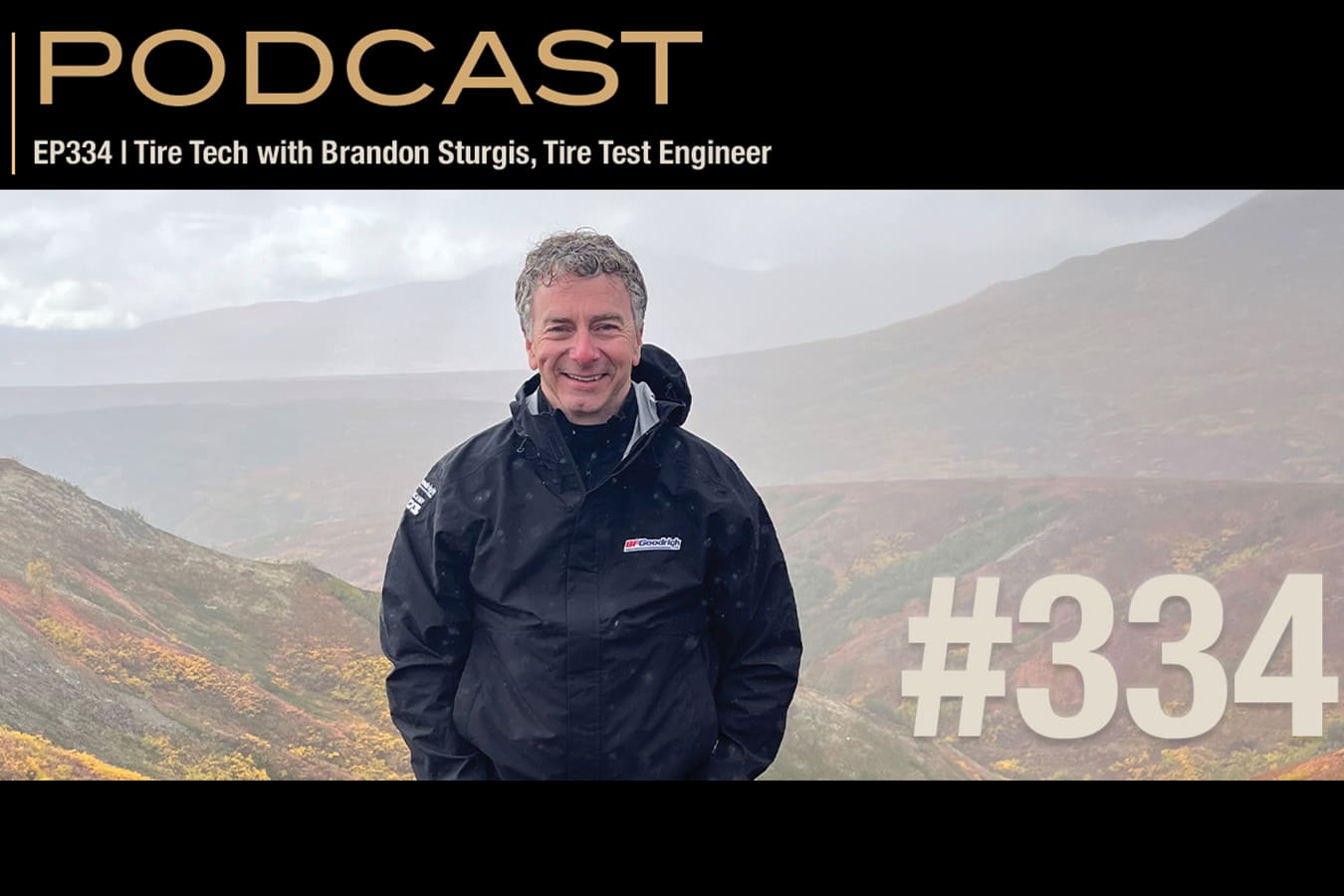
Overland Journal Podcast host Scott Brady interviews Brandon Sturgis, global product manager for BFGoodrich Tires. Tracing his journey from a Maryland farm and engineering at Virginia Tech to tire test engineering, Brandon breaks down the vital engineering required for off-road performance. He details how tires undergo rigorous testing for soft-soil traction, gravel durability, and sidewall strength. The discussion emphasizes practical trail techniques, showing how mechanical empathy and proper tire pressures minimize flats and reduce environmental impact. Brandon shares key insights on using 4WD and lockers, the benefits of tall-narrow tires, the HD Terrain T/A KT line, and common consumer mistakes like choosing overly aggressive treads.
Overland Journal Podcast Episode #334
Tune in Apple Podcasts | Spotify | YouTube
The Overland Journal Podcast is brought to you this week by Hankook Tire
For additional heritage content and news, sign up for Overland Journal’s Weekly Dispatch: overlandjournal.com.
New to Overland Journal and want to grab a subscription? Visit Overland Journal and enter code: overlandpodcast at checkout for 20% off. We thank you for being a subscriber.
youtube.com/watch?v=QqA14SOTEl0&feature=youtu.be
Guest Bio:

- Trail-Terrain T/A & Trail-Terrain T/A+: Sturgis identified rising automaker and consumer demand for a road-friendly tire with light off-road capability, helping build the business case for the Trail-Terrain T/A. He has also spoken on the newer Trail-Terrain T/A+, aimed at drivers wanting low road noise, comfort, wet traction, and Three-Peak Mountain Snowflake (3PMSF) snow certification alongside light trail use.
- All-Terrain T/A KO3: He has discussed how BFGoodrich engineers rugged all-terrain tires to maintain tough sidewalls and off-road traction while improving everyday drivability.
- UTV Tires: Sturgis has highlighted the gap between cost-focused factory UTV tires and what off-roaders need for durability and toughness in harsh terrain. [1]
- Grip and Mold Engineering: He has explained how BFGoodrich’s proprietary mold technology wraps tread elements further around the shoulder and sidewall area to add traction when aired down or in loose surfaces
Host Bio:
Scott Brady
Scott Brady is an adventurer, author, and publisher, and the first person in history to cross all seven continents. Brady is executive publisher of the Overland Collective, home to Overland Journal, the Overland Journal Podcast, and expeditionportal.com—the world’s largest vehicle-dependent adventure community. Scott wrote Overlanding 101 (Simon & Schuster) and is currently riding around the world on his BMW GS. He also led Expeditions 7, the first expedition to drive the same vehicle on all seven continents. Brady’s polar crossings include Antarctica and a south–north crossing of the Greenland ice sheet. Scott is a fellow of the Explorers Club and lives in Prescott, Arizona.
Our No Compromise Clause: We do not accept advertorial content or allow advertising to influence our coverage, and our contributors are guaranteed editorial independence. Overland Collective may earn a small commission from affiliate links included in this article. We appreciate your support.
Transcript
EP334 | Tire Tech with Brandon Sturgis, Tire Test Engineer
Scott: [00:00:00] host Scott Brady, and I’m joined today by Brandon Sturgis. Now, Brandon is the global product manager for BFGoodrich, but he has a great and amazing history of testing tires for the global market. Brandon, thank you so much for being on the podcast with me today
Brandon: Yeah, Scott, thanks for thanks for having me.
Scott: Yeah, I appreciate it. Well, I wanna start off l- maybe with a couple questions for you. Let’s talk about how you got started with BFGood- Goodrich. What a career to… What a cool company to work for. How did you get started with BFGoodrich?
Brandon: Yeah. So my, my background is… Gosh, I can take you all the way back to when I was a, probably a junior or senior in high school with Yeah so it’s a little bit of a story, I guess.
Hankook Tire sponsor: And a special thanks to Hankook Dynapro Tire for supporting this week’s [00:01:00] podcast. Hankook was recently at the Off-Road Expo in Costa Mesa, California, showcasing some interesting trucks and their tire lineup, and Expedition Portal was along for the ride. Check out our video and story online as we hang out with Joel Delock and learn about his King of the Hammers experience racing his 1989 Suzuki Samurai.
How cool is that? They were on Hankook Dynapro MT2 tires. Thanks again, Hankook.
Brandon: So I grew up on a farm, and on a farm I worked with my dad all the time to fix things. Something in the chicken house, something with the tractor, something with the lawnmower. If something was broken we had to fix it.
You didn’t call a guy. My dad was the guy. And so that, at a very early age, got me very interested in everything mechanical, and I was very good at math, and I had friends that went to school to do engineering, and I became interested in cars. And so my dream, probably junior-ish in high school, [00:02:00] was to work in the automotive industry.
I actually wanted to work for a automotive company. That was kinda my, my dream way back when. And so decided to go to engineering school at Virginia Tech, and Michelin and BFGoodrich, it seemed like a, a great company to go and work for. So that, that’s how it all, that’s how it all got started. How I ended up at BFGoodrich and Michelin was really linked back to, I would say, growing up on a f- on a farm on the Eastern Shore of Maryland.
And on that farm, we just… We didn’t have a guy to call when something went wrong. My dad was the guy, and then I was his helper. He called me his gopher. And so handing him 9/16 wrench when we were working on whatever you could think of in the chicken house- Sure … or with the tractors, that, that really got me interested in anything mechanical.
So that’s what really drove me to consider doing mechanical engineering. I was also good at math, and so that was kind of a natural progression. And then I had some friends that, that decided to go to Virginia Tech, and that was a… Seemed to be a really good engineering school. [00:03:00] So just kind of all these things lined up for me to go to engineering school at Virginia Tech, and I really wanted to work in the automotive industry ’cause I was into cars.
Also worked at a car dealership when I was in high school, which was super fun. And so it’s just- Wow … anything automotive was super interesting to me, and that’s what really drove me in the path to- To, to go do engineering. And then Michelin’s a very, Michelin BF Goodrich, a very engineering-oriented company, and so they were at Virginia Tech for recruiting.
Mm-hmm. And I interviewed, and it went well, and I ended up here. So that’s how I ended up here. But then once I got here, I found out that Michelin has a, and BF Goodrich has a test track. And gosh, I, like I said, I’m really into cars, and I used to do go-kart racing and was into motorcycle racing for a little bit and it just, the path all worked out.
Scott: Amazing. Would say so. Even obviously what you’re doing currently is very cool, but to be able to spend that many years testing tires, helping to develop entirely new segments within the space, you’ve been doing it long enough that you’ve seen [00:04:00] this progression of off-road tires. And BF Goodrich has a lot more competition now than they had in the past because everybody is elevating the products that they’re producing.
And I thought it might be interesting to walk me through what would be a typical test procedure for off-road tires. So when a consumer’s looking to buy something, what are the things that you’re looking for around pre- predictability, durability, traction? What would a typical day look like for a tire test engineer?
Brandon: Yeah, that’s a good question. And good gosh, we could probably take up the whole podcast just- … just talking about just that. Yeah,
Scott: we love d- Because- … diving deep into the technical side …
Brandon: When well when you’re trying to develop and test off-road tires you have to do all of the stuff that is already being done for on-road tires, and then also do the off-road stuff.
And so when you look at the, the normal test pro- [00:05:00] protocols, it’s wet handling, dry handling, wet braking, dry braking, noise, comfort, stability. There’s kind of a normal, I would say, gauntlet of on-road testing that you have to do ’cause the tires are also used on road. And then you have to worry about or develop or take care of the off-road part.
And like I said, off-road can mean so many things to so many people. There’s sand, there’s mud, there’s, you know- Sure … rocks, there’s everything. And so all those details we have to take into account. And it’s tire line by tire line, so what we would do for our mud terrain tire line is going to be a little bit different than what we would do for our all-terrain tire line.
And we have four products now in our, what I call our terrain family, our off-road family, and each one would be tested a little bit different. But to give a summary, I would say the three things for off-road tire testing that are important to us are, number one, soft soil traction. People are buying these tires because they want some level of traction [00:06:00] that is not on pavement.
Number two is gravel road, gravel cut chip- Yeah … durability, because some of that off pavement, in many cases, a lot of the off pavement is on gravel roads, which are a challenge for tires. And then the third thing that we really focus on, BFGoodrich really focuses on, is sidewall durability. And so for, for us, those are the three, I would say, high level aspects that we look at for our terrain family tire development, with some minor tweaks and changes depending on the tire line that we’re developing.
Scott: Mm-hmm. Well and from my own personal experience with BFGoodrich tires I’ve crossed six continents with your tires, and I’ve never had a flat with a BFGoodrich tire. I’ve had very few flats overall. The ones that did happen, happened to be with other manufacturers’ tires. So I’ve had really good success with minimizing flats and a lot [00:07:00] of that has to do with the tire, of course, but some of it also has to do with the driver.
So with you as a professional driver, what are some of the things that you have learned to help reduce damage to tires, like things that you’ve learned as a professional driver to reduce flats?
Brandon: God, the reason I’m laughing a little bit is because I I have said many times some of the biggest problems is the part that sits between the steering wheel and the seat.
Scott: For sure. For sure. For sure.
Brandon: And and everybody’s different. Everybody… I have a 15-year-old son that’s learning to drive right now, and he’s driving different than me. And-
Scott: Yeah. …
Brandon: Just everybody drives and does things a little bit different. And so we do have to take that into account with with our tire development.
But I would say the thing that I’ve learned when I was a test driver is smoother is always [00:08:00] fast, and smoother- Mm-hmm … is always easier on tires. I have ridden with and tested with so many different folks, and everybody drives a little bit different. And in the end, sometimes the lap time can be exactly the same, but the way you get to that is very different.
And there are people who are harder on equipment than others. And in- Yes … general, I wanted to make sure that any time I brought a car back to our mechanic, that they weren’t mad at me.
Scott: Fair.
Brandon: And so that was always my mindset. To answer your question more specifically is the, the smoother, the easier you can be on your equipment, the longer it’ll last.
And that’s one key way to kinda take care of your equipment slash tires. And so having what I like to call mechanical empathy.
Scott: Yeah.
Brandon: And for some people it’s easy to figure that out, and other people it’s a little bit more of a challenge. But if you can learn mechanical empathy you’ll make it way easier on yourself and your wallet.
Scott: Well, in, in [00:09:00] my experience, one of the things that causes flats most often is a distracted driver. So they’re paying attention to their GPS. They’re driving along and they’re not looking for sharp rocks, roots that are sticking out of the side of the trail, other hazards in the road that can cause a flat.
That is something that I see common. The other thing that I see that people do is that they delay putting the vehicle into four-wheel drive. If you have a heavy truck and you leave it in two-wheel drive and you’re getting a lot of wheel spin out of the back, you end up with a lot more chunking, tearing of the tire- Yes
damage to the rear tires. And you can always tell the guy who doesn’t, like you said, have that mechanical sympathy or they’re not mindful of, when I go onto a dirt road, I put the vehicle in four high. When I get onto a trail, I put it into four low. When I’m into more technical terrain, I engage the locking differential to minimize wheel spin, all of those things.
And of course, that’s our responsibility as travelers to minimize the [00:10:00] impact to the terrain, treading lightly. But it’s also gonna be treading easier on the tires.
Brandon: Absolutely. Yep. And some of that comes with experience. The car’s not gonna do it for you, the truck’s not gonna do it for you. Yeah. You have to decide when to apply all of those, and some of that just comes with the experience, learning from others, or just having a keen sense of really the r- the right thing to do.
Just yesterday like I said, my, my 15-year-old son is learning to drive, and one of the cars in our fleet has a dual clutch transmission. My wife’s car is a hybrid electric. Sure. And then my older Toyota Sequoia has a torque converter transmission. And just trying to explain to him, them how all those different systems work and how you have to drive them differently.
Mm-hmm. To me, I think that’s just a great example of if you understand your equipment and understand how it works, then you can be way better to your equipment just by simply understanding how things work.
Scott: And I think another key piece, and I’d be curious to see how you guys integrated that [00:11:00] in with testing, how did you incorporate airing down the tires?
What benefits do you see for tri- tire performance and life by adjusting air pressure? What are some of the, the testing engineer perspectives on that?
Brandon: Yep. So air pressure really comes down to footprint elongation and flotation. And that really helps on… Flotation is really key on surfaces like sand.
The, the bigger the footprint the better for flotation. It can help in mud traction. It’s not necessary all the time to go down in air pressure, and we can talk about some of those examples a little bit. But when rock crawling, for sure we actually design our mud terrain KM3 tread pattern to be able to envelop around itself so that it can specifically rock, wrap itself around a rock when it, when aired down.
So we think about that aired down usage and [00:12:00] how it can be used to actually improve the traction in, in, in certain situations.
Scott: Yeah. And in sand we’re looking for flotation. In rocks we’re lo- we’re looking for deformation. We’re looking for that carcass to deform around the irregularities and the features of the rock, a rock climber would wrap their hand around the features of a climb.
Exactly. Yep. We want those tires to do that. So airing down in the rocks is just as important as it is in airing down in the sand. But let’s talk a little bit about that, about mud. The scenarios where the mud conditions warrant not airing down. It’d be good for people to know that. Not a lot of people understand that nuance.
Brandon: Yeah when– so air pressure, like I said, is about footprint shape elongation, making the footprint bigger, giving yourself more surface area. But when you do that, you’re actually redu-reducing the surface contact pressure. And so in many [00:13:00] cases, with mud you’re actually trying to get through the mud to something that is harder packed.
And a quicker way of doing that is actually to increase your surface pressure so that you can quickly get down to the harder pack so that you have more traction. And so airing down in some of those situations for trying to go through, let’s say a, a muddy field may or may not be the best the best answer.
Scott: Correct. And not a lot of people are aware of that. The– a lot of times when we’re looking at tire size, so we’re looking at tread width, and we’re looking at diameter and all of that, one of the biggest components of that is the coefficient of friction. So one of those pieces of that formula is vertical load force, and the other one is surface area.
So as you make a tire wider, you reduce the load force, but you increase the f- the adhesion to the surface. And so you’re right. There’s times when we wanna bite through that mud. So it’s good [00:14:00] for people when they’re out in these conditions to think about what does the condition warrant, and airing down also really improves comfort, ride comfort for the occupants, so there’s a lot of different reasons to do that
Brandon: Yeah that’s a, a funny…
Y- you’re bringing back some memories from when we were doing testing of, Sure … discussions on off-road comfort at low pressure. Because it is it’s a, it, it is a thing, right? When you’re- Yeah … when you’re driving down some of these roads and es- especially when you get to the, oh gosh, the the washboard Yeah, the corrugations.
Sure. I don’t know how many times I’ve heard people complain about
Scott: com-
Brandon: yeah, cor- comfort on a, on, on roads, or roads that just have a lot of embedded rocks. Down in the Baja Peninsula, we s- BFGoodrich has spent a lot of time in the Baja Peninsula, and I have spent probably more time on a vehicle that might not be set up so well for dealing with rocks that were buried into the- Sure
into the road surface that we were driving.
Scott: Yeah,
Brandon: sure. [00:15:00]
Scott: Yeah. Well one of the- My old
Brandon: back yeah, you’re feeling it. Yeah, totally. Yeah, it’s one of the things that we want to consider is air pressure. And another thing I wanted to chat with you about, ’cause I always love hearing feedback from engineers on this idea, but one of the things that I like about BFGoodrich tires is you guys offer a lot of, like that 255/85R16 or the 255/80R17.
Scott: You even, for a while, and you may have it back in your lineup again, but for a while you had a 34 by 10.50 BFGoodrich All-Terrain. For travelers, a lot of us do prefer a slightly narrower tire. It tucks up in the wheel well better. You’re reducing rolling resistance. You’re reducing fuel consumption, which for travelers is a factor.
How do, how does BFGoodrich look at the, the tire lineup and what are your thoughts on the taller, narrower tires? Do you like ’em? [00:16:00]
Brandon: Yeah it’s a taller and narrower I would say, segment of the market. They- it- they’re ve- they’re definitely a vocal bunch, for sure. I definitely hear a lot of feedback from- Yeah, I don’t think I’m helping with that
the folks about personally love seeing the passion from the group of folks who are really into that. And it it’s one of the reasons that w- we just launched a, a size new for us, a, a 35, 11.50/17. Cool. So thinking of something on a 17-inch wheel that tucks into… You could maybe even use on your stock wheels that tucks in under the fenders a bit nicely, maybe on certain vehicles that doesn’t even really need a lift.
So I’m thinking of the, the Wrangler, for example, would be a perfect- Yeah … fitment for using stock wheels, not having to do a lift, and putting a set of 35s on f- fairly easily. So that was our thought process a little bit. And the conversation I love about the taller and narrower segment is I- I’ve had this exact same conversation with my, my father-in-law, who is a [00:17:00] huge Model T fan.
I’ve forgotten how many Model Ts this man has owned over time. Amazing. And we, the two of us, actually built a Model T pickup truck literally out of spare parts that he had, and that was his, quote-unquote, “golf cart” around his property in Virginia. And his comment is, “Well, that’s the original taller, taller and narrow tires on these vehicles-” That’s true.
if you’ve ever seen them. They were very tall and narrow. They’re super tall and super narrow. Yeah. And those things, open differential, like no power, and only two-wheel drive. And I tell you, that thing could pretty much go wherever it wanted. And we talk about we talk about being able to deal with mud, and we talk about air pressure and being able to get down and get through mud.
If you’ve ever looked back to see what roads looked like in the early 1900s, they weren’t Interstate 85 that we have here. They were dirt roads, and when it rained, it got [00:18:00] super muddy. And these two-wheel drive open diff cars or trucks could pretty much go wherever they wanted.
Pretty
Scott: amazing …
Brandon: And a lot of that was attributed to just the fact that they had really narrow and really tall tires. Yeah … and so there’s a lot to be said about that. Now vehicles are not like that today. Vehicles are quite a bit different but that same thinking of mobility off-road still does apply with a, a tall tire to help you get over obstacles, and then a narrower tire to help you get through s- some of the obstacles like, like mud.
Scott: Yeah. Yeah we appreciate the fact that BFGoodrich offers those sizes. They do allow for less lift. They do tend to fit in the wheel wells better. They reduce fuel consumption ’cause they’re narrower. They have less wind resistance and rolling resistance. They weigh less. They’re lighter weight.
Oftentimes you can put them on a narrower wheel, which [00:19:00] weighs less. You can make sure that you get the offset correct with full turning circle. So there are lots of reasons, at least from the overland segment, that we appreciate the fact that BFGoodrich has always had those kinds of tire sizes available.
Brandon: Well, yeah, thank you for that. And we- … we love listening to our customers to see what their needs are, and that’s one of the reasons that we launched that 35/11.50/17, just because some of the, the narrower, taller sizes, I wouldn’t really call them super tall because we do have some 40- Yeah
inch tires- Yeah, sure … And even- Yeah … a 42-inch tall tire. But th- those are probably, I would say those are tall and kinda wide.
Scott: Yeah, sure. But tall and narrow I would say is you’re in that 32 maybe now to 35-inch size range where, yeah, y- you’re not really wanting to do a massive lift.
Brandon: And I see that and I appreciate that ’cause I, I think that- Yeah … That’s a smart, that’s a smart move for a lot of folks.
Scott: I think it can be helpful. A [00:20:00] lot, oftentimes it can fit in the spare tire location, all of those things. One of the segments that we see growing quickly is this RT hybrid XT tire segment, and you guys recently launched what I would believe is the closest approximation to that, which is your HD tire line.
How do you guys see, view this hybrid tire segment between an all-terrain and a mud terrain? And am I correct in assuming that HD is really the best offering for that?
Brandon: Yeah. I’d say that’s a good assumpt- assumption. For me, this, this R/T segment, it’s a little polarizing in my view just because looking at it from a BF- I- if I look back to the way the BFGoodrich brand got started in off-road, was really going and building a radial all-terrain tire that, that, that could be actually used off-road.
So-
Scott: Sure …
Brandon: it was form and function together [00:21:00] from the beginning. And the, the, the little bit of hesitation that I have with the R/T segment is It’s a bit more focused on the aesthetics and less about- the performance. And I’m saying that- That’s good to know, yeah … with some, some test experience that I had ’cause when we first saw these products coming it’s the, the marketing claims of it’s everything that a mud terrain and an all-terrain is together in, in one.
And from my testing, from what I’ve seen, I’ve not really seen that. I can agree that the aesthetics might be quite pleasing to certain folks, and they do look good on certain trucks but for us, our DNA, form and function together is really kinda the approach that we take to designing our off-road tires.
And even though that our HD Terrain TA KT, so that, that tire line, I would say naturally fits in that segment because when that went from a actual [00:22:00] performance point of view, it is from a m-mud traction point of view in between an all-terrain and a mud terrain. Aesthetically, it is in between an all-terrain and a mud terrain.
But we really built that tire for work, and so that’s why it doesn’t even say RT in the name. It’s really more of a commercial all-terrain tire, a commercial mud terrain tire. There’s really no… It’s a commercial off-road ti- We built it for folks that are using their truck for work. We really tuned it towards folks that are using HD pickup trucks, heavy duty pickup trucks, on mine sites, on qu- in quarries, home builders.
Folks that actually b-bought that truck to use it for work. And what those customers told us was, “These trucks we’re towing trailers, we’re going through mud, we’re spending time on gravel roads. We need excellent wear, we need excellent gravel cut ship, and we need good mud traction ’cause we don’t want to get stuck.”
And so those were kind of the, the [00:23:00] three a-has for us of, well, we need to make th- make this tire very good for those. Those were our key focus areas. We had one fleet tell us, “We charge our drivers if they get stuck.” they actually fine their drivers for getting stuck. So that fleet, and many fleets like them, were typically fitting mud terrain tires.
Well, our mud terrain tires are designed for slow speed rock crawling, and the tread compound that we use on that tire is not, I would say, optimized for gravel cut ship and for wear. Sure. It’s optimized for rock crawling traction. Yeah. So the, the design approach that we had for our KT03 was that.
Better adhesion.
Scott: Yeah. Lower durometer. Yeah
Brandon: Exactly. And then we had some fleets that are using our all-terrain tire because they’re spending a lot of time on road. They’re not maybe using, needing the, that same level of mud traction, so they’re spending a bit more time on road. But they really need sidewall durability, and they do need o- some off-road traction.
And really, they’re spending a lot more time on gravel roads, and we’ve talked already earlier gravel roads are very challenging [00:24:00] on tires. Very challenging, yeah. And so our design approach for KT, what we call T- KT for short, is heavy-duty trucks have a high wear rate. They actually have- Mm-hmm
double the amount of torque of a Porsche 911, and customers that have these trucks expect double the amount of wear compared to a Porsche 911 owner. So we really focused on wear, we focused on that gravel cut ship, and we focused on mud traction. And then the sidewall durability of our all-terrain we kept that same level of sidewall durability that folks needed for their kinda usage.
So I know I’ve kinda said a lot there, but- No, it’s helpful. Very helpful … really what I’m trying to get across is we built that tire. It does look good. We did focus on the aesthetics. We… But we wanted to make sure that it was form and function to- together, and not just form.
Scott: Yeah. And we’re seeing a lot of fitment of that tire within our space, especially since the full-size trucks have become much more popular for overland travel.
So we’re seeing a lot of that. And I don’t know if a lot [00:25:00] of people that are listening know this, but the K of KM or KO or KT in this particular, it’s, it… I didn’t know this, but it… If I’m not mistaken, it’s the key feature of the tire. So the key feature of- Correct … the HD is tough- is toughness, KT, whereas KM is key feature is mud, and et cetera.
So
Brandon: And KO is key feature key feature off-road. That just goes back to, it’s a bit of BFG history that we’ve just kinda kept that as our naming nomenclature. It’s a little bit like a, a chassis code, right? So if you’re into Jeep Wranglers JK, JL, all of that. BMW guys are into their E chassis codes.
So it’s kind of our- That’s right … our chassis code.
Scott: And the, the heavy duty trucks are getting bigger, heavier. They’re getting… They have more torque, more power than they’ve ever had before, so it really did necessitate that. But I’m seeing that tire being fitted [00:26:00] regularly on heavy SUVs as well. So I’m seeing- Right
a lot of folks, like with the Ineos Grenadier, for example, which comes from the factory with the all-terrain BFGoodrich. But I’m seeing a lot of people fitting the HD because it’s a heavier SUV.
Brandon: Yeah and that’s okay. We’re okay with people doing that. But we just it, when we market the tire, when we talk about its intended purposes it was really designed for heavy duty trucks.
That’s why you see a much smaller size lineup. And the typical usage that people who buy those trucks and how they use them, we really wanted to intend it to be designed for that kind of usage. You should see it on a, a few of the American Expedition Vehicles. For su- That they have used it as an original equipment fitment on some of their, on some of their vehicles, and been quite happy with that tire.
Scott: Yeah. And in my experience, if something passes Dave Harrington’s testing, it’s pretty good. So they’ve definitely moved [00:27:00] towards that tire for a lot of their HD truck fitments because it’s available in a 40. It’s, it holds up. We’re seeing more and more folks going with that particular tire.
One of, one of the things that I also wanted to kind of ask you about is what do you think consumers oftentimes get wrong when it comes to buying tires? What would you love to tell our audience about, like when you’re looking for a tire, what should you be looking for based upon your needs?
Brandon: Yeah. Gosh that’s a great question. There’s so many options in the market. You mentioned that earlier. The all-terrain market is very flooded with options. I would say each brand kinda has a different approach when it comes to the off-road segment. So I can’t really speak for every single brand to answer this question.
But at least for the BFGoodrich brand I mentioned earlier, form and function is our kinda DNA. And so the, the [00:28:00] four different products that we have in our terrain family, we really focus on the customer needs to design each and every one of those tires. And I would say maybe sometimes the mistakes that some people make are they think they need maybe a KO3 when our Trail Terrain Plus is actually the better option for their for their vehicle and their usage.
And so not as many people know about that Trail Terrain Plus tire line, but it’s our, I would say, what we call our on-road oriented all-terrain tire. And it’s just being honest with yourself about how you’re gonna be using your vehicle and what you need it for. And I see a lot of people with F-150s that are hauling kids to, to school and going to the grocery store, and they might not see as much dirt as they expect it to see.
And in that kinda case something, our Trail Terrain TA Plus, which is actually new and revamped for 2026 is really probably a better fitment. But that, that’s probably [00:29:00] the biggest mistake I think that people make, is just being honest with yourself about the, the usage and what you really need, and using that to drive your purchase decision.
Scott: ‘Cause you gain the benefit of better wear, better fuel economy, less noi- noise, vibration, and harshness. So buying the tire that’s appropriate to your use case is– it is super important. You see a lot of family haulers using mud tires, and, well you’re just asking for unnecessary fatigue and frustration at the end of the day.
Brandon: Yeah. It, to me, the… When I first started in this job, I was doing a lot of research about the market segmentation. And the all-terrain category is probably the most complex categorization because our definition of an all-terrain is different than brand X or Y- Sure
or Z. And so when I was really doing some research online and seeing what an all-terrain tire is our… [00:30:00] Back– And this is back in the day of when our KO, our original KO, was categorized in the same segment as our original Rugged Terrain, and those are- Sure … two completely different tires.
Gosh- Yeah … We’ve got this whole categorization wrong. And so I really spent a lot of time working with some of our key dealers. We talked to customers. We’ve really seen that there is, in the all-terrain space, there’s someone who is more on-road oriented, and then there’s someone who’s more off-road oriented, and that’s why we have Trail Terrain+ for those on-road oriented folks.
And then our very famous all-terrain TA, now KO3 tire line, for those folks who want something more off-road oriented.
Scott: Mm-hmm.
Brandon: And really, it comes down to the… When I hear people ask questions of, “Hey, is this tire gonna affect my fuel economy, my ride quality, the, the comfort levels?”
I’m thinking, “Okay. Well, you’re already leaning over here to the on-road categor- category.” But if you’re asking questions like, “Yeah, I definitely wanna make sure I don’t rip the sidewall out. I’m gonna be doing some more off-roading, [00:31:00] so more mud traction is important to me.” And so when I’m hearing those kinda more off-road oriented comments, that’s when KO3 is kinda the right choice.
So it– But it really comes down to the, the person, like, thinking about that. How am I gonna use it? What am I gonna be doing day in and day out? Mm-hmm. And what’s most important?
Scott: Let’s talk a little bit about what’s your… In all of your testing that you did, what was your favorite vehicle to test tires with?
Brandon: That’s a great question. The, the first thing that I– that really comes to mind, I know it’s not off-road, well, maybe you can consider it off-road, was when we used to do snow testing- up in Houghton, Michigan. We had a Honda Civic SI which had this amazing little four-cylinder engine that would rev to the moon.
Scott: Sure.
Brandon: And it had a limited slip differential, and it was only front-wheel drive. It wasn’t all-wheel drive. Yeah. But you put a set of good snow tires on that car, and it felt like you could do whatever you wanted on, in the snow. And it was white, so we [00:32:00] called it the Snow Bunny, and it was- … probably one of the most fun cars to drive in the snow.
Did it still
Scott: have a
Brandon: handbrake
Scott: too?
Brandon: Yeah, it had the little, the, the Civic Si, the shifter was right in the perfect spot- … and it had this perfect little shifter feel, and then the handbrake was right next to it. And it wasn’t a tor- it wasn’t a normal pull up handbrake. Yeah. It was kinda like a pull out handbrake, so it was just- Perfect.
Boop. You could just kinda do that and then-
Scott: Get that thing, yeah. Yeah …
Brandon: so that one really, that one jumps out. For off-road, I still remember the first time I drove a Gen 1 Ford Raptor, ’cause- Yeah … we worked with Ford on the original- Sure … Gen 1, and we had a couple prototypes at our test track, and you’re like, “Oh my gosh, this is a pretty cool- So
Scott: cool.
Brandon: truck.”
Scott: Yeah.
Brandon: Turnkey from the factory. Yeah. Wow, they’ve really built a legitimate off-road truck. But they stepped it up with the Gen… I remember the Gen 2 coming oh wow, the suspension is even better. I [00:33:00] can’t believe- Yeah … that they even made it this much better. I still I was still a naturally aspirated V8 fan, so I got a little upset when they went to the turbo V6, but-
Just driving one of those trucks down in Baja, you’re like, “Oh my gosh a, a normal, regular pickup truck would not be able to drive at this level.” Yeah.
Scott: One
Brandon: funny story. Sorry, I have a full of stories. Yeah,
Scott: it’s good …
Brandon: I remember driving that truck, and other people were in some other, say, more off-road race buggies and I got on the radio and was joking with them that I was enjoying the cooled seats.
So I’m driving this amazing off-road capable truck, and I’ve got cooled seats, and they’re outside just sweating.
Scott: That’s fun. Yeah, they, it’s incred- Yeah, so those two- Across the board, vehicles are getting so much more capable. If you look at a Jeep Wrangler Rubicon or a Ford Bronco- Gosh, yeah
The locking differentials and [00:34:00] lifts from the factory. I think it’s a, it’s an incredible time for people to think about the vehicle that they’re using and the tires that they’re using on the vehicle. I believe that it used to be that tires were such a key piece of tra- of traction, and now you actually get to choose the tire that’s the best case for your use.
As opposed to every once in a while I get into mud, but so I better have a mud tire. But that’s ’cause you had no lockers and limited lift and everything else like that. The vehicles are so capable now that I find that people can really focus in on the tire that best suits their day-to-day use.
Yep.
Brandon: And not really have to do too
Scott: much to the vehicle of it ’cause it
Brandon: come- Yeah. What I think is really cool is the car manufacturers, vehicle manufacturers it’s really been the aftermarket that has shown them, “Hey, you should go do this.” Ford would not have built the Raptor if it wasn’t for people taking a stock [00:35:00] F-150 and doing things to it to make it light.
And it’s, “Oh, well there’s a market for that.” It… Jeep would not have done the Rubicon if it wasn’t for folks who were building those on their own and just, “Hey we could do that and we could sell it k- turnkey.” And so if you look at the on-road side the high performance cars good gosh, some of these cars you can go buy at the dealership are faster than purpose-built race cars from-
Scott: Yeah, they’re 700 horsepower
15 or 20 years ago. Yeah, for sure. Yeah,
Brandon: it’s pretty amazing. Yeah. I did tire development, I did tire development with General Motors and- I remember driving for the very first time, it was a C6 ZR1, and that was really our first work with General Motors. And I remember seeing the car, the prototype car being backed off the truck, and it had these massive carbon brakes that filled up the entire wheel.
I had never seen brakes that big before, and so the capabilities of that car on track, I can’t give you one favorite because there’s so [00:36:00]
Scott: many. Well it, like you said, you had a, you have a dream job. W- I remember being, when I was in the Air Force, and I had bought whatever tires I could afford up to a certain point.
And I remember I f- how I felt being able to go buy a set of BF Goodrich Mud Terrains for my Jeep. There are lots of really great tire manufacturers out there, and I just think that people need to be thinking about quality. They need to be thinking about how these tires are engineered, buying the right tire for themselves, for their use case.
But I think it’s better to invest in quality because our safety relies on it. Our trip imagine if you end up with a flat, it can greatly interrupt a trip. So I think buying the right quality tires is such a key piece of that puzzle
Brandon: Yeah I definitely agree with you, and hopefully just our conversation today help gives you a little bit of a, a peek to understand [00:37:00] that we do put some thought in behind the, the engineering of our tires.
And we’re not just sketching things on the back of a napkin to make it look like it can go off-road. Yep. Yeah, we do think about the usage for each one of our products, the customers, and that, that’s really kinda some of the behind the scenes to make sure that we bring good tires to the market.
Scott: Well, and I’ve certainly had great experience with it when I just completed my crossing of East Africa, was in a s- a stock Ineos Grenadier, which comes from the factory with the all-terrain BFGoodrich tires, and of course, no flats at all during that entire time. It just allows us to not have to bring a second spare, or you’re just– you’re not getting those trip interruptions that you would get from having a flat.
And I think one of the reasons why I was really excited to have you on the podcast is the fact that the global brand manager is a tire test engineer. I think that says a lot [00:38:00] about the brand. So normally we would never have that conversation because we’re– we don’t want this to be an ad for BFGoodrich.
We want it to be an educational piece, and the fact that you can have– bring decades of testing and experience to help people understand what tires to purchase, I think that says a lot about BFGoodrich.
Brandon: Well, thank you for those, those kind of words. Yeah. Ab- absolutely.
Hankook Tire sponsor: And a special thanks to Hankook Tire for supporting this week’s podcast.
What’s it like when over 20,000 Jeeps and more than 50,000 people get together in Pigeon Forge, Tennessee? We joined Hankook Dynapro Tire to capture the awesome energy of the 2026 14th Annual Jeep Invasion. Keep an eye on expeditionportal.com for our upcoming event recap and get inspired. Thanks again, Hankook.
Brandon: What’s your favorite of the lineup? What’s the tire that you’re most excited [00:39:00] about
Scott: right now?
Brandon: So f- for me, I have… So on my gen one Toyota Sequoia, I have Trail Terrain T/A Plus on, on that. I call it the family school bus. It hauls- … my kids around. It has hauled my kids around to many campsites and soccer tournaments, and has towed the boat to the lake, and I’m not doing serious off-roading with that, but I’m doing enough, and we do occasionally get snow here in Greenville- Yeah
South Carolina, and so that tire has been absolutely perfect for me on that vehicle. And my wife has spent enough time in that car on those tires that we literally put the same exact tires on her RAV4. So she has a, a plug-in hybrid, There you go … Prime, Toyota RAV4 Prime. And she loves that car and she is big into hiking, trail running outdoorsy stuff.
She’s big into backpacking, bigger into it than, than I am, and so sometimes she needs to go down some some roads that I would say are a [00:40:00] little unpaved. Yeah …
and that’s been absolutely perfect for her and our usage. So two of our vehicles have, have the, I would say, are on-road, Yeah
on-road-focused all-terrains. That- But
Scott: that just shows- … that was, I would say that’s my favorite one … it shows how good they are. It show, it shows how good they are and that they do what they said they were gonna do. Brandon, thank you so much for the time today. It’s an honor to have you on the podcast.
Seeing your resume is impressive. What you have done with multiple manufacturers, the time that you have spent in Japan testing vehicles, your decades in testing tires. Again, I think that says a lot about the brand, and I love talking tire tech- Yes. Thank you … so I really appreciate you letting me jump into the weeds with you today.
Brandon: Yeah, Scott, that was such a great conversation. I’m sure we could keep talking for another hour.
Scott: Yeah. No, no doubt. Well, again, Brandon, thank you so much for being on the podcast, and we thank you all for listening, and we’ll talk to you next time