

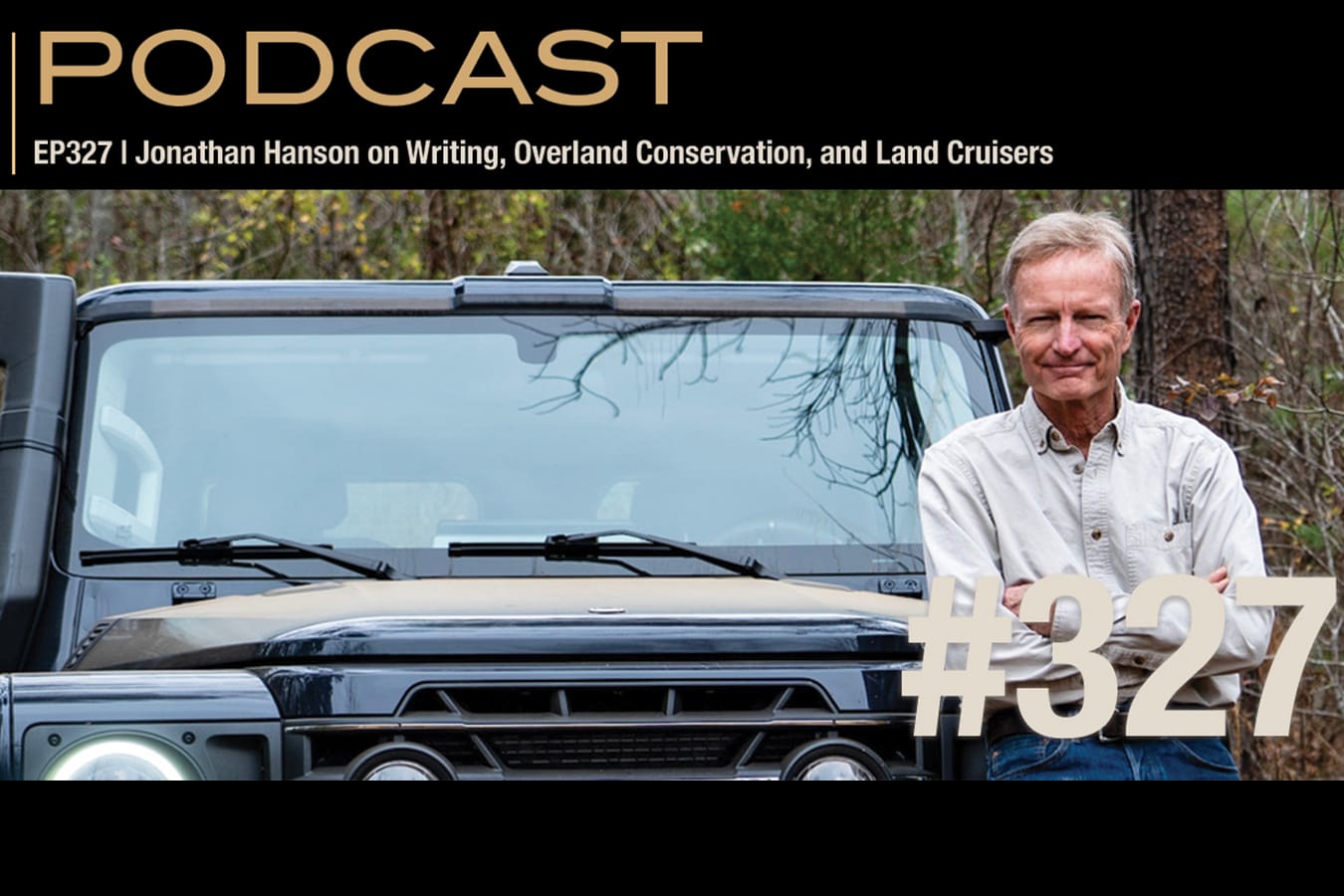
Overland Journal Podcast host Ashley Giordano interviews writer, ecologist, and Overland Journal Co-founder Jonathan Hanson for the publication’s 20-year anniversary. Hanson discusses his favorite expedition vehicles, including his 1973 FJ40 and a 1993 Land Cruiser Troopy that has traveled across Australia, Africa, and the US. He shares how early field-biology work and outdoor exploration shaped his approach to conservation and travel, leading to the creation of Overland Journal and Overland Expo alongside Scott Brady and Stephanie Brady. Reflecting on his editorial philosophy, Hanson recounts collaborating with Tom Sheppard on the Vehicle-dependent Expedition Guide, highlights memorable journeys in Southern Africa and Egypt, introduces his new publication, Exploration Quarterly, and offers practical advice on vehicle modifications, low-impact driving, and essential overlanding gear.
Overland Journal Podcast Episode #327
Tune in Apple Podcasts | Spotify | YouTube
The Overland Journal Podcast is brought to you this week by Hankook Tire
For additional heritage content and news, sign up for Overland Journal’s Weekly Dispatch: overlandjournal.com.
New to Overland Journal and want to grab a subscription? Visit Overland Journal and enter code: overlandpodcast at checkout for 20% off. We thank you for being a subscriber.
Guest Bio:
Jonathan Hanson is a freelance writer with 40 years of experience, contributing to Outside, National Geographic Adventure, and dozens of other publications. He co-founded Overland Journal in 2007, serving as executive editor until 2011. Jonathan has explored six continents by foot, kayak, motorcycle, and 4WD vehicle, and formerly ran a sea kayak guide service in Mexico. He teaches wildlife tracking, outdoor writing, and expedition driving for various organizations. Jonathan has authored a dozen books on natural history and outdoor sports, contributed to the Vehicle-dependent Expedition Guide, and written key sections for Four-by-Four Driving. He is a fellow of the Explorers Club and Royal Geographical Society.
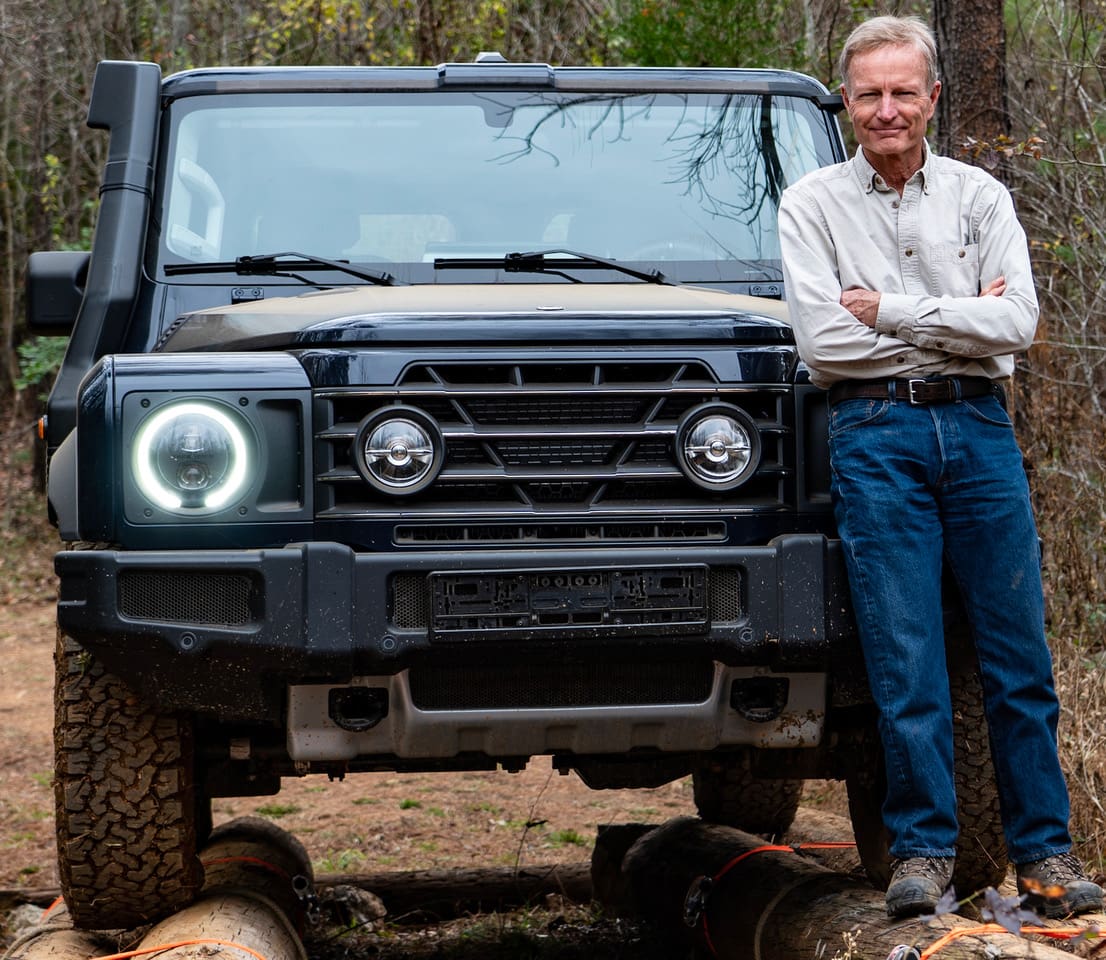
Jonathan Hanson: Exploring Overland | Jonathan Hanson Author | Exploration Quarterly
Host Bio:
Ashley Giordano
Ashley Giordano’s first foray into overland travel involved a 48,800-kilometer journey from Canada to Argentina with her husband, Richard, in their well-loved but antiquated 1990 Toyota Pickup. Currently cruising along the iconic Silk Road in a 2008 Toyota Tundra, her full-time navigator duties are rewarded with bowls of plov and lagman noodles, hikes in the Tian Shan, and countless cups of fragrant Tashkent tea. As senior editor at Overland Journal, you can usually find Ashley buried in a pile of travel books, poring over maps, or writing about the unsung women of overlanding history, including her enduring inspiration, Barbara Toy. @desktoglory_ash

Our No Compromise Clause: We do not accept advertorial content or allow advertising to influence our coverage, and our contributors are guaranteed editorial independence. Overland Collective may earn a small commission from affiliate links included in this article. We appreciate your support.
Transcript
Ashley (00:00.751)
Hello, and welcome to the Overland Journal podcast. I’m your host, Ashley Giordano. As Overland Journal approaches its 20-year anniversary, we’re catching up with some of the people who’ve helped shape this community, sharing the stories, lessons, and adventures that brought us here. And with that said, my guest today is an author and writer, teacher, guide, hunter, ecologist, co-founder of Overland Expo, an elected fellow of the Royal Geographical Society and Explorers Club.
He also co-founded Overland Journal in 2007 and was its executive editor from 2007 to 2011. Welcome, Jonathan Hansen, to the podcast. Did I forget anything? Did I forget anything? Awesome. So you and Roseanne are an absolute powerhouse. So thank you for taking the time to join us today, Jonathan.
Jonathan (00:41.422)
Thank you. Happy to be here. No, you got it. That’s enough. Stop.
Jonathan (00:56.717)
Sure.
Ashley (00:58.461)
you’ve owned over a dozen four wheel drive vehicles and I’d like to pick your brain on that subject. What’s your favorite and which ones do you still own?
Jonathan (01:05.038)
Mm. Mm-hmm.
Jonathan (01:10.2)
Sure. Well, the the one I still own is easy. I’ve got a nineteen seventy-three Land Cruiser F J forty, which I bought in nineteen seventy-eight. it was th five years old. It was owned by the the original owner who bought it on my recommendation. And in nineteen seventy eight he sold it to me for three and a half thousand dollars, which I thought was
an outrageous price at the time, just ridiculous. And of course it’s now insured for ten times that. So it was it turned out to be a good investment, even though I was annoyed with him at the time. And it’s been my number one vehicle. It was our only vehicle for several years after Roseanne and I were married. our we had our first date in it, so she’s often told me that if I ever sell it, I go with it. So I guess it’ll it’ll stay around.
Ashley (02:04.281)
Yeah.
Jonathan (02:07.499)
And that’s still our still our main vehicle. Other we’ve cycled through others. the our favorite right now is nineteen ninety-three HCJ seventy five, a Land Cruiser Troopie, the one that isn’t sold in the US. we bought that in Australia, sight unseen off the internet in twenty sixteen.
had a bunch of work done on it, including having the roof sawn off and a pop top put on it before we ever saw it. And fortunately when we finally did see it, it was it was in as good a shape as we’d been led to believe. So that’s been with us since since then, t eleven years. We we did several journeys around Australia in that, Tasmania as well, and then shipped it to Africa and drove across Southern Africa.
And then shipped it to the US after that. So that’s how it wound up here. Interestingly, we managed to do several Australian trips, the Tasmania, South Africa, shipped it across the Indian Ocean with no trouble, shipped it across the Atlantic with no trouble. And the fellow who unloaded it off the container in the port in Texas managed to back it into a garbage dumpster and put a giant crease on the side.
So we had to have that fixed. It was a little bit ignominious. But we’re now using it f to to lead to lead trips now and then here in the US. So and yeah, and then we’ve had a couple of several Land Rovers. we had a one ten Tethanus version that we loved and are sorry we sold, but that’s how it goes with vehicles like that. So and then we have also have a a twenty fourteen Tundra, which is kind of our
Ashley (03:36.837)
So close.
Ashley (03:42.894)
Very nice.
Jonathan (04:02.978)
Chore house building vehicle. Yeah.
Ashley (04:05.731)
Nice, I love a tundra. Fantastic. So you’ve written about F sorry.
Jonathan (04:07.723)
Yes. Good truck. It’s been it’s been a really good truck.
Jonathan (04:13.484)
And then there’ve been a there’ve been a few s sorry, been a few a couple of sports cars in there as well, not just overland vehicles. I had a fulfilled a lifelong dream and bought a Porsche nine eleven several years ago, had that for a while, and sold that and bought a Triumph T R six and had that for a few years, but sold that too. We live seven miles down a dirt road now. It’s not really good country for a for a for an old English sports car.
Ashley (04:43.439)
That’s fair.
Jonathan (04:43.468)
So yeah.
Ashley (04:46.553)
And you’re in where in the world are you? I know you were up living in Alaska for a bit and then now or yeah.
Jonathan (04:49.942)
Well, we we were we we finally decided to sell the cabin in Alaska. We loved being there, but in terms of the business we’re doing now, it was a little too far out of the way. So we sold that and Roseanne found us a beautiful piece of property, thirty six acres in the foothills of the Dragoon Mountains, which are about
sixty miles east of Tucson. It’s it’s the place where the Apache leader Coachese hung out and made fools of the US Army in the eighteen sixties. So we’re building a house there right now. at the moment, if you can see behind me it’s just a giant shell. No interior walls or anything yet. but we love being out here. It’s lots of wildlife. and since we’re
essentially natural history writers from the start. it’s nice to be back out where we got have a resident rattlesnake in the bird yard who ignores us.
Ashley (05:58.01)
Little warmer too.
Jonathan (05:59.511)
Yeah, yes, a little definitely a little warmer. Although it’s nicer than Tucson, we’re at forty eight hundred feet, so we get a little break from the from global warming here, at least for a while.
Ashley (06:12.075)
Good stuff. So you’ve written about everything from sea kayaking to animal tracking, reptiles to back road adventuring. what were you like as a child? Were there any previews of this life ahead?
Jonathan (06:13.422)
Yeah.
Jonathan (06:21.571)
Yes.
Jonathan (06:27.552)
Sure. my parents, my mother and stepfather, moved from Tucson out to a a ri a rural neighborhood, northeast of Tucson, n very near Sabino Canyon. So while it was a neighborhood, I it was very close to the mountains. there was a creek that ran within a couple of hundred yards of the house. So there were
plenty of opportunities for me to to get out and for me it was it was sort of an escape because my stepfather and I did not get along. So he was happy to have me out of the house and I was happy to be out of the house. So that’s how I started spending a lot of time outdoors. did my first solo backpacking trip when I was nine and just went from there.
Ashley (07:21.571)
Wow. And then you headed to the Ari University of Arizona at some point. Tell me about that.
Jonathan (07:27.712)
I did, but not not not till late. I I was and always have been a a terrible student. I’m a I’m good at being an autodidact, but when someone else is teaching me I send to I tend to daydream and look out the window. So mm I barely made it through high school and then took a break and did a lot of work and didn’t get back into college until I was twenty six, twenty seven.
and at the U of A and met Roseanne there. she was she was 10 years younger, so she was she had just started. And that we were introduced by, we like to say, a drug smuggler from New Jersey who has since made become stayed a dear friend. We still we still are in contact with him. And
We met and just everything just clicked. We were married within six months after we after we met. Yeah. So and I’m lucky to be here.
Ashley (08:27.572)
wow.
Ashley (08:35.033)
What were you studying?
Jonathan (08:37.47)
ecology and evolutionary biology. And Roseanne did a double major in ecology and evolutionary biology and journalism. So she’s she is the exact opposite of me as a student. Straight A, s magna cum laudi, that all that sort of thing. So yeah, diff different different talents there for sure.
Ashley (09:00.687)
What were some things you remember from that time in terms of what you were learning or subject matter that really stick out?
Jonathan (09:07.778)
During college days or just
Ashley (09:09.549)
Mm.
Jonathan (09:14.388)
A at at the university both Roseanne and I were lucky enough to to learn under some of the last of the great field biologists that the U of A had. These were guys who had been in their heyday in the nineteen forties and fifties and sixties and were now approaching retirement. But they were the ones who actually had always worked in the field. They didn’t do computer modeling. They went out and trapped birds and trapped animals and
and did direct observation, which has always been the way we prefer to do things like that as well. So it was lucky to to to study under those people and they’re they’re gone now and the the that college has changed a lot. So we were glad to go through it when we did.
Ashley (10:03.641)
Hm. How does that inform your travel today and what you do?
Jonathan (10:08.599)
it inf it informs it heavily because we we are experiential. We like to see and manipulate things. We don’t just we don’t just observe. We we like to collect things when we’re out when as long as it’s legal. we we like to be involved rather than just stand on the sidelines and look. So if you if you see our house it’s full of things like
shed snake skins and birds nests and rocks and such things, which makes it a real pain to move, but it’s nice to have when you’re not when you’re in one place.
Ashley (10:46.339)
Yeah, wow. That’s so I I love that. I think, you know, getting that tangible hands on, you’re probably reading about it, but you’re also observing and touching and feeling and smelling and we’re maybe losing that a little bit with all of the online online things. So it’s important.
Jonathan (10:57.006)
Yeah.
Jonathan (11:01.721)
We’re
Jonathan (11:05.465)
True. But e even out even out in the field, you know, the the mantra now is is the the whole take nothing but photographs, leave nothing foot but footprints and obviously you have to s stay within legal limits, but we think it’s a huge mistake not to let kids out in nature and let them collect rocks and snakes and look at them and birds’ nests and whatever. And I think there’s there’s a real need for that. Once
Once kids are told don’t touch, then they lose interest and you’re going to lose them as future advocates of of the wild if you do that. They’ll just go play
Ashley (11:46.979)
Yeah, I guess there’s a separation that develops there because it’s like a not a part of all of us and out there, you know, separate. Yeah.
Jonathan (11:55.162)
Quite. Yeah, quite. That’s quite true. So we’re big advocates of that. And when when Roseanne does her field arts camps, which is is one of our our businesses right now, we we encourage getting out and collecting and drawing and painting and journaling to to plant that in your brain.
Ashley (12:00.367)
So you work
Ashley (12:18.989)
Lovely. I like it. you worked as resident naturalists and caretakers for the US Fish and Wildlife at Brown Canyon and managed a guest ranch, nature lodge, and taught dozens of nature and writing workshops, led safaris in Kenya and Tanzania. How has your relationship with conservation evolved over time?
Jonathan (12:30.637)
Yes. Yes. Yes.
Jonathan (12:38.468)
Yeah.
Jonathan (12:44.909)
W well, that started very early when I was seven and started exploring around the house I mentioned that’s was that was out in a rural neighborhood. And shortly thereafter I started noticing places that I’d played in before were being bulldozed and houses were being built up and roads being put in. So by the time I was nine I was well aware that pieces of the desert around my home were disappearing.
permanently. So that was the seed of of probably all my future conservation ethic was that was that sense of loss.
Ashley (13:27.141)
Mm.
Jonathan (13:27.169)
And of course it’s much much worse now than it was. Tucson has is metastasized over the last forty, fifty years. One reason we left
Ashley (13:39.864)
Right, right. So you’ve had a lot of experiences though, like I reading through, you know, your articles and websites and things like that is just like such a beautiful, well rounded all you have a so many different interests and all the n conservation ecology and yeah, it’s I can tell that that seed was planted.
Jonathan (13:41.177)
Yeah.
Ashley (14:07.262)
And that’s informed the direction of your life ever since.
Jonathan (14:10.672)
Mm. Qua quite. someone years ago asked we were talking to someone, Roseanne with was with me and the person asked, so see if I can get this right. So are you guys polymaths or do you just have really short attention spans?
Ashley (14:28.121)
Yeah.
Jonathan (14:30.484)
And that that pretty much encapsulates how we attack life, I think. Either one. Yeah. We do we do have a lot of different interests and enjoy doing a lot of different things. It can be a pain at times, but
Ashley (14:43.397)
How do you see? yeah. Right. I think it keeps life interesting though. And you’ve learned so much. Like you’re a lifelong learner and getting diving into the details of all the things you’ve been writing about or are interested in is I don’t know. I love that. yeah. Do you think that there’s a way or how do you feel that conservation and ecology and overlanding
Jonathan (14:49.812)
It it always keeps life interesting. Yeah. Yes. Yeah, for sure.
Jonathan (14:58.916)
Yeah, yeah.
Ashley (15:12.397)
Can work together.
Jonathan (15:15.446)
Well, I think they have to work together. And I think they I think they are working together pretty well. The only the only conflict that I see is the whole issue of roadless areas. You know, that’s a big issue going on right now. there are people who are who are overlanders who are afraid of
Ashley (15:19.513)
Mm.
Jonathan (15:41.647)
Roads being closed and trails being lost and access being lost. I don’t see that as an issue. There’s the the the lower forty eight states is three percent wilderness. Only three percent of it is protected as wilderness. I w if I were the king of the world, I would probably triple that. no one in the US or anywhere else is ever going to run out of roads to explore.
So I think there’s a lot of fear about road closures and loss of access that’s just that just doesn’t make any sense. much more worrisome to me is the access that’s being added so that the last old growth forests we have can be cut down, more mining can move into places, that’s a far bigger danger than than road closures, in my in my opinion. So we’re I I consider myself
Ashley (16:34.197)
Y
Mm-hmm.
Jonathan (16:40.42)
Both an owner of three four wheel drive vehicles and a radical ecologist. And I think you can I think you can be both. I don’t think either one excludes the other. Yeah. Yeah. Someone someone once asked me to to sum up my politics in one sentence and I thought for a minute and then said, I think the US needs more aircraft carriers and more wilderness areas. So that kind of illustrates where my brain is.
Ashley (16:48.899)
I think I think so too. Yeah, that can coexist for sure. Yep.
Ashley (17:09.057)
Mm-hmm. Yeah. Interesting. Thank you for sharing your thoughts on that. It’s always yeah. I’m gonna switch gears a little bit and go back in time. Bring us to the origins of Overland Journal magazine. If I was a fly on the wall at that time, what would I see?
Jonathan (17:24.708)
Mm-hmm.
Jonathan (17:29.829)
well the very first you would have seen was at
Would have been at Roseanne’s and my old place that we owned for for several years, which was a very, very remote off the grid property southwest of Tucson. And at the time I’d I’d known Scott Brady for a year or two, met through the the website and we talked about various things and he was actually visiting.
one time. Roseanne was in Africa. This was when she was still the director of the African Conservation Center. And I’d been thinking about since I was a writer, I’d been thinking about the idea of a of a magazine that would be centered around overlanding. So as Scott and I were talking one day, I said, have you ever just thought about publishing a magazine?
And his eyes lit up and he said, Well, yes, as a matter of fact I have and that was it. We just took off from there. since I was a penurious freelance writer at the time and he was already had already had a couple of successful businessmen businesses, he T became the the motivating force in terms of economics and then I was the the manager in terms of the writing and so forth. And then
Stephanie Brady did an absolutely fabulous job of laying out the magazine right from the start. I think she went into it pretty cold, but she did a really good job.
Jonathan (19:21.326)
So we s struggled for several years and was
Jonathan (19:28.568)
s It was still a new thing in the US, as you know. When we s when we started that magazine, there were probably a dozen people in the US who knew what a roof tent was or a fridge or any of that stuff. It was still just completely unknown. so after a couple of years was we just we realized we needed a little bit more publicity. and Roseanne figured out a really good way to do it.
And that was when she started the Overland Expo, two thousand nine, which was i immediately successful. We had nine hundred people show up the first year, and I think the last one in Flagstaff they had twenty five thousand. So yes, it it definitely exploded. And once that was going, then things things started going better.
Ashley (20:14.884)
Wow.
Ashley (20:25.113)
When you were talking about the magazine at the beginning, like in the departments and things like that, you were all brainstorming about that. What were the inspirations?
Jonathan (20:34.725)
Hm, that’s well that’s been a long time ago, twenty years. we knew basically what we wanted to to do. We knew we wanted to rely heavily on equipment reviews. we knew we wanted to rely heavily on vehicle reviews, and we knew we wanted to publish stories about trips. So that was probably the triumvirate that that drove the main body of the magazine and
Ashley (20:37.505)
Yeah, while Yeah.
Jonathan (21:03.355)
probably still does for all I know. So the first issue had a a wonderful story about by Graham Jackson about the trip he and his wife took from London to Cape Town. So that was our main travel feature then. And then we did I don’t even remember the equipment review we did the first time. But that became a a regular feature as well as vehicle reviews.
So it just it just grew organically from that. It was it was pretty easy. The focus of the magazine was obvious, so choosing what to cover was pretty easy as well.
Ashley (21:45.765)
in your executive editor position, what were some of the responsibilities and some of the highlights and challenges during that time?
Jonathan (21:57.616)
Well, the the challenge was that I was it. I had no assistant editors, no editorial assistants. So everything everything that came out of the magazine was was my responsibility. Every every letter, every misspelling, every grammatical error. So that was that was my my job in addition to finding people to write for us. parsing parsing articles, rejecting the ones that
Ashley (22:00.869)
Fair.
Jonathan (22:26.917)
that wouldn’t work. I realized quickly in that position and ha have held to this ever since that I would I would much prefer I much preferred working with an amateur writer who had a really good story rather than an experienced writer and a good writer who had a bad story.
‘Cause a bad story is a bad story no matter how well it’s written. But a brand new writer with a really good idea, I could take a a manuscript and work on it, tweak it and turn it into to a story that was not only exciting but also read well. So that was always my pre preference to to look for a good story first and look for good writing second.
And a lot of times I was lucky and got both, of course.
Ashley (23:25.583)
Mm-hmm. Were there some stories during that time that st still stand out today?
Jonathan (23:32.856)
individual stories I might have a hard time coming up with. certainly in terms of individual writer, making contact with Tom Shepard, the the the Englishman who wrote the vehicle dependent expedition guide. That was a highlight a life highlight for me because I’d been following him since the mid-1980s, seeing his stories in magazines.
And so making contact with him and having him write for us was was wonderful. And then subsequently Roseanne and I met him in two thousand nine, I think, and we became very, very close friends. He’s still a very dear friend of ours and we visit him every year when we go to England. So that was that was one of the best things I got out of being with Overland Journal.
Was that relationship? And there were others. Sorry, th yeah, there were others. Graham Jackson’s and his wife become dear friends. Chris Marzoni, Pasquale Benedetto, Tim and Kelsey Huber, many others. many other relationships that outlasted my time with the magazine and are still still really good relationships.
Ashley (24:33.445)
I gonna ask you about that. No, no, go ahead.
Ashley (24:55.183)
I was gonna ask you about Tom Shepherd because you collaborated with him on the reprint of the vehicle dependent expedition guide. And I was curious during that time what you learned from each other.
Jonathan (25:03.034)
Yes.
Jonathan (25:09.433)
Well
I learned from him the incredible attention to detail that characterizes a former test pilot in the Royal Air Force. Obviously, as a test pilot you need to be detail oriented. And Tom Shepherd is nothing if not detail oriented. If you if you leaf through vehicle dependent expedition guide or VDEG as we call it.
That becomes obvious because he has an entire chapter on oil viscosities and things like that that most people would just roll their eyes and fall asleep during, but it’s important stuff. So I learned that from him and he well, mostly what he learned from me was the incredible variety of products that were starting to come out. One of I think one of my chief contributions to that to that version of the book was to
deal with all the products that he never never used, never has to use, never wanted to use. He’s he’s not into twelve volt fridges or rooftop tents or winches even. I sort of brought all that stuff, my knowledge, from from doing the magazine into the book and that wound up expanding it by, gosh, I think thirty percent or so. So that I think that was a good contribution and it made the book a lot more relevant to North American readers.
Who are into that sort of stuff?
Ashley (26:40.525)
How do you get yeah, how do you get a copy these days? Yeah. it is on eBay, okay.
Jonathan (26:45.83)
of of V DEG? eBay. eBay. yes it is. s Tom finally decided w after he turned ninety to start slowing down a little bit. And up he every single issue or or addition of of VDEG he insisted on updating thoroughly. And that was getting harder and harder for us to do. and
We were looking at having to do a major revision with the upcoming popularity of electric vehicles. So that would have required a massive n an entirely new level of input into the book. And he just decided that it was time to let that go. So the last the last one was printed in I think two thousand one, two thousand two.
So once those were sold out, then that was it. it yes, it’s still available on eBay at sometimes usurious prices, but it is available. And it’s still I would say the last the last edition of that book is still ninety-five percent relevant. Not that many things have changed.
Car models have changed, you know, there are new new types of fridges on the market, but all the basics are still the basics.
Ashley (28:20.218)
Yeah.
Jonathan (28:21.21)
Yeah. Same with his same with his four by four driving book, which is still in print. he’s he’s revising that a as we speak, actually, to do a new print on that. And I contribu I just contributed a couple of sections to that book. I contributed the section on winching, which he’s never carried, and I contributed this section on high lift jacks and the ARB jack, which he also doesn’t has never used but
But realized that they needed to be in there.
Ashley (28:54.231)
Yeah. What are some resources that you look you’ve looked to as your formative four wheel drive or expedition or overland manual?
Jonathan (28:56.314)
So that was fun as well.
Jonathan (29:08.984)
Well, most of mine af after I got the F J forty, it was all trial and error. I mean I I went out and just did stupid things and and learned by failing. So that was my approach at the time. In terms of in terms of overlanding, there’s a book that came out in n nineteen seventy-four, I think, by a man named John Steele Gordon, and it was titled simply Overland.
And that was the the seminal book of about about overlanding. So I got a copy of that sometime probably in the late nineteen eighties. And that then became my my wish book after that to to start thinking about longer longer expeditions and trips on other continents. And then in the in the meantime, I started writing for Outside Magazine.
and became a a correspondent there and they started sending me to Africa. I went to Africa for the first time for outside in nineteen ninety nine, I think. And that involved a lot of a lot of four wheel drive trips. So I started learning more and more about other continents and other vehicles, especially Landovers of course, doing that. So that was a good experience.
Ashley (30:33.633)
What were the assignments in Africa for outside?
Jonathan (30:38.237)
say say again, sorry.
Ashley (30:40.279)
What were the assignments in Africa for outside?
Jonathan (30:41.362)
well most mostly travel. the first time I went was I spent two months in Zambia and Zimbabwe and Namibia, almost completely covering walking safaris. No not this these weren’t driving safaris. These were camps where you just got out and and hiked with a guide with a gun.
And that was that was fabulous. I loved doing that. And then later on s did did several long, long trips by Land Rover and even even aircraft. So it covered quite a bit of different stuff, mostly in southern Africa, but a couple of times, once or twice I went to East Africa as well for outside. the Sulu and some other places in there.
Ashley (31:09.21)
Yeah.
Jonathan (31:37.126)
So that was my that was my real introduction to Africa there.
Ashley (31:43.439)
Great. And then obviously you’ve been back many times since and yeah.
Jonathan (31:47.195)
Yes, we’ve been back many times since. i ironically, the f I think the first half dozen trips at least that Roseanne and I took to Africa we did separately. I was doing journalism and she was doing conservation work. So as I said, she was the the director of the African Conservation Center, I think it was called. I get confused. which was based in Kenya.
So she did a lot of work with the Maasai communities in East Africa at the time. So we only we only finally went to Africa together, I think, in two thousand five, two thousand six. So and then since then we’ve done most of our trips together.
Ashley (32:36.909)
What’s the what are a few most memorable trips that you’ve been on in Africa? Like if you could recreate one, which one would you do again?
Jonathan (32:45.403)
Mm.
Jonathan (32:49.245)
Well the la th actually the last one we did just which was just across southern Africa, was wonderful trip. We were with Graham and Connie. We had we had almost matching Land Cruiser troop carriers which we had which we had both bought in Australia and done done several trips there together. And then we shipped them in the same container to Durban.
and headed and headed out from there. Basically just wandered, which is our favorite way to travel. We did not have an itinerary. We knew what we wanted to see and basically where we wanted to go. But it was really just day by day traveling. If we didn’t get as far as we thought we would, it was no trouble. We never worried about making a schedule. we had a few reservations at lodges we had to make, but mostly it was just just wandering, which is our very most favorite way.
to to travel. So that one that’s that one is standout. Yeah. Yes. Yeah. So that was a standout.
Ashley (33:47.287)
It’s the best. If you can do it. Yeah. Yeah. Nice.
Jonathan (33:57.02)
And then in we also did a a trip in Egypt, which was more of a more of a science trip. There was in nineteen twelve two men from from Arizona did a trip for the Carnegie Institution, surveying the western deserts of Egypt. And almost exactly a century later, literally sometimes to the day.
We recreated that trip with the great granddaughter of one of the men who had the journals and the photographs and we did what’s called repeat photography, which was to go to the same spots they had photographed and set up a camera so that it captured the exact same scene at the exact same aspect to record what changes had occurred over over the course of a hundred years. That was fascinating sometimes.
Obviously there was a lot of degradation, but at the same time we found some of the monuments had been significantly restored. So it wasn’t all a a matter of things getting worse. some of it was things getting much better. So that was a that was a great trip too. And that was a that was an explorers club flag expedition as well, which was cool.
Ashley (35:10.255)
Good.
Ashley (35:17.773)
Nice. I love the historical aspect so much. yeah, it’s it’s I don’t know. It’s so great. Yeah, I love it.
Jonathan (35:18.824)
Yeah.
Jonathan (35:26.085)
Same here. Yeah. No yeah, no. So our so our our new our new publication we’re we’re doing now is has a lot of history in it. That’s one of our passions as well.
Ashley (35:39.887)
So that’s exploration quarterly. you’re yeah. And i I read that it encapsulates all of your passions.
Jonathan (35:42.193)
That’s exploration quarterly, yes.
Jonathan (35:51.304)
Basically it does. Yeah. It I I think that’s a good way to put it. So it’s it’s there we do there’s a lot of overlanding in it. We do trips, we do equipment reviews, but there’s also a heavy influence of historic historical expeditions, biographies of explorers. the last one we did covered
Geno Watkins, who is a very little known young explorer who explored Greenland. and then it it also has a heavy component of field arts, what Roseanne what Roseanne does. Field sketching, painting, journaling. so it’s it’s very broad ranging, text heavy, a lot of good illustrations, but we we’re not afraid to run
long articles if they’re if they’re worthwhile. So some of our pieces will be f five thousand words long, which is pretty unusual in magazines these days.
And we decided on a we decided on a quarterly format, but it’s a hybrid. We do two print issues per year and two digital issues. And what that does in addition to saving a little bit of paper, which we thought was important, allows us to do embed videos in the in the online issues so that which we can’t do in the paper issue. So it’s it’s working out pretty well so far. And we’re having fun.
Ashley (37:26.231)
Yeah, I imagine. You seem to really love writing. I think that’s pretty obvious, but you’ve written books, both nonfiction and fiction, tons of articles for many publications. tell me about your passion for writing.
Jonathan (37:27.197)
Yeah.
Jonathan (37:36.627)
True.
Jonathan (37:43.829)
I again this it probably stems I probably owe a great deal of gratitude to my evil stepfather because read reading for me was an escape. So I started reading at reading well at a very early age. my mother was prescient enough to get me an adult library card and always kept me supplied with books, I have to say.
Ashley (37:54.048)
Ha ha.
Jonathan (38:12.572)
So I started reading devouring books from a very, very early age, especially adventure stuff like Tarzan books and things like that, which was what first got me passionate about Africa, even though most people don’t know Edgar Ice Burrows never set foot on the continent. but that that just naturally segueed into being interesting being interested in writing as well. So I
didn’t do much with it. I didn’t really think I had a talent for it until I was well into my twenties and really didn’t get going on a freelance writing career until I was into my thirties actually. But then it but then it seemed to it seemed to go quickly from there.
Ashley (39:02.849)
Is writing something that you enjoy or is it like a difficult experience? You love it. Nice.
Jonathan (39:07.994)
I love writing. I love writing. Yes, I love it. Yeah. It’s it’s i if I have the time for it, I never bored. Yeah, never bored. And I love writing about many, many different topics. I’m never never loath to take on an entirely new topic and just go down rabbit holes, researching it. So always fun.
Ashley (39:32.622)
I always love the research part. Like I love digging into something and going on a super big deep dive and then getting it all the information organized. And then it gets to the writing and I’m like, gosh, now I have to actually explain to the to everyone what this is all about. But yeah, it’s so nice. What was the difference when you wrote so you have some fiction out? what what was the difference?
Jonathan (39:47.038)
True, it it can be a challenge. Yes, quite true.
Jonathan (39:57.406)
Yes.
Ashley (40:00.546)
in that writing versus articles and non fiction pieces.
Jonathan (40:04.666)
Well, it was the the main difference of course was that since it’s fiction, I I it was more using my imagination. However, as a reader, I’m always cognizant of of novels, fiction, that incorporate things that aren’t that things that aren’t true. In other words, writers who f for example
Ashley (40:31.961)
That’s right.
Jonathan (40:34.054)
A thriller writer who writes about guns and just obviously doesn’t know anything about guns. Just annoys me to no end. I’ll throw throw the book across the room if it gets too bad. Or natural history. Since I know since I’m the the polymath or short attention span, whatever you want to say, I tend to know a lot of details about a lot of different things. And if I get into a book that’s otherwise good but is just really bad on facts, then I I toss it away.
So, writing my own, I was I was extremely careful that even though it was fiction, the things I talked about in terms of biology and weapons and so forth were all were all dead on accurate. And that was fun doing that.
Ashley (41:21.057)
Yeah, yeah. So nice. So the books are adventure thriller, right?
Jonathan (41:24.326)
And since I’m I’m a since I’m a yeah, it’s a it’s a total action adventure thriller. I grew up on them, I still love them, so and I’d always wanted to write one. So one day Roseanne finally just convinced me to just sit down and do it. So so I did it. And it sadly, I finished it in twenty twenty at right during COVID when no one no agents, no
publishers were even paying attention to anything. So rather than wait, we just decided to publish it ourselves. So it’s self published and self self marketed.
Ashley (42:03.705)
Nice. Does your main character drive a four wheel drive vehicle?
Jonathan (42:04.671)
Yeah. And it
of course. Drives he d he drives a Land Cruiser pickup. Yeah. Could hardly could hardly avoid doing that. Yeah. Yes. So the the No, the the the Land Cruiser’s actually on the on the cover, so rather rather than the protagonist, his vehicle is on the cover.
Ashley (42:10.028)
Ha ha
Ashley (42:18.799)
Gosh. I wanna pick your brain go ahead, sorry.
Ashley (42:31.703)
And all the specifications and modifications if there are any are very accurate, I’m sure. I wanted to pick your brain a little bit on modifications. Speaking of modifications, what are some modifications that should be avoided for long term travel, in your opinion?
Jonathan (42:38.163)
And naturally, yes, of course.
Jonathan (42:56.213)
easy. I have five or six that I’ve written about many times and talk about to people who ask me about it. first is no big tires. most people, males especially, are tempted by the big tires. And I think that that’s a it’s a mistake to go much beyond
factory tire size because simply because you’re putting extra stress on every single component of the vehicle when you put on bigger, heavier tires. It’s it’s harder on your brakes, it’s harder on the suspension, it’s harder on everything. And for long distance travel, my number one priority above anything else is reliability. Eve even before the capability of the vehicle is reliability. So I want to keep as much of it as possible.
Also roof racks. I’m dead set against roof racks unless they’re absolutely necessary and and even then just putting the very, very lightest loads on them. No no rows of jerry cans and stuff like that. what else? I avoid engine modifications. Again
Guys tend to like to see if they can bump up power by adding fancy low restriction air cleaners, things like that. I tend to stick with stock on on engines. just to just to enhance the reliability. And then I avoid as much as possible plastering stuff all over the outside of the vehicle. I don’t do the
Ashley (44:44.9)
Yeah.
Jonathan (44:49.769)
gas cans and things like that bolted all over the place just because it’s it’s bad for fuel economy, it’s easy they’re easy to get stolen. I like to keep everything inside the vehicle as much as possible. So those are those are a few things.
Ashley (45:11.587)
What are your musts?
Jonathan (45:13.929)
My musts? good question.
Ashley (45:15.513)
Yes.
Ashley (45:19.247)
So those are the avoid, what are your don’t avoid?
Jonathan (45:23.473)
yeah. So good tires. Not big tires, but good tires. I think that’s a a a good one to to put on immediately. I always believe in carrying the best air compressor you can possibly afford. I would s in fact when people ask me what to do to their vehicle and they’re hoping for something glamorous like driving lights or something.
Ashley (45:26.381)
Mm-hmm.
Jonathan (45:50.731)
They are they’re always a little bit disappointed when I say buy a good air compressor because it’s just not as just doesn’t show as well. But I think that’s one of the most important things to have, along with a good way to deflate your tires. Because airing down is one of the best things you can do to enhance reliability and enhance comfort and reduce trail erosion. So that pair that pairing is good.
I also like extended range fuel tanks. a lot of the Yeah, a lot of the trips we do were are are remote enough that I want a lot of fuel capacity. Our our tube carrier that’s in the in the garage next to me here holds seventy one gallons of diesel. So it’s got a it’s got a pretty massive range. And it’s also got a twenty nine gallons worth of water. So
Ashley (46:22.489)
I love I love those.
Ashley (46:40.442)
Nice.
Jonathan (46:48.19)
I like having the the ability to go out and not necessarily even travel long distances, but just stay out for a long time without having to resupply.
Ashley (46:58.361)
Agreed.
Jonathan (46:59.38)
Yeah. And then along with the air compressor, I am a firm believer in dual battery systems. I think that’s one of the first things you should do. The the biggest causes of of trouble in the field are still battery trouble and tire trouble. So if you can cover the battery trouble with a dual battery system and you can cover the tire trouble with a with air compressor and a good plug kit, you’ve essentially you’re essentially able to handle
probably seventy five percent of the things that go wrong by yourself no matter what
Ashley (47:37.338)
Hmm. I like that. Good tips. I was thinking about we were in Mongolia this year and they’re having fuel shortages with huge lineups at the gas stations. yeah. So in order to be selective, we were very happy we had our long range tank for that specific situation. a a lot of other good situations too, but that one we were like, cool.
Jonathan (47:47.562)
Mm-hmm.
Yeah.
Jonathan (47:58.07)
yeah.
Was this was was
Yeah. W was this because of the war or early or before that? Uhhuh, yeah. So petrol and diesel were short? Hmm. that’s good. Yeah.
Ashley (48:08.985)
Yeah. Yeah. Yeah. But diesel. Yeah, diesel was fine. Yeah, so petrol. So if we were driving a diesel vehicle, we wouldn’t have to worry about it. But yeah. Yeah. It’s nice to have the flexibility. And I guess the thing about when you go overlanding or you’re overlanding, you’re you want to be free to roam. And so all of the things that you’ve mentioned are a great way to continue.
Jonathan (48:20.534)
Uh-huh.
Jonathan (48:33.877)
Mm-hmm.
Ashley (48:38.628)
The role.
Jonathan (48:39.784)
Yeah, I do I do urge people who who tell me they’re they’re buying a vehicle specifically to explore on other continents to go diesel if at all possible for many reasons. As as you know, fuel economy but also safety. D sa diesel is just so such a much safer fuel. That’s a big point for me. Especially when you’ve got seventy one gallons of it underneath your butt.
Ashley (49:06.809)
Yeah. Totally. good. I have a few more questions about like you you’ve obviously four wheel drive pursuits are a thing, but you’ve also done traveling by foot and bicycle, sea kayak, motorcycle. What are some memorable moments from your other forms of travel?
Jonathan (49:10.016)
Yeah, yeah.
Jonathan (49:33.383)
a l a lot of my most memorable alternative trips were were by sea kayak. I did have done done it extensively. I ran a company, a one-man company leading sea kayak tours in the Sea of Cortez for several years. I’d done several long distance trips there. Roseanne and I have kayaked in the north Pacific Northwest. we’ve kayed the
the Mackenzie River out to the Beaufort Sea. so I I love traveling by sea kayak because you’re self propelled. So wherever you get, you’ve gotten there under your own power and you’ve burned no fossil fuels to do so. a sea kayak can the the ones I typically use are are expedition kayaks and they can hold
two hundred, two hundred and fifty pounds of gear plus you. So you can be out for a long time in this boat that is propelled only by your own arm strength. And it’s just it’s a fascinating way to travel. It’s quiet and low key. And wherever you get gives you a significant sense of satisfaction because you got there on your own. You weren’t you weren’t just burning gas to get there.
Ashley (50:57.581)
I bet the camping is just incredible too on those trips. Just
Jonathan (51:01.138)
Yes, yeah. it is it is. And you can carry enough stuff to be very comfortable. It’s not not bare bones. So it’s it’s it’s a really nice way to go. I’m I’m planning a trip next next summer. I’m not sure. Probably down the Yukon River. yeah, Roseanne’s thinking about dro dropping me off at the Alaskan border with Canada.
Ashley (51:21.365)
Jonathan (51:30.466)
And I would just paddle down the river to where the Dempster Highway crosses and then she’d pick me up there. And in the meantime, she can wander around doing her doing her field arts work. So that’s on the calendar for now. Yeah, sh that should be really fun.
Ashley (51:45.679)
Great.
Ashley (51:50.5)
Is there anything recently that you’ve been getting up to? I’m sure because you’re both so you’re always busy, always learning, always writing, always drawing, doing amazing things. what what have you been up to lately?
Jonathan (52:04.885)
Well lately we’re absorbed in in building our house. So it’s more of a kind of a domestic scene. We we had a we’re in a a desert grassland here and there are occasional grass fires, so we had a metal, steel building put up as for the for the house shell. And my job is going to be to
finish the inside, putting up walls and electricity and plumbing and so forth. So we’re slowly working on that now. I just got an air conditioning system installed just a few weeks ago actually. So we’re now cool. In the meantime we’re living in an airstream trailer next door to it. So fortunately we’re both well used to living in small places, so
And we’re also used to being in each other’s company for twenty four hours a day and seven days a week and not seeing other people for weeks at a time. So we’re compatible that way. Yeah. That’s important. Yeah. So we’re do s yeah, so we’re we’re doing that. We are leading a trip to Belize in November, though, which will be fun with Graham Jackson. So that will be fun. Yeah.
Ashley (53:00.151)
It’s yeah, it’s a thing. Yeah, yeah. Can relate.
Ashley (53:15.31)
Nice.
Jonathan (53:17.719)
And I’m doing I’ve been doing a lot of driver training recently, especially for conservation organizations, which I find really fulfilling because a lot of these organizations have employees who are young and obviously very committed, but a lot of them don’t know the first thing about safe driving off road or how to do so. So I’ve been running classes
Ashley (53:26.777)
Nice.
Jonathan (53:47.51)
Teaching them how to drive without impacting the environment, which is obviously their reason for being is is preserving the environment. So that’s very fulfilling. I’m I did a class just last week with an organization down here and I’m doing one j day after tomorrow for another one. I en I enjoy doing that.
Ashley (54:08.437)
good.
Ashley (54:12.675)
What are the main ways to reduce impact when you’re four wheel driving?
Jonathan (54:21.403)
well one’s what we already talked about, which is taking air out of your tires, as you know. I always I always hammer on having people air down w as soon as they as soon as they get on a dirt road. it saves wear on the trail, it saves it makes the drive more comfortable for the people inside, and it saves wear and tear on the vehicle itself. So it’s sort of a win win situation. But if it’s
difficult for you to air down and slow and difficult f for you and slow to air up, you won’t do it, which is why I stress having a really good air compressor and a means to air down. So a a lot of the people I teach literally have no no clue about four wheel drive at at all. They don’t know how it works, what it does. They think it’s a an all conquering thing where you just stick it in four wheel drive and you can go anywhere. And I
disavow them of that misconception and then start out with safe driving. We do failed hill climb exercises, we do a lot of marshalling so that they learn how to guide each other through tough places and a lot of recovery as well, of course, in case they do get stuck. So it it seems to work really well. And I get I get I’ve been getting a lot of references from
Ashley (55:23.641)
Mm.
Jonathan (55:49.437)
you know, one organization I’ll teach and they’ll recommend someone else to have me do something as well. So I think it I think it helps them a lot.
Ashley (55:59.44)
Fantastic. Yeah, it’s so important to have conservation and four wheel drive capability working together and having that understanding between bo on both sides. Yeah. So yeah. It’s good.
Jonathan (56:07.337)
Yes. Yeah. Yeah.
Right. And as you know, younger people these days, a lot of them can’t drive manual transmissions and many of them just know nothing about mechanics. So we go through all that so that they’ll be a little more self contained. ‘Cause a lot of them wind up in fairly remote areas in in the southwest and in Mexico. So it’s important we do tire repair and changing things like that as well.
Ashley (56:40.613)
Awesome. That’s great. well thank you, Jonathan, for joining me. It’s been a real pleasure speaking with you today.
Jonathan (56:41.463)
Yeah.
Jonathan (56:48.492)
I I was happy to be here. Thanks for inviting me. Okay.
Ashley (56:52.281)
Yay. Great. where can we find you online? I know you have a lot going on with exploration quarterly and then you’re having exploration quarterly field camps, a little gatherings and things like that. Where can we find all this information?
Jonathan (57:02.955)
Yes, yeah.
well exploringoverland dot com is probably the main site. If you go there you’ll you’ll find pretty much everything else. The magazine, trips, everything we do. So I would say exploring overland is is the way to go. Instagram we’re exploration quarterly at, I guess. I’m still a little ignorant about those things. Yeah, so that as well.
Ashley (57:34.469)
Perfect. We will include the links as we always do. And yeah, thank you. I mean, it’s wild this many years. I think I’ve been with Overland Journal for six years, but I think that the the legacy of what came before me is is really important. So thank you for your contribution and it’s made it so that I can write about incredible stories that are historical as well.
Jonathan (57:37.963)
Okay.
Jonathan (57:47.293)
Yeah.
Ashley (58:02.033)
And yeah, it’s definitely changed the way that I live my life. So thank you. And yeah. I appreciate it.
Jonathan (58:07.349)
That’s that’s very cool to hear.
Ashley (58:15.481)
Great, okay. Thank you. All good. It happens. yeah, thank you, Jonathan, for joining us and a shout out to the Overland Journal podcast listeners for joining us for today’s episode. And just as a heads up to honor the 20-year anniversary of Overland Journal, we are revisiting special heritage content in the upcoming 100th issue of the magazine. So to stay in the loop, sign up for the new
Jonathan (58:15.829)
All right, and you just froze. Yep. All right, okay.
Ashley (58:44.321)
Newsletter, which we will link in the show notes, and head to Expedition Portal for more bonus heritage content.
Ashley (58:55.771)
Top.