

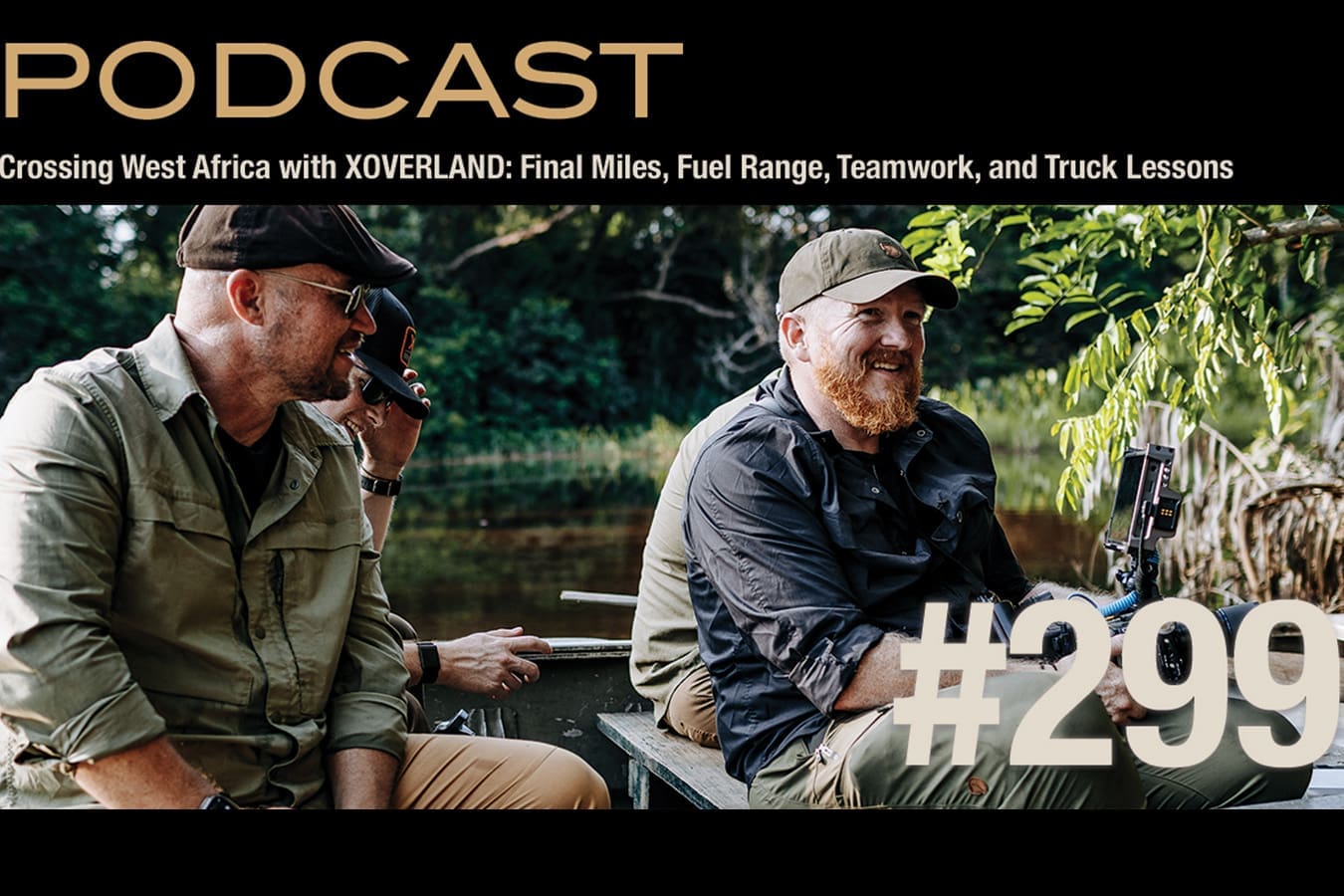
The Overland Journal Podcast host Scott Brady and Clay Croft discuss XOverland’s 40,000-kilometer Africa crossing, recorded with just 300 kilometers remaining to Cape Agulhas. They navigate West Africa’s uncertainties—coups, elections, and border hurdles—while managing sickness and tight schedules. Key practical lessons include maintaining a 1,000-kilometer fuel range due to local shortages. They credit their multi-skilled team and local support for overcoming challenges like Guinea’s extreme roads and infrastructure gaps. Reviewing vehicle performance, they highlight the reliability of Toyota hybrid drivetrains on varied fuel quality, Mobil 1 fluids, and Starlink connectivity. Despite minimal mechanical issues, they suggest future modifications like enhanced front protection for the Tacomas. This expedition underscores the resilience required for transcontinental travel through one of the world’s most demanding environments.
Overland Journal Podcast Episode #299
The Overland Journal Podcast is brought to you this week by Overland Journal Magazine
Guest Bio:
Clay Croft
Clay Croft is an innovator and thought leader in the overlanding space and co-founder of the hit television series Expedition Overland. His vast overlanding experience includes completing the Pan-American Highway, crossing Australia’s Simpson Desert, driving the Road of Bones in Russia, and serving on Expedition 7’s crossing of the Greenland Ice Cap. As CEO of Expedition Overland, Clay is focused on the company’s growing business ventures while personally pursuing his passion for award-winning cinema, adventure travel, and innovative truck building. A dedicated husband and father, Clay is also committed to supporting his wife and partner, Rachelle, and raising their boys to a life of adventure. @croftclay

Milestones: Global Expedition pushed us farther than ever. What began as an idea to drive around the world became an overland journey across 35 countries and months on the road. Thirteen team members stepped into the arena and all were stretched.
To meet the demands of the journey, we relied on two custom 2024 Toyota Tacoma Trailhunters, joined by a fully custom 2025 Toyota Tundra built for filming, travel, and livability.
Join us for the scale, setbacks, and breakthroughs. This wasn’t just another trip; it meant longer days, tougher terrain and logistics, tighter borders, and more unknowns than we typically sign up for. This series is about what happens when the road demands everything you’ve got.
Host Bios:
Scott Brady
Scott is the executive publisher and co-founder of Expedition Portal and Overland Journal and is often credited with popularizing overlanding in North America. His travels by 4WD and adventure motorcycle span all seven continents and include three circumnavigations of the globe. His polar expeditions include two vehicle crossings of Antarctica and the first long-axis crossing of Greenland. @scott.a.brady
What is the Overland Collective?
Transcription:
[00:00:00] Hello, and welcome to the Overland Journal Podcast. I’m your host, Scott Brady, and today we’re gonna do something a little bit different. We’re gonna take the podcast that Clay Croft and I recorded while we were traveling down West Africa. This is when we were almost at the end of the continental crossing, and we talked a lot about our experience, the things that we learned, the things that Clay learned along the way, how the vehicles worked, the different modifications that we had done, the things that I learned about traveling in an X Overland vehicle.
Because they’re so extensively modified, it was cool for me to be able to try out so much new gear. So this podcast was originally recorded and distributed to the XOVERLAND podcast, but because we found that there were so many great little nuggets of information, we wanted to make sure that our podcast listeners were also able to hear it.
So please enjoy my conversation with Clay Croft about crossing [00:01:00] West Africa.
Clay Croft: Welcome to the X Overland Podcast. We are currently in Southern Africa, southern South Africa, and today Scott Brady and I are going to be chatting about the expedition as a whole, the things that we’ve learned, and yeah, we haven’t fully completed it yet.
We still have… What, it’s, is it on yours?
Yeah, I do have it. It’s, we’ve got, We
Clay Croft: have 337 kilometers- That’s it … to the very bottom, and this whole expedition of around 40,000 kilometers, just over, will be finished. It’s a crazy thought. It is a crazy thought.
And I love the fact that you’ve got this concept of the final mile which is keeping us all really focused on safety and-
Clay Croft: Yeah
taking good care of the trucks. Yep.
Clay Croft: And there’s two final miles because the podcast listeners are getting a little inside baseball. There’s the final mile of us getting to Cape Agulhas, and that’s where the film will e- end- … and [00:02:00] things like that. But then there’s another final mile.
That’s right.
Clay Croft: And that’s getting the trucks to the place where we’re gonna hand them off and we shut them down and we leave them.
That truly is the final mile. That mentality exists all the way with people too. We keep it, I don’t know if I’ve told you this yet but, ’cause this is your first XO trip. Yeah. Is the expedition for the person is not finished until you walk through the threshold of your door at home.
Yeah, sure.
Clay Croft: And that just keeps our mentality sharp until the very, very end.
When you’re through your door you’re on your own- Yeah … at that point, but until then you’re still on the expedition, and it’s served us really well. But yeah, coming into the final miles.
And how does that feel, Clay? It does. How does that feel, man, for you? So much effort.
Clay Croft: So much effort, and so much was on the line when you think about the business side, all the miles in between.
Are all the vehicles gonna make it? Are they gonna get in a car accident? Is [00:03:00] everyone gonna be okay? Is… Or there’s all these things, all these reasons why it wouldn’t happen, why you wouldn’t be able to make it to the very bottom, and we saw a lot of those happen every day.
All around us.
Clay Croft: All around us all the time.
And in West Africa it’s probably the most uncertain long distance expedition route in the world at the moment. We there were coups that were happening, military coup attempts that were happening just after we went through a country. Yeah. We had coups happening as we were trying to go into countries, major elections and- And we had our, we had the US government threatening military action in Nigeria just before we crossed the border.
Yeah,
Clay Croft: 10, 10, 12 days before- Yep … we were gonna be in there.
Yep.
Clay Croft: Yeah, it was pretty, it’s pretty spicy through there.
It really was.
Clay Croft: And I think what m- we’ve talked about this off-camera, but there’s a couple factors that make [00:04:00] it spicy. When you’re on a dedicated timeline and you have to get through a certain area in a certain amount of time, that can add complexity.
It can also add simplicity, but in that case it adds complexity- Yeah … ’cause we can’t say let’s just wait it out for a week or two.” Yeah. “We’ll just park our trucks and wait.” Can’t do that. So you’ve got the expedition’s on f- full throttle, and you just gotta shoot the gap as it comes at you, and that adds a lot of tension at times.
I’m glad we were able to navigate it all, but-
And it, and we were lucky to have so many people on the trip that could solve problems. So at any time in one day, one person could be working on the next border, the next person’s working on the visa. Yeah. You’re working on making sure that we’ve got everything that we need but to support the team, that the team’s doing well, people are healthy.
Yeah. We had times when people were sick. We had ti- we had times when we got- Folks flying in and out, a lot of [00:05:00] moving pieces.
Clay Croft: Yeah. So many variables, which is what makes it fun.
Totally. Like- Yeah, totally … you don’t
Clay Croft: know if you’re gonna… in Ghana and Angola, a lot of fuel problems. Even in Cameroon a little bit.
Yeah. But you didn’t know where you’re gonna get it. We went to 13 gas stations in Ghana before we found fuel. Yeah. In Angola they- just long distances between fuel. Yep. And they weren’t guaranteed to have it. Let’s see, in Congo we carried enough that we burned through Congo, but- We- Yeah. I’m glad that we had…
We’ve talked about, a bit about top equipment, and one of them is certainly if you’re gonna go do West Africa, you need a lot of fuel. Yeah. You gotta have fuel range. Plan
on 1,000 kilometers of fuel range. Yeah.
Clay Croft: If you have that, you’ll be fine, but 1,000 Ks is the safety margin. I wouldn’t have wanted to do it with anything less.
Not even 10 kilometers left- Yeah … less than, because we had it where we came in with [00:06:00] 40, 50 kilometers of range left. Yeah. We got really tight- Yeah … at times.
Clay Croft: And having a lot of fuel gave us options as well. “Oh, we don’t have to stop today. We can keep burning. We can make up some time because we do have the fuel on board.”
It just really allowed a lot of flexibility from our side.
Yeah.
Clay Croft: It reduced that
variable. Or we would’ve had to sat in some of those lines- Oh, yeah … that were hours long. If we had to, we would’ve- That was in
Clay Croft: Angola. We saw the worst lines.
Yeah, it was unbelievable.
Clay Croft: We’d have been there for five, six hours.
We would’ve lost the border day.
Yeah, that’s right.
Clay Croft: So yeah.
What else? And I think when you look at West Africa, there’s so many different countries and so many different cultures. I was just impressed with, like, how s- like open-minded and thoughtful the locals were. They were so welcoming. I never once felt like people didn’t want us there.
Clay Croft: No, I [00:07:00] didn’t either. We were warned a couple times from other people saying, “Oh, you maybe not should be, probably shouldn’t be here.” Yep. Or, “I wouldn’t recommend that you are here, but I’m glad you’re here. Nice to meet you.”
Yeah, it was the one guy during the election. The election just, had just happened, and there was a lot of worry about safety and security, and ended up being fine.
Clay Croft: It was fine. Yeah, so we had locals helping to provide better safety and a better experience- Yeah … for us. Not, it was never the other way. It’s been a great- Africans are amazing people
They really are. They’re, yeah, they’re so open and I think they find the fact that we’re traveling through their country and through their continent, I think they think it’s pretty cool- I think so too
that we wanna see Africa
Clay Croft: So many times we’d be driving through these little towns, and we would make sure that we roll our windows down and wave at everybody and, ah, hundreds of times people, you would just hear them yell out, [00:08:00] “Welcome.” Yeah. “Welcome. Welcome to my country.” Yep.
Or you hear them say, “Americans,” or, “Montana.”
Montana. Yeah, it was so cool. Yeah. And a lot of times their heads around the world, so they’d recognize, “Oh, that’s a Tundra,” or, “That’s a Tacoma.” Yeah. Or they’d recog- they’d recognize the, even the brand. They’d rec- there were people that knew of XOVERLAND along the way. Yeah.
Clay Croft: Pretty fun, pretty cool.
Very fun.
Clay Croft: What are some of the surprises that you had? I have a few in my mind.
I think for me, the fact that this was my first ever XO trip, which thank you by the way- You’re welcome. Absolutely … Clay, for having me along. It has been, it’s been such a joy not only to travel with you, ’cause we’ve known each other for so long as buddies, but to be able to plug myself into what’s one of the most admirable expedition teams in the world.
So has built a reputation for doing big things and doing it in very cool trucks. And so for me it was [00:09:00] super fun as a fan of the brand to finally be able to come and drive along with you. So there’s a couple things that surprised me. I was really impressed with how you assembled a team. These are some of the most exceptional people on the planet.
You look, you got Kurt Williams up here in the lead truck, Baja 1000 champion, driving these trucks and keeping us safe and calling out potholes and dangers and everything else like that as we go along. We got Richard Giordano, who’s traveled around the world, and he’s one of our cinematographers, and he’s also handling a lot of the logistics and helping us solve problems.
And we got Peter Van Stralen, who’s been traveling since he’s w- was a teenager with his family around the world, so super well-traveled guys. We get to spend time with Cyrus, your son, who I’ve known him since he was just a little dude, like maybe four or five years old- Yeah … was the first time that I met Cyrus.
And now to see him as a young man doing such a great job and being [00:10:00] so thoughtful of managing the data that we produce each day, and doing an awesome job driving. And then the chance to travel with you, the chance to travel with my buddy, and you and I have been across Russia together, we’ve done Greenland together, and we did South America together.
And to now be together on this journey across We- West Africa has just been so awesome for me. Yeah. So the surprise for me was just the quality of the team, the incredible- depth and capability, the quality of this team was one of the real surprises for me. Awesome.
Clay Croft: Thank
you. Yeah,
Clay Croft: there’s good guys here.
And for all listeners out there, that’s like the best thing to strive for is find the good, find good people and go do cool stuff together. Yeah. Like it’s so worth it. It- fight for that. It makes all the difference, and we could’ve had a very different experience if we didn’t get along or if- Yeah … if there’d been tension in the group.
And it’s not that there wasn’t [00:11:00] ever tension. There was certainly not any fighting though. We worked out stuff, there was never
any fighting. No fighting. Nobody ever lost their cool.
Clay Croft: Yeah. Yep. Yeah, not on camera. I was over in the dirt kicking it a couple
times. That happens to everybody though.
That happens to everybody. Yeah, it was all
Clay Croft: good. Yeah. I- And when you got a
team like that, you can go anywhere in the world. Yeah. You go… We could take this same group of people and go anywhere.
Clay Croft: Tackle anything. Yeah. And that’s the thing about a good team, they’re all Swiss Army knives. Everybody can be sharp at one time or they can saw through this or they can cut that or they’re just multi-tools, and you’ve gotta be a multi-tool in a small team running three trucks, navigating countries, roads, cooking- Yep
water, fuel, communications, obligations, deliverables for content and photography and all the things. Yeah. All the things. You’ve just gotta be able to be a multi-tool.
Look [00:12:00] at Kurt yesterday. So we start the day and he’s lead truck driver, and then middle of the day he’s doing some wiring repair and m- and making it not only just a fix but something that’ll continue with the truck-
Clay Croft: Yeah
onto future expeditions. Yep. And then he ends the day helping to prepare spaghetti for the team. Talk about a multi-tool.
Clay Croft: Multi-tool. And that’s what drives me around a- all of these guys is they… I’m like, “Ooh, I gotta do better. I gotta be better. Look at how much they’re pulling. They pull so much weight. I gotta pull more weight.”
And that’s also, I think, a good sign of a good team, that not one person’s wanting to slack because the other people are putting in their work. And so it just creates this environment where everyone’s always pulling harder. And that’s a lot of fun. ‘
Cause we care about each other. Yeah. We wanna support each other, and I think that’s such a key component of a great expedition.
Maybe let’s talk about the trucks a little bit- Sure … ’cause that’s been another surprise for me. Yeah. You always see these XOVERLAND trucks and they look so rad, but until you get a chance to live out of one, you don’t [00:13:00] really see the thoughtfulness that goes in. You guys have had 15-plus years- Yeah
of building expedition trucks for traveling around the world, and for me to kinda come in at the peak of all of your learnings, I was super impressed with how comfortable these trucks are to live out of. We spent, I’m trying to think about the number of nights, like 30, 40 nights camping in these, maybe more- No, I think-
On this one leg alone … oh yeah, on this one leg alone at least. I think, yeah, I think we’re probably pushing- 35, 40 nights right now. Yeah. With you here, yeah. And that’s how comfortable these things are that you… And a lot of times we’ll say, “Ah, should we go grab a place or whatever?” We’re like, “Nah, we’re gonna go camp in the trucks.”
Clay Croft: Rather just stay in our- Exactly … own little ecosystem. Totally. Yeah. And then you start the day with good coffee, and the way that you’ve set up these trucks with lots of battery capacity. The fact that to start off with that they’re Toyotas, which means- … that they’re gonna be super durable and reliable.
These trucks have not even given us one single issue- No … all the way down West Africa, [00:14:00] and that says a lot for a brand-new drivetrain. Yeah. Those Trail Hunters, that’s a whole new concept for Toyota. A lot more payload, super heavy-duty drivetrain.
Clay Croft: In fact, the two dri- the two Trail Hunters that are sitting here are the first two Trail Hunters where they’re within the first batch of the first day rolling off the assembly line.
That’s amazing.
Clay Croft: Yeah, and they’re out here doing this.
And they did it without any issue. Any issue. So I think it says a lot about that new global platform. The same platform that’s used for the Land Cruiser is now used in the Tacoma. Which is why it has so much more payload than before. These hybrid drivetrains, they’ve, we’ve given them some bad fuel.
Clay Croft: Yeah.
And they have never shut off on us. Yeah. They’ve never s- failed to run.
Clay Croft: They never said, “No, I can’t do it.” Yep. I’m gonna give up or go into limp mode or anything like that. We’ve not seen
a single limp mode.
Clay Croft: We saw power reductions, but that’s what happens when you have bad gas. Yeah. You can’t fault the trucks for that.
Give it bad food, it’s not- Yes … gonna run very
well. It’s just, yeah, [00:15:00] it’s just having to back off on the power a little bit. Yeah.
Clay Croft: And then you get it, get good fuel right back in it and off it went.
And pretty good fuel economy the whole time. We didn’t need to have… You always think about you gotta have diesels, but we didn’t need to have diesel.
We did all of West Africa with petrol motors. I- imagine if you had a modern diesel, I think it would’ve been much more difficult. It would’ve been. You couldn’t get the right diesel. Yep. Couldn’t get that ultra low- You just couldn’t find it … ultra low sulfur diesel. And of course, all of our new DEF requirements.
Clay Croft: I don’t know how we w- we’d had to do a DEF delete and all that, which adds complexity. That’d be tough, yeah. We’re now re-modifying the engine itself- Yeah … to do those things. But yeah, I think a gasoline hybrid is a great choice- Yep … for all of this. Plenty of power. A- I think it adds a lot of safety when you’re going to pass.
Agreed. You know you got plenty of power to get around that truck or whatever- … for some oncoming traffic hits.
Clay Croft: And that, I think that would be maybe a surprise to a lot of other people that haven’t done it. I remember it being a surprise to me during E7 when I first started doing the bigger trips with you, and it was like, oh, [00:16:00] the most dangerous thing we do is drive these interstates- That’s right
and the highways. That’s right. And the two-lane passing. We all wanna think the romantic idea is it’s the river crossing, or it’s the- The banditos or whatever Yeah. But it’s not. No, it is the every how many times per hour that you’re navigating some sorta traffic or a person on the road or- Yeah … a donkey crossing the road- Yep
or somebody passing you on the left side- Where there is no lane, they’re just ripping down the dirt and passing you. Yep. It’s that stuff. So having that power, that hybrid train, to be able to get up and get out of the way- Yeah … get out, get around and get p- back into your lane before that corner comes up, that is a huge safety margin.
And they’re quiet and comf- And comfort … they’re quiet and comfortable. You don’t fin- you don’t finish the day feeling completely spent. Yeah. If you’re in a classic overland vehicle that a lot of people think is what you should be driving, which they’re great, too. No, they’re fun. But they’re f- super fun in their own way, but you would certainly be doing less kilometers, [00:17:00] and you’d be a lot more worn out at the end of the day.
I’ve never finished a day driving in this Tundra and felt completely spent.
Clay Croft: Yeah. Yeah, me either.
You can lay down, you can lay down the kilometers in these trucks.
Clay Croft: True global touring vehicles.
And then on top of that, we’ve been able to really rely on some premium fluids in the vehicle. Yep.
We’ve used Mobil 1 fluids in these vehicles, and that’s something that you and I have used on some serious expeditions. When I crossed Antarctica, I relied entirely on Mobil 1 fluids- … because of the low operating temperatures. We were m- a month at minus 40, so even the differential fluids were specifically from Mobil 1 to be able to operate the air lockers at that low temperature.
Oh,
Clay Croft: wow.
And the same is true on this trip. We are relying on these fluids to get us to the end.
Clay Croft: Yeah, that’s a big deal. That’s what keeps everything lubricated and moving. It’s li- it’s the [00:18:00] lifeblood- … inside the engine, literally. It is. Or in the diffs and all that. And it’ll be, we’ve been running a very special and unique oil on this expedition, and we’ve been guinea pigs, and we signed up for that, and I’m excited to see how all of the results come back.
We’ve got some of the results back, and it w- the performance of the oil was holding up extremely well. But we haven’t pushed, and Mobil 1 has not pushed an oil this hard to date that we know of, that they knew of.
Yeah.
Clay Croft: So pretty cool.
I think it’s very cool. So you take that combination of reliability and durability of a Toyota, and then you add one of the most specifically tuned series of fluids for expedition travel that we’ve ever seen.
You combine those things together, and you end up with quite the combination.
Clay Croft: Yeah. Yep.[00:19:00]
Other surprises I remember thinking that, “Oh, we’re gonna get into real bad roads somewhere around Cameroon and the DRC,” and then we got to Ghana. And my perspective was like, “Oh, these can’t be the bad roads yet. It’s, that’s all of, in front of us still- … way down the line.” And the
Guinea roads. It, yeah.
Clay Croft: Oh, sorry, Guinea, yeah.
Yeah. And it, and Guinea was just the worst.
It was the worst.
Clay Croft: It was horrible roads. It was
horrible.
Clay Croft: You think bad roads, and then, I got… Russia had some bad roads. Yeah. Central America had some bad [00:20:00] roads. South America has some bad roads, but not like
Guinea roads. It was bad. It was bad. There were days that we fought to get 200 kilometers- Yeah
and that’s only 120 miles, in an entire day of driving.
Clay Croft: A dedicated moving driving, and you’re just swerving, potholes. You’re going down into holes in the road that are about half the height of the vehicle. Yep. You’re just going down into it and back up. Sometimes deep mud. And then you’ve got semis trying to go back and forth- Yeah
through this stuff, too. Yeah, they were rough. They were. They were so hard. They were so difficult. And I wish, looking back, I d- I just thought the rough roads were still coming. I would’ve filmed those more. We should’ve spent more time filming that because I didn’t realize that they were the worst roads.
We got lucky. It felt like- West Africa was being paved just in front of us
Clay Croft: Yeah.
Except they skipped Guinea.
Clay Croft: They skipped Guinea.
Oh, we had some bad roads in Cameroon too. It was… There were, we, there were times that you’d be going along on fresh [00:21:00] pavement, and then it would just turn to the Rubicon, and then you’re in four-wheel drive and you’re clawing your way through.
Clay Croft: That was a surprise to me too. You’ve heard that China has been engaged with a lot of African countries. We can on- We’ve put our eyeballs on it. China is in all of these countries- It is … putting in roads. And you drive by a lot of Chinese contractors- Yep … Chinese equipment, Chinese signs, Chinese man camps.
And that was an interesting thing to actually physically see what you… the world politics in play.
You can see the geo- geopolitical changes happening in Africa. China’s basically offering infrastructure in exchange for access to the raw materials that they need to continue their massive industrial complex that they have in China.
So they need access to lithium, and they need access to aluminum, and they need access to gold and all these other rare earth minerals that… And wood even, like in the Congo we saw- Yeah … these huge [00:22:00] semi-trucks with massive loads of hardwood, and they all had Chinese language characters on the end of the wood describing what it was and the length of it and everything else like that.
Yeah. So it, it’s pretty interesting to see how the geopolitical shift is happening, at least in West Africa. As France pulls out, as the UK pulled out, even the US in places pulled out, it’s now created a bit of a vacuum that China’s really stepped into. And
Clay Croft: you can see why they do it because the roads and the infrastructure is terrible, and the Chinese are putting in good things.
They are. Like, it’s… That road was really nice back there. That was super nice. This overpass is actually real. A giant
bridge, yeah.
Clay Croft: Yeah. So it’s just interesting to watch and see. What else? I thought we would have a lot- I don’t know about a lot, but I knew we would have food problems through West Africa, and there were [00:23:00] some, but it was very manageable.
I’m really glad that we had the dehydrated meals that we did so that we always had the option to do whatever meal we wanted that night.
Yeah. What’s the brand of that? ‘Cause they actually tasted good.
Clay Croft: Yeah, Peak is what- Yeah … we’ve been running.
They actually tasted good They were- Which isn’t always the case- Yeah
with dehydrated meals. Yeah.
Clay Croft: Yeah. They were great. So that was good. I would’ve done that again.
We did a lot of Top Ramen.
Clay Croft: I’m done on ramen for a while.
You did a lot of ramen.
Clay Croft: I’m good.
We also had some great meals together. We had some awesome spaghetti meals, and we cooked up all kinds of yummy things along the way.
Did the best that a group of six dudes can do.
Clay Croft: And none of us are like-
No, I’m not a chef … food, foodie or cookie people at all. Yeah, I’m not a chef. Yeah.
Clay Croft: I don’t cook a lot at home. No. Yeah. I’m glad we had some guys that do do that, ’cause-
Yeah, we made it work … I’d
Clay Croft: have probably eaten a lot more bagged meals.
We made it work. Yeah. We made it work, for sure.
Clay Croft: Another cool thing, just [00:24:00] looking at the trucks ahead of us, we were able to fly a spare tire in. We didn’t know if that would work. That worked.
Yeah.
Clay Croft: That’s cool. So if you gotta fly a spare tire in up to a 35-inch tire, you can. At least, we did. I’m gonna probably try it again coming up on future trips.
The Trail Hunters are still running stock front Trail Hunter suspension, and it’s, they’ve been holding up fantastic- Great … and performing really well.
Yeah, doing great.
Clay Croft: The rear shocks are BP-51s. We put those in Germany to account for the additional extra weight. But all the way up phase one, phase two, we ran stock suspension on those trucks.
But we just knew going into Africa with all these terrible roads and a lot of speed bumps and topes, just full-flex- Potholes. Yeah. We’re like, “We need more in the rear ’cause we’re gonna damage trucks,” because while it would’ve been cool to prove that stock suspension can make it, it would’ve been a stunt.
It’s not what you should do. We were outside of the spec [00:25:00] of that shock, what it was designed to do, so we put the bright one in and i- and everything worked great. Yeah,
it’s- Still rocking … it’s incredible how well these trucks have held up, and we’ve just, we’ve not had any major failures of any of the systems.
Yeah. Yeah. Which just shows how far XOVERLAND has come, just learning what works and what doesn’t work. We’ve done little stop-and-fix here and there. Yeah. Tight- tighten the bolt here and there or whatever. But-
Clay Croft: Reattach a wire or tight- Yeah … tighten the battery- Yep … one day. Yep. Things that happen from just rattling around a bunch.
We had some beer casualties in a box one day. True. But
that was probably the worst casualty. Talking
Clay Croft: about no consequence problems so far. Yeah. Now, If I were to build these trucks again, if you were to rebuild these trucks and go do this same trip again, what would you do different? Oh,
that’s an interesting question.
I’m really impressed [00:26:00] with these Alu-Cab campers, so I would do those again. And they’re not overly complex. They’re not too heavy. They’re heavy, but they’re not too heavy. So I think that the, it’s within the spec of the vehicles, so I like that a lot. I do the fact that the Tundra has a winch on it for self-recovery because we were very fortunate with the rainy seasons.
If the rainy season in the north had extended a little bit longer- Could’ve found
Clay Croft: some problems … or if the one,
or if the one in the south had come in a little earlier, I maybe would’ve wanted a little bit more self-recovery options. But that’s about it. I’m really impressed with how well these th- even with the all-terrain tires, I would’ve traditionally thought you’d want a mud tire for West Africa- That’s what I thought
but we didn’t need it. No. In fact, we didn’t need it. We may have needed it, but we didn’t need it. Yeah. We didn’t need it.
Clay Croft: It’s really because of the thought of the contingency of getting into really bad, muddy roads. Yeah. And we saw them. Oh, yeah, if this road had been raining for the last week or even a day or two, this would’ve been a nightmare.
[00:27:00] Biblical.
Clay Croft: Biblical bad. Yeah.
Just got really lucky …
Clay Croft: the data set, if you were to run this trip exactly the same, the all-terrain tire was the perfect tire.
Yeah, exactly.
Clay Croft: Had there been the rain that you’re talking about, the mud-terrain tire would’ve really come in handy ’cause we would’ve been stuck.
Yep.
Clay Croft: Every vehicle would’ve been stuck.
Yep.
Clay Croft: So yeah, it’s just, it’s very circumstantial to the conditions. We nailed it.
Yeah, I don’t think I would’ve done anything different than maybe a- … consideration of lightweight front bumper- Yeah … or a winch tray on these Tacomas. The likelihood of a small thunder, fender bender on a trip like this is actually pretty high.
It’s high. So having some kind of a curb feeler or a bumper- Yeah … on the front of those Tacomas would’ve been good. Fortunately, we were lucky, and we didn’t have, we didn’t have any accidents or anything like that- Yeah … that, that could’ve been a trip ender. But usually in those cities, there’s a lot of mayhem, but it’s low speed, so [00:28:00] a bumper’s usually all you need for that.
Clay Croft: That’s what I would change, too. I would’ve added a front bumper with full hoop, like what Tundra has to the front, just for that added- Or an animal strike … protection or an animal strike.
Yeah, anything that can come. And
Clay Croft: when we talk about animal strike, it’s not just, it’s not that rhino you think is running out.
It’s the donkey that you didn’t see- Yeah … that hops out of the brush on the end ’cause the guy’s whipping it from the back field.
Yep.
Clay Croft: And he just comes running out on the road, so- It’s all kinds of stuff that you would wanna protect against. Or
a big goat or- Yeah … shoot any of that kind of stuff- it can make a difference.
Clay Croft: I’m glad we had really the factory stock skid plates on. Trail Hunters are, they’re very strong, but they’re also still not overly built, so we weren’t carrying a lot of extra steel that we didn’t need. Yeah. But we had all the protection that we needed.
And we used them. There was definitely- Yeah
times we made contact with skid plates. Yeah, so I think- yeah, I don’t think, I don’t think I would’ve changed anything else. I just really like the way that they work. It’s easy to lay [00:29:00] down the miles. The, just the infotainment systems, these really big screens. You and I are wa- Yeah … watching the map right now as we’re going along.
We’re able to charge our phones throughout the day. It’s amazing how stuck we are on electronics- Yeah … in the modern day. Yeah. But we’ve got Starlink running on all three trucks. So you’re able to stay connected with family, you’re able to do E-visas while we’re driving. Yep. We’re a- so we were able to be really efficient, get work done while we were driving.
Clay Croft: That made a huge difference. A surprise there was no Starlink in Angola or Namibia. Yeah. At this time of the recording, it is completely shut down. As soon as we got back into South Africa, turned right back on. DRC worked. Was fine, yep.
Everywhere else- But
Clay Croft: everywhere else it worked.
Togo it didn’t work.
Clay Croft: Oh, yeah, that’s right. Togo did not work. But we were there for about four seconds. So it didn’t matter. Only a
couple hours, right? I think. Yeah, literally a couple
Clay Croft: hours. 70 kilometers across-
That was our shortest- … togo. We did four total [00:30:00] border posts that day.
Clay Croft: That was a big one. Yeah. That was a big day.
Yeah.
Clay Croft: When it comes to the vehicle selection, if I was to be by myself or with, say, Michelle and I were to come back and travel, the truck that I would drive around in is Legion, the six-foot bed with the family camper top on it. Even if it just had the two-man top, pop- Yeah … would’ve been fine. But the family camper for two people on a six-foot bed, built into the Tacoma size.
So
good. It’s
Clay Croft: pretty perfect.
It’s so g- I do notice, though, that the Tundra is a full-size truck. Yeah. And they just don’t have full-size trucks for the most part in Africa. So even that trail coming out this morning, it was tight. It’s tight, yeah. Because it was built for a Hilux or for a Land Cruiser.
So that extra six, seven inches or so of width, sometimes you notice it, so I think you’re right. The Tacoma size is just right. Just right. It’s the size of a Hilux, so it’s perfect. Now, if I was to make it absolutely [00:31:00] perfect, I’d put a Bowen Customs bed on the six foot so you have outside storage capabilities.
Clay Croft: A little bit more cubby spots for things. But keep the Goose Gear interior design, ’cause that’s awesome, but then also have a Bowen Customs outside storage compartments. That’d be rad. And they look great. That would be so- They look great too. The money truck. Travez, Travez looks so good. Yeah. Yeah. A big expedition, Clay.
A big one You should be really p- proud of yourself. I’m proud of you. Yeah. Thank you. Proud of you too … it’s just incredible to see what XOVERLAND has accomplished over the last 15 years. You guys continue to do bigger and more ambitious expeditions, and you share it with the world. You guys have done such a great job of encouraging people to get out and explore by whatever means that they have.
You don’t need to have a fancy truck. You can do it with whatever you got and go see the world. You guys have always had such a message of get out and do things you [00:32:00] love with people you love, and I think that’s the most important thing. Yeah,
Clay Croft: I think so. Adventure makes better people. Travel makes you a better person.
And if we all had a little bit more adventure, spent a little more time around a campfire, saw a couple more countries- Yep … I think the world would be a far better place. Yeah. Because it- It’d be a lot more
tolerant …
Clay Croft: it helps round off the edges, you know- Yeah, it does … when you actually get around the fire and go see something.
And so to all the listeners and everything out there that are out there doing it, awesome. Keep doing it. Grab your friends. Grab your mom. Go make… Go do more of it. And I want to reiterate too always that we are very fortunate to be able to build and drive these incredible machines and be sponsored and have them built the way they are, but we have come across so hundreds of other travelers who have made it work, and they’re in their own machines, and they’re very cool.
Yeah. And they’re loving it, and they don’t look like [00:33:00] this. So it’s… It could be very misleading that it has to look this way. It does not. Take the vehicle you got, make it work and leave. Go. And go. Go see some things. Yeah. Like Christof, who is three cars behind me. Get out. Go. Yeah, I like that. That’s his channel and- I like that … it’s great. So yeah. It is good. All right. In 314 kilometers, we will be completing the circumnavigation of the globe. We have gone from Alaska to Argentina and from Nordkapp to Cape Town or Cape Agulhas, which is the farthest points, drivable points on the hemispheres, in both hemispheres.
Am I saying that right? Yeah. Yeah. And which is a big moment for us. So thanks for listening as we’re getting down to the very end. We’ll catch you on the next one, and as long as something doesn’t happen between here and 314 kilometers- … we can say that this mission is complete. We’re staying sharp. We’re staying sharp.
Sharp. [00:34:00] Down to the last mile.
That’s right. Cool. All
Clay Croft: right. Thanks for listening to the XOVERLAND Podcast. We will catch you on the next one wherever we are in the world.
Episode #159 Crossing Africa with the INEOS Grenadier: South Africa and Mozambique
Our No Compromise Clause: We do not accept advertorial content or allow advertising to influence our coverage, and our contributors are guaranteed editorial independence. Overland International may earn a small commission from affiliate links included in this article. We appreciate your support.