

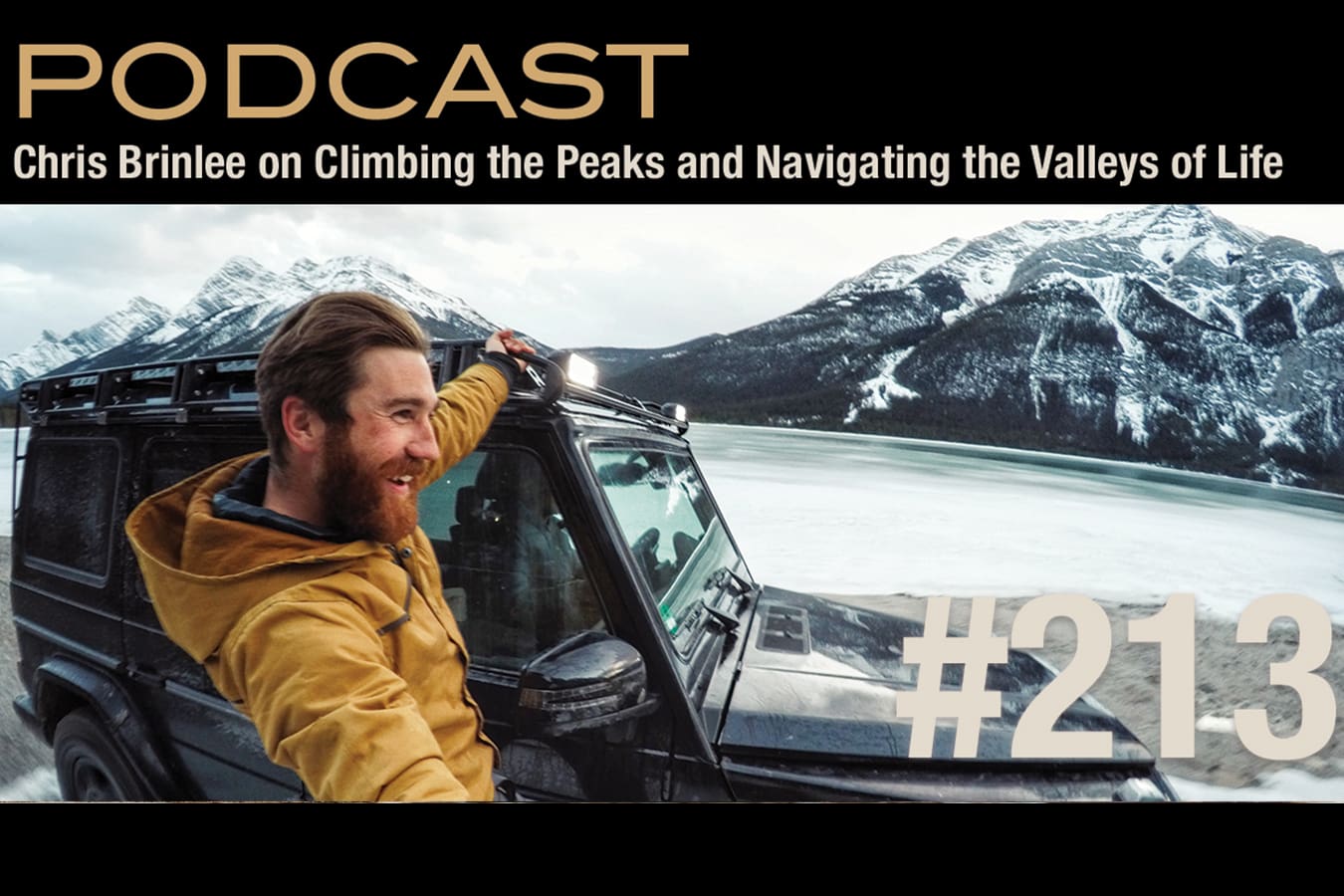
Host Scott Brady welcomes Overland Journal Podcast guest Chris Brinlee, whom he met while supporting a remote Arizona climbing trip, and they discuss Chris’s decade of unconventional travel after quitting an advertising job in 2014. Chris reflects on his essay “Dissolution of Identity,” explaining how mountaineering achievements and near-death experiences, including an avalanche, revealed resilience but also masked repressed emotions rooted in childhood trauma and his father’s alcoholism. He describes the impact of his father’s death by suicide in 2017 and how grief prompted deeper healing, vulnerability, and valuing community. Chris shares how backcountry elk hunting became a capstone rite of passage, details a monthlong Vietnam motorcycle journey (Honda XR150, guesthouses, gear choices), outlines a fitness routine centered on zone 1–2 endurance plus strength training, recounts sailing to Antarctica with explorer Mike Horn, and emphasizes resilience through accepting conditions, pivoting, and returning to one’s original motive.
Overland Journal Podcast Episode #213
The Overland Journal Podcast is brought to you this week by Overland Journal Magazine
New to Overland Journal and want to grab a subscription! Visit Overland Journal and enter code: overlandpodcast at checkout for 20% off. We thank you for being a subscriber.
Guest Bio:
Chris Brinlee
Chris is a creative who left the agency behind to seek grand adventures outside. Highs include 21,000′ Himalayan peaks; lows include timesheets. He’s got a Swiss-Army knife of skills; lots of experience bringing projects to life in harsh environments; and he excels under pressure. Passionate about human rights, policy, and living more than working–but when there’s an alignment, it doesn’t feel like the latter.
Host Bios:
Scott Brady
Scott Brady is an adventurer, author, and publisher, and the first person in history to cross all seven continents. Brady is executive publisher of the Overland Collective, home to Overland Journal, the Overland Journal Podcast, and expeditionportal.com—the world’s largest vehicle-dependent adventure community. Scott wrote Overlanding 101 (Simon & Schuster) and is currently riding around the world on his BMW GS. He also led Expeditions 7, the first expedition to drive the same vehicle on all seven continents. Brady’s polar crossings include Antarctica and a south–north crossing of the Greenland ice sheet. Scott is a fellow of the Explorers Club and lives in Prescott, Arizona.
Tune in Apple Podcasts | Spotify | YouTube
Our No Compromise Clause: We do not accept advertorial content or allow advertising to influence our coverage, and our contributors are guaranteed editorial independence. Overland Collective may earn a small commission from affiliate links included in this article. We appreciate your support.
Transcript
Scott Brady: [00:00:00] Hello, and welcome to the Overland Journal podcast. I’m your host Scott Brady, and I’m joined today by Chris Brinley. Now Chris and I met just by happenstance when we were both helping a rock climber get to this very remote location in Arizona. He happened to be along providing technical support for the climbing, and I happened to be along as a driver to help support this climber to this very unique spire outside of Sedona.
But Chris and I hit it off right off the bat. We had a lot in common. We talked about sailing and overlanding and travel. Chris is one of the most interesting friends that I know. He’s an extremely accomplished traveler. He’s learned a lot about himself during his travels, so we dig deep into that. We also talk about his time sailing down to Antarctica with Mike Horn.
We talk about his scaling solo summits of 6,000 meter [00:01:00] peaks, now how he almost died in an avalanche climbing. Chris has been through a lot. He’s also been through some real tragedies in his life with loss. So for those that are listening that may have some sensitivity around the subject of suicide, we do talk about that a little bit and that loss that Chris has had in his life.
If anyone is struggling with thoughts of suicide, please know that there is help out there, and we are available to help in the ways that we can too. So you’re never alone. Uh, please don’t hesitate to reach out to me, uh, scott.a.brady on Instagram. Um, I don’t have a lot of skills in that area, but I just want you to know that there’s always someone, uh, that you can talk to.
Chris Brinlee: So please enjoy this conversation with Chris Brinley.
Scott Brady: And a special thanks to Dometic for their support of this week’s podcast. I have personally used their fridges on multiple continental crossings and find them to be lightweight, durable, and efficient. Dometic has just [00:02:00] upgraded their CFX5 line with their new VIP insulation panels, which improve efficiency and reduce power draw.
They have also introduced a variable speed motor to reduce unit noise by up to five decibels. That makes a big difference when you’re sleeping next to the fridge. The USB port is now 18 watts for even faster device charging, and an even more refined fridge design and color. The CFX5 will cool down to minus seven degrees Fahrenheit and has a three-stage low voltage cutoff to protect your battery while running on either 12 or 24 volts DC and 110 or 240 volts AC.
These fridges are durable
Chris Brinlee: and even won our most recent Overland Journal Editor’s Choice Award. Find out more information at dometic.com.
Scott Brady: Chris, thank you so much for being on the podcast [00:03:00] with me today. I have been wanting to have this podcast happen since the day that we hung out. It was like a totally serendipitous moment.
We were both out there helping an influencer get to this rock spire in Arizona. I was the driver of the GMC, and you were the rock climbing guide, and before we knew it, we were in and in each oth- we were finishing each other’s sentences. But a lot of shared interests, and I just find your story to be fascinating.
I’ve learned a lot from you. I think that your travel has changed you in, in incredible ways, and, you know, I think life has changed you in a lot of ways based upon your story, and I think people need to hear it. I think people need to know that it’s possible to achieve these dreams and th- to maybe even live a very unconventional life as you have.
So let’s talk a little bit about recently you did an article that was titled dissolution of identity, which I thought it’s a really powerful read. You had [00:04:00] taken some time away from social media, and then you codified your thoughts in that article. So talk a little bit about what got you to that point that you did such a 180-
Chris Brinlee: Absolutely
Scott Brady: in your life.
Chris Brinlee: Yeah. So I guess to provide a little bit of context, when I was 26, I quit my advertising art director job in Los Angeles, took off on this grand trip around the world, which I thought was going to be maybe a short sabbatical from work, a little bit of an effort to find myself.
Scott Brady: Sure.
Chris Brinlee: And then before I knew it, I had been going for a decade with little slowing down throughout that entire process.
And-
Scott Brady: And big expeditions. Yeah. Big mountains.
Chris Brinlee: Yeah.
Scott Brady: A couple near deaths.
Chris Brinlee: Absolutely. Yeah. And the kind of impetus for that on one side was pursuing this more adventurous life. I had never seen a mountain with snow on it until I was 25 years old, and then [00:05:00] I took a mountaineering course on Mount Whitney, and then six months after that, I quit my job and was climbing in the Himalaya on these 6,000 meter peaks.
And-
Scott Brady: So that’s the only mountain that we have in common, is Whitney. Yeah. That’s as high as I got. There we go. I’ve actually been higher in a car than on- I
Chris Brinlee: believe
Scott Brady: it. But yeah, Whitney was my… That was my high, the high point of my mountaineering career.
Chris Brinlee: Well, that’s a great place
Scott Brady: to start. Oh, it was beautiful.
That was beautiful. And if that’s the case- And that was actually when I realized that was gonna be the end of my mountaineering career. Ne- Neanderthals aren’t meant to climb mountains. Yeah,
Chris Brinlee: it gets
Scott Brady: to
Chris Brinlee: be a slog, for sure. Yeah, yeah. No, good. But having that experience, I became very drawn to those pursuits in the mountains.
And when I was in the thick of it, what I was experiencing at the time was this profound reshaping of who I was and what I valued, and what those experiences ultimately showed me was how much grit that I had- Yeah … and how much [00:06:00] resilience I was capable of possessing.
Scott Brady: Yeah.
Chris Brinlee: And ultimately- Those experiences allowed me to carry about in daily life and be able to just roll with the punches a little bit easier.
Yeah. Because I had experienced a lot of trauma-
Scott Brady: Mm …
Chris Brinlee: based around my relationship with my dad when I- Yeah … was growing up.
Scott Brady: Sure.
Chris Brinlee: And I think because of that trauma, I had repressed a lot of my emotions and wasn’t exactly sure how to navigate feeling as an adult.
Scott Brady: Mm.
Chris Brinlee: So more often than not, I just chose to not feel- Mm
and would instead just do. Mm-hmm. And in that process of just doing, it led me to these wild endeavors. As you alluded to, oftentimes more than I am probably proud [00:07:00] of, I found myself on the edge of mortality and having to confront that in very serious, real ways- Yeah … and evaluate my decision-making from those points and going forward.
Yeah. But what I was ultimately experiencing, and I, I didn’t realize this until much later and even just more recently, was that I had repressed all of my emotions, but climbing a mountain or achieving something big outside gave me a sense of achievement that was triggered by a dopamine hit that was essentially- For sure
a chemical reaction occurring- Yeah … in my brain.
Scott Brady: Yeah. And nature is healing-
Chris Brinlee: Yeah …
Scott Brady: in many ways.
Chris Brinlee: Ab- absolutely.
Scott Brady: And so- I don’t think it can heal us fully, but it does heal us in many ways.
Chris Brinlee: Yeah. And so there were that dichotomy of experiencing this healing aspect, but then simultaneously having these experiences that allowed me to feel something beyond the [00:08:00] emotional repression- Mm
that I was- Unknowingly producing in my life
Scott Brady: Interesting
Chris Brinlee: And- Interesting … that steered so much of my motivation, and I dedicated my time, and money, and energy into those pursuits. Mm. And ultimately, what they taught me about myself was, you are tough, you’re resilient-
Scott Brady: Yeah …
Chris Brinlee: you’re durable, you can handle a lot.
But they weren’t actually allowing me to address the inner causes of why I was going out there in the first place, and-
Scott Brady: Why you were pushing so
Chris Brinlee: hard … why I was pushing so hard. And-
Scott Brady: Was there a moment that you came to that realization? That you realized that, like, “I’m really running hard-
Chris Brinlee: Yeah …
Scott Brady: away from something”?
Chris Brinlee: Absolutely. Yeah. And so when I, I quit my [00:09:00] job in August 2014, actually on the 21st, so just a couple days ago was- … my 10-year anniversary for that. Wow. Oh, wow. Yeah.
Scott Brady: That’s
Chris Brinlee: amazing. Kind of a fitting-
Scott Brady: Whole new life.
Chris Brinlee: Yeah, exactly. Whole new chapter. Yeah. Exactly. But I ran to literally the edges of the earth, Antarctica, Eastern Greenland, these great heights in the Himalaya, all in an effort to try and discover myself.
But ultimately, what I needed to find lived within me all that time. Mm. It had just been repressed. Yeah. And on Halloween 2017, my dad died by suicide.
Scott Brady: Mm.
Chris Brinlee: And I was climbing a mountain at the time. I felt this gut-wrenching- Like a wraith reached through my abdomen and, and twisted up my guts
Scott Brady: Hmm
Chris Brinlee: I, I felt this visceral feeling on this mountain, and I [00:10:00] just wrote it off not really having any context or understanding of what was happening.
It wasn’t altitude sickness. I was well acclimatized. It wasn’t anything related to fatigue or food poisoning. It was this very visceral experience. Yeah, sure. And I found out two days later via satellite text that my dad had died. Yeah And the timing corresponded exactly with that feeling- Wow … based on the time zones around the world.
Scott Brady: Little riff in the universe, right?
Chris Brinlee: Yeah, exactly. Just tore the fabric of my being- Yeah … in that instance. And because of the inherent link between my dad and me, I took his name, or I was given his name at birth. Yeah. If not for the 25 years separating us, we could’ve been identical twins. Hmm. We had so many similarities, and I, I looked at all of his traumas and his struggles and the ways that he had not addressed that and how they made his life so much more difficult, and I m- almost took the opposite approach in so many [00:11:00] ways to carve out my own identity separate from him.
Scott Brady: Yeah.
Chris Brinlee: But what I didn’t realize was that in an effort to produce some degree of normalcy in my life because of the trauma from that relationship with him, I had suppressed so much of what I felt from a child all the way through adulthood.
Scott Brady: Sure.
Chris Brinlee: And when he died, all of a sudden I was forced to confront that- identity and that link between us-
Scott Brady: Yeah
Chris Brinlee: and begin to confront that trauma- Yeah … and begin to create some degree of separation. Yeah. And for the first two years after his passing, I was so scared to even confront the grief- Mm … for fear of where that might lead me- Mm … because of that interlinking between us.
Scott Brady: Yeah.
Chris Brinlee: [00:12:00] And only when I humbled myself before that and found that rock bottom and accepted that if I were going to have true depth in my life, which I find is defined by the connections that we share with people- Right
if I were able to build those in the ways that I knew were important and that I wanted to experience that richness-
Scott Brady: Yeah …
Chris Brinlee: I had to address what was happening inside- Mm … so that I could show up and, and be vulnerable and communicate and- Yeah … create these deep connections that can only happen when you’re willing to dive into these uncomfortable emotional depths of topic and conversation.
But to do that, I had to look inside first.
Scott Brady: Yeah.
Chris Brinlee: And once I began that process of healing, only then was I truly able to [00:13:00] begin to discover what I had been searching for all of those years around the world, but just like in The Alchemist, that treasure lived within me the whole time.
Scott Brady: Yeah, and a lot of people have mentioned that book on the podcast, and I know in my own life I’ve spent so many years striving.
And I think it, it was, I, I have wonderful, loving parents and it was never… Certainly high expectations, but never, um, never that I felt was unreasonable, but I think I took that torch myself and I set myself up for unreasonable expectations. Yeah. And then you end up working seven days a week. Do you find that b- because knowing you as a friend, from the very first moment that we started spending time together, I did feel that genuine connection, that you were making an effort to know me.
Yeah. That you were making an effort to learn about my life and to share your life with me. I could see that you had really been… You had learned a [00:14:00] lot about what it meant to have a friend or to have a connection in your life, and I see that you do that with so many different people. So that’s, that in and of itself is very powerful, but did you find at the same time that you were able to connect with those parts of yourself?
Have you been able to find that way to be that friend for yourself, too?
Chris Brinlee: Absolutely. And so much of that was- Rooted in me facing up and owning who I was and understanding where that trauma came from. Mm. And my dad was a very loving, caring person, and he… L- like, my siblings and I were, like, his whole world.
Sure. And he dedicated his life to just raising us the best that he could, but he had never taken the responsibility for dealing with his own traumas. And so that crept into every aspect of his life- Mm … and characterized [00:15:00] all of his relationships. Yeah. And from the time I was a, a kid from 5 to 13, I just thought he was gonna…
’cause he was- Yeah … never around because- Right … of work, and I think that was a way for him to avoid dealing with his relationship with our mom at home.
Scott Brady: Yeah.
Chris Brinlee: And then from that point, from 13 to 18 or 19, once my parents got divorced, he was dealing with alcoholism and kept getting DUIs and- Yeah … wrecking his vehicles and just being really destructive- Yeah
through his behaviors. Right. And then after that, I was waiting for him to die by suicide from that point from 18 until I was 29 when it finally happened.
Scott Brady: Yeah.
Chris Brinlee: My whole life I was waiting- You were
Scott Brady: holding your breath …
Chris Brinlee: for him to leave. Yeah. Just holding my breath.
Scott Brady: Mm.
Chris Brinlee: And once he-
Scott Brady: That’s hard, man …
Chris Brinlee: finally did- That’s hard
I was able to release that breath and- Yeah … start to better understand him and- Yeah … appreciate the struggles that he went through.
Scott Brady: Yeah.
Chris Brinlee: But then also see [00:16:00] how that characterized my own life, and in doing so, be more graceful with myself- Yeah … and better understand why I had felt this need to run to the ends of the earth.
Scott Brady: Yeah.
Chris Brinlee: And in doing so and embracing that process, embracing that grief, embracing everything that was imparted onto me, and simultaneously all the ways that I had carved out my own identity-
Scott Brady: Yeah …
Chris Brinlee: despite what I experienced with him-
Scott Brady: Sure …
Chris Brinlee: was ultimately this characterization of who I wanted to be. Yeah. And as
I’ve continued this journey, I’ve been very intentional about growing into that person that I’m proud of for me because of me.
Scott Brady: But your friends are proud of you too, man. Yeah. And it se- it was interesting when I read that article, I could see that [00:17:00] it was this, this moment when you w- you were trying to peel away those layers of yourself.
But I can see, like, in your, in the things that you’ve talked about recently, is that you’re still proud of what you’ve accomplished. But I could see in that moment you were really like, “I wanna strip away-” Yeah … “this thing that I worked so hard to, and it never made me happy.” But there’s so much for you to also be proud of, and you’ve learned a lot.
And I wonder if it’s possible to even get to the point that you were at without all of those trials and struggles. Sometimes you gotta spend time in the wilderness.
Chris Brinlee: Absolutely.
Scott Brady: And, and we can also be… We can look back, and we can be proud of the time that we spent in the wilderness. I think about my own travels.
At the… I just finished a, a huge 15-year project for myself personally. And at the end of it, I allowed myself to be proud of the accomplishment, but what I was more grateful for was the ways that it had changed me.
Chris Brinlee: Yeah.
Scott Brady: The ways that it had made me want to spend more time with my family, want to spend more time with my [00:18:00] loved ones, spend more time with my friends.
‘Cause to your point, you start to realize what’s more important. Definitely. It’s not, like, a fancy truck in the middle of nowhere. It’s the connections that we have along the way, so.
Chris Brinlee: Exactly.
Scott Brady: And- No, that’s a really powerful journey that you’ve been on, so.
Chris Brinlee: I like to think of it as a rite of passage.
Scott Brady: Yeah.
Chris Brinlee: And in our modern technologically advanced societies- We have very few opportunities to undergo true rites of passage. Mm. And what I realized several years down the line, probably around the time that the pandemic started and I was able to step back from what I had been doing and, and be a little more still, was that entire journey had essentially been a rite of passage- Mm
to truly discover not just who I was, but how I fit into the world.
Scott Brady: And [00:19:00] young men traditionally in cultures all had a rite of passage, and those no longer exist. No. And in many places, what would’ve been the rite of passage would be entirely illegal to even attempt today. But if you think about the Maasai warriors going and killing a lion or, you know, the Aboriginal young men that would be sent off into the Australian outback for months at a time without any supplies to survive for themselves, uh, no doubt that they came back from that journey more ready to support and provide for the community.
Absolutely. And I think that unfortunately in the modern day, those things aren’t as available or there’s- The parents are terrified that their… something’s gonna happen to their kid. It’s understandable, but like, it results in maybe too much safety and not enough struggle, which I think we have to have some struggle in our life.
Which leads me to the question, you, you went through this process of, [00:20:00] of deciding that you were gonna start hunting for your own food. And talk a little bit about was that another one of those opportunities to come into touch with nature and with the struggle of, of that?
Chris Brinlee: Absolutely. I think when the pandemic started, I had been focusing all my training on these mountaineering objectives- Yeah
which at a certain point in my journey as an alpinist, I realized that the return on investment of that time and energy and money was diminishing. Mm. There wasn’t so much that those experiences were teaching me-
Scott Brady: Oh,
Chris Brinlee: sure … which was ultimately why I was going out there in the first place, was to learn something about myself.
Scott Brady: And for context, you were soloing 6,000-meter peaks.
Chris Brinlee: Yeah.
Scott Brady: That’s, that’s about as real as it gets.
Chris Brinlee: Yeah.
Scott Brady: Those are incredible endeavors.
Chris Brinlee: Yeah. Thank you.
Scott Brady: So, yeah.
Chris Brinlee: And, and those [00:21:00] endeavors were really meaningful, as you said. They showed me so much about who I am, and they were such an integral part of that process, and I am so proud of what I’ve done, and I wouldn’t trade any of that for anything.
Scott Brady: Mm.
Chris Brinlee: But when the pandemic happened, I realized that I had all these skills that were… essentially I had been orienting them to these pursuits of personal growth, but at a certain point, they just became hedonistic-
Scott Brady: Yeah …
Chris Brinlee: which is fun and fulfilling, but I was seeking something deeper. Yeah. And I realized that they were transferable to backcountry hunting.
And I grew up in rural western Arkansas but always felt like a social outcast there, and in a way to carve out distinction for myself, I’d purposefully abstain from that because I was like, “Okay, if people aren’t going to accept me for who I am, then why should I try and conform to the lifestyle that you have?”
Scott Brady: Right.
Chris Brinlee: And I think [00:22:00] that was a young and naive take, but that was- Yeah,
Scott Brady: we all do that …
Chris Brinlee: combative. We
Scott Brady: all did
Chris Brinlee: that. Yeah, exactly.
Scott Brady: Yeah. If you don’t accept me, I’m not gonna accept you. It’s totally understandable. Yeah, exactly. We’ve all- I’ve done that. I don’t speak for everybody, but- … I think most of us have done that.
Chris Brinlee: Yeah. And as time went on and I found myself in this environment of uncertainty- Yeah … that was predicated on a bunch of wild things happening around the world-
Scott Brady: Yeah …
Chris Brinlee: I ultimately was like, “Okay, how can I take what I know about mountain travel, and how can I take this fitness that I spend a lot of time developing and apply it to something that can generate sustenance- Yeah
and have like- true alignment with what it means to be human from the perspective of literally sustaining life.
Scott Brady: Yeah And- And humans have been doing that for a very long time.
Chris Brinlee: Exactly.
Scott Brady: And it’s another rite of passage.
Chris Brinlee: Exactly. And in many ways, I felt that my elk hunt in [00:23:00] the tundra of the San Juan Mountain Range in Colorado was the capstone of my rite of passage.
Mm. Not just from the perspective of going out and harvesting an animal and being able to feed myself and my community for months off of that harvest-
Scott Brady: Sure …
Chris Brinlee: but also from what it allowed me to experience from a perspective of emotional growth. Because that was the first time that I had taken a life-
Scott Brady: Yeah
Chris Brinlee: and simultaneously, I had still been reeling with losing my own dad.
Scott Brady: Yeah.
Chris Brinlee: And then just before losing my dad, I had a very close confrontation with death in the mountains, and so- Was
Scott Brady: that the avalanche?
Chris Brinlee: It was the avalanche- Yeah … in the Canadian Rockies. Yeah. And so there was this triad of loss that was focused as an epicenter- Yeah
around this hunt, [00:24:00] and it allowed me to truly feel all of these emotions- Mm … that
Scott Brady: were
Chris Brinlee: Embodied by this experience Yeah And when I was coming down from the mountain after that hunt with the quarters in the cooler, I felt this metamorphosis-
Scott Brady: Yeah …
Chris Brinlee: occur in my soul, in the core of my being that I’ve only experienced on a couple of occasions.
Mm. And to me, that epitomized this journey of personal growth- Mm … that I experienced. And in so many ways it brought together all of these verticals that I’d been pursuing and the ways that I’ve been progressing as my development as a human.
Scott Brady: Yeah.
Chris Brinlee: And, and it brought them into this prism of reflection, and that [00:25:00] was a truly transcendal- transcendent moment.
Scott Brady: Yeah, and I, I would never recommend that someone hunt. It should be a very much a personal choice, but it is… And you can spend a lifetime without eating meat too, and entire cultures do that, so it’s not a… I’m not suggesting that this is an answer for a lot of people, but for some people it probably is.
Because it’s not only something that human beings have done for a very long time, but in my own experience as a hunter, in talking with other hunters, it does connect us more with what it means to be human. It connects us much more with our responsibilities to the planet, our appreciation for where our food comes from.
There are a lot of people who don’t like hunting but are happy to go to Costco and buy a package full of meat, and there’s no difference. They… Either way, you’re just not pulling the trigger. Yeah. And I think it’s the process, it’s the struggle to be at altitude, to stalk the game, to be quiet, to, to not be on your phone, to probably be out [00:26:00] of cell coverage entirely, to spend days in usually bad weather, ’cause it’s t- typically fall.
And then you have to pull the trigger and take a life, and then you have to take the… You have to take a moment, and then you have to go to this animal. You have to… Of course, you should s- we should all show great gratitude for the fact that it is providing sustenance to us. But then we have to- Take this animal apart.
Yeah. And we have to bring it back to our family or to our community. And if you think about it, that is something that human beings have been doing from well before recorded history. Just it’s a cycle that we, that humans have gone through, and I think it’s part of human growth. It’s part of the human experience, so.
Chris Brinlee: Absolutely.
Scott Brady: Yeah. No, that would be an interesting one. Let’s talk a little bit, get more, talk a little bit about some of the overlanding stuff that you’ve done. So recently you went to Vietnam, and you’re like, “Scott, I’m gonna get some motorcycles. I’m gonna go rail around this country for a while.” Yeah.
Talk about how did that go?
Chris Brinlee: [00:27:00] Oh, man. It was-
Scott Brady: There was a lot of smiles in the photos.
Chris Brinlee: One of the greatest experiences of my life. Yeah. Not just travel related. Yeah. But period. And in many ways it was also a bookend. When I quit my job in 2014, I found myself in the Himalaya climbing, mountaineering, and then from there I found myself in Southeast Asia as it was a, a pretty easy transition.
And riding motorcycles had been a huge part of my life growing up. It was something that my uncle introduced me to and that my dad continued to foster. Mm-hmm. And so it was this experience that I’d had with these two important men in my life from a kid. Yeah. And then when I was living in LA, I didn’t have a car.
I only rode a Triumph Street Triple around.
Scott Brady: Hell yeah.
Chris Brinlee: And so that was very much my life. Yeah,
Scott Brady: sure.
Chris Brinlee: And when I left Los Angeles, I gave up on that huge part- You’re
Scott Brady: like the modern Steve McQueen. [00:28:00]
Chris Brinlee: Yeah. But it was, uh, it was something that I really missed. And so when I realized that I could buy a motorcycle for a few hundred bucks in Vietnam- Yeah
I, I did it in a heartbeat. And I rode from Ho Chi Minh City down to Cần Thơ on the Mekong Delta in the south, and then all the way up to Hanoi over the course- Mm … of a month. And that was probably the full epitomization of that very first round-the-world trip was wrapped up in that. I think that’s where I had the most emotional struggle.
Mm. It’s where I started having my eyes opened to the rest of the world in a really big way.
Scott Brady: And you went pretty quiet on social media around that time. I think you were really working through it, so.
Chris Brinlee: Yeah. And this very first trip, it was- And in many ways, it was like a bookend to my start of this journey of personal growth.
Scott Brady: Mm.
Chris Brinlee: When I got to Hanoi, I had essentially run out of money, [00:29:00] run out of visa time. I lost my camera, my computer, my hard drives. It was- Oh,
Scott Brady: no …
Chris Brinlee: this whole ordeal.
Scott Brady: Yeah, yeah.
Chris Brinlee: And I, I bought a ticket and flew back to LA after that, but I had missed out on the northern section of the country, which is where I had been most excited about going.
Scott Brady: Mm.
Chris Brinlee: And I had been dreaming and scheming of going back up there to complete that journey- Mm … to ride to the Chinese border ever since then. But after that first Vietnam trip, I found myself diving headlong into alpinism and dedicating most my resources into that pursuit- Mm … because of the, the kind of personal growth that I, I thought I was getting out of it.
And so when I had come around and started to step away from alpinism a little bit, all of a sudden it opened up more of my time and my energy to explore other things. And the idea of going back to Vietnam to [00:30:00] finish what I had started- Nice … all those years ago was wrapped up in that trip I took in December.
And so- And
Scott Brady: what were some of your lessons learned, takeaways? You, because you’re a, an alpinist, you do pack light by nature. Yeah. How did you prepare for that trip? ‘Cause a lot of people are interested in, like, how do I go to Thailand or Vietnam, rent a motorcycle, and go ride around the country? What were some of the…
What was some of the gear that you thought really helped with that? What was the kind of motorcycle that you picked? What were some of the things that you learned from that journey?
Chris Brinlee: Yeah. So I think that simple is better, and in Vietnam, a lot of the roads are quite small. A lot of them have- Not yet developed and so you’re going to encounter a lot of sections of aspirational highway that is maybe just a construction zone, and so it’s very kind of core adventure riding.
Maybe there will be a little bit of s- single track depending on how ambitious you [00:31:00] are. A little bit of highway riding, but very windy roads where speed is not really possible. And so I opted to rent a Honda XR 150 for that trip.
Scott Brady: Perfect.
Chris Brinlee: Small, light bike, easy to handle. Yeah, rip a little dirt bike. Yep, exactly.
Yeah, for sure. And it, it was the perfect choice for that mission.
Scott Brady: And then did you go with a backpack or did you have a duffle that you strapped to
Chris Brinlee: the back?
Scott Brady: How did
Chris Brinlee: you deal with that? I went with a, a travel backpack from- Yeah … Matador, which kind of had a little bit of a- Oh, their stuff is great
convertible feature. Yeah. Yeah, able to tuck the straps away. Yeah, their stuff is great. So I traveled over there with just that bag and then a duffle for my moto gear.
Scott Brady: Right.
Chris Brinlee: And I took proper riding boots and pants and helmet and gloves. Some of that stuff you can get over there, but I prefer to ride with my own kit and just-
Scott Brady: Yeah
Chris Brinlee: I’m, I really like to emphasize the safety aspect when I’m on a motorcycle, and I find that bringing my own kit is a, a sure way to make sure that I’ve got that dialed.
Scott Brady: And that’s a tough envi- that’s a tough environment too, [00:32:00] because it’s, there’s so much rain, it’s so humid, and it can be so hot that you really have to have very technical riding gear in order to stay cool.
Chris Brinlee: Yeah.
Scott Brady: Was there, was, what kind of a, riding gear did you find worked best for you in that environment?
Chris Brinlee: So I opted for a little bit of a hybrid style. I took adventure pants with built-in inserts that had decent ventilation, and then for my top, I opted for just an Under Armour type moto- Yeah … like a enduro-
Scott Brady: Enduro style,
Chris Brinlee: yeah
kit with a durable enduro jersey and then just a Craghoppers hard shell rain jacket for the implement, kinda inclement weather.
Scott Brady: That’s perfect.
Chris Brinlee: Yeah. It’s-
Scott Brady: I think a lot of times in the heat you’re way better off having modular armor, so that way you can wear lighter clothing on top of the armor.
Obviously, it’s the abrasion resistance that a lot of times we’re looking for. Sometimes it gets so hot that you’re gonna die [00:33:00] if you don’t- Yeah … get some airflow.
Chris Brinlee: Totally.
Scott Brady: So you gotta strike a balance sometimes- Yeah … for sure.
Chris Brinlee: And then with those roads, especially in northern Vietnam, very rarely were we even able to go more than- 100 kilometers an hour because the roads were so windy.
Yeah. And so abrasion resistance was little bit less of a consideration. No,
Scott Brady: that makes a lot
Chris Brinlee: of sense. We weren’t spending too much time on asphalt.
Scott Brady: And then did you try to camp or did you stay in… I know it’s so cheap over there, you probably just stayed in hospitals and- We just stayed in
Chris Brinlee: guesthouses
hotels and yeah,
Scott Brady: guesthouses.
Chris Brinlee: Yeah. Uh- Nice … it, it was wonderful. And-
Scott Brady: I bet …
Chris Brinlee: uh, the-
Scott Brady: I’ve heard that the people there are just incredible …
Chris Brinlee: so warm and inviting. Yeah. You feel like family.
Scott Brady: Yeah, nice.
Chris Brinlee: We stayed in these guesthouses along, the circuit that we did was called the Ha Giang, uh, Loop. And so we did that but with some slightly more adventurous variations throughout.
But because it is a little bit of a, a known route- Mm-hmm … there are designated spots along the way where it’s pretty easy to find a guesthouse. And- Nice … [00:34:00] a lot of those, logistically, 10 years ago maybe would’ve been tougher to find or you’d have to roll into the village and kind of ask around. But most of these people have their places listed on booking.com now.
Yeah, sure. So it was pretty easy to, to get a book. Yeah. But it didn’t make the experience any less homey oriented. Yeah, sure. We’d have family dinners with them every night and all just eat together around table sitting on these little wood stools. That sounds
Scott Brady: amazing. Chris-
Chris Brinlee: It was truly blissful.
Scott Brady: You enjoyed it?
Chris Brinlee: Absolutely.
Scott Brady: Oh, that’s awesome, man. And, and I think you’re working on a piece for Overland Journal, if it hasn’t already gone live. Yeah,
Chris Brinlee: yeah. Working on that
Scott Brady: right now. Yeah. That’s awesome. So we’ll, that, that, uh, journey will be in the magazine for those that are listening, so you can see Chris’s trip through there.
Let’s pivot a little bit towards how we maintain our physical fitness while we’re traveling. That’s something that you’re like my dose of inspiration because usually you’re smiling at the ca- camera talking about your day while you’re running. Which I can do [00:35:00] one of the three of those. And then maybe I could smile and look at the camera.
I bet you could
Chris Brinlee: get
Scott Brady: two down. Maybe I could get two down. It would be… Yeah, it would be impossible for me to do all three. But it looks like that you have found a, a way to make physical fitness a part of every day of your life, and I know that many people on this podcast, we’ve had many questions and inquiries around maintaining health and strength while we’re traveling.
So talk a little bit about your fitness routine. What are some of your go-tos? How do, how did you get into that consistency? What are some recommendations that you would have for people who want to stay more fit for travel?
Chris Brinlee: Absolutely. I think it’s important to note that I have a background as a high school and then collegiate athlete, and when I graduated, I pretty much stopped all of that training that I’d been doing for most of my youth.
Yeah. Just I was still somewhat active, and I did different activities. Sometimes I rode my bicycle to work. I [00:36:00] got into some extracurricular sports in the city. But I pretty much stopped training with regularity in my early 20s.
Scott Brady: Yeah.
Chris Brinlee: And when I transitioned from my desk job into this more adventurous career pursuing mountaineering and storytelling around that, I did not- pick up any of those same training habits that I maintained when I was younger.
Mm-hmm. I was just doing stuff off the couch. And I got to this point to where my objectives were getting bigger and more committing.
Scott Brady: Yeah,
Chris Brinlee: sure. And I got to this point where, as you alluded to earlier, I was on this expedition and had triggered an avalanche and nearly lost my life. And after that experience, I realized, oh, the things I’m doing out here are really serious.
Scott Brady: Yeah.
Chris Brinlee: If I’m going to be, like, pushing this envelope for myself, I need to treat it like I’m an athlete. Mm-hmm. And so that was a wake-up call, [00:37:00] and the following year, I hired a coach that-
Scott Brady: Smart …
Chris Brinlee: trained me specifically for alpinism so that I could make sure that at least I could take that variable out of the equation.
If I knew that I was prepared physically for these endeavors, then hopefully everything else could go a little bit smoother.
Scott Brady: Hmm. So I- What were some of the foundational movements within that routine?
Chris Brinlee: So those movements I’ve- … continued on from that point. That was 2018 when I first hired the coach, and I have maintained that same type of training ever since then, and it’s very much aerobic-oriented, but still incorporating strength training in that to climb a mountain.
Well, you have to be able to
Scott Brady: haul… And with heavy gear.
Chris Brinlee: Yeah. Mm-hmm. You gotta be able to haul heavy gear, and the same thing applies for backcountry hunting. Yeah. It’s very physiologically similar. You’re going far distances at a pretty slow pace, and you’re having to haul gear. And so what that looks like from a practical [00:38:00] standpoint is I will run about four days a week, and I’ll do strength training two days a week.
Mm-hmm. And then I’ll have a rest day almost every week.
Scott Brady: Hmm.
Chris Brinlee: And the mix of that, it’s mostly aerobic endurance r- running.
Scott Brady: So you zone two, zone three?
Chris Brinlee: Zone one and two, and so it’s that- Yeah, that’s- … long, slow distance …
Scott Brady: people have really learned a lot about that. The fact that you can run in zone two is impressive.
That’s a… But that’s- You have to be really fit in order to be running and staying in zone two.
Chris Brinlee: Yeah. That’s
Scott Brady: hard.
Chris Brinlee: It’s… A- and the other thing is it’s not- Or
Scott Brady: I’m walking in zone two. Okay. I’m hiking in zone two.
Chris Brinlee: That- that’s fair. The more consistently you stay in that zone two-
Scott Brady: Yeah …
Chris Brinlee: and the more time you give it, the- higher aerobic capacity you’re going to have- For sure
and your pace is gonna be able to increase.
Scott Brady: Yeah, for sure.
Chris Brinlee: I think a lot of issues that people have when they start out running or, or trying to get into training is that they have this idea that they gotta run fast. Right. And so that puts them into zone three or four, and that is not building your aerobic capacity.
Scott Brady: Yeah.
Chris Brinlee: And so [00:39:00] ultimately it’s not helping you work towards these longer endurance-oriented goals.
Scott Brady: As I understand it, and I, I’m, I am not a doctor and I don’t play one on the internet, but the more that we stay in zone two, the better our mitochondria performs to be able to manage ATP and to be able to manage energy and to be able to be efficient with the calories that we have, that we’re consuming.
So it seems like zone two just really does give us that long distance performance.
Chris Brinlee: Yeah, absolutely. And that’s the baseline for anything you’re gonna wanna do in the mountains because if you’re going on a hike, if you’re going on a hunt, all of that is predicated on being able to just walk for a long time.
Scott Brady: And that’s a very human thing to do. Again- It’s … if you think about some of the, still the hunter gatherer tribes that are present around the world, they can walk With short periods of running, but they can walk for 15, 20, 25 miles in a day. And human beings got really good at actually running down their [00:40:00] prey, not with speed- Yeah
but they literally exhausted. Because-
Chris Brinlee: Yeah …
Scott Brady: we can sweat and we can be very efficient over long distances, the way that we can run. Pretty interesting. That’s cool. That’s… I’ve been hearing more and more about zone two, and I’m trying to change my own mindset, ’cause I’ve always focused on strength training because with overlanding, you do have to be strong.
We have heavy things that we’re moving, we’re pulling winch cable, we’re shoveling heavy materials to get unstuck, we’re hauling heavy bags on and off of a rack, lifting heavy tires, all of those things. So I think strength training is important. And we… strength training also helps us build a bigger motor, just helps us to be stronger and more stable.
But I’m learning that I really need to get serious about this zone two stuff, so.
Chris Brinlee: Yeah, I think it’s good to have a balance of both.
Scott Brady: Yeah. No, that’s great feedback. Awesome.
Chris Brinlee: Yeah.
Scott Brady: One of the things that I wanted to ask about, ’cause I just… it was just such a fascinating story that I got just a brief bit from you from on, was so you [00:41:00] somehow ended up on an expedition sailboat with Mike Horn going to Antarctica.
Like, how… I suspect that there were very few seats on that trip. How did you get approached? Mike Horn is one of the g- you know, greatest living explorers, extremely accomplished. How did you get on that trip?
Chris Brinlee: Yeah, it was really serendipitous. When I got back from my round the world trip after quitting my job, I got sent to the GoPro athlete…
not the GoPro Athlete Camp, it was the GoPro Mountain Games- Okay … to go cover the launch of one of their new cameras-
Scott Brady: Okay …
Chris Brinlee: for a blog that I was writing for.
Scott Brady: Okay.
Chris Brinlee: And while I was there, I ended up meeting Nick Woodman, their CEO or founder, and- Nice … kind of the whole marketing team. And we all hit it off.
And then a few months later, they invited me to go to their athlete camp in Alberta to just tag along, write a story about it, but also get to experience all of the activities and hang out with [00:42:00] their crew.
Scott Brady: Sure.
Chris Brinlee: And that trip was being co-produced by Travel Alberta, and they connected me to the tourism board up there.
Mm. And so Jimmy Chin was doing this photo shoot for Travel Alberta and the GoPro. And he’s
Scott Brady: an incredible person.
Chris Brinlee: Yeah, absolutely. And
Scott Brady: he’s done some writing for us. Okay. We’ve been very, very lucky to have his work in the magazine.
Chris Brinlee: That’s amazing.
Scott Brady: Yeah.
Chris Brinlee: So I got connected to Travel Alberta through GoPro, and then onboarded with this trip with Jimmy Chin.
And so we’re doing some helicopter hiking and camping up in the mountains there on the British Columbia, Alberta border. And from that trip, I- Just got tied in with that whole Travel Alberta crew, and then also Jimmy Chin and Mike Horn have the same management company. Got it. Who, uh, is this company called Inkwell.
And so through that experience where I was embedded as a photographer, I got tied in, and then six months later I get a call from Travel Alberta, and they’re like, “Hey, [00:43:00] we’ve got this guy coming up to do some overland journey in preparation for some trip. We’d love to have you come photograph it.” And that guy ended up being Mike Horn, and so I got to go do-
Scott Brady: Didn’t he do stuff with, um, the G-Wagon for a while?
Yeah. Yeah, that’s what it was.
Chris Brinlee: So, uh-
Scott Brady: He’s a genuinely accomplished overlander as well. Like, he seems to dig the long vehicle trips too.
Chris Brinlee: Yeah. I think the big trip that he had done around that time was driving from Europe over to Pakistan- Ooh … overland, which seemed like a pretty wild journey. And so I got to ride around in those same G-Wagons around Alberta.
Scott Brady: Nice.
Chris Brinlee: And that trip was a little bit of a soft launch for his pole to pole expedition.
Scott Brady: Right.
Chris Brinlee: And while I was there he invited me to, to come join him for a segment of that expedition to cover it for a magazine that I was contributing for, uh, Red Bulletin, and we talked about different segments that were an option for me to join.
He had put Namibia on the radar, and I was like, “That-” Incredible … “sounds really cool.” [00:44:00] Incredible.
Scott Brady: Yeah.
Chris Brinlee: But when else am I gonna get to go to Antarctica-
Scott Brady: Yeah …
Chris Brinlee: on a sailboat?
Scott Brady: Yeah. And had you done any sailing before
Chris Brinlee: that? I had never sailed. I had never been on a boat for more than a day.
Scott Brady: Yeah. Ha- ha- Did you get sick?
Oh, yeah. Sea sick? Yeah.
Chris Brinlee: I got so sea sick.
Scott Brady: Uh, yeah. Like B- Brian McVickers, who’s on our team, he’s currently, as we’re recording this, he’s about two-thirds of the way across the Northwest Passage. Wow. And this guy is, like, impervious to sea sickness. Like, I would wa- He’d be sleep… He was the only guy that was willing to sleep in the V-berth, and he would be catching air off of these when we’re crossing the Pacific, and I’m like, I’ve got all of the Dramamine and the wristbands.
Yeah, that’s… It’s… I love it, but it’s tough.
Chris Brinlee: It was- It’s
Scott Brady: hard …
Chris Brinlee: rough. I learned a lot about myself on that mission.
Scott Brady: Yeah, for sure. So what was the size of the sailboat?
Chris Brinlee: It was, I think, don’t quote me on this, it was around 30 meters or 35 meters long.
Scott Brady: Okay. That’s a big one.
Chris Brinlee: Had about a 30-meter mast-
Scott Brady: About a 90-foot
main mast. Yeah, about a 90-foot- Yeah … [00:45:00] sailboat. So a proper expedition class-
Chris Brinlee: Yeah, and it, it- … sailboat … was, uh, kind of custom design, aluminum hull. It was, at the time, maybe still one of two icebreaking sailboats in the world.
Scott Brady: Wow.
Chris Brinlee: And yeah, we were the first ones cruising down. We took off from Cape Town and basically- Oh,
Scott Brady: you did from Cape Town
Chris Brinlee: instead of-
went straight due south … from
Scott Brady: South A- Yeah …
Chris Brinlee: South
Scott Brady: America.
Chris Brinlee: Yeah. Interesting. So it was about- Two and a half weeks to get down to the ice shelf- Yeah … and then we spent a week on the ice getting Mike prepped to take off for his kite skiing journey- Mm … solo across the continent at its widest point.
Scott Brady: So you guys were around, like, the, I think it’s called the Novo Russian base?
Chris Brinlee: I-
Scott Brady: If you were straight down from Cape Town, you probably were.
Chris Brinlee: I’m not certain.
Scott Brady: Like, the Queen Maud Land mountains- Okay … and all that. Probably.
Chris Brinlee: Yeah. Yeah,
Scott Brady: cool.
Chris Brinlee: It was, uh, there was nothing around- Yeah … where we docked.
Scott Brady: Amazing. Amazing.
Chris Brinlee: Yeah, and for seven and a half weeks we didn’t see another soul. We didn’t see [00:46:00] any land except for that ice shelf that we were docked on.
Scott Brady: Right.
Chris Brinlee: And then once we dropped Mike off, we sailed and continued on to Perth, Australia, which was where I debarked. So- That was three and a half weeks …
Scott Brady: and then did the sailboat continue on to pick him up on the other side?
Chris Brinlee: Yeah.
Scott Brady: Oh, how sweet.
Chris Brinlee: So that was the idea. I think, uh-
Scott Brady: That’s incredible …
Chris Brinlee: s- 60 days later, I think he finished his ski trip in 57 and a half days.
He got picked up on the other side, and then continued this north-south circumnavigation.
Scott Brady: Yeah, that guy’s a rock star.
Chris Brinlee: Yeah.
Scott Brady: But what an incredible experience. I know that for me, sailing across the Pacific was one of the most formative and totally unexpected experiences of my life, and in so many positive ways.
Just, I, I was able to read a lot. There was a lot more downtime than I was expecting. Yeah. Lots of time just sitting on watch, listening to an audiobook or reading, and there was just short periods of time when we would have connection during the day, so lots of time without my phone. Yeah. Uh, so it was, like, a [00:47:00] huge- like intellectual reset for me- Absolutely
in so many positive ways. So what were some of the things that you learned, uh, maybe even from Mike? What were some of your key takeaways from not only being able to spend time with one of the world’s greatest living explorers, but also to be sailing, to be going to Antarctica? What were some of your lessons learned from that one?
Chris Brinlee: I never wanna do it again.
Scott Brady: I like that. I like that. Yeah. The honesty’s good.
Chris Brinlee: Yeah. It was a really tough circumstance. I was not a sailor, and we were in some of the most notoriously dangerous and difficult waters- Oh, big time … to navigate in the entire world.
Scott Brady: Oh, big time. Yeah, big time.
Chris Brinlee: And so-
Scott Brady: Roaring 40s, all of it.
Yeah.
Chris Brinlee: I mean, really. I, a lot of my existence was confined to be inside the cabin from a safety precautionary
Scott Brady: perspective. Yeah, they didn’t
Chris Brinlee: want you falling off
Scott Brady: the boat.
Chris Brinlee: They didn’t want me falling off- … because if I fell off, by the time they could turn around- No, you’re done … and come back, I- Yeah, you’re done
I would be
Scott Brady: dead. Most likely, yeah.
Chris Brinlee: And so for about three weeks I didn’t really go outside because we [00:48:00] were sailing through these really rough waters, and at one point we had this week-long storm that we got caught in with 60 knot winds and 30-foot swell, and we were just getting tossed around like a rag doll.
Scott Brady: In a 30-meter
Chris Brinlee: sailboat. In a 30-meter boat.
Scott Brady: That’s no joke.
Chris Brinlee: And so I was in the forward-most cabin on- Oh … the top bunk.
Scott Brady: Brutal.
Chris Brinlee: And there’s a little netting with a string to keep me in place while- Sure … I’m sleeping, but these waves, the swell was so huge that the bow was coming up three or four meters at a time and just slamming down.
And so I literally had to stick my arm underneath the mattress and sleep on my stomach on my arm to try and anchor myself into the bunk to keep from rolling off and breaking my neck while we were doing this. And it was like that every night for a week.
Scott Brady: Wow.
Chris Brinlee: And then at one point I’d got used to the boat just listing- Yeah, sure
almost all the way over.
Scott Brady: Sure.
Chris Brinlee: [00:49:00] And I was sitting in the main cabin area just reading my books- Yep … as you alluded to, and at one point we had been tipping over a lot.
Scott Brady: Heeling over,
Chris Brinlee: yeah. Heeling. Yeah. And, uh, at one point we had heeled over and this second wave came in and hit the bottom of the boat and pushed us over even further, and the window behind me exploded like that scene from Mission Impossible 1 where he throws the gum on the fish tank- Yeah
and it floods the whole restaurant- Right … into the street. So I was sitting there when this window blew out and seawater started flooding in around me, just completely immersing the, the whole bottom of the boat.
Scott Brady: Wow.
Chris Brinlee: And- That’s terrifying … that was absolutely terrifying. I was like- You’re
Scott Brady: like, “The boat is not supposed to be filling with water.”
Chris Brinlee: Exactly. So close getting sucked out to sea- Yeah, sure … through this window.
Scott Brady: Yeah, sure.
Chris Brinlee: And then we, that was close to nighttime and- Had to do an [00:50:00] emergency repair, and they had everything on board- They had plexiglass and stuff … the materials, the plexi- Yeah, sure … and everything to be able to do that. But- Yeah
I’d never been exposed to that. I was in this little cocoon- … of what I thought was safety- Yeah, yeah … inside this cabin, and then all of a sudden I was awoken to how real of an experience it was, and that- And they sound
Scott Brady: so- … hit me pretty hard … they sound like a really competent crew, and they were well-prepared and all that, so.
Chris Brinlee: Absolutely, yeah. Incredibly competent.
Scott Brady: Yeah.
Chris Brinlee: But-
Scott Brady: What an experience, man …
Chris Brinlee: yeah, yeah. It was wild.
Scott Brady: And then in your time with Mike, was there any takeaways or little pieces of wisdom that you grabbed from him?
Chris Brinlee: Mike’s kinda like a walking motivational poster and it was- … impossible- But
Scott Brady: it’s true. Yeah, like, he is that guy.
Chris Brinlee: Yeah. You know, you can’t be around him and not be inspired. And just getting… He was obviously very busy and preparing physically and mentally and logistically for this expedition, but there were definitely a couple nice moments where we got to spend some one-on-one time together and have- Yeah … some of these conversations and, and that was really meaningful.
[00:51:00] Like, I was the last person to walk with him on the ice as he took off for his solo journey.
Scott Brady: Yeah.
Chris Brinlee: And getting to just have that off into the sunset.
Scott Brady: What was that conversation? What was the, what was some of the last things that you guys talked about before he took off?
Chris Brinlee: Just the follow your path type things that you might expect.
I think at that point in my journey, it was always uncertain where I would be sleeping the next week financially. There’s so much uncertainty into living a, a life that is off the beaten path as that is. And
Scott Brady: to- That’s about as off the beaten path as you can get … yeah,
Chris Brinlee: exactly. Yeah. And to get to have that alignment with him and see the ways that he made it work through great personal sacrifice, but also sheer determination, was just very inspiring for me to trust the journey that I had set myself on.[00:52:00]
And even though it was as unique to me in many ways, to just trust in that process, and I think that was the big takeaway. It
Scott Brady: seems like he, it seems like he di- has done a good job of maintaining a high degree of integrity and authenticity in his pursuits. Where he is working with companies, there are corporate sponsors, but he’s really aligned with the best of the best, and I think it helps keep you above reproach when you’re doing it that way.
Absolutely. It seems like he’s done a good job of that.
Chris Brinlee: Yeah. And the things he sets out to do are very much his motivations. They’re not influenced by these sponsors
Scott Brady: or- Yeah … or- They come along for the
Chris Brinlee: ride … exactly. And in a world, you see it in- polar travel. You see it in Himalayan expeditions right now where it’s become so commercialized.
Scott Brady: Yeah.
Chris Brinlee: And it’s just about ticking off these really ambiguous hair-splitting records, oftentimes with huge amounts of logistical support- Yeah … in order to make that stuff happen. [00:53:00] Mike is out there. He’s got a team that supports where necessary.
Scott Brady: Sure.
Chris Brinlee: But where he thrives is just going off and charging headlong into the unknown by himself.
Scott Brady: Right.
Chris Brinlee: And he does that in a very genuine, authentic way that is so true to the core of his being.
Scott Brady: Yeah.
Chris Brinlee: And-
Scott Brady: That’s the inspiration we
Chris Brinlee: need … it’s such a, a contrast.
Scott Brady: And it’s the inspiration that we need. Exactly. In the, in the world of, like you said, influencers splitting hairs, like, I went up the left flank of the, the shortest mountain in the Himalaya.
Yeah. Exactly. Yeah. Yeah, I think that guys like that or people like that are the kind of inspiration that we need. So to wrap the conversation up, ’cause, I m- we could spend days talking about not only your adventures, but the things that you’ve learned, but I think one of the things that it seems like you’ve had an incredible journey on is also in addition to physical health, your mental health.
What are some things that you can share with the audience when they’re in the middle of something really [00:54:00] challenging on their travels, when they’re in the middle of when it feels like life is hitting you from about 16 different directions? What are some things that you’ve learned? What are some mantras that you’ve learned or some touch points that you have, an anchor point that you have that helps you with that mental strength when you’re traveling as well, or expeditions?
Chris Brinlee: I also wanted to take a brief moment to thank all of you for listening to the Overland Journal podcast. By listening to this podcast and subscribing to the Overland
Scott Brady: Journal magazine, you’re supporting our employee-owned and veteran-owned business. Impartial reviews and in-depth content like this would not be possible without your support.
If you enjoy the podcast, I think you’d really love the print magazine as well. And 100% of that subscription price goes back into creating the content like you’re listening to right now. And as a special thank you for your loyalty, we’re giving 20% off any subscription, and that even [00:55:00] includes our special lifetime subscription, which includes numerous lifetime-only benefits.
You can go to overlandjournal.com and use the code OVERLANDPODCAST at checkout. Again, that’s code OVERLANDPODCAST at checkout, and that’ll give you 20% off. I sincerely appreciate your support.
Chris Brinlee: I think that resilience is born from being confronted with those challenges and then staying true to your course and your motive.
And one thing that I’ve found that’s incredibly important is that it’s okay to pivot.
Scott Brady: Yeah.
Chris Brinlee: So often when we’re going out and we have a, a vision or an idea for what we want to do and we want it to go a certain way, but oftentimes the reality of these circumstances are dictated by forces that are so completely out of our control.
Scott Brady: True.
Chris Brinlee: Whether it is, like, immigrations and custom stuff if you’re going- Oh, yeah … country to country, as I’m sure- Yeah … you’ve [00:56:00] experienced plenty of. Yeah. Or whether it’s weather and conditions in the mountains, these forces are always going to be there to confront us. And earlier in my career, I would get so frustrated and discouraged when I’d, like, done all the planning, had done all the training, everything should’ve been going just right, but then it wasn’t, and I would just get so frustrated that I couldn’t keep charging down this path.
And I would beat my head against the wall. And what I learned was that it’s far easier and much more healthy to just accept those circumstances for what they are- Yeah … and then make a pivot so that you can continue to flow.
Scott Brady: Yeah.
Chris Brinlee: And when you think about it from the perspective of nature, like a river, it’s gonna take its course.
If it runs into a canyon wall, it’s not just gonna keep hitting that canyon. Yeah. It’s gonna find a way to flow around.
Scott Brady: Right.
Chris Brinlee: And I think that’s a great metaphor that we can apply to our own lives and- Bruce Lee … and be like water. And, and simultaneously, [00:57:00] we’re going to be confronted by these challenges, and they’re going to discourage us.
And- Going with that flow does not mean quitting, it doesn’t mean giving up. There’s a reason that we put ourselves out there in these situations, in these environments. And when we’re there, and when everything is going wrong or shit is hitting the fan, it can be really easy to question our motive why we’re there.
But I think it’s really important to look back at the initial motive- Mm … and our impetus for going out in the first place. Mm. And using that as an anchor point, and trusting our own intuition and our own decision-making process from a point when we were able to be grounded, and look back on those anchor points as we need to make these course corrections and, and allow them to just continue to guide our path forward.
Scott Brady: That makes a lot of sense, Chris. I think if I’m hearing what you’re saying, I have found many times in my life [00:58:00] that my anchor point has been whatever the destination was- Mm … or whatever the goal was. And it sounds like that what you’re suggesting is come back to the reason why you’re, you left. The what did you hope to experience, and how did you hope to grow?
And I would suspect that it’s probably not, never more true than for a mountaineer- Yeah … or for an alpinist. Because if I understand it, like, one of the m- most important disciplines you can have as an alpinist is to be willing, 200 meters, 200 feet- Yeah … from the summit to turn around and go back. And I have gotten summit fever most of the trips in my life.
Chris Brinlee: Yeah.
Scott Brady: Where… And I didn’t have the same risks that a mountaineer does. Uh, but I would find myself pushing really hard. Even in Greenland when we were crossing the Greenland ice sheet, um, we were in really bad conditions, and the risks were getting really high.
Chris Brinlee: Yeah.
Scott Brady: Um, and I continue, I wanted to continue to push.
Um, and I had to [00:59:00] actually find a way to get some structure around the decision process- Mm-hmm … so that I didn’t get us all killed. Um, and was a big lesson for me.
Chris Brinlee: Absolutely.
Scott Brady: That’s a huge- Like, not only our own life, but the people that are with us- That’s right … are really counting on our ability to make good decisions.
So that’s a really important framing, and I appreciate you saying that, ’cause that is part of- the mental journey is to realize, like, why are you doing this in the first place?
Chris Brinlee: Yeah.
Scott Brady: Yeah, that’s really good advice, Chris. What are some of the other things that you would, you’d s- what are some of the biggest takeaways you’ve had from all of these experiences that you can share with the audience?
Where are you at in your journey now?
Chris Brinlee: That’s a great question. What I’m finding as I’ve been reflecting on this past decade are a stronger understanding of my own values, and I think that’s largely rooted in community, and the, the people that kind of characterize and provide the richness of life and those [01:00:00] connections.
And there are other places that I’ve traveled to where I’ve found that those are very ingrained into the culture. Yeah. For example, in Vietnam, we were having kind of some of these evenings in different cities along the way, and I remember showing up in this one town on a Saturday night, and the entire main street had shut down to vehicle traffic, and just the entire town was there moving around and- Hanging out
playing. Oh. Hanging out. There were games. There were kids running around by the hundreds in little groups of two and three. Nobody was on their smartphone. Nobody on their smartphone. Right. But the crazy thing was that these kids didn’t even have supervision. They were just able to be out there in their community, playing around, having a good time.
There were talent festivals with these groups of grandmas doing dance competitions, and just the enrich- I love it. Grandma
Scott Brady: dance-off
Chris Brinlee: [01:01:00] Exactly. I love it. Yeah, like in the square, and they were just going through these circuits.
Scott Brady: Yeah.
Chris Brinlee: And it was so enriching to get to be a part of, just for an evening.
Scott Brady: Yeah.
Chris Brinlee: And same thing in Japan, rolling into an island on a weekday night and there’s some big festival going on where the whole community comes together. And I think it’s difficult to find that in North America, but I also believe in the inherent value of that and in the cultivation and the creation of that.
Yeah. And so if you have an opportunity to build or strengthen those communities and to find ways to enrichen that, it’s so important and it’s so meaningful. And so just- Taking those opportunities or taking those initiatives to deepen that is, is so imperative, especially when we look at how isolationist our societies have become.
We have to- Very much
Scott Brady: so …
Chris Brinlee: take initiative to move beyond that so that we can understand our common ground and realize [01:02:00] that we have so much more in common with each other than most people give credit for.
Scott Brady: Yeah, if you spend more time on your virtual relationships than you do with your physical relationships, it’s probably time to reassess.
Absolutely. And I think a lot of people today, they can spend hours a day with people that they’ve never met, and as humans, we’re not meant to do that. We are meant to spend time physically sitting across from each other like you and I are right now, spending time together, helping each other through challenges, encouraging each other, learning from each other, being in physical space, eating, celebrating, doing hard things together.
We’re supposed to do that, for sure. Now, one of the things I’ve been watching on your social is you’ve developed, and I’ve… This has been another good inspiration, encouragement for me, is you have found a way to… You were writing 2,000 words a day Now you don’t need to share what it is that you’re writing, but te- is it fiction or nonfiction?
Chris Brinlee: The book that I just completed the draft for based on that structure is a fiction.
Scott Brady: [01:03:00] Fiction. Yeah. Okay, cool. So watch this space. I can’t wait to see what that’s gonna be. But that’s awesome that you were a… And were, were you pretty much able to pull that off where you wrote 2,000 words a day?
Chris Brinlee: Yeah, and- That’s incredible
that, that quota actually increased as I became more efficient.
Scott Brady: Yeah.
Chris Brinlee: I had this idea for a novel, and I had written an outline back in the autumn, and I knew if I was ever going to have any hope of completing it, I had to carve out some time for myself, and I had to create a structured discipline and able to be able to reach that goal.
And so I m- all the writing I’ve ever done has been short form for magazines or blogs, social media, things like that. And I knew that I was capable of writing 2,000 words a day. I knew that it would be somewhat ambitious but also very doable. Hmm. And I basically did the math. Said, “Okay, this particular genre of novel needs to have 80 to 90,000 words,” and so I broke that down.
How does that break down into 2,000 words a [01:04:00] day? And then I basically took out my journal, and I listed every single one of
Scott Brady: those days out. I
Chris Brinlee: watched. I… It was awesome. And then I told myself, “You’ve gotta do this one thing every day.” And that was the same kinda structure that I utilized in my training for alpinism to get out of some of these physical ruts- Yeah
knowing that I had a big goal. So you don’t bite it off all at once. You take a little bite every single day, and over the course of six months, you’re gonna be super fit- Yeah … and ready to tackle this goal. Yeah. And so it was the same thing for this process of writing a novel. And so I just, I told myself, “You gotta cross it off the list.
You can’t go to sleep until you cross it off.” Sometimes I’d be crossing that off at 10:30 PM- … ’cause I had gotten distracted. But as I got a little bit more dialed in my process and a little more focused, I’d be crossing it off by noon and have the whole rest of the day to go do the things I wanted to do, and it was, uh, incredible.
journey and process to be able to commit to that discipline and then stick to it. And so anyone- Yeah, that- … going through a big project, you know,
Scott Brady: just- It was an encouragement- …
Chris Brinlee: break it down …
Scott Brady: it was an encouragement for me ’cause I’ve got a book deal going and, and [01:05:00] I was in, right in the middle of it with you.
I was nowhere near as successful as you were. So there were days that I would, had to write 6,000 words, ’cause I didn’t… And that’s, you’re asking a lot-
Chris Brinlee: Yeah …
Scott Brady: of yourself to try to pull that off. I would’ve been much better off with sticking with around 2,000 words a day. But, or even if I had just picked 1,000 words a day- Right
it would’ve… Because it was pretty weighty nonfiction. A lot of research and stuff that went into it. But that was certainly a big encouragement for me. So I look forward to hearing what the book’s gonna be. Get it out there to the world so people can read that. How do people find out more about what you do?
How do they follow you on the social medias, and how do they keep up with what you’re up to?
Chris Brinlee: Yeah, probably the easiest, most consistent day-to-day type thing is going to be my Instagram or my Threads account, which are both my name, Chris Brinlee Jr. I’ve also got a Substack where I periodically will publish a little bit more short form type stuff that’s more introspective- Cool
on my own takes on the world and things like that. It’s a great place to dive in.
Scott Brady: Yeah.
Chris Brinlee: And those [01:06:00] are the, the two that I’m more consistent about.
Scott Brady: Chris, I’m so grateful for our friendship. I’m so grateful that w- with you and I always scattered to the winds, that we both happen to be in Denver- Yeah … today.
I’m here for the Overland Expo, and you’re here seeing some family, and you’re leaving this afternoon to- Yeah … fly to Turkey, I think- Yeah … is what you said. Really fortunate that we were able to sit down and have this conversation and- Absolutely … spend the time together, and I’m just really proud of you.
I’m proud of everything that you’re accomplishing, and I look forward to seeing what you do over the next couple years. And maybe we’ll get a chance to get back together and talk- Yeah … about the next journeys.
Chris Brinlee: Yeah. Maybe share one together. That’s what I
Scott Brady: hope- Yeah, that’d be great, man …
Chris Brinlee: next.
Scott Brady: Awesome, Chris.
Well, thank you for being on the podcast, and we thank you all for listening, and we’ll talk to you next time.