

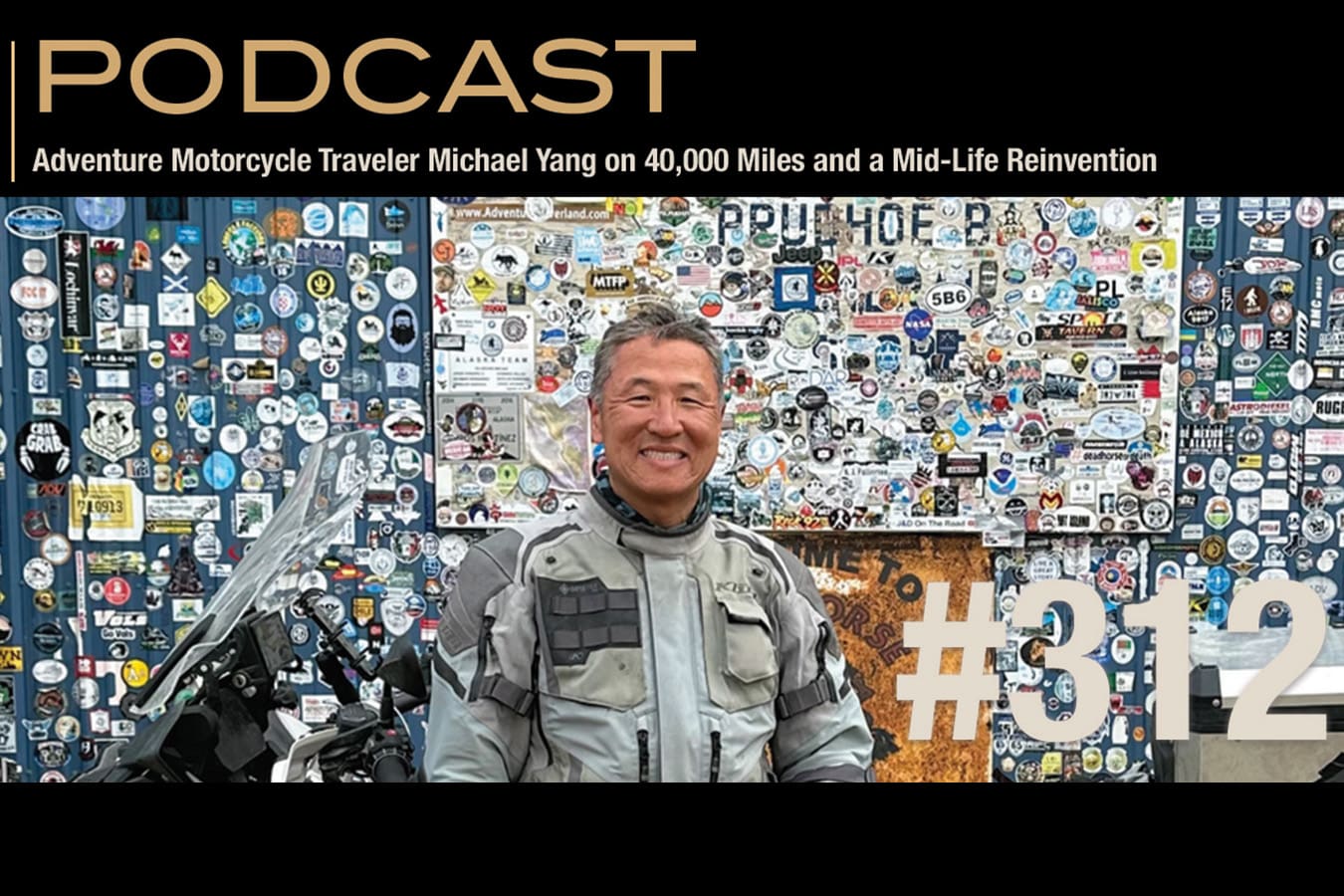
Overland Journal Podcast host Ashley Giordano welcomes Michael Yang, a Korean American author, entrepreneur, investor, and adventure motorcycle traveler, to discuss his experiences riding over 40,000 miles from California to Alaska’s Arctic Ocean, across Newfoundland, and through Patagonia. Michael touches on adventure motorcycling in his 60s, the impact of immigrating to America during his childhood, and how buying his first motorbike primed him for his adventures to come later in life.
Overland Journal Podcast Episode #312
The Overland Journal Podcast is brought to you this week by Nitto Tire, Overland Journal Magazine, and Hankook Tire
New to Overland Journal and want to grab a subscription! Visit Overland Journal and enter code: overlandpodcast at checkout for 20% off. We thank you for being a subscriber.
Guest Bio:
Michael Yang
Michael Yang is a Korean American author, entrepreneur, investor, and adventure motorcycle enthusiast traveler. He was born in Seoul, South Korea, and immigrated to San Jose, California, at 14. He founded a Silicon Valley tech startup, which was successfully acquired by a large corporation. In his sixties, Michael began embarking on epic motorcycle journeys across North and South America. Michael holds a bachelor’s degree in electrical engineering and computer science and a master’s degree in business administration from UC Berkeley, and a master’s degree in computer science from Columbia University. Michael holds a fourth-degree black belt in Taekwondo. He lives in La Canada, California, with his wife and family. Coming Alive on the Ride is his first book.
Michael Yang Website | Instagram | Facebook | Coming Alive on the Ride
Tune in Apple Podcasts | Spotify | YouTube
Host Bios:
Ashley Giordano
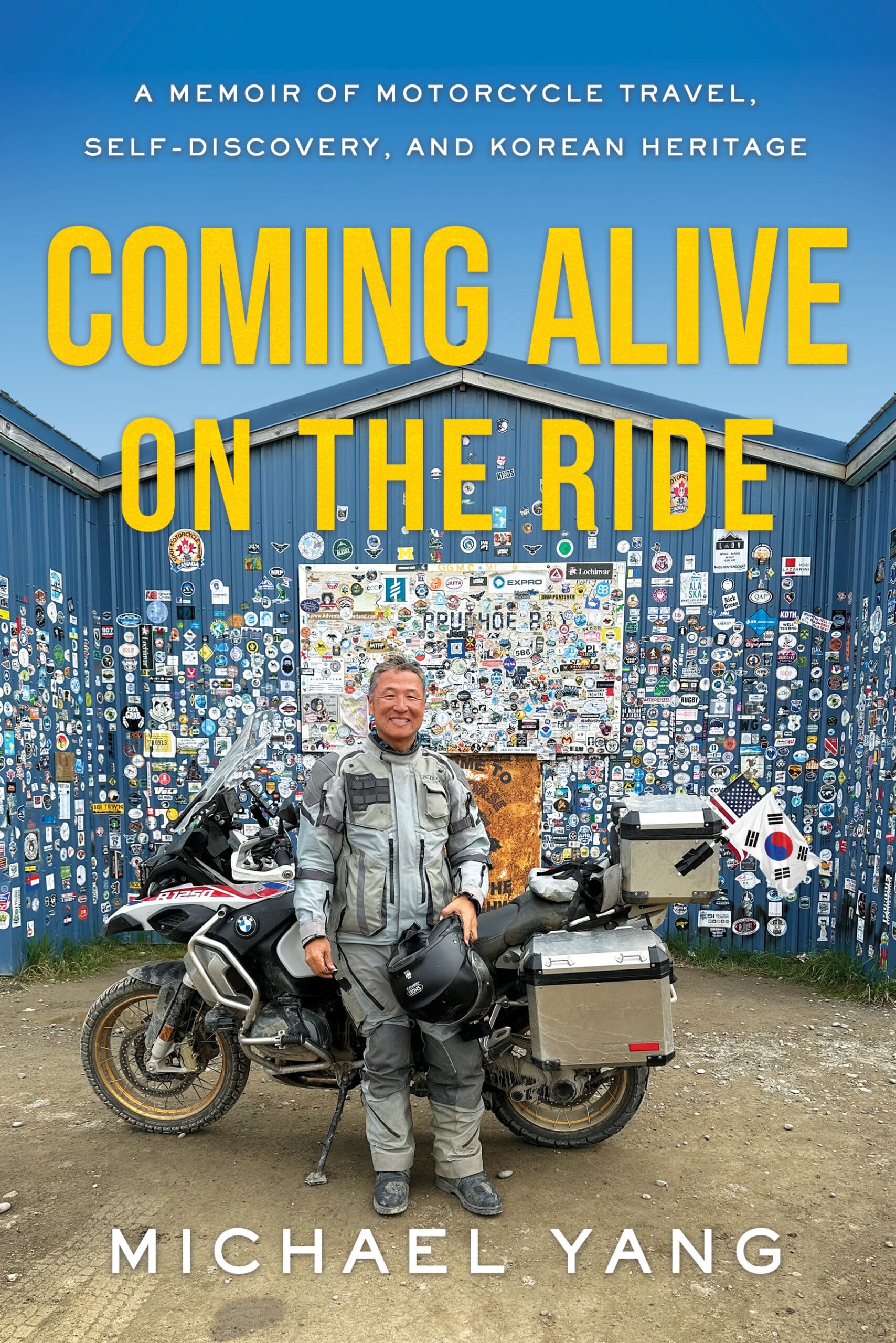
Ashley Giordano’s first foray into overland travel involved a 48,800-kilometer journey from Canada to Argentina with her husband, Richard, in their well-loved but antiquated 1990 Toyota Pickup. Currently cruising along the iconic Silk Road in a 2008 Toyota Tundra, her full-time navigator duties are rewarded with bowls of plov and lagman noodles, hikes in the Tian Shan, and countless cups of fragrant Tashkent tea. As senior editor at Overland Journal, you can usually find Ashley buried in a pile of travel books, poring over maps, or writing about the unsung women of overlanding history, including her enduring inspiration, Barbara Toy. @desktoglory_ash
Tune in Apple Podcasts | Spotify | YouTube
Our No Compromise Clause: We do not accept advertorial content or allow advertising to influence our coverage, and our contributors are guaranteed editorial independence. Overland Collective may earn a small commission from affiliate links included in this article. We appreciate your support.
Transcript
[00:00:00]
Introduction
Ashley: Welcome to the Overland Journal Podcast. I’m your host, Ashley Giordano. Today, my guest is a Korean American author, entrepreneur, investor, adventure motorcycle traveler, and a fourth degree black belt in taekwondo. Please welcome to the podcast Michael Yang. Thank you so much for joining us today. Thank
Michael: you.
Thank you, Ashley. I’m excited to be here.
Ashley: Yeah. Where are you coming in from today? Where are you located?
Michael: I’m in Los Angeles, California right now, which is my base.
Ashley: Great. Awesome. So really wanted to talk about your new book called Coming Alive on the Ride, and we’re gonna kinda go back in time, talk about when you had your first motorcycle and coming to America and your life and all the things that have led you to being here and all things [00:01:00] motorcycle.
So I’m excited to chat.
Sponsor: Nitto Tire
Sponsor: And a special thanks to Nitto Tire for supporting this week’s podcast. The Terrain Grappler G3 is the third generation of one of Overlanding’s most trusted all-terrain tires. A new compound and tread pattern delivers improved wet traction and a three-peak mountain snowflake certification.
Improved uniformity reduces road noise while still ensuring performance on the road and in the backcountry. And for even bigger news, the G3 is now available in up to 37-inch sizes. But my personal favorite is the new 255/80R17 that I’m testing on my Quartermaster. This is the first all-terrain available in that size.
And since payload matters, the G3 is lighter than most competitive all-terrains. Nitto backs the [00:02:00] G3 with their best treadwear warranty ever. That means 70,000 miles for hard metric sizes and 55,000 miles for LT and flotation. For more information, visit nitto tire.com. Thanks, Nitto.
Michael: Great. Yeah, love to, uh, sh- share the story, uh, of my adventure and my journey.
First Motorcycle at 15
Ashley: So you buy your first motorcycle at 15 after immigrating to America with your parents. Um, what did riding represent back then? To you.
Michael: Riding, yeah, I mean, I, uh, I was riding a, a 10-speed, uh, bicycle to school and to, um, my work at the time, which was at a 7-Eleven store. I had a part-time job there. Uh, but, uh, the school was a little bit long and there were, um, some, uh, teenagers in the neighborhood, uh, where we lived, um, who were riding these mini bikes, dirt bikes, uh, small motorcycles.
[00:03:00] And, um, so one of the teenagers, uh, was selling his used Yamaha 100cc Enduro bike, so I bought it, and I just had so much fun, uh, riding that, um, Yamaha motorcycle to school and to my work and to the mountains on the weekends in the San Francisco Bay Area, uh, because we were living in San Jose, California at the time.
We had just immigrated from South Korea to United States. And riding to me was such a fun excitement. It was such a joy, and also gave me a sense of freedom, the thrill of riding through the, uh, open road, feeling the air, feeling the surface of the road, as well as slippery dirt road, and I just loved it.
Ashley: Amazing. Yeah, I can imagine as a teenager, that’s a really good time of life to, uh, be mobilized.
Michael: Exactly. Yes. It was, uh, you know, a time to, uh, explore and time to take some risk. And, uh, I was trying wheelies and stuff, and I dropped my bike a few times, breaking the tail lights and everything, but [00:04:00] it was pretty harmless.
I had to go get another, uh, tail light to replace the broken plastic and, um, I may have scraped my, you know, uh, knees or hands a few times, but it was, it was a great experience. Unfortunately, my motorcycle got stolen a few months after I bought it because I had to park it on the street because we’re living in a small two-bedroom apartment with only, like, one parking space, and my father parked his car there.
So I had to park my moto- motorcycle on the street, and one morning, I went out there with my helmet, with my backpack to go to school, and it was gone. And so I was so disappointed, but I didn’t ride for, uh, almost 30, 35 years. But then when I turned 47, I started to have itch to ride again, and that’s when I started riding motorcycle again.
Ashley: An incredible story coming all, you know, decades later. Um, what prompted you to get back on the bike? ‘Cause I’m sure- Yeah … you’re a very different person at that point.
Return to Riding
Michael: Right. I was going through some, um, um, difficult period. I mean, I [00:05:00] had success as a Silicon Valley founder of a dot-com startup that got sold to, um, CNET, uh, in 2000 during the first internet boom.
So that was a, a great exit, a great experience for me, uh, gave me a lot of financial, uh, independence, and I, uh, had just started a family. But my new company that I started, um, started going sideways and it was, um, difficult period because there were a lot of investor pressure, but the business wasn’t growing, and so we hired a new CEO to run the company, and I had some extra time on my hands and, you know, I think it was my body telling me that I should have some fun for myself, not just work and, and, and, you know, raise the family and do, do…
you know, go to church. But I felt like, you know, the fun and excitement was one missing thing in my life, and my body was telling me to go ride motorcycle again. And with, you know, my wife’s consent or permission, I went back to riding motorcycle on a Yamaha 225cc enduro bike. And I loved riding enduro bike because, you know, riding on [00:06:00] the street is good, but, uh, riding on the dirt is, uh, is even more exciting and I could go to some of the more remote places on a enduro bike that I cannot with a street bike.
So yeah, that was the beginning of my adventure, uh, motorcycle travel all over the world.
Ashley: Was there a moment in time where there was something that reminded you of the bike, or had you been thinking about it since that time when you were a teenager and kind of wanting to get back to it?
Michael: Yeah. So I’m– I, um, I think I was really focused on my career.
So during my 20s and 30s, I really didn’t think about motorcycle, uh, riding. But then I think when I was in my 50s, we would take a, a family vacation to like, um, Hawaii, and I rented a, um, a motorcycle there to ride up to the, the Haleakalā peak in the, the Big Island of Hawaii. Um, and maybe it was Maui, I’m not sure which island it was.
But yeah, it was, it was fun to rent a bike for a day and go riding, and I still knew how to ride motorcycle. But [00:07:00] the idea of getting my own motorcycle to ride again, um, sort of frequently didn’t come until I was 47.
Ashley: Gotcha. That is– That’s a fun transition. Um, I’m wondering, like you have all this life experience at that point, you have a background in engineering, entrepreneurism, and you’re all of a sudden going back into the solo motorcycle riding and…
Yeah. How did you see parallels between those two worlds, if any?
Michael: Yeah. So I, um, I, I write about this experience in my book, Coming Alive on the Ride. I had a friend from college who I found out later, uh, in, in life, in our 40s, that he’s also rides motorcycle, and he was living up in the Seattle, Washington, at the time.
And so we kind of talked about going for a ride together sometime. And then when we moved down to Southern California in 2013, got a larger [00:08:00] motorcycle, uh, I got a BMW R1250GS Adventure. He rode his, uh, Suzuki V-Strom motorcycle down from Seattle to LA, and we would, uh, take a short trip down to San Diego, Baja California, to Arizona, Utah, up to, um, you know, uh, Yellowstone National Park.
And so yeah, it, it started with a very short, you know, overnight trip or a four-day trip, but then it started getting longer and longer. And one time we rode from the West Coast, from LA for me and Seattle for him, and rode all the way to the eastern end of North America at the St. John’s, Newfoundland and Labrador.
There is a point called Cape Spears, which is the easternmost point of North America. Yeah, that was a cross-continental ride And that was just so much fun and, uh, exciting experience that, uh, I wanted to write a book to share my experience on my motorcycle. But also, uh, I realized there’s a story of my life as a series of [00:09:00] adventures, uh, coming from Korea as a young teenager and not– without speaking any English and not knowing the, the culture and not having any friends and trying to, you know, fit in and adapt to a new, new country to, you know, starting and selling a Silicon Valley dot-com startup during the internet boom, and then, like, going on these, uh, motorcycle travels across different continents.
So that was the kind of a, a big, uh, life-changing, uh, experience, and I, I just love riding motorcycle and going to see new places on motorcycle, especially on a dirt, because you get to see more of nature through riding on the dirt road.
Coming to America
Ashley: What was your experience like when you came to the US? Like, what do you remember as a youngster of that transition and what it was like?
Michael: Yeah. Yeah. So, you know, it was a bit of a cultural shock for me because, um, first, uh, I grew up in Seoul, South Korea. I was born and raised there. Uh, and when I arrived in San Jose, California, in 1976, um, it [00:10:00] was, uh, a suburban area, uh, kinda rural. There were a lot of, uh, fruit orchards, like apricot orchards and cherry orchards.
And so it, it was kind of, um, a different surrounding. It felt like moving kind of into the suburban or countryside. And when I went to the supermarket for the first time, uh, we didn’t have supermarkets in Korea back then. We would have open markets on the street where you buy produce and other grocery items.
And then there was a little neighborhood, you know, hole-in-the-wall like store selling candies and trinkets. But, uh, we didn’t have supermarkets. But when I walked into a supermarket in United States, I was like so impressed. Aisles and aisles and shelf full of all kinds of food and stuff that, you know, that was so abundant.
And that was a big… um, uh, that made a huge impression on me how abundant things are in the US. And of course, there were some moments of discomfort when, um, my brother and I were walking back from supermarket back to our apartment, and there was, uh, these bunch of teenagers on a, on a car with their windows rolled [00:11:00] down making these funny noise like ching chong wong and…
So I could tell that they were kind of teasing us or making fun of us speaking some Chinese-sounding noise, but we’re not Chinese. I’m, uh, Korean, and it didn’t feel good to, to be sort of teased at or to be, um, um, you know, yelled at like that by these young teenagers. So I realized that, you know, I, I’m a, uh, a minority in this country.
I’m a, I’m a newcomer. Um, yeah, that was a interesting experience when I first came to America as a 14-year-old teenager.
Ashley: And I imagine over time your experiences have changed as you’ve grown older. What has that been like? What’s the experience been like for you
Michael: here? Yeah. So one of the things, um, that, that I did before I left Korea is I took taekwondo and obtained my first-degree black belt before coming to America.
During high school, I played soccer at the, in the varsity soccer team, and one of the soccer players in my team was kind of bullying me because he was bigger and, and stronger. He was, um, [00:12:00] another immigrant from Eastern Europe. And so I had to use my taekwondo to kind of defend myself so that I would maintain some level of dignity in the eyes of teammates and other students.
And I think that, that… And other soccer teammates watched what happened and, and so that kind of changed the perception of me amongst the, the other students in the school that, “Oh, Michael,” or, or Min, that was my Korean name at the time, before I became a naturalized US citizen, adopted Michael as my, uh, American name, that I have, I know this martial art, taekwondo, that, um, so I’m kind of, uh…
A- after that incident, kids sort of paid me, uh, a little bit more respect and gave me more space in the locker room. And anyway, so that was an interesting experience to, to, to be able to stand on my own and sort of maintain my dignity by defending myself.
Ashley: And you’re still doing taekwondo now, and I read you’re a part of a running club.
Um, how do these athletic pursuits help you on the bike?
Michael: Yeah. So, um, you know, my wife and I have four kids, [00:13:00] and so I love to go on long motorcycle trips once a year, and I may be gone for 30 days or 40 days, uh, during the summer or winter, depending on whether I’m going to a northern hemisphere or southern hemisphere.
So I wanna see as much as possible. I typically ride 3 to 400 miles a day if I’m traveling within North America. Shorter in other parts of the world because of the road conditions. But, so I ride between 8 to 10 hours a day, and so it l- it involves– I need to kinda keep myself in a pretty good, um, fitness level.
And so I started running just for my health about eight years ago by joining a local running club, and I, um, decided to go back to work out in taekwondo at the local taekwondo studio. So it’s, it’s a way for me to maintain my fitness level so that I could continue to go on these long-distance motorcycle trips.
Yeah, so that’s kind of the motivation there.
Ashley: Nice. That’s [00:14:00] awesome.
International Adventures
Ashley: So your first international trips, correct me if I’m wrong, uh, was to Newfoundland, uh, in Canada, and then returned as well in another trip up to Tuktoyaktuk when you went up north.
Michael: Yes.
Ashley: Yeah. And then more recently, you went to Patagonia as well- Yes
after a lot of experience riding in the US. Yes. What was it like riding in Patagonia that was a completely different experience than in North America?
Michael: Yeah. So, um, you know, I, I kinda compared riding to Prudhoe Bay, Alaska, which is the, the northern edge of North America to Patagonia, which is on the southern edge of South America.
And one thing I noticed that is that South America, the Patagonia region, is extremely windy, and also that the region down there between Argentina on the Atlantic side and Chile on the Pacific side, there were a lot [00:15:00] of European settlers who had come there three to 400 years ago and did sheep grazing as one industry to support themselves.
And so I saw that there was lots of, uh, grazing area where, where, uh, grazed, and, and it was kind of more, more sort of, um, touched by the human sort of, um, uh, you know, uh, livestock raising. Whereas Alaska was m- a lot more natural. I think the half the state is covered by the national parks. Then the, the, the, the Inuit people or the, the native Alaskan, um, indigenous people, uh, there were more, uh, hunters and fishermen and other sort of things, and raising sheep was not something that they did.
And the, the European settlers didn’t really s- do the sheep farming up there. So it’s both two most beautif- two of the most beautiful places on Earth, but one was more inhabited because of the, the sheep grazing that was going on in Patagonia, and that’s– that was one sort of, um, uh, impression. And the other is how I expected, um, Chile and Argentina to be a [00:16:00] lot more sort of, uh, native people, Latino, Hispanics, but it was a lot more, uh, Northern European immigrant, um, uh, sort of ethnicity from like Germany, Italy, Spain than I, I had expected.
And so there were a lot more European culture that was down in Argentina and Chile than I had expected
Ashley: Yeah. Interesting, hey, how you have this idea of what you think it’s like, but that’s the beauty of going there is to be surprised.
Michael: That’s right. Right. Very different than what I had expected or thought it was.
Ashley: What were the challenges on that part of the trip that you did in Patagonia?
Michael: You know, I think that the wind, such a strong wind down there caused some severe neck pain and shoulder pain because I was wearing a, a, you know, a pretty good size helmet for protection. And when we were riding to the town of El Chaltén, uh, where the, the Fitz Roy, the, the, the peak where the [00:17:00] Patagonia logo is based on, the Patagonia jacket and the, the clothing.
Yeah, as we were riding up to El Chaltén, there was, you know, 70, 80 miles per hour side wind, and we had to keep riding to get to our destination. Um, my, uh, my… I had to, like, push my head and helmet against the wind, and that night my neck started hurting and I had a bad kink on my neck, so that was very painful.
And so I, I could not ride the next morning because of the neck pain that was from such a, you know, resisting that strong side wind. So I think that was one of the most difficult things and, you know, the, that’s So the, the, you know, Patagonia is famous for such a strong side wind and also just, you know, cold temperature in the, in the 30s and low 40s even during the December, January time where it’s summer down there because you’re so close to the Antarctica and then you’re so far south of the, um-
Ashley: Hmm.
Nice. And you– Did you ship your vehicle there or you rented a vehicle there and shipped some [00:18:00] gear?
Michael: I, I decided to rent my bike in the town of Osorno, Chile, which is sort of the beginning point of Patagonia in South America because I didn’t have like three to four months to ride my motorcycle down through Mexico, Central America, and cross the Darien Gap and ride through the Colombia, Bolivia, Peru, down to Chile because of my family obligations.
And then I thought about shipping my bike either to Buenos Aires, Argentina or Santiago, Chile. Many people, um, uh, on, on Facebook group like Horizons Unlimited and other adventure, uh, groups said if I’m there less than like, uh, one or two months, it-it’s probably better to just rent. There are places that rent BMW Adventure motorcycles rather than shipping, which costs about $5,000.
You know, going through the customs is kind of, um, uh, could be tricky because you don’t know when it’s gonna pass and when you’re gonna get your bike. So I was pressed for time because I wanted to ride as much of that 30-day time that I had. So [00:19:00] yeah, I, I found a good place to rent a motorcycle down in Osorno, uh, Chile.
And then, and after I finished riding down to Ushuaia, Argentina, which is the southern tip of South America, I returned the bike at Punta Arenas, which is only about two days ride away from Ushuaia. And then from there I was able to take, um, airplane back home, which took another 20 hours, but it’s mu- a lot better than, you know, having to ride back, which would’ve taken a month or two.
Ashley: Yeah. It’s far, hey. Even from, I think we… When I had flown down there from Houston, I was like, “This flight is long. It’s far-
Michael: Yeah,
Ashley: it is
Michael: Yeah. And with the layover, it’s like, uh, I was tired when I got there after being- Yeah … you know, on the, on the road for like 24 hours since I left home, you know? And, and it’s, uh, adjusting to the local time and climate.
Yeah, it was, it was, it was quite exhausting.
Ashley: What were some of the highlights for you on that trip?
Michael: Highlight for me, I think [00:20:00] it was when I arrived in El Chaltén, I challenged myself to hike up to the Fitz Roy Trail, which is about a 14-mile in and out trail. Uh, so I had brought my hiking shoes, hiking poles, a hiking backpack, and, and, um, just, just barely enough stuff with me so that, um, uh, I could hike to Fitz Roy.
There’s a lake at the top there, and, and, you know, hike back down and then continue my motorcycle journey south down to Ushuaia, Argentina, which is the southern tip. And I think, you know, arriving in Ushuaia was, uh, another special moment where I felt like I’d reached the, the southern end of the, the road, so to speak, on the south side since I had done the, the end of the road on the northern side at Prudhoe Bay, Alaska, and Tuktoyaktuk, Canada.
Ashley: Was it really windy at the lake? ‘Cause when we were there, I always had to hide behind a rock ’cause we went up for sunrise, and it was just absolutely crazy- I see you hiked up there too … windy. Yeah, it was just out of control. [00:21:00]
Michael: Yeah.
Ashley: But beautiful.
Michael: Yeah. It wasn’t so windy. I took some photos and I took some videos.
But, uh, Fitz Roy Peak was covered in cloud. And there’s a local name for that Fitz Roy, uh, I forgot the name, but there’s a native name for it, and it kinda means it’s kinda like covered in cloud. So it’s kinda like shrouded kind of, uh… It was interesting to learn about local name for that peak because it was like that when I, when I, uh, arrived at the, uh, at that lake at the top of the Fitz Roy Trail.
Ashley: Very cool. Yeah, it’s special there. I don’t know if you had this feeling. There are a few places in the world I’ve felt this feeling of, um, I don’t know if I can describe it exactly, but it’s a sp- special place that you think it feels different, feels special.
Michael: It does. That, I mean, that, that whole area is such a beautiful area with snow-covered mountains and the greeneries and blue sky.
I, in [00:22:00] fact, have a, a photo of Fitz Roy as a screensaver on my office computer, so I get to kinda, you know, be reminded or relive that, that moment that I was, you know, hiking up to Fitz Roy Peak.
Ashley: Perfect stuff
Michael: Yep. Yep.
Ashley: You mentioned- Beautiful place … you mentioned, um, balancing family with riding. So you, you choose trips that are a bit shorter so that you can balance family obligations with travel.
Um, tell me a little bit more about that.
Michael: Yeah. So, you know, I, I’m passionate about, um, motorcycle riding and traveling, um, all over the world on, on two wheels. And I– You know, my wife and I have four children age 22, 18, 16 and 13, so we still have two in high school. And I also have, you know, other sort of, you know, small responsibilities of, uh, you know, managing some income property that we own or other sort of management responsibili- asset management responsibilities.
So I try to find a balance [00:23:00] by agreeing with my wife that I would just take off once a year, maybe 30 to 40 days long, and, and the rest of the time when I’m home, I do extra work around the house or doing things with kids so that it balances out. And also, my wife doesn’t like to ride motorcycle, uh, but she loves to go skiing.
And so we, we go skiing together as a family. And she also likes to go skiing with her friends, um, to, you know, whether it’s, uh, Mammoth Mountain or Colorado or Utah or she just came back from a, a ski trip to Hokkaido, Japan. So yeah, I, I let her take off on her trip, though they’re not nearly as long as my motorcycle trip.
But that’s, that’s kinda how I balance my passion for motorcycle riding and traveling around the world while I, uh, still sort of, um, you know, do my role or responsibility as a husband and father. And also my, my mom, uh, my, my mother is 91 years old, and, um, I… You know, she lives, um, in a guest house behind our house.
She worries a lot when I’m traveling, you know, all over the world [00:24:00] on my motorcycle, like any mother would. And so, yeah, I, uh, I have responsibility to take care of, you know, the family. So that’s how I manage doing both family as well as my passion for adventure motorcycle traveling.
Ashley: Yeah, I think it’s important because everybody’s life looks different, and the amount of time they have available is different.
And so I love that it’s, you know, you’ve worked it out to work for you and your schedule and your family and your wife and your mom and everybody, because not everybody has six months or four months or, you know, only maybe a
Michael: couple weeks. Yeah,
Ashley: exactly.
Michael: Yeah. I think if I, if I was a single or didn’t have family, uh, responsibility, I, I may, you know, want to go travel for a year and do, you know, around the world, right?
Um, you know, maybe all at once or in, you know, two or three increments. Um, I don’t, I, I, you know, I am, I, I am a, a, you know, a husband and father, so what I decided is I’ll do divide and conquer. I’ll do, you know, one continent at a time. So each year I would go [00:25:00] to, you know, uh, South America, or this summer I’m riding up to Norway and to Nordkapp and, and cover Baltic states and Northern Europe.
And then, you know, maybe a year after that, I could ride to Pamir Highway and Mongolia and, you know… There’s so many, as you know, beautiful places to, to go see in the world, and I will never be out of place to go ride and, and enjoy just the amazing nature as well as, uh, all the people and experience that you run across.
Ashley: Absolutely. Yeah. There are al- there’s always somewhere else to go, so-
Michael: That’s
Ashley: right. Yeah … that’s a, a wonderful way to do it. So you started your, these journeys in your 60s, and what do you say to people that think you’re too old or too busy? We kinda just talked about that, too busy, or too late to pursue their own adventures.
I think 60 is, what is it? The new 50. 50 is the new 30. So what do you, what are your thoughts?
Michael: Right. Yeah. I mean, I, um, encourage, uh, you know, [00:26:00] anybody and everybody to embrace adventure in whatever form. It could be motorcycle, it could be bicycle, it could be just walking or hiking, but just get out of your, um, home, get out of your comfort zone, and kinda push yourself to, you know, challenge yourself to take on some risk and do some adventurous things.
And so, you know, I think age is– I think fear catches everybody. It doesn’t have to be just people in their 50s and 60s. So I think you don’t want fear to decide for you. I think you wanna manage your fear by doing the, the research and the planning on whatever adventure travel that you wanna go on. And even though there’s a lot of unknowns and uncertainties, go do it because I think traveling and, and going on these adventure trips kind of makes you, uh, a better person because of the experience that you gain and, and maybe the confidence or sense of accomplishment that you gain from that experience.
So yeah, I, I encourage people of all ages to, to do something that’s a bit adventurous [00:27:00] because, uh, they’ll, they’ll be, um, uh, they’ll find that, that it was worthwhile.
Ashley: For sure
Sponsor: Overland Journal
Sponsor: Not a week goes by that someone doesn’t reach out to ask how, uh, they can help support the podcast. Uh, we are, uh, supported entirely by, uh, Overland Journal, the magazine.
So when you become a subscriber to the Overland Journal print magazine, you get this beautiful book, uh, that comes in five times a year. It also gives you access to our digital archive. Uh, and it’s well over 100 pages of, of gorgeous images and detailed testing and adventures from around the globe. So if you go to overlandjournal.com and you subscribe to the magazine, use the code OVERLANDPODCAST, and that’ll get you 20% off.
It’s only available to our podcast listeners. We don’t advertise it anywhere else. Um, and then you help us to maintain that independent employee-owned journalism, um, that we have been famous for. So it allows us to conduct those tests without any advertorial. Another way you can help out [00:28:00] too, I produced a book, uh, last year with Simon & Schuster called “Overlanding 101.”
You can find it on Amazon or Barnes & Noble or even your local bookstore. And that encompasses my decades of travel around the world, all of my mistakes and failures and, and the lessons that I’ve learned in traveling around the globe. Um, many of those, um, that you hear on the podcast have been distilled down into print form with great lists and beautiful imagery.
Uh, so you can find that, uh, at your local bookstore, “Overlanding 101.” And thank you all for listening and for supporting us so much throughout these years.
Ashley: Are there any people that have inspired you?
Michael: Oh, yes, many people. You know, I used to love, uh, read about autobiographies of, um, famous entrepreneurs, um, businessmen, industrialists, or even, even political leaders.
So I remember enjoying, uh, reading, um, Lee Iacocca’s autobiography or Bill Gates’ autobiography Just to name a few. And, uh, I also love reading about books written [00:29:00] by people who rode their motorcycles around the world. So for example, I think Amelio from Argentina, who spent 10 years on the road traveling around the world on a Honda Gold Wing motorcycle and writing a book about his journey, uh, that was very inspiring.
And there’s another motorcycle rider named Helge Peterson, who, um, was a Norwegian motorcycle traveler who rode his BMW, um, adventure motorcycle all around the world. And I think he’s one of the first, if not the first human to cross the Darien Gap between North America and South America on his motorcycle, which was quite a, quite a major challenge, but he did it.
And, uh, yeah, so I love being inspired by other people who have accomplished, um, you know, these, um, unbelievable feats of, uh, um, you know-
Ashley: Yeah, there’s certainly plenty of great stories out there to inspire, that is for sure. For sure. For sure. That’s part of why I do this podcast.
Michael: Yeah, it’s great. It’s great.
Rapid Fire Q&A
Ashley: So Michael, I’d love to take you through some rapid [00:30:00] fire questions now. Okay. It’s just going to be a series of one or th- few word questions and you’ll have the answers. So the first one is most ingenious repair.
Michael: So when I was riding from LA to Newfoundland, I was riding through the south shore of the Lake Superior, and that’s about 400 miles of stretch and not many towns or, or service stops in between.
And so I saw that my motorcycle shifter, gear shifter was, uh, very loose and the screw had fallen out. And so I almost lost that shifter, and if I did, uh, I would’ve been stuck in one gear and would not be able to shift. So it would’ve been, uh, caused a major kind of delay in my, my trip. But I used a, a zip tie to put that shifter back on without having a, you know, proper sized screw on hand, and that tied me over until I got to Sault Ste.
Marie and there was a Home, Home Depot there. Bought a screw and, and fixed it there. I think zip tie, using zip tie to, to fix that [00:31:00] temporarily was, I felt, was, you know, I thought that was a great solution to the problem at hand until I got to somewhere where I could get the proper repair done.
Ashley: Yeah. Shout out to the zip tie.
It’s like the- Yep … overlander’s best friend. I love a good zip tie. Exactly.
Michael: Yep.
Ashley: Okay. Best food is the next question. Now, I know you’ve traveled other than on your bike to a bunch of different places, so these questions can include those destinations as well. It’s up to you.
Michael: You know, I loved the lobster roll at the Prince Edward Island in, uh, Canada.
I mean, the, the… It was such a fresh, um, you know, Maine lobster or whatever the, the locally caught lobster was in a toasted bun and just the right amount of mayonnaise and butter and boiled lobster meat. It was, it was, um… I loved eating, like, fresh local food and, and that was, to me, one of the best sort of treats in terms of, you know, fast food that I had on my travels.
Ashley: Nice [00:32:00] That’s awesome. I’m Canadian, and so I feel very proud that you chose the lobster roll.
Michael: That’s great.
Ashley: Okay. Next is worst illness.
Michael: So yeah, again, on my trip from LA to Newfoundland, Canada, um, I was wearing this Alpinestar Tech 10, um, motocross boots to kind of protect my foot and ankle from any, any potential injuries because I had broken my ankle the year before, so I was particularly sensitive to, to making sure that I was wearing the most pr- protective gear I can.
And so… But wearing Alpine Techstar, the Alpine Techstart– Alpinestar Tech 10 boots is meant to be worn one day or two days or maybe three days max, but I was wearing it on this 40-day trip. And so after wearing it for like, I don’t know, 20 days, almost every day straight, when I got to this town of Red Bay, Labrador, which is the m- northernmost point of our journey, my left foot, I mean, left ankle was under a [00:33:00] lot of pain.
And I think it was because, you know, wearing that very heavy, stiff, protective boots didn’t agree with my left, you know, foot and ankle. So, you know, I was in a lot of pain and but I still need to ride and shift gears to get to, you know, our destination. So I remember, you know, uh, suffering from this se- severe pain in the, in the motel room we were staying in, and we’re…
I was five thousand miles away. I couldn’t go see, um, any doctors or, or, uh, acupuncture, you know, therapist or anything. So I was just suffering, and I was thinking, you know, “What am I doing here? I’m like five thousand miles away from home. Nobody told me I have to do this. I’m doing it out of my own sort of, you know, um, my own desire, and, and here I am just suffering, you know, from this, this, this severe pain in my left ankle.”
Fortunately, I got to St. John’s, Newfoundland, a couple of days later and rested for like three days, and it got better without having to go to see a doctor. So yeah, so one of the things I, I wrote to myself is never [00:34:00] go on long distance motorcycle trip wearing a motocross, uh, boots like, you know, like that.
Ashley: Good advice.
Michael: Yep.
Ashley: Okay, next is lowest low.
Michael: You know, when I rode from LA to Alaska by myself in the summer of 2023, I, uh, I brought with me camping equipment in case I couldn’t find lodging. Uh, normally, I like to just stay in a motel or a cabin, uh, just to conserve my energy because I’m riding like three to four hundred miles a day.
And, you know, I was 61 years old. Uh, you know, just conserving energy and, and staying as fresh as I can is, was high priority. But when I was up in, uh, Alaska, coming back down from Prudhoe Bay, I wanted to go explore this national park called, uh, Wrangell-St. Elias National Park on the southern part of Alaska near Valdez or there’s a town called McCarthy and, um, Kennicott.
And so I w- needed to find lodging nearby there, but there were– all the lodges, uh, were like booked up or nothing was available in the [00:35:00] area that I wanted to stay. But I called this one place called Gakona Lodge, um, and they were, you know, booked out, no rooms available. But I explained my situation and asked if there is any, uh, place I could set up tent.
And the owner said, “Well, there is some grassy area right outside of our saloon that you could set up tent and you could do that for free, and you could use the, the restroom.” So I said, “Oh, that would be great. I, I do have a tent and I could camp out.” So I stayed there two nights, but it so happened that it was Saturday night and that Gakona Lodge is kind of where the local people kind of hang out.
It’s their only form of social entertainment. Um, and so, uh, I was, I was dead tired. I needed to get some sleep, but there were people so loud in that saloon, and people were just drinking and lis- you know, there were loud music playing. So it was going on till like two, three in the morning, so I was, uh, you know, just kind of, just kind of frustrated and annoyed that they’re so loud.
But what can I say? It was a free lodging, so I couldn’t really do anything. And next morning, I woke up feeling really achy and cold [00:36:00] and, um Um, and I asked the question, “So what am I doing here again?” Which is the same question that I asked when I got to Newfoundland when I was under a lot of pain because of that thick protective, you know, motocross boots that I wore for so long.
So anyway, that was, that was, uh, one of the lowest points of my, like, travels. But, you know, nothing, you know, horrible in any way. It’s just, uh, when you’re so tired and exhausted and you couldn’t get much sleep and you’re so achy from riding, you know, nonstop for so long.
Ashley: Yeah. Let’s go the opposite now, and highest high.
Michael: Well, you know, I think when I made it up to, uh, Tuktoyaktuk, Canada, and I tried, uh, you know, eating the muktuk, which is a raw beluga whale meat, which is what they hunt and eat up there by the Inuit people, because that’s how they survive. They cannot raise, like, cattles or pigs because the, the ground is, um, uh, frozen most of the year.
So trying that and then continuing on my journey to get up to Prudhoe Bay, Alaska, which is the end of the road on the Arctic Ocean. So it was pretty hard to [00:37:00] get up there. I had to ride, like, 2,000 miles of gravel road through the Dempster Highway and then Dalton Highway, and there were not many stops in between.
And so it was, it was quite challenging, uh, physically as well as mentally. But when I made it back down to Fairbanks and then down to, uh, Tuk, I felt like I accomplished something that was, uh, very challenging. And, and I, I felt like that was one of the highlights of my motorcycle travels.
Ashley: Beautiful stuff.
Next is current favorite piece of gear.
Michael: Does my motorcycle count as a gear?
Ashley: Yeah.
Michael: Or is it something- Of course. Oh. Oh, yeah. Then my, my, my bike, my, uh, 2021 R1250GS Adventure. Uh, I have about, um, almost 40,000 miles on it now, and, and I’ve taken that motorcycle pretty much everywhere in North America, and it hasn’t let me down.
Uh, I’ve had some, you know, uh, flat tires and that shifter gear, shifter that kinda became loose and I almost lost it. But, um, yeah, it’s [00:38:00] my, uh, favorite, uh, gear, my, my go-to bike. Uh, yeah, I love that bike, and so I’m gonna just, you know, continue to ride it to all over North America. Um, and, and yeah, so that’s my favorite gear.
Ashley: I love it. So
Shinage & Family Legacy
Ashley: I wanna switch gears a little bit here and ask you about the Korean concept of shinage. Hopefully I pronounced that properly. Yeah, you mention it pretty early on in the book, and I think it is a wonderful theme that runs throughout. So tell us a little more about it.
Michael: Right. Yeah. And, you know, my book title, “Coming Alive on the Ride,” is kinda tied to this Korean, um, uh, word called shinage.
Shinage, uh, is essentially, um, this, this, um, emotional state where you’re feeling such a natural high. It’s, uh, you’re in a state of bliss. You’re enjoying your moment so much, uh, that you, you sort of, um, feel so positive, enthusiastic, and you kind of lose, um, sense of time because you’re kind of in the zone.
And when I was riding [00:39:00] through the Rocky Mountains across Colorado four years ago, I felt this shinage. And whenever I describe my travel to other friends, they say, “Wow, you come alive when you talk about your motorcycle trips, and you’re like shina or shinage.” And yeah, it’s a, it’s a state of being in a bliss or so excited and enthusiastic and, uh, feeling positive.
Ashley: I love that. I love that. The other question I had, this is also related to the book. So you mentioned that your aunt, uh, who you visited, asked you, “Who are you like that you love adventure so much?” And I’d like to know more about just sharing more about your family history and how it has led you to Your adventure, adventuresome life
Michael: Right.
Right. So, you know, I, I recently found out about this recently after I finished the book. But, you know, in my book, I talk about how my aunt, when I was coming back from Alaska, asking, “Who are you like that you love adventure so much?” Because she didn’t, um, think of anybody in the family who did such an [00:40:00] adventure.
But, uh, you know, in my book, I talk about my friend Carl Park, who’s, uh, you know, my best friend and motorcycle riding buddy, um, who was one of the sources of, uh, inspiration for these m- adventure motorcycle travels. And my father, who actually, you know, came from South Korea to United States when he was 42, and he didn’t speak any English, and so it was complete start over for him.
And so it took a lot of courage for him to, like, decide to come to America and bring the family along. So I, I think he was very resilient. He was a survivor of the Korean War and the Japanese occupation during the ’30s and ’40s when he was a t- you know, um, child and teenager in Korea. But I found out recently that my grandfather on my mother’s side and my great-grandfather on my father’s side had traveled all over South Korea as well as, uh, what is now, um…
It used to be called Manchuria. Manchuria is a country that is northern part of, uh, China. But there was a, um, that’s, [00:41:00] that’s a whole region out there and I found out that both my grandfathers on my both sides traveled to those regions, as well as the mountain Geumgang area along the east coast of Korean peninsula when they were like, you know, in their 30s.
Uh, I think that, um, sense of adventure and travel, uh, does kinda run in the family, it’s just that my parents didn’t get to do much of it just because they were busy, you know, trying to provide for their family, and they didn’t have the financial or time, extra resource to, to pursue that. I realized, you know, it, it’s kind of a…
It, it’s expressing itself, sort of it skipped a generation in a way. There was that adventure travel sort of, um, genes that, that, you know, comes through. So I think that, um, you know, I think there’s adventurous people everywhere and, and some do it more than others, and some have more courage or curiosity that drives them.
So I’m, I’m, I’m very lucky that I found this, um, sense of [00:42:00] curiosity, wonder, and strong desire to go on adventure travels. Uh, and it’s been a, a great thing for me, and that’s why I wanna encourage others to do the same.
Ashley: Absolutely. What would be your advice to somebody who would like to make a change or head out on a trip or, I guess, start an adventure of their own in some sort of way?
It doesn’t have to be travel, just to take those first few steps.
Michael: Yeah. So I think ask yourself, what are things that you enjoyed doing when you were young, when you were a child, something that you’re curious about or you have some interest. It could be, um, um, you know, outdoor activities of any kind. It could be hiking, bicycle riding, just traveling solo to a new town or, um, yeah, something that involves a level of excitement but also a little bit of fear and anxiety.
Because if it’s not scary, then it’s not an adventure. So, um, you know, as long as, um, if you fail and, and it’s not gonna kill you, then, then I would say go, go try it. Go, like, push yourself to do something that scares you a little bit but [00:43:00] also it’s exciting. ‘Cause I think if you finish that, then you will feel much better about yourself and find a better version of yourself.
Ashley: Yeah, great advice, and building that confidence a little bit at a time. You know, they say leap and the net will appear. Um, and also I think having a strong support system that if you go do something that feels scary to you, you have, uh, friends or family that can reassure you, you know- Exactly … you’ll be okay.
Sponsor: Hankook Tire
Sponsor: And a special thanks to Hankook Tire for supporting this week’s podcast. With summer underway, head over to expeditionportal.com for Jeep Beach vibe inspiration. Our team spent the weekend with Hankook Dynapro Tire at this year’s 2026 Jeep Beach week in Daytona, Florida, and took a look at their Wrangler 392.
Look for Jeep Beach 2026 when you go to expeditionportal.com.
Ashley: Probably.
Michael: Yeah. [00:44:00] That’s a great way to start. I, uh, I also wanted to, to mention that, you know, find, you know, someone in your family or, or friends who you could do this with, and after you do it a few times, you may gain enough confidence to be able to do it on your own if your friend cannot go together next time And you love that solo experience Yeah, I love that Yeah
Ashley: Yes.
Yes. Yep. Great.
What’s Next & Where to Follow
Ashley: Thank you, Michael. Before we wrap up, um, what is next for you? You have this trip coming up in this summer, uh, in Norway and Europe and the Baltics, and I think you have some speaking engagements going on. But, uh, anything else? Any other news? And where can we follow you?
Michael: Yeah. So, um, yeah, I, uh, I love riding, going on motorcycle riding and traveling, but I also love sharing the story.
And so my book is one of the ways that I wanted [00:45:00] to share my story and with a, with a goal to encourage and inspire other to seek adventures. And now I am trying to create some, uh, videos to upload to YouTube and, and share it on my YouTube channel called Alive on the Ride. It has less than 100 subscribers now, but I’m, I wanna, I wanna be intentional about filming and, and uploading the video after, um, I do some editing through help of a, a marketing helper and, and sort of, you know, do that on a more, uh, regular basis so that, uh, video could become another way of sharing my story.
So yeah, that’s kind of, uh, what I’m planning in addition to my upcoming motorcycle trip to Norway and to, uh, other places, um, around the world after that.
Ashley: Fantastic. Well, we’ll be sure to follow you and your journey along the way. Do you have… You have Instagram and a website. Where can we find you online?[00:46:00]
Michael: Yeah. So, um, I have a, a Facebook page, facebook.com/michaelyang1. Um, and then I have a website at, uh, michaelyang.com, and, um, I have a YouTube channel called Alive on the Ride. And also you could find me on Instagram at instagram.com/michaelyang831. And my book, Coming Alive on the Ride, is available on amazon.com or anywhere where books are sold, in, uh, hardcover, e-book, as well as audiobook.
Ashley: Perfect. That’s great. I’m sure the listeners will have a great time tracking that down, following your next adventures. Michael, thank you so, so much for taking the time to speak with me today on the podcast. It’s been a pleasure, and I can’t wait to see what your next adventures hold.
Michael: Thank you so much, Ashley.
Enjoyed talking to you.
Ashley: And a shout-out to the Overland Journal podcast listeners for tuning in to today’s episode. Thank you so much, and we’ll see you on the next episode.