

Photography courtesy of the Scientific Exploration Society
To honor the 20-year anniversary of Overland Journal, we are revisiting special heritage content in the upcoming 100th issue of the magazine. Originally published in Overland Journal’s Fall 2016 issue, this article is part of that celebration.
Having been taught that Christopher Columbus discovered America, I was intrigued by the 1965 discovery in Greenland that confirmed the existence of Viking settlements in the New World. Were Vikings the first Europeans to land on American shores? Archaeologists and anthropologists have long theorized that there may have been ancient transatlantic contact, pointing out unexplained similarities between supposedly isolated peoples around the world. In the early part of the last century, European anthropologists saw similarities between ancient Egyptian civilization and South American and Mesoamerican cultures such as the Inca, Aztec, and Maya. They cited architectural, calendrical, and mythological parallels when proposing Egypt as the source of all advanced societies. Encouraged by the distinguished Norwegian explorer Dr. Thor Heyerdahl, I began to study the fascinating possibility that man had succeeded in crossing the oceans thousands of years ago.
Heyerdahl’s 1947 voyage of 8,000 kilometers from Peru to Polynesia on a traditional balsa raft brought him fame and controversy. However, his 1970 Atlantic crossing from Morocco to Barbados in a reed craft proved beyond doubt that such early voyages were possible. Interestingly, Phoenician coinage dating from 350–320 BC depicted the Atlantic Ocean and apparently part of the American coast. Furthermore, Roman jars had been found in a Brazilian bay, and sculptured Olmec heads looking decidedly like proud Africans were found in Mexico. These discoveries mystified anthropologists. In 1992 came the startling news that a German toxicologist had identified traces of cocaine and nicotine in 3,000-year-old mummies of Egyptian priestesses. Both substances were then unknown in Egypt but were plentiful in the New World. Heyerdahl was convinced that there had been a thriving maritime trade in South America, but could clans of the central regions have carried goods to the Atlantic?
Thus was born a series of expeditions aimed at proving traditional reed boats could navigate the rivers from central South America to the Atlantic. Our Aymara boat builders on Lake Titicaca named the project Kota Mama (Mother of the Lake). The organization would fall largely on the Scientific Exploration Society (SES), established at Sandhurst, England, in 1969 to bring together servicemen and civilian experts to foster scientific exploration.
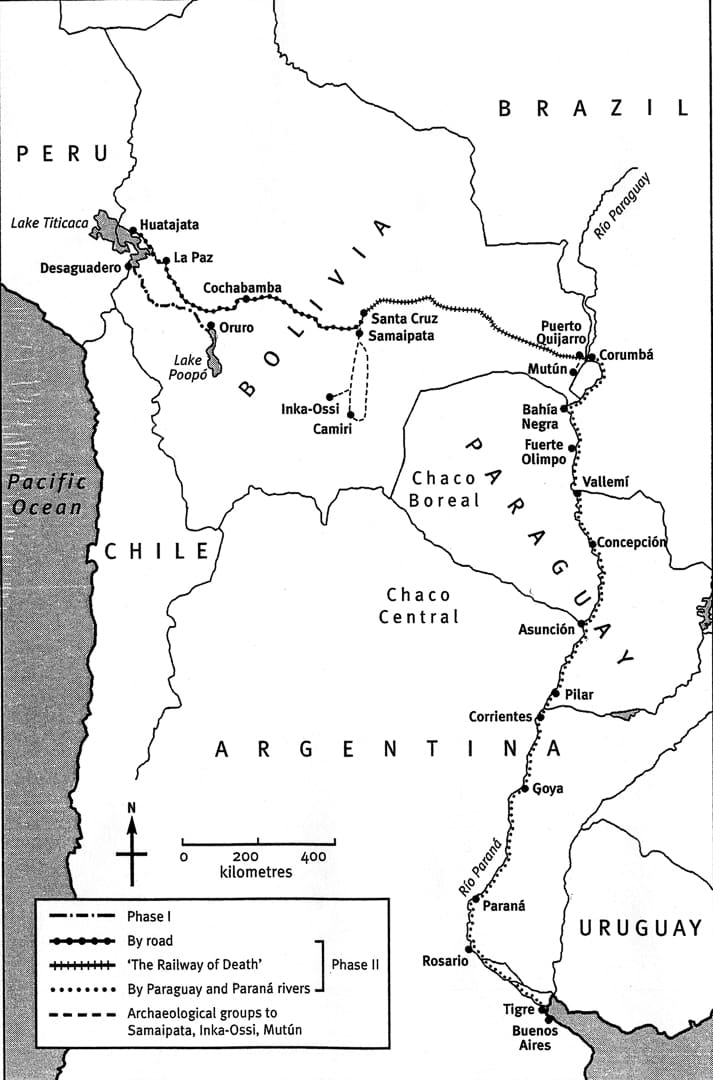
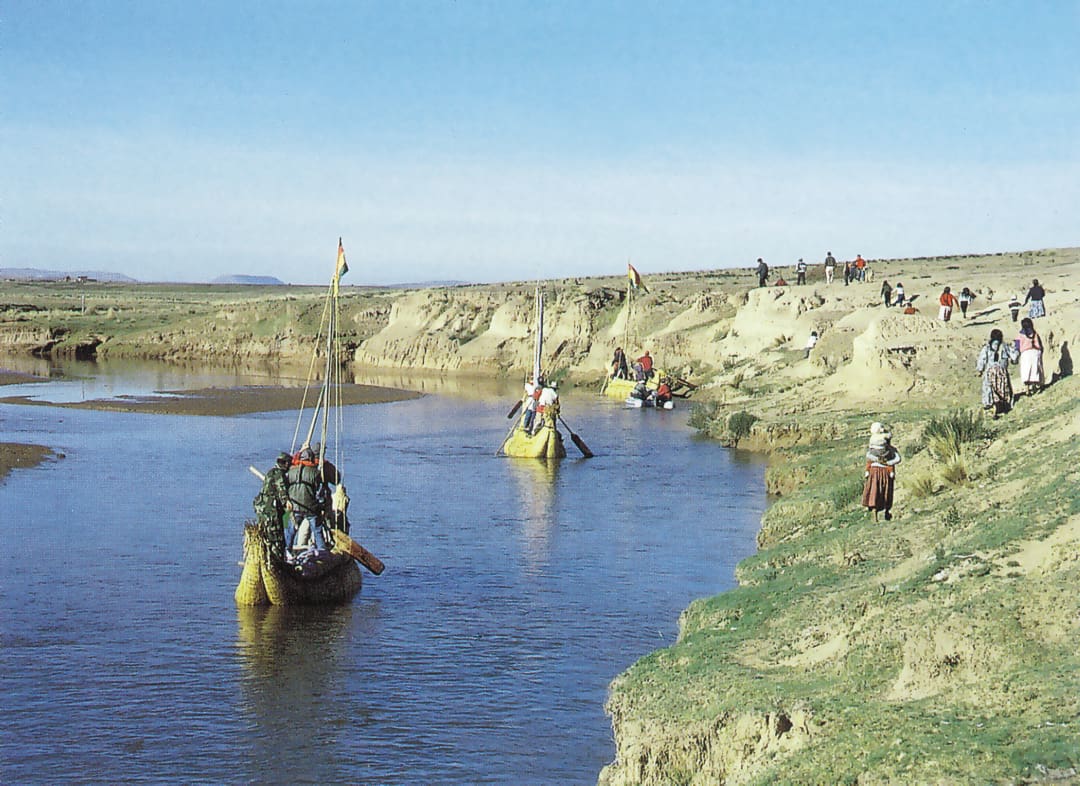
Having consulted Bolivian archaeologists, the first project was to be a voyage down the Desaguadero River. Running south through the desert from Lake Titicaca, the world’s highest navigable lake, to Lake Poopó, this river is believed to have been a waterway used 3,000 years ago by an advanced civilization known as the Tiwanaku. In March 1998, El Niño weather reduced it to a sluggish stream winding for 400 kilometers through reed beds and sand banks. It was here that we chose to test three traditionally built crafts whilst searching for undiscovered archaeological sites. Bolivia is a wilderness of archaeology with an estimated 30,000 sites still to be explored: a long job for our eight underfunded mates from the National Institute of Archaeology and Anthropology. Each of the Kota Mama expeditions would involve ethnographic and hydrological studies, wildlife conservation tasks, and assistance to remote communities.
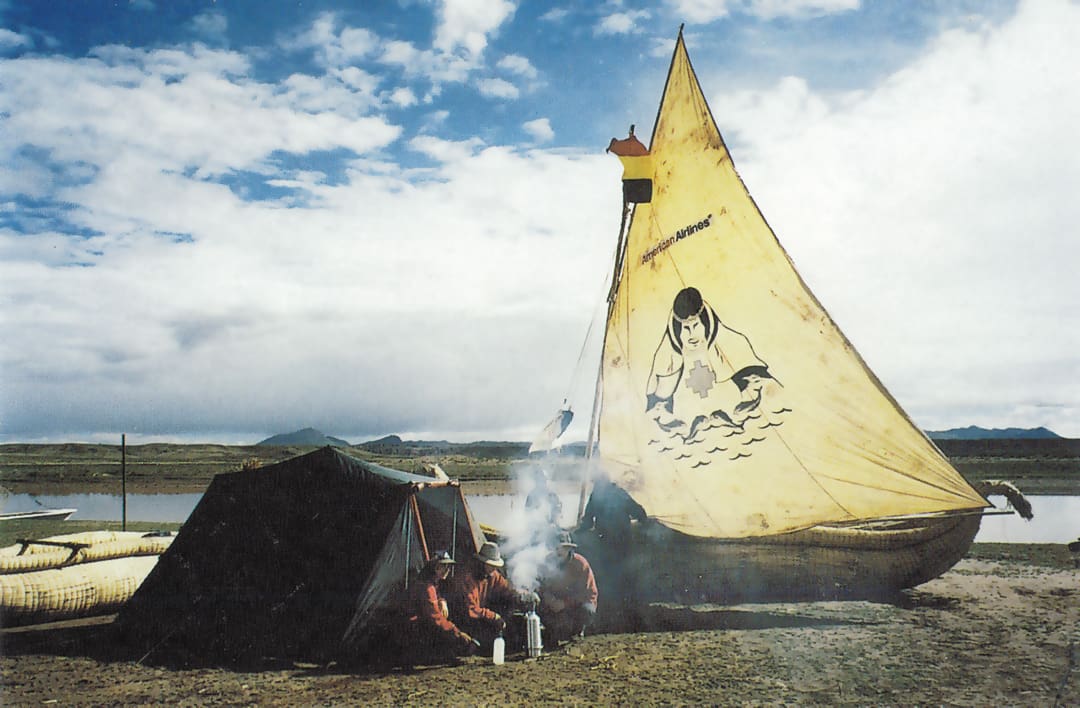
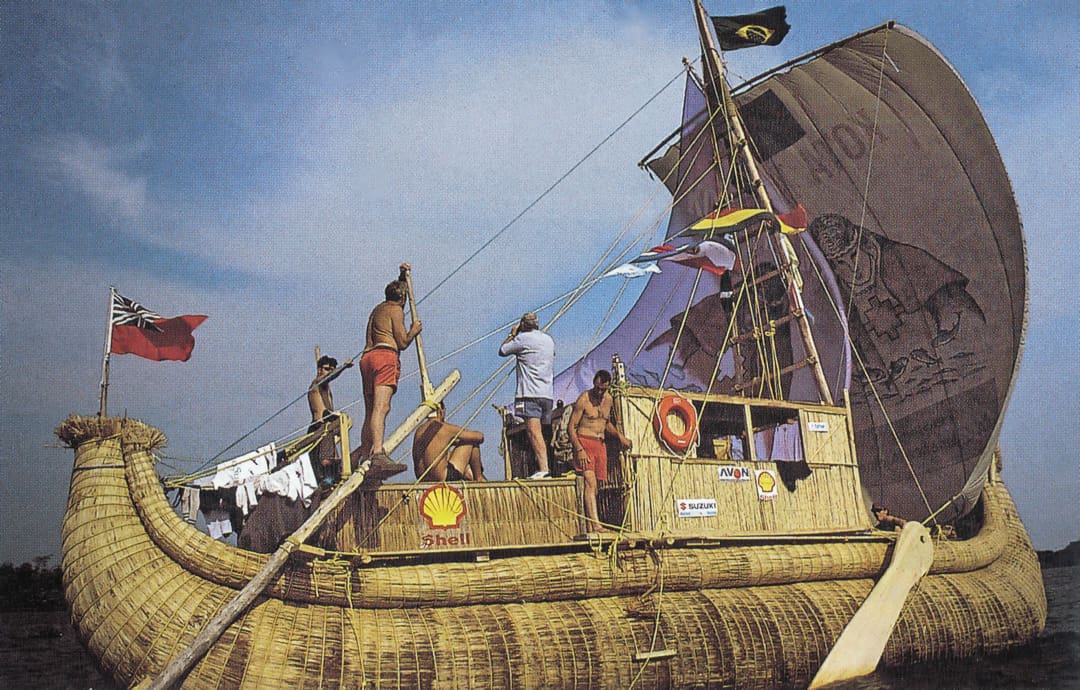
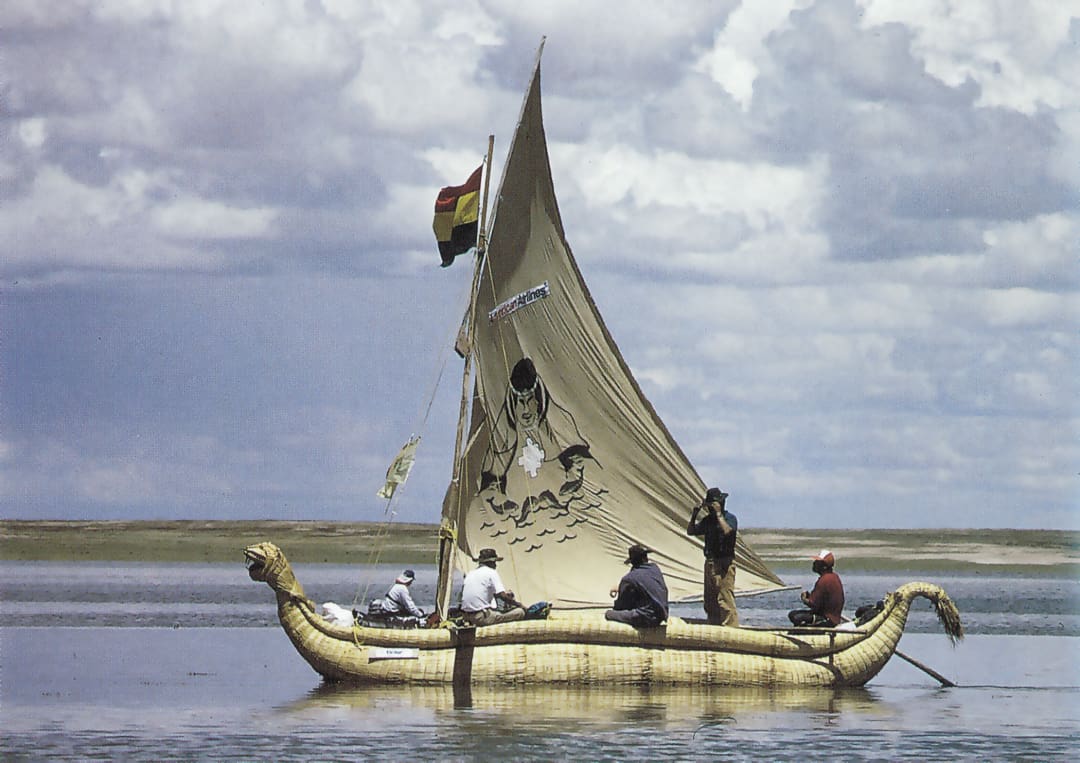
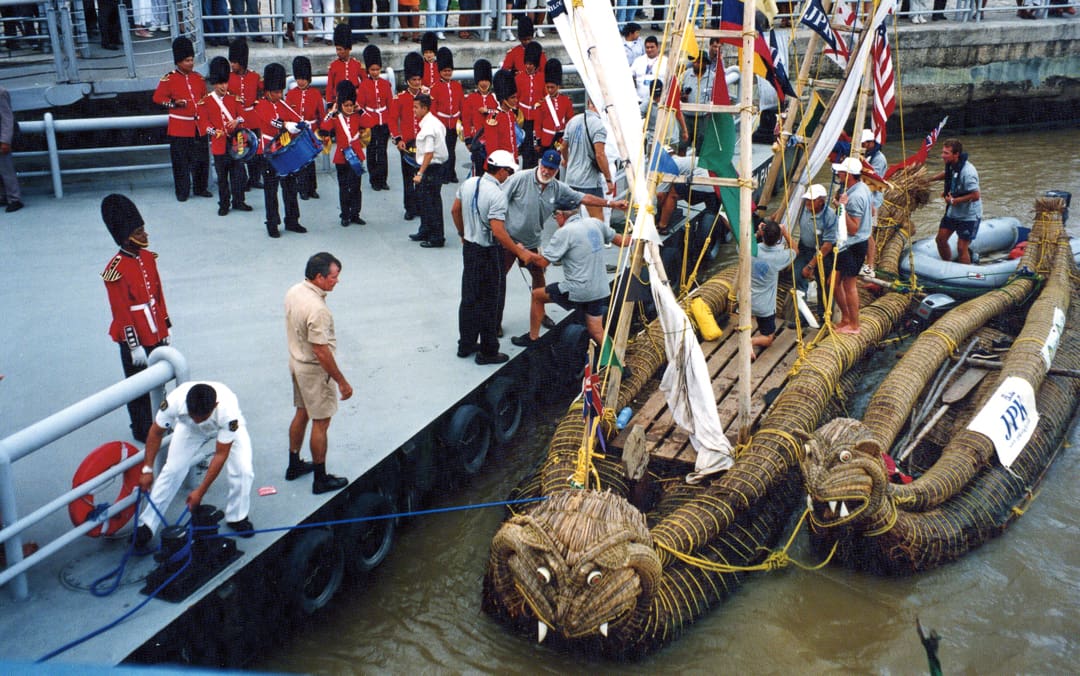
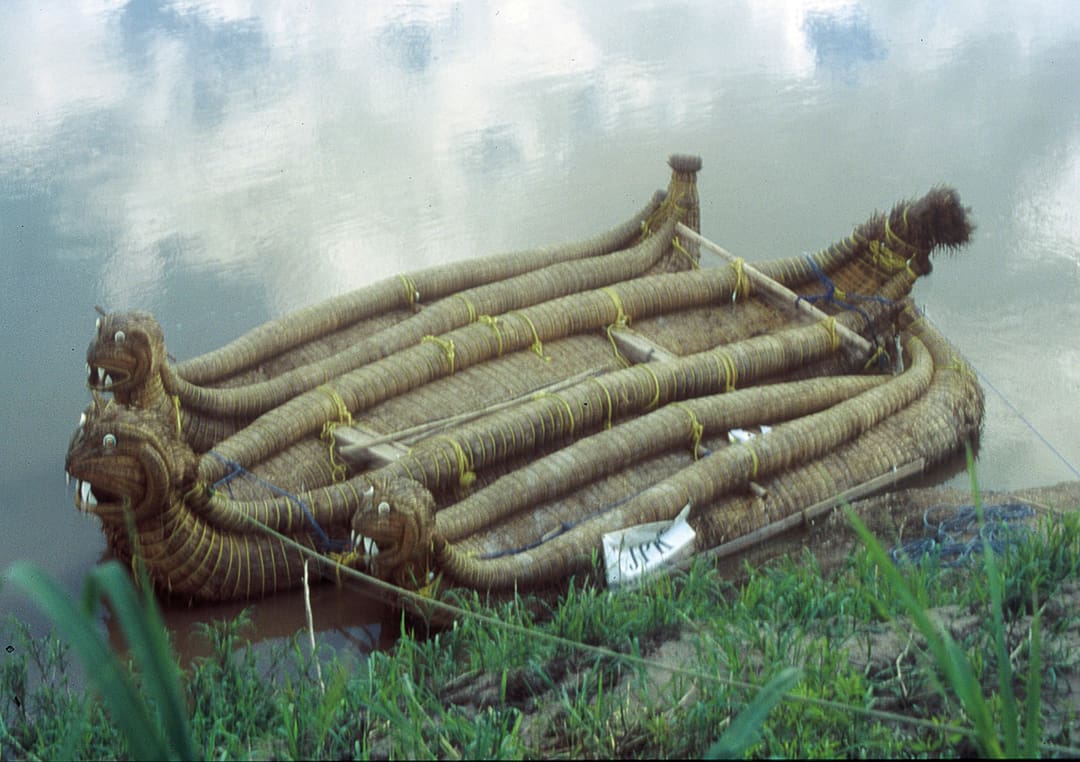
After years of reconnaissance and planning, construction of the craft began in December 1997. Gathering totora reeds on Lake Titicaca, celebrated reed boat builders Maximo Catari and his son, Erick, set to work. Their yard soon became a hive of activity as the three robust, corn-colored vessels took shape. Each was built of two tightly bound bundles of dried reeds that were filled with tiny air pockets. More bundles were added to increase buoyancy. A light mast carrying a gaff mainsail was stepped in and a figurehead attached. The 7.5-meter flagship sported a puma’s head with vicious wooden teeth. A ginger cat had taken up residence in its jaws and was named Tittypusspuss. The two slightly smaller boats were adorned with condors’ heads.
Our team consisted of 30 Bolivian, British, American, and Colombian explorers. Several, like Jim Masters, had considerable experience, while others were new to the game, but all were selected because they had skills to offer. Although landlocked, Bolivia has an extensive river system and a 5,000-strong Navy. It had an outlet to the Pacific, but lost it after a disastrous war with Chile in 1879. Today, their sailors long for the sea, and many regarded the Kota Mama expeditions as a way of reaching it.
On March 14, 1998, the boats were trucked to the town of Desaguadero on the Peruvian border. Bolivian naval officers organized the launch ceremony for the next day, and a tired team sank into their cots at the local “flea pit.” No sooner were they asleep than the alarm was raised. Peruvian thieves from over the river had stolen vital rigging from the boats. Pistol in hand, a Bolivian lieutenant went and recovered the items.
.
The next morning, government ministers, admirals, and the British ambassador stood in the bitter cold Andean wind as the Bolivian national anthem was sung with pride to a taped accompaniment on the town’s speaker system, followed by a somewhat shorter “God Save the Queen”—intoned a little self-consciously by the British on hand. Speeches and a blessing by the priest came next, and wine was poured over the boats’ bows. It was fortunate the guests had departed by the time Jim gave the order to cast off, for a sudden gust of wind carried the boats into the reeds on the bank. The crews soon learned to handle the gaff sails, and led by an Avon inflatable fitted with an outboard, the fleet disappeared downstream beneath an ominous, darkening sky.
They were still on the water when the storm broke, and thunder, lightning, rain, and hail surrounded the boats. All came in safely, though those who had neglected to carry their waterproofs were speechless with cold. The quartermaster’s hot soup saved the day, but it was a miserable night—not made any easier by the pigs who sought shelter in our tents.
Overcast skies on the following day promised little relief as the craft neared the village of Iruhito. Another storm swept over the Andes and struck us just as the boats had run aground mid-river a mile offshore. This was one of the tensest moments of the expedition. Those on the bank could do nothing to help, and if the stranded crews tried to wade ashore, they would have sunk in quicksands or been forced to swim several deep channels.
Masters, the “admiral” of our fleet, radioed the support party and informed them that hypothermia was setting in. If some could not get out of the cold quickly, there would be casualties. As thunder crashed overhead and lightning forked into the black water, the mayor of Iruhito appeared. Realizing the danger, he poled his tiny skiff out to guide the boats to a deep channel and then to the village. With teeth chattering, the sailors downed piping hot drinks they could hardly hold in their numb fingers.
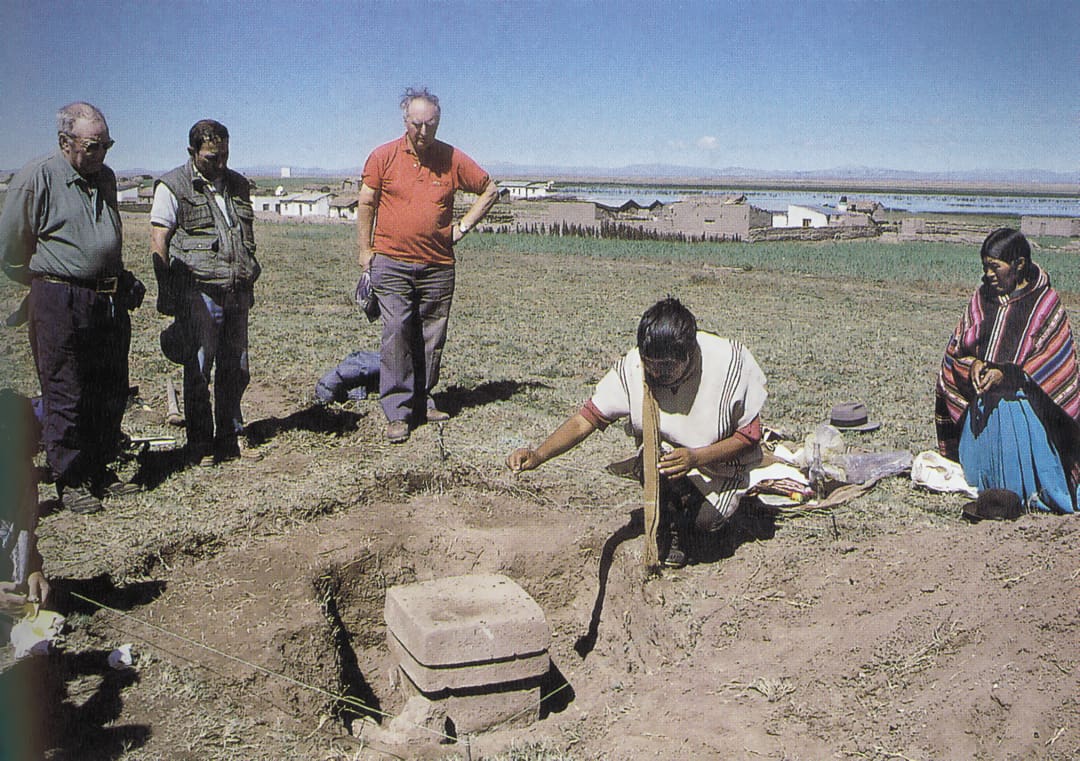
The morning dawned fine, and with it came the expedition’s first major discovery. An Indian woman told historian Richard Snailham that she kept striking a large stone while ploughing on a low mound. Prodding with a stick, he found a rectangular slab about a square meter in size, and soon the archaeologists were digging like terriers. Only a handspan beneath the surface, they came to a meter-high pedestal, carved from volcanic rock, at the base of which were two statues depicting the god Chachapuma. Other discoveries revealed a temple on a low pyramid that was a Tiwanaku religious centre dating back 27 centuries. Morale rose!
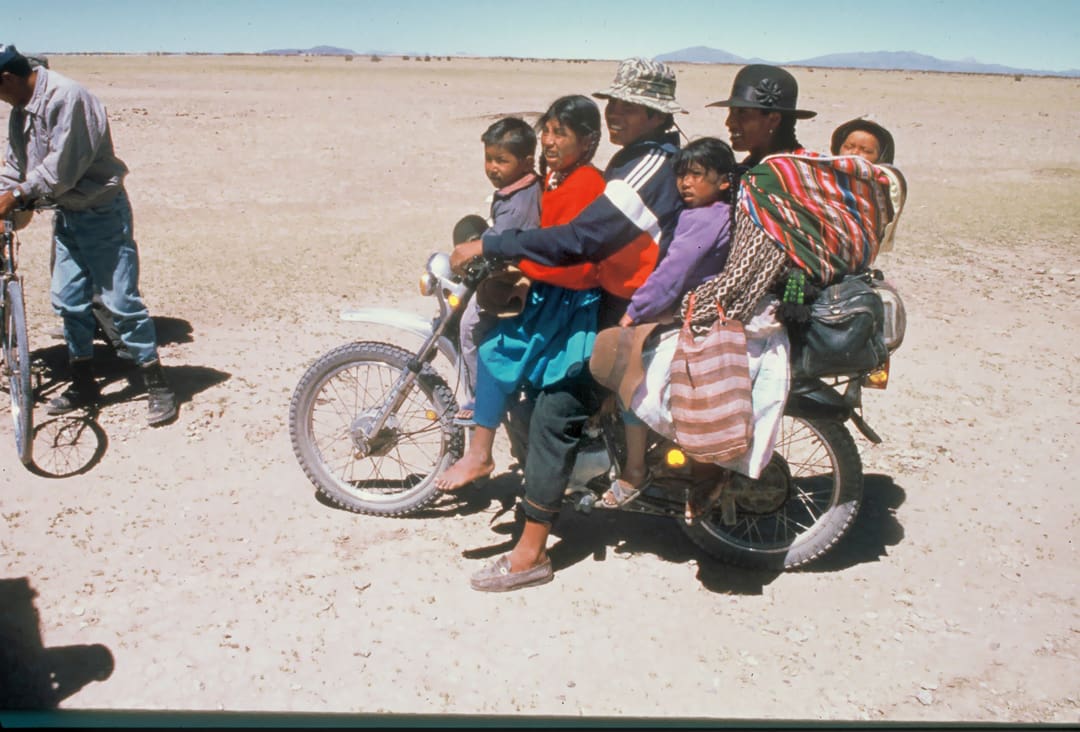
Sailing south, the boats encountered more shallows as the river narrowed. Praying for rain, the team poled, pushed, and portaged their craft—it was back-breaking work. Herds of gingery long-necked vicuña, a species of wild llama, stared in surprise as we passed. Upon our arrival at settlements, bands played, school choirs sang, and Indian ladies in voluminous skirts and traditional bowler hats danced with our perplexed expeditioners. At Calacota, the welcome was very special. By satellite phone we linked students of the village school to children in England, all speaking in Spanish. The first question the Bolivians asked was, “Do you play football?”
Nearby we made more fascinating discoveries, finding three cities attributed to the Pakajes, or “Eaglemen,” a tribe that lived on heavily fortified table mountains, or mesetas, around 1200 AD. Vertical rock faces and concentric dry stone walls were penetrated by the narrowest of entrances, only wide enough for one person. They would present a challenge even to well-trained modern attackers. Within the walls were beehive-shaped stone tombs, or chullpas, their shapes strangely similar to structures found in Turkey and the ruins of Great Zimbabwe. Could this be a link with Africa?
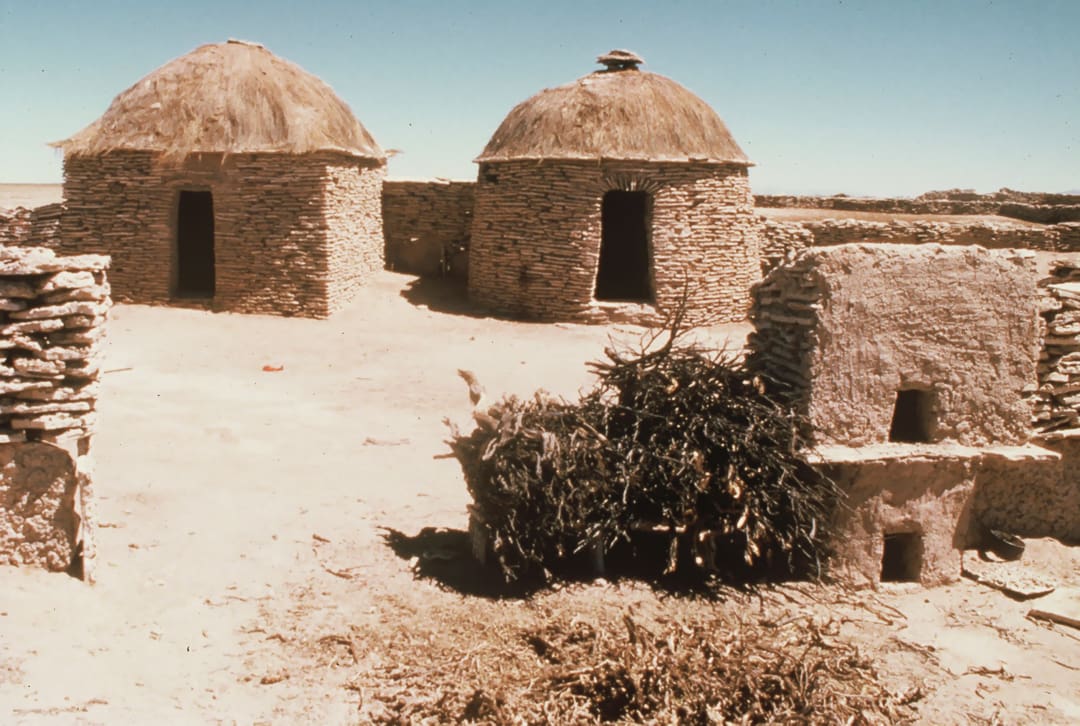
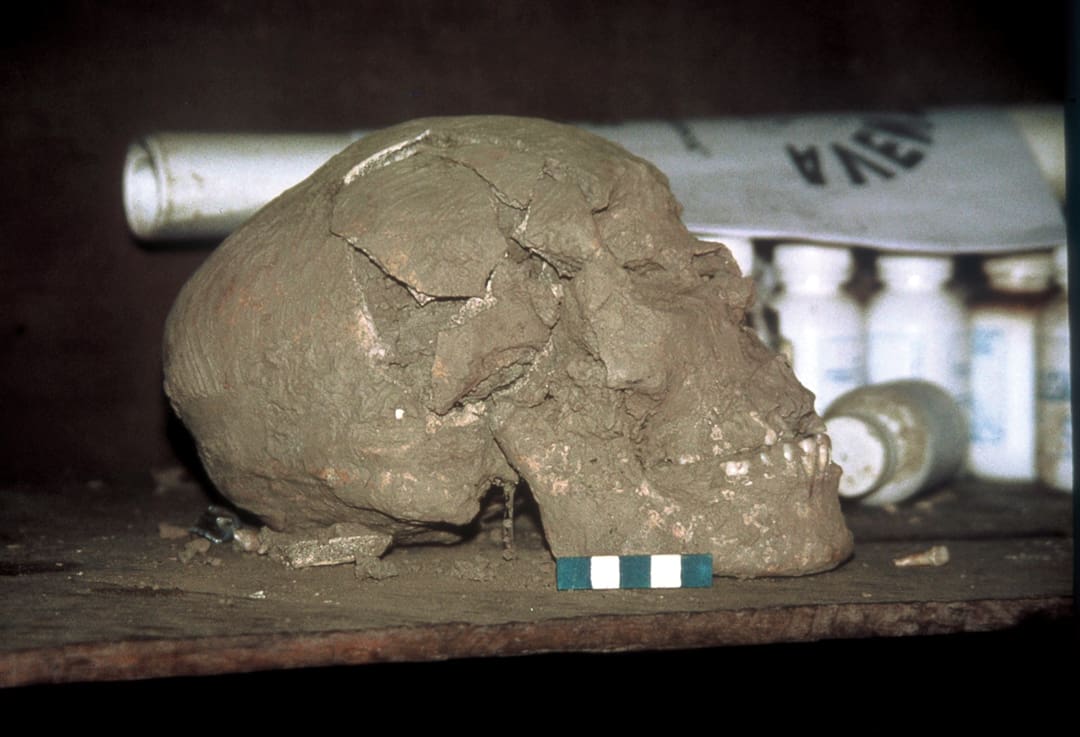
Many of these elaborate graves contained mummified bodies, held in a foetal position by sacks of woven grass. Animals and tomb robbers had obviously been there, scattering skulls, bones, and body bags about, so that it appeared that one had come upon the evidence of some terrible slaughter. Most skulls had been deformed and elongated during the person’s childhood to suit the fashion of the day. (A similar custom is found in Egypt.) Like the Tiwanaku, the Pakajes had practiced matricide, where wives and favourite women were killed and buried with chiefs and great men. Evidence of this was seen in several chullpas containing one male skull and up to eight female skulls. It is known that human sacrifices, often of captured enemies, were made at such burials. We found many remains of children, and it may be that they were also sacrificed.
At first these mountaintop settlements seemed to be cities of the dead, but careful examination revealed dwellings far less sophisticated than the tombs. Clearly the Eaglemen venerated the deceased and built the best for them. Masses of broken pottery, stone corn grinders, unsmelted copper, and hand tools fashioned from hard rock littered the ground. One fortress had a tunnel connecting it to the hillside—perhaps an escape route.
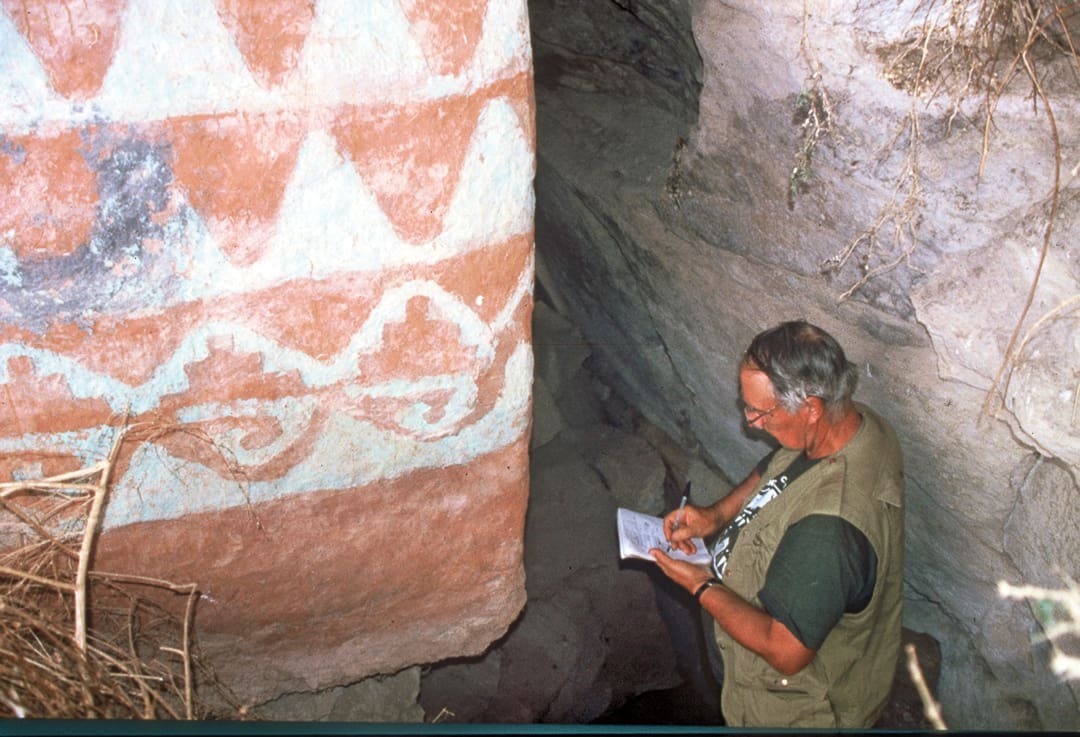
Beneath the cliffs, square tombs decorated with painted designs were discovered. The patterns showed what may have been step pyramids as found in Mexico and early Egypt. A design that might be crescent-shaped boats filled with humans was also seen. Beneath these, tunnels ran back into the mountain, but were blocked with debris. Subterranean sepulchers hewn from the rock contained parts of up to 10 skeletons, and teeth marks on the bones indicated the presence of a large carnivore (probably a puma). Fearing ghosts, the locals kept clear, but we mapped the site and explored the underground passages whilst a captain, a talented artist, made excellent paintings of the site.
Apart from the beautiful vicuña and the odd sightings of a bushy-tailed fox or puma, wildlife consisted of hares, small, fat mole rats, and countless water birds. The fossilized remains of a glyptodon, a massive tortoise-like creature that roamed the Altiplano 5 million years before, was also discovered. Further south, in a remote wasteland on the edge of an area of extensive salt flats, we met the Chipaya Indians. Said to be direct descendants of the Tiwanaku, their language is thought by some anthropologists to have similarities to Arabic and Hebrew. During the 1996 rains, a river and ancient irrigation canals had burst their banks, flooding their village. We found Chipaya living under wretched conditions and later designed flood defenses that were financed by the British Embassy.
We originally planned to navigate the Pilcomayo River to the Paraguay River, but by mid-April the Desaguadero River disappeared into the sand at the edge of Lake Poopó. El Niño had dried up the lake, and the voyage was over—we needed to seek an alternative.
Kota Mama II
Having benefited from our experience on the Desaguadero River, Royal Engineering geologist Toby Marriner carried out reconnaissance for the next phase. We planned to sail a new fleet of boats 2,770 kilometers from Bolivia to Buenos Aires and the Atlantic. The Paraguay and Paraná are major rivers, and for this voyage a much larger flagship and smaller tender were required. Kota Mama II would be 13.5 meters long with a beam of 3.2 meters. Two large sails, one gaff-rigged and the other square, would provide propulsion. However, on the twisting rivers we would depend largely on current.
A pair of traditional steering oars were fitted and, as she had no keel, a leeboard was incorporated. To conform to local regulations and ensure we did not collide with one of the giant river barges, a 15-horsepower outboard was attached. Designed to carry a crew of 16, Kota Mama II had a main cabin that housed the navigation table and ration store, whilst the aft cabin provided more storage and three bunks. The majority of the team would sleep on deck or ashore, as we would moor up at night. There was no galley and, in view of the vessel’s flammable nature, no smoking was allowed. The tug company JP Knight had kindly sponsored the craft. An Avon safety boat with a 25-horsepower outboard also joined the flotilla. The Viracocha, our 6-meter tender, was similar to those used previously on the Desaguadero. We finalized the design and recruited a new team of 59 servicemen and civilian volunteers.
Our patron, Bolivian President Hugo Banzer, wished to commission the boats in front of his palace in the Plaza Murillo. Thus, Jim Masters was faced with the challenge of getting them to La Paz mounted on low loaders. Alas, when Kota Mama II arrived, we found she was far larger than the design. The Cataris had lost our plan and done their best from memory. Seizing saws, the sappers set to work cutting her down by a meter, but the flagship was still too tall to clear the power lines. The police produced wooden poles for us to push up the cables as we passed beneath, but when two touched with a splintering crash and a shower of sparks, the suburb’s electricity was cut off. Eventually, we got our smaller boat and the figurehead of Kota Mama II to La Paz. The president took me onto an iron balcony to pronounce his blessing. “I’m always worried when standing here,” he whispered. When I asked if it was safe, he replied, “Yes, but a predecessor of mine was hanged from it.”
With 2 centimeters to spare, the boats squeezed through the tunnels on the Trans-Andean road. At Santa Cruz, we placed them on a flatbed rail car and trundled through the bush to the Paraguay River. I reckoned ancient mariners could have hauled their boats there, but we did not have time for this. When all was ready at the Bolivian Naval Base at Puerto Quijarro, our small fleet cast off. Snakes tried to climb aboard, and cows attempted to eat the hull, but our main problem was the weather. As we passed through the endless insect-ridden swamps of the Pantanal, the wind changed, bringing in bitter cold air from Patagonia. For several days we battered short, sharp waves using our steering motor to keep us on time. The temperature then rose to 108°F. It was a land of extremes, and one imagined the difficulties faced by the early explorers who sailed up this waterway.
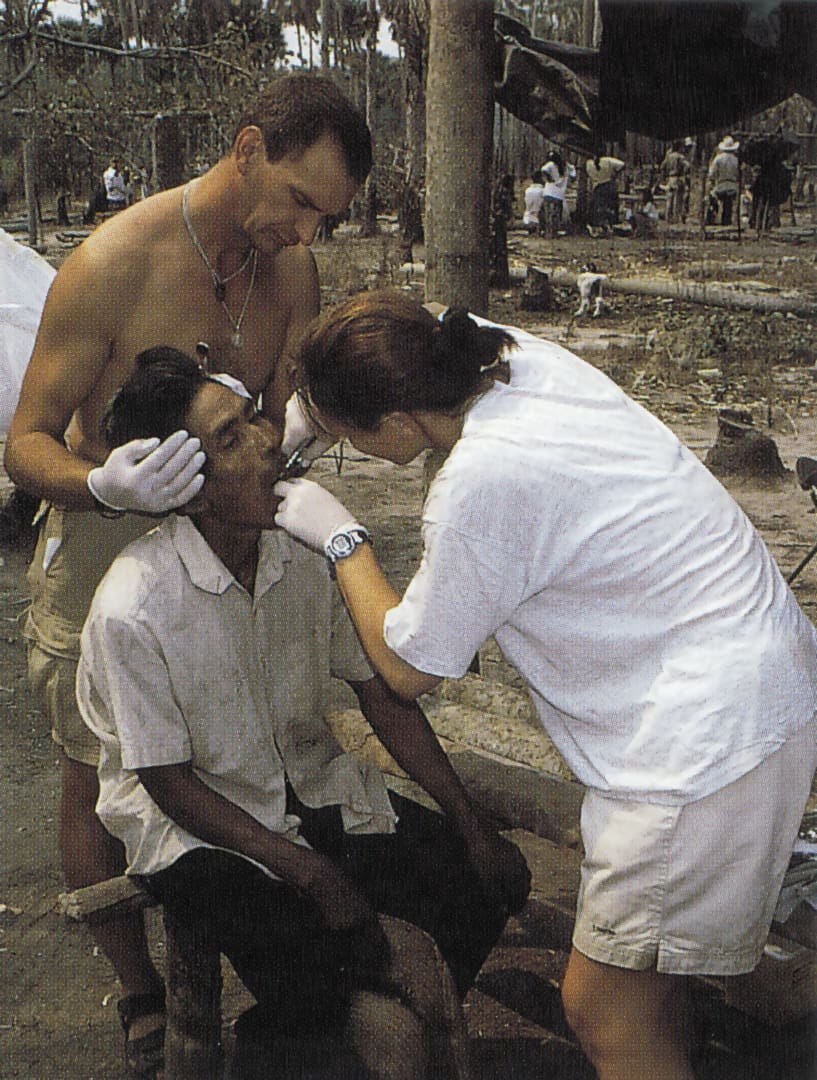
Along the route, scientific and community aid projects were carried out, and archaeological sites examined. Petroglyphs, thought by some to be of Scandinavian origin, were located in eastern Paraguay, but our archaeologist did not consider them to be the work of Vikings. The histories of some extremely interesting tribes were recorded by the anthropological team. We catalogued the region’s fauna, and in the swamps of northeast Argentina, located endangered marsh deer. We had a doctor onboard and two British Army dentists. The physician gave medical assistance to hundreds, and the dentists extracted 1,400 teeth from the mouths of persons unable to afford treatment.
As we neared Buenos Aires, a Force 6 wind and 2-meter, white-topped waves hit us, but the reed boat withstood the battering better than our metal-hulled support vessel. With the flags flying, we tied up in Tigre on Río de la Plata. The 2,700 kilometers had taken us two months, but Kota Mama II and her tender were still in good shape, despite the fact that she now weighed over 21 tons due to the water absorbed. Although some reeds were already rotting, we estimated she would last six months. We could only surmise as to how the early navigators had handled heavy sails, probably built of basket work, and how they got home . . . the southerly winds would have certainly helped. Reeds found growing en route may have been used for repairs, but I fancied a different craft would have been needed to cross the Atlantic.
Kota Mama III
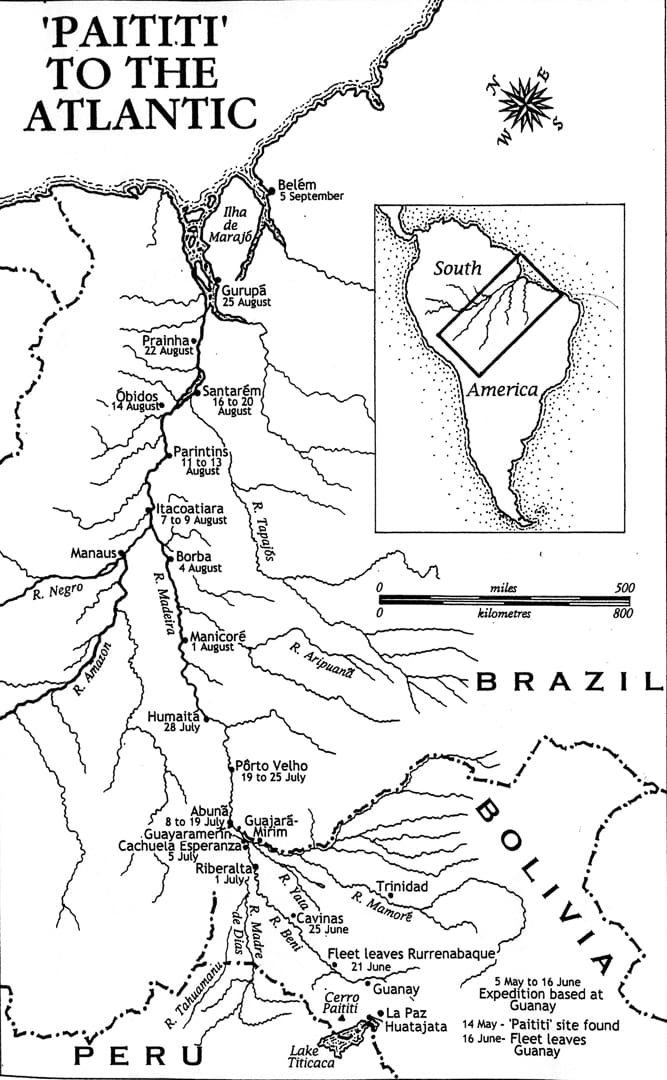
It was now time to test our theory on a route to the Atlantic via the Amazon River. Indeed, it was not going to be an easy voyage. Three cataracts would need to be negotiated on the Beni River, and there were 300 kilometers of rapids, some quite impassable, on the rivers between Bolivia and Brazil. Sand banks, floating and submerged trees, and a healthy population of mosquitoes added to the challenge. It seemed that traders would have pulled their boats around the worst rapids on cleared trails, but we felt they must have negotiated at least some of the rapids. A ceramic model of a reed trimaran found in a Peruvian tomb indicated that such craft were used around 400–500 AD. With support, again from JP Knight, we designed Kota Mama III: a trimaran with a central hull of 9 meters joined to 7-meter outriggers by rope ties. The hulls could rise and fall independently and conform to wave patterns in a cataract. Jim and I had used giant flexible rubber rafts on the Zaire River expedition in 1974, and they had performed splendidly. We prayed Kota Mama III would do the same. The outriggers could also be detached to pass through narrow sections, where we would attach an outboard motor. Some would argue that this was not authentic, but our aim was to test the hull and avoid being run down by seagoing ships on the Amazon.
The sail arrangement was the subject of much discussion, and for the new boat we settled on a bird’s-wing rig. Additionally, 14 members of our crew would have long-handled paddles. By various means of propulsion and a current of 3 to 5 kilometers per hour, we aimed to cover 50 kilometers per day. The problem was that the trimaran could not be tested until we reached the river. And at that point, there was no turning back.
We also decided to test the traditional balsa rafts that are still used on these rivers. Eight balsa logs pinned with stakes of hard, black palm made up the 9.3-meter craft. On the deck, a raised platform of plaited bamboo provided relatively dry storage for cargo. We calculated she would carry up to half a ton, including three crewmen who propelled it with paddles and poles. Jim convoyed Kota Mama III in Bolivian Army trucks over the Andes from Lake Titicaca to the riverside town of Guanay. Once again the Bolivian and British national anthems rang out, and on June 21, 2001, we set off for the Atlantic.
An Antarctic cold front had us shivering as we shot the first set of cataracts, but the trimaran coped easily. We began to believe that gold and coca could have been transported on these waters thousands of years before. Prehistoric rock carvings and partially eroded burial mounds provided more evidence, along with axe heads found along the river.
The temperature became decidedly tropical, and yawning alligators, turtles, colorful birds, and leaping monkeys watched us sail by. At Esperanza we met the first big rapid, and lowered Kota Mama III’s masts to tackle tossing wave towers. To the cheers of locals, our reed flagship rode them magnificently, her hulls rising and falling just as intended. However, thereafter the rapids grew more severe, and at Ribeirão we met a monster.
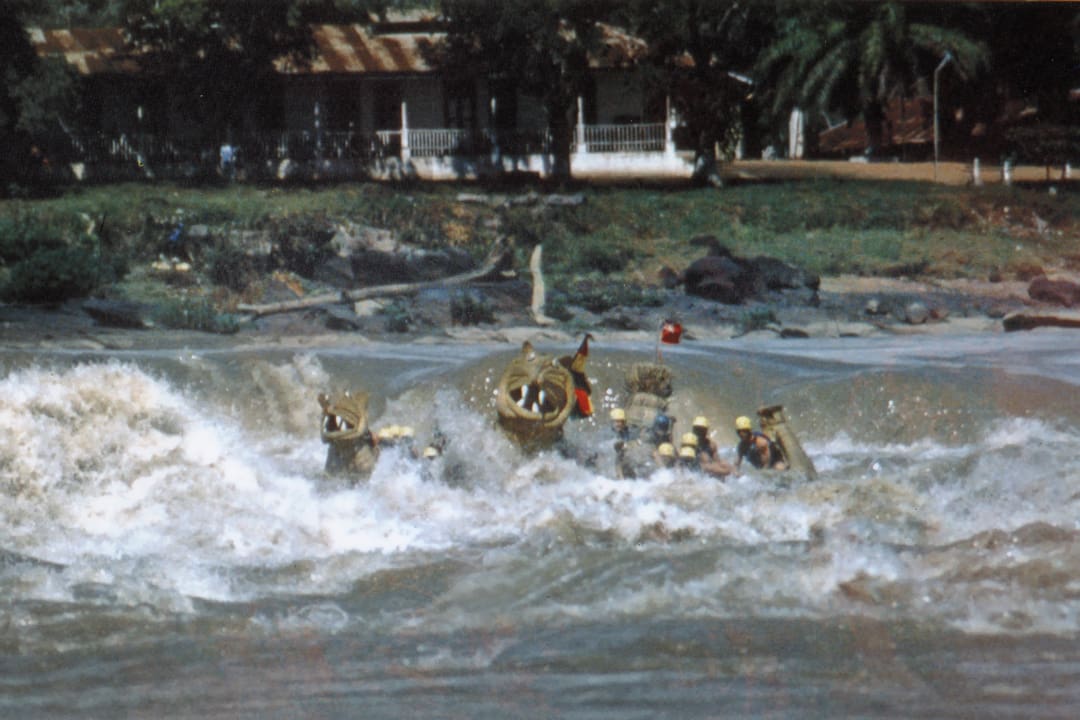
We had done an aerial recce and knew the route, but the powerful current swept the big boat away from the relatively smooth tongue that ran through the foaming breakers. To their horror, the crew saw a 5-meter-deep hole appear at the foot of a fall, and beyond it a massive stopper wave. Racing down the slope, the bows collided with the wall of creamy water. The rope ties on the starboard outrigger snapped, and the central hull and port outrigger capsized. Eleven crew members were pitched into the torrent, and the craft plummeted over another fall. As it did so, the central hull righted, bringing up those clinging to lifelines. She was wrecked but still afloat, and by a miracle no one was seriously hurt.
The safety boats quickly picked up the crew, and darkness fell as Kota Mama III drifted away. Some said it was the end of the expedition, but Yolima Cipagauta, our Colombian liaison officer, called a friendly Bolivian pilot who agreed to fly us downriver the next day. Twenty kilometers downstream, we found the trimaran neatly tied up to the shore. The Bolivian Navy had seen her drifting during the night and, thinking she was a drug runner, brought her in. “God looks after little children and mad people,” said their captain. Maximo Catari flew in, and within a day he had straightened the distorted hull. We were again on our way to the Atlantic. Six hundred kilometers from the ocean, Jim abandoned the damaged, waterlogged outrigger and Kota Mama III became a catamaran.
Our medical team had been cooperating with mission organizations in remote communities, but in such a short period of time, only basic assistance could be given. Although many patients could not be helped, one heart-warming result was a six-year-old Brazilian girl named Ronalda who had a double-cleft lip and cleft palate. She was later given corrective surgery thanks to US-based Smile Train and funds raised by the SES. Additionally, our dental surgeon may have established a record by extracting 1,125 teeth in 120 days.
On the Amazon, mosquitoes attacked in clouds, but we were more worried by the presence of pirates who boarded a ferry ahead of us. Having left our firearms in Bolivia, we fashioned improvised bazookas with drainpipes and distress rockets. Our Brazilian Marine liaison officer called in the Navy, and a gunboat preceded us in the final stage. Less fortunate was the New Zealand yachtsman, Sir Peter Blake, who was murdered here a few weeks later.
After 4,300 kilometers and countless cataracts, the balsa raft was still intact. Kota Mama III was 30 centimeters lower in the water than when she began, and had several species of plant and animal life thriving in her rotting reeds. However, it seemed likely that the early people of South America could have reached the sea in this fashion.
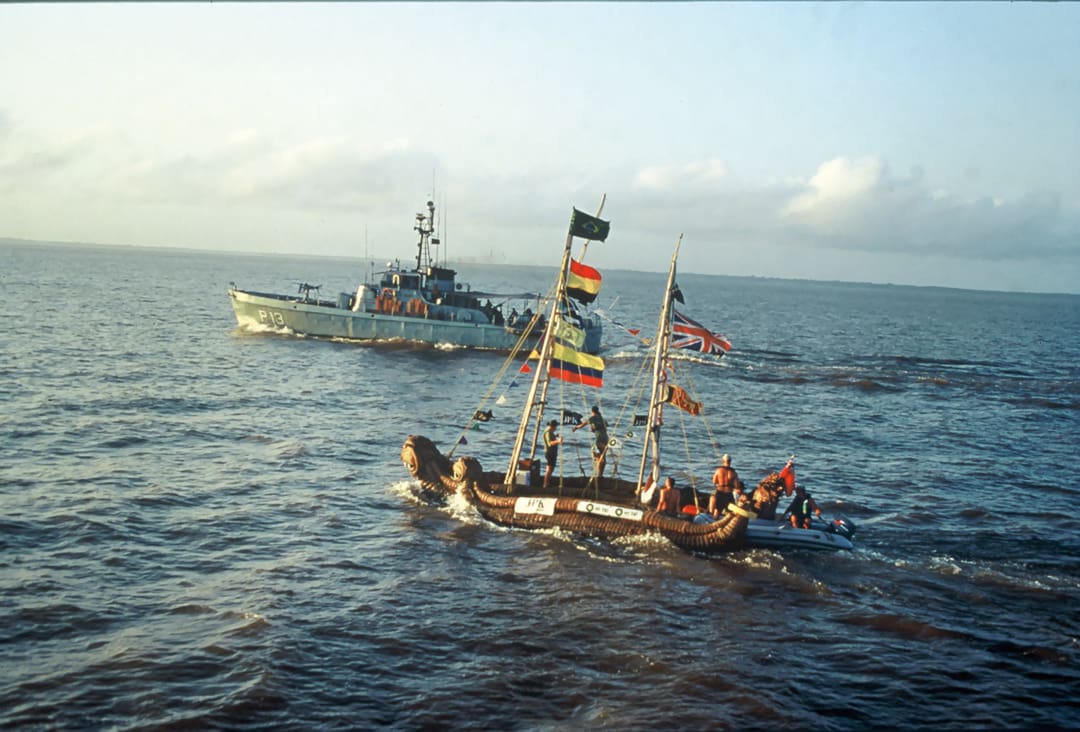
At the mouth of the great river near Belém, our support boat ran onto a sand bank and listed 20 degrees to one side. It was a good time to hold a Burns Supper, and our cook produced tinned haggis and Scotch. No one really noticed the list thereafter. When we finally reached Belém, bands and large crowds were there to greet us, and we received a letter from Her Majesty the Queen, whom I think had watched our progress with amusement.
Kota Mama
A full account of this epic research expedition can be found in John Blashford-Snell and Richard Snailham’s book Kota Mama: Retracing the Lost Trade Routes of Ancient South American Peoples. ISBN 978-0747222811.
For information on the Scientific Exploration Society and upcoming hands-on environmental and humanitarian projects, go to ses-explore.org.
Our No Compromise Clause: We do not accept advertorial content or allow advertising to influence our coverage, and our contributors are guaranteed editorial independence. Overland Collective may earn a small commission from affiliate links included in this article. We appreciate your support.
