

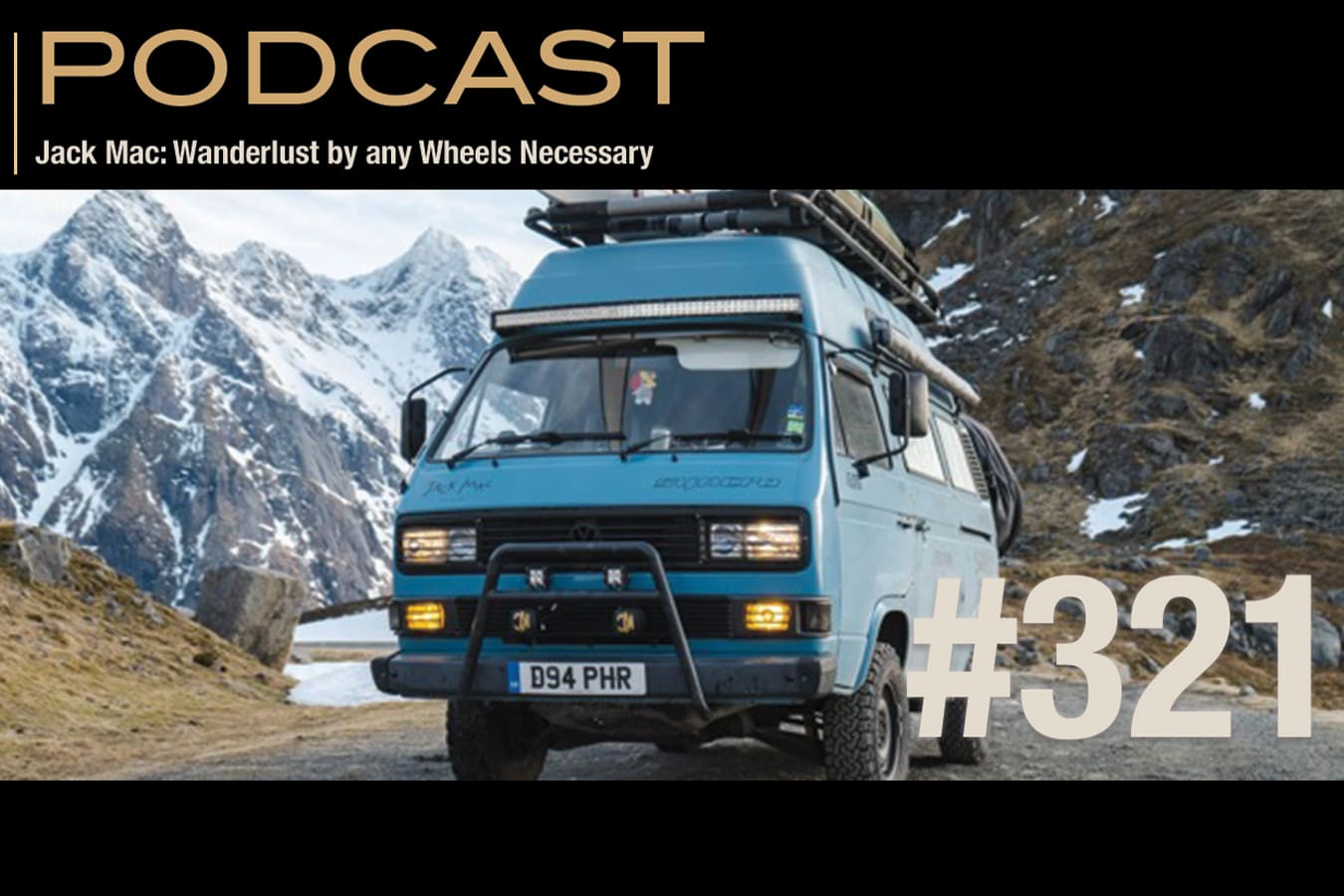
Overland Journal Podcast host Scott Brady talks with team member Jack Mac about minimalism and life on the road. Jack shares insights from over five years managing Expedition Portal’s classifieds and global travel by bicycle, backpacking, and vehicles like a 70-Series Land Cruiser Troopy. They discuss how a travel mindset lowers consumer spending, why high-end gear can become a burden, and why you should choose a vehicle you can afford to lose. Jack reflects on how bikepacking taught him minimalism and pacing, details a perilous Iceland crossing, and emphasizes preparation, managing vehicle mass, supporting local communities, keeping overhead low, and his passion for photography.
Overland Journal Podcast Episode #321
Tune in Apple Podcasts | Spotify | YouTube
The Overland Journal Podcast is brought to you this week by Hankook Dynapro Tire and Midland Radio
New to Overland Journal and want to grab a subscription! Visit Overland Journal and enter code: overlandpodcast at checkout for 20% off. We thank you for being a subscriber.
Guest Bio
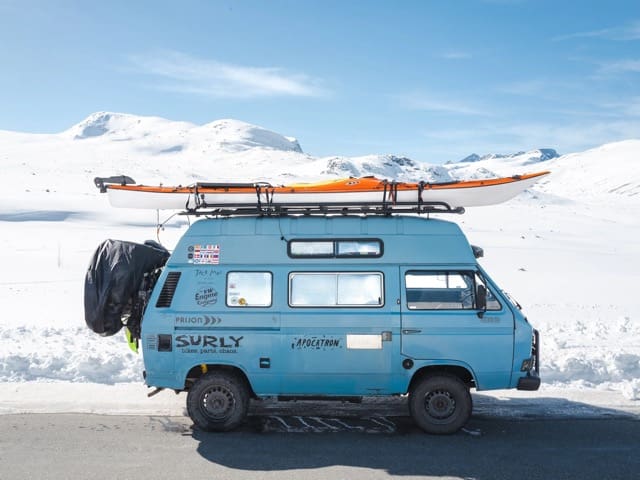
No money in the bank, but gas in the tank. Our resident Expedition Portal Bikepacking Editor Jack Mac is an exploration photographer and writer living full-time in his 1986 Vanagon Syncro. He spends most days at the garage pondering why he didn’t buy a Land Cruiser Troopy. If he’s not watching the Lord of the Rings Trilogy, he can be found mountaineering for Berghaus, sea kayaking for Prijon, or bikepacking for Surly Bikes. Jack most recently spent two years on various assignments in the Arctic Circle but is now back in the UK, preparing for his upcoming expeditions and looking at Land Cruisers. Find him on his website, Instagram, or Facebook under Bicycle Touring Apocalypse.
Host Bios:
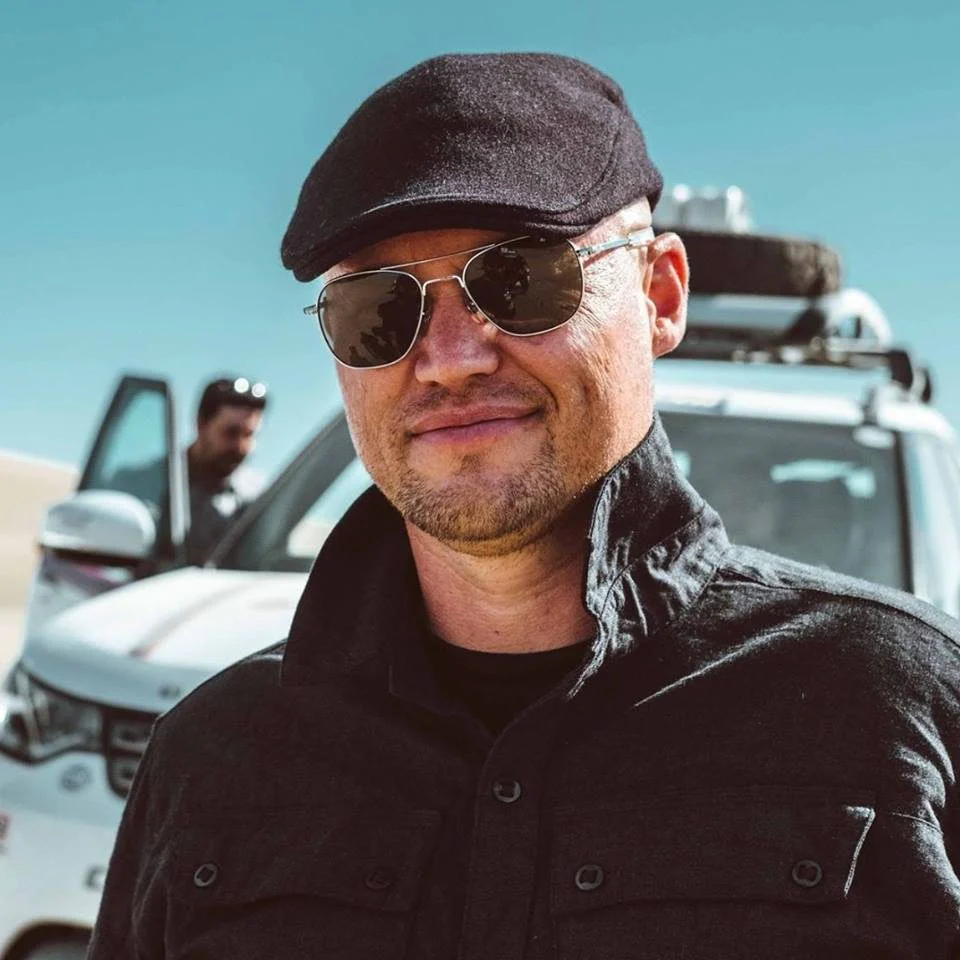
Scott Brady
Scott Brady is an adventurer, author, and publisher, and the first person in history to cross all seven continents. Brady is executive publisher of the Overland Collective, home to Overland Journal, the Overland Journal Podcast, and expeditionportal.com—the world’s largest vehicle-dependent adventure community. Scott wrote Overlanding 101 (Simon & Schuster) and is currently riding around the world on his BMW GS. He also led Expeditions 7, the first expedition to drive the same vehicle on all seven continents. Brady’s polar crossings include Antarctica and a south–north crossing of the Greenland ice sheet. Scott is a fellow of the Explorers Club and lives in Prescott, Arizona.
 Our No Compromise Clause: We do not accept advertorial content or allow advertising to influence our coverage, and our contributors are guaranteed editorial independence. Overland Collective may earn a small commission from affiliate links included in this article. We appreciate your support.
Transcript
EP321 | Jack Mac: Wanderlust by any Wheels Necessary
Scott Brady: [00:00:00] Hello, and welcome to the Overland Journal podcast. I’m your host, Scott Brady, and I am here with longtime friend and team member Jack Mack. Jack has traveled around the world. He’s done it in some super cool ways, including bicycles and backpacking and- Yep … and currently in his Land Cruiser. Yep.
But Jack’s a big part of our team. He’s a really important team member. He’s been working on the Expedition Portal side of things for just over five years. He’s also the one that has been the mastermind behind all of our classifieds growth. When you go onto Expedition Portal and you see all these really cool trucks that are for sale from travelers around the world Jack’s the one that helps pull all that together and make that- Yep
possible. So thank you, Jack, for being on the podcast today.
Jack Mac: No, thanks for having me. If anyone wants to make any bad decisions or spend lots of money- … I’m the person for the job. Yep.
Hankook Dynapro Tire: You’re their guy. Yep. You’re their guy.
And a special thanks to Hankook Dynapro Tire for supporting this [00:01:00] week’s Overland Journal podcast.
Be sure to visit expeditionportal.com to see our features on the recent Hankook experience at the fourth annual Bronco Stampede in Pigeon Forge, Tennessee. We took a look at the full line of Dynapro tires and some great Ford Broncos from all over the country as they gathered at this community event of enthusiasts and top brands.
Thanks again, Hankook. It is easy to spend a bunch of time scrolling through Expedition Portal or Bring a Trailer or whatever, looking at vehicles that I shouldn’t be buying. So I spend a little bit too much time doing that myself.
Jack Mac: Yeah, it’s easily done. I always think that with travel and stuff as well, it’s funny how when you’re at home, you do most…
At least for me, I do most of my spending and looking at stuff when I’m in one place, I’m working, ’cause it’s that little dopamine hit of buying stuff. But then when I go away, I don’t really think about the rig or the gear that much. It’s… you kinda make do with the stuff you have on you a lot more.
But that, that means I’m not guilty of it. I’m [00:02:00] like, I spend a bunch of money. I would go and work seasonally, and I’d be so good, not spend any money. Come back and then spend my year’s wages. I’d be like I deserve this. I deserve a little- … a little treat ’cause I’ve been away and I’ve been so good with my money.”
And then I’d spend my entire earnings for the year. A bunch of Amazon box- boxes start piling up, so I’m very guilty of it as well.
Scott Brady: You mentioned that yesterday, and I think you make a really good point. I think when we, as travelers, when we have a goal around travel or if we’re in the process of doing a trip, it does shift our perspective around where we spend our money.
Yeah. So I find with myself too, like when I’m between journeys and I’m sitting at home, I have more idle time.
Jack Mac: Yeah.
Scott Brady: It gets me onto Amazon or I p- pick something up in the… Like, why do I need this wooden, display stand for a timer at my desk, for $180. Yeah, it’s so easily done. Yeah.
Yeah. So I do find that, Like right now, I’m doing this trip around the world with Tavia and we’re starting to figure out that if we really wanna extend this or if we wanna travel [00:03:00] for longer, we need to spend less money- Yeah … on the gadgets and stuff that we have back home.
So it starts to be an easier decision, I think, when we are in the mindset of travel.
Jack Mac: Absolutely. And I think to take that one step further as well, and I think we spoke about this yesterday, I think that if you have too fancy gear and stuff on the road, it does own you a little bit. Because, I love nice cameras.
I really like Leica stuff. I, I like nice watches, and nice equipment, and nice vehicles and stuff. But I feel that when I had a, I had for a period, I had a very cheap Mitsubishi Delica, and what that really taught me was that I could just leave it anywhere and not worry. And so I was more focused on the experiences.
But when you have all these fancy cameras, you gotta drag them around with you and stuff as well, because, most places are great, but the more valuables you have on you, the more you have to think about that. I think it was Christian sorry to pronounce his name- Pelletier.
Yeah … Pelletier. Yeah, he was on the podcast, and he said something about, you know, you should really only travel in the vehicle you can afford to lose, and I think that’s super important. Because [00:04:00] yeah, you don’t wanna have your life savings necessarily tied into the vehicle, because I think it makes you less ambitious- Yeah
With the trips you take. That’s something that I think has been important to me.
Scott Brady: And he really lived it, too. He actually, he bought a used limousine in Las Vegas- Yeah, that’s so cool … and shipped it to Africa- … and drove it all the way to Timbuktu. And a- as I understand it, that limousine is still in Timbuktu somewhere.
Jack Mac: That’s
Scott Brady: amazing. He just left it. He just l- pulled his bag out of the trunk or what- wherever. And like they were camping inside the limo, of course, those long benches- That’s awesome …
Jack Mac: and everything. And it is funny, isn’t it? How you, you just make do of it. It’s once you’re on the road and you don’t have a choice, you make any setup kind of work.
I actually have… One of the projects I’ve been working on at the moment is I’ve got an, not a really old Fiat Panda 4×4 because they’re just quite expensive and I didn’t want a rusty, old relic car. I’ve just got too many of them. But I’ve got a little Fiat Panda, and it’s the same kind of thing because it costs so little, and you can just throw it around.
I can chuck a sleeping bag in the back, Jetboil, camera, and just go. [00:05:00] And you can leave that anywhere. No one cares. Is
Scott Brady: that how you typically get to the start of your bike trips?
Jack Mac: So in the- Just- … past, yeah, I have done that in the past. I’ve had going back a little bit, ’cause it’s been a long time since I’ve had just a normal car, to be honest.
I’ve had the, a Syncro probably going on 15 years. And I’ve been never financially recovered from that. And and so I used to drive the car. Yeah, for example, I did a, a bikepacking ride in the Black Forest in Germany. And we would dr- ride to the, drive to the start. That was ’cause going from UK to Calais is super easy. And also done a few like that. So that’s been useful. I think overland vehicles as a way to facilitate outdoor adventures has been a huge part of my journey. In fact, I started out on a bike, and it was… I was actually in the Black Forest, funny enough, when I realized that everything that truly made me happy, everything I really needed could be fit on the panniers on a bicycle, and that was the impetus really to be like if I can do this on a bicycle, a vehicle is gonna be like pure luxury.”
Yeah. Because I was with one of my good friends, Mo, [00:06:00] just looking over at my, one of my best mates. Got, everything you could possibly need inside the bags on a bicycle, and it was really liberating. And I’ve had quite a few experiences in my life like that where I realized that sometimes the things we aspire to the, some of the simplest things are, like, the biggest victories in life.
And similarly, when I started out- I had a job in London originally. I left that job, moved into the Syncro full time, and I was just pot washing out the back of a a fancy restaurant in the top of the Highlands. And I remember thinking I had no money. I was so broke. I couldn’t even put fuel in the vehicle to drive it, to charge the battery, to use the heater, and it was winter, and it was, it was cold.
And I was sleeping in my uniform inside the sleeping bag because I didn’t want to be, like, wet and damp in the morning. But I remember thinking to myself, I was so happy compared to the London city life, which it was all these kind of ideals of money and success, and suddenly I just had the great outdoors, which cost me nothing and brought me so much joy.
And I realized, oh, wow, if I pursue things I actually love, even if there’s not tons of money in [00:07:00] it all the things I enjoy are actually free, and I’ve already won in life. And every penny from this point on is just a bonus. And I’ve always stuck by that. I’ve never chased chased money.
Money is important, and I think it, for me, it gives me more freedom to do the things I love. But I’ve always first and foremost feel like you should pursue your passions and the things you enjoy, and the money usually does come with that. If you can a- apply kind of a commercial attitude or a corporate attitude to your passions that’s always been useful for me.
Scott Brady: I like that a lot. And if you think about that experience that you were having in the Black Forest you were doing something you love. You were do- doing something difficult. You had a purpose. Yeah. You were trying to get to a place. You were doing it with your buddy. Yeah, with Wilson. You were doing it with your best mate, and you guys are having that experience, that shared experience together.
And I found the same thing for me just on the, the ride up here to Montana, getting the chance to be on motorcycles with Tavia. Cheap bikes, they’re both- Yeah … inexpensive, less than $5,000 a piece. But the roads we were seeing, I was just awestruck [00:08:00] with what I was seeing through the helmet.
And yeah, doing something you love with somebody you love, like how lucky is that?
Jack Mac: Yeah. And that’s the thing in life, it’s just the great outdoors, family, friends, experiences. I think it’s really important sometimes to take stock of the stuff. I really feel when I’m really stressed, I just try to take a step back and think about how grateful I am.
I think another thing that’s really helped me is working in tourism all these years, guiding, whether it’s like sea kayak guiding or mountain guiding or photography workshops. You meet people from so many different walks of life. People that… when I was working my in Norway, we’d have a mooring for a boat, so you’d have actual people with like s- really premium sailing boats, like people who are multi-millionaires.
The same day you’d have somebody coming who’s just living out of a backpack. And after a few days, they get comfortable with you. They would share their hopes, their dreams, their ambitions, their struggles, and you realize that it doesn’t matter the job or how much money you have in the bank.
All of our struggles are our own. And I’ve always just tried to be grateful for the things that I have and that understanding that [00:09:00] nothing will ever make life perfect- Yeah … either. And I was actually interested because you c- you guys have gone down to the motorbikes. How has that compared to being in something like the Grenadier, where you have a bit more comfort and luxury, and how have you found that kind of transition back to the bike?
Scott Brady: I would say for me the great thing about being on the bike is that Tavia loves to ride motorcycles. Yeah. So-
Jack Mac: I’ve
Scott Brady: heard. So I get the chance to see her enjoy… W- when you’re in a vehicle, one of you is a passenger all the time. Yeah. Whereas o- on the two motorcycles, we’re both always engaged in the process.
And I get the opportunity, because I don’t really care how I travel. It… the Grenadier was awesome- … because I really wanted that, that company to have a chance in the market, so we wanted to be as supportive as we could be. But then I’ve also traveled the Silk Road in a, I think I paid 5,000, 6,000 pounds for this old Suzuki Jimny, drove her all the way to, to Mongolia, and that was great too.
That’s awesome. So I don’t think it really mattered so much what it was. I had a lot of respect for the 70 [00:10:00] series Land Cruisers that we did E7 with. When I ended that trip, it was a different kind of, I think you can fall in love with a vehicle like a Land Rover or a Syncro or the Grenadier, but I don’t think you can leave a trip like that in a Land Cruiser without just feeling such reverence for the fact that company can make that car that way.
Jack Mac: Yeah. I totally agree. I’ve obviously owned a 1986 Volkswagen Syncro or the Vanagon Syncro for US listeners, which is I guess is predominantly the audience- … i, I’d had the Syncro for a long time and It I’ve always … I love the Syncro, and I think for living inside, it’s really hard to beat.
Volkswagen got the dimensions just right. There’s a reason why so many of the greatest trips have been in an old Volkswagen,
Scott Brady: that’s so true.
Jack Mac: Yeah, they get just about everywhere, and I love that vehicle, and it’s one of, one of the reasons. When I first bought the Troopy, people were like, “Oh, you must be selling the Syncro,” but it’s really hard, because I absolutely love that vehicle, and it always brings a smile to my face and an overdraft to my bank balance.
But I bought the 70 Series ’cause I thought if I’m gonna buy something else, [00:11:00] it has to be the pinnacle. Because I’ve, I don’t want another vehicle where I am… It is so temperamental. With the Syncro, if I do a journey, I have to think, “Okay, where can I break down? What parts do I have?
Can I get parts flown out if it’s something major? Who can work on this? Is this something I can fix myself?” Every day is you wake up in the morning, and you do a little prayer at the wheel being like, “Please work.”
Scott Brady: Yeah. “
Jack Mac: Please.” And it’s always really- “Will it
Scott Brady: start?”
Jack Mac: Yeah.
And do you know what? It’s been really reliable. I’ve done so much preventative maintenance that I’ve had very few breakdowns, but that has required a lot of constant investment. Listening to every noise, that kind of… I don’t know if you’ve seen funny videos where people are walking alongside their vehicle kind of like-
listening to absolutely every creak and rattle. So I knew that if I was gonna get something else, it had to be a vehicle that had that that reverence, that kind of real this is considered the pinnacle. And when I bought my Troopy, actually it was the craziest story. It was really funny. I was in, working in Norway, and I had the Delica at the time, also a great vehicle.
Cost me under 5,000 pounds. Yeah. That thing, I…
Scott Brady: It was- Another van, [00:12:00] really space efficient, yeah.
Jack Mac: Yeah, and that, it almost … It was a modified Pajero chassis or the Montero. I always forget the old designations in the US. But that thing is awesome, because it’s like a four-wheel drive wheel base with a proper high/low range, really good four-wheel drive system, with a little van body on it and a pop top.
It r- that is really close to perfection, to be honest. It’s such a good size, and I love that vehicle. It was really cheap, and it was a good reminder as well that the Japanese manufacturers, they just do a really good job. Whether you get the smallest little run-around, like a little Corolla or something, or you’re buying the newest Land Cruiser 250 or something- Yep
Toyota or, Nissan or Mazda, they just make things really well.
Scott Brady: They do. They
Jack Mac: do. And I feel like I always try to think of the Troopy as, Toyota are like the kind of pinnacle brand, and then their cars are great. And then you’ve got as you go up the designations, I feel like the Land Cruiser’s awesome, and then the, the Troopy is the next level up as well.
It’s… When I got behind the wheel, I actually… I’ll backtrack a little bit, ’cause it’s funny. I was in Norway. I’d looked at three, three other Land Cruisers over the, or Troopys, over the [00:13:00] years. None of them had quite worked out, and I was in Norway, and I was working in a seasonal job, and this one came up, and I almost bought it sight unseen.
And I was nervous ’cause it was a lot of money, and the guy was super nice, but he was like a real-life Indiana Jones. His name is Peter, and we became really good friends, and he was like, “You can pay half of it, and then when you get back, we’ll sort out the rest.” And when I went to his house, it just felt like it gives me goosebumps.
It felt so like it was meant to be. I turned up to his house. It’s in this really small medieval little village in England. I
Scott Brady: love
Jack Mac: that. And it was down-
Scott Brady: As Indiana Jones would be, right?
Jack Mac: This is just the beginning as well. This guy was so interesting. I couldn’t believe. He’d be great for the podcast, actually.
He, And I was nervous because it was a lot of money. It was like my savings and I w- I went down and he lived in like a, a building that was called like The Old Jailhouse and I thought, “I am gonna get robbed. This guy is gonna rob me. He lives in a place…” I thought that’s maybe a bit of a warning sign.
But I went up there and it was like this little loft and he was like about… The guy was in his 80s and it was just this [00:14:00] building, just this kind of loft above near a really a medal- medieval kind of old buildings and it was just full of maps and old rocks. Up to the ceiling. I was with one of my close mates at the time.
He drove me up there and I was like, “Oh man this is just meant to be. This guy’s the real deal.” And he traveled around the world and he’d done lots of sailing and geology and he was absolutely fascinating and then he drove me around to where the Troopy was stored and that was like honestly one of the best moments of my life ’cause it was a lot of years of saving to make it happen- and I finally got it. And it’s always a scary like you’ve been about to meet your heroes. And I remember when I drove it home I said out loud “If I sell a vehicle it won’t be this one.” I actually said that, even though I have such a love for my Syncro because it, it just suddenly I was like, “I can see the world in this.”
And the, the Troopy has… And I know people say the 1HZ is not very powerful but it, it really is so relative.
Scott Brady: Compared to a Syncro.
Jack Mac: Yeah, exactly. I remember once I got corrected and rightly so by Akela Wild, you know these guys with the big blue- Yeah … old Mercedes. Incredible people as well. And I remember [00:15:00] saying to them once in the Syncro, “Oh, I can only do 20 miles an hour up these mountain passes.”
And they’re like, “20 miles an hour? That’s crazy fast.” “How can you do that?” They’re like, “We’re at 10.” And I think that was the thing with the 1HZ and I bought that thing. It’d been in storage for two years and I just got in it, did servicing, changed the cam belt, changed the fluids and I didn’t have a, a ton of time and it had a Kea conversion inside.
Pretty old but perfect again to our point, made it work. Was perfectly fine and I drove that straight to the Top of the World. And it has a
Scott Brady: pop top.
Jack Mac: Pop top, full length pop top, a really nice interior and it just… They’ve really… It’s one of those conversions where they’ve clearly done a lot of them and they just know what works.
You look at it and like I don’t really know how I would change this. I think they’ve done a great job. Maybe some of the material’s a bit old now but it works super well. And I’d made a promise to myself. I thought, “If I buy this and it’s already got a conversion in it I don’t wanna start ripping it out and spending money.
This is here to get me around the world and to do ambitious trips. I don’t wanna spend like a crazy amount of money.” I’d done that with the Syncro- … and I was like, “I’m gonna make [00:16:00] this work.” I did a- a lithium battery upgrade, and I made some improvements. Just simple things like the gas struts on the pop top were absolutely knackered.
I needed a way to get a sea kayak on the roof as well, so it needed to be a bit more powerful, and just some very small, modest changes. And then I drove it to the top of Norway, and then I drove it straight from Norway within about a week to the border to Montenegro, and then we did about, I don’t know, the best part of 1,000 miles of trails, and then I drove it home.
And I think that just sums up the Troopy. Didn’t give me a single issue. 1,000 miles of range, you know- Amazing … from the factory pretty much. Amazing. And yeah, I know, like I say, I’m just yappering on, but I have- I love that vehicle.
Scott Brady: There’s a lot to love about a Land Cruiser. It’s the one, and I like to say this a lot in my life, but it is the one decision that removes a thousand decisions.
Yeah. And I think a lot of times as humans we pursue novelty. Certainly me being b- born in December, I purs- pursue travel and novelty. But it is the one decision that removes [00:17:00] a thousand decisions. It’s made specifically for that job of traveling around the world. So now you have something that you don’t have to think about anymore.
You don’t have to wake up in the morning and say, “Ah, I bought the Prado, but I really should have bought the 70 series,” or, “I bought the 200, and I really should have bought the 70 series.” You don’t have to worry about that anymore. Now you get to just plan your trips and go.
Jack Mac: Absolutely, and I think that when you get behind the…
I don’t know if you have the same experience when you do Expedition 7, but you get into the for me with the Troopy It’s built… You can tell this isn’t made for the average person. It’s not like a recreational vehicle. You go and you go, “This thing is built… This has real intention.” Everything about it is so utilitarian.
Yeah. And it reminds you, like, when I drove the Syncro is when are we done for the day? This is a long journey.” “I’m tired, I’m hot. We need to pull over now. We should’ve pulled over yesterday.” Whereas with the Troopy, when you do a big journey, it’s “Is that it?
I thought you were- Oh, you’ll wear out way before the car will. Yeah. Oh, yeah. It’s “Oh, I thought we were going on a journey. This is [00:18:00] pathetic.” I really love that about it. And like you said, you… I think you put it perfectly that it removes those a thousand decisions.
If you buy a Land Cruiser, and it doesn’t have to be a Troopy, but I think any… A lot, just Toyota in general, it does remove a lot of that decision-making because you are focused on the journey and the destination- … and just being, like, really absorbed in your adventure as opposed to being tied into, the constant things.
And I think that of course we all love like old Land Rovers, and we love… I love the Syncro, and I love all these quirky cars. Yes, I wanna drive around the world in like an Alfa Romeo or something like that. It’s awesome. But I think unless you’re like a creator or a YouTuber where those breakdowns are an awesome part of the story- … and you’re probably gonna get engagement because of that- Yeah … I think a lot of the time it’s never that convenient. ‘Cause y- I was talking to Clay about this the other day, when they’ve got the Milestones. And for those that don’t know, that thing is such an oiled machine. The amount of work and time that goes into that is just extraordinary, and they don’t have time for those type of inconveniences.
That’s a huge setback. [00:19:00] And in my own life, ’cause I’ve worked so much, I’ve often run like two or three jobs at a time. When I have my trips, I don’t really wanna have a breakdown. Yeah. And it’s nice to romanticize the idea of scr- you know, rolling up your sleeves and getting stuck in, but so often m- the time is so precious- and I wanna spend as much of that exploring the cultures and people and destinations. And the Land Cruiser, I haven’t had to do anything. It just works.
Scott Brady: Isn’t that amazing? And that’s good for us. And what year is the Land Cruiser?
Jack Mac: Mine’s a 2006.
Scott Brady: Yeah, so think about it. It’s a 20-year-old car- Yeah … and it drives like a brand-new vehicle.
Jack Mac: Yeah. It, it really does. It… And yeah, the, the 1HZ is obviously- Of
Scott Brady: course. Yeah …
Jack Mac: legendary.
Scott Brady: And the… You only notice the power of that motor when you’re in the first world countries. Like, when you’re trying to go down the M1, of course you’re like, “I wish I had a little more power.” Yeah. Yeah. But as soon as you hit Morocco, you’re not gonna…
You won’t even notice it. It like, it will be a non-issue.
Jack Mac: I totally agree. And I think the thing is as well actually, we shouldn’t really ha- I don’t think we wanna have vehicles that are too powerful. When you’re [00:20:00] lugging that much weight, you have a lot of responsibility as well. And, you know- you wanna be driving quite slow.
You’re aware, I think the Troop is almost a bit scarier than the Syncro in some respects because it feels so much like a car ’cause it’s quite narrow, quite compact. And you’ll go around a corner sometimes and think, “Oh God, this is heavy actually.” And I think the same with these super powerful…
I was just looking at the Tundras. It’s crazy how powerful the new Tundra is. Yeah. And I think you could get yourself into a lot of trouble because unfortunately you can’t escape mass. Like- Yeah … you can do a lot of modifications, and they’ve done some incredible ones, but y- you’re also aware that this is a big vehicle, and with that comes a lot of responsibility.
And I think I try to just keep at the speed of lorries and trucks, honestly. And just yeah, because to brake or to do a sudden maneuver dynamic maneuver, you wanna know that you’re not going too fast. And I think that having a vehicle that doesn’t even allow you to do that is helpful sometimes.
Midland Radio: And a special thanks to Midland Radio for supporting this week’s podcast When the trail takes you farther, clear communication keeps your crew connected. [00:21:00] Meet the new Midland
MXT295 PRO Micro Mobile GMRS Two-Way Radio. With a reliable 15 watts of power, hideaway base unit, and Midland’s first ever fully integrated wireless Bluetooth microphone, essential controls are right in your hand and cable-free, giving you the freedom to communicate on the move. Compact, capable, and ready for your next
Jack Mac: adventure, the MXT295 PRO keeps communication close wherever the route takes you.
Stay connected. Go farther. Midland. Thanks again, Midland.
Scott Brady: People are always scared of the wrong thing. They’re scared of banditos or something like that, and in all of my travels I’ve only had that happen one time.
Jack Mac: Yeah.
Scott Brady: And but what you should be afraid of is driving too fast, and that’s the last thing that people think about ’cause everybody…
Un- unfortunately everyone is convinced that they’re a good driver. But unless you’ve been [00:22:00] through professional driving training where you’ve actually done limit handling and you’ve learned how to correct for oversteer and understeer, if you haven’t had genuine training around that, then y- you’re just an average driver, so you need to drive at average speeds.
And I think that’s the thing that people should be afraid of when they’re traveling, is all of that mass, like you said. That La- Land Cruiser you’ve got is probably 8,000 pounds going down the road. Yeah. Maybe nine.
Jack Mac: I have to do the conversion. I’m-
Scott Brady: Yeah. In kilos … working in the correct British metrics.
You should… Yeah. How many stones- Oh, yeah … is your Land
Jack Mac: Cruiser? Exactly.
Scott Brady: Yeah,
Jack Mac: it’s about… Yeah.
Scott Brady: Yeah. Let’s back it up a little bit. Yeah, sure. When you, What was the first moment that you remember in your life where you felt that spark of desire to see beyond your village where you grew up in the UK?
Where you were like I wanna go further”? What was that spark that really kicked that off for you?
Jack Mac: When I was growing up at school, I was always… I think I’ve always… we chatted about this earlier on, I’m a bit of a stoic but also, I [00:23:00] love talking to people and I’m sociable, but I’m also quite on my own a lot of the time.
And I think bicycle touring really. It was like the first vehicle of freedom was a bicycle, and both of my parents are just… I’m like I don’t want to do it, like well up, but I’m so lucky to have amazing parents. You wanna talk about winning the lottery in life- … having a good family, just- Yeah … wow. I mean-
Scott Brady: Makes a big difference
Jack Mac: it’s huge. Yeah, I’m so lucky. And I… My dad always did a lot of bicycle touring growing up, and he really got me riding a lot, as did my mom as well. Both are really keen. But my dad did a lot of c- camping on the bicycle when he was a kid, and that was the first kind of- vehicle of freedom, so to speak.
So chucking stuff on the bike, cheap panniers, learning the hard way that they leak, and getting out into the countryside. Whereas a lot of people were going out on their Friday and Saturday out to the bars and stuff, I was out camping and being out with a group of friends that really like that.
So we used to go have a barbecue on the beach, go kayaking, and then go bicycle touring and camp out and stuff like that. So that was the first real freedom thing. And it’s also in my, my, my family’s [00:24:00] history as well because my mom’s family from her grandparents, they were actually gypsies.
They lived in horse-drawn carts, which is- Amazing … a lot of people don’t realize that we we have a really long history on my mom’s side. And so it’s And I didn’t really know a ton about that when I was growing up. It was only when I got later on. My dad was in the military and fell in gy- love with a gypsy woman.
There’s a Black Sabbath song about that. Looked in her… L- there’s a line, it’s like, “Looked into her eyes and it was over,” my mom had him, that was it. And yeah, he’s, So they were, like, m- her grandparents were, particularly in World War I and World War II, they had a role of taking care of the horses, ’cause obviously that was a big part of the society then.
And obviously later on more moved into housing and stuff like that. So I think it’s always been in my blood, and I’ve always been just forever curious about what’s around the next corner. But that was for me, with a bicycle, started it. And I started to feel that you hear those statistics that most people don’t leave their hometown.
They live and die there. And I don’t think there’s anything wrong with that because comparison is the thief of joy. [00:25:00] Just ’cause you see someone traveling around the world, they’re probably thinking about you back home with your family and friends around you and thinking the same thing. But I certainly had an appetite for exploration and adventure from a really young age.
And just camping out under the stars realizing… I think I realized really early on, mainly thanks to my parents, that, most of the things that are really important in life, they’re not gold-plated.
Scott Brady: No. No, not at all. But I mean- Marketers, companies do a really good job of making us- Oh
feel like we’re missing out- Oh, I
Jack Mac: know. …
Scott Brady: by not ha- not having that fancy new thing. So it’s something that I certainly struggle with-
Jack Mac: Me too,
Scott Brady: yeah … every day is trying to be focused on experiences. And f- you know, I’m, fortunately I’m reminded when I get to do things that yeah, this is what it’s all about.
Jack Mac: Yep.
Scott Brady: It’s certainly not about having something super expensive. Like if we had started this trip with two brand-new motorcycles, literally the cost of the bikes, the cost of a new 1300 and a new 950 Adventure [00:26:00] with all of the stuff on it would be more than the trip is gonna cost, just the bikes.
So-
Jack Mac: And do you ask yourself would that really fancy bike, would that… Or do you think that having those slightly cheaper bikes has diminished the experience? How
Scott Brady: often have you thought- I think it’s ma- Yeah … I think it’s made it better. Yeah. A- and the th- fortunately the motorcycle that I’m riding is, it’s vintage now.
Yeah. Which I love that. Yeah. So it’s kinda, it it’s got a steel tank, and so I love the, the kind of the, the vintage-
Jack Mac: Scrapes the
Scott Brady: photos … side of it. Yeah. Yeah. So to me I’m actually… I’m loving it, and it was… And I got it from Matt. Matt Scott? I bought the bike from him, so it was my buddy’s bike.
I get to take his bike around the world, and it was, cost 2,500 bucks.
Jack Mac: Yeah. Matt Scott he’s the guy to go to for vehicles. Yeah. Yeah. I love Matt- Me too … and speak to him a lot as well. It’s there’s certain people you need to, be kept apart from- … ’cause you’ll just chinwag all day.
So I love the fact he’s always got some cool vehicle on the go.
Scott Brady: Yeah, if you ever have a chance to buy a used vehicle from Matt Scott, do it. That’s my- Yeah,
Jack Mac: exactly … that’s
Scott Brady: my recommendation in this
Jack Mac: podcast. He does all the spending, and then you get it when it’s absolutely dialed and he’s ready to move it on, so it’s perfect.
And not only that,
Scott Brady: but he detailed the bike. Like, when I [00:27:00] got it from him, it looked like it was brand new.
Jack Mac: I can believe that, yeah.
Scott Brady: It was so clean. Yeah. It, like he’d removed the tank and every- it was unbelievable. But y- I think you’re right. I think find an appropriate tool, which fortunately motorcycles are cheaper to begin with- my motorcycle is basically the same age as your Land Cruiser.
Yep. And a BMW GS is a Land Cruiser of motorcycles. Yep. So it’s an easy decision, and it’s the one decision that removed 1,000 other things because it was ready to go, and I could just leave on it.
Jack Mac: And the GS is such a good choice. I love motorbikes as well. I actually got to a point in my life where I just realized I cannot afford another hobby.
I just can’t do it. Yeah. I played guitar since I was young. I love sea kayaking, bikes, vehicles, cameras, and I realized “Jack, you need to rein this in because I can’t afford it.” If any more, and I will be begging on the street, I need to just know when to stop. But motorbikes are very cool.
My dad has a bike as well, and yeah I love them. I think [00:28:00] the UK, though, is particularly hectic- … on the road, and I think that scares me. And I think the thing with motorbikes, and not to put you guys off because you’re doing this amazing trip, but it’s the one ve- it’s the one hobby where an accident on that could potentially affect all my other hobbies- Yeah, for sure
because they can be… And I, that’s obviously why you have to concentrate. I don’t think that should dictate whether you have one or not. But certainly in the UK, where the roads are so narrow, it’s so busy. We’ve had a lot of conversations since I’ve been here in Montana the, the space you guys have here in, in North America is so- It’s
Scott Brady: different,
Jack Mac: yeah
it is different, yeah. It, and I’m very envious of that. Yeah. Yeah.
Scott Brady: I’ve definitely been down roads, two, two-lane roads in the UK that are smaller than one of our lanes- … in the US,
Jack Mac: and it’s a 60 mile an hour thing as well, yeah. You come around that you gotta expect… I always say to people, “You’ve got to expect there’s gonna be a tractor coming around there- or like some cows or something,” but that doesn’t stop people doing it, there’s a good few 18-year-olds flying around in little- … one liter Renault Clios and stuff. Yeah.
Scott Brady: Same here. It’s the same here. Yeah. Give an 18-year-old their first car. Yep. Mine [00:29:00] lasted about three minutes.
Yeah, exactly. You started off on the bike. What was the most ambitious of the bicycle touring trips that you’ve done so far? What was the one- … that you look back on and you’re really proud of?
Jack Mac: It’s a difficult question because it’s when somebody says, “How far is it?” And they’ll go, “Oh, it’s 10 miles.”
And you say but that’s not the metric to take because the time, it actually takes a lot… Some roads are much more difficult than others.” Sure. So I… The longest one I did, I think probably in one go, is I, as soon as I finished university, I just rode from the top of the UK to the bottom, like just straight off the bat.
That’s awesome. Which was really cool. From John O’Groats all the way- John
Scott Brady: O’Groats
Jack Mac: to Land’s End.
Scott Brady: Amazing.
Jack Mac: And we didn’t just go the, the, the normal way. Actually, with my friend Mo, who came to Black Forest as well, and we didn’t just go like direct point to point. It was, in fact, incredibly selfish. Mo, if you’re listening he decided that for Scotland we were gonna…
‘Cause he wasn’t doing the whole journey. He was gonna finish, I think in maybe Glasgow or something like that. So he’d planned his ultimate Scottish adventure ride- … knowing that I was still maybe just a, a [00:30:00] small section of the total distance. Yeah. So we were zigzagging on all of the, the crazy gravel tracks and stuff for a long time.
And then he’s like I’m going home now. Enjoy the rest of it, sucker.”
Scott Brady: You’re only
Jack Mac: a
Scott Brady: third of the way through.
Jack Mac: Yeah, exactly. Thinking, “Oh, great.” I, And I remember him leaving thinking, “Oh, g-” It was only the, the penny kinda dropped thinking, we’ve done double the distance and I’m like one third of the way.”
So that was a really cool trip. And that… It also, I think what was valuable about John O’Groats to Land’s End is, and it’s just a reminder on the bicycle, it doesn’t matter what vehicle you have You’re just doing one pedal in front of the other. You’re not thinking about the total distance. In terms of things that have been really challenging, there’s been quite a few honestly, where with bicycle touring, y- being in the vehicle, it’s hot, you’re bothered.
But human-powered adventures is a different ballgame because you are the engine. So the, the amount of weight you will lose in a week in a hot climate going up extremely steep gradients and stuff, you can be on a climb for hours and hours. And I personally love that. I love torturing [00:31:00] myself, and I love just pushing my body to the absolute limit.
I think that there’s… It’s because when I come back to normal life, everything else feels easy after that. Putting yourself in a position where, you’ve got a really heavy bicycle. You’re, And oftentimes you, you ha- I get off, I’ve learned to protect my knees. If I can’t ride faster than I can walk on a really steep gradient- i’ll just push the thing. Because I think, okay, I’ve g- I’ve got to be on this bike for, say, two weeks- Yeah … so I don’t wanna burn myself out too early. A couple of- And
Scott Brady: you’re carrying all of your fuel too. You’re carrying your own water and your own calories on the bike. Oh,
Jack Mac: absolu- That’s crazy.
Yeah, it is. That’s crazy. And the, and that can really add up to a lot of weight really quick, especially in hot climates, where you’re taking, like, six liters of water, and you’re just drinking so often that and you’re sweating so much. You get through it s- really quickly. One thing that’s funny though with my bike, and it’s almost like a point of shame because I will cut my toothbrush in half, but then have a 1976 Rolleiflex camera that’s like-
a metal brick because I will suffer for my art, yeah, of course. And I love ph- As you should. And photography’s sort of hand-in-hand with bicycle touring or [00:32:00] any trip I do. And so there’ll be, like, people with me like what’s he got in his bags? ‘Cause I know he’s only got half a toothbrush.”
And I’m like, “Don’t look. Don’t look in that one.” It’s full of metal cameras and,
Scott Brady: just one of those lenses can be pounds.
Jack Mac: Oh, honestly, it is shameful. Just for this trip, I brought an arsenal of cameras with me, but I just can’t help myself, i’m wearing the same underpants for the entire Mon- Montana trip.
But I’ll burn those when I get back. But the cameras I’m, like equipped, let’s say. Yeah. So yeah, but I remember one particular ride, I think it links into some of the things we’ve spoken about before, but I did a ride in Iceland, and this was one where I got a bit into trouble, let’s say.
That was a tough ride. Really interesting, taught me a lot of lessons quite early on. I was bikepacking, and obviously there’s a distinction to be made between sort of traditional bicycle touring where you might have four panniers, you’re sticking to the road, much like let’s say, grand touring and- Yeah
overlanding. Yeah. So I would have the, the bikepacking bike set up to be more on rough terrain with oversized tires and a bit of a lighter setup. I was trying to ride from basically Vik kind of area to Akureyri, [00:33:00] so straight across the- Yeah, beautiful … the middle of the- Yeah, beautiful
Iceland, Icelandic Highlands. But I didn’t wanna go the generic F road route, so I made this kind of complicated zigzag across the highlands, and there was a lot of river crossings on that route. And it was three problems right off the bat. It was too early in the season. They had exceptionally high temperatures, so you had a lot of snow melt, and you also had heavy rain as well.
So they’d had this combination. So from the beginning I was underprepared. I didn’t have enough food really, and as I set off, I’d made an already extremely challenging route, like way harder. It was just madness, to be honest, looking back. But, Quite early on, I started to realize there was a lot of river crossings, and I was getting wet and I was getting cold.
And every time I’d go over a river, I thought, “Okay, I think that was maybe the last one.” And they were getting bigger and scarier each time. And I made a contingency plan. There was a point, I think, maybe a couple of days in where I realized, okay, this could be getting a bit sketchy, so I’m gonna look and see if I can hook off of this kind of [00:34:00] minor track to one of the more serious F roads.
And then I started to get on this, the last bit of the second day, I The, the rivers were getting to a point where I was having to portage stuff over, like one bit at a point, like whole, one part at a time, carrying the bike above my head. The banks were steep as well, so you’re almost dragging yourself over.
And I thought I’d gotten to the last river, and I realized I couldn’t go back. I was tired. There were so many rivers behind me at this point. I felt like I had to keep pushing forward to this kind of… And I’d realized I needed to hook up to a v- a more serious F road and not take all these trails.
And I come over the brow of this hill, and this river was just enormous. Like I can’t cross that. It’s too ferocious, too wide. I’m gonna kill myself, yeah. I’m gonna get dragged down the river. I also realized I was starting to get really cold, and everything was wet. So you go into damage management mode.
So I set up the tent in the middle of these two rivers, and it’s this mossy ground. Straight away it was a problem because water was coming up through the bottom of the tent. It was so damp [00:35:00] everywhere. So I took off, before I did that I started to think maybe this is a bad situation.
But it’s funny, when you’re in real peril, you don’t realize. It’s a British thing to be like, “Oh, I don’t wanna bother somebody.” “I can’t possibly ring for help. I’ll be fine.” So I didn’t I didn’t send out any sort of warnings or anything like that. But I did see that there was these big tracks where there were the big SuperJeeps had been crossing- at some point. So I got the biggest rocks I could, and I made like a line across this track. And then I got into my tent and I took off. I was just in my underwear and like a T-shirt, trying to get my sleeping bag, trying to get warm. And I w- I remember- I just remember starting to shake quite a lot and trying to just keep myself calm and get warm.
And I had ways to call people, but I didn’t know… What, at what point do you know how… When you’ve not been in that situation, you don’t know, is this normal? Am I just a bit too cold or whatever? And about four hours later, and it was in the middle of the day, I was just trying to get warm, I heard a kind of noise outside.
And I opened the tent a little bit, looked out, and there was a huge Merced- Mercedes Sprinter, like super jeep with some [00:36:00] Rangers in it. I couldn’t believe it. I couldn’t believe my eyes. I thought I was, like, hallucinating or something. And I thought I couldn’t have been that lucky ’cause I was in the middle of absolutely nowhere.
And so I opened the tent, and I was in my underwear, so I ran over a little bit ’cause I did not want them to drive off. Yeah. I was like, “This is my ticket out of here.” Yeah. And there was these two big… ’cause Icelandic dudes are huge. They are huge. Yeah. Yeah. And he just, The window just came down, where he’s like boo.
Yeah. And he just looked out, and I was, like, in my pants shaking. And he just looked so confused. And I went to tell him what happened, and I just couldn’t speak. I just… My jaw was like ba. And they just realized probably I was starting to get hypothermia or- Sure … not in a good state.
So he… They grabbed my stuff, chucked me in the back of the v- this huge super jeep, and then got me in the back, and I was sitting there cold behind the seat. And they just both turned over big arms look over, and they just handed me a beer and was like- … “You are so lucky.” But they didn’t use those words.
They used some profanities, but I won’t include those. But in fairness, they did say to me I hadn’t done anything wrong. It was that [00:37:00] route had just been hit by… They’d struggled in the super jeep, so they were like, “This has been a real problem for us as well.” But great tip. Not a great tip, but I then got to spend…
‘Cause they couldn’t go back to the main road straightaway. They were on a s- they were restocking some of the emergency shelters. I got to spend two or three days with the Icelandic kind of search and rescue. It was great. You-
Scott Brady: That is a great
Jack Mac: story … you’d have paid a lot of money for that experience, and I got it free.
So all you have to do is get hypothermia and a- … great holiday, so that was awesome. So that was definitely… Going to your point, to circle back, I’m a real chatterbox as well, so I’m the worst guest for a podcast. But,
Scott Brady: This is… No, it makes you the best guest- No … ’cause that’s the point is for you to tell us these stories.
Absolutely. Now, what are some of the key takeaways that you… ‘Cause you’ve done a lot of bikepacking. Yeah.
What are some of the things that you’ve learned in bikepacking that you’ve translated over to your travels in the Land Cruiser?
Jack Mac: Yeah. Taking too many cameras. That’ll be one. But no, I think a big one is if you can live off a bicycle with those things, it should be easy technically to live out of a vehicle.
Because I can live for- [00:38:00] For a year off of, with the stuff on the bicycle, the, the sleeping bag, the kit. So if I can fit that on these small little bike bags, I should be able to s- live in comfortably in almost as any car is a luxury then. If you can sleep inside the car- … I should be able to store that stuff.
Somehow it still seems to scale up however much hard you try. I think a lot of that’s as well ’cause tools and spare parts take equipment, and inevitably you’ll, once you have a vehicle, you’re gonna take, you’ve got the opportunity to do more hobbies and things. So it does balloon out a little bit.
But I think a big part- Like
Scott Brady: you said, you have three coffee makers in your Land Cruiser.
Jack Mac: I wasn’t gonna say that on this podcast, Scott- … but if you’re gonna bring it up. It’s
Scott Brady: okay. I
Jack Mac: have two. Yeah.
Scott Brady: I- Actually three- Yeah … ’cause I do have one of those filter ones too.
Jack Mac: I am incredibly… I’m a, I’m a real awful hypocrite because I’m telling people like, “Yeah, keep it light, keep it safe.”
Got your toothbrush in hand. Yeah. And then I’m thinking, “Am I in a more of an Americano or an espresso mood,” I have a… I think though that those small creature comforts, when you’re living in the vehicle full-time, those little things, they do make all the difference. Oh, totally. So I allow myself some lead way on that.
But it does get a bit over the top. [00:39:00] And, Richard Giordano, if you’re listening to this, I know I’m not the only one, so- … I’m gonna drag him, throw him under the bus as well.
Scott Brady: Coffee, coffee is
Jack Mac: life. Coffee is life. Exactly. So yeah, that would probably be a big one, is I think just trying to keep your pack list as minimal as possible because that clutter inside the vehicle will drive you insane.
That’s the thing, keeping it light, just having the things you need that really helps because otherwise just having to move things from the front seat to the back seat to the back seat, it seems silly, but when you’re doing, every single day, I just wanna stop, park my vehicle, and be ready to camp.
Yeah. That’s how I want my stuff set up. It doesn’t always end that way, and the Troopy is tight for space actually for me with my interests. As soon as you have kayaking stuff like dry suits, s- safety equipment, paddles, all those kind of things, that, they’re bulky, so that could be a problem. It takes up space.
Yeah, absolutely.
Scott Brady: And I would think also- doing bikepacking, which I’ve always been really interested in the idea of doing that, and I hope I can do that in the next couple years, just try that out. But I would think it would also help you recalibrate the speed at [00:40:00] which you go through a country.
Jack Mac: Definitely.
Scott Brady: Because you, on a bicycle, you’re maybe averaging 18, 20 miles a day. 20 miles an hour, excuse me. So- Yes … something like that.
Jack Mac: Yeah. W- in terms of, I think, your first estimate was b- ideal, like you… In the sense that you’re probably doing anywhere, with bikepacking especially. Bicycle touring’s a little bit different ’cause you’re on the road, so you can carry a pretty good average speed then.
You might be at 15, between 10 and 15 miles per hour. Bikepacking can be really slow. Yeah. If you’re on steep gradients, the tracks are just atrocious, like really rutted, you’re on kind of a goat path, in Greece or something, or in Italy. It can be very slow, and then it can be just like 20 miles, but then, you could have these days where you’re doing over 100 if you’re on the road and stuff.
Yeah. I always try to start really early in the morning, and just trying to beat the heat as well in those kind of places. But to your point, it really slows you down, and you… I think you have to be very good at… I’m terrible at it. It’s why my account on Instagram, by the way, is called Bicycle Touring Apocalypse, because everything I do is usually a [00:41:00] disaster.
I don’t even know why I’m on the podcast, honestly. This is terrible. Everything I give you is terrible advice. But I, I would, I feel that you have to be good at knowing when to stop for camp. ‘Cause you know it’s even in the vehicle, you sometimes see a good camps but you think, “Oh, I’ll find another one down the road.”
And it’s a problem in a vehicle, but it’s an even bigger problem on the bicycle because you– again, you’re the engine. So I always feel like it’s important if you see a good spot like later afternoon and you’re not sure if you’re… And especially in some countries in Europe where you don’t necessarily have easy places to camp, it’s good to take advantage of that- Grab it.
Yeah … and you think about it. Because so many times I’ve ended up so similar to this. It really is like a human-powered overlanding. There’s so many comparable elements, but you don’t wanna be riding into the dark. It’s a nightmare. You’re trying to find somewhere to camp. It’s pitch black. Y- you keep telling yourself you’re gonna find something around the next corner, and it goes on and on, and I’ve had a lot of really late nights doing that.
And I still– I’m still trying to learn that skill, but it’s important to know when to stop. And yeah, and to your point about the cultures, I don’t wanna go too far off topic. I think it, it [00:42:00] does slow you down, and I know there’s a lot… I have so much appreciation and respect for people that are doing like the Silk Road Mountain Race, these high endurance big, really fast-paced bikepacking and bicycle races.
But for me, that’s not really the stuff I enjoy. I enjoy stopping at the local little ham- little villa- houses- Yeah … in the mountains and trying to find out who lives there and getting photos of locals and chatting with them and just learning. It’s really helped me understand how wonderf- wonderful humans are.
Scott Brady: Yeah.
Jack Mac: I loved there was that, I think it was actually Eva Zubeck, I’d heard her say, I don’t know if it’s her quote, but she said that you can you can find bad people anywhere, but you can find good people everywhere.
Scott Brady: Yeah.
Jack Mac: And I love that. I think that it’s so true. I’ve only ever been met with just the most amazing people that are always willing to give you the coat off their back to help.
Yeah. And it doesn’t matter where you are. That’s just common ground. That really gives me… I really feel like it allows you to put aside so much of the stuff that we’re shown on the news that’s really- sensationalized to make us feel fear towards one another. And [00:43:00] actually, people are really lovely.
They just wanna love their families and- Yeah,
Scott Brady: they want the same things we do.
Jack Mac: Yeah. Yeah. Exactly.
Scott Brady: Yeah, and I, I think in my experience, it seems like that the bikepacking is probably the, that perfect delta of travel purity and a little bit of pace. So I would think that you would experience more if you were walking.
But you wouldn’t… It would be hard to get anywhere. Yeah. Whereas on a bicycle, you’re traveling at three to four times the pace of walking typically. So I think that there’s a lot to be said around backpacking or bikepacking. I think people would probably become better overlanders if they at least- Definitely
tried some bikepacking. Yeah. Realize how little that they needed slow down, look around, stop, smell the roses- Yeah … ’cause you need to. You need to take a break and- Yep … whereas on the vehicles, we can really consume a lot of kilometers quickly,
Jack Mac: yeah, definitely. I think that’s said perfectly.
I think I really like hiking as well, but it just gives you that extra bit of pace just to get around a bit quicker. And the thing is [00:44:00] you can still walk the bike. So it’s just a… It’s almost like your back… ‘Cause it, yeah, backpacking, bikepacking is a bit of a play on words. You’re having what you’d have on your back, but on the bike.
Hence bikepacking. So I think that it just allows you to have the, kind of the best of both worlds- … in a way. There’s… I don’t feel like I’ve been restricted much by having the bicycle with me. It was… But I’ve pushed my bike over a lot of the mountains, that I would probably have hiked.
Yeah, sure. So I love that. And it’s also fun. Going down big descents, you can hit some pretty gnarly speeds on a bicycle as well. And it’s, Yeah, it can get a bit sketchy sometimes. I always have to remind myself that you’re in a pair of, sometimes even sandals, which I don’t…
Don’t do that, kids, ’cause it’s dangerous. But you’re not in motorbike leathers and- Yeah … a helmet. You’re in shorts and a vest listening to Led Zeppelin on your headphones and not really… you’ve got to pay attention.
Scott Brady: Oh, yeah, bicycles were my first love for sure, like well before I got a car.
I loved bicycles. Yeah. So I’d love to at least try a couple bikepacking trips just to gain that experience. I’d enjoy that. I think you would,
Jack Mac: I think you would love it, honestly. It’d be
Scott Brady: good for me.
Jack Mac: [00:45:00] Yeah, I would get a call being like, “You… This was terrible.” “Why did you send me here?” But you… I think it will really make you…
I, it seems like the, the, the la- one of the things you, you haven’t explored yet in terms of vehicle stuff. Obviously, I’m sure you grew up with bicycles, but I think it’s a really It, I think as well, anyone who wants to get into bikepacking don’t necessarily take the most brutal, hardest trip first.
Much like overlanding, again. Go out there and fall in love with it. I think that’s the mistake a lot of people make with camping and a lot of things, is they get super ambitious right off the bat, and they’re not maybe fully prepared, and then the experience isn’t great. You wanna just start a bit smaller maybe and just fall in love with something super easy.
Could just be a weekend ride or something. And then build it up from there, as opposed to dragging your family and kids or your significant other or, and then doing some, “I’m gonna ride to Mongolia next week” without any f- form of planning.
Scott Brady: Oh, man.
Jack Mac: Yeah.
Scott Brady: Yeah, no, it just, it does look like a really important way to travel ex- and see things at a different pace, for sure.
Jack Mac: Yep.
Scott Brady: I, we can’t have this podcast without me [00:46:00] asking this question because I think it’s just absolutely fascinating. But as I understand it, you paid for university by being a model. So tell us, how did that happen?
Jack Mac: Yeah. I also told the team not to bring this up specifically on the podcast because it’s so embarrassing.
But, Yeah. It, and it really is. I wanna tell people, I never, ever planned to do anything like that. But when I was… I was… It was really funny- It’s not your
Scott Brady: fault that you’re a handsome guy.
Jack Mac: No.
Scott Brady: It’s just it’s
Jack Mac: y- this is what you were born- I don’t know what they saw in me. No I wasn’t handsome.
I just had… I looked weird. I think there’s a difference. People have to understand that. It’s not about being handsome, it’s that I looked like a freak. And they said, “That’s the person we need. That’s- “… that’s high fashion for you.” There’s a difference between the catalog mo- models that are, like, super chiseled and handsome, and the guy that I was at the time, which was I was in a band from when I was really young, and I had very long blonde hair.
And I was in London with my mom and my sister, and someone came up to my mom and was like, “Oh, we’d be maybe interested in your boy because he’s got… He looks like a freak.” Not to those words, but I was quite androgynous looking and long blonde hair, and [00:47:00] I… My… At first I thought, m- it’s probably just a scam.
But it ended up being one of the agents for Kate Moss and stuff- … which was really crazy. And they sent me to the office. And most parents would be a bit concerned about exploiting their kids, but my mom was like, “Make money out of him immediately.” That’s, that was her way she…
Both my parents were like, we can make money out of our son. Let’s do it.” So they marched me down there, said, “You take this job.” And- Yeah, it was interesting. I think for me, what I loved about that world was just being around extremely creative people. And the– yeah, I got to have some pretty crazy experiences and traveled a bit with that as well.
And I was b- yeah, I actually changed my name because I didn’t want people and my friends at school to know I did it, ’cause if there was any rumors, they wouldn’t be able to find my portfolio online. And yeah, so I did that and I would– like we were chatting a bit about it earlier on. It was funny because I hadn’t even really had a girlfriend and I was, walking down a catwalk in Speedos.
I was really self-conscious and introverted. But it’s funny when– One thing I know about myself is that in like any sort of [00:48:00] high-stress environment and stuff, like I can keep super calm and just make it happen. I think that’s what’s helped me with guiding and stuff in the f- the future, like I c- later on.
I don’t freeze. And so even though I felt super self-conscious and body conscious and everything else, because it was a job and they were like, “You’re gonna walk down this catwalk like right now, or you’re gonna do…” I had to do, I had to do a thing for Kylie Minogue once where I had to do improvised dance with body paint on.
I can’t dance, Scott. With
Scott Brady: Kylie M- with Kylie Minogue? That’s cool.
Jack Mac: Yeah, that’s true. Yeah, it was actually like if they, someone had gone to a concert, they would’ve probably had a long-haired blonde Jack dancing. And I wanna say dancing, I know people that can dance. I cannot dance. Yeah. I’m with you. It was something like- I’m with you
it was like a kind of goblin from Lord of the Rings kind of look. It really, I- Yeah … I hope to goodness that footage never revisits because, all of you will be like- You’re
Scott Brady: probably lucky. It was probably just before social media, huh?
Jack Mac: It was, yeah. And I think, I would…
You guys would have to bring me in, Clay, Rochelle, and yourself would be like, “I’m sorry, Jack, we’re gonna have to let you go.” “We’ve seen the video.”
Scott Brady: The reason why I asked the question is actually one of the loves of your life is photography, [00:49:00] and a- as I understood the story, it gave you the chance to see, to, obviously you were in front of the camera but it gave you the chance to interact with these incredible photographers that were behind the camera.
How did that love for photography start for you? Yeah, I think it, it started earlier on because I always felt if you have a camera, even if you go on a local walk or something, you can create a little mission. So particularly for me, it’s been really helpful. If I’m in the middle of nowhere and I’m working a seasonal job in the mountains, loneliness is a real big thing, and you need to know how to navigate that.
Jack Mac: And I can walk out of my door and say, “I’m gonna go out. I’m gonna get three photos I’m proud of,” or even in my local area, and I found that to be really valuable for me. And certainly though as a– I did that from a kid even. If I was out going for a walk with the dog or something, I would take a cheap camera around and be like, “I’m gonna try and find kind of cool compositions.”
And I think it just gives you… It’s like a, almost like a, it sounds… It’s like a friend almost you can take with you. Like- Yeah … it keeps you occupied, and you can engage with it. But certainly with like that world, the fashion industry and [00:50:00] stuff, you get to know how they’re using light and these big rig cameras and just people, how they’re creative, how they set people up.
And I mean- If you’re doing any sort of campaign now for any brand, whether it’s like awesome brands in the outdoor industry, there’s a bit of how you set the shot up to get the best out of it and stuff, and I learned a lot about how they did that. And I got to work with some awesome, actually some automotive stuff as well.
And yeah, it was really interesting, and working with amazing photographers and the way they would just… There was a confidence to them in the way that they know they’ve got this big client that’s waiting on them to do this, and just how they made it happen was really inspiring.
Scott Brady: And it’s really neat Jack, to see how all of these pieces fit together to create the life that you now get to live.
You’ve obviously you’ve had to make decisions that have kept you from maybe being in your own home, but now you have your home on wheels. Yeah. And it was those early experiences with photography that made you a better photographer and gave you that, that [00:51:00] passion for that creative expression for you.
And you’ve done hundreds if not a thousand articles for Expedition Portal now.
Jack Mac: Yeah, thousands. Oh, yeah.
Scott Brady: So you, you have… You’ve learned to be able to make all of these both creative outlets and adventure part of your vocation. Being a young guy and having been able to achieve the things that you wanted to ach- like you wanted to be in this place, you want to be in this space.
Jack Mac: Oh,
Scott Brady: so much. You want to, you want to be in this job. You’ve… You now have the job that you’ve always wanted. What advice would you give to young people that are listening to this podcast or someone who’s looking for a career change? Like I have some opinions on what I think helped made you, make you successful, but I’d love to hear what you, what your plan was to get to this place.
How did you get there?
Jack Mac: Yeah, I think some of it, I- I think people need to give themselves a lot of grace and stuff. I think that society… Comparison is the thief of joy, and I think that something that my dad always taught me is that [00:52:00] there’s enough work for everyone, and just focus on being good at the things that, you know you do.
And I’ve always… First of all, I’ve always pursued my passions. I’ve not chased a dollar sign. I’ve… A- and some of it as well, I think, is y- you can’t plan everything. You let, have to let the cards, to some extent, fall where they may. But I think for young people that are starting out, I think it’s just important to take a step back and think about w- what things you just value in your everyday life and how you can maybe…
And things you enjoy, and how, where you can find that in a career. I think there’s a lot of… So it’s a difficult question, actually. I’m trying to think about the best way to approach this. I’ve just always followed the things that I loved, and it’s been serendipitous a little bit. I’ve…
The way that my life has unfolded has been funny twists and turns and stuff, but I’ve always just stayed. I’ve never worried about what other people are doing around me, basically. And it can be a bit scary because people are getting a lot further ahead. They’ve got the big house, they’ve got the [00:53:00] fancy car.
Scott Brady: Yeah.
Jack Mac: And it’s easy to look at those things and think, “Oh man, maybe I should be doing that.” But you often talk to these people, and maybe they’ve all got their own struggles- … and they’ve all got their own stuff going on. N- and I kinda- And they
Scott Brady: gotta make those payments-
Jack Mac: Exactly. … every month. And that is a big thing I will say, actually, and it’s a great point, Scott, is that we’re set up in society now that…
There’s that saying you might know better than I do, but it’s like your, “You won’t own anything, and you’ll be happy,” or like- … you end up renting everything. The… I would say, though, keeping my costs low has allowed me to do a lot more, to be a bit more of a risk-taker. So I have such low overheads that I can take that crazy job overseas.
I can do that. And I think it’s r- been really empowering for me as well because my overheads have been so low at points that I can take a minimum wage job and I’m, like, totally fine. Yeah. I don’t have to worry. Whereas if you do have the really expensive car payments and stuff, then you’ve got to support that, and you then feel locked into the job that you maybe don’t enjoy.
So any ways that you can keep your life a bit cheaper. Just don’t… Try not to fall into those traps too much [00:54:00] of putting everything on a credit. I know that, I know also, I know that’s really hard for a lot of people. If you’ve got family payments and things that are expensive, that’s not always easy.
But any way that you can keep your costs a bit lower it’s so you… Whatever you earn, it’s easy to burn it as well. So I think that trying to keep costs, that’s really helped me, and that’s also allowed me to be in a position where when I’m pursuing the things I love, if I feel like I have to leave a bit of a corporate job to You know, for example, when I started out doing this, I was doing articles for free.
Not with Overland Journal, and I wanna make… Actually, since Scott’s on the podcast. Scott is such a, an absolutely outstanding person and human, and when I started out, he’s always… All of our team have nothing but amazing words to say about Scott. He always really supports us all, and gave us the opportunity to do more of this, and has always paid for all of our work and time.
But in the early stages, I was doing a lot of articles for free, but because my outgoings were lower, I could have a bit of part-time work- … and just have the time to, start working in industry. And obviously, doing work for free, it can be a bit of a gray area. It depends. It did help me, honestly, to get my foot in the door with a lot of companies, and to have [00:55:00] something to show when I did go for paid work.
But yeah, I’ve tiptoed around this question. It’s a difficult one, but I think that keeping my costs low and also just staying true to the things I love, and not comparing myself to others, because it’s very easy to fall into that trap of seeing people get… ‘Cause I’m 35 years old, and I’m on my own, and I haven’t got the family and the big house and stuff like that.
But I wouldn’t have it any other way, but it’s easy in the process to pursuing a career in a bit of an alternative space- … to feel like you’re falling very far behind. And that, that can catch a lot of people, and then they give up on the dream a bit early just ’cause of the social pressure. So that, that’s helpful for me.
But sorry that was- And
Scott Brady: think of the number of 35-year-olds, though, who wish that they could be traveling around the world in a Land Cruiser. Yeah. And you’re right, so comparison can be the thief of joy. We need to be thinking about what it is that we need, what brings us joy. And from my perspective, having watched you over the last five years you come into everything that we do or we talk about doing together with a lot of enthusiasm.
Jack Mac: Yeah.
Scott Brady: And the other thing that I think that you’ve done a great [00:56:00] job of is, they say, chop wood, carry water, and you’ll do it. You’ll write an Expedition Portal classified article. Every single one of them, you find a unique hook. You find… you take it seriously. You spend the time to do a good job on the article, and that’s difficult to do hundreds of times over.
Yeah. But it shows a discipline, and it… What I… What it comes across to me is that you know how important this is to that person. They’re trying to s- sell their vehicle. Maybe they need the money or maybe they wanna upgrade into something different, and you take on the fact that you know that this is important to them.
Yeah. And it comes across in your writing. You find a way to make it interesting every single time even if it’s the third time or the fourth time that month you’ve written about a sports mobile or whatever. You find a way to make it interesting.
Jack Mac: And I think that this is what’s so special about the Overland Collective, is that we…
I am a vehicle addict, so anyone- Yeah … who contacts me knows that I have a problem. I’m here to help. Come to me. I… We can both talk [00:57:00] about why you’re making that decision and- Yeah. That’s right … with people that come and use our classified service, like where… I think we’re different to some of the other people in the space, is that- I’m just like a dude on the other end of the phone or email that wants to help you sell the vehicle.
We’ve got the biggest overlanding demographic in the world. But it’s not like a corporate feeling service because- … it’s just me and this person having a conversation about it. Yep. And to your kind of m- point about the hooks or the things about that I find about the different things, it’s because I’ve talked to that person, and I might talk to them about their sports mobile and another person’s sports mobile.
Both of their use cases are different. This is why this person had this one, this person has it, this has it for this reason. And you build from that point onwards. But I think that it’s just h- like everything I do has been just because I’m obsessed with it. I’m… The things I do in my life, I am obsessive with, and selling vehicles is one of those things.
I get such a joy in helping our community members sell their rigs as well. It’s so satisfying and, you know- ‘
Scott Brady: Cause this is a community.
Jack Mac: It is. And we’re at the big thing right now. It’s [00:58:00] incredible just People want to be here. The staff want to be here. It’s such a… It feels so informal. I love that about it, and we’ve been laughing because every night I’ve been trying to go to bed at a reasonable time, and there’s just too many interesting people. You keep looking at something and I have to be up so early tomorrow.
Scott Brady: Exactly.
Jack Mac: But yeah, and for people that are thinking about selling their vehicles as well we have an amazing forum and that is free.
Yeah. You don’t have to pay for a service with us. If you feel like you need a bit of extra help, that’s where I’m- Go for it … here to help. But, by all means, get on the forum first. Just make sure that you’re including… I always say to people, our audience appreciates proven more than pristine.
Yeah. It doesn’t have to be sparkling or anything like that. But be sure to share your story. Do an introduction on the forum. This is where I’ve taken it. This is why I love this vehicle. And then make sure you’re including as much information as possible, and photos are key. You’d be amazed how many people list a, half a million pound vehicle and it’s one blurry iPhone photo.
If someone’s gonna part with their money for that, they need to be able to see- [00:59:00] They need to, that’s right … as much information as possible. So- Give
Scott Brady: as many photos as you
Jack Mac: can. Yeah, exactly.
Scott Brady: Yeah, and be really candid about the issues with the car, because the person’s gonna find that out.
Jack Mac: Yes.
Scott Brady: So you’re…
it’s part about, it’s part of being a good community member, is when you go to sell a vehicle, everybody understands they’re buying a used car. Yeah. They know it’s not gonna be perf- There are some times when vehicles are perfect, that’s true. But most of the t- time they’ve got some little thing about them, or two or three.
And make sure you disclose that stuff, because wouldn’t you want that if you were spending all that money on a car? You’d wanna know what was wrong with it. And as travelers, that’s the reason why we need to know what’s wrong with it, is because we’re, our life may depend on that vehicle. If you don’t disclose something and somebody breaks down someplace really remote, it could be life-threatening.
Just say, “Hey, you may wanna take a look at the U-joints on the rear drive shaft.” Absolutely. “They’re making a little bit of noise. It’s still working fine, but…” And then that person can make their own decision, but that disclosure is really key.
Jack Mac: Yeah, definitely. Honesty in, in life as a general rule as well, like honesty is the only [01:00:00] policy.
And I think that you’d be amazed at if you’re super… I think what’s interesting about that, you could be like, so instead of people being like, “This vehicle is perfect. Enjoy,” most people are gonna look at this, and you’re, maybe you’re selling something and the wheels are falling off, yeah. It’s like people know when they’re get in an overland vehicle and it’s been used. And actually, unfortunately, a lot of vehicles aren’t used. Yeah. That’s a big thing with it. Don’t buy really expensive vehicles without trying the interest first. ‘Cause I know a lot of people that buy a vehicle and then they’re just selling it because they didn’t know really what they wanted.
They didn’t like it, yeah. Take your time on what you choose, and buy used is a great way to get into the space. But being honest goes a long way. I think it’s funny how when you do get an ad which goes so this thing has been used.” “It has this dent. This was from when I was in Baja,” b- Yeah
or “I was in Alaska,” or whatever. Yeah. And Baja, I should say. This is from this and this. You’d be amazed. People are so excited to get a vehicle, and they know they’re going into them- Yeah … in most cases to fix it. If you buy a, a overland vehicle and you’re going to do any sort of serious trip, you know if you’ve got any sense, you’re gonna do some at least- [01:01:00] basic maintenance.
Scott Brady: That’s right.
Jack Mac: And to your point, don’t put somebody’s sa- safety at risk. If the brakes are a bit spongy and they need a- addressing, just mention it. Because the more honest you are, ironically, even if it’s stuff that’s broken, you’re almost more likely to make the sale, honestly.
I would agree.
Scott Brady: I would totally agree.
Jack Mac: Because peop- And- Sorry. Sorry,
Scott Brady: go. And that’s for, for me, it’s the same way. Like, when I bought that old Ford, Carter from Nomad Wheels, I bought it from him, and he’s “Dude, the- these are all the things.”
Jack Mac: Yeah. “
Scott Brady: This has got that, and it’s got some rust over here.”
And I just appreciate it. I was g- about, about ready to drive it back from California with my dad in the car, yeah. I just wanted to know.
Jack Mac: Yeah.
Scott Brady: And I always said let’s take it. Can you take it to the shop, and I’ll pay for these couple things to be addressed?” And he was awesome about it.
Yeah. And it just… I think you just wanna know what’s going on. But all right, let’s pivot to kind of the wrap-up here. One of the things that we’re trying to do with the podcast, and Ashley will be asking the same questions, but we wanna start to ask a series of questions that we can then curate this content in, into, to other f- other forms of editorial.
So we’ve got these kind [01:02:00] of seven questions that we’re gonna ask. So it’s a little bit of a lightning round. You don’t have to provide a long answer, but things that you can share with the audience. So the first of the questions is what’s the most intense moment you’ve ever had as a traveler, and what was your key learning around that?
Jack Mac: Ooh, that’s a good question. There’s been quite a few
Scott Brady: other than having to walk down the catwalk in Speedos. That would be a pretty intense moment.
Jack Mac: Yeah, that’s pretty high on the list. Yeah, trying to still work through that shame.
Scott Brady: I don’t know if it’s shame. You shouldn’t… There’s no shame in that game, it’s just that would be pretty intense.
Jack Mac: I think probably one of the most intense ones is probably the the Iceland experience was pretty intense. Yeah, that would be. That was probably right up there. And I think weirdly, f- just for the sheer significance I would probably say as well for me, like sea kayaking in Norway, going out to like glaciers and stuff, and just being like totally…
Just realizing that those moments have cost not much money, and that they will stay [01:03:00] with me for my entire life. There was actually- Yeah … a big shout-out to my friend Thomas, who he’s called TFBergen on Instagram. He’s a really famous kayaker, and a GoPro ambassador. And he’s taken me to some of the most incredible places.
And I remember being in a place called Stryn. I think, sorry for my Norwegian friends, I pronounce that horribly, I’m sure. I remember just being with my friends on this turquoise blue glacial water. And in terms of a really significant moment that, yeah, that will stay with me for my entire life, and it just didn’t cost any money really.
Scott Brady: Yeah.
Jack Mac: Just be- Life-changing … yeah just pure bliss. I think, what was the question again, Scott? Can you remind me?
Scott Brady: No you got the intense moment. I hope that was it. Yeah. What was your key learning from Iceland? What was the thing you really took away-
Jack Mac: I think- …
Scott Brady: from that Iceland experience?
Jack Mac: I think preparation is key and also understanding s- stan- understanding it’s okay to turn back. If y- i- if in doubt, don’t, I think is important. I think that really applies especially to trail driving as well. I’ve been in those scenarios where, there’s so many times where you’ve gone and been a bit ambitious and you c- I’m sure you’ve [01:04:00] can speak to this.
You think I had a choice at a point to turn back- Yeah,
Scott Brady: sure …
Jack Mac: and now I don’t know why I’m up here, and now it’s really scary.” So I think that the take, the, the big take home from Iceland was just understanding that if you start to think this is getting bad, don’t keep, like, pushing on hoping it’s gonna get better.
Just take stock. And it’s a bit like when you’re stuck and you need to recover a vehicle. Probably the best thing you can do is stop and make a cup of tea- … and look at the situation, and not have that immediate gut reaction of, “I need to fix this right now,” full blast, full thi- Yeah
’cause that’s when accidents happen, and that’s when- For sure … things go wrong. So I think slowing down and being able to take stock, and just making sure you’re prepared. And don’t just rely on one form of contact. Make sure that, to your point in the past on the podcast about navigation, don’t just rely on that one thing on your phone, ’cause if it breaks, then that’s a problem.
Scott Brady: So- Yeah, you wanna have a contingency, a backup, yep. For sure. And how do you feel that travel has changed you as a person? What, what do you… L- what is so different about Jack today than when you did that very first bikepacking trip across the UK? How have you [01:05:00] changed as a person?
Jack Mac: I think I’m just more… I don’t feel really intimidated about going to new places- … I suppose is a big one. Just people are always so lovely. So I think that was real- You’re really nervous when you go to certain places because you think, “Oh, they’ve got the reputation for this or for that,” or what you’ve heard on the news.
That’s never the case. I’ve never found that to be the way. Obviously I do think that you should be vigilant and you should trust your gut, and I think that goes a long way. I was talking to Claire about that. There’s just some places you go through and you just have a bit of a feeling. I can’t really explain it.
Yeah,
Scott Brady: you gotta trust that, for sure.
Jack Mac: Yeah. Just don’t take any chances. But also for me personally, what’s changed me is just a confidence in myself just to go, and I just realized that I would rather take the chance and live a full life and see the world than to just mollycoddle myself and be…
and just out of fear- Yeah … not go to these places. Yeah, no
Scott Brady: mollycoddling.
Jack Mac: No.
Scott Brady: I don’t even know what that means-
Jack Mac: Neither do I … but it sounds, it’s Hopefully it’s the right term. If that’s offensive in any way, I’m sorry. I’m British. Yeah.
Scott Brady: It’s British, so it wouldn’t be offensive. But we may not know what it [01:06:00] means.
H- how do you help support the places and cultures that you travel through? What are some ways that you think we can give back as travelers?
Jack Mac: I think, like, when I go to a place, I never– I really try to just eat locally and, e- especially some places you have an option to go to maybe the more mainstream places- That’s a good point
like big campsites or, you know- Good point … the, you, when you can choose between a coffee shop that’s owned by a big conglomerate or you can take the little local person or whatever it happens to be. Yeah. I think I try to be generous with my money, and I know that a little bit extra in some places goes a long way.
So I really try to do that and to yeah, just give back in all the small ways that I can. But yeah, Yeah,
Scott Brady: that’s a-
Jack Mac: There’s lots of small stuff
Scott Brady: you can do … that’s a good advice, though. If you think, there’s noth- Starbucks is actually a good company, but if you go to a Starbucks you’re, adding to the CEO’s yacht.
Yeah. Whereas if you go to a little local coffee shop that’s owned by a local, you’re probably helping them put their kid through college. Yeah. You can really make a difference [01:07:00] locally by spending your money with local businesses.
Jack Mac: And you always, to be honest as well, when you’re going to those little places in the mountains and stuff, people just go out.
It’s b- it’s incredible. These people have very little sometimes, and they go above and beyond for a really small f- fee sometimes, I always try to give a bit more because I realize that money’s gonna help a lot. But I Yeah, I think you get a more authentic experience as well.
It’s so selfish in a way ’cause you’re helping the local community, but you’re getting a better experience for it as well. Yeah, totally. So I like to try and do that wherever I can.
Scott Brady: What did you believe about travel when you started that you’ve since changed your mind on or f- or thrown out?
Jack Mac: I think it’s that you don’t have to be totally all in and just on the road all of the time. In fact, for me personally, it diminishes the experience a bit, and I know I’ve heard you mention this quite in podcasts as well that… And sorry if I’m speaking on your behalf here. No, please. But I feel that you’ve mentioned sometimes it’s nice to go away for a period and then come home and absorb the experience.
I think if you’re looking at people who are traveling around the world from your desk at work and stuff, and you think, “Wow, that looks [01:08:00] just so idyllic,” it’s lonely and hard and this really can be tough being on the road all the time. Maybe even if you’re just living in your vehicle, being in a, a locale or not moving so much.
I don’t believe that I need to be on the road all the time doing big trips. I actually like the balance. I think life is all about balance. That is so f- such a valuable… It’s so simple, but it really goes a long way. It’s
Scott Brady: hard to achieve though, isn’t it?
Jack Mac: It is really difficult
Scott Brady: to achieve.
Ba- just balance in- inherently is difficult to achieve. But no, I agree with you, and I’m in the same boat where I like to travel for six to eight weeks, but then I l- really miss Prescott, my little town, and I miss the local coffee shop, and I miss seeing my dad and having lunch with him. And I know that time that I have with him gets shorter with each passing year and I just don’t know how much longer I’ll have those moments to go work on the tractor on the ranch.
So if I was- Absolutely … traveling for two to three years straight I may not have a dad to come home to. So that to me- Yeah … those kinds of things, seeing family I love to interact with our team, so I get a lot of joy out [01:09:00] of coming back too. Yeah. And that kind of recharges me for the next run.
Jack Mac: Yeah, definitely. And I think that to your point, I think that especially ’cause you tend to, like us, we’re like passionate photographers, and you wanna consolidate your stories from the road. I like that. I have that- really imme- immersive experience of going away and traveling, but then coming back and having the routine to process it all.
And to your point as well, I will say, and I don’t know if you have the same, the longer I spend in my home area, and I know the same for you with Prescott, the actual harder it is to leave- Yeah … because it is so important to me. It’s so special to have that experience with my family and friends, ’cause they’re like, my folks are like my best friends as well, so I really miss them when I go away.
I, yeah, definitely to your point, I- Routine is what it is. It is, yeah. Routine can become routine. It can be where that, I’m, “Hey, I would love going to the gym every other day, and I like- Definitely … going out,” and then you end up buying, going on Amazon and the packages start showing up.
Scott Brady: And the next thing you- That’s when you know
Jack Mac: you
Scott Brady: when to leave. Yeah. I know. I should take that as my own advice, for sure. And I’m like, “Why did I… Why do I have so many vehicles now? I don’t need all [01:10:00] these cars.” It’s been a good lesson for me, too.
Jack Mac: I really think that’s the marker for me when I know I need to start traveling again, is when I start buying stuff.
Scott Brady: Yeah.
Jack Mac: I really believe that, ’cause I have everything now. I’ve been doing it for so long, but then I start to convince myself, I need this and I need this. And that’s usually a m- that’s a note of the, I’m seeking dopamine- … in consumerism- Yes … and not in the experiences. Yeah. We gotta send each other
Scott Brady: the little update texts- Yeah, exactly.
Time to leave … of “I’m killing it, man. I’m, it’s time to go. It’s time to go.” Oh. If you could only own one overland vehicle built today what would it be and why? If you could only have, it- take your pick, any of them.
Jack Mac: Is this a modern off the shelf or
Scott Brady: like- Yes, it needs to be what, one that’s sold today Yeah, new, brand new car Ooh, ‘
Jack Mac: cause the obvious one for me would be, like, the only car I’d have would be my Troopy.
But if it was like- Oh, they still make the 70s … they still make it, yeah, I think anything Toyota really. W- I’ve been driving Nomad, the, the LC250. You just get this feeling, you just get in that and just use it. Yeah. And I think that’s the thing that I gravitate towards the most now, is that I wanna maximize my time on Earth- and just to be… I don’t wanna waste any [01:11:00] time. And the fact that I can do everything with that vehicle, I think it’s a great one. It’s quite expensive though the, these new cars. So I think that the, n- there are some more affordable options out there. I think that would be something as well that I would look into.
But anything- But I
Scott Brady: think a 250 is pretty fairly priced. Yeah, no. Yeah, absolutely. Even the, in the US you can get one, in the mid-50s- Oh … which of course seems like a lot of money. But when, there’s also, sedans that are sold in the mid-50s, you know. Yeah. So to get a Land Cruiser 250 for that kind of money feels like a, a fair value.
Jack Mac: And also, of course I also drool over a Prospector XL. Yeah, of course. You’ve seen them driving- Way to
Scott Brady: Montana.
Jack Mac: Yeah, exactly. Tho- those, those vehicles. I think that what I really love about the Prospector as well is that on one end you have midsize trucks and smaller travel vehicles, and then in the U- in Europe and stuff you have a lot of the big expedition trucks- kind of on military chassis. What I love about things like the Prospector is that, you put a, a Boeing Customs bed or something in a camper. Yeah. And I feel like it finds a middle ground between the m- smaller vehicles and the huge, great, big articulated almost like lorries- … which [01:12:00] are s- very slow, very noisy, very- Very expensive
very hot, very expensive. And I feel like it’s a real nice sweet spot, and I saw one going down the road the other day. I was actually sitting beside one of our colleagues who was driving Clay’s Prospector, looking at a Prospector out the window. I thought, “God, this is heaven,” there are all these big rigs.
But it was… I did look at one and got a bit hot and flustered if I’m honest. So- … I do c- covet the idea of a big full-sized truck. But again, I think- They
Scott Brady: have their place. They’re very capable too.
Jack Mac: Yeah. Yeah. They are really impressive now. Yeah. But I think it, for my case, I don’t need something quite that big- Yeah
most of the time.
Scott Brady: Yeah. And you can service a 70 series anywhere in the world if you needed to, in the rare occasion that you need to- Yeah. … service one. And what are some of your favorite books? What’s a book or two that has really- I- … changed your life since-
Jack Mac: I’ve been listening to the podcast for so long, and this is hopefully gonna be the cheesiest and most embarrassing- I like that though
Scott Brady: one. That’s good.
Jack Mac: But, I’m gonna say if I have to pick one book, it’s gonna be The Lord of the Rings.
Scott Brady: Oh, okay.
Jack Mac: I like that. And I’ll tell you for why. I know it’s, I know it’s a bit cheesy, but what I love about that book is about life [01:13:00] starts outside your comfort zone. It’s not just about goblins and pixies and stuff, guys.
Like it’s, there’s some real substance to this. But for real, it’s about life starts outside your comfort zone. You can find friends in unlikely places, that nobody’s perfect. We’ve all got inner struggles. And it just has so many key themes about, like a big metaphor for life really, and nothing good ever came easy alliances in un- unlikely places.
So I feel it’s a very kind of nerdy choice, but I love that, and it’s also been just… It’s the thing, there’s like values and, that are shared in those books of just taking care of one another and- … going, doing that hard thing for the good of others and stuff that I absolutely love, and I’ve been waiting for years to be able to say that on here.
I feel like I might be one of the first people. And, I lo- I do li- I think also funnily enough, working for the Journal and Portal, I don’t read as much as I probably should because I’m reading all day for work. Yeah, that’s true. So it’s sometimes hard to read read as much as I should do. [01:14:00] But I’ve now finally dropped Lord of the Rings onto the OJ podcast.
And I’m really pleased about
Scott Brady: that. Well done. Do- first of all, it’s an amazing book. Yeah. Amazing series of books. An incredible story. The movies are awesome,
Jack Mac: I always say to myself “What would Aragorn do in this scenario?” That’s how I live my life. Okay,
Scott Brady: that’s fair. That’s fair.
We should add that as a new column to the magazine. Yeah. Yeah, exactly. Just at the last, like check, check your air pressure. What would Aragorn do?
No, I like it. All right, and the last of the seven questions what’s your favorite place on this planet, and what draws you to it?
Jack Mac: Do you know, I was thinking about this the other day, and I think for me, at the moment, it’s probably the US.
I think it, it’s a, it’s just a… I guess it depends on what time in your life you’re at, but because I’m so enthralled by the overlanding space and stuff, just the public lands and the… Just, you can have… you’re going down to Arizona, you’ve got this kind of arid desert state- kind of things, and then you’ve got Alaska at the top, and I just [01:15:00] l- for me, it’s the sense of when you get here, you just feel very small. I think we were looking at, I… And nobody fact-check me on this, ’cause it’s gonna be horribly wrong, but it’s half the population of Europe, but with I don’t know, something like twice the land mass or something like that.
And you feel that when you’re here, and I love that sense of adventure and I think it’s because it’s so different as well. You guys have such a different array of vehicles and I love the idea of doing it in something so different. So for me right now, that’s the place where I would like to try and carve out a trip at least a year to try and do- a bunch of the states. That’s- Yeah … that, that’s my focus at this precise moment. And obviously, with the Troopy back home, I’m really following… I think we all are following Dust to Glory. Yeah, for
Scott Brady: sure.
Jack Mac: And what I, I love so much about Richard and Ashley is that… And I was talking to some of the people at The Big Thing over the weekend about them actually, like, singing their praises, is they make it feel so accessible.
They’re just so sincere and kind and- So down to earth, and they don’t go, they don’t make a big fuss and jump. Like a big thing about going to this place that a [01:16:00] lot of us would feel a bit intimidated by. They’re going, “Oh, we’re going to Mongolia. We’re just gonna transit through Russia and go to this place.
We’re gonna do that.” And they just do it. They do it. And they don’t overthink it. Yeah. And they’re, consummate professionals, and they do things at, to a really high standard and everything like that. So I’m sure there’s a lot of planning that goes into it, but they certainly just “Hey, we’re here.
We’re having a great time. We’re doing it.” And it really inspires me to wanna go to those places. So back home, like the ‘Stan countries and obviously Africa is huge on my list. But it’s… I think I’ve always tried to be also mindful of the fact that it can be really expensive, and I wanna do it at my own pace so I don’t overstretch myself ’cause I’m on my own, so everything I have to think about a bit carefully financially as well.
Yeah, sure. Don’t know… ‘Cause I’m still trying to have balance, like life and business and-
Scott Brady: Yeah …
Jack Mac: work and travel but yeah, for me at the moment, probably the US I wanna carve out more time to do more of the States, but also back home, like ‘Stans, Africa is-
Scott Brady: So much to see.
Jack Mac: There is a lot to see. Yeah, exactly.
Scott Brady: There’s so much to see. We appreciate you being here. I’m glad that I, after five years, I finally got to see you in person, got to spend some time with you. We’ve been talking about [01:17:00] getting you on the podcast for a long time. We almost pulled it off in Europe, I can’t remember, a couple years ago.
Yeah. We were very close to being able to get you on the podcast somewhere up near John O’Groats I think is where we were at. But thanks for your time, Jack. I really appreciate you being on the podcast. You’re an incredible member of the team. You’ve done such great work, and we’re really proud of you, so thanks for being here.
Jack Mac: No, thank you, Scott, and thanks for giving me the opportunity to be here in the first place. And also management told me to come on the podcast. I’m not worthy to be here. All the guests are so incredible. I definitely… i’m not sure how I’m sitting at this table, but I’m very grateful for the opportunity, so thank you.
Oh
Scott Brady: I think the same thing every time I interview someone. I’m like, “Wow.” Especially you, like the things that you’ve accomplished in your life, the decisions that you’ve made so young in your life. I was very much bumbling through a bunch of things by my mid-30s. So the fact that you have found some balance and you’ve been able to pursue your dreams and do the things that you love, that speaks a lot- Yeah.
Thank
Jack Mac: you …
Scott Brady: to who you are as a person. So thanks for being on the podcast.
Jack Mac: Yeah. Thank you for letting me be here. So been a real privilege, so thank you.
Scott Brady: You’re [01:18:00] welcome. And we thank you all for listening, and we’ll talk to you next time.